There are two excellent books free or nearly free for Kindle apps for a time: How I Know God Answers Prayer by Rosalind Goforth is a Christian Classic and is free at the time I am posting, and Words by Ginny Yttrup is 99 cents (my review of Words is here). I highly recommend both of these.
Steve Hafler posted Before You Take a Sip, Consider This, about the liberty of drinking alcohol, and the very next day his brother’s car was hit by a drunk driver, killing his sister-in-law and hospitalizing I think two of their children. Unfortunately he has taken down his post commenting on the accident, but Pastor Chris Anderson posted Ambivalence About Alcohol after ministering to the family. I am sure the family would appreciate prayer during this difficult time, and may this cause many to rethink the dangers of alcohol.
Ask For Tolerance up front when discussing different viewpoints, HT to Challies.
A Literal Epidemic of Crutch Words, those “empty” words we could well leave out of our speech and writing, or words that don’t mean quite what we think they do. A few days later I saw this on Pinterest (with special meaning for Princess Bride fans) and chuckled:
This was going around Facebook:
And this was a series of texts between my husband and myself, illustrating the iPhone’s tendency to overdo auto-correction:
Welcome to Friday’s Fave Five, hosted by Susanne at Living to Tell the Story, in which we can share five of our favorite things from the last week, a wonderful exercise in looking for and appreciating the good things God blesses us with. Click on the button to learn more, then go to Susanne’s to read others’ faves and link up your own.
It’s been a pretty good week! Here are some of my favorites from it:
1. Meals from favorite places. My husband took us out to Cheddar’s one night, and then one day when I was out running errands, I stopped and got take-out from Cracker Barrel.
2. Oven meals. I think I must say this every year about this time, but I don’t use the oven much in the summer, so when the weather turns cooler it’s nice to get back to some meals we haven’t had in months. Plus it is nice to get something in the oven and then rest or do something else for an hour or so.
3. A new futon. The one we had in the sewing room was Jason and Mittu’s, which they needed back when they moved into a 2 BR apartment a few weeks ago.
4. The futon cover. There is a story behind that…We had ordered a dark blue cover, and when Jim picked it up, out in the sunlight it looked blue. But in the room it looked jet black. I really wanted blue, so we took it back. We showed them the difference between the swatch we chose from and the cover we got, but they just said, “Oh, yeah, it varies from time to time.” 😦 But they did offer to let us exchange it. Unfortunately, we couldn’t find anything else we liked. On the way home, we remembered that we still had a cover from our other futon that had a white streak on it (which was why we sent for a new one). That cover was for a queen sized futon and the new one was full-sized, so I washed it and dried it on low….the streak disappeared and it shrunk just enough to fit just right on the new mattress. I was a happy camper.
5. Coolness. The temperatures have been so pleasant this week. I wish it could stay like this through, oh, about December or January.Or spring. 🙂
“Dependent Discipline” is the 8th chapter in the book The Discipline of Grace by Jerry Bridges, which we’re discussing every Thursday in the “Reading Classics Together” challenge at Challies‘ place.
Bridges likens dependence and discipline to the two different wings of an airplane, both of which are needed to fly. By discipline here he means not God’s discipline of us, which he discussed in chapter 5, but rather “certain activities designed to train a person in a particular skill”as when Paul told Timothy “to train himself, or discipline himself, to be godly (I Timothy 4:7)” (p. 130).
Now we will be looking at the discipline of ourselves, the responsibilities we must shoulder to pursue holiness. But the point of the airplane illustration is that we must not carry out our responsibilities in our own strength and willpower. We must depend upon the Holy Spirit to enable us. At the same time we must not assume that we have no responsibilities simply because we are dependent. God enables us to work, but He does not do the work for us (p. 130).
Bridges then discusses several Scriptural examples of dependence coupled with work, such as Psalm 127:1, Nehemiah’s rebuilding of the city wall (especially 4:8-9), and Paul’s testimony in Philippians 4:11-13 and Colossians 1:28-29. In that last reference, Paul says he labored, striving (or struggling, depending on the translation), using “a strong [Greek] word, denoting toil to the point of weariness or exhaustion,” the word “agonizomai, from which we get our word agonize, and conveys the idea of an athlete straining to win the race” (p. 133). But he labored “according to his working, which worketh in me mightily,” not in his own strength.
Balance comes up so often in the Bible, and balance is needed here as well. People tend to err by leaning too far one way or the other. In this instance, many advocate the passive approach of “letting Christ live His life through me.” I’ve known some very good people whom I greatly respect who advocate this view, and it never set right with me, because of its passivity as opposed to the action verbs in the gospels and New Testament. Bridges clarified the problems with this approach for me. “He does not live His life through me. Rather, as I depend on Him, He enables me to live a life pleasing to Him” (p. 134). “God’s work does not make our effort unnecessary, but rather makes it effective. Paul did not say, ‘Christ shows contentment through me.’ Rather, he said, ‘I have learned to be content through Him who gives me strength'”(p. 134-135).
The other end of the off-balance spectrum is relying on our spiritual disciplines, necessary as they are, as the source of our spiritual strength rather than on Christ’s strength applied in our lives by the Holy Spirit.
There were times in Old Testament battles when God miraculously gave a victory without Israel having to fight or provided food without any effort of the people involved. But more often than not, He worked through the people going to battle and planting and watering and toiling.
As I Corinthians 3:7 says, planting and watering is needed, but God gives the increase. “The truth is, we must plant and we must water if we are to make progress in holiness, but only the Holy Spirit can change us more and more into the likeness of Jesus. Our problem is that we tend to depend upon our planting and our watering rather than on the Lord” (p. 137). Farmers can plow, plant, fertilize, irrigate, cultivate, and harvest, but they can’t control weather or make things grow. So in our spiritual growth, there are things we can and should do, but we can’t make ourselves grow.
We know that apart from Him we can do nothing (John 15:5), yet sometimes we can live an act as if we’re doing it all ourselves. One way we can combat that is through prayer, expressing our dependence on God. Bridges brings up several examples from Psalm 119 of the psalmist’s diligence in studying and attempting to obey God’s word while asking for God’s help and direction and ability. Bridges also points out Nehemiah’s times of protracted prayer as well as spontaneous prayer in the moment of need and points out that we need both kinds of prayer as well.
This was a helpful chapter in many ways. I probably err more on the side of relying on spiritual disciples and need to frequently remind myself my strength and ability comes from God alone, yet there are a few “besetting sins” that I keep waiting for God to take completely away without employing the efforts I need to.
More discussion on this chapter can be found here. My discussions of previous chapters are here.
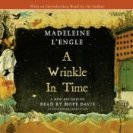
I had read A Wrinkle In Time by Madeleine L’Engle as a child, but the only thing I could remember about it was one scene where boys in driveways all down a street were bouncing balls in perfect rhythm with each other. It was one of those titles I had always wanted to revisit, and I just did so over the last several days via audiobook.
In the time between that first reading and now, I had also heard L’Engle described by some as a Christian fantasy writer in the tradition of C. S. Lewis and by others as a dangerous New Ager. That was another reason I wanted to revisit the book, to see what angle she was coming from. I can definitely see why there is confusion.
The story itself begins with teenager Meg Murry. Meg is finding it hard to fit in at school. Her teachers feel she does not do nearly as well as someone with two brilliant parents should. She doesn’t fit in socially and gets into a fight when someone calls her little brother dumb. She doesn’t like her appearance. And her father has been away for over a year, but no one knows where he is, and some of the townspeople are beginning to gossip about his disappearance.
Meg’s little brother, Charles Wallace, is about five years old and is thought dumb because he does not speak to outsiders, but he is quite articulate with his family. He even seems to go belong the spoken word to know what his family is thinking and what they need, at least his sister and mother. Meg has twin brothers as well, but they seem to be in the background most of the time: by contrast to Meg and Charles Wallace, they are not bad at anything but not exceptionally good at anything either and have no problem “fitting in.”
Meg and Charles Wallace meet a teen-age neighbor, Calvin, and a Mrs. Whatsit, who, along with Mrs. Who and Mrs. Which, tell the children they are needed not only to save their father but to save their planet from the Black Thing. The three Mrs W’s take the children through time and space via a tesseract (which “wrinkles” time, in a way), to the planet where Meg’s father is being held captive by IT, a being that takes captive the thoughts of the people on the planet and makes everyone act in perfect conformity. A man with red eyes, controlled by IT, tells the children that this is the best way because there is no crime, hate, or sorrow. But the children know better and continue to resist the pull of IT and to to look for Mr. Murry.
I’ll leave the plot there for you to discover. There are recurring themes through the book: good vs. evil, creativity vs. conformity, vigilance vs. passivity, and love vs. hate. Meg continually is reminded that things aren’t always what they appear and she needs patience, and these admonitions are repeated in various ways through the book.
Just as a fantasy or science fiction, the story is quite interesting and well put-together. The differing opinions come in when trying to discern where L’Engle is coming from. It’s interesting that secular sources cite her the book as reflecting her Christian faith, but some Christians have trouble with a few elements. There are definitely Christian elements: Scripture is quoted directly, the whole good vs. evil and love vs. hate themes reflect a Christian base. But Christianity is spoken of more as a philosophy: there is nothing in the actions of the characters that suggest what we’d consider normal Christian life (praying, for instance, even in times of extreme duress). Some of the troubling elements include a “Happy Medium” and Mrs. Which, though not called a witch, described with the typical garb of fairy-tale witches. And when the children are asked who are lights in the world they know of that fight against darkness, they mention Jesus as seemingly just another light beside Shakespeare, Einstein, Bach, Gandhi, and others (I think Buddha may have even been mentioned, but one problem with an audiobook is that I can’t go back and find that exact reference).
I mentioned in a post about magic in Narnia that I had wrestled through the whole issue of magic in books, and came to realize that fairy tale or fictional magic is often not the same thing as the magic the Bible warns against. Real life witches don’t wear pointy hats, ride brooms, or turn people into frogs. I think the magic in this book is more along the lines of fairy tale and not promoting such things in real life. Still, there are serious warnings in the Bible against witches, wizards, and the like, so I don’t know why a Christian writer would use elements known to trouble Christian readers and then scoff at them for being troubled (which L’Engle did in some of the articles I read about her, calling such people “narrow.”) The “Happy Medium,” for instance, uses her crystal ball to show the children the “dark thing” hovering over earth and to show them their families (and the Mrs W’s want her then to look at something pleasant so she’ll stay a happy medium). Since this is science fiction, she could have easily been a scientist with something other that a crystal ball to observe the planets. She is kind of a play on words, though, from earlier in the book when Meg’s mother tells her she needs to find the happy medium (between mindless conformity to fit in with the crowd vs. being so individualistic that she’s peculiar).
In looking through some articles and interviews with L’Engle, I’d say she’s Christianish, but I’d definitely disagree with her on several key points, like universal salvation or viewing the Bible as just stories rather than literal truth. A couple of the interviews I read about her were here and here and here, and of course the Wikpedia entry is here if you’d like to read more about her. I think some of you have read other books by her, and I’d love to hear your insights from her own words.
I didn’t know, when I chose to read this book at this time, that this is the 50th anniversary of its publication, and a new graphic novel of it will be released October 2:
I also didn’t know there was a film made of it, but what little I read and saw of it (clips on YouTube), I don’t think I’d like it. They changed too much of it (as usual). In one of the interviews I read, L’Engle was asked if the film met expectations, and she said, “Yes. I expected it to be bad, and it was.” 🙂
I also gained a lot by skimming through SparkNotes. They pointed out connections and other things I hadn’t caught, like the many references to seeing clearly and people’s glasses, and the fact that Meg’s disappointment that her father couldn’t fix everything when they found him was necessary to her own maturity..
Have you read A Wrinkle In Time or anything else of L’Engle? What do you think?
(This review will also be linked to Semicolon‘s Saturday Review of Books.)
The folks at 5 Minutes For Books host What’s On Your Nightstand? the fourth Tuesday of each month in which we can share about the books we have been reading and/or plan to read.
Here is what I’ve finished since last time (links in this section are to my reviews):
Rare Earth by Davis Bunn. Former operative Marc Royce has been sent into Kenya to help bring supplies to an area devastated by drought and a volcano eruption, but he secretly has another mission. Excellent.
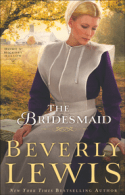
The Bridesmaid by Beverly Lewis, second in the Home to Hickory Hollow series, Amish fiction. Joanna has been a bridesmaid multiple times but finally meets a young man, except he is from another town and obligated to work his father’s farm. Her secret hobby of writing becomes known and gets her in trouble. Always love Beverly Lewis: hers is the only Amish fiction I read.
The Discovery by Dan Walsh. A young author inherits the home of his famous author grandfather and finds an old unpublished manuscript which may reveal things his family never knew. Very good.
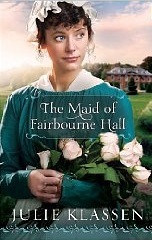
The Maid of Fairbourne Hall by Julie Klassen. A well-to-do young women escapes her step-father’s plans for her to wed an unscrupulous young man by disguising herself as a maid and going to another town, ending up at the home of two brothers who were former suitors. A very enjoyable read.
A Wrinkle in Time by Madeline L’Engle, not reviewed yet.
Uncle Tom’s Cabin for Carrie‘s Book Club October pick, which I happen to be hosting. Join us? I’ve listened through the audiobook but want to go through the book as well.
Full Disclosure by Dee Henderson coming out next week. I’m glad to see a new one from Dee! I really enjoyed her previous books.
In The Maid of Fairbourne Hall by Julie Klassen, Margaret Macy is a well-to-do young woman in London whose mother has remarried a man only interested in the family’s wealth. He had thought Mrs. Macy was the one to receive an inheritance, but it is actually Margaret who will come into it on her next birthday. So Margaret’s step-father, Sterling Benton, brings his nephew in to woo Margaret, planning to “manage” their finances after they marry. But Margaret can easily see that Benton’s nephew is no better than he is, and after overhearing their unscrupulous plans, she escapes, hoping to hide out a few months until her next birthday when she comes into independence.
She disguises herself and travels as far away as what little money she has in hand will take her. She finds a hiring fair, hoping to find work as a maid, even though she has never done any such labor in her life. She is hired by a kindly steward and doesn’t learn til they are on their way that the home they are going to is one in which two brothers who had been former suitors of hers live.
Her disguise seems to work, though, and Margaret learns over time that she may have misjudged both the brother she spurned as well as the one she preferred. She also learns much about herself and life “below stairs.”
This was a delightful book. It didn’t take long for me to get hooked and then look for nooks and crannies of time beyond the norm to get a few pages read.
I’ve read books about maids before, but this one incorporated a lot of information that was new to me.
I had seen Julie Klassen’s books but hadn’t yet read one. When this one was free for the Kindle app (at the time, it no longer is), I decided to try it, and now I’ll be looking for Julie’s other books as well!
(This review will also be linked to Semicolon‘s Saturday Review of Books.)
Welcome to Friday’s Fave Five, hosted by Susanne at Living to Tell the Story, in which we can share five of our favorite things from the last week, a wonderful exercise in looking for and appreciating the good things God blesses us with. Click on the button to learn more, then go to Susanne’s to read others’ faves and link up your own.
It’s been a pretty good week! Here are some of its high points:
1. Jesse’s birthday Sunday.
2. His lemon bundt cake with lemon glaze. Normally I’m more into chocolate, but this was a nice change.
3. A visit from my kids’ friends. I’m glad my children share their friends with us. 🙂 The young man who was the best man in Jason’s wedding and his new wife were coming to town to visit Jason and Mittu, and they came over to our house for dinner on Jesse’s birthday. It was fun to meet her and catch up with him.
4. A dental cleaning and fluoride. The favorite part of the dental cleaning is that it is over. I don’t know why I get so antsy about anything dental when a cleaning is easy compared to a root canal. I’d been having some sensitivity in one area and found it was due to recession of the gum. I’ll have to go in to have that taken care of later but as a temporary measure they put some kind of fluoride gunk on the area. It was really uncomfortable at first but feels much much better now.
5. Nice weather. We had two days of rain, but it was a fairly gentle rain, not at all stormy. Then it’s been a little cooler and more fallish a few days this week. Some of the leaves are starting to turn already.
“Obeying the Great Commandment” is the seventh chapter in the book The Discipline of Grace by Jerry Bridges, which we’re discussing every Thursday in the “Reading Classics Together” challenge at Challies‘ place.
The Great Commandment Bridges refers to is from Matthew 22:36-40:
“Master, which is the great commandment in the law?”
Jesus said unto him, “Thou shalt love the Lord thy God with all thy heart, and with all thy soul, and with all thy mind. This is the first and great commandment. And the second is like unto it, Thou shalt love thy neighbour as thyself. On these two commandments hang all the law and the prophets.”
However, love is not just a nice warm feeling. Bridges shares several passage that show that love for God with result in obedience to him, among them these from John 14:
15 If ye love me, keep my commandments.
21 He that hath my commandments, and keepeth them, he it is that loveth me: and he that loveth me shall be loved of my Father, and I will love him, and will manifest myself to him.
23 Jesus answered and said unto him, If a man love me, he will keep my words: and my Father will love him, and we will come unto him, and make our abode with him.
24a He that loveth me not keepeth not my sayings.
For many of us, obedience means fitting in with whatever Christian culture we’re in rather than a whole-hearted purposeful pursuit of learning and doing God’s will. Or we obey with mixed motives — fear of punishment, gift, withholding of blessings, negative consequences, desire to “look good” before others, the feeling that we’ll earn God’s blessing by our deeds, etc. “Without the motive of love, my apparent obedience may be essentially self-serving” (p. 122).
“Fervency of worship on Sunday morning or in our private devotions is vain without an accompanying fervency in obedience to God. On the other hand, precise and exact obedience to the law of God is in vain if it is not prompted by love for Him” (pp. 122-23).
“A person who struggles with some persistent sin but does so out of love for God is more pleasing to Him than the person who has no such struggle but is proud of his or her self-control” (pp. 123-24).
But how do we develop that love for God? “We love him, because he first loved us” (I John 4:19). Our love is a response to His, so meditating on His love for us is the greatest way to increase our love for Him. “To love God, I must believe that He is for me, not against me (Romans 8:1), and that He accepts me as a son or a daughter, not a slave (Galatians 4:7) (p. 125).
Guilt and a sense of condemnation keep us from love, so we need continually cleansed consciences, cleansed by confessing our sin to Him and trusting in His forgiveness, in order to keep that right relationship with Him. His love for us in the gospel is the greatest factor in creating and maintaining our love for Him.
This was perhaps the easiest chapter to understand so far, but it convicted at several points, mainly in having a laid-back rather than a whole-hearted pursuit of obedience and the many wrong motives for obedience.
More discussion on this chapter can be found here. My discussions of previous chapters are here.
I’ve tried some tips seen on the Internet, mostly on Pinterest, lately, and I though I’d share how they turned out.
This post, seen on Pinterest, told about making an entire meal in the crock pot: pork chops on the bottom, potatoes wrapped in foil and placed on top, and corn on the cob wrapped in foil placed on top of that. I thought that sounded like a great idea, so I tried it, except instead of wrapping the potatoes in foil I cut them in chunks and placed them under the pork chops. I love potatoes that way, when the sauce and meat juices slow cook into them. But I did place corn on the cob in foil on top of that. The meat and potatoes were great, but to me the corn ended up tasting old and dry. It may be I just had some older ears of corn and it may turn out better for others, (it obviously did for the person who posted the recipe), but for me, I think I’ll stick with boiling corn on the cob in water.
Rating: 💡 💡
This pin told about using equal parts of Dawn dishwashing liquid and vinegar on the tub for an hours or more to get rid of soap scum and build-up. I tried it first with the dish liquid I use, and it didn’t really do anything. But then I bought some Dawn and tried it, and it worked great. I wouldn’t say it is completely spotless, but it did a great job. I kept clicking through to get back to the original post about it, and it said to heat the vinegar. I hadn’t seen that when I tried it, so I don’t know if that would make it work even better.
Rating: 💡 💡 💡 💡
This pin said to soak paper towels in vinegar, wrap them around the faucet, leave them for an hour, and wipe it off to remove the gunky stuff that gets around the base of the faucet. That really didn’t work any better for me than commercials cleaners, then the kitchen smelled like vinegar all afternoon. Yuk. Plus it left a white residue.
Rating: 💡 💡
What worked just as well, even a little better, was to make a paste of baking soda and vinegar and scrub it around the faucet with a toothbrush and then wipe off. The vinegar smell wasn’t bad at all and didn’t linger. And those both these methods cleaned the gunk, but they didn’t remove the hard water spots. I finally bought a commercial cleaner for that but haven’t tried it yet.
Rating: 💡 💡 💡
My favorite Internet tip wasn’t found on Pinterest but rather through a search for getting rid of ants. We had problems with them off and on through the summer. Oddly, they didn’t get into any food cabinets but came up through the medicine cabinet. Even then they didn’t get into anything there but expanded onto the counters. We’d spray them, and they’d be gone for a few days, but then come back. I wanted something longer lasting and less toxic. I saw a number of ideas that seemed pretty messy, but the one that looked easiest was leaving bay leaves in the area where they come in. So I scattered a few bay leaves in that cabinet, and we haven’t seen ants in the kitchen since!
Rating: 💡 💡 💡 💡 💡
I’ve found a number of food-related ideas and tips online. The one I was most excited about recently was how to make my own tartar sauce. We don’t have fish often, and the last time we did I discovered I was out of tartar sauce, so I dashed to the computer to find this. It really tasted great, and making about half that recipe would be about enough for one meal, which I’d prefer to do so it wouldn’t spoil since we don’t use it much.
Rating: 💡 💡 💡 💡 💡
I guess it was a sign that I have been perusing Pinterest too much when I saw what looked like grandparents in Home Depot buying a big metal drip pan and thought, “Oh, they must be making a magnet board for their grandkids!” Maybe — or maybe they just needed an oil drip pan. 🙂
Here are some other neat ideas I haven’t tried yet (if you’re not familiar with using Pinterest, usually if you click on the photo it will take you to the site that explains more about the idea):
The Bridesmaid by Beverly Lewis is the second in her Home to Hickory Hollow series, and some characters are in both books, but each can easily be understood alone.
Joanna Kurtz is close to suffering from the old cliche, “Always a bridesmaid, never a bride.” She is 24, which by her community’s standard sets her in danger of being an old maid, and there are no prospects of a suitor in site. But an out-of-town trip for a relative’s funeral leads to a meeting with Eben Troyer, a young Amish man near her age.
The two hit it off immediately, but their relationship is beset my many problems. Besides living in different states and only communicating by letter and an every-other-week phone call, Eben is responsible for helping his father on the farm. The farm would go by rights to his younger brother, Leroy, but Leroy is off “in the world,” getting higher education and learning to fly planes, both taboo to the Amish. All of Eben’s hopes are tied up in Leroy’s coming “back to the fold,” which humanly speaking does not look likely.
Joanna has a semi-secret hobby: she loves to write stories. While not expressly forbidden, it is frowned upon. When news of it reaches the bishop’s ear, he pays a visit to warn her against it. Innocently she asks about the difference between writing stories and telling them, as there are famed Amish story-tellers, but she is threatened with shunning if her impertinence continues. If Joanna is in trouble with her bishop, that would not only affect her own life and her family, but it would likely prevent her from being able to move out of state as well.
Just as these problems and others for Joanna and Eben come to a head, another young man from Joanna’s community, who seemed undesirable before, begins to show her attention, and she wonders whether God might be leading her toward him.
A relative gives Joanna a quilt stitched by her namesake, and as Joanna learns the story behind the quilt, it inspires her to trust the Lord for her future.
I enjoyed this story and Joanna’s journey. I especially appreciated that in this series, each plot wraps up instead of being held over until the sequel. I always enjoy Beverly’s books. There is something cozy about them, and I admire the industriousness and gentleness of the Amish women. Beverly does not gloss over the problems the Amish face, though, especially the legalism that varies from church to church. I’m looking forward to the next book in the series in April.
(This review will also be linked to Semicolon‘s Saturday Review of Books.)








 Stray Thoughts