“Don’t Call Me Spry”

It’s a shock to the system when you realize someone thinks of you as “old.”

For me, it happened when a fast-food cashier rang up my order with a senior discount—and I was only 50.

For Win Couchman, it happened when she ran into an old friend who commented, “You’re so spry!” “Spry” was a “compliment reserved for exclusively for old people.”

As the shock of this well-meant statement brought Win to tears, she began to consider aging.

I am at the young end of old: junior-high old. Youth is gone and now, also, middle age. My life at sixty-four is rich, adventurous, blessed, and full of joy (p. 2).

I am not only wrinkling. I am growing. And while I am forgetting some things, I am learning much that is new. This season of my life is as fearsome and exciting as turning fourteen. Nobody told me it would be this way (p. 3).

She decided to investigate “what it means to grow old” from the Bible, culture, the examples of older people in her life (“Not everything I learned from Grandmother about aging was glamorous, but all of it was valuable” [p.84]). She wanted to “notice and enjoy the perks that come with old age” (p. 4).
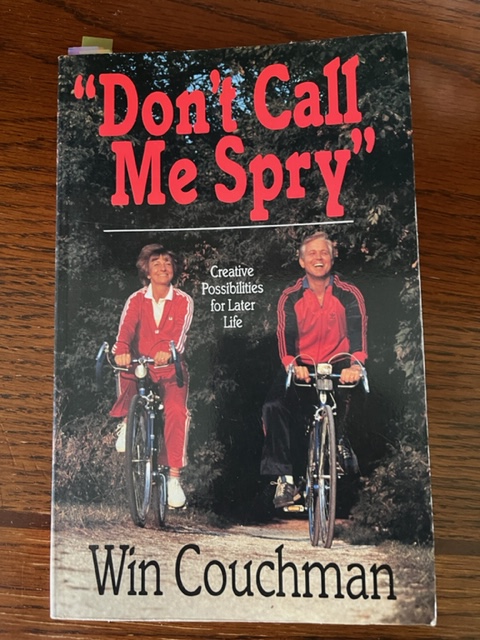
The results of her study and contemplation is “Don’t Call Me Spry”: Creative Possibilities for Later Life.

Win noted, “The halves of my life each merit my attention. The tension between the material and spiritual aspects of reality are normal. The struggle is to keep a balance: to live in light of the unseen while resetting the washer from ‘permanent press’ to ‘delicate fabrics.’ In order to live for God’s glory and not lose heart, I have the perspective of the eternal as a gift” (p. 4).

In their fifties, Win and her husband, Bob, began to pray and consider what to do when he retired. For many years, they had hosted a ministry called Forever Family which combined hospitality, mentoring, counseling, and teaching. But they were sensing maybe the time had come to do something different.

Through a series of events and contacts, the door eventually opened for them to minister in a variety of other countries eight months out of the year. They enjoyed the novelty and the opportunities to minister, resulting in some never-to-be forgotten experiences.

But they also experienced stresses with travel and continual adjustments, and they handled them differently. She liked to talk things out when stressed or anxious; he withdrew and became quiet. I’m sure those tendencies were always a part of their personalities, but these new experiences brought them to the forefront and required them to meet each other half-way.

Bob’s retirement brought other stresses and adjustments, like sharing space that she had previously had to herself.

Then new stresses arose when Win developed a heart issue which brought not only their international travel to a close, but their full-time active ministry as well. She had to rethink what she could do within her new reality. “It grieved me to give up thinking I could do anything anyone even a generation or two younger than I can do” (p. 45).

It saddened me to give up the illusion that I could always push myself a bit more if I needed to, that pushing was the thing to do. I could no longer be casual about getting too tired. I was newly aware of another true separation between me and those who are younger (p. 46).

She tells how God led her to other types of ministry, mainly mentoring, prayer, being involved with her grandchildren. She still taught and spoke on a limited basis.

One of my favorite chapters is “The Downside,” dealing with some of the negative aspects of aging. “When you ask me how I am, sometimes it is a little hard to know how to answer” (p. 107).

But even though Win describes herself as a pessimist, overall the book is hopeful and positive. The Bible assures that God’s care and love and grace will always be with us. In addition:

As I have looked repeatedly into the mirror of these verses, I have not only been provided with new assurance of God’s caring for me, but I have a greatly enhanced concept of the possibility of lifelong usefulness (p. 136).

While searching for more information about Win, I came across this video of her.

I had not heard of Win before until I read a chapter by her in The Wonder Years: 40 Women over 40 on Aging, Faith, Beauty, and Strength compiled by Leslie Leyland Fields. I didn’t discover until recently that her chapter, “The Grace to Be Diminished,” originally came from a magazine here. Then I found her poignant article, “The Beds I Have Known,” about living separately from her husband of 72 years when she could no longer care for him. I saw somewhere that she had written this book, so I searched for it. It’s out of print, but I found a used copy in good condition for $5 at Amazon.

I am glad to have found and read it. It gave me much encouragement as I look ahead.

Content . . . with Thorns?

In 1940, Isobel Kuhn found herself hitchhiking on an obscure Chinese road. She “had always thought that womanly women did not do such things,” but there was no other way to get where she needed to go. She caught a ride with a truck driver, “cringing with humiliation inside.”

She asked God why she had to be put in such situations. The verse came to mind, “For I think that God hath set forth us the apostles last, as it were appointed to death: for we are made a spectacle unto the world, and to angels, and to men” (2 Corinthians 4:9). A spectacle was just what she felt like. She was a little comforted. Even though this particular incident was a small one, she felt she endured it for His sake since she was a missionary.

Isobel felt that the spectacle Paul probably had in mind was the Arena in Rome, where Christians were thrown to the lions for sport. Later, she wrote:

Through the several years which followed, years of war strain and danger, this thought kept returning to me. The different trials of us Christians of the twentieth century are like so many platforms in the world’s Arena of today. The unbeliever looks on at our struggles and is only impressed or influenced if he sees the power of God working there. The purpose of the Arena experience is not for our punishment; it is that God might be revealed.

. . . God taught me through the years to view my own trials as platforms in today’s Arena. I thought this concept was original with me, but one day my husband found that Hudson Taylor had formed the same opinion many years ago. He said, “Difficulties afford a platform upon which He can show Himself. Without them, we could never know how tender, faithful, and almighty our God is.” I found it so, too. . . It seemed that my most valuable lessons have been learned on these platforms.

Her book In the Arena was written with this idea in mind, showcasing how God manifested Himself through obstacles, frustrations, strain, necessities, danger, and illness.

In 2 Corinthians 12, Paul had been praying for deliverance from a “thorn in the flesh.” Commentators offer good evidence for the different possibilities as to what that “thorn” might have been, anything from some physical ailment to actual demonic oppression. I agree with what Warren Wiersbe said in his commentary: it’s good we don’t know exactly what it was, so we can apply it to any kind of “thorn” in our lives.

Paul said God gave him this thorn in response to some special revelations He had given Paul. Paul mentioned earlier in this chapter that he had one experience in the “third heaven” that he was not even allowed to tell the details about.

We’re easily prone to pride when we hit spiritual heights, as though we had anything to do with them. So God gave this “thorn” to Paul “to keep me from becoming conceited” (verse 7). Paul asked God three times to remove the thorn. But God said no. Instead:

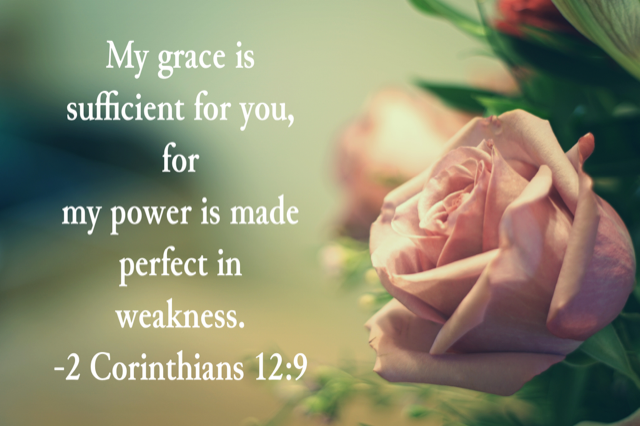
He said to me, “My grace is sufficient for you, for my power is made perfect in weakness.” Therefore I will boast all the more gladly of my weaknesses, so that the power of Christ may rest upon me. For the sake of Christ, then, I am content with weaknesses, insults, hardships, persecutions, and calamities. For when I am weak, then I am strong (2 Corinthians 12:9-10).

The ESV Study Bible says twice that “Paul’s earthly weaknesses, not his revelations, are to be the platform for demonstrating the Lord’s power and grace” (p. 2238).

That’s just the opposite way we think it should work, isn’t it? We think some mountaintop experience, some spiritual high point, will “show off” God’s power. And God does use those moments in people’s lives. But we don’t reach those heights in our own strength. Moses spent 40 days alone with God, and his face shown afterward. David went from the depths of despair to the heights of praise in the psalms. Elijah faced off with the prophets of Baal for a showdown of their respective deities. Yet spiritual highs don’t keep us from sin. Relying on God’s power does. Each of these men had very human weaknesses for which they needed God’s grace.

Paul’s thorn not only kept him humble; it kept him dependent. God had told him, “My grace is sufficient for you, for my power is made perfect in weakness.” When we’re tempted to go off on our own, our weaknesses remind us we can’t: we need God’s help. When a trial is more than we can handle, we’re reminded to give it to the One who can handle it.

The ESV Study Bible points out that in 2 Corinthians 12:9, when God says His grace is sufficient for Paul, the word “sufficient” is in the present tense, “underscoring the ever-present availability and sufficiency of God’s grace” (p. 2238).

Sometimes we don’t want people to get close enough to see our weaknesses. We think our weaknesses will mar our testimony. But people see our blind spots that we’re unaware of: they know we’re not perfect. When they see God’s grace and power in our lives, they know there is hope and help for themselves as well.

Seeing those needs in people’s lives makes them more relatable. When we see them recover from a stumble or struggle with human weakness, it encourages us that we can access God’s grace and carry on.

Even our Lord Jesus, though He never sinned, experienced weakness that draws us to Him. The fact that He stooped to experience humanness for our sakes shows us how much He loves us. We know He understands our weaknesses and needs, not just from omniscience, but from experience.

Since therefore the children share in flesh and blood, he himself likewise partook of the same things, that through death he might destroy the one who has the power of death, that is, the devil, and deliver all those who through fear of death were subject to lifelong slavery. . .Therefore he had to be made like his brothers in every respect, so that he might become a merciful and faithful high priest in the service of God, to make propitiation for the sins of the people. For because he himself has suffered when tempted, he is able to help those who are being tempted (Hebrews 2:14-15, 17-18).

Since then we have a great high priest who has passed through the heavens, Jesus, the Son of God, let us hold fast our confession. For we do not have a high priest who is unable to sympathize with our weaknesses, but one who in every respect has been tempted as we are, yet without sin. Let us then with confidence draw near to the throne of grace, that we may receive mercy and find grace to help in time of need (Hebrews 4:14-16).

Paul said he was not only content with “weaknesses, insults, hardships, persecutions, and calamities,” but he boasted in them (gloried, the KJV says). Some translations say “delight” instead of “am content.”

My first response in any trial is to pray for deliverance, and maybe secondarily to ask that I might learn what I am supposed to from it. But to be content in it? Even more, to delight in it? I can’t say I am there yet.

But maybe I’d be closer if I looked at the situation like I am supposed to, as a way for God’s power to be displayed.

One guest preacher at my college spoke of giving everything he had over to the Lord. When the car broke down, he prayed, “Lord, Your car needs help.” That’s probably a good way to look at it.

So we can be content with our thorns and even glad for them, because:

  • They keep (or make) us humble.
  • They remind us our strength is not in ourselves.
  • They keep us dependent on God’s grace and help.
  • They’re a testimony to others.
  • They make us more relatable.
  • They showcase God’s power.

How about you? Do these truths help you with your “thorns in the flesh”?

This song written by Mike Harlan and Cary Schmidt has helped me carry these truths with me:

2 Corinthians 12:9

(I often link up with some of these bloggers.)