
Heaven is not a lesser answer

img_1289

Some years ago, our church was fervently praying for someone’s healing. When that person passed away, I was heartsore and disappointed. Someone mentioned that this person had received “the ultimate healing” in heaven. In my immaturity, I thought that sounded like rationalization, putting a positive spin on it.

In God Is Just Not Fair: Finding Hope When Life Doesn’t Make Sense, Jennifer Rothschild described a friend’s death during a cruel assault. When Jennifer lamented to her father that she couldn’t understand why God let her friend go through such a thing, he responded that she didn’t go through it, she went from it. He went on to explain:

God delivers us in different ways. Sometimes he protects us from awful things so we never have to endure them. Other times God delivers us by rescuing us or healing us. Sometimes God brings us through hard things —that’s also a form of God’s deliverance. But then there are the times that God, out of his great care for his children, delivers us out of the horror and into glory.

God compassionately took Regina out of her tragedy and into his presence. She was delivered from it —out of it —and into glory, where there are no tears, no crying, and no pain, and the only scars are the ones on the hands of Jesus.

Heaven is not a rationalization or a positive spin on unanswered prayer. Heaven is not a lesser answer to prayer than healing.

If we look at the death of Christians from God’s standpoint, He’s gathering His children to the home He has been preparing for them for millennia.

It’s fine to seek and pray for healing, and we rejoice and praise God when He allows someone to remain with us a little longer. Healings were a major testimony to the reality of the power of God and the validity of Jesus’ ministry in the Bible. God has implanted in us a strong will to live, but living “the American dream” of a nice house, good family, and 70+ years of excellent health is not the “ultimate.” The ultimate is being with Him in our new home in heaven some day.

Once I saw a video in which the speaker had a long rope that extended all the way across the stage and then past the curtain beyond sight. That rope, he said, represented eternity. The speaker held the end of the rope wrapped in a few inches of red tape which represented our time here on earth. Our few decades that we value so much are so short, and eternity is so long. How shortsighted we are that we put so much emphasis on the one to the neglect of the other.

A full Biblical study of heaven would take more space than we have here, but here are just a few aspects of heaven:

Father, I desire that they also, whom you have given me, may be with me where I am, to see my glory that you have given me because you loved me before the foundation of the world. John 17:24

There the wicked cease from troubling, and there the weary are at rest. Job 3:17

Let not your hearts be troubled. Believe in God; believe also in me. In my Father’s house are many rooms. If it were not so, would I have told you that I go to prepare a place for you? And if I go and prepare a place for you, I will come again and will take you to myself, that where I am you may be also…Jesus said to him, I am the way, and the truth, and the life. No one comes to the Father except through me. John 14:1-3, 6

And I heard a loud voice from the throne saying, “Behold, the dwelling place of God is with man. He will dwell with them, and they will be his people, and God himself will be with them as their God. He will wipe away every tear from their eyes, and death shall be no more, neither shall there be mourning, nor crying, nor pain anymore, for the former things have passed away. Revelation 21:3-4

For to me to live is Christ, and to die is gain. If I am to live in the flesh, that means fruitful labor for me. Yet which I shall choose I cannot tell. I am hard pressed between the two. My desire is to depart and be with Christ, for that is far better. Philippians 1:21-23

What should we be doing in relation to heaven before we get there? Here are a few things:

But we do not want you to be uninformed, brothers, about those who are asleep, that you may not grieve as others do who have no hope. For since we believe that Jesus died and rose again, even so, through Jesus, God will bring with him those who have fallen asleep. For this we declare to you by a word from the Lord, that we who are alive, who are left until the coming of the Lord, will not precede those who have fallen asleep. For the Lord himself will descend from heaven with a cry of command, with the voice of an archangel, and with the sound of the trumpet of God. And the dead in Christ will rise first. Then we who are alive, who are left, will be caught up together with them in the clouds to meet the Lord in the air, and so we will always be with the Lord. Therefore encourage one another with these words. 1 Thessalonians 4:13-18 (KJV uses “comfort” in place of “encourage.)

Since all these things are thus to be dissolved, what sort of people ought you to be in lives of holiness and godliness, waiting for and hastening the coming of the day of God, because of which the heavens will be set on fire and dissolved, and the heavenly bodies will melt as they burn! But according to his promise we are waiting for new heavens and a new earth in which righteousness dwells. Therefore, beloved, since you are waiting for these, be diligent to be found by him without spot or blemish, and at peace. And count the patience of our Lord as salvation. 2 Peter 3:11-15a

Do not lay up for yourselves treasures on earth, where moth and rust destroy and where thieves break in and steal, but lay up for yourselves treasures in heaven, where neither moth nor rust destroys and where thieves do not break in and steal. For where your treasure is, there your heart will be also. Matthew 6:19-21

If then you have been raised with Christ, seek the things that are above, where Christ is, seated at the right hand of God. Set your minds on things that are above, not on things that are on earth. For you have died, and your life is hidden with Christ in God. When Christ who is your life appears, then you also will appear with him in glory. Put to death therefore what is earthly in you. Colossians 3:1-5a (followed by a discussion about what earthly things he is talking about, like immorality, covetous, and lying, and what things to put on in their place).

So we do not lose heart. Though our outer self is wasting away, our inner self is being renewed day by day. For this light momentary affliction is preparing for us an eternal weight of glory beyond all comparison, as we look not to the things that are seen but to the things that are unseen. For the things that are seen are transient, but the things that are unseen are eternal. 2 Corinthians 4:16-18

In Frank Houghton’s biography, Amy Carmichael of Dohnavur, he tells of a time when one of the little ones at the Dohnavur compound died. Amy was comforted by the words of Samuel Rutherford written to a grieving mother over 200 years before Amy’s time:

You have lost a child. Nay, she is not lost to you who is found to Christ; she is not sent away but only sent before, like unto a star which going out of our sight doth not die and vanish, but shineth in another hemisphere: you see her not, yet she doth shine in another country.

If her glass was but a short hour, what she wanteth of time that hath she gotten in Eternity; and you have to rejoice that you have now some treasure laid up in heaven…Your daughter was a part of yourself, and you, being as it were cut and halved, will indeed be grieved; but you have to rejoice that when a part of you is on earth, a great part of you is glorified in heaven…There is less of you out of heaven that the child is there.

We grieve when someone we love leaves this life, and that’s perfectly normal. Even Jesus grieved. We’re sad whenever we have to be away from our loved ones for an extended time, especially without the ability to converse with them. But we remember that this life is short, that those who die in Christ are in His presence, fully healthy and without pain. We could not wish them back, and we know we’ll see them again. and in the meantime we live, as an old song used to say, “with eternity’s values in view.”

If you don’t have this sure hope of heaven, please read here for more information.

(Sharing with Literary Musing Monday, Tell His Story, Let’s Have Coffee, Porch Stories, Woman to Woman Word-filled Wednesday, Faith on Fire, Grace and Truth)

Happy New Year!

crown-the-year-new-year-550x320

(Graphic from crosscards.com)

A New Year’s Prayer

May God make your year a happy one!
Not by shielding you from all sorrows and pain,
But by strengthening you to bear it, as it comes;
Not by making your path easy,
But by making you sturdy to travel any path;
Not by taking hardships from you,
But by taking fear from your heart;
Not by granting you unbroken sunshine,
But by keeping your face bright, even in the shadows;
Not by making your life always pleasant,
But by showing you when people and their causes need you most,
and by making you anxious to be there to help.
God’s love, peace, hope and joy to you for the year ahead.

~ Author Unknown

Wishing you all God’s best this year!

A Time to Look Back, a Time Not to Look Back

The end of the year encourages a lot of looking back over the past 365 days. I enjoy end-of-the-year compilations, whether they are book lists, news stories, or family newsletters.

A few years ago, a saying was making the rounds on Pinterest and Facebook: “Don’t look back: you’re not going that way.”

Is that good advice? It can be sometimes, if looking back is keeping you from moving forward, keeping you from obedience, tempting you in any kind of wrong way, fueling your longing for something or someone you should not have, or causing you to wallow in regret instead of moving on to repentance and change.

Jesus said, “No one who puts his hand to the plow and looks back is fit for the kingdom of God” (Luke 9:62).

Also, when God says, “Go!” then it is not time to look back. We don’t know all the reasons Lot’s family was told not to look back. And we don’t know all the reasons Lot’s wife did look back, but she was turned to a pillar of salt for disobeying. When Jesus admonished His hearers to “Remember Lot’s wife,” the context was the coming of the kingdom of God. Just after mentioning her, Jesus said, “Whosoever shall seek to save his life shall lose it; and whosoever shall lose his life shall preserve it.”

Paul said, “But one thing I do: forgetting what lies behind and straining forward to what lies ahead, I press on toward the goal for the prize of the upward call of God in Christ Jesus” (Philippians 3:13-14).

But are there times to look back? This depiction of the saying I mentioned amused me, because in context, not looking back would be a major safety hazard!

Looking backThis one also makes a good point:

don't_look_back,_but-85120
There are times God tells us to look back. Isaiah 51:1 tells us, “Listen to me, you who pursue righteousness, you who seek the Lord: look to the rock from which you were hewn, and to the quarry from which you were dug.” It is good to look back at where the Lord found us and where He brought us from. Many times in both the Old and New Testaments, a prophet, preacher, or apostle recounted Israel’s history to them, reminding them of their unfaithfulness and His faithfulness and mercy and grace. They were told to “remember all the way which the LORD thy God led thee these forty years in the wilderness, to humble thee, and to prove thee, to know what was in thine heart, whether thou wouldest keep his commandments, or no” (Deuteronomy 8:2), “Remember the days of old, consider the years of many generations: ask thy father, and he will shew thee; thy elders, and they will tell thee” (Deuteronomy 32:7), “Remember his marvellous works that he hath done, his wonders, and the judgments of his mouth” (I Chronicles 16:12).

Also, throughout the Bible God told the people to set up memorials to mark some occurrence of His help on their behalf in the past. Those memorials were reminders of what He had done plus a testimony as people told the story behind the memorials to their children.

A couple of churches mentioned in Revelation were admonished to Remember therefore from where you have fallen; repent, and do the works you did at first. If not, I will come to you and remove your lampstand from its place, unless you repent,” (Revelation 2:5), and “Wake up, and strengthen what remains and is about to die, for I have not found your works complete in the sight of my God. Remember, then, what you received and heard. Keep it, and repent. If you will not wake up, I will come like a thief, and you will not know at what hour I will come against you” (3:2-3).

The Psalmist said “I remember you upon my bed, and meditate on you in the watches of the night; for you have been my help, and in the shadow of your wings I will sing for joy” “Psalm 63:6-7, ESV_. By doing so “satisfied as with fat and rich food, and my mouth will praise you with joyful lips” (v. 5). In Psalm 77:11-12 (ESV), he said “I will remember the deeds of the Lord; yes, I will remember your wonders of old. I will ponder all your work, and meditate on your mighty deeds.” Many times psalmists encouraged themselves by looking back and remembering how God had met their needs and faithfully dealt with them in the past.

Peter said, “This second epistle, beloved, I now write unto you; in both which I stir up your pure minds by way of remembrance: That ye may be mindful of the words which were spoken before by the holy prophets, and of the commandment of us the apostles of the Lord and Saviour” (I Peter 3:1-2).

So, do we look back or do we not look back? We can’t live life by catch phrases. Ecclesiastes 3 tells us “For everything there is a season, and a time for every matter under heaven: a time to be born, and a time to die; a time to plant, and a time to pluck up what is planted,” and so on. There are times and reasons to look back: to learn from our mistakes, to humble ourselves, to remember God’s help, deliverance, and provision of the past,to encourage ourselves that God is loves us, is faithful, and powerful to take care of us now and in the future. But there are times and reasons not to look back, as I mentioned above. It depends on what we are looking at and why and what effect it has on us.

O God, our help in ages past,
Our hope for years to come,
Be Thou our Guide while life shall last,
And our eternal home.

~ Isaac Watts, 1719

(Revised from the archives)

(Sharing with Inspire Me Monday, Literary Musing Monday, Let’s Have Coffee, Porch Stories,Woman to Woman Word-filled Wednesdays, Faith on Fire, Grace and Truth)
Wishing you a Happy Christmas!

IMG_1262.png

I hope you have a wonderful time reflecting on God’s great gift to us and the love of people He puts in our lives.

I’ll leave you with my favorite Christmas song:

Infant holy, Infant lowly, for His bed a cattle stall;
Oxen lowing, little knowing, Christ the Babe is Lord of all.
Swift are winging angels singing, noels ringing, tidings bringing:
Christ the Babe is Lord of all.

Flocks were sleeping, shepherds keeping vigil till the morning new
Saw the glory, heard the story, tidings of a Gospel true.
Thus rejoicing, free from sorrow, praises voicing, greet the morrow:
Christ the Babe was born for you.

Tra­di­tion­al carol, trans­lat­ed from Po­lish to Eng­lish by Edith M. Reed, 1921.

Christmas Grief, Christmas Hope, Christmas Joy

grave-at-christmas

December’s festivities are tempered with sorrow for some. My mother passed away December 10, my father December 12, and my grandmother Christmas Eve, each in different years. In more recent years a college friend and our only family dog died on December 21. My brother once commented that he just wanted to cancel the whole month.

The death of a loved any any time of year can shadow the whole Christmas season as we miss our normal interactions with that loved one. Grief begins as a flood but slowly transforms into a stream that occasionally overflows its banks. Even several years after a loss, it’s not abnormal to be caught off guard by a memory or a longing leading to a good crying jag.

I mentioned a couple of weeks ago that there is no one right way to celebrate Christmas. That’s true not only among different families or individuals, but even within the same hearts in different years.

When someone is grieving over the holidays, they may not want to participate in some of the “normal” happy pastimes. It’s not that they don’t ever laugh or enjoy gatherings. But as Sherry said, “I am enjoying the traditional holiday celebrations, and at the same time they move me to tears, sad tears for things that have been lost this year. I am singing the music, and yet I’m tired of the froth of jingling bells and pa-rumpumpum.” I remember almost wishing that we still observed periods of mourning with wearing black or some sign of “Grief in progress” — not to rain on anyone else’s good time, but just to let people know there was woundedness under the surface. Just as physical wounds need tenderness while healing, so do emotional ones.

Other events can cast a pall over Christmas: illness, job loss, a family estrangement, etc. One Christmas we were all sick as dogs, and my father-in-law had just had a major health crisis and wanted us to come up from SC to ID to visit. There was just no way we could drag ourselves onto a plane until antibiotics had kicked in. But a few days later we did go, and if I remember correctly, that was the last time any of us except my husband saw him alive. In retrospect we were glad we went, though it wasn’t the merriest of Christmases. A good friend grieved over “ruining” her family’s Christmas by being in the hospital with a severe kidney infection. Another wrote about visiting her husband in prison for Christmas. Quilly commented about being homeless one Christmas.

If you’re grieving this Christmas, don’t feel guilty if you’re not quite into the “froth” this year.  Give yourself time to heal. It’s ok to pull back and have a quieter Christmas. There may be times to go through with some holiday festivities for family’s sake — and, truly, those times can help keep you from the doldrums.

Perhaps a new tradition commemorating your loved one might help. My step-father and sisters who live near my mother’s grave go out together as a family to put up a little Christmas tree there. I’m too far away to join them, but every year on the anniversary of my mom’s death, I have a private little moment of remembrance. A family we used to know whose daughter was killed by a drunk driver requested that their church host a special service in December for those who have lost loved ones in that way. Some men from our former church participated in a biking event together in memory of our pastor who died of liver cancer.

On the other hand, don’t feel guilty for enjoying Christmas. Experiencing joy shows no disrespect to your loved one or your circumstances. Your loved one would want to be remembered but would also want you to be happy. Sherry shared how making a list of reasons to celebrate Christmas helped. Look for the good things to rejoice in. My two friends mentioned above, Lizzie and Quilly, mentioned reasons for rejoicing in the midst visiting prison and homelessness. E-mom left a valuable comment that we can treasure up the memories of good Christmases to tide us over the not so good ones, and then look forward to better things ahead.

As I mentioned before, the first Christmas was not all about the froth, either. It was messy, lonely, and painful, yet out of it was born the Savior of the world and the hope of mankind.

If it weren’t for the hope that Christmas represents, I wouldn’t be able to endure the losses. The Christmas carol “O Holy Night” shares “A thrill of hope, the weary world rejoices, For yonder breaks a new and glorious morn.” “Good Christian Men, Rejoice” comforts, “Now ye hear of endless bliss: Joy! Joy! Jesus Christ was born for this!…Now ye need not fear the grave: Peace! Peace! Jesus Christ was born to save.”

The baby in the manger didn’t stay a baby.  He was no ordinary child: the only begotten Son of the Father came to earth for a special mission. “Mild he lays his glory by, born that man no more may die, born to raise the sons of earth, born to give us second birth.” He taught, He healed, He lived as an example, but His main purpose in coming was to take sin away by bearing it Himself on the cross some 33 years after His birth, so that all who believe in Him could have their sins forgiven and live with Him in heaven some day. I have the hope of eternal life and the hope of seeing my loved ones again. Biblical hope isn’t tremulous: it’s a confident expectation.

But eternal life doesn’t begin at death: it begins the moment God’s gift of faith is received. We have hope not only for life after death, but for joy and peace in the midst of sorrow, for help, grace, strength, love in this life as well. “Thanks be unto God for His unspeakable gift.”

Rejoice in that hope and promise. Draw near to Him who has borne our griefs and carries our sorrows until grief and sorrow are done away forever.

(This post is a blending of a previous post from the archives and a newspaper article published in 2011.)

(Sharing with Inspire me Monday, Literary Musing Monday, Tell His Story, Let’s Have Coffee, Porch Stories, Faith on Fire)

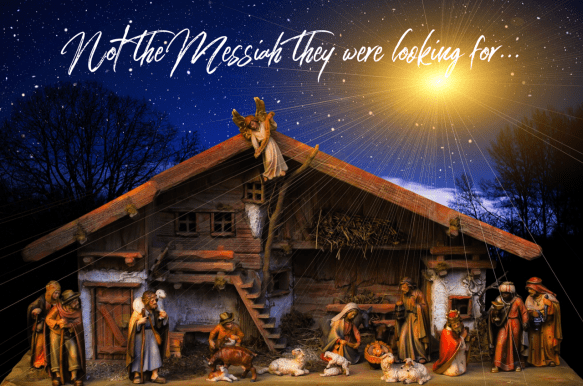
Not the Messiah They Were Looking For

As a young Christian, I wondered why Jesus came incognito, so to speak. Why didn’t He go on a hilltop or to the temple and proclaim Himself: “I am the Messiah you’ve been waiting for all these years!”

There may be a variety of reasons. But in my current I-don’t-know-how-many-eth time through the Bible, I happen to be in John after having read the other three gospels. I’ve enjoyed going over all of Christ’s life on earth during the month of December, not just the “Christmas” portions. I’m using the ESV Study Bible, and its notes often remark that Jesus did not declare Himself openly because most of the Jews at that time were expecting a military ruler who would throw off Roman oppression. Several times in the gospels Jesus had to get away from the crowds because they wanted to make Him king immediately. Some, Jesus said, followed Him because of the loaves of bread He miraculously reproduced in the feeding of the 5,000.

There is a sense in which Jesus does fulfill all those roles already. He is the King of Kings, and some day the whole world will be under His righteous rule. Someday the crooked will be made straight and rights will be wronged. But these roles will be fully manifested at His second coming.

And there is a sense in which we do depend on Jesus for our daily bread and all other needs. But, as He told the crowds then:

Truly, truly, I say to you, you are seeking me, not because you saw signs, but because you ate your fill of the loaves. Do not work for the food that perishes, but for the food that endures to eternal life, which the Son of Man will give to you. For on him God the Father has set his seal.” Then they said to him, “What must we do, to be doing the works of God?” Jesus answered them, “This is the work of God, that you believe in him whom he has sent.” (John 6:26-29, ESV).

Before He could declare Himself openly, He had to teach them the true nature of the Messiah. By many signs (miracles), by His claims (“I am the bread of Life,” “I am the light of the world,” etc.), by His declarations and teachings, bit by bit He showed them exactly who He was and what He was about. And some understood and accepted Him for who He was. They came to understand that His kingdom is a spiritual one.

But some left Him when he started to share “hard things.” Others realized He didn’t fit their image of what the Messiah would be and do, they rejected Him and sought to destroy Him.

Don’t people still do that today? Instead of learning from God’s Word the true nature of the Savior, they’ve imagined their own version of what a Savior would be like. He wouldn’t let evil happen. He’d take care of the bad guys. He’d answer every prayer just the way they want Him to. And when He doesn’t perform according to expectations, well, then, who needs Him?

We all need Him. But we need Him as He truly is, not as we think He should be. Even those of us who are Christians, even those of us who have been for a long time, still have to continually “renew our minds” and adjust our thinking according to truth. We come to know Him as Savior and Lord, but then we spend the rest of our lives getting to know Him better and adjusting ourselves away from our preconceived notions and expectations and toward who He really is. And we’re not disappointed, because in the end He’s a much better Savior than we could ever have imagined.

Do you know Him today as He truly is? Get to know Him through His Word. If you’re new to the Bible, start reading the gospel of John. See what He does and what He says about Himself.

And if you’ve known Him for years, keep getting to know Him better. Keep learning more and more what a wonderful Savior He is.

(Sharing with Inspire Me Monday, Literary Musing Monday, Tell His Story, Let’s Have Coffee, Porch Stories, Wise Woman, Woman to Woman Word-filled Wednesday, Faith on Fire)

There is no one right way to celebrate Christmas

Traditions help make holidays special. We look forward to the things we “always” do, the seasonal foods, events, activities, decorations.

But as busy as everyday life is, adding in all the holiday extras can increase pressure. Every year brings tips about managing Christmas. But this year I have seen a new emphasis, calling for a more minimalist approach to the holidays: less spending, less decorating, less going and doing.

Most of us truly appreciate finding ways to reduce pressure. We shouldn’t keep doing things just because that’s what we’ve always done. It might be best to discard traditions that have become burdensome rather than joyful or rotate some so that we’re not overwhelmed.

But some of the posts I have read on this topic cause me to fear a new judgmentalism, a looking down on those who don’t do less.

If a minimalist approach appeals to you, that’s fine. But the person who enjoys putting out all 32 pieces of a Christmas village because she loves the way they look and she remembers the people who gifted her with the pieces one by one through the years shouldn’t feel guilty about it.

What everyone does for Christmas depends on how many people are in the family, how much time, energy, and money is available, personal preferences, etc.

One person likes to put out just a handful of decorations. Another likes to display every Christmas item she has accumulated for 30 years or put trees of various sizes in every room.

One family’s Christmas dinner might look like any other meal, with the exception of pumpkin pie for dessert. Another likes to go all out with special dishes for the season.

One family prefers no gifts or a gift to a charity in their name. Another saves up for months or shops all year for gifts.

Some like to hit all the Christmas performances and events they can. Others prefer quiet nights at home by the fire with hot chocolate and Christmas movies. Most of us are somewhere in-between.

None of these is wrong one way or the other.

Most of us find that some traditions change through the years. We’ve added some and discarded others over time. We made Christmas cookies when my sons were young. Then one year we just didn’t get to it – but no one seemed to notice. We have so many sweets that time of year, we didn’t suffer for not having cookies. But with a young grandson now, it’s fun to revive that tradition. We used to do a birthday cake for Jesus mainly for the kids to remember Whose birthday it was. But in later years we stopped. One year we had an elementary Christmas piano recital on Monday night, a high school piano recital Tuesday, church on Wednesday night, an elementary school Christmas program Thursday night, and a high school Christmas program Friday night. That week was probably bookended by Christmas cantatas and children’s Christmas programs at church on Sundays. Talk about exhausting. Fun, but exhausting. Thankfully our church and school adjusted their calendars after that. But in those years of so much to attend, we didn’t go to many community events. Since our kids are grown, we have been able to venture out and try a few new things. Some have laid aside the tradition of Christmas cards and family newsletters, but I will determinedly keep sending them as long as I can because I enjoy both sending and receiving greetings

The point is, there is no one right way to celebrate Christmas. We have to be careful that we don’t impose the solutions we find for our family onto everyone else. It’s up to each family or individual to assess all the factors involved and decide what works best.

We can commemorate the birth of our Savior in many ways. Let’s not judge each other on how we do it. Let’s just each work on keeping the focus of Christmas where it ought to be: remembering that Jesus Christ came into the world to save sinners.

(Sharing with Inspire Me Monday, Literary Musing Monday, Tell His Story, Let’s Have Coffee, Woman to Woman Word-filled Wednesday,Wise Woman, Faith on Fire)

The Fatal Flaw

“If you look for the fatal flaw, you’ll find it.”

I remember a Sunday School teacher saying this in our adult class over thirty years ago, but I don’t remember the context or what we were studying at the time. His point, though, was that none of us is perfect and even the best of us has feet of clay. He was not promoting nitpicking and fault-finding; he was encouraging realism.

That saying has come back to mind many times in recent years with the advent of social media: some people use their online voice primarily for airing their for fault-finding. Sometimes one mistake is bandied about such that a person’s life or opportunity for further work or usefulness is destroyed.

Recently as I read an acquaintance’s impassioned but cryptic account of overcoming issues in her upbringing. I knew the family years ago, and the mother was a lovely woman, someone with several attributes I admired and wished I had. I’m not saying the daughter was right or wrong, but I wondered what could possibly be the problem. On the other hand, every individual family member has its flaws, resulting in the whole group being in real life something less than their perfect, smiling Instagram photos might suggest. I don’t think this is always a case of hypocrisy, though sometimes it is. Some families do hide dark secrets. But usually our collection of flaws is just real life.

As our faults bump against each other, it’s hard to know sometimes when and how to deal with them. Some sins are crimes and need to be reported as such. In cases of abuse, protection of the abused is the first order of business: then the abuser needs to face whatever punishment is due.

But with what we might call our less flagrant, more every-day flaws, we struggle with when to confront the other person, as Matthew 18 describes, and when to cover over each others faults in love (Proverbs 10:12; 1 Peter 4:8). One former pastor suggested that when we have tried to overlook something another person keeps doing and it keeps bothering us, maybe that’s an indication that we need to have a talk about it.

It’s better to discuss issues with other people than to assume. And it’s better to address an issue than to seethe inwardly. Back in college the only microwaves in the dorm were in the snack room with the vending machines. We weren’t allowed any other kind of cooking in the rooms besides a “hot pot” for heating water for instant coffee. One particular roommate liked to use my hot pot for loose herbal teas. I didn’t mind that except that she’d forget to clean her tea out: so in the mornings when I made my coffee, I’d have to clean out her leftover tea with the leaves floating in it. I don’t know why I didn’t just speak to her about it. I could easily do so in the same situation now. But then I just (wrongly) fumed about it to myself.

It’s far better to confront the one person whose flaw is bothering us in some way than to gripe about it to everyone else. We need to consider how our words will hurt the other person and damage our relationship. Years ago Clearwater Christian College had a song on one of their CDs with a chorus that went like this:

You can tell the Lord all the things I’ve done
that didn’t seem right to you,
but don’t tell your neighbor ’cause
he can never give me the grace to see me through.
You can tell Him all about how weak I am
and pray that He’ll strengthen me–
you can talk about me any time you wanna
but please do it on your knees.

(Author unknown)

Sometimes dealing with a person’s flaw is the most merciful thing we can do. But we need to speak the truth in love.

We also have to consider whether we know the whole story and understand the other person’s context. A long time ago my husband was acting uncharacteristically short-tempered and irritable. Instead of asking what was wrong, I just got irritable back. When we finally did talk about it, he told me there were some issues going on at work, particularly with one man that seemed to have it out for him. He had been under tremendous pressure enduring all this and trying to figure out how to respond, but he didn’t share with me what was going on because he didn’t want me to be upset about it as well. In a “prodigal daughter” story I’m reading, the daughter saw her parents through a critical, rebellious lens that colored all their actions and motives. In later years when their relationship improved, she could see more clearly. She then understood them better and appreciated them and was able to discuss the one or two areas she did have problems with in a more constructive way

We need to remember that a person’s flaws are not the totality of his or her personality.

Some years ago one of my sons brought home a report card that was fine except for one low grade. He had evidently been bracing himself for my questioning of that grade, because, when I did, he exploded: “Why do you have to focus on the one grade that’s not good?” Well, because that’s the area where there is obviously a problem. So we need to see what the problem is: do you need help understanding, did you do the assignments, etc. His response did remind me, though, that I needed to praise the good marks and not just notice the one bad one.

When someone is wearing a white shirt with a black spot, the eye is naturally drawn to the black spot. Some of us just cannot rest when we notice something not “right”: we either have to do something about it, or we’re lost to all further conversation and interaction because we’re so distracted by the one thing wrong.

Yet we can’t handle people that way, or we’ll wreck all our relationships. We’re quick to defend ourselves with “Well, nobody’s perfect” when someone points out our flaws. Or we couch our traits in the best terms while casting the other person’s flaws in the worst. I’m persistent, but she’s stubborn. I have a take-charge personality: he’s bossy. We should instead be more generous with other people and more wary of our own elevated self-evaluation. “And as you wish that others would do to you, do so to them. (Luke 6:31).

We know not to expect perfection from other people, but we do. We react in anger, dismay, or disappointment when we come across their imperfections. We need to give them grace and make sure we understand where they’re coming from. We need to decide whether to deal with the issue in some way or overlook it, and we need to do either in love. We need to deal with others in hope for their best. We need to look at the whole person and not write them off because of one failing.  And we need to realize our own flaws as well.

But most of all we need to remember how our gracious God deals with us.Just this morning as I sat down to have my quiet time with the Lord, I was in a snippy, irritable mood. I’m not sure why: I had not even been awake long enough for anything to influence me that way. But I confessed that to the Lord and told Him I had not one iota of goodness of my own and I needed to be filled with His love, joy, peace, longsuffering, gentleness, goodness, faith, meekness, and temperance (Galatians 5:22). Then I opened my Daily Light on the Daily Path, and the very first verse was a phrase from Isaiah 62:4: “The Lord delighteth in thee.” In the midst of my sins, faults, and failure, He loves me and delights in me. My heart melted.

Jesus died so that all our sins could be forgiven when we believe on Him. He has forgiven us so much more than anything we need to forgive others for. When we’re filled with His love, we can see others’ faults in perspective and love them in spite of them.

Finally, all of you, have unity of mind, sympathy, brotherly love, a tender heart, and a humble mind. Do not repay evil for evil or reviling for reviling, but on the contrary, bless, for to this you were called, that you may obtain a blessing. 1 Peter 3:8-9, ESV

(Sharing with Inspire Me Monday, Literary Musing Monday, Tell His Story, Let’s Have Coffee, Porch Stories, Wise Woman, Woman to Woman Word-filled Wednesday, Faith on Fire)

The Potter’s Loving Care

We walked into church one morning to see the entire platform covered with plastic sheeting and a potter’s wheel in the middle of the stage. One of our missionary deputees was planning to go to a country closed to the gospel. He and his wife were gifted artists and planned to use their skills to work in the country, establish relationships, and and look for ways share the gospel. He was going to actually throw some clay on the wheel that morning and bring out some parallels to God as a potter.

We get that imagery of God as a potter from a few passages in Scripture. Isaiah 29:16Jeremiah 18:1-12, and Romans 9:20-21 assert God’s right to do as He will with the vessels He made and the ludicrousness of the vessel answering back or questioning the potter. In Isaiah 64, the people understand that they are under deserved judgment for their sin, but they issue a plaintive appeal in verse 8, reminding God “But now, O Lord, you are our Father; we are the clay, and you are our potter; we are all the work of your hand.”

An experienced potter’s hand are skillful and sure. The potter, in his wisdom, know just how much pressure to exert where in order to make the shape he has in mind. He wants to make a vessel that’s useful but also pleasing. He has nothing but the best results in mind for the vessel. This particular potter, Mickey, wanted to make excellent and beautiful vases and vessels not only to open doors of ministry, but to reflect his own Creator. Many potters have a distinct style: one can see certain vessels and sculptures and know at a glance who made them. Our Creator wants the vessels He makes to reflect His own glory, not because He “needs” to be glorified, but because it’s by beholding His glory that we’re changed to be more like Him.

But the one picture that stood out the most to me at this demonstration, the one that had not occurred to me in any thoughts of potters, was what Mickey called the intimacy with with he shaped his vessel. He pointed out that the wheel and vessel were practically in his lap, he was bent over it, and both hands were shaping it. His attention was riveted and almost his whole body was involved, surrounding the vessel he was shaping in the closest proximity.

What a picture of our Father’s attention and care as He shapes us! He’s not “watching us from a distance,” as one song used to say. He’s up close, surrounding us, intimately involved in every detail of our shaping.

The pressure the potter exerted on the clay might not feel good, if the clay could feel. But that pressure is necessary to shape the clay into something besides a useless lump.

It’s comical to think of a piece of clay standing up to talk back to the potter, to ask him if he’s sure he knows what he’s doing, to make suggestions. And yet we’re prone to do just that.

How we need to just yield to His wise, skillful, and loving hands.

(Sharing with Inspire Me Monday, Literary Musing Monday, Tell His Story, Woman to Woman Word-filled Wednesday, Porch Stories, Faith on Fire)


Love Costs

Looking up a reference from a book I was reading, I found myself in Isaiah 58. It’s one of a few chapters in Isaiah that I was somewhat familiar with, but I wanted to look at the referred-to verses in context.

The first twelve verses deal with fasting, a subject about which I know very little. I have low blood sugar problems, so any attempt at fasting ends for me before 10 a.m., if not before, with shaky hands, lightheaded brain, and other issues. But in this chapter Israel is wondering why God had not noticed or responded to their fasting. God pointed out their wrong motives and actions. The kind of fast God wanted them to observe looked more like this:

Is not this the fast that I choose: to loose the bonds of wickedness, to undo the straps of the yoke, to let the oppressed go free, and to break every yoke?

Is it not to share your bread with the hungry and bring the homeless poor into your house; when you see the naked, to cover him, and not to hide yourself from your own flesh? (verses 8-9, ESV).

To be perfectly honest, I’m still working on what verse 8 means. But verse 9 immediately made me think of my mother-in-law’s need of caregiving. I know that’s not specifically what this verse is speaking about, but there are corresponding elements: taking someone into your home, feeding them from your own bread, covering them, not hiding from their need. Verse 10 mentions “pour yourself out for the hungry and satisfy the desire of the afflicted.”

True fasting, then, was not so much a ceremonial observance as a giving from one’s own stores to minister to another. Giving til it hurts, so to speak.

When a repentant David went to build an altar to the Lord and someone kindly offered to give him everything he needed to do so, David responded, “I will not offer burnt offerings to the Lord my God that cost me nothing.

A widow was asked to give her last food to a prophet. The “Good Samaritan” went out of his way and spent his own time and money to minister to a stranger. Paul told the Corinthians he would “very gladly spend and be spent for you; though the more abundantly I love you, the less I be loved.” Paul also speaks of trials, beating, shipwrecks, various dangers in the course of his ministry, not the least of which was “the daily pressure on me of my anxiety for all the churches.” Throughout the Bible we see that ministering to another costs something, culminating in the biggest sacrifice of all when God the Father gave His Son, who willingly laid down His life on the cross.

There are tidy, simple ways to give. A pledge here, a check there, a spaghetti dinner fundraiser. Those aren’t wrong. They’re made possible by hard-earned cash, so they’re costly. Individuals and organizations depend on that kind of support.

But sometimes God wants us to get our hands dirty. Sometimes He wants us in the thick of it.

So then what? We give until, like a leaky balloon, we end up a crumpled, empty mess on the floor?

No. Isaiah 58 goes on to list, among other results:

Then shall your light rise in the darkness and your gloom be as the noonday. And the Lord will guide you continually and satisfy your desire in scorched places and make your bones strong; and you shall be like a watered garden, like a spring of water, whose waters do not fail. (Verses 10b-11, ESV)

Luke 6:38 says, “Give, and it will be given to you. Good measure, pressed down, shaken together, running over, will be put into your lap. For with the measure you use it will be measured back to you.” This is not a “prosperity gospel” proof text: it follows admonitions about forgiving and not judging and condemning. The point is, you reap what you sow. But you can’t outgive God.

Jesus said, “Greater love has no one than this, that someone lay down his life for his friends (John 15:13, ESV). We think of this as dying for someone, and there is certainly no greater love than giving one’s life for another. But I wonder if there is a sense in which that’s also true of laying down one’s life day by day in the service of another. Jesus demonstrated both kinds of love: the daily pouring Himself out for others as well as laying down His life.

The purpose of this post is not about fasting or caregiving. It’s about the truth that loving others and ministering to them doesn’t always come about in the ways we’d most prefer. It’s often messy and costly.  But “your Father knoweth what things ye have need of, before ye ask him” (Matthew 6:8, KJV). God continues to water our garden as we give out of it.

If anyone would come after me, let him deny himself and take up his cross daily and follow me. For whoever would save his life will lose it, but whoever loses his life for my sake will save it. Luke 9:23-24, ESV

(Sharing with Inspire Me Monday, Literary Musing Monday, Tell His Story, Let’s Have Coffee, Porch Stories, Wise Woman, Woman to Woman Word-filled Wednesday, Faith on Fire)