Jesus, I Am Resting

This hymn has been on my mind for a couple of weeks. We used to sing it in church quite a bit but I haven’t heard it in years. I was going to post it last week, but then went with another one instead.

Now this hymn is especially poignant to me today as a young wife and mother in our church passed away suddenly and unexpectedly Saturday morning from heart failure in response to a catastrophic reaction to some kind of medication. We’re all stunned and saddened, I just ache for the husband and two young children left behind. I just can’t fathom how he was able to tell their children that Mommy is gone and the many ways this will affect them all in the days ahead. Only by God’s grace, which I am asking Him for them.

But I’m also comforted by the words to this song. We rest in Him by faith: now she is doing so by sight. I can only imagine what that is like.

Jesus, I am resting, resting,
In the joy of what Thou art;
I am finding out the greatness
Of Thy loving heart.
Thou hast bid me gaze upon Thee,
And Thy beauty fills my soul,
For by Thy transforming power,
Thou hast made me whole.

O, how great Thy loving kindness,
Vaster, broader than the sea!
O, how marvelous Thy goodness,
Lavished all on me!
Yes, I rest in Thee, Belovèd,
Know what wealth of grace is Thine,
Know Thy certainty of promise,
And have made it mine.

Simply trusting Thee, Lord Jesus,
I behold Thee as Thou art,
And Thy love, so pure, so changeless,
Satisfies my heart;
Satisfies its deepest longings,
Meets, supplies its every need,
Compasseth me round with blessings:
Thine is love indeed!

Ever lift Thy face upon me
As I work and wait for Thee;
Resting ’neath Thy smile, Lord Jesus,
Earth’s dark shadows flee.
Brightness of my Father’s glory,
Sunshine of my Father’s face,
Keep me ever trusting, resting,
Fill me with Thy grace.

~ Jean S. Pig­ott, 1876.

Though I have always liked the old tune, I really like this new version as sung by the Steve Pettit Evangelistic Team on their CD, If Eyes Could See.

Be Still? Or Fight?

file000594726062

Photo courtesy of morguefile.com


I Corinthians 10:12-13 says, “Wherefore let him that thinketh he standeth take heed lest he fall. There hath no temptation taken you but such as is common to man: but God is faithful, who will not suffer you to be tempted above that ye are able; but will with the temptation also make a way to escape, that ye may be able to bear it.”

In reading Made to Crave by Lysa TerKeurst, she cites this passage in Chapter 16 and then says one “way out” the Lord provided for her was deciding in advance what she will and won’t have that day.

I have to admit, when I think of the “way out,” I think more of God coming to my rescue with supernatural strength and reminders of His truth rather than this kind of thing, but He does also say “Casting down imaginations, and every high thing that exalteth itself against the knowledge of God, and bringing into captivity every thought to the obedience of Christ” (I Corinthians 10:5), and planning is part of doing that.

In Exodus 14:14, when Israel was caught between Egypt’s advancing army and the Red Sea, Moses said, “The Lord shall fight for you, and ye shall hold your peace.” Some versions say “be still” instead of “hold your peace, some say “be silent.” I’ve seen people post this verse ending with “be still” on Pinterest or in other places as if that is God’s instruction to anyone facing any battle any time. In Israel’s battles, sometimes God supernaturally intervened, like He did at the Red Sea, and sometimes they had to take up their swords and fight. They couldn’t win unless He was with them and they relied on Him, as they discovered, but they had to actually go into battle and swing a sword and get sweaty and messy and strain their muscles in reliance on Him. In fact, after Moses tells Israel to “be still” in Ex. 14:14, in the very next verse “the Lord said unto Moses, Wherefore criest thou unto me? speak unto the children of Israel, that they go forward.”

When God gives me that “sword” of His truth like Lysa described of planning ahead for eating, or of reminding myself of His truth to oppose Satan’s lies, or of fleeing temptation,  I’m to use it, with His promise of help and grace, rather than waiting for Him to do the battle for me. Sometimes He will supernaturally win the battle for me while I only watch, but sometimes He gives me victory by handing me a sword.

I Run to Christ

I run to Christ when chased by fear
And find a refuge sure.
“Believe in me,” His voice I hear;
His words and wounds secure.

I run to Christ when torn by grief
And find abundant peace.
“I too had tears,” He gently speaks;
Thus joy and sorrow meet.

I run to Christ when worn by life
And find my soul refreshed.
“Come unto Me,” He calls through strife;
Fatigue gives way to rest.

I run to Christ when vexed by hell
And find a mighty arm.
“The Devil flees,” the Scriptures tell;
He roars, but cannot harm.

I run to Christ when stalked by sin
And find a sure escape.
“Deliver me,” I cry to Him;
Temptation yields to grace.

I run to Christ when plagued by shame
And find my one defense.
“I bore God’s wrath,” He pleads my case—
My Advocate and Friend.

Words by Chris Anderson
Music by Greg Habeggar

You can peruse more of Chris and Greg’s hymns at their web site, Church Works Media. Notes on the text to this hymn are here. The version on the video is from the Wilds CD, A Living Sacrifice.

May you run to Christ for any and every need, large or small.

The Spiritual Value of a Secular Job

time card

I recently read an article about people who didn’t want a regular 9-5 job because they wanted to do more with their lives than be tied to a desk (or garage or store or whatever). That got me to thinking.

It certainly sounds nice to be free to be involved in worthy projects rather than a boring, seemingly dead-end job. I’ve known some people who could do that. One man in our former church worked hard and regularly but had his own business and enough freedom in his schedule that he could go on mission trips many summers.

But not everyone can do that. Here are some points of value of regular secular jobs:

1. God ordained work. Adam and Eve were to “to dress and to keep” the garden (Genesis 2:15) and have dominion over the other creatures (Genesis 1:26-28) before they sinned  and faced the consequences. Work was not ordained as a punishment for sin: it was a God-designed activity even in a perfect world. It was just made harder after sin entered the picture when thorns and thistles grew up and Adam was told, “In the sweat of thy face shalt thou eat bread” (Genesis 3:17-19). These days some jobs call for sweat of the brain rather than the body, but we can’t escape the fact that life involves hard work.

2. Biblical instruction. I Timothy 5:8 says “But if any provide not for his own, and specially for those of his own house, he hath denied the faith, and is worse than an infidel.” The Christian life is not ethereal or theoretical or philosophical: it is intensely practical. Yes, we trust the Lord to meet our needs, and sometimes He does that miraculously, but the way He usually does that is through regular work. Here are some other passages about work:

“And that ye study to be quiet, and to do your own business, and to work with your own hands, as we commanded you; That ye may walk honestly toward them that are without, and that ye may have lack of nothing” (I Thessalonians 4:11-12).

“Blessed is every one that feareth the Lord; that walketh in his ways. For thou shalt eat the labour of thine hands: happy shalt thou be, and it shall be well with thee” (Psalm 128:1-2).

“Wealth gotten by vanity shall be diminished: but he that gathereth by labour shall increase.” Provers 13:11.

“In all labour there is profit: but the talk of the lips tendeth only to penury” (Proverbs 14:23).

“The desire of the slothful killeth him; for his hands refuse to labour” Proverbs 21:25).

“I know that there is no good in them, but for a man to rejoice, and to do good in his life.And also that every man should eat and drink, and enjoy the good of all his labour, it is the gift of God” Ecclesiastes 3:12-13.

“Behold that which I have seen: it is good and comely for one to eat and to drink, and to enjoy the good of all his labour that he taketh under the sun all the days of his life, which God giveth him: for it is his portion.” Ecclesiastes 5:18.

“Let him that stole steal no more: but rather let him labour, working with his hands the thing which is good, that he may have to give to him that needeth” (Ephesians 4:28). Here we’re instructed to work not just to meet our own needs but also to be able to give to others.

Add to that the instruction in Proverbs about the diligent man vs. the slothful or sluggard. True, the principles involved apply to what we might think of spiritual or ministry work, but many of the examples are secular work, like planting and harvesting. Colossians 3:23 (“And whatsoever ye do, do it heartily, as to the Lord, and not unto men”), though applying to everyone, was written in context to servants.

3. Biblical example. Yes, Jesus’s twelve disciples were called to leave their fishing nets and tax collecting and follow Him. But other believers were slaves, soldiers, tentmakers, merchants, carpenters, and in various other occupations. Even Paul sometimes made tents and “labour[ed], working with our own hands (I Corinthians 4:11). God calls secular rulers His ministers (Romans 13:3-5). Jesus washed the disciples’ feet, a task that was usually done by a servant, and apprenticed as a carpenter. And the Bible opens with God working (Genesis 2:2-3).

There is an interesting passage in Psalm 104 that touches on man’s work as part of God’s manifold works and wisdom:

21 The young lions roar after their prey, and seek their meat from God.

22 The sun ariseth, they gather themselves together, and lay them down in their dens.

23 Man goeth forth unto his work and to his labour until the evening.

24 O Lord, how manifold are thy works! in wisdom hast thou made them all: the earth is full of thy riches.

4. Mission. One does not have to be in “full time Christian service” as a pastor or missionary to be “missional.” Those in secular work have the opportunity to work side by side with unsaved people who would not be interested in coming to church or would be on their guard if a pastor came to visit them. I should say here that the first best testimony a Christian has at work is doing his job well. No one is going to respect him if he’s slothful and sloppy or doesn’t get his work done because he is using company time to “witness.” I don’t know that someone even necessarily has to organize Bible studies during lunch break, though I’ve known some who have done that. A Christian on the job can be a  witness by how he conducts himself and his business and his genuine interest in others, and talking and befriending coworkers and customers can often lead to opportunities to share more about one’s faith.

5. The world depends on it. Where would our country or indeed our world be without doctors, truckers, cleaning people, or any of the multitudes of other jobs that all work together to provide an economy? Even if your work seems to be a minor cog in the whole machinery of the country’s economy, you can be confident that you are providing a useful service in some way.

6. It provides the means to give to others. Ephesians 4:28, mentioned before, says, “Let him that stole steal no more: but rather let him labour, working with his hands the thing which is good, that he may have to give to him that needeth” and I Timothy 6:17-18 say, “Charge them that are rich in this world, that they be not highminded, nor trust in uncertain riches, but in the living God, who giveth us richly all things to enjoy; That they do good, that they be rich in good works, ready to distribute, willing to communicate.”

I’ve shared before my own testimony that in camps or meetings for teens,  there was an emphasis on salvation, surrender, and full-time Christian service. Being surrendered to full-time Christian service was presented almost as the next natural step after being saved, or the highest and best calling. Those who were really sold out to the Lord, or at least thought to be, were the ones that went on to some kind of ministry occupation.  Thankfully by the time my sons were teens, the general emphasis seemed to be more on taking the next step one needed to take spiritually, whatever it might be, yet the surrender to full-time Christian service still seemed to be urged as the highest and best, the ultimate calling. I’ve known sweet Christian girls who only wanted to marry preachers and parents who were disappointed that their sons did not become preachers. I’ve known Christian college graduates who felt looked down upon by their peers for being in a secular job and not out “serving the Lord.” Sometimes the kids in the youth group who do plan on training for ministry are given something of a special status or special responsibilities or opportunities. I wonder if this is where some of the “let the preacher do it” mindset gets started. Every teen should be training for ministry, because we all have ministry, whether it is in a paid professional capacity or not. If God called someone to preach or be a missionary, that is God’s highest and best calling for them, but He does call some to be scientists and teachers and office workers and truckers and grocery store clerks and many other occupations, for His glory.

There are many other Bible passages that pertain to work, like not trusting in our riches but rather being willing to distribute to others’ necessities (I Timothy 6:17-18), not laboring to be rich (Proverbs 23:4), and not letting the practical obscure the spiritual (John 6:26-29), taking God’s will into account (James 4:13-16), and seeking first the kingdom of God (Matthew 6:33). But the Bible speaks of the church as a body, with each member having a different part (I Corinthians 12, Romans 12:3-8) and different gifts. Not all are called to be full-time paid professional preachers or missionaries, but we are all called to be full-time Christians, doing everything as unto the Lord, serving Him with the gifts and calling He has ordained for each of us.

LET me but do my work from day to day,
In field or forest, at the desk or loom,
In roaring market-place, or tranquil room;
Let me but find it in my heart to say,
When vagrant wishes beckon me astray—
“This is my work; my blessing, not my doom;
Of all who live, I am the one by whom
This work can best be done, in the right way.”
Then shall I see it not too great, nor small,
To suit my spirit and to prove my powers;
Then shall I cheerful greet the laboring hours,
And cheerful turn, when the long shadows fall
At eventide, to play and love and rest,
Because I know for me my work is best.

~ Henry Van Dyke, Poems of Sentiment: VI. Labor and Rest: Work

Servants, be obedient to them that are your masters according to the flesh, with fear and trembling, in singleness of your heart, as unto Christ; Not with eyeservice, as menpleasers; but as the servants of Christ, doing the will of God from the heart; With good will doing service, as to the Lord, and not to men: Knowing that whatsoever good thing any man doeth, the same shall he receive of the Lord, whether he be bond or free.

See also:

You Do Not Labor in Vain.
5 Ways Pastors Can Affirm Faith, Calling, and Vocation.
Bosses Don’t Give Gold Stars – And Other Career Advice.
When It Feels Like Your Work Doesn’t Matter.
7 Motives in Our Work.
How to Glorify God at Work.
Do You Bring Meaning to Your Work?

This Is My Word

“For as the rain and the snow come down from heaven and do not return there but water the earth, making it bring forth and sprout, giving seed to the sower and bread to the eater, so shall my word be that goes out from my mouth; it shall not return to me empty, but it shall accomplish that which I purpose, and shall succeed in the thing for which I sent it.

“For you shall go out in joy and be led forth in peace; the mountains and the hills before you shall break forth into singing, and all the trees of the field shall clap their hands.” Isaiah 55:10-12

As the snow falls from heaven,
As it comes in swirling showers from the sky,
So is my Word.
As the rains bring the water to the earth that is thirsty and dry,
So is my Word.
And the Word of my mouth, it shall not return empty:
It will bless the earth wherever it is heard.
This is my Word.

As the rain brings renewal
And the tender buds begin to come alive,
So is my Word.
Giving seed to the sower,
And the bread to the hungry ’til they thrive,
So is my Word.
And the Word of my mouth, it shall not return empty;
It will bless the earth wherever it is heard.
This is my Word.

O Lord, when I am weary,
When I fell the days I’m living are in vain,
My God, help me be faithful to the Word You have given to proclaim.
Proclaim the Word, and you will go out in joy,
And be led forth in peace,
And the hills will break before you into song.
So be faithful, brave and true,
For I will go before you,
And when your earthly journey here is done.
I’ll say well done, well done!

As the snow falls from heaven,
And the rain comes in showers from the sky,
This is my Word.

Words and Music by Pepper Choplin

The track on the video is from the CD If Eyes Could See by the Steve Pettit Evangelistic Team.

Sanctity of Life

I didn’t realize until earlier today that it is Sanctity of Human Life Sunday, but I didn’t want to let the day end without saying something about it.

As a Christian I believe God is the author of life, and He says he knew us even in the womb.

“Before I formed you in the womb I knew you, And before you were born I consecrated you; I have appointed you a prophet to the nations.” Jeremiah 1:5

For you formed my inward parts;
    you knitted me together in my mother’s womb.
 I praise you, for I am fearfully and wonderfully made.
Wonderful are your works;
    my soul knows it very well.
My frame was not hidden from you,
when I was being made in secret,
    intricately woven in the depths of the earth.
Your eyes saw my unformed substance;
in your book were written, every one of them,
    the days that were formed for me,
    when as yet there was none of them.
Psalm 139:13-16

This column, On abortion, it’s best to err on the side of life, makes the point that if there is any chance at all that the unborn fetus is a real human life, then it is best to treat it as such.

I saw this going around Facebook:

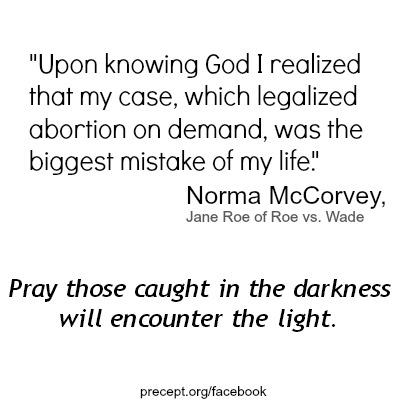
Roe mistake

“Each day, 2,150 women wake up in America believing abortion is the only realistic solution to an unplanned pregnancy” (care-net.org).
God brought Norma out of darkness and into His marvelous light.
Many women are still sitting in the darkness;
will you help them see the light of the world?

We win by showing love, compassion, and mercy to one frightened woman at a time.”

Book Reviewed: Unglued

UngluedUnglued by Lysa TerKeurst was one of those books I heard good things about, got when it was either free or on sale for the Kindle app, and then let sit there for months. I’m not sure what prompted me to read it now, but I am glad I did.

The subtitle is Making Wise Choices in the Midst of Raw Emotions. Most of us have had experiences with out-of-control emotions, both externally from others or internally within ourselves. Some of us are “exploders” who lash out at others in some way, and some of us are “stuffers” who seethe inside, or some combination of the two.

Emotions in themselves aren’t wrong: God gave them to us for various reasons. But just like with the rest of His gifts, we can use them in wrong ways.

Lysa starts with the idea of making “imperfect progress.” Sometimes we beat ourselves up over missteps and failures, but we need to remember it’s okay to take baby steps and to get up and start over as many times as needed, as long as we’re moving forward.

A big part of diffusing our emotions is taking control of the thoughts that feed them. “We won’t develop new responses until we develop new thoughts. That’s why renewing our minds with new thoughts is crucial. New thoughts come from new perspectives” (p. 22K – the K means Kindle version. I’m not sure if the page numbers are the same in the book itself). “Scripture also teaches that we can accept or refuse thoughts. Instead of being held hostage by old thought patterns, we can actually capture our thoughts and allow the power of Christ’s truth to change them: We demolish arguments and every pretension that sets itself up against the knowledge of God” (p. 23K).

The other biggest factor in getting our emotions under control is spending time in God’s Word, and Lysa shares many applicable Scriptures.

Here are some other helpful quotes:

“I can face things that are out of my control and not act out of control” (p. 23).

“Could I trust God and believe He is working out something good even from things that seem no good? You see, if I know there is a potential good hidden within each chaotic situation, I can loosen my grip on control” (p. 24K).

“We can’t always fix our circumstances, but we can fix our minds on God” (p. 28K).

“Instead of condemning myself with statements like, I’m such a mess, I could say, Let God chisel. Let Him work on my hard places so I can leave the dark places of being stuck and come into the light of who He designed me to be” (p. 37K).

“I choose to view this circumstance as a call to action, not a call to beat myself up mentally” (p. 40K).

“In processing unglued reactions, soul integrity if the heart of what we’re after. Soul integrity is honesty that’s godly. It brings the passion of the exploder and the peacemaking of the stuffer under the authority of Jesus where honesty and godliness embrace and balance each other” (p. 52K).

“I stuff to protect myself by keeping conflict at bay. But if I’m stuffing and not being honest about my true feelings, that self-protection quickly turns into selfishness, and the unresolved conflict gives birth to bitterness” (p. 56K).

“Choosing a gentle reply doesn’t mean you’re weak; it actually means you possess a rare and godly strength” (p. 69K).

“Feelings are indicators, not dictators. They can indicate there is a situation I need to deal with, but they shouldn’t dictate how I react. I have a choice” (p. 72K).

“We must spend time with God, letting His truths become part of who we are and how we live. That’s what it means to have an internal experience with Him. Only then will we develop holy restraint” (p. 75).

“I acknowledge that I can only control myself. I can’t control how another person acts or reacts. Therefore, I shift my focus from trying to fix the other person and the situation to allowing God to reveal some tender truths to me…My job isn’t to fix the difficult people in my life or enable them to continue disrespectful or abusive behaviors. My job is to be obedient to God in the way I act and respond to those people” (p. 88K).

“I stuff as a false way to keep the peace. True peacekeeping isn’t about stopping the emotion. Remember, emotions move inward or outward – whether we want them to or not. True peacekeeping is about properly processing the emotions before they get stuffed and rot into something horribly toxic” (p. 91).

“Is my desire in this conflict to prove that I am right, or is my desire to improve the relationship?” (p. 92K).

“Instead of reacting out of anger, I pause and let the Holy Spirit redirect my first impulses. Then I tackle the issues – not the person” (p. 93).

“It is through God’s ‘great and precious promises’ (2 Peter 1:3-8) that I can participate in the divine nature. A nature very different from my own. I may not be gentle by nature, but I can be gentle by obedience. If – and only if – I equip myself with predetermined Biblical procedures that I can rely on when I start to feel the great unglued coming on” (pp. 104-105K).

“I started thinking that maybe I needed my own set of default procedures for when selfishness, pride, impatience, anger, or bitterness rear their ugly heads. Because in the moment I feel them, I feel justified in feeling them and find them hard to battle. But God’s promises – His truths and examples from Scripture – are powerful enough to redirect me to the divine nature I’m meant to have. Having a predetermined plan from Him will help me stay calmer when I start to feel unglued. More godly. More in line with Scripture” (p. 107K).

That’s probably way too many quotes – and that’s not even all I marked. But I hope some of them spoke to you as they spoke to me.

This is the first book by Lysa Terkeurst I’ve read, though I have two more on hand. I enjoyed her style, and I gleaned much from this one (I even went skimmed back through it after I finished to remind myself of some of the main points).

There were places where I didn’t agree with something she said, but I instead of going into them here, I’ll refer you to this review for more detail. Reading it has made me rethink this book.

(This will also be linked to Semicolon‘s Saturday Review of Books.)

Christian Fans

Microphones Over White Background

I’m not going to get into the remarks make by a professing Christian reality show star a few weeks ago: there has been plenty written about that in the weeks since. But I did want to address something that has concerned me about Christian celebrity culture.

If there are Christians in the entertainment and sports world who can let their light shine for Christ without compromising their conscience or standards or testimony, that’s wonderful. They may not do and say everything just like I would, but that’s fine – that could probably be said of all of us, and God doesn’t make cookie-cutter Christians. What concerns me is not the famous Christians out there making news: what concerns me is their Christian fan base.

Some months ago (probably years, now), when another Christian was in the media spotlight, some folks I know were discussing him on Facebook. A loved one left a verse in the comments indicating that he wasn’t totally behind one of his practices. He didn’t rail about him, discredit him, or leave a lengthy diatribe; he just left one verse, but it was a verse that seemed to go against what the man was doing. Instead of drawing the commenter out with questions and having intelligent further discussion, the fans of this man harshly turned on the commenter like hungry dogs on raw meat. These were people that this loved one knew personally and had gone to church with. (Is it any wonder that this loved one isn’t so interested in church these days?) And I thought, how sad that people will defend at all costs a media personage, even a Christian one, who will never know them or care about them, at the expense of a relationship with someone they know and are supposed to love in their very own church and community.

I saw some similar things happen after this last situation: fans and non-fans started drawing up sides for and against the Christian celebrity and fans took any opposing viewpoint as a criticism and defended their man, sometimes without much grace for their “real life” acquaintances.

If I may, I’d like to share some thoughts about Christian fandom:

1. Not everyone will like the same program or person that we do. If you talk much to people (and social media perhaps makes it more possible to toss around opinions on a variety of things), you’re going to run into people with differences of opinion on just about everything under the sun. There are some fundamental issues we can’t budge on (but even those we can discuss with grace with those who differ), but we need to learn that on secondary issues, and especially something as low on the scale as liking a celebrity, we can show grace to someone with a differing viewpoint. We all know people who come down on the opposite sides of some issues of importance to us, and both sides can love God, extend grace to each other, and be friends.

2. A difference of opinion about something a celebrity did or said is not necessarily an “attack.” Even if it were, is attacking back the right way to respond? Like any other difference of opinion, we should be able to discuss the issues and at least come to understand the other’s viewpoint even if we can’t totally agree with it. If one side or the other gets too heated about it, it’s best to “agree to disagree” and drop it.

3. We need to keep Biblical relationships in mind. If we feel the need to defend “our guy,” we need to do so with grace and remember that the friend (even the Facebook friend), neighbor, or fellow church member we’re interacting with is a person we’re supposed to exercise Biblical “one anothers” with, not someone we harbor hard feelings against because they said something on Facebook that opposed the guy we’re fans of.

Dictionary.com lists one definition for “fan” as “an enthusiastic devotee, follower, or admirer of a sport, pastime, celebrity, etc.,” and I don’t think it is wrong to be a fan of a public figure or to discuss or even promote him or her. But it also says “fan” can be short for “fanatic,” “a person with an extreme and uncritical enthusiasm or zeal” with synonyms such as “zealot, bigot, hothead, militant.” We can be fans of a Christian celebrity without being so fanatical that we harm other relationships or let our own testimony shine more for our favored celebrity than for our Lord.

A New Year’s Prayer

551-1024-x-768

I saw this on Ellen‘s Facebook page yesterday, and it really resonated with me. It’s been dawning on me lately that, with my own family especially but with others as well (and even for myself), I tend to pray that whatever trial they’re going through will pass quickly and everything will work out for the best as soon as possible. That’s not wrong, I don’t think, but I often forget to pray that they’ll be strengthened in it, grow from it, see God in it, and learn whatever He has for them in allowing it. Sometimes in just wanting out of it we can miss the benefits of it.

A New Year’s Prayer

May God make your year a happy one!
Not by shielding you from all sorrows and pain,
But by strengthening you to bear it, as it comes;
Not by making your path easy,
But by making you sturdy to travel any path;
Not by taking hardships from you,
But by taking fear from your heart;
Not by granting you unbroken sunshine,
But by keeping your face bright, even in the shadows;
Not by making your life always pleasant,
But by showing you when people and their causes need you most,
and by making you anxious to be there to help.
God’s love, peace, hope and joy to you for the year ahead.

Anonymous

I pray the same for you! May 2014 be a year of growth and blessing and drawing ever nearer to our God.

Book Review: The Women of Christmas

I like to read something devotional about Christmas during December, with the Scripture passages regarding Advent themselves and/or a devotional book. I’ve enjoyed Come, Thou Long Expected Jesus, compiled by Nancy Guthrie, a number of times and thought about picking it up again this year, but I kind of wanted something new and different. Then my friend Kim mentioned she was enjoying Liz Curtis Higgs’ book The Women of Christmas: Experience the Season Afresh with Elizabeth, Mary, and Anna.  I have read several of Liz’s novels, but never one of her non-fiction books, so on Kim’s recommendation I decided to give this one a try.

Women of ChristmasIt was just what I wanted this year. The book takes us thoughtfully through the Christmas passages of Scripture, focusing mainly, as the title indicates, on three women: Elizabeth is older, beyond the usual childbearing years, but finds herself miraculously expecting the forerunner of Christ. Mary is a young teenager, a virgin, yet she is told she will bear the Son of God. Anna is elderly yet still serves God with all her heart and life. Though Zacharias, Joseph, and Simeon are discussed as well, the main focus of the book is on how God worked in the lives of these women.

It’s obvious that Liz has put a wealth of study behind this book, but it’s not what I would call a technical book. She touches on some of the controversies and questions of the Christmas story but wisely doesn’t spend a lot of time speculating on that for which we have no answers. She brings and out meditates on the truth we can find from what God has told us in His Word and provides an opportunity to get a fresh viewpoint from passages so familiar that we can sometimes zip through them without stopping to think about the real implications for the real people in these real stories.

For instance, I never thought to wonder before why Mary went to see Elizabeth right after learning that she was going to bear Jesus. We can’t tell from the text how well they knew each other or whether they were close, though they are cousins. Elizabeth was quite a distance away from Mary. Yet when the angel, in his announcement to Mary, told her that her barren older cousin was pregnant, that must have been an encouragement to her that the God who did this impossible thing for Elizabeth could and would do the impossible thing the angel foretold for her as well. But it also provided her with someone who would understand something of what she was going through. There is no record that Mary told anyone about the angel’s announcement. We assume she told Joseph, though we don’t really know. But Elizabeth was the one person who would believe her about an angelic visit and a miraculous pregnancy.

A few quotes that stood out to me:

“Now consider this: the first person to hold the newborn Christ was Mary of Nazareth, and the first person to touch the newly risen Christ, however briefly, was Mary of Magdala. God placed himself in a woman’s care when he came to earth, then entrusted a woman to announce his resurrection when he came back to life.

“When I hear women rail that the Bible is misogynistic, I wonder if we’re reading the same book. God loves women, redeems women, empowers women – then and now. On the day we call Christmas, he could simply have arrived on earth, yet he chose to enter through a virgin’s womb. On the day we call Easter, he could have appeared first to his beloved disciple John, yet he chose as his first witness a woman set free from seven demons” (p. 122)

(On Mary’s bearing a child in a stable), “Given the circumstances, it’s surprising what we don’t find in the passage. She whined. She complained. She demanded better accommodations. Not our Mary. Even after giving birth to the Savior of the world, she didn’t insist on special treatment, didn’t fuss about there being ‘no space for them in the living-quarters'” (p. 124).

“On that day in Bethlehem, absolute abasement was bathed in breathtaking glory. Born the lowest of the low, the infant Jesus was the highest of the high” (p. 125).

(On the announcement by the angels to the shepherds), “We’ve seen countless Christmas cards and tabletop Natvity scenes with Jesus as a ‘newborn baby’ (CEB) dressed in ‘swaddling-clothes’ (KNOX) and ‘lying in a feeding trough’ (ERV). But we’ve had a lifetime to embrace that reality. Think of these men hearing it for the first time” (p. 130).

(After the shepherds told everyone about the baby on their way back to their sheep), “What about Mary? Did she run around Bethlehem, telling everyone about God’s Son? She did not. ‘But Mary treasured up all these things and pondered them in her heart.’ Luke 2:19. Mary focused on caring for her baby while she stored all she’d seen and done ‘like a secret treasure in her heart’ (NIrV). Some women like to talk their way through experiences; others prefer the Mary approach: ‘weighing and pondering’ (AMP), ‘mulling them over’ (CJB), and ‘trying to understand them’ (ERV)” (p. 136).

Note in the last quote that she didn’t say this was a better approach: just that it contrasted with the reaction of the shepherds and then later Anna. That was a blessing to me in this year of having read and heard a lot about introverts and extroverts: neither is better, God made both, and He works in and through both in different ways for His glory.

I’m so glad I read this book this year. It provided me with many quiet, meditative moments during the mornings of this Christmas season. I’m sure I’ll be using it again in years to come.

Save