The King of Love

One of my favorite hymns:

The King of love my Shepherd is,
Whose goodness faileth never,
I nothing lack if I am His
And He is mine forever.

Where streams of living water flow
My ransomed soul He leadeth,
And where the verdant pastures grow,
With food celestial feedeth.

Perverse and foolish oft I strayed,
But yet in love He sought me,
And on His shoulder gently laid,
And home, rejoicing, brought me.

In death’s dark vale I fear no ill
With Thee, dear Lord, beside me;
Thy rod and staff my comfort still,
Thy cross before to guide me.

Thou spread’st a table in my sight;
Thy unction grace bestoweth;
And O what transport of delight
From Thy pure chalice floweth!

And so through all the length of days
Thy goodness faileth never;
Good Shepherd, may I sing Thy praise
Within Thy house forever.

~ Henry W. Baker

God is able…

(This was originally posted three years ago but is on my mind again today.)

The March 8 evening reading of Daily Light for the Daily Path had a list of verses concerning what God was able to do. That led me to look up other references with the word “able” referring to God. The results were a faith-inspiring blessing to me, and I wanted to share them with you:

II Chronicles 25:9
And Amaziah said to the man of God, But what shall we do for the hundred talents which I have given to the army of Israel? And the man of God answered, The LORD is able to give thee much more than this. (See II Chronicles 25:1-9 for the bigger picture.)

Daniel 3:17
If it be so, our God whom we serve is able to deliver us from the burning fiery furnace, and he will deliver us out of thine hand, O king.

Daniel 4:37
Now I Nebuchadnezzar praise and extol and honour the King of heaven, all whose works are truth, and his ways judgment: and those that walk in pride he is able to abase.

Luke 3:8
Bring forth therefore fruits worthy of repentance, and begin not to say within yourselves, We have Abraham to our father: for I say unto you, That God is able of these stones to raise up children unto Abraham. (See also Matthew 3:9)

Matthew 10:28
And fear not them which kill the body, but are not able to kill the soul: but rather fear him which is able to destroy both soul and body in hell.

Acts 20:32
And now, brethren, I commend you to God, and to the word of his grace, which is able to build you up, and to give you an inheritance among all them which are sanctified.

Romans 4:21
And being fully persuaded that, what he had promised, he was able also to perform.

Romans 11:23
And they also, if they abide not still in unbelief, shall be grafted in: for God is able to graft them in again.

Romans 14:4
Who art thou that judgest another man’s servant? to his own master he standeth or falleth. Yea, he shall be holden up: for God is able to make him stand.

2 Corinthians 9:8
And God is able to make all grace abound toward you; that ye, always having all sufficiency in all things, may abound to every good work…

Ephesians 3:20-21
Now unto him that is able to do exceeding abundantly above all that we ask or think, according to the power that worketh in us Unto him be glory in the church by Christ Jesus throughout all ages, world without end. Amen.

Philippians 3:21
Who shall change our vile body, that it may be fashioned like unto his glorious body, according to the working whereby he is able even to subdue all things unto himself.

2 Timothy 1:12
For the which cause I also suffer these things: nevertheless I am not ashamed: for I know whom I have believed, and am persuaded that he is able to keep that which I have committed unto him against that day.

Hebrews 2:18
For in that he himself hath suffered being tempted, he is able to succour them that are tempted.

Hebrews 7:25
Wherefore he is able also to save them to the uttermost that come unto God by him, seeing he ever liveth to make intercession for them.

Hebrews 11:19
Accounting that God was able to raise him up, even from the dead; from whence also he received him in a figure.

James 4:12
There is one lawgiver, who is able to save and to destroy: who art thou that judgest another?

Jude 1:24
Now unto him that is able to keep you from falling, and to present you faultless before the presence of his glory with exceeding joy….

Believe ye that I am able to do this? . . . Yea Lord. . . . According to your faith be it unto you. (Matthew. 9. 28, 29).

Top o’ the mornin’ to you!

stpat14

(Graphic courtesy of Anne’s Place)

Happy St. Patrick’s Day!

We don’t really do anything special for the day, but these Shamrock Shakes look good, even though I don’t care for mint myself…and can’t have ice cream…but they’re cute! 🙂

I do like that it has become a celebration of all things Irish. I did a longer St. Patrick’s Day post with several related links last year, so I won’t repeat that, but I was reading a little in one of the links there and can say a hearty Amen to this from St. Patrick FAQ at IrishChristian.net.

Is Patrick A Saint?

That Patrick is a saint is no myth, although he has never been canonized by the Roman Catholic Church. When the Roman Catholic Church established the first list of Saints (the first official saint was Ulrich canonized in 993), Patrick was already on it.

But is that how one becomes a saint? According to the Bible, sainthood is not attained by what others think of us, but by who we own as our Saviour. At least six New Testament epistles are addressed directly “to the saints.” The authors were not writing to dead people, but to all those who believe this: “By grace you have been saved through faith, and that not of yourselves; it is the gift of God, not of works, lest anyone should boast” (Ephesians 2:8).

Patrick did not become a saint because of his good deeds in Ireland, but because of what he came to believe while still a slave boy in that country. After his salvation, he was called by God to return to Ireland, “to dwell in the midst of barbarians … for the love of God.” He went, not to obtain salvation, but because he was already saved and wanted to share his faith out of love for his Saviour.

I was going to do Linda‘s Random Dozen, but I am a little late getting to the computer and have to go to the dentist in about an hour (NOT a fun way to celebrate anything!), then have an errand in another town. So…I might do it later or just skip it this week. I’ll be by to visit here and there as I am able today.

Meanwhile, I’ll leave you with my favorite Irish hymn, Be Thou My Vision:

An inspiring giveaway!

Comments are now closed. The winner is:

Need A Nap2!

_______________________________________________

If you’ve looked at any wall decor in stores lately, you may have noticed a lot of plaques with words on them. “Believe.” “Dream.” Live, Love, Laugh,” etc.

Jeanne Winters takes that idea a step further, inspired by the Scriptural instruction to keep God’s word in our hearts and even upon the door posts of our homes. She creates decorations for the home which incorporate Scripture. She designed the “Simply Inspiring” line of inspirational gifts at Hallmark, maintains a blog called Inspiring Ideas, and has a book out titled Inspirational Home: Simple Ideas for Uplifting Decor and Craft.

When I saw that Jeanne was having a special buy one, get one free sale of her book at her Etsy store, I decided that would be a perfect opportunity to get one for myself plus one to give away!

The book is divided into four sections: Inspiring Accents, Artistic Walls, Fresh Florals, and Delightful Favors. You can see the first few pages here. I tried to take a few photos which really don’t do justice to the loveliness of the book, but you can get a little taste of her style and the kind of projects included.

This last photo is from Jeanne’s site where she shows how to make this wall art:

If you would like to win a copy of Inspirational Home: Simple Ideas for Uplifting Decor and Craft, just leave a comment on this post. I will use the Random Number Generator to choose a winner from the comments next Tuesday morning, March 23. Only one entry per person, please. This giveaway is open to anyone in any country: I will pay shipping, and I wouldn’t think there would be any customs fees, but if so, the winner is responsible for those.

Best wishes!

The Week In Words

http://breathoflifeministries.blogspot.com/2010/01/announcing-week-in-words.html Melissa at Breath of Life hosts a weekly carnival called The Week In Words,which involves sharing something from your reading that inspires you, causes you to laugh, cry, or dream, or just resonates with you in some way.

I forgot to note where I saw the first one, but I think it was on someone’s Facebook wall:

“I must secure more time for private devotions. I have been living far too public for me. The shortening of devotions starves the soul. It grows lean and faint. I have been keeping too late hours.” William Wilberforce

Wilberforce was a busy man behind good causes, yet felt the need of Scripture to strengthen and support him. We all have that need.

This is from the daily Elisabeth Elliot e-mail devotional:

He who refreshes others will himself be refreshed (Prv 11:25). “If you…satisfy the needs of the wretched…the Lord will satisfy your needs” (Is 58:10,11 NEB).

Do you often feel like parched ground, unable to produce anything worthwhile? I do. When I am in need of refreshment, it isn’t easy to think of the needs of others. But I have found that if, instead of praying for my own comfort and satisfaction, I ask the Lord to enable me to give to others, an amazing thing often happens–I find my own needs wonderfully met. Refreshment comes in ways I would never have thought of, both for others, and then, incidentally, for myself.

Lord, be as the dew to me today, as You were to Israel, that I may “flower like the lily” (Hos 14:5 NEB).

She’s not discounting the refreshment that comes from the Word, prayer, worship, fellowship, etc., but this avenue of refreshment is often over-looked: getting our attention off ourselves and concentrating on serving others.

Finally, this prayer was at the end of the March 14 reading from Our Daily Walk by F. B. Meyer:

Lord, be Thou within me, to strengthen me; without me, to keep me; above me, to protect me; beneath me, to uphold me; before me, to direct me; behind me, to keep me from straying; round about me, to defend me.

What struck me was not just the wonderful, bracing truth contained within the prayer itself, but the fact that each phrase recalls a truth of Scripture. I decided to look up at least one Bible verse for each phrase:

Within me, to strengthen me:

Christ in you, the hope of glory. Colossians 1:27:

Without me, to keep me:

For the bodies of those beasts, whose blood is brought into the sanctuary by the high priest for sin, are burned without the camp. Wherefore Jesus also, that he might sanctify the people with his own blood, suffered without the gate. Let us go forth therefore unto him without the camp, bearing his reproach. Hebrews 13:11-13.

Above me, to protect me:

He sent from above, he took me, he drew me out of many waters. Psalm 16:18.

Beneath me, to uphold me:

The eternal God is thy refuge, and underneath are the everlasting arms. Deuteronomy 33:27b.

Before me, to direct me:

I have set the LORD always before me: because he is at my right hand, I shall not be moved. Psalm 16:8.

Behind me, to keep me from straying:

Thou hast beset me behind and before, and laid thine hand upon me. Psalm 139:5.

Round about me, to defend me:

Thou art my hiding place; thou shalt preserve me from trouble; thou shalt compass me about with songs of deliverance. Psalm 32:7

I wrote a post last year about the blessing of looking at prepositional phrases such as these in the Bible. Those who know God are wonderfully surrounded by His love, care, and strength.

As the bridegroom to his chosen

As the bridegroom rejoiceth over the bride, so shall thy God rejoice over thee. Isaiah 62:5b.

As the bridegroom to his chosen, as the king unto his realm,
As the keeper to the castle, as the pilot to the helm.
As the captain to his soldiers, as the shepherd to his lambs,
So, Lord, art thou to me.

As the fountain in the garden, as the candle in the dark,
As the treasure in the coffer, as the manna in the ark,
As the firelight in the winter, as the sunlight in the spring
So Lord art thou to me.

As the music at the banquet, as the stamp unto the seal,
As refreshment to the fainting, as the winecup at the meal,
As the singing on the feast day, as the amen to the prayer,
So Lord art thou to me.

As the ruby in the setting, as the honey in the comb
As the light within the lantern, as the father in the home,
As the eagle in the mountains, as the sparrow in the nest,
So Lord art thou to me.

As the sunshine in the heavens, as the image in the glass,
As the fruit unto the fig tree, as the dew unto the grass,
As the rainbow on the hilltop, as the river in the plain,
So Lord art thou to me.

You can hear this song here. John Rutter composed the music; I’m not sure about the words.

Parting the Waters

I first read Jeanne Damoff when someone (I’m sorry, I forgot to note who) linked to her articles “How fiction can powerfully inform the practical application of truth,” part one and part two. Both her insights and her writing style resonated with me. Since these articles were part of a writer’s blog called The Master’s Artist, I clicked around to see what else she had written.

I discovered her book Parting the Waters: Finding Beauty in Brokenness about her then fifteen-year old son’s near drowning. Such an accident is the stuff of parents’ nightmares. Jeanne takes us from the day before the accident, when unbeknownst to them at the time, they had their last “normal” conversation for a long while, straight into the events of the next day — hearing the startling news that one boy on a class outing had died and that Jacob was in the hospital, having been underwater for several minutes and then receiving CPR for twenty minuted before reviving.

After the first few weeks, the Damoffs were told that Jacob would likely remain in a persistent vegetative state. But doctors and friends continued to work with him, trusting that God would have the last say. I rejoiced right along with the family at Jacob’s first movement, first laugh, first weeping, first words.

Jeanne is transparent and truthful about all of the issues involved as well as the wrestling of her own heart, trusting that God was in control yet struggling with why He allowed this to happen. Early on she wrote:

I saw God’s mercy in the timing [at the beginning of summer, when their teaching responsibilities were over], and the thought upset me. Why did God time this at all? Even in these earliest hours of uninvited, undesired affliction, I feared for the potential damage to our faith and begged God to preserve it. We didn’t understand His plan, but we knew we couldn’t endure this hell without Him.

Yet all throughout the pain and struggle, many different people remarked that something beautiful and unusual characterized the whole situation: they could see the grace of God in action through provision of different items or just the right person, through the family’s, friends’, and community’s interaction and support.

Not only is the story compelling and inspiring, but I love how Jeanne has organized the chapters around a theme, with titles like, “A Pebble Falls,” “First Ripples,” “Breakers,” Deep Waters,” “Stormy Winds, “Undercurrents,” etc., with verses at the beginning of each, such as Isaiah 43:1-2a (But now, thus says the LORD, your Creator, O Jacob, And He who formed you, O Israel, “Do not fear, for I have redeemed you; I have called you by name; you are Mine! When you pass through the waters, I will be with you;And through the rivers, they will not overflow you.”) and Psalm 42:5a,7b (Why are you in despair, O my soul? And why have you become disturbed within me?…All Your breakers and Your waves have rolled over me.)

At the back of the book are two appendices: one contains thoughts and testimonials from others involved in the story, and the other deals with “God’s Purposes in Suffering.”

I am so thankful Jeanne shared their story with us.

(This review will be linked to Semicolon‘s Saturday Review of Books.)

Dr. Sa’eed of Iran

Some months back I wrote about Dr. John Dreisbach, a modern-day missionary who recently went Home to heaven. I was listening to his memorial service online when I heard the following poem read:

Christ is my Life, and Christ is my light;
Christ is my guide in the darkness of night;
Priest and strong Advocate Christ is for me;
Christ is my Master, to truth he’s the key.

Christ is my Leader, he peace to me brought;
Christ is my Savior, Christ righteousness wrought;
Christ is my Prophet, my Priest, and my King;
My Way, and the Truth to which I firmly cling.

Christ is my Glory, and Christ is my Crown;
Christ shares my troubles when woe strikes me down;
Christ is my treasure in heaven above:
In every deep sorrow he soothes me with love.

Christ is my Savior, my Portion, my Lord;
All honor and homage to Him I accord.
Christ is my Peace, and Christ my Repast;
Christ is my Rapture forever to last.

In joy and in sorrow Christ satisfies me;
‘Tis Christ who from bondage of sin set me free.
In all times of sickness Christ is my Health;
In want and in poverty Christ is my Wealth.

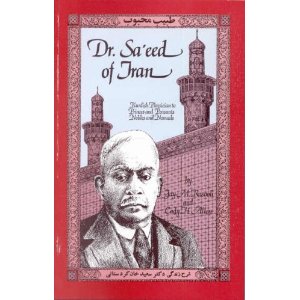
Afterward I searched online to find out who wrote this poem and discovered it was titled “Dr. Sa’eed’s Hymn” and was contained in the book  Dr. Sa’eed of Iran: Kurdish Physician to Princes and Peasants Nobles and Nomads by Jay M. Rasooli and Cady Hews Allen. It is no longer in print, but Amazon.com has inexpensive used copies, so I ordered one. (If you don’t mind reading books on the computer, the text is online through Google books.)

Dr. Sa’eed’s is a fascinating story. He was born into a Kurdish mullah’s (an Islamic teacher) family in June of 1863 in what was then Persia, now known as Iran. He was uncommonly bright and well-taught, so much so that he was given the title of mullah at the age of thirteen when his father died.

As a child he once saw a foreigner wearing a hat with a brim, uncommon because Persians then wore brimless hats. When he asked his mother why the man wore that “funny hat.”

“He is an unbeliever,” she replied, “and they do not wish him to see the sky, which is the abode of God.” By such an answer was aversion to non-Moslems instilled in the receptive mind (p. 23).

Sometimes he might be in a Christian home and “accidentally” knock something fragile off a shelf so that it broke or sit on a rug and cut holes in it with his knife. “Such misdeeds, while inspired by bigotry, were done especially to earn merit with God by causing damage to an unbeliever or even to one of a rival Moslem sect” (p 24).

But he also had a thirst for holiness that led him to fervent study and extreme rituals. After years he was still “dissatisfied and restive” (p. 29.) His first encounters with professing Christians were with Catholics who disgusted him, as they drank alcohol (forbidden in the Koran).

When he was seventeen, some Protestant missionaries came to town and engaged Sa’eed as a tutor in the Persian language. He had heard even worse things about Protestants, but he acquiesced.

He was surprised by many things: they knew something of the Koran, they prayed for their enemies, they did not drink, lie, or gossip. Their behavior matched their teaching. They used the Bible for language study, and Sa’eed heard many discussions about Christian teachings. Over time he began to speak with Kasha Yohanan about religion and read the Bible for himself. He began to see his own failings and to doubt what he had always been taught. This was agony to him, causing him to burn himself with hot coals as a vow never to speak with Christians about religion again and to tell the missionary that he was no longer available. But the words he had heard continued to burn in his heart until he finally prayed to be led in the true way. He decided to study both the Bible and the Koran. “In Mohammed’s teachings and personal life I found nothing which would satisfy the longing soul — not a drop of water to quench the thirsty spirit” (p. 38). Finally he yielded to faith in God.

His heart was now at peace, but his persecutions began in earnest. Even his own brother planned to kill him. The rest of the book details his growth, his training as a physician, and his life as a testimony to the One who saved him. Though often in danger, he never failed to treat anyone who called on him, even his enemies. His faith and godly character were a witness and a reflection of the One in Whom he believed.

(This review will be linked to Semicolon’s Saturday Review of Books.)

The Week In Words

http://breathoflifeministries.blogspot.com/2010/01/announcing-week-in-words.html Melissa at Breath of Life hosts a weekly carnival called The Week In Words,which involves sharing something from your reading that inspires you, causes you to laugh, cry, or dream, or just resonates with you in some way. Melissa explains,

“Playing along is simple, just write a post of the quote(s) that spoke to you during the week (attributed, of course) and link back here [at Melissa‘s]. They can be from any written source, i.e. magazine, newspaper, blog, book. The only requirement is that they be words you read.”

This blog post from my friend Rita, who is a missionary in Paraguay, had me sympathizing yet smiling.

Nothing will wake you up on a Sunday Morning like being introduced to a classroom full of Hispanic ladies as the guest speaker when no one ever mentioned it to you… then , when you frantically look down at your Bible for a verse of inspiration, you discover that you are carrying your English Bible to Spanish Sunday School.

This is from the March 5 reading from Our Daily Walk by F. B, Meyer:

But what we are in the smallest details of our life, that we are really and essentially.

Lastly, I finally began Jesus, Keep Me Near the Cross: Experiencing the Passion and Power of Easter, compiled by Nancy Guthrie. These lines stood out to me in the preface:

Oh, what we miss out on when we rush past the cross of Christ.Oh, the richness and reward when stop to linger before it, when we take the time to “consider him who endured from sinners such hostility against himself” (Hebrews 12:3). In a culture where crosses have become commonplace as architecture and jewelry, how we need to truly gaze upon the cross of Christ in all its ugliness and beauty, in its death and in its healing, in the painful price paid there, and in its free gift of grace. Jesus, keep us near the cross.

May Thy cross be to me…

May Thy cross be to me
as the tree that sweetens my bitter Marahs,
as the rod that blossoms with life and beauty,
as the brazen serpent that calls forth the look of faith.
By Thy cross crucify my every sin,
use it to increase my intimacy with thyself,
make it a ground of all my comfort,
the liveliness of all my duties,
the sum of all Thy gospel promises,
the comfort of all my afflictions,
the vigor of my love, thankfulness, graces,
the very essence of my religion,
and by it give me that rest without rest,
the rest of ceaseless praise.

From The Valley of Vision – A Collection of Puritan Prayers