
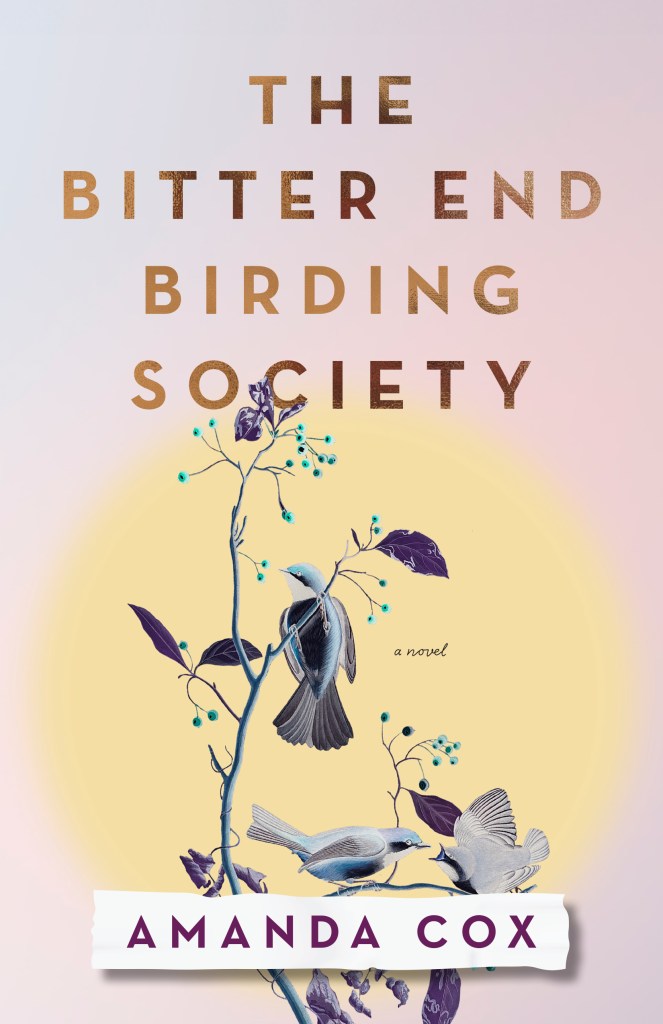
Review: The Bitter End Birding Society

The Bitter End Birding Society

In Amanda Cox’s newest novel, The Bitter End Birding Society, Bitter End is a small town in eastern Tennessee with a variety of legends about how it got its name.

Ana Leigh Watkins, the most recent newcomer to Bitter End, plans to spend the summer helping her great aunt Cora sort through her belongings in preparation for selling her house and moving to a retirement community. In reality, Ana needs time away to recuperate from her year of teaching kindergarten. She’s regarded as a hero for confronting a school shooter who entered her classroom. But she remembers the fear in the young man’s eyes and feels she escalated a situation that could have been resolved peacefully. She can’t forgive herself for the young man’s fate and the trauma caused to her students. The praise she receives only weighs her down further.

Ana gets adopted by a stray dog. While taking him for a walk one day, she runs into a neighbor with a group of birdwatchers who invite her to join them. She learns her aunt is bitter enemies with the head of the bird-watching group. As Ana gently investigates further, she discovers a story over sixty years old of a moonshiner’s daughter, Viola, who falls in love with a preacher’s son. The tragedies that befell them are still having repercussions.

The narrative switches back and forth between Ana’s and Viola’s points of view.

I just discovered Amanda a few years ago and have read all of her books except a novella. I’ve loved every one. The stories are well-written and the characters are easy to identify and empathize with and root for. Their situations tug on the heartstrings, but gentle humor is laced throughout as well. Grace and redemption are underlying themes.

Some of the quotes that stood out to me:

I thought I could fit everything into tidy boxes and sort right from wrong. But now I see that sometimes a saint acts like a sinner. And sometimes a sinner acts like a saint.

Those lines can seem pretty blurry sometimes. One can look just like the other from the outside. I’d say that the difference comes down to the heart. A lost sheep wants to come home but can’t for some reason. Something is getting in their way. But a prodigal is running in the opposite direction on purpose. You can’t make someone come home if they don’t want to. 

It was a mystery how some trinkets and knickknacks were alive with meaning and memory while others were soulless souvenirs. 

Did he know that what he needed for his pain was healing, not an anesthetic? The numbness he felt was not a cure. Anesthesia was not the sort of thing a body could live on.

Healing was an ongoing journey without a fixed destination.

Sometimes things don’t come to a tidy conclusion. Words are left unsaid. Things are left undone. But this life is not the end. . . . . Our present circumstances, our perceived failures, they are not final.

I loved that the birding society visited the Seven Islands State Birding Park, which I have been to.

I listened to the audiobook read by Rachel Botchan, who had a distracting habit of taking a breath in odd places. But otherwise, I enjoyed her narration.

The audiobook does not include the author’s notes, but Amanda has linked to a few interviews she did about this book here, and I found another one here.
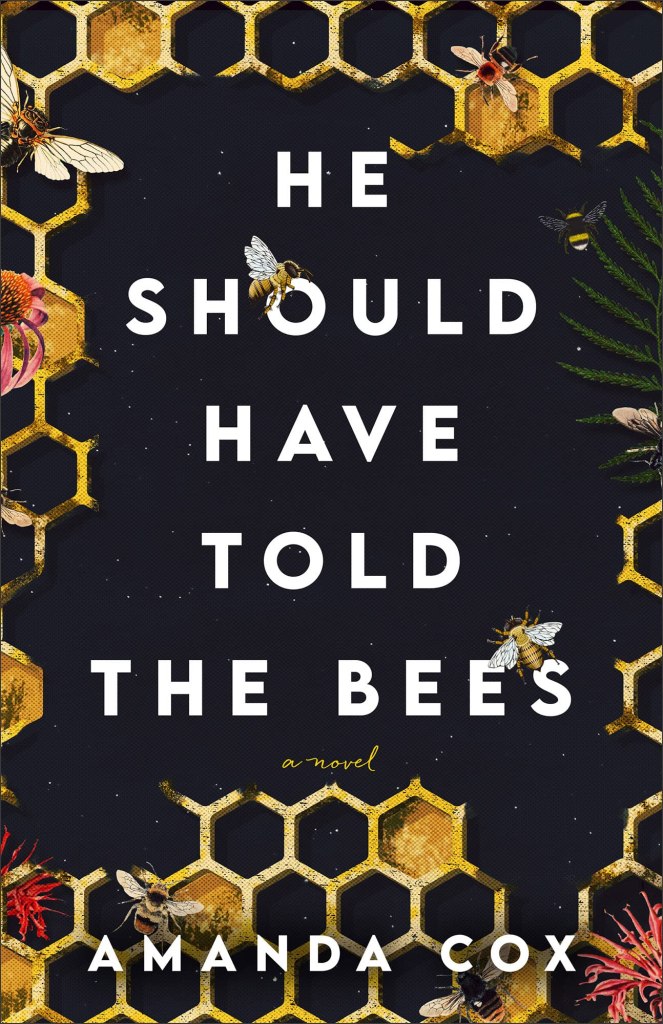
Review: He Should Have Told the Bees

He Should Have Told the Bees by Amanda Cox tells the story of two young women whose lives intersect unexpectedly.

Beckett Walsh kept bees with her father until he died unexpectedly. Her mother had left them when Beckett was small. Though memories of her mother are hazy, her leaving sent Beckett into nightmares of monsters when she was a child and panic attacks as a young person and adult. Her father had left his job as a banker to homestead, start an apiary, and accommodate Beckett’s needs. But now he’s gone. Still, Beckett thinks she can do just fine, despite her aunt’s attempts to manage her life.

Callie Peterson grew up with an unstable alcoholic mother who went through a series of men. Now Callie has distanced herself and bought a building to start a new business making candles, lotions, etc. But the building is going to need more work than she thought. And then her mother shows up on her doorstep, claiming she’s ready to seek help. When Callie takes her to a rehab center, she’s unaware that her mother named her as the person responsible for the finances needed.

Both women get a summons about a hearing for a trust that Beckett’s father had set up, naming them both as co-owners of the farm. The two women never knew each other before. Beckett can’t fathom why her father would name this stranger a co-owner when he knows Beckett’s needs and problems. Callie doesn’t, either. But she wonders if selling the farm could help her financial problems. But doing so would oust Beckett from the only safe place she knows.

Both women try to understand why Beckett’s father named Callie in the trust. Their search leads them to secrets and connections they never knew about. Will both their lives be upended–or fulfilled?

I enjoyed this story quite a lot. It was easy to sympathize with each woman’s journey and pain.

The side characters are delightful. Beck is unexpectedly visited by a neighbor in the form of a young girl who says she is an alien. Callie’s booth neighbor in the markets where they sell their wares turns out to be a stabilizing factor in her life.

The book opens with an excerpt of a poem by John Greenleaf Whittier titled “Telling the Bees,” in which beehives are draped in black as the bees are told their keeper has died. Evidently, according to Wikipedia, this is a custom in many European countries. It was even done when Queen Elizabeth died in 2022.

At one point, Callie’s friend points out some sunbeams and says:

They’re called crepuscular rays. And they happen because of light hitting dust. It’s just ordinary, boring particulate floating all around us like it always does, and then bam, the light hits it and suddenly it’s something that makes people stop and take pictures. If that’s not a miracle, then I guess I don’t know what a miracle is (p. 54).

That becomes an underlying theme.

A few other quotes that stood out to me:

If she could stack up all the hurt in the world and sort the kind inflicted with malicious intent from the hurt inflicted by carelessness, how would the two compare? Was there really any difference when the result was the same? (p. 216).

It was a hard lesson to learn—that you couldn’t be the one to fill the holes in another person’s life. Working through dysfunctional patterns, finding healthy coping skills, and letting God heal the wounds the past left behind, those were things you couldn’t do for another person. No matter how much you wanted to (p. 251).

It’s possible for treasured things to come out of the brokenness. Even if it doesn’t happen the way any of us would have wanted. Even if it comes through loss (p. 299).

On a humorous note, it’s fun to notice a particular author’s unique repeated words. In this book and others, Amanda uses the word “scrubbed” a lot (eight times in this book)–she scrubbed her eyes, he scrubbed his hand over his face. And hearts tend to “stutter-step” when upset. And people “worry” their bottom lips.

Amanda doesn’t have end notes about the story, but there is an interview here where she discusses the book.

All in all, I’m happy to recommend this book.

(I often link up with some of these bloggers.)

Review: The Secret Keepers of Old Depot Grocery

The Secret Keepers of Old Depot Grocery by Amanda Cox

In The Secret Keepers of Old Depot Grocery, a novel by by Amanda Cox, Sarah Ashby’s husband has just died. She returns to Brighton, TN, where she grew up and where her mother and grandmother still run the Old Depot Grocery Store which her grandfather began. All she wants to do is settle back in Brighton and help run the store she loves so much.

But her mother, Rosemary, doesn’t want Sarah to feel stuck in Brighton like she did. She keeps pushing her to move on and see the world.

And even if Sarah stayed, the old grocery isn’t doing well since the big new chain store opened nearby. Rosemary is pushing her mother, Glory Ann, to sell while they have interested buyers. Besides, Rosemary has urgent reasons to sell, reasons Sarah and Glory Ann know nothing about.

But the Old Depot was Glory Ann’s husband’s legacy, his way of ministering to the community. He never gave up. How can she?

The novel is told with a dual timeline, the second one in 1965 detailing Glory Ann’s life from her teen years. She was engaged to her blue-eyed farmer boy, Jimmy. But he was called up to fight in Viet Nam and was killed not long after. She didn’t have a chance to tell him that she carried the baby conceived from their one night of indiscretion.

Glory Ann’s father was a preacher who arranged for Glory Ann to marry Clarence, the son of an old-time friend. Clarence has been told the situation and is willing to marry Glory Ann. She resists, but her father says her sin will destroy his reputation and ministry as well as hers if it becomes known.

Glory Ann, Rosemary, and Sarah each have secrets that they think are protecting the others. Instead, misunderstandings and assumptions strain their relationships.

I love the way Amanda wove the different threads of this novel. As with her first novel, which I loved, The Edge of Belonging, the story has multiple layers: unplanned pregnancies, the nature of true love, the nature of everyday ministry, the damage secrets can cause and the freedom truth brings, PTSD. (Her first novel had a character with PTSD, too, making me wonder f someone in her family did.)

I listened to the audiobook, which was free from Audible’s Plus Catalog and read by Stephanie Cozart. The narration was well-done except the fake Southern accents were a little overwrought and grating to me. I think I would have liked this better in print.

But I did love the story and highly recommend it.