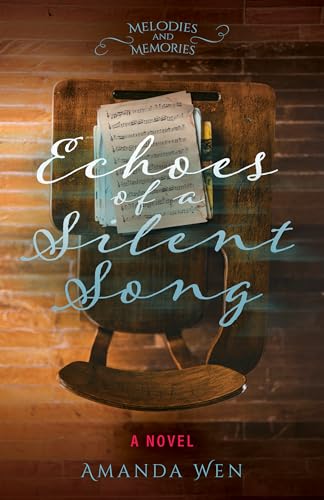
Review: Echoes of a Silent Song

Echoes of a Silent Song

Echoes of a Silent Song is a dual-timeline novel by Amanda Wen.

Blair Emerson has been the accompanist–or collaborative pianist, as she prefers to be called–for all of Peterson High School’s choirs for several years. But the last five years, no one conductor has stayed more than a year. The lack of continuity has hurt the kids and the music program. And the newest conductor, some hotshot from Boston, is no better. He has said upfront that he only plans to be there for a year.

Callum Knight had been a successful composer and conductor in Boston. But the pandemic brought everything to a screeching halt. And then his fiancee died. His old friend, the retired conductor from Peterson, Illinois, told him about a job opening at the high school–the last thing Callum ever would have considered if he wasn’t desperate. But it would pay the bills for a year and hopefully help his composing muse to come back.

Blair and Callum clash immediately. She has been the only constant in the students’ musical lives for years and feels protective of them. Callum feels they need to be challenged. She feels he’s choosing material that’s too hard and settling them up for failure. She reminds him they are children, not professionals. She thinks he’s arrogant. He thinks she is an ice queen.

They go round and round until they discover an unsigned partial piece of music in an old box in the choir room. They play a part of it on the piano and feel it’s brilliant, but they can’t find any more of the music. As they search, Blair remembers an Iris Wollingford, a student at the school who was said to have composed music but died by suicide before graduation. As Callum and Blair work together to find out more about Iris and her music, they come to understand each other better. But what they find out about Iris stuns them.

Some chapters tell Iris’ story from the late 1960s and early 70s. She was indeed a high school student whose mind was obsessed with music. She was not antisocial, but she didn’t have many friends. Then Victor, a boy in her class, saw a piece of music she was working on and confessed he was a composer, too. They became a couple with big plans to go to college and compose together. But then the draft for the Viet Nam war changed everything.

I’ve not read anything by Amanda Wen before except a Christmas novella, but I saw this as a free audiobook for Audible subscribers and decided to give it a try.

I felt the narrator of the audiobook overdid things in places. I think I would have enjoyed the print version more, but the library didn’t have the book and the Kindle version was more than I wanted to pay. About halfway through the book, either I got used to the narrator by then or she settled down into the story better.

It took me a little bit to get into the story. Some of Blair’s early conversations with her best friend, Joy, seemed downright juvenile. But once we got past that, I became more intrigued. The story seemed to get better as it progressed. We find out what is driving both Blair and Callum, what’s keeping them from opening up to each other, and what really happened to Iris.

I didn’t like the multiple uses of the word “crap.” The faith element seemed a little lacking in the first part of the book, but came out beautifully by the end. Overall, I enjoyed the story, especially the latter half.

The audiobook didn’t contain any notes from the author, but I found one interview she gave about the book here.


Review: The Lumber Baron’s Wife

Lumber Baron's Wife novel

The Lumber Baron’s Wife by Lynn Austin is a dual-timeline novel set in Michigan.

In 1873, Hannah Wagner had lost three children to diphtheria. Her husband, John, was a doctor but was unable to save them. To keep from feeling the pain of her loss, Hannah has numbed herself and closed herself off to love and the risks that come with it. She’s civil, but distant.

An old friend of her husband’s, Henry Abernathy, comes to visit them in Brooklyn. He has started a lumber mill in the untamed area of Michigan, and the bustling new town there needs a doctor. He wants John to start a practice in Michigan and promises to build him a home. John welcomes the new start, but Hannah doesn’t want to leave her children’s graves and everything else familiar to her. But eventually she agrees to go.

Hannah finds Henry’s wife, Kate, to be much younger than her husband and quite uncouth. Kate claims Hannah’s friendship with puppy-dog eagerness that drains Hannah. Hannah has no choice but to socialize with the younger woman, who scandalizes her with stories from her past.

When Kate goes missing (not a spoiler, as we’re told this on the first page), multiple possibilities arise that may have led to her disappearance. Yet none of them satisfies Hannah. She knows something must be wrong.

In the present day, Ashley Gilbert comes to Michigan with her new husband, David. She didn’t wanted to come to Michigan, but David has found his dream job there. Trouble arises when they search for a home: David wants something sleek and modern, but Ashley is a historian who is intrigued by an old but beautiful home once owned by the town’s doctor and his wife in the 1800s.

A mansion built by the area’s lumber baron in the same time period has fallen into disrepair. It has been used as multiple businesses through the years, including a daycare, an antique shop, and a Red Cross headquarters the second floor was even chopped up into apartments. A local group is volunteering to try to restore it to some of its former glory. When Ashley learns of the restoration and offers her services, she is viewed as a godsend. That strikes her as odd. She has never given God much thought.

Ashley becomes fascinated with the unsolved mystery of the lumber’s baron’s wife from all those years ago.

The point of view switches between Hannah, Kate, and Ashley. There are many layers to this story: overcoming difficulties and learning to work together in marriage, the power of friendship, the power of the gospel lived out and gently shared. The past affects and influences us but can be overcome.

The story drew me in from the first page. I don’t know when I have identified with a character as much as I did with Hannah. Though our circumstances were different, our personalities are similar.

When I finally found out what happened to Kate, I was totally surprised and did not see it coming.

I had never thought of Michigan as a nearly wilderness area, but I guess much of America was early on.

The audiobook, wonderfully narrated by Sarah Zimmerman, didn’t include the author’s notes, in the narration. But it did have PDFs of her notes and discussion questions. I also found interviews with Lynn here and here where she gives some background into the story. She’s from Michigan, which really was a hub of the lumber industry. Short-sighted lumber barons didn’t think about the long-term results of their industry, which devastated the area for many years. The Abernathy mansion in the book is based on a couple of similar mansions in MI that were turned into museums.

Overall, I greatly enjoyed this book and highly recommend it.

Review: The Bitter End Birding Society

The Bitter End Birding Society

In Amanda Cox’s newest novel, The Bitter End Birding Society, Bitter End is a small town in eastern Tennessee with a variety of legends about how it got its name.

Ana Leigh Watkins, the most recent newcomer to Bitter End, plans to spend the summer helping her great aunt Cora sort through her belongings in preparation for selling her house and moving to a retirement community. In reality, Ana needs time away to recuperate from her year of teaching kindergarten. She’s regarded as a hero for confronting a school shooter who entered her classroom. But she remembers the fear in the young man’s eyes and feels she escalated a situation that could have been resolved peacefully. She can’t forgive herself for the young man’s fate and the trauma caused to her students. The praise she receives only weighs her down further.

Ana gets adopted by a stray dog. While taking him for a walk one day, she runs into a neighbor with a group of birdwatchers who invite her to join them. She learns her aunt is bitter enemies with the head of the bird-watching group. As Ana gently investigates further, she discovers a story over sixty years old of a moonshiner’s daughter, Viola, who falls in love with a preacher’s son. The tragedies that befell them are still having repercussions.

The narrative switches back and forth between Ana’s and Viola’s points of view.

I just discovered Amanda a few years ago and have read all of her books except a novella. I’ve loved every one. The stories are well-written and the characters are easy to identify and empathize with and root for. Their situations tug on the heartstrings, but gentle humor is laced throughout as well. Grace and redemption are underlying themes.

Some of the quotes that stood out to me:

I thought I could fit everything into tidy boxes and sort right from wrong. But now I see that sometimes a saint acts like a sinner. And sometimes a sinner acts like a saint.

Those lines can seem pretty blurry sometimes. One can look just like the other from the outside. I’d say that the difference comes down to the heart. A lost sheep wants to come home but can’t for some reason. Something is getting in their way. But a prodigal is running in the opposite direction on purpose. You can’t make someone come home if they don’t want to. 

It was a mystery how some trinkets and knickknacks were alive with meaning and memory while others were soulless souvenirs. 

Did he know that what he needed for his pain was healing, not an anesthetic? The numbness he felt was not a cure. Anesthesia was not the sort of thing a body could live on.

Healing was an ongoing journey without a fixed destination.

Sometimes things don’t come to a tidy conclusion. Words are left unsaid. Things are left undone. But this life is not the end. . . . . Our present circumstances, our perceived failures, they are not final.

I loved that the birding society visited the Seven Islands State Birding Park, which I have been to.

I listened to the audiobook read by Rachel Botchan, who had a distracting habit of taking a breath in odd places. But otherwise, I enjoyed her narration.

The audiobook does not include the author’s notes, but Amanda has linked to a few interviews she did about this book here, and I found another one here.

Review: The Edge of Belonging

The Edge of Belonging by Amanda Cox opens with a homeless man, Harvey James, finding a newborn baby abandoned near his camp. He cleans her up and decides to look for a nice house with toys in the yard. A family with children would know what she needed. But none of the places he sees seem suitable.

He names her Ivy for the way she wound her way around his heart so quickly.

When he stumbles upon a pantry at a church with baby supplies, he begins to wonder if he could take care of her after all. At least for a while.

Twenty-four years later, Ivy is engaged and working her dream job as a counselor in a school when she learns that her grandmother has passed away. None of her family is related by blood, but their bond is strong as if they were. She goes home for the funeral, but her fiance’s selfishness in not wanting her to go makes her realize how controlling and emotionally abusive he has been.

She receives a letter her grandmother sent before her death, asking Ivy to take care of some of her things and telling her about a journal detailing her origin.

Ivy had always been told she had been left on her adopted parents’ doorstep as a baby, and they took her in. But her grandmother indicates there was more to the story.

After breaking up with her fiance and losing her job, Ivy travels back to her grandmother’s house. But the journal is missing. Her parents and uncle won’t answer any questions about her birth, saying the past is better left behind. But Ivy feels she needs to know where she came from to determine where she should go next. She begins to piece together clues found in her grandmother’s belongings.

The story switches back and forth from the events after her birth in 1994 and the present day, with the people and circumstances in Ivy’s and Harvey’s lives slowly revealed.

I loved this book. Some of the themes involve the nature of family, healing of wounded souls, the nature of sacrificial love, reaching out to help others even when they might reject it. The book also touches on homelessness, PTSD, depression, infertility, the foster care system, sex trafficking, and more. Everyone has a story, and that’s true of all of the main characters here.

Although I enjoyed Ivy’s journey, Harvey is my favorite character. At the beginning, he’s so skittish he can barely hold a conversation. He’s been shuffled aside so many times, he’s closed off to everyone. But his love for Ivy pushes him to extend himself far beyond his comfort zone.

Ivy’s Grandma Pearl is another favorite, but I can’t tell you too much about her without spoiling the story. Though both sides of the dual timeline focus on Ivy, Pearl is in many ways the hub of the wheel that connects all the characters. She says of herself, “If the story of my life could say one thing, I’d hope it would show the importance of venturing into the highways and the hedges to let invisible people know they’re seen and loved. To invite them in.”

A couple of other sentences that stood out to me:

I’m starting to see that when I let go of my grip on my pain, I make space for new things. Things that bless me in a way I never would have imagined. I’m getting there little by little—learning how to release my disappointments and embrace the gifts I have (pp. 295-296).

It’s not about my pain versus your pain. It’s about sharing in the human experience and knowing what it is to hurt. It takes courage—stepping forward and healing when it’s so tempting, so safe, to stay and worship the altars we’ve built to our pain (p. 297).

I started out listening to the audiobook, nicely read by Leah Horowitz, which was free from Audible’s Plus Catalog. But Audible rotates titles in and out of their free offerings, and this book rotated out about a day before I could finish it, so I lost the quotes I had marked in the early part of the book. Thankfully, our library had a copy, so I could finish the book.

This book was Amanda’s debut novel in 2020. I’m looking forward to reading the books she has written since then.

Review: The Winter Rose

The Winter Rose by Melanie Dobson is a dual-timeline novel.

Grace Tonquin is an American Quaker woman living in Vichy France during WWII. She had left behind the lifestyle of her actress mother, Ruby. Now she works with a network of others to help Jewish children escape France over the Pyrénées mountains into Spain. Grace has been told by Roland, her friend and leader, this must be her last group. Previously she had gotten the children to those who would take them over the mountains; now she must go with them. It was no longer safe for her to remain in France.

One boy, Louis, ends up having to remain behind in hiding with Helene, a woman who worked with Grace. Grace takes the remaining eleven children through various dangers until they finally arrive in Spain.

Most of the children are sent to live with relatives. Grace takes two of the children, siblings Elias and Marguerite, home with her to Oregon. She and Roland marry, and they raise the children as their own.

In 2003, Addie Hoult comes to Tonquin Lake in OR to look for any remnants of the Tonquin family. Her mentor and father-figure, Charlie Tonquin, is desperately ill and needs a transplant preferably from someone related. Charlie has always steadfastly refused to share anything about his family or his past. But Addie is determined to try to find his relatives, hopefully even his long lost sister.

I had seen films about people who helped Jewish children escape over the mountains. However, those movies ended with the children getting safely over, where it was assumed they lived happy and stable lives afterward. This book deals with the aftermath some of them faced. Even getting to safety, many of them couldn’t help but be traumatized by having to leave their homes and families, travel in difficult conditions, and witness things children should not have to see.

Some of the quotes I liked best:

She didn’t understand, nor would she ever, why God didn’t rescue everyone in this life, but it was her job, her grandfather had often reminded her, to be faithful in caring for those God gave to her (p. 37, Kindle version).

No one wants to hold you against your will. We want you to master your will so you can be in control of yourself (p. 189).

Living, I think, defies the loss. Loving well defies it, too (p. 301).

I enjoyed Melanie’s notes at the end where she told some of the history the novel was based on as well as what was fictional. She included some of that information on her website here.

When I’ve shared Melanie’s books before, some have wondered if she was related to or connected with the Dobsons of Focus on the Family. The “About the Author” page at the back of the book says, in part, “Melanie is the previous corporate publicity manager at Focus on the Family, owner of the publicity firm Dobson Media Group, and a former adjunct professor at George Fox University.” Since her husband’s last name is Dobson and she worked at Focus, I assume he is related somehow–unless the same last name is just a coincidence.

Overall, I thought this was a good book. I got a little lost in some places, unusual for Melanie’s books. But I appreciated getting to know “the rest of the story,” as Paul Harvey wold have said, behind some of the displaced children of WWII and the people who helped them. However, they aren’t the only ones in the story dealing with past wounds and needing to heal from their experiences. That seems to be the common theme among many of the characters.