Bookish fun

813359_book_stack_4.jpgI saw this over at Joyful Reader, who found it at Two weeks from everywhere, and it looked like a fun thing to do. I haven’t done this kind of thing in a while. All links are to my thoughts or reviews.

1. Favorite childhood book?  Little Women by Louisa May Alcott

2. What are you reading right now?  The Fruitful Wife by Hayley DiMarco (actually for the second time in a row. I finished it, but it was so full and I didn’t feel I had really grasped a fraction of it, so I am going back and outlining the chapters), Daniel Deronda by George Elliot, and Overcoming Overeating by Lisa Morrone.

3. What books do you have on request at the library?  None at the moment

4. Bad book habit?  Probably buying too many. 🙂

5. What do you currently have checked out at the libraryGulp! by Mary Roach

6. Do you have an e-reader?  I have a Kindle app on my HP tablet and iPhone. It took some getting used to, and I still prefer an actual paper book, but I have enjoyed some electronically. I especially enjoy finding free or very inexpressive e-books!

7. Do you prefer to read one book at a time or several at once?  I usually have 2, sometimes 3 going at once.

8. Have your reading habits changed since starting a blog?  My To Be Read list has grown quite a bit longer! And I probably read things I might not have otherwise because I saw them recommended.

9. Least favorite book you read this year (so far)?  Probably The Duet by Robert Elmer. It was not a bad book at all – I just couldn’t engage with the characters. I loved his Wildflowers of Terezin, though.

10. Favorite book you’ve read this year?  The Secret Thoughts of an Unlikely Convert by Rosaria Champagne Butterfield.

11. How often do you read out of your comfort zone?  Occasionally, usually if a book is highly recommended by someone whose judgement I trust or if the subject matter is really interesting to me.

12. What is your reading comfort zone?  Christian fiction, biographies, classics.

13. Can you read on the bus?  I haven’t had occasion to in many years, but the last time I tried it I could. I can read in the car as well, thankfully. I am not a good traveler and reading is the only thing that makes it endurable.

14. Favorite place to read? Curled up on the couch with a throw blanket and something to drink.

15. What is your policy on book lending?  I don’t mind lending books out generally, but you have to be prepared that something might happen to it or you might not get it back. For that reason I might not lend one that wasn’t easily replaceable or had sentimental value or that I had a lot of notes in that I wanted to keep.

16. Do you ever dog-ear books?  Rarely.

17. Do you ever write in the margins of your books?  Sometimes.

18. Not even with text books?  Textbooks were my most marked-up books.

19. What is your favorite language to read in?  English – I can’t read any other language.

20. What makes you love a book?  That would take a while to answer…but I guess I’d say I have to really connect with it in some way. Sometimes it is the plot, sometimes one of the characters, sometimes beautiful writing, with the best  books connecting all of those.

21. What will inspire you to recommend a book? Probably any of the elements mentioned above, or if it is non-fiction, if I found it helpful and truthful.

22. Favorite genre?  Christian fiction when it is good.

23. Genre you rarely read (but wish you did)?  I can’t think of any I wish I did read more of. There are some I don’t read and have no intention of ever reading.

24. Favorite Biography?  That’s a hard one – I have several favorites. But the top ones would be Amy Carmichael of Dohnavur by Frank Houghton, By Searching and In the Arena by Isobel Kuhn, and Climbing by Rosalind Goforth.

25. Have you ever ready a self help book?  Oh, sure.

26. Favorite cookbook?  My old faithful falling-apart Betty Crocker cookbook that I have used for 30+ years and the church cookbook put together at our last church.

27. Most inspirational book you’ve read this year (fiction or non-fiction)? Through Gates of Splendor by Elisabeth Elliot.

28. Favorite reading snack?  I don’t usually snack while reading, because I don’t want to get food stains on my books, but I usually do have either a cup of decaf coffee or a decaf Diet Coke nearby.

29. Name a case in which hype ruined your reading experience.  I know I have had that experience, but at the moment I can’t think of any particulars.

30. How often do you agree with critics on a book?  I don’t usually read the critics, but I do peruse Amazon.com reviews as well as that of several bloggers I follow.

31. How do you feel about giving bad/negative reviews?  I feel it is important to give an honest review, whether it is good or bad, both as a matter of character and because people have told me they have bought a book on my recommendation, so I feel a heavy responsibility in what I say about a book. I don’t usually read books that I am expecting to review negatively, but if I find something that troubles me, I feel compelled to mention it, and my readers can take that information and make their own decisions.

32. If you could read in a foreign language, which language would you choose?  I don’t know – I really have no desire to learn a foreign language, despite all the reasons I have heard for doing so. Probably Greek, as I’d love to read the New Testament in its original language.

33. Most intimidating book you’ve ever read? The unabridged Les Miserables just because of its size, but I loved it.

34. Most intimidating book you’re too nervous to beginWar and Peace or Crime and Punishment. I have heard both are good and not as hard to read as one might think.

35. Favorite poet?  Hmmm…probably Robert Frost or Edgar Allen Poe.

36. How many books do you usually have check out of the library at any given time?  1

37. How often have you returned a book to the library unread?  Not often.

38. Favorite fictional character?  Oh wow. That is a hard one. Maybe Aslan. Or Jean ValJean in Les Miserables. Or Mr. Peggoty, the old fisherman in David Copperfield. Or…

39. Favorite fictional villain?  Javert in Les Miserables.

40. Books I’m most likely to bring on vacation?  Just whatever I am reading at the time, but probably Christian fiction or biographies rather than non-fiction or older classics with older language styles that require more concentration.

41. The longest I’ve gone without reading. I’ve not gone more than a few hours without having read something, but I’ve gone a day or so without dipping into whatever book I am currently in.

42. Name a book that you could/would not finish. The Shop on Blossom Street by Debbie Macomber. I’ve seen bloggers mention this name for years and I finally decided to check out one of her books. I had to put this one aside due to quite explicit sexual content. I had no idea that would be in a story about ladies coming together over knitting! Very disappointing as I have seen a lot of bloggers favorably mention her books and they look so good.

43. What distracts you easily when you’re reading?  Other people talking or playing videos on their electronic devices.

44. Favorite film adaptation of a novelAnne of Green Gables and The Lion, the Witch, and the Wardrobe.

45. Most disappointing film adaptation? Anne of Green Gables: The Continuing Story.

46. The most money I’ve spent in the bookstore at one time?  Several hundred dollars – but that was not for myself. 🙂 That was when I was in charge of buying items for our church’s mission closet. For myself – I don’t really know. Maybe upwards of $75…or more….on occasion…

47. How often do you skim a book before reading it?  I will usually skim the table of contents and occasionally look at a page or two ahead of time with non-fiction, but I don’t want to ruin the surprise of fiction.

48. What would cause you to stop reading a book half-way through?  Bad language or illicit sexual scenes. Otherwise, if the writing is poor or the characters uninteresting, I keep hoping it will get better and usually persevere til the end.

49. Do you like to keep your books organized?  Yes, they are organized by genre and some genres are organized by author name or subject.

50. Do you prefer to keep books or give them away once you’ve read them? I prefer to keep them, but one only has so much room, so I have to be discriminating about what I keep.

51. Are there any books you’ve been avoiding?  I don’t know if I’d use the word avoiding. I haven’t gotten into the Harry Potter books because I just have no interest in them and have stacks of books I do want to read. If my kids had been interested in them I probably would have read them.

52. Name a book that made you angry. There was a book we checked out from the library when my kids were younger that was like a New Age allegory complete with a personal note from the “spirit guide” in the back. Much of it was subversive, and I wanted to destroy it.

53. A book you didn’t expect to like but did? I can’t say I liked The Picture of Dorian Gray per se, but it was fascinating in some respects, and though it wasn’t meant as a book to draw lessons from, I did glean many pertinent observations.

54. A book that you expected to like but didn’tIntroverts in the Church by Adam McHugh. I did glean many good things from it, but I expected to thoroughly love it, and instead I found many things that troubled me or that I could not endorse.

55. Favorite guilt free, pleasure reading?  I think about all of my reading could be described that way.

Wow….that was a long meme and took a lot longer to do that I thought it would. But if you decide to do it, too, let me know and I’ll come read your answers.

(Graphic courtesy of the stock.xchng)

Book Review: Invisible

InvisibleI sought out Invisible by Ginny Yttrup because I dearly loved her first novel, Words: it was one of my favorite books of 2011.

Invisible tells the story of three very different women who become friends. Normally I don’t just copy the publisher’s description of a book, but in this case it seemed the fullest yet the most concise way to sum them up:

Ellyn DeMoss — chef, café owner, and lover of butter — is hiding behind her extra weight. But what is she hiding? While Ellyn sees the good in others, she has only condemnation for herself. So when a handsome widower claims he’s attracted to Ellyn, she’s certain there’s something wrong with him.

Sabina Jackson — tall, slender, and exotic — left her husband, young adult daughters, and a thriving counseling practice to spend a year in Northern California where she says she’s come to heal. But it seems to Ellyn that Sabina’s doing more hiding than healing. What’s she hiding from? Is it God?

Twila Boaz has come out of hiding and is working to gain back the pounds she lost when her only goal was to disappear. When her eating disorder is triggered again, though she longs to hide, she instead follows God and fights for her own survival. But will she succeed?

Though two of the characters have issues pertaining to weight, the book is not about weight: it’s about what it means to be made in the image of God and what the implications of that are in our lives. Each character has to learn that we don’t do certain things outwardly in order to be made in the image of God: we already are. And when rightly understood, that truth permeates our being and affects our thinking and then our outward actions.

I don’t want to reveal much more about the plot than that. Though the book didn’t grab me from the first page and not let go like Words did, it still provided much food for thought and I enjoyed it.

The character I liked the most was Miles, friend to all three main characters and potential love interest of one. His walk with God and the way he sought His guidance in everyday life was very realistic to me. This is one reason I love Christian fiction: this is the missing element, the ultimate reality missing in secular stories, no matter how good they are. Sometimes people accuse Christian fiction of being a sermon disguised as a story or a story with spiritual bits put in in order to make it “Christian,” but neither is the case in Ginny’s work (or even of the great majority of Christian fiction I’ve read.) Her characters are genuine (if sometimes a bit unconventional, in the case of Twila), and though there is spiritual truth she is trying to convey, each character grapples with it in a natural and realistic way.

Here are a few quotes that stood out to me from the book:

“I’ve learned enough through the years that when God is silent, it’s my cue to hold on tight. Do nothing. Wait on Him” (p. 49).

“When I pass from the discomfort of need to the tranquility of satisfaction, the very transition contains for me the insidious trap of uncontrolled desire. Augustine” (p. 168).

“I have forgiven him and I will forgive him again. But I won’t allow him to use me or mistreat me” (p. 262).

“Oh, Lord, remind me that this confrontation is an act of love and respect for both myself and my mom. It is not retaliation for years of pain” (p. 310).

There were just a couple of things that bothered me to a degree. One was Twila’s worship experience (pp. 166-167), which seemed a little New Age-y to me but would probably be called contemplative (which I don’t know a lot about yet but am not a fan of what I do know). The other was Ellyn asking if a dress had too much cleavage and Sabina telling her it was “lovely and appropriate” (p. 326). In my book no amount of cleavage is appropriate for anyone other than one’s husband in private.

But with those caveats, this is a book I am happy to recommend.

(This will also be linked to Semicolon‘s Saturday Review of Books.)

Book Review: The Last Battle

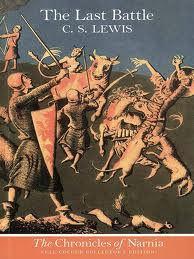
Last BattleThe Last Battle is the last book in the Narnia series by C. S. Lewis. It opens with a false Aslan: a confused donkey coerced to wear a lion skin by a conniving ape, who in turn is being controlled by others. In Aslan’s name, talking beasts are turned into slaves, dryads are dying because their trees are being cut down, Calormenes are overseers. Strange things are afoot, everything seems not quite right to everyone, but Aslan is not a tame lion, after all, so his ways will of course be a little different, and they think they must obey.

King Tirian sees at once that something is wrong, but he sets off rashly without thinking and winds up in trouble, He calls out for help, and Eustace and Jill show up. Together with the few Narnians who don’t believe in the false Aslan, they wage a last battle to save Narnia.

Even though the Narnia series is not an allegory per se, it’s still not hard to see the Biblical allusions to the end times and the antichrist. In Narnia as on Earth, things will get much, much worse before the end comes. And “Aslan’s country” has always typified heaven. All the beasts and creatures and people going “further up and further in” to Aslan’s country, the joyful reunions with those who have gone before, the sense that “this is what I have been seeking and waiting for my whole life” are the best parts of the books to me.

I think this time through the series, that is most what I have carried away with me: that longing, as in the song “Beulah Land”: “I’m kind of homesick for a country where I’ve never been before.” I have to admit that too often I am caught up with the joys and cares of this life. I look forward to having no more sin, sorrow, suffering, and tears some day, but I don’t always carry that personal longing just to be with Christ there, and this series as a whole stirs up that longing for Narnia and Aslan that all who visit experience while they’re away. It calls to mind Biblical texts like Hebrews 11:16: “But now they desire a better country, that is, an heavenly: wherefore God is not ashamed to be called their God: for he hath prepared for them a city,” and Colossians 3:1-2: “If ye then be risen with Christ, seek those things which are above, where Christ sitteth on the right hand of God. Set your affection on things above, not on things on the earth,” as well as Lewis’s own words from Mere Christianity: , “If I find in myself a desire which no experience in this world can satisfy, the most probable explanation is that I was made for another world…I must [therefore] keep alive in myself the desire for my true country, which I shall not find til after death.”

There is sadness for those who choose not to believe, such as the dwarves who are only for the dwarves and refuse to be “taken in.” As Aslan says, “They will not let us help them. They have chosen cunning instead of belief. Their prison is only in their own minds, yet they are in that prison, and so afraid of being taken in that they cannot be taken out.” Unfortunately there will be people like that as well.

There is a point of confusion with the Calormene Emeth, who served the Calormene god Tash, yet is admitted to Aslan’s country, not because Tash and Aslan are one, as some tried to proclaim (Aslan shook the earth with his growl at the very thought), but because Aslan took to himself everything Emeth had done for Tash. For, he says, “he and I are of such different kinds that no service which is vile can be done to me, and none which is not vile can be done to him. Therefore if any man swear by Tash and keep his oath for the oath’s sake, it is by me that he has truly sworn, though he knew it not, and it is I who reward him. And if any man do a cruelty in my name, then, though he says the name Aslan, it is Tash whom he serves and by Tash his deed is accepted…unless thy desire had been for me thou wouldst not have sought so long and so truly. For all find what they truly seek.” I don’t know how much of this reflects Lewis’s personal belief system, but I can’t endorse the idea that someone sincerely serving and seeking a false God is really serving the one true God unaware.

A couple of my favorite quotes:

“I have come home at last! This is my real country! I belong here. This is the land I have been looking for all my life, though I never knew it til now. The reason why we loved the old Narnia is that it sometimes looked a little like this.”

“Your father and mother and all of you are – as you used to call it in the Shadowlands – dead. The term is over: the holidays have begin. The dream is ended: this is the morning.”

It was only the beginning of the real story. All their life in this world and all their adventures in Narnia had only been the cover and title page: now, at last they were beginning Chapter One of the Great Story which no one on earth has read, which goes on forever.”

I have to thank Carrie for sponsoring the Chronicles of Narnia Reading Challenge, which spurred me on to revisit the series. I’ve so enjoyed being in Narnia again! I also marvel at how someone with an intellect as large and complex as Lewis’s can write something simple enough for children to understand yet engaging to adults, too, with such nobility and depth and beauty.

Here are my posts from the whole series:

The Lion, the Witch, and the Wardrobe
Prince Caspian
Voyage of the Dawn-Treader
The Silver Chair
The Horse and His Boy
The Magician’s Nephew
The Lion, the Witch, and the Wardrobe Graphic Novel.
The Way Into Narnia
Narnian Magic.

Chronicles of Narnia Reading Challenge

(This will also be linked to Semicolon‘s Saturday Review of Books.)

What’s On Your Nightstand: July 2013

What's On Your NightstandThe folks at 5 Minutes For Books host What’s On Your Nightstand? the fourth Tuesday of each month in which we can share about the books we have been reading and/or plan to read.

Wow, it’s been another super busy month. Here’s what I’ve been reading and plan to read next.

Since last time I’ve finished:

Through Gates of Splendor, by Elizabeth Elliot, a missionary classic about the lives and deaths of Jim Elliot, Nate Saint, and their three friends who tried to reach a savage tribe in Ecuador, for Carrie’s Reading to Know Book Club for June, reviewed here.

The Hidden Art of Homemaking by Edith Schaeffer along with Cindy at Ordo Amoris who is hosting a read-along book club where we discuss a chapter at a time. My discussions are here.

The Incorrigible Children of Ashton Place, Book II: The Hidden Gallery by Maryrose Wood, reviewed here, another fun one.

The Magician’s Nephew by C. S. Lewis for Carrie‘s Chronicles of Narnia Reading Challenge, reviewed here.

Light From Heaven by Jan Karon, last of the Mitford series, via audiobook. I summed up all the Mitford books here.

I’m currently reading:

The Last Battle by C. S. Lewis for Carrie‘s Chronicles of Narnia Reading Challenge

The Fruitful Wife by Hayley DiMarco.

The Wedding Dress by Rachel Hauck.

Next up:

Invisible by Ginny Yttrup.

On Distant Shores, hot off the press by Sarah Sundin.

Gulp: Adventures on the Alimentary Canal by Mary Roach.

Daniel Deronda, by George Eliot for Carrie’s Reading to Know Book Club for August.

If I should finish those, I have others lined up and just have to decide which to delve into. 🙂

What’s on your nightstand?

Book Review: The Incorrigible Children of Ashton Place, Book 2: The Hidden Gallery

Hidden GalleryAfter I listened to Book 1 in The Incorrigible Children series, The Mysterious Howling (linked to my thoughts), I had to get the audiobook for Book 2: The Hidden Gallery. The children are not called incorrigible because they are disobedient, but their benefactor, Lord Ashton, has given them that name after he found them in the woods, deduced they had been raised by wolves, and brought them home. His wife was less than pleased, but hired a star graduate from Swanburne Academy for Poor Bright Females, Penelope Lumley, age fifteen, to be their governess in the first book. Miss Lumley genuinely cares about the children and has brought them a long way, though they still have some howling inclinations and the tendency to drool at the sight of small birds.

The Hidden Gallery opens with workmen repairing the damage caused by the mayhem in Book 1. The noise and bother causes Lady Ashton to take the whole family to London while the work is being done. Penelope enjoys taking the children to see the sites, but they do have some mishaps, such as when the children mistake the furry hat of a stoic guard at Buckingham Palace for a bear.

The also have an odd encounter with a gypsy soothsayer with a mysterious prognostication and meet a new friend in young Mr. Simon Harley-Dickinson (he of the “perfectly nice young face, waves of brown hair, finely formed features, gleam of genius,” p. 154), and Penelope receives some strange warnings and instructions from her former teacher and mentor, Miss Mortimer.

Some mysteries just hinted at in the first book are expanded upon a bit here, such as the similarity in color between Penelope’s hair and the children’s, Lord Ashton’s somewhat wolfish behavior and absences during full moons, and the mural in the attic whose likeness appears in an art gallery, but we don’t seem to be close to finding answers for them nor the questions of what happened to the children’s parents nor Miss Lumley’s. I don’t know what the long term plans are for this series – I know Book 3 is out and Book 4 is due in December – but I’d rather have a short, really good series than have some of these questions dragged on for 8 or 10 books. But if the rest of the books are as fun as the first two, I don’t suppose people will complain too much, and it will be an enjoyable ride.

There are more pithy sayings from Swanburne Academy for Poor Bright Females’ founder, Agatha Swanburne, sprinkled throughout the book (such as “She who waits for the perfect moment to act will never make a turn at a busy intersection”) and apt descriptions (“If you have ever ridden on a tire swing after turning the rope ’round and ’round until it was twisted from top to bottom, you will have some idea of the wild, spinning, escalating whirl of Lady Contstance’s distress,” p. 5). Author Maryrose Wood also offers some amusing asides of instructions to her younger readers, such as the difference between high dudgeon and dungeon, or the meaning of some French phrases, and then refers back to these throughout the book.

Katherine Kellgren did another wonderful job narrating, and I enjoyed the book so much more by hearing her intonations. I did check the book out of the library as well to refer back to passages I heard in the audiobook.

The only real objectionable element was the soothsayer. She’s not a major character, but she appears three times in the book and speaks of a curse on the children. If I were reading this to children I’d feel the need to expound against soothsaying and fortune-telling.

With that caveat, I can recommend this as another fun, clever, witty, enjoyable book from Maryrose Wood.

(This will also be linked to Semicolon‘s Saturday Review of Books.)

Book Review: The Magician’s Nephew

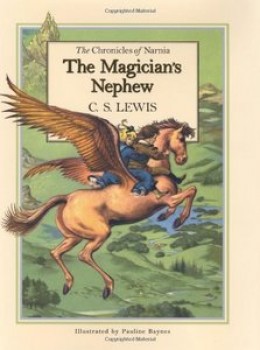
Magicians NephewI read The Magician’s Nephew by C. S. Lewis for Carrie‘s Chronicles of Narnia Reading Challenge. It’s the fifth book in order of publication but the first book in the Narnian time line. I liked reading it as the fifth book very much, and I’ll tell you why in a moment.

The story opens with two children, Digory and Polly, meeting. Polly lives in London, and Digory has just come there to stay with an aunt and uncle because his mother is very ill and his father is in India. Digory is not happy about leaving his pony and nice home in the country to come to London, and he is concerned about his mother, but after his meeting with Polly gets off to a shaky start, they become friends.

Digory’s uncle is thought by some to be mad, but if he’s not exactly mad, he’s at least strange. One day Digory and Polly go exploring in an attic corridor that seems to run along the length of the row of houses (the description of stepping on the rafters reminds me of a description of Lewis doing the same thing when he has a boy in a biography I read years ago – I don’t remember which one). They’re trying to get to an empty house to explore, but they miscalculate and find themselves in Uncle Andrew’s attic room. He dabbles in magic and has made some rings which he thinks sends people to other worlds – at least that seems to be what’s happened to the guinea pigs he has sent through. He suddenly sends Polly through and then manipulates Digory into going after her.

The children find themselves in what looks like a land of ancient ruins, where Digory inadvertently awakens an ancient evil, which follows them to London and causes a ruckus. In trying to get everyone back where they belong, they end up in an uninhabited world, and witness the creation of Narnia, beautifully and wonderfully described.

But they’ve brought the evil with them into the brand new world on its first day, which Aslan predicts will cause further evil later, but he promises to “see to it that the worst falls upon myself,” an echo of Christ’s taking the punishment for our evil on Himself.

More of those echoes to Biblical truth are found when Aslan breathes life into his creatures, when Aslan questions Digory as to how the evil came to be in Narnia, and Digory finds that Aslan won’t let him fudge the truth at all, when Digory concludes “the Lion was not at all the sort of person one could try to make bargains with,” with the freedom of choice that might lead to evil and its consequences, when Digory is sent to retrieve a particular apple from a particular tree enclosed by a particular gate and reads a sign that one must come through the gate, that stealing or climbing over the wall will lead one to despair, when Digory is tempted by forbeidden fruit, when Aslan welcomes him back from his quest with “Well done,” and probably in other ways as well which I am not remembering. With this book as well as the others, as Aslan told the children in Voyage of the Dawn-Treader, “You were brought to Narnia, that by knowing me here for a little, you may know me better there.”

I’m leaving our great chunks of the story on purpose so as not to spoil it for those who haven’t read it yet. But this book as well as the others leaves me with an appreciation of its underlying truths and a wistfulness for Narnia.

And personally, I think I got so much more out of this book reading it at this stage rather than the beginning because of the thrill and anticipation when I recognized certain connections – realizing just who the children were waking up, recognizing the lamppost in the woods as that lamppost, finding out who Digory turns out to be, etc.. If I had read this book first I think I would have had a hard time caring much about what was going on with Digory and Polly at the beginning: I even had to almost fight to care this time, even knowing, from having read the book before, where their adventures were going to lead. But I suppose people who read this book first might experience the same thrill of recognition when they get to The Lion, the Witch, and the Wardrobe. It’s just hard for me to fathom experiencing these stories without starting there.

I ended up loving this book much more than I thought I would at the beginning, and I’m very much looking forward to The Last Battle next.

(This will also be linked to Semicolon‘s Saturday Review of Books.)

The Hidden Art of Homemaking Book Club: Chapter 10, Drama

Chapter 10 of The Hidden Art of Homemaking by Edith Schaeffer, which we’re discussing a chapter at a time at  The Hidden Art of Homemaking Book Club hosted by Cindy at Ordo Amoris, is about drama.

I didn’t think I would get much out of this chapter. I have little if any ability in regard to acting anything out. I remember one night at church when I was a child and we were supposed to be acting out a scene from the Bible where people were mourning (I think maybe the widow in the New Testament whose son had died whom Jesus raised to life). We either had veils or handkerchiefs – I remember all that showed for us “mourners” was our eyes, and I couldn’t stop giggling, but that left me red-faced and teary, so I suppose it had the same effect. 🙂 I tried maybe once doing a skit in college and was miserable at it. It’s hard for me to keep a straight face even when as a family we are trying to surprise or put something over on someone.

I also wasn’t sure how Edith would incorporate drama into home life. I can see its use in the church or in Christian ministry, but in the home, at first the only application I could think of was in reading aloud to children. And that’s primarily what she talked about, though she ventured into some discussions of the value of reading books, different types of books to read, etc.

Some of my favorite times with my children when they were young were when I read stories out loud to them, and though I’m not great at doing different voices for different characters, I made an attempt and also tried to convey the different emotions of what we were reading. I agree with much of she she said when one has young children, but if no one is interested as they all get older, if no one besides Mom would enjoy reading a book aloud together, then there is not much else one can do with that, at least until grandchildren come along. The Christian school where we used to live they did have moms and grandmothers come for class library times to read stories aloud for the elementary classes instead of the librarian always doing that.

I’m surprised she didn’t venture into other areas that could use dramatic talent. One family in a former church had a mom who was very dramatic, and she was frequently asked to take on a character for cantatas or dramatic productions at church, and she and various members of her family were involved in a local community theater: she was the White Witch in The Lion, the Witch, and the Wardrobe, and I think one of her daughters was Lucy, and the whole family as well as several church members enjoyed seeing them do that. I think of Little Women and the various plays they put on, little puppets, even finger puppets, that we used with our children, pretending their stuffed animals were speaking to them or acting something out, etc. At lot of their play involved acting our various scenarios: school, church, etc.

There are various ways to incorporate drama into family life, even for those of us who don’t necessarily have any latent dramatic longings such as she describes in the first few paragraphs. It can definitely be used for fun, but even reading the Bible aloud can and should be done, yet not overdone, with feeling rather than in a deadpan monotone.

So I did end up having my imagination sparked and getting more out of this chapter than I thought I would.

What’s on Your Nightstand: June 2013

What's On Your NightstandThe folks at 5 Minutes For Books host What’s On Your Nightstand? the fourth Tuesday of each month in which we can share about the books we have been reading and/or plan to read.

It’s months like these when the fourth Tuesday occurs when there are several days of the month left that tend to throw me, but thankfully I did remember. It’s been a busy month (seems like I always say that…) with two sets of company, but I did get some reading in.

Since last time I finished:

Island of the Blue Dolphins, by Scott O’Dell for Carrie’s Reading to Know Book Club for May, reviewed here.

The Greatest Thing in the World by Henry Drummond, a closer look at I Corinthians 13. It’s a very short book: I should try to read it once a month or so for a while.

Bonhoeffer: Pastor, Martyr, Prophet, Spy by Eric Metaxas. I finished listening to the audiobook but I was going through the Kindle version as well (both were on sale around the same time) to highlight some things, and have not finished that yet. Hope to get my thoughts together for a review soon.

The Merchant’s Daughter by Melanie Dickerson, based loosely on Beauty and the Beast, reviewed here. Liked this one very much.

The Duet by Robert Elmer, about two older people who are complete opposites in many ways but are attracted to each other, reviewed here. Not wowed by it, but it was pleasant.

The Incorrigible Children of Ashton Place, Book 1: The Mysterious Howling by Maryrose Wood, reviewed here. This was quite fun, especially the audiobook version read by Katherine Kellgren.

I’m currently reading:

Through Gates of Splendor, by Elizabeth Elliot, a missionary classic, for Carrie’s Reading to Know Book Club for June, selected by myself.

Light From Heaven by Jan Karon, last of the Mitford series, via audiobook.

The Hidden Art of Homemaking by Edith Schaeffer along with Cindy at Ordo Amoris who is hosting a read-along book club where we discuss a chapter at a time. My discussions are here.

Next up:

Invisible by Ginny Yttrup. Her first novel Words was one of my favorites of 2011, so I have have high hopes for this one.

The Incorrigible Children of Ashton Place, Book II: The Hidden Gallery by Maryrose Wood.

The Magician’s Nephew and The Last Battle by C. S. Lewis for Carrie‘s Chronicles of Narnia Reading Challenge

Possibly The Wind in the Willows for Carrie’s Reading to Know Book Club for July. I saw a video of it some time ago that I didn’t really care for, but that may not be the story’s fault. I might give it a try.

After that, I’m not sure, but I have a few books stacked on my Nightstand and scores downloaded into my Kindle app to choose from.

Book Review: The Duet

DuetIn The Duet by Robert Elmer, Gerrit Appeldoorn is a widower who is supposed to be retired from his dairy farm in the primarily Dutch community of Van Dalen, Washington. But he struggles trying to figure out what he is supposed to do with himself, especially when his son, who has taken over the farm, fusses at him every time he tries to do any of his old chores.

One day he meets his granddaughter’s new piano teacher, widow Joan Horton, and is instantly attracted. Their many differences cause sparks to fly at first: he is staunchly Calvinistic and opinionated, has rarely been outside Van Dalen, and spent most of his life with mud on his boots. She is a Nazarene, citified, not Dutch, refined, a world traveler, on her way to becoming a department head in her university.

In addition, each faces various problems with a son and a major crisis.

I had picked this up because I loved Robert Elmer’s Wildflowers of Terezin (linked to my review) and wanted to check out another of his books. This one has its sweet moments, and I love when a love story involves someone other than the young, svelte, and beautiful, but I didn’t like it quite as well as Wildflowers. Maybe that’s because I found nothing in Gerrit that was appealing to me except his relationship with his granddaughter. But it was a pleasant read and one I wouldn’t hesitate to recommend.

(This will also be linked to Semicolon‘s Saturday Review of Books.)

Book Review: The Incorrigible Children of Ashton Place, Book 1: The Mysterious Howling

IncorrigibleI hadn’t planned on reading The Incorrigible Children of Ashton Place, Book 1: The Mysterious Howling by Maryrose Wood, but I had seen the title on different people’s book lists, and when I saw the audiobook was free (through today, June 12) via Sync, I decided to give it a try. I’m so glad I did.

The story involves a star graduate from Swanburne Academy for Poor Bright Females, Penelope Lumley, age fifteen, who is taking up her first assignment as a governess. Her charges are unusual: two boys and a girl with somewhat…canine tendencies, having been raised by wolves. Lord Ashton found them, but Lady Ashton is less than pleased.

Penelope is up for the challenge, which has its various ups and downs, along with several mysteries: How did the children come to be living alone in the woods? What happened to Penelope’s own parents? Why does Old Timothy, trusted servant and coachman, seem to be lurking about when Penelope is outside with the children?

The writing is a delight, with the quirky flavor of the Lemony Snicket and Mysterious Benedict Society books and an abundance of colorful similes, odd sayings of Swanburne’s founder (“If it were easy to resist, it would not be called chocolate cake”), amusing asides, and references to Dickens and Sherlock Holmes.

Katherine Kellgren’s reading brought the book wonderfully to life, with a variety of accents and tones for the different characters.

I’m hooked, even though it is technically a children’s book (but then, some of the best books adults love are children’s books, e.g, Narnia, Anne of Green Gables. etc). I already checked out the second book from the library.

(This will also be linked to Semicolon‘s Saturday Review of Books.)

And Carol‘s Books You Loved.

Books you loved 4