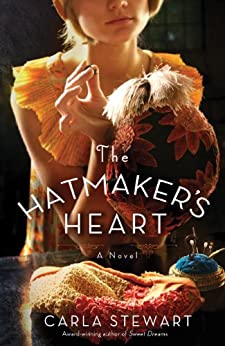
The Hatmaker’s Heart

In The Hatmaker’s Heart by Carla Stewart, Nell Marchwold is an apprentice designer at Oscar Fields Millinery in 1920 New York City. Nell loves to make hats that frame a woman’s face and bring out her best features.

But Nell speaks with a lisp when she’s flustered, so Mr. Fields has kept her in the background—until one of his best clients falls in love with Nell’s designs. The prestigious Mrs. Benchley wants to commission Nell to make hats for herself and her two daughters for an upcoming event.

Then another well-known designer wants to use Nell’s talents for a show he is putting together.

Mr. Fields allows Nell to work on these other projects, but under the auspices of his shop. He’s two-faced, promoting her in public but treating her like dirt in private.

When Nell and Mr. Fields have an opportunity to go to London, Nell seeks a chance to visit her grandmother and a childhood friend, Quentin. Nell realizes she loves Quentin, but he seems to have moved on. And Mr. Fields is not giving her much time to spend with other people.

It’s hard to imagine that Nell just keeps taking what Mr. Fields is dishing out. But then, she’s young and naive. A big part of her character development is becoming her own person, deciding what she truly wants, and developing the backbone to stand up for it. Nell’s grandmother’s counsel reminds her to seek the Lord and walk with Him.

The book’s setting was interesting with the details about hatmaking. I had done just a tiny bit of that when working for a florist friend part time years ago, but we mostly just decorated hat forms. We didn’t make them from scratch like they did in the 1920s. And I never would have suspected that hat designs could be such a cutthroat business. But I guess they were a big enough fashion item in the day for designers to compete for their sales and designs.

A friend recommended a counselor to Nell to deal with her stammer. I wondered if his methods were true to the times–concluding that the stammer was related to a childhood trauma, having Nell remember specific incidents and draw pictures of them.

Quentin didn’t seem terribly well developed as a character. Since he and Nell were apart for most of the book, we really didn’t get a feel for any chemistry between them. Plus he seemed to have abrupt changes of heart in a couple of places.

So, I have mixed responses to the book. But overall it’s a good story.

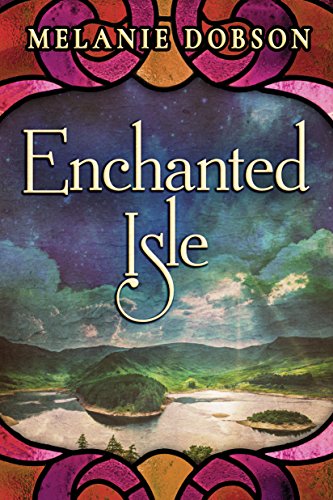
Enchanted Isle

In Enchanted Isle by Melanie Dobson, it’s 1958 and Jenny Winter doesn’t know what to do with herself. She dropped out of college because she wasn’t doing well in any subject. Her grandfather has someone from his company lined up for her to marry, but Jenny’s not sure that’s what she wants.

Her mother encourages Jenny to go to the Lake District in England for a couple of months. Jenny’s mom, Liz, had visited the area some twenty years earlier and had a friend who would be willing to let Jenny stay with her.

So Jenny flew to Lakeland. Though she wasn’t academic, she saw life through pictures and had a vivid imagination, Her mom had purchased a camera for Jenny’s upcoming 21st birthday, and Jenny is eager to try it out on the beautiful lakes and fells.

One place Jenny especially wants to visit is a theme park called the Enchanted Isle. Liz thinks it’s probably closed now, but Jenny wants to try to get in, just to see it and take pictures.

She finds that the park was indeed closed down, but not due to its age. An unsolved murder occurred there twenty years earlier. And the nice young man she just met, Adrian, has had a shadow hanging over his family because of it. His father had built the park with his business partner. But the business partner disappeared, and everyone thinks Adrian’s father killed him.

Jenny’s mother’s friend warns Jenny to stay away from Adrian, not only for his family’s history but for his own mistakes. But as Jenny gets to know him, she thinks he has been misjudged.

As Jenny uncovers the theme park’s history, she and Adrian discover that not everyone wants the park’s secrets revealed. And Jenny finds that even her mother didn’t tell her everything about her visit to Lakeland.

Another book I read recently mention the Lake District, so it was fun to find out more about the area.

The faith element of the story was natural and not preachy.

This was a sweet story, despite the murder mystery part of it. That part was handled well and with suspense. But I liked even better the themes of finding your own place in the world despite others’ expectations and not judging others, but getting to know their story.

Always, Only Good: A Journey of Faith Through Mental Illness

Ron and Shelly Hamilton’s oldest son, Jonathan, began experiencing strange symptoms after taking a medicine prescribed by a dermatologist for acne. Shelly called the doctor’s office to ask about the medication, but the nurse said the medication was not responsible for Jonathan’s symptoms. When Shelly took Jonathan back in to see the dermatologist and explained how Jonathan was acting, the doctor told her to take Jonathan off the medication immediately. He said it would take a couple of weeks for the medicine to get out of Jonathan’s system, and then he would return to normal.

But Jonathan did not return to normal. He began a downward spiral of mental illness which was eventually diagnosed as schizophrenia. After fifteen years with his illness, Jonathan took his own life on Mother’s Day.

Shelly wrote Always, Only Good: A Journey of Faith Through Mental Illness for several reasons. She wanted to share her son’s story, give an idea what life is like for someone suffering from mental illness, and encourage those with mental illness and their caregivers that they are not alone and there is hope. She also wanted to help remove the stigma of mental illness, especially among Christians, so sufferers would feel more freedom to get help.

Sadly, many well-meaning people feel that mental illness is a only spiritual problem.One friend’s college professor called psychiatrists “quacks” and belittled taking drugs for mental problems.

Shelly differentiates between “the brain, which is an organ, and the mind, consisting of spirit, will, and emotions” (p. 207). Like any other organ, the brain can have physical problems which then affect the mind and body. A person with a mental illness can’t just “reason his way back” to right thinking.

Unfortunately, it can take a doctors a lot of tries to find the right medications or combination of medications which help each individual. And sometimes it takes weeks of trying medications to see if they work. Then, many have unpleasant side effects. When they are thinking right, most patients agree that being able to function is worth the side effects. But then many go through a cycle of becoming stable, thinking they don’t need their medicines any more, stopping them, feeling great for a couple of weeks until the medicine gets out of their system, and then crashing.

The title Always, Only Good comes from two sources.One was Shelly’s struggle at the beginning of Jonathan’s illness with how a good God could allow someone who loved Him and wanted to serve Him to have such an illness. Through struggle, counsel, and Bible study, she reaffirmed her belief that God is always, only good.

The other inspiration for the title was a song written to the last music Jonathan composed. Shelly gave the music and some verses and thoughts to Chris Anderson (pastor and author of “His Robes for Mine,” “My Jesus Fair,” and other hymns at Church Works Media). Chris put together this beautiful song as a testimony of Jonathan’s life. Here it is sung by Shelly, her youngest son, Jason, her daughter Tara and son-in-law Ben Farrell, and her daughter Megan and son-in-law Adam Morgan.

Shelly shares about her book here:

My family and I have listened to the Hamilton’s Majesty Music and Patch the Pirate recordings for decades. I knew some of the family’s story, particularly Ron’s testimony of trusting God through losing his eye to cancer. I didn’t know Jonathan’s troubles until his suicide. I am grateful Shelly was willing to be transparent in order to help and give hope to others. This book is a good resource for those suffering from mental illness and their families and those who want to be a help to them. It’s also a testimony of faith, of God’s grace and help through the hardest circumstances.

(I often link up with some of these bloggers.)

A Lady Unrivaled

In A Lady Unrivaled by Roseanna M. White, Lady Ella Myerston is quick to laugh and always sees the bright side of life. But danger has come to her brother and sister-in-law and their friends. Ella is determined to help, even as the others want to shelter her and keep her from danger.

Lord Cayton, the cousin of one of the Myerston’s friends, had been a cad in his youth. He had led one woman on but then married another for her fortune. Then his wife died in childbirth, leaving him with a beloved baby daughter, Addie. Regret over his past and a desire to do the best for his daughter lead him to Bible study with his cousin, Lord Stafford. Cayton becomes a changed man, but he has trouble convincing everyone except Stafford. And he doesn’t trust himself, doesn’t feel he deserves another chance at love after breaking the hearts of two women.

Now some past associates have come back to lure him into their scheme–the very scheme that threatens Ella’s family, and now her.

The merry Lady Ella and the moody Lord Cayton become unlikely allies in the effort to remove this threat once and for all. They are surprised both by unsuspected betrayals and unforeseen friendships.

In a secondary plot line, Kira Belova is a “kept woman,” a Russian ballerina who became the mistress of a wealthy mogul, Andrei Varennikov. She feels secure, until Andrei announces his plans to marry a princess. He sends Kira to England in disguise as a maid to get information about some missing diamonds. She and her mistress end up guests in Cayton’s home. Kira begins to question her life and choices and must decide whom to trust and whom to help.

This book is the third and last of the Ladies of the Manor series. The author deftly combines suspense, intrigue, humor, faith, and sweetness. This book was a satisfying end to the series and a reminder that we all need to receive and extend grace.

Essentialism: The Disciplined Pursuit of Less

Normally I wouldn’t have looked twice at a book like Essentialism: The Disciplined Pursuit of Less by Greg McKeown. I’ve read a number of books on time management, achieving goals, etc., so I wasn’t looking for one more.

But I listened to an interview with the author as part of one writer’s group’s attempts to draw in new members. And though I decided not to join the writer’s group, I appreciated much that Greg had to say.

These days, we’re all beset by having more opportunities and responsibilities than we can keep up with. Plus other people can pile their agendas on to us. We spend much of our time “busy but not productive.”

The way of the Essentialist means living by design, not by default. Instead of making choices reactively, the Essentialist deliberately distinguishes the vital few from the trivial many, eliminates the nonessentials, and then removes obstacles so the essential things have clear, smooth passage. In other words, Essentialism is a disciplined, systematic approach for determining where our highest point of contribution lies, then making execution of those things almost effortless (p. 7).

Lest that sound cold and heartless, one of our essentials is our loved ones. One of the catalysts to McKeown’s journey towards essentialism was when he was pressured to be at a meeting with a client just hours after his daughter was born. He was told the client would respect him for his sacrifice of being there. But the client didn’t, and the meeting in the end turned out to be pretty worthless.

Trade-offs are going to happen as we learn we can’t do everything. It’s better to decide ahead of time what’s really most important and spend our energy there, even when that means saying no to other things, even good things.

Part 1 of McKeown’s book focuses on essence: to do what’s essential, we first have to figure out what’s essential according to our goals and values. We have to determine what’s non-negotiable and what’s a trade-off.

Part 2 is Explore: the “perks of being unavailable,” the necessity of sleep and even play.

Part 3 is Eliminate: to say yes to some things, we have to say no to others. Part 3 explores principles and methods for eliminating the nonessential.

Part 4 is Execute: protecting our essential goals by implementing buffer zones, starting small and celebrating small wins, the helpfulness of routines to eliminate unnecessary decisions, flow and focus.

Sprinkled throughout the book are simple but very effective illustrations. This one, for example, shows “the unfulfilling experience of making a millimeter of progress in a million directions” vs. “investing in fewer things” to “have the satisfying experience of making significant progress in the things that matter most” (pp. 6-7).

Here are a few of the other quotes that stood out to me:

For capable people who are already working hard, are there limits to the value of hard work? Is there a point at which doing more does not produce more? Is there a point at which doing less (but thinking more) will actually produce better outcomes? (p. 42).

We need to be as strategic with ourselves as we are with our careers and our businesses. We need to pace ourselves, nurture ourselves, and give ourselves fuel to explore, thrive, and perform (p. 94).

An essential intent, on the other hand, is both inspirational and concrete, both meaningful and measurable. Done right, an essential intent is one decision that settles one thousand later decisions. It’s like deciding you’re going to become a doctor instead of a lawyer. One strategic choice eliminates a universe of other options and maps a course for the next five, ten, or even twenty years of your life. Once the big decision is made, all subsequent decisions come into better focus (p. 126).

The way of the Essentialist isn’t just about success; it’s about living a life of meaning and purpose. When we look back on our careers and our lives, would we rather see a long laundry list of “accomplishments” that don’t really matter or just a few major accomplishments that have real meaning and significance? (p. 230).

McKeown includes multiple examples from businesses and institutions. Just about the time I wished he brought some of his illustrations and principles down to a person level, he did.

One problem that he didn’t discuss, though, is when you can’t say no to obligations that seem meaningless. He says several times that saying no to the unnecessary meeting or obligation actually garners respect instead of resentment. But that’s not always the case. And you can’t always say no if your boss requires something that you think is a waste of time.

And you have to be careful that your time-savers don’t become an imposition on someone else. For instance, he mentions someone who skipped a regular hour-long meeting at work to get his own work done, then got a ten-minute summary from a coworker, thus saving himself forty minutes. But he doesn’t note that this guy was putting an unnecessary drain on his coworker’s time. If I had been the coworker, I would have been tempted to say, “If you want to know what happens at the meetings, you need to be there. I have too much to do to recap them for you every week.”

But those instances are minor. Most of what the author had to say was very good.

This isn’t a Christian book, and the author recommends a wide range of resources that I wouldn’t always agree with.

But overall, McKeown gave me much to chew on.

The Reluctant Duchess

The Reluctant Duchess is the second in Roseanna M. White’s Ladies of the Manor series.

Brice Myerston, the duke of Nottingham, was a side character in the series’ first book, The Lost Heiress. He was one of England’s most sought-after eligible bachelors, which he handled by being a notorious flirt to fend off serious advances from young ladies and their mothers. But he also had a close walk with God and uncanny sense of the right thing to do.

He finds himself in a knotty dilemma, though. His family has made their annual visit to Scotland to visit his mother’s family home not long after the death of his father. There, the Scottish laird, who has no use for Englishmen and has avoided the Myerstons all this time, asks the family to dinner. While there, the earl of Lochaber tries to set a trap for Brice to wed the earl’s daughter, Rowena. Brice steadfastly refuses at first. But then he realizes this is no title-seeking or money-grubbing ploy. Rowena is in serious trouble. Brice feels the Lord’s direction to protect her, and the only way to do that seems to be to marry her and take her back to England.

Rowena’s father has become harsh and distant since the death of her mother. Her fiance, Malcolm Kinnaird, seemed loving and kind at first. But his true colors came out when he forced himself on Rowena and became as controlling and as harsh as her father. Rowena hates that her father has set a trap for Brice, but she accepts his offer as the only way to escape.

But Rowena trembles at the thought of being a duchess in English society. And her fears come true when no one accepts her except Brice’s family and two of his closest friends. Rowena has been beaten down mentally and physically and has no confidence. She recoils from Brice physically and emotionally.

In addition to trying to discern how to help his new wife, Brice has another problem on his hands. He had offered to take and hide the rare treasure that had caused his friends, the Staffords, so much trouble (in the first book). But, though the main troublemaker had been killed, other dangerous pursuers are not giving up. And one of them is trying to entice Rowena into a false friendship.

This book had a bit of a rough start for me, with Rowena facing off against Malcolm, the knowledge that He had abused her, and a lot of yelling. In The Lost Heiress, even the villains had an air of gentility. In this book, even the Scottish nobility were quite rough around the edges.

But once I got into the story, I enjoyed it. Brice and Rowena had much to learn to trust each other, and each made many mistakes along the way.

The whole hidden treasures story line was as intriguing as any suspense novel. Besides the enemies Brice knows of, he discovers new unseen ones.

I think this could be read as a stand-alone story, but it’s a much richer experience to read both of them.

I listened to the audiobook, wonderfully read by Liz Pearce. I thought she did a great job with the different accents, which added a lot to the story.

As always, Roseanna did not write a fluff piece with this novel. She leads her characters to an understanding of their need and God’s abundant grace in an organic and not a preachy way.

Jesus Led Me All the Way

I’ve mentioned before that Margaret Stringer is one of my favorite people. She was a missionary in Indonesia for forty years among former headhunters and cannibals. Though she had a variety of ministries among the people, one of her main jobs was reducing their language to writing, translating the New Testament into their language, and then teaching the people how to read.

The church we attended in SC supported Margaret. When she “retired,” she lived close enough to the church that she was available to come speak to the ladies’ group several times. She could have us laughing til we were in tears telling us about incidents that would have been quite scary when they happened to her.

Jesus Led Me All the Way is her second book about her time in Indonesia, the first being From Cannibalism to Christianity.

Margaret tells how from a very early age, she was sure God had called her to be a missionary. She had a hard time getting the first visa she needed, and it seemed like everyone brought up to her how Paul wanted to go to Macedonia in Acts, but God wouldn’t let him. Margaret wanted God’s will, whether that was Indonesia or somewhere else. But the delays and obstacles just made her more sure that Indonesia was where God wanted her. Later on the field, she was grateful for the hard time she had getting there because of the assurance it gave her that she was in God’s will.

She tells of her arrival on the field, early missionary life, learning the customs and language, getting adjusted to jungle food (like grub worms). She talks about how important it is to understand the world view of the people you’re trying to witness to.

It took a lot of patience to teach people who had not been taught before or hire helpers to learn the language when they had not had paying jobs before. If they wanted to go fishing instead of come to “work,” they did.

One chapter is on “People I Can’t Forget,” most of whom became part of the church there. It took much time and patience and prayer and overcoming many mistakes, but what a joy to see God open people’s eyes to His truth at last.

Margaret includes here one of my favorites of her stories. Once she was in an area where no house or huts were available, so she stayed in a small metal building with open windows (screens but no glass). Once when a terrible storm hit, rain blew in, destroying about 90% of her handwritten translation work. As she tried to salvage what she could and mop up the rest, she felt discouraged. She “fussed” with the Lord about dropping her down in the jungle and leaving her all alone. When she went to bed, something fell off the wall and hit her on the head. She felt like that was the last straw. She turned on her flashlight to see what had fallen. It was a plaque that said, “He cares for you.” She started laughing and said, “OK, Lord, I get it. Thank you.” She comments, “For some people, God speaks in a still small voice. Others of us, however, He conks on the head” (p. 125).

Margaret tells of difficulties in the translation work. She had to consider not just getting the words into Citak, but making them understood in their culture. For instance, they did not have a word for sister or brother—their words were older sister, younger sister, older brother, younger brother. That took some thought when dealing with Mary, Martha, and Lazarus. All of their verbs incorporated time of day, so that had to be considered when translating narratives. The suffix “na” at the end of a sentence indicated the information was heard from someone else rather than witnessed directly. In Luke 11:11, when Jesus asks whether a father would give a serpent to his child when asked for a fish, they said, “Of course.” “The Citak people love to eat snake, and a good-sized python has much more meat on it than the average fish, so who wouldn’t want a snake instead of a fish?” (p. 205). they had to find a different word for a poisonous snake that conveyed the idea of the passage, that “no good father would give his son a poisonous snake when he asked for a fish.”

The Citak people had a big celebration day with invited guests, including dignitaries, when they handed out the completed New Testaments. One of Margaret’s greatest joys was seeing the Citak people’s joy at having the Word of God for themselves and their ability to read and understand it. But one of her greatest sorrows was when people from other villages with different dialects wanted the Bible in their language, too. She knew that it would take more time than she had left on the field to translate the NT for all the people there that needed it.

Margaret writes that the people “went from naked cannibals, without the Bible or ability to read, to 23 churches, and having the New Testament in their language. The journey was sometimes funny, sometimes frustrating, sometimes discouraging, sometimes dangerous, but always rewarding” (p. xvii). I’m thankful she shared glimpses of that journey with us.

The Lost Heiress

In The Lost Heiress by Roseanna M. White, set in the Edwardian era, Brook Eden grew up as the ward of Prince Grimaldi in Monaco. But the circumstances of her real family are a mystery. When Brook was a young child, she and her mother were in a carriage accident. An opera singer came to their aid, and Brook’s mother asked the woman to take Brook, a packet of letters, and her necklace before she died.

Brook friend, Justin, thinks he has discovered her real family and makes the arrangement for Brook to meet them in Yorkshire, England. Brook’s father, Lord Whitby, and his sister know right away Brook is his lost daughter. It takes the rest of the family and the servants longer to accept her.

This happened fairly early in the story, leaving me to wonder where the conflict was going to come into the plot.

Well, there’s plenty of conflict. A distant cousin, Lord Pratt, is a predator who sets his sights on Brook as the heiress of the Whitby estate. He bribes a servant to spy on Brook and bring him information. Justin’s father dies, leaving him as the new Duke of Stafford. His responsibilities necessitate his traveling to his family’s holdings in other countries, leaving Brook vulnerable to Pratt’s machinations. Justin begins to feel more for Brook than friendship but doesn’t want to seem like he is only interested now that she is an heiress. He decides to wait. But when he returns, he and Brook clash instead of resuming their easy friendship. Unbeknownst to either of them, someone has been preventing their letters from reaching each other. Other suitors appear to have made inroads into Brook’s affections. And no one realizes the danger Brook is in from a possession she doesn’t even know she has until a near-fatal attack and a stunning betrayal opens their eyes.

Several of the main characters are Christians and learn to deal with broken dreams, new and uncomfortable circumstances, trust in God when He doesn’t seem to be near, and finding forgiveness.

In the author’s notes, Roseanna said she wrote the first version of this story when she was twelve, finishing it at thirteen! After nineteen years, nine books, and many rewrites, it was finally published as the first in the Ladies of the Manor series.

A story about a lost heiress finding her true home might seem like a fluff read. But I have found no fluff in Roseanna’s books. She brings so much depth into her characters’ personalities and struggle. I enjoyed this book very much and have already started the sequel.

Daily Light on the Daily Path

When I mentioned Daily Light on the Daily Path in my post about pursuing the fruit of the Spirit, my friend Susan commented that she wasn’t familiar with the book. Since that might be the case for others as well, I thought I’d take the opportunity to share about it.

I first heard about Daily Light in missionary biographies, particular Amy Carmichael’s and Isobel Kuhn’s. I don’t remember if I assumed it was an older, out of print book: I don’t recall seeking it out. But one day when a home school conference was held nearby, I visited their sales area. I found a 1906 copy of Daily Light on sale for $2. So I grabbed it! They must have printed a lot that year, because I have worn out two versions from that year and am on my third (the latter two found online).

I found that Daily Light is a devotional book made up entirely of Scripture readings for every day. They were compiled by Jonathan Bagster of Bagster and Sons Publishing Firm for his own family’s devotions. His son later published the readings as a devotional book.

Most of the Scripture selections for the day follow a theme, like the one from September 1 about meekness.

Others follow a progression of thought, like this one.

One of my favorites from April 10 pairs verses together like this:

Behold, I was shapen in iniquity; and in sin did my mother conceive me.—Thy renown
went forth among the heathen for thy beauty: for it was perfect through my comeliness,
which I had put upon thee, saith the Lord God.
I am a sinful man, O Lord.—Behold, thou art fair, my love; behold, thou art fair.
I abhor myself, and repent in dust and ashes.—Thou art all fair, my love; there is no
spot in thee.
When I would do good, evil is present with me.—Be of good cheer; thy sins be forgiven
thee.
I know that in me (that is, in my flesh) dwelleth no good thing—Ye are complete in
him.—Perfect in Christ Jesus.
Ye are washed, . . . ye are sanctified, . . . ye are justified in the name of the Lord Jesus,
and by the Spirit of our God.—That ye should shew forth the praises of him who hath called
you out of darkness into his marvellous light.
Psa. 51:5. -Ezek. 16:14.Luke 5:8. -Song 4:1.Job 42:6. -Song 4:7.Rom. 7:21. -Matt. 9:2.Rom. 7:18. -Col. 2:10. -Col. 1:28.I Cor. 6:11. -I Pet. 2:9.

We used the book for family devotions for a while, but my husband didn’t like reading verses grouped together out of context. Though I do prefer reading through the Bible a book at a time in order to get everything in context, these selections seem to have been combined prayerfully and carefully.

Many days these readings were just what I needed for the day. One of the most memorable times was when I was in the hospital with transverse myelitis and scheduled for an MRI. Every nurse and aide who came into my room asked me if I was claustrophobic. I wasn’t sure—I’d never been in a situations when I felt claustrophobic before. They described the close quarters of the MRI machine and the need to be perfectly still. They could give medication for calmness for the procedure, but it would have to be done ahead of time. I opted not to take the medicine. The morning of my MRI, September 4, the day’s selection from Daily Light contained several verses about being still, something that had been emphasized to me so much for the scan:

Ruth 3:18  Sit still, my daughter

             Isaiah 7:4 Take heed, and be quiet; fear not, neither be fainthearted.

             Psalm 46: 10   Be still, and know that I am God

   John 11:40 Said I not unto thee, that, if thou wouldest believe, thou shouldest see the glory of God?

   Isaiah 30:15 In returning and rest shall ye be saved; in quietness and in confidence shall be your strength

             Psalm 4:4 Commune with your own heart upon your bed, and be still

             Psalm 37:7 Rest in the LORD, and wait patiently for him

   Psalm 112:7-8 He shall not be afraid of evil tidings: his heart is fixed, trusting in the LORD. His heart is established

When they first put me in the MRI machine, I did feel panicky. But God kept bringing these verses to mind over and over, and they calmed and comforted me.

So every September 4 when I come across these verses, I am reminded of the Lord’s help that day.

Another time that stands out was when we were house-hunting as we prepared to move from SC to GA in the late 90s. The reading for March 6 included these verses:

The Lord your God . . . went in the way before you, to search you out a place to pitch your tents in, in fire by night, to shew you by what way ye should go, and in a cloud by day. -Deut. 32:11,12.
—As an eagle stirreth up her nest, fluttereth over her young, spreadeth abroad her wings, taketh them, beareth them on her wings: so the Lord alone did lead him. Psa. 37:23,24.
—The steps of a
good man are ordered by the Lord: and he delighteth in his way. Though he fall, he shall not be utterly cast down: for the Lord upholdeth him with his hand. Psa. 34:19.

When I read the first verse to my husband, he said, “Does that mean we’re going to live in a tent? Thankfully, no. 🙂

The 1906 version has a section at the back titled “Thoughts for Personal and Domestic Exigencies” (love that title!) It has a page of Scripture readings for thanksgiving, birthdays, marriage, sickness, anxiety, affliction, and bereavement. My 1999 version doesn’t have this section, unfortunately.

I’ve read Daily Light for about 30 years now. I like to read it to begin my devotional time, to get my mind and heart in gear. But some days, like when we’re traveling, or when I have an early medical appointment, or on Sundays, DL may be all I read for devotions that day.

I didn’t know there were evening readings until I ordered a more modern version. I don’t know if they were added later or if originally the morning and evening readings were published separately.

The original versions use the KJV, but you can find DL in several other Bible versions now. It is also online several places, including Crosswalk (if you don’t mind their ads) and Christian Classics Ethereal Library. This site will send the day’s readings from the NIV via email.

So that’s my long history with Daily Light on the Daily Path. Had you heard of it? Have you read it?

To Treasure an Heiress

In Roseanna M. White’s novel, To Treasure an Heiress, Beth Tremayne loved exploration and adventure. She lived in the Isles of Scilly in the early 1900s and traveled to all of them in her sloop. She found some old letters and a map in her grandfather’s house that indicated a legendary pirate king had lived on her island, Tresco, and had left a fortune somewhere in the vicinity. That was fuel to Beth’s adventure-loving heart.

Beth had a trinket box, given to her by her mother, which had King Rupert’s seal on the top. Beth sent the box to the father of her friend at finishing school who was an expert in antiquities. Her friend’s father, Lord Scofield, authenticated the box—but then sold it! Worse yet, both Lord Scofield and his buyer, Lord Sheridan, were intrigued by the thought that more items connected to King Rupert might be on the islands. Scofield was interested mainly in the purported treasure, but Sheridan was a descendant of Rupert and interested in artifacts.

Worst of all, Sheridan had actually come to Tresco. Beth’s efforts to shield her family from the repercussions of her search had failed miserably. Her grandmother urged her to forgive and to work together with the family, and even Sheridan, to find Rupert’s treasure. But Scofield is looking as well and isn’t above using less than honorable means.

A secondary story line involves Beth’s former governess, Senara, who had been dismissed from her most recent job due to indiscretions. Senara had fallen in love with a man who had misled her, and now she feels tarnished and ashamed. A new friend helps her see that with God’s forgiveness, she can be forgiven and made new.

He makes us with great worth. Creates us that way intrinsically. Our sins, our bad choices, perhaps they coat us like mud. But the mud cannot take away the value He instilled in us. Mud does not make a pearl any less valuable. If it did, they why would Jesus have deemed us worthy of the sacrifice of His life? Because He loves us, as does the Father. Because we are valuable. And the blood of Christ, when it washes us clean, fully restores us to what He created us to be. A pearl cannot be stained. No matter how many centuries it sits in mud, wash it in a bit of water and it’s gleaming again.

This book is a sequel to The Nature of a Lady, which I enjoyed last year. I think this book could be read alone, but it’s richer together with the first. I normally wouldn’t be attracted to a book about chasing pirate treasure, but I have loved everything I have read of Roseanna’s. She manages to bring out deeper levels of meaning for her characters. Parts of the story are touching and sweet; some are even funny.

I didn’t like Lord Sheridan at all in the first book, and when this one hinted at a romance between him and Beth, I didn’t think it would work. But he grew on me in this story.

I found the resolution just a bit anti-climactic. But all in all, I found this a lovely story.

I listened to the audiobook, nicely read by Liz Pearce.