In Home to Chicory Lane by Deborah Raney, Audrey and Grant Whitman decide to turn their empty nest into a bed and breakfast in Missouri. They’ve sunk a good bit of their resources into it, hoping to make some back, and Grant has retired from his stressful job to help operate the inn. After decorating and getting everything ready, friends and family come in for the grand opening. But someone totally unexpected shows up right in the midst of the big day: their daughter Landyn, a newlywed living in NY with her husband, unannounced, alone, and with a UHaul.
Trying to get to the bottom of what’s going on with Landyn, trying to figure out how best to help, while still staying on top of things for the inn makes for a stressful time.
Landyn made me want to shake her by the shoulders at first. But I enjoyed seeing how she and her husband, Chase, finally came together and tried to work out their issues through very plot twists and turns.
I identified most with the parents: it’s hard to know sometimes with adult children when to advise, when to help, and when to step back and let them figure it out and grow on their own.
Overall it was a very enjoyable book. The one spot I didn’t like was when the young couple came together after a long separation. It’s not as graphic as Song of Solomon or Proverbs 5:19, but I would rather the scene had stopped a few paragraphs earlier.
It did convince me definitely that one thing I never want to do is open a bed and breakfast. 🙂
This is the first of three in a series called Chicory Inn novels, and I’m looking forward to getting to know more of the Whitman’s large family.
Genre: Christian fiction My rating: 9 out of 10 Potential objectionable elements: The scene mentioned. Recommendation: Yes.
In Every Waking Moment by Chris Fabry, Devin Hillis is a filmmaker with vision but no cash. He wants to make a documentary of the stories of people in the Desert Gardens assisted-living facility. He tries to support himself in the meantime by making shorter memorials for funerals, but that’s not paying the bills, and both his partner and his landlord are on his case.
His time in Desert Gardens brings to his attention an employee there named Treha Langsam. At first she looks like perhaps she is developmentally delayed somehow, but she is very intelligent. She has nystagmus, a condition which causes her eyes to be almost constantly moving, and when she’s agitated she makes a typing motion with her hands, but otherwise she seems emotionless. She grew up in various foster homes and has little to no memory of her history. But she seems to have a gift: she is able to bring out residents who have been closed off and uncommunicative to where they are speaking clearly. She was hired for janitorial services, but when the facility supervisor, Miriam Howard, saw her work with the residents, she let her have free reign to interact with them. Devin thinks Treha may be the story he’s looking for.
But Miriam is about to retire, and the new supervisor is more concerned about her own rules and regulations than care of the residents. She has her eye on Treha, threatening to fire her if she does anything other than clean.
What will happen to Treha and the residents if she loses her job, and will Devin and Miriam be able to solve the mystery of Treha’s background, not just for the documentary, but for her future?
I got this book right on the heels of finishing Not in the Heart by Chris Fabry because I loved his writing so much and wanted to read more. I was looking at that book on Amazon when a link to this book with these words from Chris intrigued me:
What if this is as good as life gets? Are you okay with that?
This question has haunted me over the past few years. Several years ago we moved to the desert for health reasons. Looking for recovery in a dry and thirsty land. And I realized my soul was more thirsty than anything.
Every Waking Moment is my effort to take some of the pain and loss of life and sift it through the life of a young woman who’s been marginalized in society, working among people who are marginalized (the elderly). This character, Treha, has an extraordinary gift that few observe because she’s “different.”
Like most of my tales, it’s a love story, a mystery, part thriller–but mostly a character sketch of lonely people looking for hope. And it’s my intent that you find hope and meaning for your own life through Treha’s journey.
That theme of “What if this is as good as it gets” comes up for several characters throughout the book. Poking around Chris’s web site, I saw that this novel arose in part because of his family’s experience with toxic mold and the detrimental effects it has had on his family’s health. That is not what caused Treha’s problems, but he draws parallels from the experience.
Not in the Heart was fast-paced and suspenseful. Every Waking Moment is a different kind of book. It has moments of suspense, and of course there is the mystery of Treha’s history and what made her the way she is. But overall the book has a different pace and feel to it. But it is still quite good.
The daughter didn’t realize that this was part of the problem. The same tasks that wore her mother down were the tasks that gave her structure and stability. Worth. When she could no longer do them and others were paid to accomplish things she had done as long as she could remember, life became a calendar of guilt–every day lived as a spectator, watching others do what she couldn’t.
Deciding what Mother would like or wouldn’t like was a seesaw between two relatives who were guessing. Love looked like this and worse and was accompanied by a mute, white-haired shell.
“I want that person you knew to return. But the truth is, this may be the best we achieve. Today, having her here and comfortable and not agitated…that may be as good as we get. Are you okay with that?”
“Your love for your mother is not conditional on her response. You love her for who she is. You don’t love her because of the things she can do for you.”
“The medical community views individuals as patients to be cured. But when people age, they’re not looking for a cure as much as they are for encouragement to continue. Our work here is not about curing. It’s about the dignity of each person…”
“Value people not just for the income they provide us. Value them because of the lives they’ve lived. Value each person who pushes a broom or cleans a bedpan. And value the girl whose life is marred, yes, but who gives these people more than a doctor ever will.”
“Growing older is not much fun. It’s the slowing down that gets to you. Elsie calls it ‘vigor mortis.’ You just can’t do what you used to.”
“Old age teaches you in a very unkind way that things won’t necessarily get better. Not in this life. In fact, you can pretty much count on things degenerating. Being content is not a lack of ambition. It’s being able to rest and relax and know that your worth doesn’t come from what others think of you or even what you think of you.”
And one I loved just for the writing: “Retirement was bearing down on Miriam like a semitruck trying to make it through a yellow light.”
For those of you who like book trailers:
I enjoyed this book quite a lot and can heartily recommend it to you.
I had not read Tamera Alexander before, but I have seen her blog posts at Inspired By Life..and Fiction, where ten or so inspirational fiction writers post regularly. So when one of her books happened to come up on an Audible sale, I got it.
To Whisper Her Name is set in the historic Belle Meade plantation near Nashville, TN, just after the end of the Civil War. Though the war has ended, thoughts and feeling for the most part have not changed. Olivia Aberdeen’s husband, Charles, had been a cruel man who was found to be a cheat and a traitor to the South and was violently killed by a mob in Nashville. People assumed Olivia was in on his schemes, and though she is not harmed physically, she is looked down on in society. Her husband’s brother takes over all her husband’s assets and sends her away. She has no living family members left and nowhere to go until Elizabeth Harding, her mother’s closest friend, invites her to live with her family at Belle Meade. Elizabeth’s husband, William Giles Harding, had been a general during the war and owned a thoroughbred farm that, though suffering financially after the war, was holding its own.
The same day Olivia arrives at Belle Meade, a stranger does as well: Ridley Cooper wants to travel west to start a new life in the Colorado Territory. But before he goes, he wants to learn how to handle horses the way Belle Meade’s head hostler, Bob Green, does, so he travels to Belle Meade to seek a temporary job. What no one except Bob knows is that Ridley, though from South Carolina, had fought for the Union because he was against slavery. At that time in history, his life would likely have been forfeit in the South if anyone found out, so he tries to keep a low profile.
Olivia and Ridley happen to meet under untoward circumstances on their first day at Belle Meade, and at first she is only aggravated by him. But over time their circumstances keep pushing them together, and they find things to appreciate about each other as they each grow in character and faith.
I very much enjoyed the consideration of what life would have been like in the South just after the Civil War and how changes were beginning to be implemented, slowly and with resistance at first. I had not known when I first listened to the book that Belle Meade was a real place and the Hardings were real historical people. Unfortunately the audio book did not include any preface or afterward the author may have had in the print book. Living in the Knoxville area now, I also enjoyed the descriptions of East Tennessee.
Though in the end I enjoyed the story, I have to admit this book reinforced to me why I don’t usually read “romance novels,” even Christian ones. It is hard to find a novel without some romance in it, and I don’t mind that as long as it fits within the plot and the basic story is good. But I don’t often read stories where the romance is the main plot. I hadn’t realized there was a distinction between romance and women’s fiction until reading this post, but after reading it, a light bulb came on in my brain, and I realized that’s the difference, and that I am definitely more comfortable with women’s fiction in general. I do enjoy hearing how couples (even fictional ones) come to love each other, but in a romance novel, there seems to be an excess of emphasis on the physical – how they feel when they touch, accidentally or on purpose, how his breath smells and how warm it is, how muscular he is, his appreciation of her various physical assets, etc., etc. There wasn’t anything explicit in this book — though there may have been a couple of instances of suggestiveness, depending on how one read the scene — but there was just so much of the “mushy stuff.” I know to a certain extent that’s normal when people are falling in love, but still…not something I want to spend much time reading. At a number of places in the book, I felt like I probably would not read another Alexander book, but then towards the end I was enjoying the rest of the story so much that I thought I probably would. I especially like that her Belmont Mansion series is based on another historical home and personality, so I may give the first of those a try.
(Updated to add: I just found a page on Tamera’s web sitediscussing this series and am enjoying some of the videos there, one of them about the actual people in the book.)
(This review will also be linked to Semicolon‘s Saturday Review of Books.)
The Captive Maiden by Melanie Dickerson is a retelling of Cinderella set in Germany of the 1400s. Gisela’s father has died and her step-mother has taken over and treats Gisela like a servant. While Gisela submits when she has to, she is spirited and uncowed When a big tournament is held in town, Gisela sneaks away to see the games and unexpectedly runs into Valten, the duke’s son. They had met years ago when she was seven and he and his father had bought one of her father’s horses, and she has thought about him ever since.
Valten is the older brother of Gabe from The Fairest Beauty but quite different in personality. Where Gabe is glib-tongued, especially with the ladies, Valten never knows quite what to say and seems aloof. Valten excels at winning tournaments, particularly in jousting, but is beginning to think there has to be something else in life.
Valten also has an enemy in Ruexner, his main challenger in the tournaments. When Ruexner observes that Valten has an interest in Gisela, Ruexner sees her as a means of getting back at Valten. And of course Gisela’s step-mother hinders her attempts to pursue a relationship with Valten, so, to paraphrase Shakespeare, the course of their true love is not going to run smoothly. But I won’t spoil the details.
Along the way, Valten has to realize that he needs to rely on God’s strength rather that his own, and they both have to wrestle with the vengeance belonging to the Lord rather than being theirs to exact.
I didn’t think the writing in this story flowed quite as smoothly as in some of Melanie’s other books, and, although it is normal for couples to have some misunderstandings at first as they are getting to know each other and learning to read each other, the misunderstandings and misreadings here seemed excessive. But overall I did enjoy the story. I think anyone who likes fairy tale retellings and/or clean Christian romances would like this book.
(This review will also be linked to Semicolon‘s Saturday Review of Books.)
In A Promise Kept by Robin Lee Hatcher, Allison Kavanagh moves into her aunt’s cabin in the woods of Idaho after a divorce that she did not want, prayed against, and was certain that God would prevent. In fact, she had been fairly sure that God had impressed upon her that He would heal her marriage. Tony was an alcoholic and his drinking had grown more out of control until it threatened the safety of their family, particularly their daughter. Allison had issued an ultimatum – and Tony had left. Now Allison’s not certain whether she knows how to ascertain His voice and leading at all, and she feels like a failure as a wife and a Christian.
Allison discovers a hope chest with photos, her aunt’s journals, and a wedding dress. She decides to pass the long winter nights by organizing the photos and reading the journals. A number of photos of her single aunt show her in close company with a handsome young man when they were both in their twenties. Did Aunt Emma have a beau that no one had known about?
As Allison settles into small town life and her “new normal,” she begins to heal emotionally and spiritually. Getting to know a new friend and getting back into church and her Bible help along those lines. Thanks largely to her daughter, she has several encounters with Tony and notices apparent changes in him, but after the numerous cycles they went through in their marriage, she is wary of trusting that the changes are permanent. And then when she least expects it, God shows her that His way and timing of keeping His promises may be different from hers, but He does keep them.
This story was largely based on author Robin Lee Hatcher’s own life. It’s not an exact replication, and there are differences between the circumstances and personalities of all involved. Oddly, some of the points of the story that some have criticized as “fairy-taleish” are the most true parts. I appreciated Robin’s note to readers at the end with a bit of a window into her own story, and I am thankful she and her husband were willing to share their story with others.
I wanted to read this book because I enjoy Robin’s books, especially her contemporary stories; because her stories are usually set in Idaho, and my husband is from ID; and because my own father was an alcoholic. My own parents’ story was closer to Emma’s than Allison’s or Robin’s; their marriage was not healed, but I am thankful God did heal my father of his alcoholism and save him, also in a time and way totally unexpected but shining forth with His grace. And I am thankful for the reminder Allison’s mother gave to her that while “God hated divorce, He did not hate the divorced. God loved her and wanted His best for her. Her life was not over. God still had a purpose and a plan for her. All she had to do was trust Him.”
(This review will also be linked to Semicolon‘s Saturday Review of Books.)
I picked up The Girl in the Gatehouse by Julie Klassen when it was on sale for the Kindle because I had enjoyed a previous book by the author, The Maid of Fairbourne Hall. Unfortunately I did not enjoy this book as much.
Set in the Regency era, this is a story of Miss Mariah Aubrey, who, due to some kind of disgraceful indiscretion we’re not made privy to at first, is sent away from her family to stay on a widowed aunt’s estate. She has fallen so far that she is not even welcomed into her aunt’s home: she is sent to live in the estate’s gatehouse. Only her former nanny and companion, Dixon, is with her, and they set up housekeeping. To supplement their meager stores, Mariah secretly and anonymously writes romance novels.
When her aunt dies, her cousin rents the manor house out to a Captain Matthew Bryant, successfully returned from the Napoleanic wars. Byant’s main purpose in living is such a place is to try to win back a high-society maiden who had previously rejected him, even though she in engaged to another. He meets Mariah in the meantime and they strike up a friendship, he is aware that there is some kind of cloud over her reputation.
There are several Jane Austen nods and epigraphs throughout the book, which I enjoyed. The author’s afterword says Bryant was inspired by Captain Wentworth of Persuasion and Horatio Hornblower, but I don’t think he lived up to either, personally.
The theme of the story is a good one, that though there are consequences for sin, there is grace a forgiveness from God and should be from others as well. Mariah is well-advised late in the story that “God is far more forgiving than people are, or than we are to ourselves. Society may never forgive and certainly never lets anyone forget. But God will forgive you if you ask Him” and “None of us gets through life without a tangle or two. Accept His mercy and move forward.”
But the story is disjointed in places, has some odd and unlikely plot twists, and has too many coincidences (three people on the same estate who have secretly published novels under a pseudonym unbeknownst to each other?)
Worse than that to me are unneeded references to things like Mariah being distracted by how Bryant looks in a wet shirt when she comes upon him as he’s just fallen into a pond. Do women notice and get distracted by such? Sure. But elaborating on it is just not needed. I wouldn’t want to read of the male character’s thoughts and distractions if the situation had been reversed, so why would I want to read of hers, either? Mariah also writes of what caused her own disgrace in her novel, and while it would serve (as she meant it to) as a cautionary tale to readers, it went too far. Dixon’s editing of one offending phrase in Mariah’s novel seems like an acknowledgement of that by the author, so I don’t know why she felt she needed to include it in the first place. References like this are sprinkled throughout the book:
“…aware of the modest display of decollete her simple gown allowed” (an oxymoron. NO “decollete” is modest.)
When Bryant helped guide her foot into a stirrup: “Warm pleasure threaded up her leg at his touch, innocent and pragmatic though it was.”
“She grasped the chain and fished the key from [her bodice]…Matthew forced himself to avert his gaze.”
“Miss Aubrey put her hands on her hips, causing her billowy dress to cling to her curves.”
Not only are these kinds of things unneeded, but their inclusion makes the story cheap and tawdry. I don’t remember any of this kind of thing in the previous book I read by this author and I hope they are not characteristic of her. If you’ve read any of her other books, I’d love to know, because some of them look interesting but I am just not going to read any more if they follow his pattern.
So, all in all I am very disappointed in what could have been a great story. Reviews are mixed on Goodreads. Amazon reviews are mostly positive, at least the ones that I perused. Some loved it, some did not. I did not.
(This will also be linked to Semicolon‘s Saturday Review of Books.)
Betrayal by Robin Lee Hatcher is the second in her Where the Heart Lives series about three orphans who were separated and try to find each other as adults. Each book focuses on one of the siblings: the first book in the series, Belonging, reviewed here, featured older sister Felicia.
In Betrayal older brother Hugh Brennan has just been released from prison where he had served as a result of his father’s betrayal. He has heard that Felicia is in Idaho and sets out to find her, but then his horse is injured and he has to stop for a while. He comes across the ranch of Julia Grace who, though wary, offers him food, a place to stay, and a few days work while his horse heals. Hugh, of course keeps his background as private as possible.
Julia has secrets of her own. She was plunged into a marriage of convenience to escape a lifetime of shame, but her husband abused and belittled her. He has passed away, and her one security is the ranch he left her, which she steadfastly refuses to sell to her husband’s brother.
Can these two wounded souls ever come to trust each other with their futures as well as the secrets of their pasts?
I enjoyed the story and the journey Robin led Hugh and Julia through and the things they learned along the way about trust and true security.
(This will also be linked to Semicolon‘s Saturday Review of Books.)

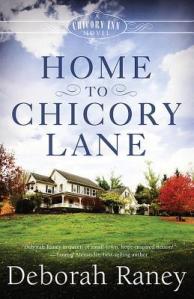 In Home to Chicory Lane by Deborah Raney, Audrey and Grant Whitman decide to turn their empty nest into a bed and breakfast in Missouri. They’ve sunk a good bit of their resources into it, hoping to make some back, and Grant has retired from his stressful job to help operate the inn. After decorating and getting everything ready, friends and family come in for the grand opening. But someone totally unexpected shows up right in the midst of the big day: their daughter Landyn, a newlywed living in NY with her husband, unannounced, alone, and with a UHaul.







 Stray Thoughts