
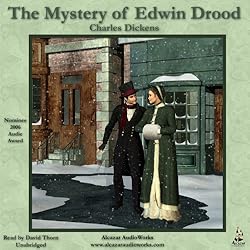
The Mystery of Edwin Drood was the last of Charles Dickens’ novels and only about half-finished when he died.
The story opens in an opium den as a man awakens from his drug-induced stupor, then goes to the cathedral, where he is the choirmaster.
A little later, this man, John Jasper, tells his nephew, Edwin Drood, that he takes opium for a physical condition. The reader is left unsure for a while whether Jasper is telling the truth or leading a double life.
Edwin is a young man engaged to Rosa Bud. They are both orphans, but their fathers were good friends and arranged their marriage. Edwin comments that the prearrangement “flattens” the excitement of their courtship. But he’s willing to go along with the plan. He and Rosa often end up arguing.
Twin siblings, Neville and Helena Landless, also newly orphaned, arrive from Ceylon with their guardian. Neville is to study with the minor canon, Rev. Crisparkle, while Helena will attends the nuns’ boarding school. She and Rosa, also a student there, become good friends.
Nevile has been mistreated by his stepfather and has a quick temper. He is secretly attracted to Rosa and can’t stand the way Edwin treats her. The two young men argue, goaded on by Jasper.
Crisparkle urges the two to settle their differences. The day after they do, Edwin disappears. Neville is immediately suspect, but there’s no proof of his guilt.
Dickens always has multiple threads and quirky characters woven into his plots. Mr. Durdles is a stonemason and undertaker. Jasper asks Durdles to take him on a nighttime tour of the crypts. “Deputy” is the nickname of a street child who throws rocks at people out at night but who also sees and hears much that goes on. Mr. Sapsea is a somewhat self-important auctioneer who later becomes the mayor. Dick Datchery comes into the story later, a man of independent means supposedly looking for a pleasant place to stay. A former sea captain, Mr. Tartar, arrives later, too, and ends up living next to where Neville is hiding out. At first I thought Tartar was spying on Neville for Jasper, but later I didn’t think so.
One of the most touching moments for me involved Mr. Grewgious, Rosa’s guardian. At first he comes across as a little silly and fussy. But later, as he remembers the women he silently loved, who died long ago, he wonders whether the man she married ever suspected him of having feelings for her. As he catches sight of himself in the mirror, he says “A likely someone, you, to come into anybody’s thoughts in such an aspect! There! There! There! Get to bed, poor man, and cease to jabber!” The narrator notes, “There are such unexplored romantic nooks in the unlikeliest men.”
Another favorite quote, said of Rev. Crisparkle: “He was simply and staunchly true to his duty alike in the large case and in the small. So all true souls ever are. So every true soul ever was, ever is, and ever will be. There is nothing little to the really great in spirit.”
I liked the turn of phrase that a bombastic man targeted another as “kind of human peg to hang his oratorical hat on.” Then, “the remainder of the party lapsed into a sort of gelatinous state, in which there was no flavour or solidity, and very little resistance.”
And this brought a smile: “The two shook hands with the greatest heartiness, and then went the wonderful length—for Englishmen—of laying their hands each on the other’s shoulders, and looking joyfully each into the other’s face.”
Wikipedia lists some of the theories about how Dickens intended to finish the novel. I feel pretty sure I know what happened to Edwin and why and by whom–the clues seem to point one direction. But it would have been fun to learn whether I was right and to see the plot unravel and the bad guy get his comeuppance.
I listened to the audiobook, narrated by David Thorn. He did a great job, except I had a little trouble understanding a few of the characters. I also got the Kindle version, which was free at the time, to go over the passages which weren’t clear to me.
Some years ago I set myself a mission to read all the Dickens novels I hadn’t read yet. Now I have read all of them except Barnaby Rudge, which, honestly, doesn’t sound very exciting. But I will still read it some day.
While Edwin Drood isn’t my favorite of Dickens’ novels–those would be A Tale of Two Cities and David Copperfield--I did enjoy it and got caught up in the mystery.
 Stray Thoughts