Book Review: Ella Enchanted

Ella EnchantedWhen I first heard of Ella being “cursed” with the gift of obedience by her fairy godmother, I was a little suspect. But I watched and enjoyed the film starring Anne Hathaway and Hugh Dancy. Then I discovered and just listened to the audiobook Ella Enchanted by Gail Carson Levine, and it is almost completely different from the film. I had really liked the film, but now that I’ve read the book, I’m really disappointed that the film veered so far from it.

The book Ella Enchanted is a clever retelling of Cinderella. When Ella is first born, her fairy godmother bestows what she feels is a wonderful gift: the gift of obedience. But the gift seems more of a curse, as Ella is at the mercy of anyone who gives her an order. And she still finds ways not to quite do what she has been told, or to add to it, and she confesses at one point that there is a difference between being obedient and being good.

She hides her “condition” well, until Dame Olga and her two daughters come into her life. The older daughter, Hattie, doesn’t know about the curse but does figure out quickly that Ella obeys direct orders, and Hattie uses that knowledge in multitudes of ways, especially when the girls are all sent to finishing school. Olive catches on soon as well, and Ella is at their mercy, until she runs away from school to try to find her fairy godmother to ask her to lift the curse, which she refuses to do. Then she discovers that her father is going to marry Dame Olga, and her doom is sealed.

Earlier in the book Ella had met Prince Char at her mother’s funeral. His attempts to comfort her began a friendship which grows until they are old enough to realize they love each other. Ella’s initial joy turns into sorrow, however, when she realizes that she can’t marry the prince while she is cursed: any enemy could use her against the prince to do him harm. So she refuses him, but can’t resist going to the balls thrown in his honor just to see him and be near him again.

This book has delightful fairy tale elements and characters – giants and ogres and elves and gnomes (even a baby gnome with a beard!) The glass slippers and pumpkin coach are there are well as a different kind of a fairy tale book.

Some see it as a feminist version of Cinderella, with strong characters who take action rather than sitting in a castle with no will of one’s own while waiting to be rescued by a prince. I do not know if that is the author’s intent. I am no feminist, and I would disagree that meekness equals passivity, but I think this can be enjoyed as a fun story as is without bringing political correctness or ideologies into it.

This was a nicely-written, lighter read after some of the heavier subject material I’ve been into lately.

(This will also be linked to Semicolon‘s Saturday Review of Books.)

Book Review: The Last Battle

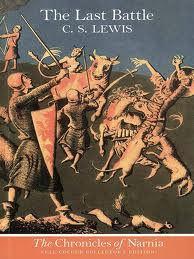
Last BattleThe Last Battle is the last book in the Narnia series by C. S. Lewis. It opens with a false Aslan: a confused donkey coerced to wear a lion skin by a conniving ape, who in turn is being controlled by others. In Aslan’s name, talking beasts are turned into slaves, dryads are dying because their trees are being cut down, Calormenes are overseers. Strange things are afoot, everything seems not quite right to everyone, but Aslan is not a tame lion, after all, so his ways will of course be a little different, and they think they must obey.

King Tirian sees at once that something is wrong, but he sets off rashly without thinking and winds up in trouble, He calls out for help, and Eustace and Jill show up. Together with the few Narnians who don’t believe in the false Aslan, they wage a last battle to save Narnia.

Even though the Narnia series is not an allegory per se, it’s still not hard to see the Biblical allusions to the end times and the antichrist. In Narnia as on Earth, things will get much, much worse before the end comes. And “Aslan’s country” has always typified heaven. All the beasts and creatures and people going “further up and further in” to Aslan’s country, the joyful reunions with those who have gone before, the sense that “this is what I have been seeking and waiting for my whole life” are the best parts of the books to me.

I think this time through the series, that is most what I have carried away with me: that longing, as in the song “Beulah Land”: “I’m kind of homesick for a country where I’ve never been before.” I have to admit that too often I am caught up with the joys and cares of this life. I look forward to having no more sin, sorrow, suffering, and tears some day, but I don’t always carry that personal longing just to be with Christ there, and this series as a whole stirs up that longing for Narnia and Aslan that all who visit experience while they’re away. It calls to mind Biblical texts like Hebrews 11:16: “But now they desire a better country, that is, an heavenly: wherefore God is not ashamed to be called their God: for he hath prepared for them a city,” and Colossians 3:1-2: “If ye then be risen with Christ, seek those things which are above, where Christ sitteth on the right hand of God. Set your affection on things above, not on things on the earth,” as well as Lewis’s own words from Mere Christianity: , “If I find in myself a desire which no experience in this world can satisfy, the most probable explanation is that I was made for another world…I must [therefore] keep alive in myself the desire for my true country, which I shall not find til after death.”

There is sadness for those who choose not to believe, such as the dwarves who are only for the dwarves and refuse to be “taken in.” As Aslan says, “They will not let us help them. They have chosen cunning instead of belief. Their prison is only in their own minds, yet they are in that prison, and so afraid of being taken in that they cannot be taken out.” Unfortunately there will be people like that as well.

There is a point of confusion with the Calormene Emeth, who served the Calormene god Tash, yet is admitted to Aslan’s country, not because Tash and Aslan are one, as some tried to proclaim (Aslan shook the earth with his growl at the very thought), but because Aslan took to himself everything Emeth had done for Tash. For, he says, “he and I are of such different kinds that no service which is vile can be done to me, and none which is not vile can be done to him. Therefore if any man swear by Tash and keep his oath for the oath’s sake, it is by me that he has truly sworn, though he knew it not, and it is I who reward him. And if any man do a cruelty in my name, then, though he says the name Aslan, it is Tash whom he serves and by Tash his deed is accepted…unless thy desire had been for me thou wouldst not have sought so long and so truly. For all find what they truly seek.” I don’t know how much of this reflects Lewis’s personal belief system, but I can’t endorse the idea that someone sincerely serving and seeking a false God is really serving the one true God unaware.

A couple of my favorite quotes:

“I have come home at last! This is my real country! I belong here. This is the land I have been looking for all my life, though I never knew it til now. The reason why we loved the old Narnia is that it sometimes looked a little like this.”

“Your father and mother and all of you are – as you used to call it in the Shadowlands – dead. The term is over: the holidays have begin. The dream is ended: this is the morning.”

It was only the beginning of the real story. All their life in this world and all their adventures in Narnia had only been the cover and title page: now, at last they were beginning Chapter One of the Great Story which no one on earth has read, which goes on forever.”

I have to thank Carrie for sponsoring the Chronicles of Narnia Reading Challenge, which spurred me on to revisit the series. I’ve so enjoyed being in Narnia again! I also marvel at how someone with an intellect as large and complex as Lewis’s can write something simple enough for children to understand yet engaging to adults, too, with such nobility and depth and beauty.

Here are my posts from the whole series:

The Lion, the Witch, and the Wardrobe
Prince Caspian
Voyage of the Dawn-Treader
The Silver Chair
The Horse and His Boy
The Magician’s Nephew
The Lion, the Witch, and the Wardrobe Graphic Novel.
The Way Into Narnia
Narnian Magic.

Chronicles of Narnia Reading Challenge

(This will also be linked to Semicolon‘s Saturday Review of Books.)
Book Review: The Merchant’s Daughter

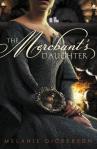
Merchants daughterI picked up The Merchant’s Daughter by Melanie Dickerson on Lisa’s recommendation.

It’s the story of Annabel Chapman in the England of 1352, whose merchant father has died and whose proud family refuses the duty of every villager to work in the lord’s fields. As punishment, someone from her family is required to be his servant for three years, and Annabel offers herself for that position.

Lord Ranulf le Wyse is said to have a very short temper and to have some sort of deformity, making him repulsive to look upon and frightening to Annabel, but she soon discovers a different side to him.

Meanwhile, the bailiff, old enough to be her father and disgusting, has set his sights on her. Unfortunately, her duties at the lord’s house bring her into more contact with him, and even worse, her brother has given the man permission to pursue her.

Annabel feels the only way to both escape the bailiff and have access to the Bible she longs to read for herself is to escape to a nunnery as soon as her servitude is over, but when the opportunity arises, she questions that desire.

This story is based loosely on Beauty and the Beast, so of course I knew where it was ultimately going, but that was actually fun, to see how it corresponded to the fairy tale. It is a realistic retelling, though – no magic wands or spells – but I enjoyed that.

Probably my favorite parts involved Annabel being asked to read the Bible to Lord le Wyse since she is one of the few people in his household who can read Latin. Reading the Bible for herself (not everyone had one: even the local priest did not) has been one of her lifelong desires, and it’s a joy to watch her pore over it and discover its treasures for herself, stopping in her reading to ponder what it says.

This book was a pleasant companion on a recent “sick day,” and I thoroughly enjoyed it. I’m looking forward to checking out Melanie’s other books.

Here’s the book trailer for The Merchant’s Daughter:

Updated: I just discovered that the Kindle edition of this book is on sale for a limited time at $2.99. You don’t have to have a Kindle to get deals on Kindle books: they have apps for computer, tablets, and phones.

(This will also be linked to Semicolon‘s Saturday Review of Books.)

And Carol‘s Books You Loved.

Books you loved 4