

Can you imagine a body without joints? It wouldn’t even be able to move.
We don’t usually appreciate the joints in our body until they start to give us problems.
I’m at the age where various joints take turns stiffening, aching, tingling, creaking, or even going out on me. If they all ganged up on me at once, I’d be in real trouble.
What happens when a joint doesn’t work right? An achy joint limits mobility. If the joint is stiff or painful enough, it could stop movement altogether. The Bible likens an unreliable person to an unreliable joint: “Confidence in an unfaithful man in time of trouble is like a broken tooth, and a foot out of joint,” (Proverbs 25:19, KJV).
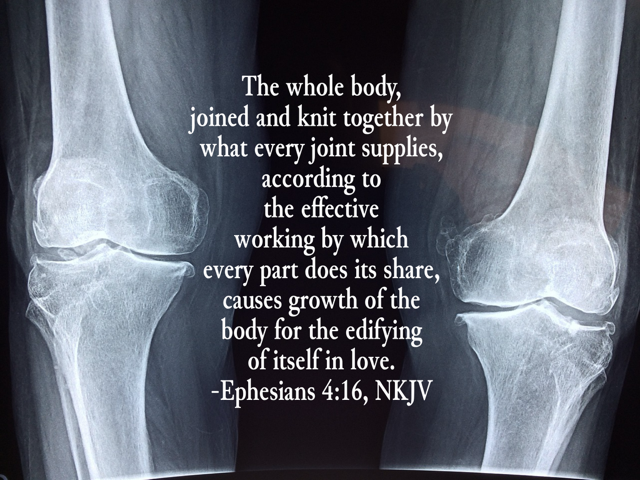
There are multiple passages comparing Christians to a body, with Christ as its head. And that body is held together and moves by way of its joints.
After telling about the gifts God has given to the church in teachers, shepherds, and evangelists to help the church mature and equip the saints for the work of the ministry, Paul says:
Speaking the truth in love, we are to grow up in every way into him who is the head, into Christ, from whom the whole body, joined and held together by every joint with which it is equipped, when each part is working properly, makes the body grow so that it builds itself up in love (Ephesians 4:15-16).
Colossians has similar imagery:
Holding fast to the Head, from whom the whole body, nourished and knit together through its joints and ligaments, grows with a growth that is from God (2:19).
In looking up the anatomy of joints, I was surprised to find just how complex they are. But one significant part of a joint is the synovium, which secretes synovial fluid, which in turn provides lubrication and nourishment for the joint, according to this article.
Interestingly, that article also says, the synovium “not only has its own specific functions but also interacts with other tissues in the joint both structurally and functionally.” That’s just like the body of Christ, too, isn’t it? 1 Corinthians 12 says we each have our own gifts and areas of usefulness, but we also interact as different parts of the same body.
What’s the synovial fluid among God’s people?
Ephesians 4:15 says we should be “speaking the truth in love.”
Jesus said, “A new commandment I give to you, that you love one another: just as I have loved you, you also are to love one another. By this all people will know that you are my disciples, if you have love for one another” (John 15:34-35).
Peter said, “Above all, keep loving one another earnestly, since love covers a multitude of sins” (1 Peter 4:8).
Paul wrote, “Love is patient and kind; love does not envy or boast; it is not arrogant or rude. It does not insist on its own way; it is not irritable or resentful; it does not rejoice at wrongdoing, but rejoices with the truth. Love bears all things, believes all things, hopes all things, endures all things” (1 Corinthians 13:4-7).
Wouldn’t our interactions as a body go so much more smoothly if we expressed that kind of love?
The synovial fluid also nourishes joints. Colossians says we’re “nourished and knit together through its joints and ligaments.“
How do we nourish each other? What’s our spiritual food? Job said God’s Word was more than his necessary food, and the author of Hebrews speaks of God’s Word as milk and meat.
As we take in God’s Word and grow in Him, we share it with each other, so that we help others grow as well.
Adrian Rogers* calls this activity within the body “flexible harmony.” “When each part is working properly, [it] makes the body grow so that it builds itself up in love” (Ephesians 4:16).
May we avoid spiritual achy joints by loving and nourishing each other in Christ.
*(This post was inspired by a couple of paragraphs near the end of Adrian Roger’s message, Faithful in Ministry, heard on BBN Radio 10/25/24. The link contains a summary, along with tabs to listen or download the transcript.)
(I often link up with some of these bloggers.)
 Stray Thoughts