
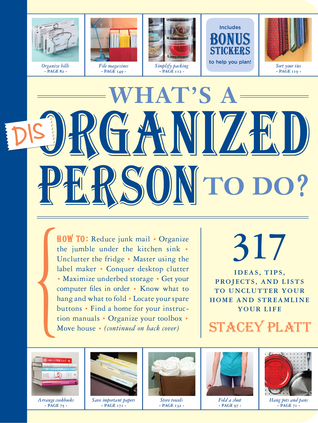
Review: What’s a (Dis)Organized Person to Do?

What's a Disorganized Person to Do?

Stacey Platt’s What’s a (Dis)Organized Person to Do? is subtitled 317 Ideas, Tips, Projects, and Lists to Unclutter Your Home and Streamline Your Life.

Stacey is a professional organizer and runs a company in New York with a wide variety of clients. One reviewer described this book as an organizer’s Pinterest board.

The book is organized according to different rooms in a house, except that the last chapter deals with trips and moves. Yet within each chapter are tips not just for the physical objects there, but for saving time and energy. Scattered throughout the book are one-hour projects, like organizing under the sink, the junk drawer, the bathroom vanity, or making a master grocery list.

I appreciated that the book was filled with specific tips, though some principles were discussed. Many books on organizing/productivity/time management that I have read are filled with broad principles, or are so rigidly organized as a whole system that they are overwhelming. This books lets you pick and choose what works best for you.

The book is probably meant to be dipped into as a reference resource rather than read straight through as I did. But I didn’t want to miss anything. 🙂

Some of the tips didn’t appeal to me; some I already used; some seemed like overkill. A few were outdated (this book was written in 2010. But I marked many tips to remember.

This appears to be the only book Stacey has written. I didn’t find a website for her. I did find one with her company name, but I am not sure it’s hers.

I can recommend this book as a good resource if you’re looking for organizational tips.

Review: Organizing for the Rest of Us

Organizing for the Rest of Us

In my early married life, I read Sandra Felton’s The Messies Manual and received her newsletter for several years. Those helped me immensely. I don’t know if my husband realizes how much he’s indebted to Sandra. 🙂

But I realized that organization isn’t a destination. It’s a continual journey. You can’t just set up routines and places for things: you have to maintain them. And you continually get new things, get rid of old things, or get ideas of ways your organization could work better.

So I still read occasional books about organization. I don’t read books on decluttering because, though decluttering is a part of organization, it’s just one part. I don’t read books on minimalism because they go too far for my tastes.

Some of the more recent books I’ve read on time management and productivity focus on the larger principles. Those are needful and foundational. I need those reminders sometimes. But I’m more in need of practical everyday life hacks, those “Why didn’t I ever think of that?” ideas and solutions.

I just recently discovered Dana K. White’s Organizing for the Rest of Us: 100 Realistic Strategies for Keeping Your House Under Control when it was on sale for the Kindle. It’s full of great ideas, laced with humor, and written concisely. You could easily skim through chapter titles and just read about the areas you want help with. But I enjoyed the whole book.

Dana started sharing tips on an originally anonymous blog titled A Slob Comes Clean. It resonated with so many people that it grew into books, podcasts, and speaking engagements.

Dana was one of those people (like me) who wasn’t naturally organized. She discovered her tips one at a time while trying to “deslobify” her own house.

One of her principles I liked is that clutter is personal. Maybe that’s why I don’t like decluttering and minimalist books—I didn’t always agree with what they said I needed to get rid of. Dana defines clutter as “anything that gets out of control in your home” (p. 6, Kindle). “You can keep anything. You just can’t keep everything” (p. 58).

One of my favorite tips from this book was not to take everything out of a closet or cabinet when trying to organize it. Most of us do that, then we get tired or need to go tend to something else, and we have a massive mess on our hands. Instead, Dana urges taking one thing out at a time and deciding immediately what to do with it. Have a trash bag and donation box handy to put items that you want to get rid of. If you decide the item is something you want to keep, immediately put it where it goes. That may seem to take longer in the short run. But dealing with the item immediately saves having a pile of items to put away when you’re done and fatigued. Plus handling it just once cuts down on rethinking it. And if you’re interrupted or tired, you don’t have a mess to clean up (or shove back into the closet) before you can move on.

This was a fun and very helpful book. Highly recommended.