

Laudable Linkage

Laudable linkage

Some of the good reads fond this week:

Petty Annoyances and Minor Insults. “I wonder if you are like me in that, as you look back on your life, you realize that most of the circumstances that have troubled you, most of the annoyances and disgruntlements, were produced by circumstances that were hardly worth noticing. In retrospect, most of the situations that stirred you to anger, kept you tossing and turning at night, or caused you to lash out in retaliation, were minor rather than major, little peeves and provocations more than grave injustices.”

Is a Quiet Life Consistent with the Culture Wars? HT to Challies. “The challenge here is that legitimate issues are at stake underneath the logic of the culture war. . . . If the culture wars involve (in part) a constant need to comment on political . . . and social issues and degregrate your neighbor, I wonder if we can honestly say that participation in the culture war is consistent with what Paul calls us to in 1 Thessalonians 4:11: a quiet life.”

5 Habits for Better Prayer in 2026, HT to Challies. “A healthy prayer life involves a steady stream of shorter communications (brief prayers throughout the day), paired with more intimate and extensive conversations (unhurried times of solitude with God). Jesus modeled both forms.”

We Have Dusty Bibles and New iPhones, HT to Challies. “This blog is not meant to condemn but to be a wake-up call to us all, myself included. I accidentally came across Josiah Queen’s song, ‘Dusty Bibles,’ which the algorithm providentially brought to my playlist. In the song, Josiah asks, ‘We’re too busy and can’t find the time. Are we busy or is it all a lie?’ and I could totally relate. I had spent countless hours on my phone, scrolling and watching reels on social media, but did not have time to read even a chapter of the Bible. Those words hit me hard!”

Helping Students Read the Bible for Themselves, HT to Challies. “A few years ago, a former student came up to me with a question that sounded simple, but clued me into a deeper problem. He said, ‘Hey, I’ve been reading the book of Mark like you told me to… but now what? I don’t really know what to do after that.’ He wasn’t lazy. He was trying, but like so many students today, he didn’t have a framework for how to read the Bible – no direction or understanding of what he was even looking for. That moment stuck with me because it reminded me: opening their Bibles is not the same as reading it well. So how do we help them read the Bible for themselves?”

The Key to Finding the Author’s Emphasis When You Read the Bible, HT to Knowable Word. “Often, however, we do not work hard to actually find the structure of the biblical passages that we study. We simply read them and ask general questions—or make general comments—about them, or we focus on the impressions or feelings that biblical passages give us. When we study this way, failing to pay attention to the structure of the passages we are focusing on, we run the risk of making incorrect interpretations and applications.”

The Courage in Encouragement, HT to Challies. “To encourage isn’t just to soothe; it’s to put courage into someone—to strengthen the will, to stiffen the spine, to remind a weary saint why the path is worth walking and how to keep going.”

Christians Bear Fruit, HT to Challies. “If you are sitting beneath live-however-you-wish-after-you-have-raised-your-hand-and-repeated-this-prayer-after-me type of preaching, run. Your soul is in danger.”

Fruitful to the End, HT to Challies. “Slowing down feels like fading away. Thankfully, the gospel tells another story. Output and speed do not equal fruitfulness. Old age is not a winding down—but a deepening. Productivity is reframed, not as busyness, but as rootedness; not as the accumulation of achievements, but as the cultivation of character and blessing.”

The Freedom of a Lower Reading Goal, HT to Challies. Much of this resonates with me. I set my reading goals realistically to allow time to be selective and spend as much time as I want with a book rather than racing through them just to reach a number.

Martin Luther quote

If I did not see that the Lord kept watch over the ship, I should long since have abandoned the helm. But I see Him! – through the storm, strengthening the tackling, handling the yards, spreading the sails – yes more, commanding the very winds! Should I not be a coward if I abandoned my post? Let Him govern, let Him carry us forward, let Him hasten or delay; we will fear nothing! –Martin Luther
Laudable Linkage

Here are some of the good reads found this week:

To the Older Woman in the Church: You Are NOT Obsolete. “Older women in the Body of Christ are not obsolete, and ‘so we do not lose heart.’ Though our outer self may be forgetful, less agile, and plumper than we’d like, our inner self is on duty, continuing in service to our God.”

Potential Dangers of “Applying Scripture to My Life,” HT to Knowable Word. “Imagine asking a friend how her day was and two minutes into her summary interjecting, ‘Wait, tell me how this applies to me?’ We’d never do this. And yet we do it to God. We exchange the feast of relational intimacy and holistic formation for the porridge of minor behavioral change and practical nuggets for our optimized life.”

What We Regard as Little, HT to Challies. “The lack of obedience in small things would always eventually lead Israel to idolatry, to drifting from the God who rescued them and made them His own people. We like the dramatic stories of walls falling and dry river crossings but deemphasize the daily obedience to God’s Word because that’s not as gripping or faith-growing.”

Obituary for a Quiet Life, HT to Susan. “When the notable figures of our day pass away, they wind up on our screens, short clips documenting their achievements, talking heads discussing their influence. The quiet lives, though, pass on soundlessly in the background. And yet those are the lives in our skin, guiding us from breakfast to bed. They’re the lives that have made us, that keep the world turning.”

At the Center of All Things. “Christians are prone to take a relatively minor point of doctrine, one we might identify as second- or third-order, and set it like the earth at the pivot point of Ptolemy’s universe. Their love of this doctrine and their conviction that it is key to a right understanding and practice of the Christian faith means that soon everything begins to orbit around it. It becomes the center of their beliefs in such a way that any other point of doctrine is understood only in relation to it.” Tim shares a better way.

The Danger of Playing God. I caught part of this from Stephen Davey’s Wisdom for the Heart program on the radio then skimmed through the transcript online.The part that grabbed my attention was the difference between critical thinking and judgmentalism. “The Christian is actually told, and I quote, to judge all things (1 Corinthians 2:15) – the same root word for judge that James uses here when he obviously tells us not to judge. So is the Bible confused? Not if you understand the context of this prohibition. What James is forbidding here is judgmentalism – a critical spirit that judges everyone and everything and runs everyone down. / Hughes, p. 196. There is a difference between making a discerning judgment and having a judgmental spirit. There is a difference between judging and judgmentalism.  There is a difference between thinking critically and being critical.”

The Assignment I Wasn’t Expecting, HT to Challies. “I once was an eager college student flush with conviction, laying my life out for Jesus. His love had captured and transformed me, and I was driven by the wonder of it. I would go anywhere, do anything, I vowed. And I did. It was difficult and painful and exhilarating and beautiful, while it lasted. But somehow I didn’t expect it all to come down to this.”

Why We Should Read Poetry, although the piece talks about literature, not just poetry. HT to the Story Warren. “Reading literature offers us profound solidarity with an author and admits us to a broader human community but it also holds up a mirror that allows us to see aspects of ourselves more clearly than we could have before.”

Why Build a Personal Library? HT to Linda.”Writing in the Guardian, Rhiannon Lucy Cosslett recently took aim at ‘everything that is smug and middle class about the cult of book ownership.’ She clarified, ‘I don’t mean reading. . . . No, I specifically mean having a lot of books and boasting about it, treating having a lot of books as a stand-in for your personality, or believing that simply owning a lot of books makes one ‘know things.’ But, seriously: Who does that?” Joel J. Miller shares some good reasons *for* a personal library.

I enjoyed looking through several illustrations by Liz Fosslien, many about time management, HT to Redeeming Productivity. I especially liked this one about having a bad day and breaking the cycle.

It’s a good time for my occasional reminder that links do not mean 100% endorsement of everything on these sites.

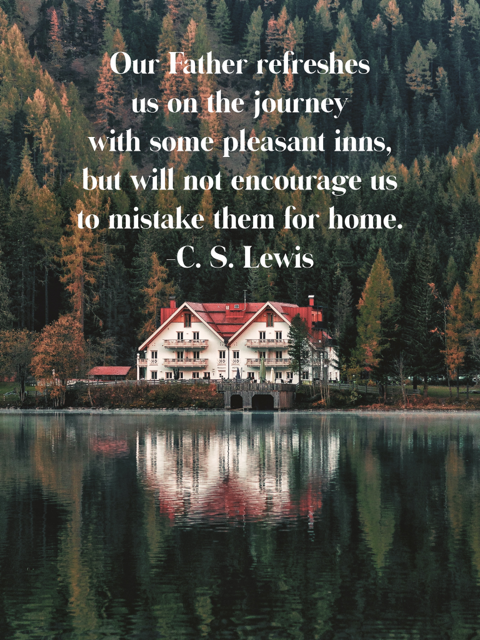
Our Father refreshes us on the journey with some pleasant inns, but will not encourage us to mistake them for home.  C. S. Lewis