Review: The Man Behind the Patch: Ron Hamilton

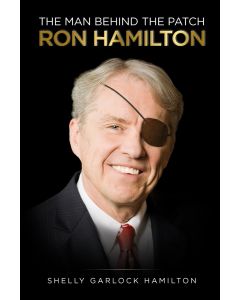
Ron Hamilton and his alter ego, Patch the Pirate, are household names in some places but unknown in others. I wrote something of a tribute to him a couple of years ago after he passed away. His wife wife, Shelly, wrote a biography of him, published last year, titled The Man Behind the Patch: Ron Hamilton.

I first knew of Ron in college. He and Shelly were newly married and GAs (graduate assistants) during my freshman year. They were always active in music both on campus and at the church they attended, which I visited occasionally.

I remember when Rob debuted some new songs he had written at college. “It Is Finished” was inspired by a teacher pointing out that when Christ said “It is finished” from the cross, it was a victory cry. The other two were “Come to the Cross” and “The Blood of Jesus.” I had not known that these songs were part of his requirements to graduate in his major. It’s interesting that these songs continued to be well-known and well-loved all through his career.

I remember when Ron was diagnosed with cancer in his eye. When they did surgery, he wouldn’t know until he woke up whether they had to remove the eye or not. They did. Sometime after his recovery, he gathered together all the notes and verses people had sent him and wrote what became his signature song, “Rejoice in the Lord.”

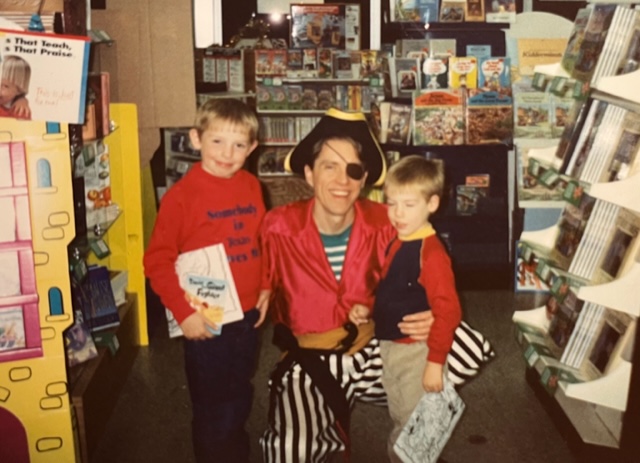
As Ron wore his eye patch, kids in his church began calling him “Patch the Pirate.” He had written music for adults but then decided to write some for kids as well. He put together a story line with interesting character voices for a children’s recording. Kids loved it, and parents soon begged for more because they were tired of listening to the same album over and over. Thus a children’s ministry was born. A Patch the Pirate adventure has been released every year since then, over forty all together.

He continued to write music for adults and choirs, cantatas, books of music arrangements for his songs. He wrote the words, various people wrote the music, and Shelly arranged them.

One of the trials of their life was when their oldest son developed a mental illness over several years, ending with the taking of his own life. Shelly told his story in Always, Only Good: A Journey of Faith Trough Mental Illness.

Another severe trial came when Ron was diagnosed with early onset dementia. He passed away at his home in 2023.

Shelly tells Ron’s story in three sections, Becoming Patch the Pirate, Life with Patch the Pirate, and Patch’s Long Journey Home. She begins with his early childhood in Indiana, to attending college, meeting and dating Shelly, their marriage and children. Then Ron’s eye surgery and budding career. They took over and managed the music company her dad began, Majesty Music.

Many of the middle chapters are something of a travelogue, along with which recordings came out when, sprinkled with anecdotes. The whole family traveled to churches doing “Patch” concerts until the family grew too big. Ron traveled alone for a while, eventually cutting back to traveling just a bit while becoming the music pastor of a local church.

Shelly was warned that biographies of men by their wives often become hagiography, idealizing the husband. Shelly attempts to show all sides of Ron. He wasn’t perfect–no one is. He was a prankster, and some of his pranks backfired badly.

A couple of other interesting facts I had not known: Ron had a deviated septum, which gave his voice a slight nasal quality. He didn’t know if surgery would change his voice for better or worse, so he decided to leave well enough alone.

Also, he considered doing doctoral work in music at another school and was accepted, but he was told his music would need to be more academic. He considered the offer, but decided to decline. He wanted to “put the cookies on the lowest shelf”–make them accessible to everyone. Shelly wrote later that Ron “chose to compose biblical texts that united with simple, memorable melodies for everyday life and everyday struggles (p. 368).

Ron wrote about 700 songs. Some for children were fun, like “I Love Broccoli” and “The Poochie Lip Disease.” Others focused on character. All of his songs for children and adults were biblically based. I shared some of my favorites in my earlier post about him.

By all accounts, Ron was a humble man. When Shelly once mentioned how many lives he had touched, he said, “I’d like to think God did it.”

This book was nostalgic for me in many ways. I didn’t know Ron and Shelly personally, though I had met them each a couple of times. But since I was in school a few years behind them and lived in the same town for over fourteen years, I was acquainted with their ministry. Then my kids grew up on “Patch the Pirate” tapes, especially in the car and at bedtime. We listened to many of Ron’s albums for adults over the years and sang some of his music in choir. Finally, I followed Shelly’s public Facebook page the last years of Ron’s illness.

I think this book would be especially interesting to anyone familiar with Ron or Patch. But even for those who don’t know him, this is an inspiring account of a humble servant of God using his talents for His glory.


Laudable Linkage

Here’s my latest list of noteworthy reads found this week.

What Do You Do When You Are Spiritually Dry? HT to Challies. “Often when we feel dry, we are tempted to neglect the one thing that will satisfy our souls. Think about it: When you feel dry, what things do you want to toss out? Bible reading, prayer, fellowship. But this is the problem. If you are dry, spiritually thirsty, the worst thing you can do is go to the desert! You need to go to the fountain! God calls Himself “the fountain of living waters” (Jer 2:13). If we do not desire God, we need to go to God!”

When We Fear the Worst, HT to Challies. “Friend, I don’t know what fears and worries weigh on your soul today. But I do know that they can feel heavy—sometimes debilitatingly so. They can nag at you and trip you up and keep you discouraged and despairing. But there is a sure foundation we stand on, a God who holds us fast even while the winds and waves beat down. And he will not let us go. Not now. Not ever.”

Where Do I Find the Grace to Forgive? “Christians should be the most gracious of people. But when we forget what we’ve received from God or minimize our need for salvation, we become bill collectors. We go through life trying to collect the love, respect, appreciation, apology, or attention we feel others owe us.”

Standing on the Promises Is More Active than it Sounds. “‘Standing on the promises of Christ the Lord/…Overcoming daily with the Spirit’s sword…’ Standing on a promise requires knowledge of what has been promised. Do you have a sufficient base in Scripture for your heart to rest upon?”

The Art of the Ebenezer, HT to the Story Warren. “He looked into the past and remembered Israel’s defeat and anguish. He wanted to memorialize their repentance, prayer, fasting, fighting, and victory. But by erecting the stone of remembrance, Samuel also looked toward the future, wanting to remind the next generations to look at that stone and remember God’s faithfulness and power when the next tough trial came their way.”

The Strangeness that Stands Out, HT to the Story Warren. “If we give up essential truths of the Christian faith in order to be culturally relevant, we make ourselves eternally irrelevant. We make the church boring. The world needs a church that does more than offer an echo of our own times.”

Ron Hamilton Has Come Forth as Gold. I wrote about Ron earlier this week, and I’m sure many tributes will be written. But I enjoyed this one from Chris Anderson about ways Ron ministered to us. And he rightly includes a note about Ron’s wife, Shelly, at the end.

Goodnight, Ron

Ron Hamilton and his wife, Shelly, were graduate assistants when I was a freshman in college. They were well-known on campus, perhaps because they were both involved in most school music productions, or perhaps because Shelly’s father, Frank Garlock, was a well-known speaker and the song leader at one of the largest churches in town.

A few years into their marriage, Ron developed a problem with his left eye. After numerous tests, the doctor recommended surgery to see what the trouble was. If nothing serious was wrong, Ron would wake up with a sore eye. But if the trouble was cancer, the eye would have to be removed.

When Ron woke up, his wife told him his eye was gone. Though this was a trial, they were thankful the cancer was contained within the eye and had not spread to his brain, as the doctor had feared.

Some time after his surgery, Ron brought out the cards and verses people had sent him and wrote what became his signature song, “Rejoice in the Lord.” The lyrics contain imagery between spiritual and physical sight.

In darkness, He giveth a song. . .

I could not see through the shadows ahead
So I looked at the cross of my Savior instead . . .

Now I can see testing comes from above. . .

When Ron came home with a “pirate patch,” kids began calling him “Patch the Pirate.” Ron had written a few other songs, and parents asked him if he could write some songs for children. Ron adopted the persona of Patch the Pirate and his wife became Sissy Seagull (mainly because she had laryngitis when they started taping and could only “squawk”). Their first recording took off with parents clamoring for more. They currently have some 42 “Patch the Pirate Adventures,” each usually around a theme, with a story and several songs.

My children listened to Patch the Pirate tapes for years as they went to sleep at night. I sang this to them and to my grandson:

Ron became a local celebrity. We attended a few of his appearances at local Christian bookstores. My youngest two each performed in Patch the Pirate musicals when they were in elementary school.

One of our former pastors was an assistant pastor at the church where Ron served as song leader and music director. Our former pastor said that Ron would quietly visit children in the hospital as Patch.

Many of the songs that I think were originally written for children have ministered to me over the years. One was “How Can I Fear?”

Another was “A Tender Heart.”

“Abba, Father” was a favorite of mine and my youngest son’s. It especially meant a lot to me when recovering from transverse myelitis.

Ron wrote a number of fun songs for the Patch adventures, too, like “The Poochie Lip Disease” and “I Love Broccoli.

Ron and his family traveled to minister in churches. Shelly’s father had opened Majesty Music, which became an outlet for Patch tapes, CDs, and songbooks as well as the adult music Ron and Shelly wrote.

Later, “Patch clubs” were formed for children to participate in local churches. Now there is a Patch the Pirate app, with the Hamiltons’ daughter and son-in-law taking over the reins.

BBN Radio plays the Patch adventures on Saturday mornings.

The Hamiltons had no way of knowing that an eye surgery would lead to all this.

Yet life was not always rosy. Their oldest son, Jonathan, developed mental problems and took his own life on Mother’s Day, 2013. Jonathan had wanted to serve God with music and had written music for several songs, among them “Higher Ground” and “You Are Always Good.” Ron shared a bit of testimony from that time here:

Then several years ago, Ron was diagnosed with early onset Alzheimer’s. He’s been slowly declining the last few years. Shelly has been keeping folks updated via her Facebook page.

Ron just slipped into eternity yesterday.

If there is anyone who has used all their talents for the Lord, it was Ron. Only eternity will tell how God has used him.

Ron would not have wanted to be put on a pedestal. But I like what Elisabeth Elliot said about pedestals in A Lamp for My Feet:

Pedestals are for statues. Usually statues commemorate people who have done something admirable. Is the deed worth imitating? Does it draw me out of myself, set my sights higher? Let me remember the Source of all strength (“The Lord is the strength of my life,” says Ps 27:1 AV) and, cheered by the image of a human being in whom that strength was shown, follow his example.

I didn’t know Ron personally, though I encountered him a few times. He seemed a quiet, humble man who earnestly desired to share God’s truth through song and story. Ron wrote a song for his father titled “I Saw Jesus in You,” but many of us can see we saw Jesus in Ron.

Ron also wrote “Goodnight” for his father as well. The first verse speaks of a father putting children to bed. The second tells of the grown son putting his dad to bed. The last verse looks forward to seeing in the morning those we’ve said “Goodnight” to on earth.

Goodnight, Ron. We can’t thank you enough for the way you have ministered to our hearts for God for more than forty years. We’ll see you in the Morning.