Nick was born into an elite Charleston family but was considered and outsider because his mother was. After his father’s death and his mother’s abandonment, he was raised in an uncle’s family, always aware he was not really a part of the family except by blood.
The first book had Nick coming back to Charleston after several years due to receiving a clue about his mother’s disappearance. He comes into an inheritance and the family home.
He’s not really a detective or investigator—he teaches astronomy. But a detective friend has been in a serious car accident, and Nick volunteers to help her.
It turns out that the hazing and apparent suicide of a Citadel cadet two decades ago is related to the disappearance of a debutante, both of which are also connected to a current case. As Nick asks questions, he’s repeatedly warned not to stir up this hornet’s nest. But as he continues unraveling surprising connections, he finds himself in danger.
Some favorite quotes:
Merely going through rites was a much easier task than following the spirit behind them (p. 40, Kindle app).
Without God, life was dust and had no meaning. With God, hope transformed life and its sorrows (p. 158).
“I understand,” I said. “I will tell this woman how you feel.”
Life burst into the old woman’s face. She pointed at me, still clutching the shawl. “You, young man, have no idea how I feel!”
It was a well-deserved rebuke. “No,” I said quietly. “I don’t” (p. 160).
Not so fast, my junior-grade sidekick (p. 201).
I don’t often read this kind of book, but it’s nice for a change. I like Brouwer’s breezy style of writing here. Though there are dark and scary turns, there’s a lot of underlying humor and banter as well as a few sweet moments.
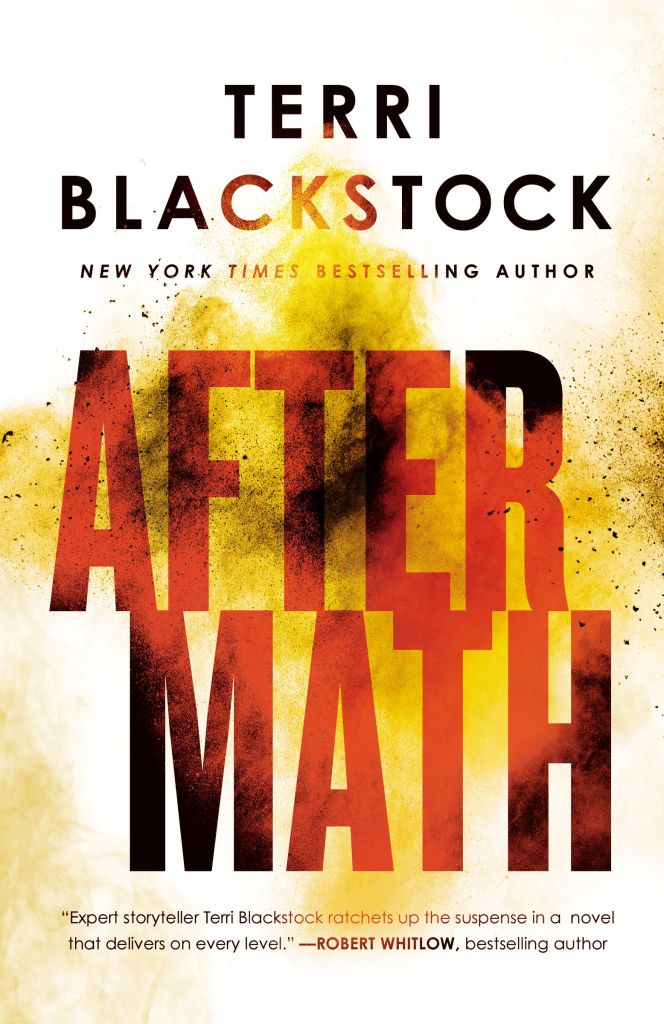
Terri Blackstock’s novel, Aftermath, opens with three young women at their favorite band’s concert. As the Libertarian political candidate the band was opening for came to the podium, an explosion rocked the stage area. Only one of the girls, Taylor, makes it out alive.
Just minutes after the explosion, policemen pull aside Dustin Webb’s car. They ask to search his trunk, and, having nothing to hide, he agrees. He’s shocked to see plastics for explosives in his trunk. He insists he doesn’t know how they got there and he didn’t put them there. The officers don’t believe him. They got an anonymous tip that he was the bomber, he worked with bombs in the Army, and his security company had a client which had explosives stolen from them. Everything adds up to Dustin being involved in the bombing.
Desperate, Dustin calls a friend from his past, Jamie Powell. She was the only person who believed in him when she lived next door. Perhaps she’ll believe in him now. They haven’t spoken since he went into the Army, but she’s a lawyer now, and he needs a good one.
Jamie drops everything to help Dustin. She has to fight for the right to represent him with the partners of her firm, who fear the repercussions of defending a suspected terrorist.
Meanwhile, Taylor’s fragile recovery from OCD is threatened by the tragedy she underwent. Despite seeing her psychiatrist, starting a new medicine, and being watched over by her sister, Taylor’s grief and guilt over not staying behind to help her friends escalates her symptoms. She feels the only way she can set things right is to find who did this.
I don’t often read suspense novels, but Terri is a master of them. This one had me on the edge of my seat, yet every character drew my sympathy. The faith element is clear and natural and not heavy-handed. If you like suspense—and even if you don’t—I think you would enjoy this book.
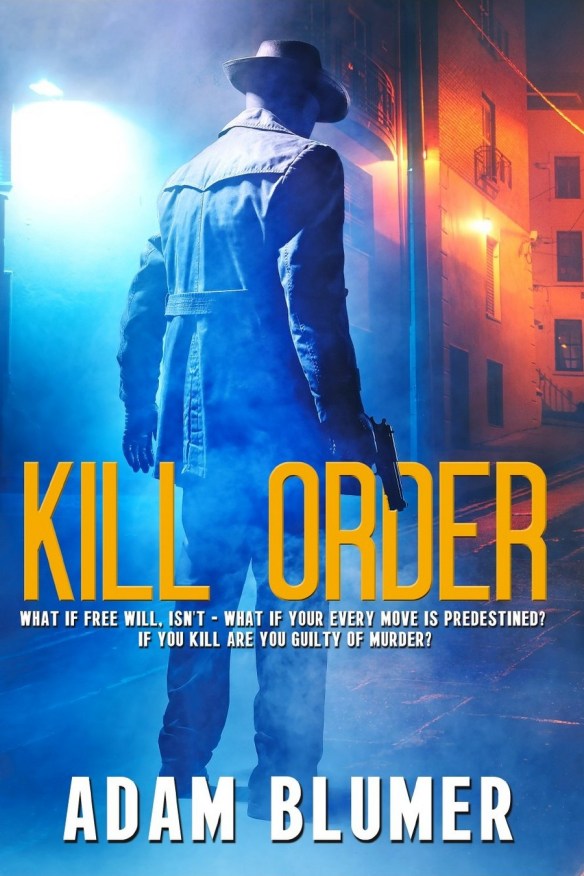
Adam Blumer writes page-turning “meaningful suspense” novels. I loved his first two: Fatal Illusions and The Tenth Plague (linked to my reviews). His third novel, Kill Order, just released a few days ago. Here is the summary:
When he sleeps, the forgotten terrors of the past come alive.
Grammy-winning pianist Landon Jeffers’s brain cancer has given him only a few years to live. But when he sleeps, the forgotten terrors of his past torment him. When he wakes, shameful memories come rushing back. Desperate for answers, Jeffers discovers that a brain implant intended to treat his cancer is really a device to control him, forcing him to commit terrible crimes. Now he’s being manipulated by an evil crime syndicate and a crooked cop.
What if free will isn’t? What if your every move is predestined? If you kill, are you guilty of murder?
Intriguing, isn’t it? I’ve read the book and will be reviewing it next week, and I can assure you, it’s excellent! At the end of this post, I’ll let you know how you can enter to win a signed copy of the book.
Today I am welcoming Adam to Stray Thoughts to share a little about about himself, Kill Order, and writing.
First, a little background information:
Adam Blumer fixes other people’s books to pay the bills. He writes his own to explore creepy lighthouses and crime scenes. He is the author of three Christian suspense novels: Fatal Illusions (Meaningful Suspense Press); its sequel, The Tenth Plague (Kirkdale Press); and Kill Order (Lighthouse Publishing of the Carolinas).
A print journalism major in college, he works full-time from home as a book editor after serving in editorial roles for more than twenty years. He lives in Michigan’s Upper Peninsula with his wife, Kim, and his daughters, Laura and Julia. When he’s not working on his next thriller, he’s hiking in the woods, playing Minecraft with his daughters, or learning new chords on his guitar. He is committed to writing clean suspense that is free of profanity, vulgarity, and sexual content. He is a member of American Christian Fiction Writers (ACFW), the Christian Editor Network, and The Christian PEN. He works with literary agent Cyle Young of Hartline Literary Agency.
What gave you the inspiration to write Kill Order?
My dad, Larry, passed away from brain cancer in 2011, and several aspects of his cancer journey kicked off the initial story idea. One key detail involved a medical procedure; the doctors agreed to remove as much of my dad’s brain tumor as possible and replace it with medicinal wafers intended to fight the existing cancer. My mind began playing the what-if game. What if the doctor implanted something else, something that could monitor or even control my dad’s life? The story’s premise grew from there.
I noticed that your branding on your website is for “meaningful suspense.” What inspired you to write these kinds of thrillers and suspense novels? Also, could you please tell us what inspired your “clean fiction guarantee”?
I began reading Christian novels in junior high and soon gravitated to suspense. Back in the day, an inspirational thread was a staple in Christian fiction, and I believe a Christian novel can do more than simply entertain. These days many authors are leaning toward writing clean, moral stories but avoiding overt Christian content. I’m a believer that the inspirational content should stay (hence “meaningful suspense”). Books can encourage and even challenge readers’ thinking while taking them on a roller coaster of a ride. The “clean fiction guarantee” came about due to the rise of objectionable content in some Christian fiction. My fans were expressing disappointment to me due to content issues when they tried books by some Christian authors. I felt it was time to declare where I stood, and many readers have appreciated my guarantee.
When did you realize your calling to create words on paper to share with the world?
When I was a child, I began writing wildly imaginative pirate and fantasy stories. My first handwritten story was a fantastical tale about Captain Kidd’s spyglass. In high school, I also wrote and finished an unpublished novel called Down with the Ship. It’s such an Agatha Christie copycat that I laugh whenever I peruse it, but emulation is how a lot of authors get to be where they are today. Those were the early projects that inspired me to take novel writing seriously. When I won a high school award for creative writing, I wondered if God wanted to do more with my love for fiction. In college I won more writing awards, and though I studied journalism, I took as many creative writing courses as possible. God opened doors from there, and I’ve never lost my love for fiction writing.
If you could go back in time and give advice to your younger self, what would that be?
Writing the story is only half of the project. The other half is finding out what readers like to read, crafting the story for them by following publishing standards, and writing the story to the best of your ability. Then remember that publishers can take a very long time to decide whether they want your work. Don’t get discouraged. Just keep going and waiting.
Name your three biggest frustrations about the writing business.
The amount of time each book requires from start to finish. Included in this is the long wait time from publishers.
The continually changing rules in writing and publishing. Just when you think you know what publishers are looking for, your agent tells you something else.
Book marketing. One cannot guarantee sales. I wish a book release was like the movie Field of Dreams. “Build it, and they will come.” If only it were that easy. There is almost an equal amount of work in just promoting the book.
On the flip side, what excites you the most about the creative process?
I get most excited about the creative process when a plot development I never saw coming unexpectedly presents itself, taking the story in a new but stronger direction. This epiphany has happened to me several times.
Where is your favorite place to write?
I have been blessed with a wonderful home office. Though I often like to write in other locations, this is by far my favorite place. I can close the door, shut out life’s distractions, pray, and become immersed in my story. Now and then, if I need a break, I can glance out the window and delight in God’s creation.
What are you reading at the moment, and who are a few of your favorite authors and why?
I’m currently enjoying Mind Games by Nancy Mehl. I especially enjoy a good thriller, whether Christian or secular. Some of my favorite authors are Steven James, Terri Blackstock, Frank Peretti, Ted Dekker, and Brandilyn Collins. I like how they weave story threads together and craft their scenes in ways that keeps the plot moving forward. Their books are great examples of what works in suspense writing. I learn so much simply by reading their novels.
What is the best part of your author’s life?
I love hearing from readers who went to work tired because they stayed up too late finishing one of my novels. If I kept them immersed in my story and entertained, that’s a score in my book.
Do you have any new writing projects on the horizon?
I’m almost finished with the first draft of the sequel to Kill Order and hope to have something ready for my agent sometime this fall.
Adam, thank you for stopping by and for giving us another great book. I am looking forward to the next one. Thank you, especially, for producing books that are not only well-written, but clean and meaningful.
Thank you for the opportunity to talk about my writing life at your blog.



 Stray Thoughts