Listening to God

I just saw this today at The Good Life, and it really speaks to something I’ve been pondering recently. It’s from God’s Wisdom in Proverbs by Dan Phillips, which I haven’t read, nor do I know much about Dan Phillips, but I appreciate this quote:

“Listen” does not mean, here or anywhere else in Scripture, to harken to a subjective, mystical, murmury, semi-revelatory inner voice of God. God has no intention of turning our attention within ourselves, of urging us to seek after holy hunches and vaporous mumblings inside our own deluded hearts. He categorically condemns such orientation (Prov. 28:26; Jer. 17:9). God knows all too well that dense foolishness is “original factory equipment” in our fallen minds, thanks to Great-Great-Grandad Adam (Prov. 22:15).

No, God is not speaking of our listening to the inscrutable mumblings of some spirit, as if it were His Spirit. Rather, here and everywhere God is urging us to listen to the Word of God (cf. 1:23, 33; 16:20; contrast 28:9). The content makes this unavoidable. Solomon means the wise man to listen to the words he is writing. Internal, lowgrade, spiritual “sweet nothings” would have been far from the inspired king’s mind.
~Dan Phillips
God’s Wisdom in Proverbs

Friday’s Fave Five

Welcome to Friday’s Fave Five, hosted by Susanne at Living to Tell the Story, in which we can share five of our favorite things from the last week, a wonderful exercise in looking for and appreciating the good things God blesses us with. Click on the button to learn more, then go to Susanne’s to read others’ faves and link up your own.

It has been a great week. Here are some of the highlights:

1. Jeremy (oldest son) has been home for the week! We celebrated his birthday on Wednesday. As I have said before, Skype and Facetime help a lot to keep us in touch, but it is not the same as having him here in person.

2. Time off. My husband was able to take the week off and Jason and Mittu half the week, so we’ve been able to do some fun things together. It’s been a nice combination of just hanging out and talking, playing games, and going on a few outings.

3. Help with meals. Of course, even if everyone else is on vacation, Mom still has kitchen duty. But Mittu prepared a couple of meals and we ate out for a few, so I got a bit of a vacation, too.

4. An outing in Gatlinburg/Pigeon Forge. We went to the Ripley’s Aquarium of the Smokies, walked around some of the shops, and ate dinner at the Applewood Farmhouse Restaurant and Grill.

5. A good Samaritan. Just as we finished up at the restaurant last night and were preparing to trek homeward, our car wouldn’t start. Jim found someone willing to jump the battery and help us on our way. I’m thankful that’s all the problem was (I had already been mentally running through the need to get a tow truck, rent a car to get home, and then figure out how and when to get back to pick the car up) and that someone was willing to help.

Because of much of the above, I haven’t been around to visit other blogs much this week, or often I have read but not commented. But I know you understand. 🙂

Happy Friday!

Happy Birthday, Jeremy!

His birthday was actually yesterday, but I didn’t have much chance to get to the computer yesterday. 🙂

All in all I think he had a good day. We’ve been enjoying his week home very much, though it is going too fast!

One who has influenced my life

Annette at This Simple Home and Dorie at These Grace Filled Days have teamed up to create Together on Tuesdays as “a casual way to meet and connect with other women” over the summer. They’ve created a schedule of topics to discuss in order to get to know one another better, and the topic for this week is someone who has influenced our lives.

I could name several, but one who has had a significant impact is Mrs. C. I had become a Christian as a teen-ager, and my family was mostly unsaved. On Sunday mornings I would take my younger sisters to Sunday School and church with me, but otherwise I went by myself. My church was my second home, and I think of that time as my childhood in the Lord. The church folks were wonderful to me.

During my sophomore year of college, a new family moved to our area and began attending our church. I met them when I came home for the summer. On Father’s Day several of us were asked to give testimonies about our fathers. I don’t remember what I said except that, with my father being unsaved, there was something missing from our relationship, and I began to give testimony instead to God as my heavenly Father. (If I were to give a similar testimony today I would also emphasize that the Lord had taught me to respect my parents, even when they did things that did not invite respect, and more than that, to love them, and that godly love is the greatest testimony and influence to them.)

Afterward this new family, the C. family, spoke to me. They told me if I ever needed someone to talk to, I should feel free to call them. I warned them that I would take them up on that offer. :) At some point they invited me to their home for dinner, and our relationship just grew from there until I began to think of them as my spiritual family.

I don’t think they took me “under their wing” with a view to teach, to instruct, to be an example — I don’t think they saw me as a ministry or a project. I think they were just extending love. But just seeing the example of a godly Christian home was such a tremendous influence on me. I had always, in all my childhood imaginings of what I wanted to be when I grew up and alongside those other aspirations, wanted to be a wife and mother. After I became a Christian I wanted to have a distinctively Christian home. And in the C. household I saw that lived out. I saw the father’s firmness and headship of his family. I saw the children, though normal and not perfect, sinless children, love and respect their parents. I saw a loving cheery atmosphere. But most of all I saw Mrs. C. — her merry heart, her loving submission to her husband, her gentleness with her children, her creativity and industriousness in her home, her servant’s heart at church, and her interest and care for me. She was the same sweet, cheery, helpful, outreaching person in every venue. I began calling her “Mom” (not to replace my mom — I loved my mom dearly — but in a way different from my mom) and her daughter, who was a few years younger and who happened to look like me, and who later was my maid of honor, my sister. To this day she is “Mom C.” Though Mr. C. passed away several years ago, I still keep in touch with Mrs. C. She remembers all of my family’s birthdays and our anniversary.

I don’t know what I would be and what my home would be without her example and influence. I am thankful for her and I love her dearly.

The winner…

of my blog anniversary give-away of Not By Chance: Learning to Trust a Sovereign God by Layton Talbert is Amy at Hope Is the Word!

I want to say a heartfelt thank-you to all who posted very kind comments there. I was not anticipating that. My heart was very touched and blessed. You all really make blogging a joy and I feel so blessed that anyone reads anything here.

Backyard fun

The Together on Tuesdays topic last week was backyard fun, but I didn’t post because we don’t have much of a back yard now and haven’t spent much time out there in ages, except when my husband grills food.

But over the next few days, some backyard fun from earlier days came to mind.

I’m not sure how old the boys were when they wanted a treehouse. Just buying lumber from a commercial store was beyond our means at that time, but somewhere Jim found a place with a bunch of old wooden pallets, and he asked for them, took them apart, sanded them, and built a treehouse, compete with trap door. To my chagrin, it doesn’t look like we have any photos of it. But they and the neighbor kids spent hours out there.

I found a couple of other photos of their backyard activities:

These little scooters were all the rage at one time.

They pulled each other around in the wagon, and this time it looks they cooled off by adding water. 🙂 (The boys are mine, the girls are neighbors).

There was a little rise at the back of the property that allowed just enough of a thrill for small boys when it snowed to sled down or use an inner tube, or in a pinch, a flattened cardboard box.

Once my husband built a teepee for them.

I think a few times they camped out in the back yard.

We had a sandbox for several years, and when we got the dog, she was always someone to play with in the backyard. They blew bubbles, played ball, constructed mazes out of big cardboard boxes. They had a kiddie pool at one time.

And the trampoline was a big hit, but the pièce de résistance was when Jim put together some PVC piping and punched holes in it to make a sprinkler for the trampoline:

image0-2.jpg

You’d think the water would have made it slippery, but it actually slowed down the bounciness some. It combined running through the sprinkler with jumping on the trampoline. And it looks like it made a handy water fountain, too.

I had always wanted a swing set, and we never had one, but I don’t think they missed out. 🙂 They associated swings and slides with the park which we visited often in those days.

I enjoyed this trip down memory lane. Thanks, Annette and Dorie, for the prompt!

Thy words were found, and I did eat them; and thy word was unto me the joy and rejoicing of mine heart: for I am called by thy name, O LORD God of hosts.
Jeremiah 15:16

It is the spirit that quickeneth; the flesh profiteth nothing: the words that I speak unto you, they are spirit, and they are life. John 6:63

May you find joy and life as you partake in His Word today.

Friday’s Fave Five

Welcome to Friday’s Fave Five, hosted by Susanne at Living to Tell the Story, in which we can share five of our favorite things from the last week, a wonderful exercise in looking for and appreciating the good things God blesses us with. Click on the button to learn more, then go to Susanne’s to read others’ faves and link up your own.

Here are some favorites from the last week:

1. Jeremy’s coming home today! For a whole week!

2. Jesse’s job. Jesse hadn’t found work this summer except for a man from church who called him on an as-needed basis. But this man recently had an opening come up for more regular work and offered it to Jesse, and the hours are flexible so it will fit around his college classes .

3. Sleep. I usually wake up once or twice in the night and usually have no trouble going back to sleep. But for the past few weeks whenever I’d wake up, I’d be awake for an hour or so. That provides a nice time to pray or think, but then it makes me sleep later or else drag through the next day. This week has been more back to normal and has felt so good.

4. Kind comments on my sixth blog anniversary post. Almost made me cry!

5. God’s help — every day! But specifically in a situation last week. The ladies’ newsletter for church needed to be printed out by Friday, and I didn’t find out til Tuesday that the lady who writes up the testimonies and information for our “Getting to Know You” section for new ladies wasn’t going to be able to do that this time. It’s a highlight of the newsletter so I hated to leave it out, but wasn’t sure I could find someone who would be willing to share their testimony and such in such a short time frame. We usually “introduce” two ladies per newsletter and I was hoping to at least have one — but God provided two! And for a number of reasons I didn’t get to actually working on the newsletter until Thursday, though I had been thinking and planning what to do before that. Yet, by God’s grace, it was done by Friday afternoon. (I debated whether to go into all that or just say “God really helped me in a pinch this week,” but then I decided it may be an encouragement to you in your ministries.)

Bonus: Our pastor’s message last Sunday from Romans 16, where Paul lists a number of people who ministered in various ways other than what we think of as the “main” ones of teaching and preaching. He discussed some of those people as well as some of those folks in our church and ended with “interviewing” a lady from our church who teaches English in a closed country and has various ministry opportunities. That was a blessing to me.

Have a great weekend!

Reading Classics Together: The Disciplines of Grace

I’m joining in the “Reading Classics Together” at Challies‘ place for the first time. I’ve always liked the idea: a group of people reads a chapter of a book a week and discusses it. But this is the first time the title they are discussing appealed enough to me for me to jump in.

The Disciplines of Grace by Jerry Bridges attracted me for a couple of reasons. I’ve heard Bridges favorably mentioned and recommended for years but just have never gotten to one of his books. And the title of this one seemed to explore what I was pondering in a post a while back, Of grace, law, commandments, rules, and effort (who knew someone had already written a book about it? 🙂 ) As I said there, people often seem to go too far one way or the other, either emphasizing grace to the point of having a laid-back attitude toward sin and obedience and even accusing those who emphasize obedience of legalism (I’ve seen this so many times in online discussions), or emphasizing obedience so much that they get caught up in their own performance and think they have to earn favor with God.

The first chapter, “How Good Is Good Enough?” deals with those two sides and illustrates them by contrasting two days, a good one where we’ve done pretty well by our standards, and a bad one where we failed at the starting block and can’t seem to get back on track all day. Bridges emphasizes that we can never earn God’s grace — by its very nature grace is undeserved, and though God wants us to obey (by His grace), even if we do, it’s only by His grace. He also emphasizes that depending on God’s grace every day doesn’t negate the need for vigorous personal effort in the pursuit of holiness.

Here are just a few quotes from the chapter that stood out to me:

The pursuit of holiness requires sustained and vigorous effort. It allows for no indolence, no lethargy, no halfhearted commitment, and no laissez faire attitude toward even the smallest sins. In short, it demands the highest priority in the life of a Christian, because to be holy is to be like Christ — God’s goal for every Christian (p. 12).

When we pray to God for His blessing, He does not examine our performance to see if we are worthy. Rather, He looks to see if we are trusting in the merit of His Son as our only hope for securing His blessing (p. 19).

It is only the joy of hearing the gospel and being reminded that our sins are forgiven in Christ that will keep the demands of discipleship from becoming drudgery. It is only gratitude and love to God that comes from knowing that He no longer counts our sins against us (Romans 4:8) that provides the proper motive for responding to the claims of discipleship (p. 21).

And my favorite:

Your worst days are never so bad that you are beyond the reach of God’s grace. And your best days are never so good that you are beyond the need of God’s grace (p, 19).

More discussion on this chapter is here.

Book Review: Roots: The Saga of an American Family

I first became vaguely aware of the mini-series of Roots when it came on TV back in 1977. I didn’t watch it then. According to Wikipedia it came on in January of that year, so I was probably back in college by the time it aired, where we did not have TVs nor the time to invest in a mini-series. I knew it made a sensation, but I was never interested in pursuing it. Videos of commercial films and home video players were not quite so prevalent then. And the whole subject of slavery is awful and cruel and a blight on our national history, and I had no desire to spend several hours watching a film about it.

Some years later, our pastor happened to mention a scene from Uncle Tom’s Cabin in a message, and commented, “Uncle Tom is the kind of Christian you always wanted to be.” I had not read it for the same reasons I hadn’t watched Roots, but I hadn’t known it had a Christian perspective to it. Curiosity piqued, I picked it up one day, and after reading it agreed very much with my pastor’s assessment. Though some scenes were horrible, the way Uncle Tom met them was inspiring and admirable.

Fast forward a few years later: I was watching some black comedy from the 80s, and I heard someone derisively called an “Uncle Tom.” Derisively, I thought? They don’t like and admire him? Didn’t that book lay the groundwork for the Civil War? Didn’t it lend a voice to back people when they were not allowed to have one? Why wouldn’t anyone like Tom?

I didn’t know. But just a few weeks ago, as I was scrolling through the classics listing at Audible.com looking for a new book to listen to, I came across Roots. It wasn’t on my radar at all, but in October I’m hosting the reading of Uncle Tom’s Cabin at Carrie’s book club, and I began to think: “Kunta Kinte from Roots is held in high regard and Uncle Tom is not, at least from what little I have heard. I wonder why.” So I decided to listen to the book and find out. I’ll come back to that thought a little later.
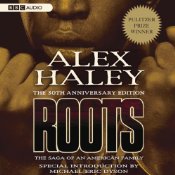
The book opens with Kunta’s birth in the small village of Juffure in the Gambia in the 1700s. The description of family and village life as he grows up is fascinating. Everyone has a responsibility: the youngest boys greet visitors passing the traveler’s tree and invite them in; boys a little older herd goats;, after “manhood training” they go on to other responsibilities, until they’ve established a home, built up their flock of goats and land, and desire to marry. The religion is primarily Islamic but some superstition is mixed in. At first it seemed kind of idyllic, but gradually the problems and dangers of life crowded in (drought, near-starvation before harvest, people disappearing, captured by slavers.) And some of the customs themselves seemed cruel. Men were not to show emotion, and when a boy excitedly runs to greet his father during manhood training, he is beaten. Children and wives could be beaten for many reasons. Women were even lower in social standing than teen-age boys. So it wasn’t perfect, but it was home, and there was much admirable about it outside of those things.

Knowing that Kunta was eventually going to be captured, every time he went off by himself I was afraid for him, and one of the saddest parts of the book is when he is actually captured by slavers. He endures a grueling and horrid few months in the hold of a ship with scores of others, chained together, eating poor food, being beaten at a whim, having to sit in their own filth with festering wounds, being at the mercy of disease that spreads rapidly in the close conditions.

When he is sold to a Virginia plantation owner, he makes several attempts to run away, but is captured and cruelly treated each time. The last time was especially horrid, and he is taken, bleeding and broken, to a doctor’s home, where the doctor and his maid nurse him back to health. The doctor eventually buys him from his first owner, who happens to be the doctor’s brother. The doctor is not what I would call a kind man, but life on his place is a heap better than the first place Kunta had been.

But Kunta holds himself aloof from the other slaves. He comes across as proud, and indeed he does look down on them because they don’t do things in the “superior” way he is accustomed to, but especially because they seem to have forgotten their heritage. But he can no longer run, and eventually he marries and has a child.

The rest of the book traces the next couple of generations and what happens to them, each of them passing down the story of their ancestor, Kunta.

The book is aptly named for several reasons: Kunta’s trying to hang on to his own roots, his ancestors passing down his story, the other blacks having forgotten theirs, and the setting of new roots down in this country.

One caveat: the book is very….frank about Kunta’s awareness of his budding sexuality as he grows up, and in its description of a couple of rapes and of one master’s leeriness. But I didn’t think any of it was meant to be sensationalized or titillating. It was just matter-of-fact.

Overall the book was wonderfully told, though heartbreaking in places.

The book was inspired by Alex Haley’s grandmother telling stories of her ancestors. He began to research and believed Kunta was his ancestor. That research is disputed now, but Haley defended it.

A shadow is cast over the book with the accusation of plagiarism. Haley first denied it, then settled in court and released a statement that he did use material from Harold Courlander’s book, The African.

I must say that Avery Brooks’ rich timbre greatly enhanced the audiobook. During the African section of the book, I almost felt like I was sitting on a log at the evening fires listening to a master storyteller passing along the oral traditions and history of the village’s forefathers, and then when Kunta is taken to Virginia, Brooks ably displays an amazing variety of Southern accents.

I’ve watched the first hour or so of the mini-series on YouTube. I definitely prefer the book so far. But I do hope to see it all at some point.

Back to the question: why does Kunta Kinte seem to be held in high esteem and Uncle Tom does not? I’ll be better able to think about this after I refresh my memory by rereading Uncle Tom’s Cabin in a few months, but I think it has a lot to do with the fact that Kunta never did fully settle in to life here, and he continued to have a hatred of white people (understandably). Uncle Tom, by contrast, was a Christian and as such was governed by admonitions to love his enemies and overcome evil with good. That looks like “kowtowing” to those who don’t understand, but the meekness of Uncle Tom is the same meekness Christ showed, not the meekness of a sycophant or of the conquered. There is a difference.

Interestingly, Kunta’s grandson married a Christian girl, and late in the book the story of Joseph in the Bible is a comfort to her and to others when she shares it.

(This review will also be linked to Semicolon‘s Saturday Review of Books.)