It’s Friday, time to look back over the blessings of the week with Susanne at Living to Tell the Story and other friends.
Here are some highlights of my week:
1. Feeling back to normal after the “procedure that wasn’t” last week. I was thinking I shouldn’t have much to recover from since they didn’t actually do the procedure, but I guess poking around in my heart for a couple of hours takes its toll.
2. Hospital discount. Forgot to mention this last week, but when we got a call for pregistration, we were told if we wanted to go ahead and pay our portion then, we’d get a 20% discount. Since we were still paying from our deductible before insurance kicked in, that helped quite a lot.
3. Nature’s Valley Protein Crunchy Granola with Peanut Butter and Dark Chocolate.
Saw this in the grocery store and decided to try it. Normally I don’t care for dark chocolate, but this is good. The protein helps with those low late morning or afternoon slumps.
4. A new pastor. Some of you may remember that our pastor passed away last September. We recently voted on a new pastor, and he accepted the position. He happens to be our former assistant pastor! Now we will need to look for a new assistant, but I am hoping that is not as long a process. Even though the leadership has been doing a great job — the church hasn’t just been sitting on the sidelines, but has been engaging in various ministries along the way — it does feel good to have a designated senior pastor to take the reins.
5. Jason and Mittu’s anniversary. Hard to believe it has been six years already, and this year has been momentous with a new job, having a preemie baby who is doing great, and a new home. We watched little Timothy while his mom and dad went out for dinner, and he did well. He’s such a joy!
This is going to be another of those “odds and ends” posts.
I tend to take a long time to make most any decision. When it comes to trends or decorating, by the time I decide I like something, then the trend has moved on and I can’t find those items and that color any more. I’ve been wanting to replace my bedspread/quilt, and wanted something in pink and blue. “Shabby chic” probably comes closest to the style I like best, though it doesn’t necessarily have to be in that exact genre. You used to be able to find that kind of thing, sprinkled with pink roses, in almost every store. My family has been asking me what I want for my upcoming birthday, and I thought this might be a good time to ask for a new bedspread or quilt. I’ve been searching online all over the place, and can’t find just what I want. Either the pinks are too peachy or red or too bright, or the designs are too little-girlish, or something. This one from Target has the right colors that I want, but I think I like a more orderly pattern. But I am thinking of going with that because it’s the closest I have found and because I think it is on its way out and I want to get it before it, too, is gone. I like this one, too, though it is a bit too reddish in places. I’ve even thought of maybe trying to venture out and make my own. But besides lamenting the time it would take, I can’t find what I want even in fabrics except on Etsy and Ebay in small pieces that get pretty expensive by the time you add shipping charges and such. Of course I am kicking myself for not getting one when I could find them everywhere.
Timothy likes to look at my cookbooks and pulled one out recently that I had forgotten about called Feed Me, I’m Yours by Vicki Lanksy, published in 1974. I had gotten it when my oldest was little, 30 years ago, but don’t remember how much I used it. Mostly it emphasizes creative but simple foods for kids at different stages. The main “enemy” at that time seemed to be refined sugars. It’s mainly recipes or ideas of what to try, but it has a few other tips in it. Mittu was perusing it after Timothy pulled it out and read out loud for us some of the more absurd advice. We were cracking up. One was, “When jam or jelly jars are almost empty, pour in cold milk. Shake and serve as a fruit-flavored drink.” I don’t guess anything is wrong with that, but it doesn’t sound very appetizing to me. Another I found odd was “For diaper rash, use your hair blower to warm a sore bottom.” But the weirdest was, “If your child won’t drink the needed liquids, try putting him/her into a clean tub of water equipped with a straw!” Bleah! I wouldn’t want my child drinking the same water he is sitting in! I did find there is an updated version of this book now: I’d be curious to know how it compares. It’s about 20 pages longer than the one I have.
I used to follow a few “homey” blogs, where the blogger just shared things she had done around her home, whether organizing, decorating, sewing, or crafts with an occasional tutorial. I found them inspiring for my own homemaking. Many of them have closed up shop. Some have taken down their blogs completely, others like The Sparrow’s Nest, have thankfully left them up but have not added to them in years. I’ve looked for some new ones, but the newer ones are too “professional.”
Speaking of closing up shop, 3 of my good blogs friends and most frequent commenters have closed and have taken or are about to take their blogs down soon. 😦 I am really, really going to miss their blogs.
Some weeks ago on a lengthy book review, I mentioned that I was thinking of posting just quick, short ones that didn’t take quite so much time so I could spend more time writing other things. Some of you graciously told me you liked the longer reviews, and I thank you for that. I decided to keep doing what I am doing in writing about books, partly because I am writing down the things I want to remember about them. I don’t know how many times I’ve thought about a book I read before blogging days and wish I had notes somewhere to remind me what it was about and what I thought of it.
I follow a couple of multi-author blogs, where a different Christian fiction author will post on different days. I was dismayed recently to see one author’s response to criticism about “PG-13” content in her books. I had, in fact, stopped reading her books over that issue. She had gotten some pretty harsh emails in response to this issue in her latest book. Of course, stating a problem in a harsh and attacking way rarely accomplishes anything except to make the other person feel wounded and defensive and close them off to hearing the issue. We need to “speak the truth in love.” Still, the first response to any criticism should be, “Is this valid? Is this something I should examine and pray over?” I didn’t see anything like that in the post or the comments. Most of the comments were along the line of, “Oh, you poor dear. You’re doing great: just ignore the stupid critics” and a plea for grace for both authors and characters. Though we definitely should extend grace, that doesn’t mean we never gently and kindly point out an area that might be going astray from what would truly honor the Lord. I tried to convey in what I hope was a kind way that I had a problem with that kind of content in books as well, that, yes, characters need to be flawed, but we can go too far in our descriptions, citing the Bible passages about David and Bathsheba and the simple man being tempted in Proverbs 7 as ways to convey exactly what was going on and what the problem was in a way that didn’t arouse the readers to lustful thoughts or pictures in their own minds. But apparently to no avail.
It’s hard to believe it’s “back to school” time already and still feels a little odd not to have kids in school any more. One of my favorite times when I was a student was getting supplies and get everything ready for class. One of life’s simple pleasures is a box of new crayons. 🙂 Though we have no students at this time, we’re still affected by the school schedule in living close to two school zones and having to try to remember not to venture that direction at certain times of the day unless we want to sit in our cars for a while. I’ve enjoyed the many “first day of school” pictures on Facebook. Wish I had thought to do that when mine were younger!
Though I am not really ready for summer to end, I am looking forward to some cooler weather hopefully in a few weeks.
You might think, from my remarks on Growing Up Amish, that I don’t read Amish fiction, and it is for those reasons that I don’t read much of it. But I was reading Beverly Lewis long before Amish fiction started exploding on the Christian fiction market. Since her books were based on or inspired by some of her grandmother’s experiences, and since she didn’t idealize the Amish lifestyle but delved into some of its problems and hardships, I’ve enjoyed all of her books that I have read. (Some other authors of Amish fiction may do the same, but I am not interested in expanding my reading of that genre.)
The River is about two sisters from an Amish family who had left the Amish years before to “go fancy” into the world of Englischers. They receive word from a brother that there is a celebration planned for their parents’ 50th wedding anniversary, and both sisters are invited. They’re not inclined to attend until they hear that their father has a serious heart condition and is resisting the idea of surgery. They decide to go, with some trepidation.
Tilly, the older sister, had left the Amish first. There had always been tension between her and her father, and when her youngest little sister, Anna, had drowned in a river, that tension was exacerbated because Tilly blamed herself for not watching her sister closely enough and felt her father blamed her as well. Her sister Ruthie left a few years later primarily due to a hard breakup with a beau. Since their leaving, Tilly married and had two children; Ruthie was single but actively involved in a good church.
As they return, Tilly has the harder time, feeling that she is blamed not only for Anna’s death, but also for influencing Ruthie away from the Amish. Her father is not hostile but is not welcoming, either. Ruthie runs into her old boyfriend and at first wants to avoid him, but then decides she should at least hear him out when he wants to talk with her. Both women struggle with the parts of their former lives that are good and familiar vs. the parts that are painful.
Strong themes in the book are the need to look at another person’s side of things and the need for forgiveness, both extending and receiving.
I very much enjoyed the book and felt the struggles that were faced were realistic.
Beverly mentioned in her note at the end that she had made a documentary called “Glimpses of Lancaster County.” Part 1 is here and Part 2 is here. Each is only a few minutes long. The end of Part 2 mentions a Part 3, but I didn’t see it on the site (later I did find Part 3 on YouTube.) It was enjoyable to hear Beverly describe her childhood, her grandmother who was shunned for marrying outside of her father’s will, and to see some of the places where she and her family grew up and where some scenes for her books take place.
For those who enjoy book trailers, here is the one for The River.
A Captain’s Duty: Somali Pirates, Navy Seals, and Dangerous Days at Sea by Richard Phillips first came to my attention through Lisa. I vaguely remembered this incident in 2009 and knew a movie had been based on it, which I’ve not seen. But I decided I wanted to read the story behind it.
Captain Phillips tells a bit of his own background and a bit of merchant marine history. I had a step-uncle in the merchant marines and didn’t know much about it, so I found this quite informative. I liked that Phillips read a lot of merchant marine history and regarded his position as not just a job to earn a paycheck and pay bills, but rather a continuation of that tradition. This information as well as some background into his family is told mostly in flashbacks in conjunction with getting ready for his next trip. He also tells of the danger of pirates, particularly in certain hot spots, but said there had not been an instance of pirates taking an American ship in 200 years. However, he notes, “Sailors are bringing the world’s most vital resource through the world’s most unstable region, which had turned the area around the Gulf of Aden and the Somali coast into a shooting gallery. Anyone sailing there would be under constant threat of attack from pirates, who were getting smarter and more violent by the month” (p. 26).
The chapters are set up in a countdown fashion leading up to the day the pirates did overtake his ship. He talks about training his men in what to do in case of a pirate attack and shoring up security. They had two uncanny close calls with pirates, and then, suddenly, when the Somali pirates did come after his ship, it happened incredibly fast. They had time to sound an alarm so that most of the men could go into a prearranged hiding place and so that Phillips could turn dials and switches that would disable the radar and many of the functions on the ship. They wanted as few people as possible to be visible so that the pirates could not kill them or hold them hostage.
The way it usually worked was that the pirates had a larger “mother ship” nearby which they could communicate with once a ship was taken, and negotiations would begin to demand a ransom. But Phillips had made it so that the radar wasn’t detecting their ship and had turned the radio channel so their hails were on a little-used frequency. He convinced them that many of the ship’s operations were broken and he couldn’t fix them and didn’t know where the rest of the crew was, and they believed him. They threatened to kill the four men on the bridge but did not carry out their threat after two deadlines, and finally stopped threatening. They took Phillips through the ship to try to find the missing crew, but he was able to keep them away from their hiding place, or, in a couple of instances, the one or two crewman who were at large heard them coming and hid in time. When they began taking the other crewmen on the bridge to do the same thing, those men were able to get away into hiding places of their own. Finally Phillips was able to convince the pirates to take the lifeboat, and him along with them. I had not realized that the bulk of this ordeal occurred with just Phillips and the pirates on the lifeboat, but he succeeded in getting ship and crew free.
The pirates thought they could still hold out for a ransom. They actually all got along pretty well, even joking together, until Phillips tried to escape. Then they turned on him, kept him tied up, and began beating him. After four more long days, Navy SEALs rescued him (no spoiler there since that was in the news. 🙂 ) In fact, during some of the tenser moments in the book, I had to keep reminding myself, “It’s going to be ok. He makes it our alive.”) The SEALs did admit, though, that the outcome was better than they thought it was going to be.
Phillips weaves in to the story what was going on with his wife and family during this situation as well, how friends came to be with his wife and help in various ways, how the media made a nuisance of itself by camping in front of their house.
Even knowing the outcome, this was a riveting story.
One major problem with the book, however, is a heavy smattering of bad language. I had set it aside for a time, not sure if I should go ahead with it. I finally decided to pick it back up again, and large chunks of it would be profanity-free, then I would be blasted with it again. Of course, it’s his story, and he is telling it like it happened. “Cussing like a sailor” is a known idiom, though I don’t know why they have a penchant for or think they’re free to engage in such speech. I know it’s real to the story: I just don’t like to fill my brain with it so that it comes into my own mind in tense moments.
I am always interested in the spiritual side of things, even though spirituality is not a major component of the book. Phillips and his wife were Catholics, but, by his admission, not good ones. He talks about being a believer in some sense of the word, and says that this incident helped his wife come back to her faith. He calls one of his crewman a born again Christian, so he seems to acknowledge that that’s something different from himself. He says he prayed:
“God, give me the strength and the patience to see my chance and to take it. I know I’m going to get only one shot. Give me the wisdom to know it.” I never prayed to get away. I just prayed for strength and patience and knowledge to know when to make my move. I believe God helps those who help themselves. Asking for Him to do all the work is just not my style (p. 191).
What a wonderful opportunity that would have been to completely humble himself and abandon himself to God. I’m glad he had the measure of faith he did and pray God will continue to grow it.
Another interesting thing he discusses near the end is what he calls “the H word: Hero.” He was very uncomfortable with people calling him that and noticed that other people in a similar position would also comment that they didn’t feel they were. I have noticed that, too, in those kinds of interviews. People will say things like, “I wasn’t a hero – I just did what I had to do.” Phillips theorizes that “we are stronger than we think we are” and we can handle far more than we think we can (p. 284). He feels that everyone has “this potential inside you, too. If fate put you in my shoes, you’d have done the same thing” (p. 285). He acknowledges that “mental toughness” and “training your mind never to give up” are a part of it (pp. 284-284).
I’ll close with one quote I especially liked that he opened the book with from John Paul Jones, who was also a merchant mariner and Revolutionary war hero:
If fear is cultivated, it will become stronger. If faith is cultivated, it will achieve mastery.
(This review will also be linked to Semicolon‘s Saturday Review of Books.)
It has been quite a while since I have been able to do one of these, but here are some posts I’ve found interesting the last few weeks. Maybe you’ll enjoy one or two of them as well:
It’s Friday, time to look back over the blessings of the week with Susanne at Living to Tell the Story and other friends.
This has been a full week. On Monday I was supposed to have a procedure to correct a misfiring nerve in my heart that caused rapid and irregular heartbeats. After hours of their attempts to stimulate my heart into the abnormal rhythm in the OR, most of which I had to be awake for, they found that the trouble was in a different area than they thought and required a longer and riskier procedure, so they were not able to do anything that day. I am supposed to see the doctor in a few weeks to discuss treatment options, which will probably include a new medication. It was tremendously disappointing, after finally deciding to have this surgery after 15+ years of putting it off, going through all the mental preparation for it, and looking forward to finally being done with, to find I not only wasn’t done with it but had something else to deal with. But still, there were good things about the week:
1. Peace that passes understanding. I had written before the surgery of several concerns I had, and usually any kind of medical appointment has my nerves stretched pretty taut. But none of the things I was concerned about were a problem, and God gave me a calmness that floored me and could only have come from Him.
2. Kind people. I mentioned in my post after the surgery that there were several kind people along the way, some of whom I only interacted with for a few moments, who were a great blessing. I loved Susan’s comment about letting that inspire her to see and be kind to people. A good reminder to me as well.
3. My wonderful family. My son and daughter-in-law brought dinner over Sunday and then spent Monday afternoon at our house making dinner for both Monday and Tuesday and cookies. Plus they brought me pink roses in this gorgeous vase:
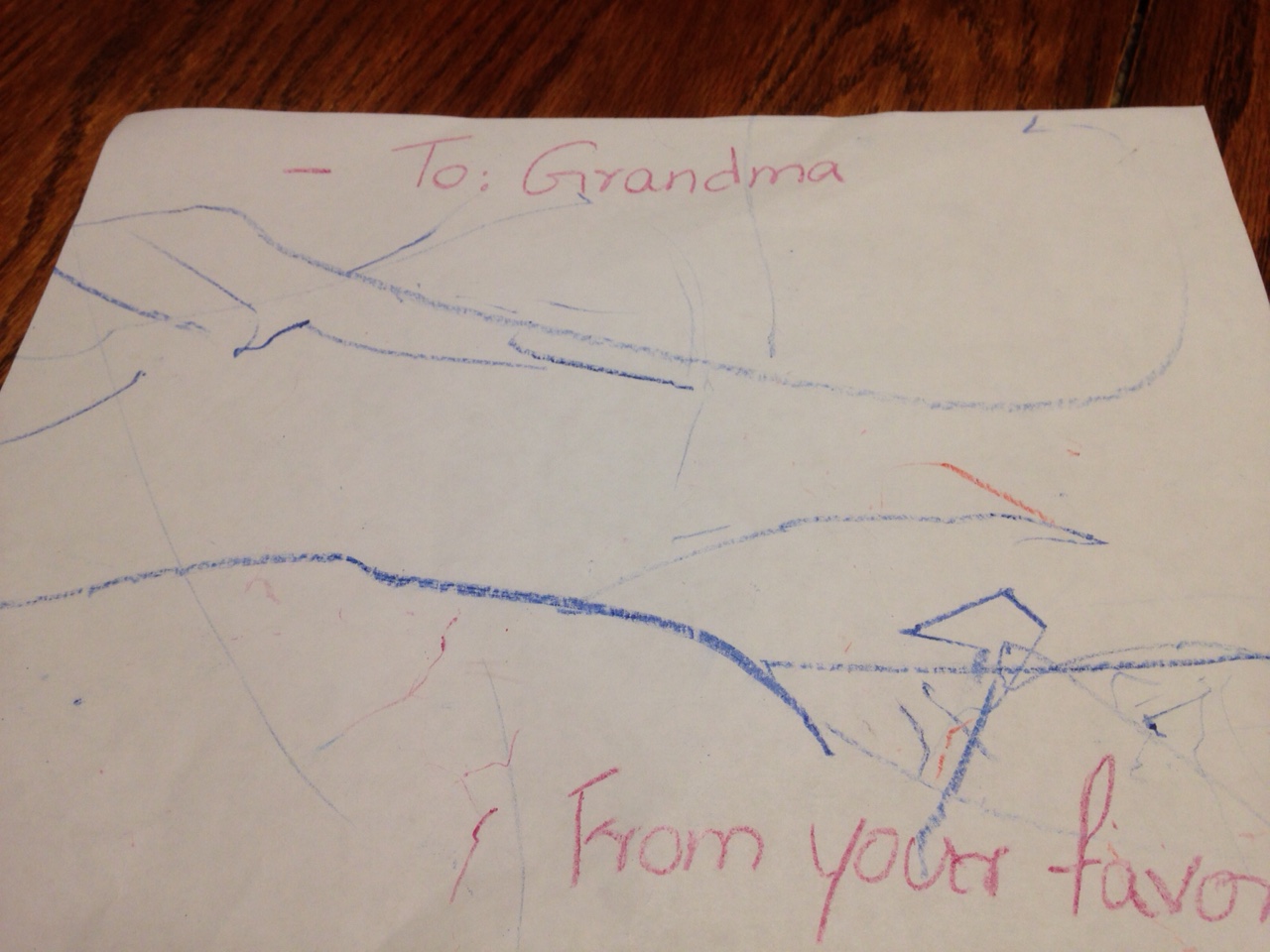
Timothy colored my first ever picture from him. 🙂
Jesse accompanied me to the store and has been doing things around the house requiring any heavy lifting, since I am not supposed to do that for a few days. And my dear husband patiently put up with my fears beforehand and my tears afterward, put Benadryl on my back where I had an allergic reaction to some adhesive, and has been doing a great job taking care of me in various ways. It was good to FaceTime with my oldest son, too, after getting home that night.
4. Timing. I didn’t set the date for this procedure–the doctor’s office did — but it was perfect timing. We had Jason’s birthday and move in the last couple of weeks and my oldest son’s coming for a visit and his birthday in the next couple of weeks, but this week there is nothing going on, so it has been a good time to take things a little easier.
5. My first ever chicken and dumplings. I don’t think I had ever made them before. A lady in one of our former churches used to make a great version and often brought them to potlucks and for meals when someone was sick. I think I was afraid mine would never live up to hers and I was afraid of the dumplings ending up totally mushy. But somehow this dish was just what I was in the mood for one night, and this recipe looked simple enough. I used frozen chicken tenderloins (love that I can cook them straight from the freezer), so that eliminated the tedious task of picking meat off bones. I thought it turned out pretty well, and husband and son seemed to like it ok. It hit that craving spot for me and was fairly easy as well.
My 9th blogging anniversary was at the end of July, but with everything going on, I didn’t really observe it except as a passing thought. Usually I do a giveaway or something on that day, but we’ll save it for next year’s 10th anniversary! Thank YOU for being a part of my blogging experience! Your kind comments have meant a great deal to me.
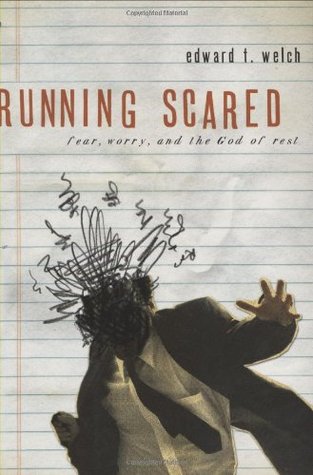
Edward T. Welch aims Running Scared: Fear, Worry, and the God of Rest primarily at himself as a “fear specialist,” but thankfully he lets us in on what he has learned. He notes that “Fear not” is the most often repeated command in the Bible and can be taken either as “a judicial warning, which has a threatening overtone” or as a “parental encouragement, which aims to comfort.” He says, “Luke places the accent on parental encouragement,” and Welch does as well. The thirty meditations are not an outline or in linear form — there’s a bit of overlap — but reading a chapter a day is doable and helps build on the principles he discusses.
The first couple of chapters set the scene, and, if you didn’t think you were fearful or had anything to worry about, these will convince you! One problem with dealing with fears in a conventional way is that they don’t usually submit to logic, and some techniques for dealing with them are only temporary and don’t get to the heart of the matter.
The heart of the matter, Welch asserts, is that our fears and worries reveal something to us about ourselves. Most of them focus on not getting something we think we need, or fearing something that might happen. Both involve a fear of not being in control and reveal what we value. So he encourages us to “Rather than minimize your fears, find more of them. Expose them to the light of day because the more you find, the more blessed you will be when you hear words of peace and comfort.”
“Worriers are visionaries without the optimism.” Most worriers would qualify as false prophets because our predictions don’t come true more often than not.
“The sheer number of times He speaks to your fears says that He cares much more than you know…The way He repeats Himself suggests that He understands how intractable fears and anxieties can be. He knows that a simple word will not banish our fears.”
“Search Scripture and find that our fears are not trivial to God. ‘Do not be afraid’ are not the words of a flesh-and-blood friend, a mere human like yourself. They are not the words of a fellow passenger on a sinking ship, who had no experience in shipwrecks, can’t swim, and has no plan. These words are more like those of captain who says, ‘Don’t be afraid. I know what to do.’ When the right person speaks these words you might be comforted.”
There is so much that is helpful in this book and so many places I have highlighted that it’s hard to know which ones to share without quoting half the book here. I’ll try to just share some of the things that were most helpful to me.
One was the “manna principle,” lessons drawn from God’s providing Israel with manna in the wilderness. One lesson was that the Israelites weren’t really models of prayer in that instance. They were complaining. That doesn’t give us the right to complain, but it does highlight the fact that God answers because of His grace, not because of “the quality of our prayers.” Another I shared earlier is that the Israelites were to gather what they needed for each day. If they tried to hoard enough to last, the excess would rot. So for us, we depend on God’s grace for each day’s needs. Most worry is about what is going to happen in the future, but Jesus said, “Therefore do not be anxious about tomorrow, for tomorrow will be anxious for itself. Sufficient for the day is its own trouble” (Matthew 6:34). That doesn’t mean we never plan ahead — there are Scripture verses about that, too — but we don’t worry or become anxious about them, trusting God will provide what is needed when the time comes. We won’t have grace for a future event because we don’t need it yet. Another was that the principle of Sabbath rest was built into their system and served, among other things, as a test of faith and a way to honor God and acknowledge His control. Just as they had to trust that the manna would be there every morning, they had to trust that when they gathered enough on Friday to last through the Sabbath, it wouldn’t rot like it usually did when they gathered extra. This is a principle largely lost on modern Christians. True, we’re not under the specific Sabbath restrictions that Israel was, but a Sabbath rest was exemplified by God in the first week of creation. Businesses feel they can’t afford to lose the business that they would if they were closed on Sundays, and individuals feel they can’t possibly get everything done they need to do if they take a day of rest. We don’t realize what we’re missing out on.
Another chapter, “The God of Suspense,” deals with the fact that sometimes God delivers before we even know we have a need, sometimes He seems to deliver at the last minute, and sometimes He delivers after the fact, “after hope dies,” as with the death of Lazarus and the widow’s son. In those cases. God had a greater purpose in mind: to show people that Christ had power over even death. He cites some cases in which the very thing someone feared came upon them (as Job said), and God didn’t deliver in the way hoped for, yet He did something greater in drawing the person closer to Himself and helping them know Him in ways they would not have otherwise. He cites many Biblical examples that God does not shield us from every hardship, but “If the difficulty you anticipate comes upon you, you will receive grace” to deal with it.
He talks a great deal about the Sermon on the Mount and being taken up with God’s kingdom:
Are you worried? Jesus says there is nothing to worry about. It isn’t our kingdom, it’s God’s. We take our cue from the King, and the King is not fretting over anything. He is in complete control.
When you know that the Kingdom is God’s alone (though He gives it to us), that is the only thing that can lead to peace and rest. Owners are the ones who do all the worrying; stewards simply listen to the owner’s desires and work to implement them. Owners are responsible for the outcome; stewards strive to be faithful.
A few more favorite quotes:
“Worry is focused inward. It prefers self-protection over trust…It can reveal that you love something more than Jesus. It crowds Jesus out of your life.” It can even “choke the word” of God in our lives (Mark 4:19), so it is nothing to be ignored or treated lightly. “Anxiety and worry are wake-up calls that must be handled by spiritual means.”
“Worry’s magnetic attraction can only be broken by a stronger attraction, and David is saying [in Psalm 27] we can only find that attraction in God Himself.”
“When you call out, you might feel like He isn’t present or easily found. That is the nature of pain. The worse it is, the more alone you feel. But this is a time when the words of God must override your feelings. There are times when we listen to our feelings and times when we don’t. This is a time when we don’t. Instead, whenever there is a clash between our sensory experience and the promises of God, the promises of God win. The one who says, ‘verily, verily’ can be trusted. Call out and He will be found when you need Him.”
Welch deals with not only the anxiety and worry over physical needs, like money and provision, but with personal needs like approval and love, fear of death and judgment. He discusses prayer and what it means to have died in Christ and what freedom that can bring us. He points to our need to find and focus on our calling from God, what God’s peace, or shalom, means, and His instructions to be peacemakers. In short, I think he pretty much covers every base he can think of that might be related to anxiety and worry and points us to Christ in each instance.
There were a few places I disagreed with him about some particular, but I don’t fell the need to delineate all of that here. Overall I found this one of the most helpful books I have ever read. I mentioned before that I had bought it as a Kindle sale and forgotten about it, then came across it about a month before my recent surgery and decided to read it in the days leading up to the procedure. Combined with the prayer of friends, it helped me keep my mind on God and off the “what ifs,” and I know I will return to it often in the future.
(This review will also be linked to Semicolon‘s Saturday Review of Books.)
Pygmalion by George Bernard Shaw wasn’t really on my radar, but one of the categories for the Back to the Classics Challenge was a play. At first all I could think of was Shakespeare, and I wasn’t quite up to him just now. Then, perusing a list of classic play titles, I saw Pygmalion. Perfect!
The play opens with a number of people in front of Covent Garden late on a rainy night. All different classes of people are represented here. Someone trying to find a cab runs into a flower girl and knocks her basket out of her hand, spilling her wares and thus ruining her income for the night. In trying to sell her flowers, someone points out a man taking notes. She fears he is with the police and starts protesting her innocence and right to be there. As it turns out, he is not with the police. He is Henry Higgens, a professor of phonetics who can tell everyone where they are from by their accent. One of the crowd is a Colonel Pickering, who, as a student of Sanskrit, had just come from India to confer with Higgens. In their conversation, Higgens remarks offhandedly that he could take the flower girl’s “depressing and disgusting sounds” that would “keep her in the gutter to the end of her days,” and within three months’ time pass her off as a duchess.
To his surprise and consternation, the flower girl. Eliza Doolittle, shows up at his house the next day to take him up on what she perceived as an offer. She’d like to work in a flower shop instead of on the streets, and needs to know how to talk better to do so. Pickering encourages Higgens to take her on, saying that if he can teach her to pass for a refined member of society by an ambassador’s garden party, he’ll pay for her lessons. Despite the protests of his housekeeper that “You can’t take a girl up like that as if you were picking up a pebble on the beach,” Higgens agrees.
Thus begins their work, with much clashing of wills and opinions, triumphs and not-quite triumphs. A couple of my favorites of the Professor’s instructions:
Remember that you are a human being with a soul and the divine gift of articulate speech: that your native language is the language of Shakespeare and Milton and The Bible; and don’t sit there crooning like a bilious pigeon.
Remember: that’s your handkerchief; and that’s your sleeve. Don’t mistake the one for the other if you wish to become a lady.
If you’ve ever seen the musical My Fair Lady, you may know that it is based on Pygmalion. The ending is vastly different, and the actual scene of Eliza’s ultimate test is shown in the film whereas it is only referred to in the book, but otherwise for the most part it follows the play pretty closely (at least as far as I can remember – I haven’t seen the musical in a long time). Pygmalion is based in turn on a Greek mythological character of the same name who falls in love with a statue he created and gets his wish for it to come to life.
The end of My Fair Lady has Eliza and Higgens falling in love: Pygmalion does not. In fact, the end of Pygmalion seems a little unsatisfying at first. I thought that was just because I was used to My Fair Lady’s ending, but according to a number of sources I read, many who produced or directed the play varied the end slightly to at least hint that Eliza and Higgens came to some understanding. Shaw got so disgusted that he wrote a very long afterward explaining why they could not possibly have married, whom she does marry, and what happens to the major characters after the end of the play. Though this Pygmalion does not fall in love with his creation, he does “bring her to life.” In one of their final scenes together, when they’re arguing over what’s to become of her now, she shows she has gone from simpering and whining about it to having a plan, even if it means standing up to Higgens. He replies, “It’s better than snivelling; better than fetching slippers and finding spectacles, isn’t it? By George, Eliza, I said I’d make a woman of you; and I have. I like you like this.” So if we can set aside the desire to see a “romantic” ending, it is a conclusive ending in that now his “creation” is truly complete. Cliff notes says:
Consequently, with the conflict clearly stated for Higgins, the essence of human life is through mutual improvement; for Eliza, it is through human loving and commitment — then only the most sloppy, sentimental reader could ever think that their relationship will ever change.
In Shaw’s afterward he says, “The rest of the story need not be shown in action, and indeed, would hardly need telling if our imaginations were not so enfeebled by their lazy dependence on the ready-makes and reach-me-downs of the ragshop in which Romance keeps its stock of ‘happy endings’ to misfit all stories.” SparkNotes suggests Shaw was trying to deconstruct the typical fairy tale. If he was, he did a good job. Henry Higgens is no Prince Charming. He’s gruff, conceited, ill-mannered and self-centered. Though Eliza is transformed, she’s not exactly a Cinderella. And their ending, if not “happily ever after,” is probably more realistic (“What is Eliza fairly sure to do when she is placed between Freddy and Higgins? Will she look forward to a lifetime of fetching Higgins’s slippers or to a lifetime of Freddy fetching hers?”)
Other sources say Pygmalion is a satire of the social classes, and I can see that angle, too, especially in the subplot with Eliza’s father. And though each class is shown to be ridiculous in some ways, Shaw makes some poignant observations as well. Eliza tells Colonel Pickering:
Your calling me Miss Doolittle…That was the beginning of self-respect for me. And there were a hundred little things you never noticed, because they came naturally to you. Things like standing up and taking off your hat and opening doors — yes, things that showed you thought and felt about me as if I were something better than a scullery maid…
The difference between a lady and a flower girl is not how she behaves, but how she’s treated. I shall always be a flower girl to Professor Higgens, because he always treats me as a flower girl, and always will; but I know I can be a lady to you, because you always treat me as a lady, and always will.
Shaw says in his preface, though, that it is primarily about speaking English and based on well-known phonetics specialists. He says, “The English have no respect for their language, and will not teach their children to speak it. They spell it so abominably that no man can teach himself what it sounds like…German and Spanish are accessible to foreigners: English is not accessible even to Englishmen. The reformer England needs today is an energetic phonetic enthusiast: that is why I have made such a one the hero of a popular play.” He says later:
I wish to boast that Pygmalion has been an extremely successful play all over Europe and North America as well as at home. It is so intensely and deliberately didactic, and its subject is esteemed so dry, that I delight in throwing it at the heads of the wiseacres who repeat the parrot cry that art should never be didactic. It goes to prove my contention that art should never be anything else.
As I said earlier, I had no thoughts of reading this play until I saw the title and thought it would be good for the Back to the Classics play category, and indeed it was. It was nice to have lighter fare after some longer and heavier works. Though I missed the musical numbers, I did enjoy finding out what the original story was like. I enjoyed listening to the audiobook delightfully read by a full cast but also got the free Kindle version to go back over some parts more thoroughly.
Some readers will want to know that it has a smattering of “damns” in it.
And even though these are not part of the original play, especially the last two, they’re on my mind after finishing the story, so I will share them here:
Thanks you so much for praying for the procedure that was scheduled yesterday, an ablation which was to correct supraventricular tachycardia. Unfortunately, they were not able to perform the ablation – as my oldest son said, they did everything for the procedure but that.
Before they can do the ablation, they have to “map” the heart and then try to stimulate it into an SVT rhythm. They did a number of things to try to do that, but it never would convert over. That was the worst part of the day because I had to be awake for it, and it was quite uncomfortable. They did send it into fast heartbeats and irregularities, but not an SVT. They had to shock my heart to set it back to a right rhythm, but thankfully they put me to sleep for that. The doctor did see that the problems were in the atrium, not the ventricle, which is a whole different set of risk factors, procedures, and treatment options. He said we’ll discuss those next time I see him, which, unfortunately, isn’t for about a month.
As you can imagine, I was profoundly disappointed. In fact, when they wheeled me back to a room, I was a blubbering mess, and the lady helping me told my husband I would be emotional for a while. I’m sure that was mainly disappointment, but the pent-up emotion of the day probably contributed, and I can’t help but think that emotion might be an aftermath of all that happened in the OR as well.
We’re left with more questions than answers now, like why did all those ER EKGs for years show SVTs if the problem was in the atrium? Do I have both, or were those wrong? I was Googling atrial tachycardia last night and found several places that said it was a type of SVT, which I don’t quite understand if the tachycardia is in the atrium and SVTs are ventricular. I’m not sure why they couldn’t go ahead and deal with that while they were in there, but he did say it was a different kind of surgery where I would be sedated the whole time. He told my husband they don’t usually do that surgery unless there were 3 risk factors: being female, having diabetes, and having high blood pressure. Of those, I only have one risk – being female. So hopefully we’ll get more answers when we talk with the doctor. I’m trying to write down my questions between now and then.
After all of that I had to lay on my back in a hospital room for 4 hours to make sure the areas where they inserted the catheters into the blood vessels weren’t going to start bleeding again. I ended up not getting home until about 9 p.m.
There were a few really nice people we met along the way. After we parked the car in the hospital parking lot, an open shuttle was right there, the driver asking if we wanted a ride to the entrance and wishing us well when he dropped us off. The man who came to take me to the OR was kind and kept cracking jokes. You have to be careful about that because some people in that situation would not be in the mood, but he kept saying unexpected things that cracked me up. The man who wheeled me out to the car was very kind. Unfortunately, in the OR everyone talked over me and to each other (about recipes, sound systems, etc.) rather than to me except one lady who was in charge of the different things that were put into the IV, and she explained things to me, answered questions, kept asking how I was doing, offered to scratch my nose if needed since I wasn’t supposed to move. I wished I’d had a chance to tell her how much I appreciated all she did. But it was just another reminder that even the seemingly small jobs, like driving a shuttle or transporting a patient, can make a big difference in someone’s day if done kindly and graciously and thoughtfully.
As to my other “issues” I asked you to pray about, I didn’t have any low blood sugar issues even though I didn’t eat for about 10 hours. I consider that something of a miracle! I had an IBS flare-up on Saturday, but nothing Monday. God gave me such a calm, I was in awe. It could only have come from Him. I am so thankful for His grace and the prayers of His people.
Another thing that helped was reading Running Scared: Fear, Worry, and the God of Rest by Edward T. Welch, which I mentioned before. I had finished it on Friday and Saturday and spent some time Saturday and Sunday going through and jotting notes from the chapters, and then Monday before leaving I spent some time looking through the passages I highlighted. In some ways it was mostly nothing new, though there were a couple of new ways to think about a couple of things. But going over and over those Scriptural principles helped me take my thoughts captive and keep my focus on the Lord and not on all the other things that could cause alarm. I am looking forward to reviewing it hopefully in the next few days.
My wonderful daughter-in-law and son brought dinner over Sunday and then made dinner for Monday and Tuesday while at our house on Monday. They stayed til we got back Monday night. I received my first picture from Timothy. 🙂
I have a few little restrictions over the next couple of days but after that should be back to “normal.”
Thanks so much for your prayers, your care, your comments on my previous post about the surgery. They meant much more than you can know.

 It’s Friday, time to look back over the blessings of the week with Susanne at Living to Tell the Story and other friends.







 Stray Thoughts