The Hidden Art of Homemaking, Chapter 13: Integration

We’re discussing The Hidden Art of Homemaking by Edith Schaeffer a chapter at a time at  The Hidden Art of Homemaking Book Club hosted by Cindy at Ordo Amoris.

The subject of Chapter 13 is integration, and though it is a vital subject, I wondered at first how Edith thought it fit in with the overall concept of creative homemaking.

She begins by quoting Revelation 7:9-10: “After this I beheld, and, lo, a great multitude, which no man could number, of all nations, and kindreds, and people, and tongues, stood before the throne, and before the Lamb, clothed with white robes, and palms in their hands;And cried with a loud voice, saying, Salvation to our God which sitteth upon the throne, and unto the Lamb.” At that time, the barriers of differing language and class will have been removed, there will be no more war, hostility, anger, or sin. Everyone who has been born again by faith in Jesus Christ as Savior will be perfectly integrated into one family, so it behooves us to start living that way now.

She quotes as well Mark 10:13-14: “And they brought young children to him, that he should touch them: and his disciples rebuked those that brought them. But when Jesus saw it, he was much displeased, and said unto them, Suffer the little children to come unto me, and forbid them not: for of such is the kingdom of God.” “The disciples were displaying an attitude which regards adults as more important, while children needed to be brushed aside. Jesus was quite definite not only that children could come to Him but that the disciples had it all backwards. The adults needed to come as the children come. It is the trust of a child for its father that is needed, the whole-hearted belief” (p. 198). She points out that at that time when we stand before God’s throne, every age will be represented as well.

“What has all this to do with creative living, as a Christian?” (p. 199). She posits that laws do not solve the problem. They may open doorways, a good beginning, but they cannot make a people truly integrated in heart.

“True integration is a matter of people really feeling a oneness with others and attempting to understand them in personal communication of the sort that takes place around the fireplace, washing dishes together, having tea together, eating together, walking together, discovering things in common together. True integration is a matter of people having spiritual communication and fellowship together, discussing and discovering new thoughts and ideas by sharing trends of thought, or thinking out loud and having some kind of creative activities or recreation together – by choice, not law” (p. 200).

Integration of age, too, can best be accomplished at home. I grew up in the “children should be seen and not heard” era, and while children do need to learn not to interrupt and that the conversation should not center around them all the time, they should also be included in the conversations. “Family occasions can be planned to include each member of the family: meals together during which the viewpoints and interests of the children are given a place and during which the world events discussed are not discussed as if the subject matter were high above their heads, with the adults being careful to explain, even to the five year old, what is being talked about. Opinions and reactions should be encouraged” among all the different ages and sexes present (p. 201).

I’m not of the opinion that children should never do things with others their own age, but I think all too often in our communities and churches we are separated by age and life situation too much. At one church we were in, there were programs for children through the sixth grade at each and every service, so that, if a family participated in all of them, their children would never be in “big church” with the adults until they were in junior high. We have no objection to Sunday School and children’s church – it is helpful at times for children to receive instruction on their level in a way that can handle their wiggliness – but we thought having them “out” at every service was overdoing it, and voiced that to the pastor. He said he understood, but he had parents begging him for these programs (it wasn’t the other adults wishing the church would do something with “those kids” – it was the parents.) That was so sad to me. When our boys were small, the nursery only went up to age 2, so at a very young age they started coming into the worship services. The parents with younger kids tended to sit in a section off to the back so as not to be a distraction, and we brought small notepads and pencils and such for the kids to “doodle” while the service was going on (it’s too much to expect a two year old to sit completely still for an hour and a half and listen, but on the other hand, they can learn to be relatively still and quiet with something to occupy their attention). Ours did fine with that. They loved to wave their arms while the songleader led singing, they played “preacher” at home (my husband even build a kid-sized pulpit for them to play church at home). Once when my oldest was drawing on his notepad, the pastor was preaching and asked a rhetorical question, and my son answered it out loud. That caused a few giggles in the area, but I was gratified that he was listening and taking things in even at a young age.

And though we’ve been blessed with good youth pastors and my kids have benefited from youth group, that can be overdone as well. I’d like to see more projects where the teens interact with other members of the congregation.

In the first church we attended when we were married, the adult Sunday Schools were divided by topic, and though people might tend to stay with the same group through different topics and teachers, people were free to go to whichever one they wanted. We had a wonderful mix of single adults, young married couples, middle aged, and older adults, which added a lot of depth to discussions. In most of the churches we have been in since, the adults are divided by age, and the “singles” are sent to their own class. In one church, a young married woman came to the ladies’ group meeting, saw that all the women there were older than she was, and she never came back. That really pierced my heart, especially as ladies’ groups I had been in before had had a great mix of ages and experience.

We tend to seek out people just like ourselves to extend friendship. That’s natural and there is not anything necessarily wrong with that, but we shouldn’t stop there: we should reach out to and interact with people of varying nationalities, skin colors, ages, life situations, etc. If we have a group of friends who are all young married couples, and one couple has a baby, they shouldn’t feel they don’t “belong” any more, the others shouldn’t feel they can no longer relate. Yes, there are changes that will come in, but that’s not a bad thing. That’s life. We shouldn’t regard the “singles” (I wish we could come up with a different name) as incomplete and not able to join in with the rest of the adults until they have a mate. Yes, there is some advantage in breaking off into different groups in like stages of life – the young adults having a camp-out, the teens going on a mission trip or having a fellowship, young moms getting together to encourage each other, etc. But we shouldn’t be totally segregated from anyone different from ourselves. We have much to learn from each other. I’ve often said that the older women teaching the younger as instructed in Titus 2 was probably not originally in classes and seminars (though there is nothing wrong with those occasionally), but rather they probably occurred in everyday life as the women did chores together, had each other over for meals, etc.

Here are a few other quotes from this chapter that stood out to me:

When you really get to know people, their hopes and fears, aspirations and disappointments, viewpoints and misunderstandings, there is a sympathy and a desire to help, a true compassion and love which begins to grow (p. 202).

The tight little segregated life, always spent with people your own age, economic group, educational background, and culture tends to bring an ingrown, static sort of condition. Fresh ideas, reality of communication and shared experiences will be sparks to light up fires of creativity, especially if the people spending time together are a true cross-section of ages, nationalities, kindred, and tongues (p. 202).

You do not have to be a delegate to an international gathering on a large scale to do something. The most real ‘something’ you can do is within the family unit, as you open it up to others, to a cross-section of ages and peoples, or the gathering together of community life on a small scale (p. 203).

There is no real possibility of an integration that is true and meaningful in the total sense unless it is based on the inner integration which God made possible through the Second Person of the Trinity, Jesus Christ. He died so that man might move out of his ‘segregated’ position, segregated from God, from other men, and even from himself in so many aspects, into true integration. This true integration comes only when man is integrated with the Trinity. Jesus becomes one’s Saviour, as one accepts that which He has done for man on the Cross. His death is not for ‘mankind’ as an impersonal whole, but for each individual who accepts Him. God the Father becomes one’s own Father at that time, and the Third Person of the Trinity, the Holy Spirit, indwells one, so that one is truly integrated with the whole Trinity. When this has happened, a man can be helped by the Trinity to find at least the beginning of a true integration with other people. We can have help in understanding others, loving them and communicating with them (p. 204).

I don’t know how the Christian community missed this for so long. All those parables Jesus told involving Samaritans, the times He went out of His way to minister to Samaritans, should have been a wake-up call when we realize the Samaritans and Jews were enemies, due at least partly, if not primarily, because of race. The racism that has run rampant, not just through the American South, but through the world, is a blight and should have no place in those who belong to Christ:

11 Therefore remember that at one time you Gentiles in the flesh, called “the uncircumcision” by what is called the circumcision [the Jews], which is made in the flesh by hands— 12 remember that you were at that time separated from Christ, alienated from the commonwealth of Israel and strangers to the covenants of promise, having no hope and without God in the world. 13 But now in Christ Jesus you who once were far off have been brought near by the blood of Christ. 14 For he himself is our peace, who has made us both one and has broken down in his flesh the dividing wall of hostility 15 by abolishing the law of commandments expressed in ordinances, that he might create in himself one new man in place of the two, so making peace, 16 and might reconcile us both to God in one body through the cross, thereby killing the hostility. 17 And he came and preached peace to you who were far off and peace to those who were near. 18 For through him we both have access in one Spirit to the Father. 19 So then you are no longer strangers and aliens,but you are fellow citizens with the saints and members of the household of God, 20 built on the foundation of the apostles and prophets, Christ Jesus himself being the cornerstone, 21 in whom the whole structure, being joined together, grows into a holy temple in the Lord. 22 In him you also are being built together into a dwelling place for God by the Spirit. (Ephesians 2:11-22, ESV).

The Mitford Books

Last December I reread, or rather, listened to a book I had previously read: At Home In Mitford by Jan Karon. I reviewed it here and then set off to listen to audiobook versions of the whole series. I found I wasn’t necessarily inclined to write a review of each one, though, I suppose because although there are movements of plot in each book, the overall people and themes are the same. So I decided at the end of the series I’d write one post summarizing each one.

I wrote previously that “I first encountered Jan Karon in the pages of Victoria magazine some years ago. Victoria chooses a “Writer-in-residence” whose work they showcase in each issue throughout the year, and Jan was featured one year. I loved her warmth and hominess and clear faith depicted — in fact, I was surprised and pleased that a secular magazine would feature a writer whose faith was integral to her stories. I believe it was there I also first heard of and then sought out Mitford.”

The series mainly follows the life of Father Tim Kavanagh, a sixty-something Episcopal priest, and the various characters in the fictional small town of Mitford, NC. Father Tim is a hard-working single priest, but in the first book an appealing single lady moves in next door, and though he thought he was a confirmed bachelor, he finds himself entranced but not sure what to do about it.

His flock consists of a number of memorable characters: his sometimes annoying secretary, Emma: Miss Sadie Baxter, town matriarch; LouElla, her companion; Uncle Billy Watson, resident joke-teller, perhaps to take the edge off of living with his wife of several decades, Miss Rose, who is schizophrenic but refuses to take her medicine; Esther Bolick, who expresses her love via her famed Orange Marmalade Cake; the “Turkey Club” he eats lunch with regularly at Percy Mosely’s Main Street Grill, the “man in the attic” (one of my favorite story lines), and a host of others.

Mitford is a typical small town where everyone knows everyone’s business, which can be a thorn in the flesh occasionally, but overall everyone genuinely cares. I think of it as something like Mayberry but not as corny. 🙂 Though every book contains some of the same familiar, comforting elements, the lives of the characters do progress: people fall in love, marry, babies are born, people face crises and grow and some die. Father Tim himself progresses over the series and deals with a couple of lifelong issues; his wife Cynthia is a bright spot in his life and helps him become less staid and more sure of himself.

The Mitford books were not marketed as Christian fiction that I remember, but there are ample amounts of Biblical truth and pure gospel woven in naturally.

So here are brief descriptions of each book in the series:

At Home in Mitford (reviewed here): Father Tim, the town, and its characters are introduced; a dog “as big as a Buick” finds and “adopts” Father Tim and becomes a pleasant companion; new neighbor Cynthia moves in next door; neglected orphan Dooley Barlow enters Father Tim’s previously quiet life.

A Light in the Window, reviewed here: Father Tim and Cynthia become more serious while a widow in town also sets her cap for Father Tim and he doubts whether he can give himself in marriage as he should; Miss Sadie takes an interest in helping Dooley, who is now living with Father Tim, by wanting to send him to a prep school out of town; the Main Street Grill is in danger of being closed; a very abrasive, rough around the edges construction supervisor, Buck Leeper, is in charge of the nursing home being built with Miss Sadie’s donated money.

A Common Life: The Wedding Story, not reviewed, was not published until after the next three books had been written, but fits in here in the story line. It is Father Tim and Cynthia’s wedding story, both sweet and comical.

These High Green Hills, not reviewed: Father Tim adjusts to marriage; a severely abused child ends up at Father Tim’s door; an unidentified burn victim is brought to the hospital; Dooley’s mother is found; a long-time Mitford resident dies.

Out to Canaan, not reviewed: Father Tim contemplates and prepares for retirement; Mayor Cunningham faces an unlikely opponent; a mysterious Florida corporation is trying to buy up Mitford property, including Miss Sadie’s Fernbank.

A New Song, not reviewed: Father Tim supplies a pulpit as an interim in Whitecap, an island on the NC coast, gets a disturbing phone call about Dooley back in Mitford, discovers a mysterious neighbor, and performs an unusual wedding.

In This Mountain, not reviewed: Father Tim deals with retirement and wonders what his life has been worth while his wife’s fame as an author and illustrator soars to new heights; neglect of his diabetes causes a major breakdown; a serious accident plunges Father Tim into a season of depression. Though this is a bit darker than the other books, it was still a very good read.

Shepherds Abiding, not reviewed: a lovely Christmas story dealing with many aspects of the season; Father Tim, who has worked with his mind most of his life, discovers the pleasure of working with his hands by restoring an old Nativity scene in a state of disrepair as a Christmas gift for his wife; bookstore owner Hope Winchester may have to close down and move, but then the possibility of may open new doors. (In the audiobook, smaller gift books Esther’s Gift and The Mitford Snowmen are also included.)

Light From Heaven, not reviewed: Father Tim and Cynthia “house sit” at Meadowgate Farms while dear friends, the Owens family, are away for several months; Father Tim is asked to revive a little mountain church and discovers another batch of unique characters: gentle Agnes and her deaf son, Clarence, who kept up the church building for years in faith that God would bring it back into use, invalid Dovie, crusty Jubal, and many others; Dooley, nearing the end of his college career, learns about an inheritance.

Throughout the books, too, each of Dooley’s lost siblings were found, though I neglected to note which one came in which book.

Two other things I loved about this series is that Karon weaves in a number of literary references throughout each book (some of the quotes are gathered into two separate books, Patches of Godlight (which I own) and A Continual Feast: Words of Comfort and Celebration (on my wish list), both in the style of Father Tim’s quote book), and that with just a few words she can set a scene that is very warm and homey.

The only real negative in the books was that many characters have a tendency to say “Good Lord!” or “Oh Lord,” which I perceive as taking the Lord’s name in vain, using something holy and glorious as an empty epithet. It’s tame compared to the type and amount of objectionable language found in many modern books, but still it rankles.

Some have felt that the series lagged a bit in the middle books, but I did not think so: there is enough sameness to keep it familiar but enough difference in each one to keep it moving and interesting. Probably the first one is my overall favorite, with These High Green Hills and In This Mountain tying for second, but I enjoyed each one.

The audiobooks I listened to were read by stage actor John McDonough. It took me a while to get into his style, but in some parts he reminded me of a beloved pastor from my teen and college years, and once I got into the stories I enjoyed his rendition very much. He did a wonderful job with the variety of voices and accents involved, and his voice will always embody Father Tim’s for me.

Finally, one last note, The Mitford Bedside Companion is a wonderful accompaniment to the books. In it, Karon tells how the Mitford stories came about (I was surprised to learn they started as a newspaper column), groups some favorite scenes from the book under different headings (characters, prayers, meal scenes, etc.), adds some essays, some recipes, trivia, a quiz, crossword puzzle, and a list of most commonly asked questions. I haven’t read all of it, but I have enjoyed dipping in at various places in it.

There are two more books concerning Father Tim, Home to Holly Springs, where he revisits his home town and comes to grips with events from his past, and In the Company of Others, (both linked to my reviews) about his and Cynthia’s long anticipated trip to Ireland, but they are listed as a separate Father Tim series rather than a continuation of the Mitford series, fitting since they take place away from Mitford with only a few references to some of the people. I would like to listen to them as well, but I think I’ll take a little break from Mitford for a while. I always enjoy visits there.

(This will also be linked to Semicolon‘s Saturday Review of Books.)

Book Review: The Magician’s Nephew

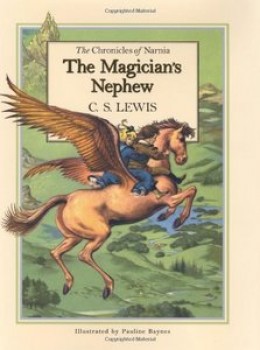
Magicians NephewI read The Magician’s Nephew by C. S. Lewis for Carrie‘s Chronicles of Narnia Reading Challenge. It’s the fifth book in order of publication but the first book in the Narnian time line. I liked reading it as the fifth book very much, and I’ll tell you why in a moment.

The story opens with two children, Digory and Polly, meeting. Polly lives in London, and Digory has just come there to stay with an aunt and uncle because his mother is very ill and his father is in India. Digory is not happy about leaving his pony and nice home in the country to come to London, and he is concerned about his mother, but after his meeting with Polly gets off to a shaky start, they become friends.

Digory’s uncle is thought by some to be mad, but if he’s not exactly mad, he’s at least strange. One day Digory and Polly go exploring in an attic corridor that seems to run along the length of the row of houses (the description of stepping on the rafters reminds me of a description of Lewis doing the same thing when he has a boy in a biography I read years ago – I don’t remember which one). They’re trying to get to an empty house to explore, but they miscalculate and find themselves in Uncle Andrew’s attic room. He dabbles in magic and has made some rings which he thinks sends people to other worlds – at least that seems to be what’s happened to the guinea pigs he has sent through. He suddenly sends Polly through and then manipulates Digory into going after her.

The children find themselves in what looks like a land of ancient ruins, where Digory inadvertently awakens an ancient evil, which follows them to London and causes a ruckus. In trying to get everyone back where they belong, they end up in an uninhabited world, and witness the creation of Narnia, beautifully and wonderfully described.

But they’ve brought the evil with them into the brand new world on its first day, which Aslan predicts will cause further evil later, but he promises to “see to it that the worst falls upon myself,” an echo of Christ’s taking the punishment for our evil on Himself.

More of those echoes to Biblical truth are found when Aslan breathes life into his creatures, when Aslan questions Digory as to how the evil came to be in Narnia, and Digory finds that Aslan won’t let him fudge the truth at all, when Digory concludes “the Lion was not at all the sort of person one could try to make bargains with,” with the freedom of choice that might lead to evil and its consequences, when Digory is sent to retrieve a particular apple from a particular tree enclosed by a particular gate and reads a sign that one must come through the gate, that stealing or climbing over the wall will lead one to despair, when Digory is tempted by forbeidden fruit, when Aslan welcomes him back from his quest with “Well done,” and probably in other ways as well which I am not remembering. With this book as well as the others, as Aslan told the children in Voyage of the Dawn-Treader, “You were brought to Narnia, that by knowing me here for a little, you may know me better there.”

I’m leaving our great chunks of the story on purpose so as not to spoil it for those who haven’t read it yet. But this book as well as the others leaves me with an appreciation of its underlying truths and a wistfulness for Narnia.

And personally, I think I got so much more out of this book reading it at this stage rather than the beginning because of the thrill and anticipation when I recognized certain connections – realizing just who the children were waking up, recognizing the lamppost in the woods as that lamppost, finding out who Digory turns out to be, etc.. If I had read this book first I think I would have had a hard time caring much about what was going on with Digory and Polly at the beginning: I even had to almost fight to care this time, even knowing, from having read the book before, where their adventures were going to lead. But I suppose people who read this book first might experience the same thrill of recognition when they get to The Lion, the Witch, and the Wardrobe. It’s just hard for me to fathom experiencing these stories without starting there.

I ended up loving this book much more than I thought I would at the beginning, and I’m very much looking forward to The Last Battle next.

(This will also be linked to Semicolon‘s Saturday Review of Books.)

The Hidden Art of Homemaking Book Club: Chapter 12: Clothing

We’re discussing The Hidden Art of Homemaking by Edith Schaeffer a chapter at a time at  The Hidden Art of Homemaking Book Club hosted by Cindy at Ordo Amoris.

Chapter 12 discusses clothing, and Edith brings out many important points to consider. Some consider certain colors or patterns to be wrong, some feel it is more spiritual to dress in styles just before the current times. For some time conservative Christians in my area looked like they stepped off the set of Little House on the Prairie. How does one discern what is truly pleasing to the Lord in our clothing?

Edith brings out first of all that Jesus said, “Consider the lilies how they grow: they toil not, they spin not; and yet I say unto you, that Solomon in all his glory was not arrayed like one of these. If then God so clothe the grass, which is to day in the field, and to morrow is cast into the oven; how much more will he clothe you, O ye of little faith?” (Luke 12:27-28). She then spends several paragraphs considering flowers of the field, their variety and beauty, and reasons that the God who designed them must not have intended for His children to be dressed dowdily. He who could have made the world simply utilitarian also made it beautiful and filled it with variety. She points out, too, that the Proverbs 31 woman “maketh herself coverings of tapestry; her clothing is silk and purple,” not burlap or drab attire.

These thoughts helped me as a newly saved young woman years ago when I struggled with some of these questions. I also struggled with whether it was right or wrong or “worldly” to want to be in style. Edith discusses that, too. She points out with a bit of humor that those who dress ten years behind the times to avoid worldliness don’t stop to consider that ten years ago others would have considered that style worldly. There was a time when it was risque to show ankles. There is nothing in the Bible that indicates dressing out of accord with one’s times is more spiritual and less worldly, and practically speaking, dressing in an obvious out-of-style way can cause more negative that positive attention for Christ. All things must be kept in balance, of course, and we have to be careful not to spend too much time, money, and attention on clothing. She is not advocating that we dump our wardrobe for a new one every season, and even if we need to go among those in a higher economic class than ourselves, we can dress tastefully without having to go buy a lot of expensive new items. (On the other hand, of course, sometimes what is in style can be immodest or inappropriate for a Christian. Modesty would be the higher principle here. We shouldn’t run after the latest styles just because they’re the latest styles if there is something wrong with them.)

If I can go off on a side trail here, I agree with her on this, but it has bothered me for a long time that the world in general or sometimes Christians in particular decide that a style is suddenly old and unworthy any more. For instance, some years ago someone called denim jumpers “home school mom’s uniforms,” and then suddenly it was uncool to wear denim jumpers. I loved them for their durability and continued to wear them until I couldn’t find them any more. When I was growing up, a “comb-over” was what we called the hairstyle when a balding man tried to comb a few strands of hair over his bald spot, but for a while it was what some people called it when a man parted his hair on the side, and it was deemed too conservative and straight-laced, We can be silly with some of this kind of thing, and we have to be careful not to judge people unfairly on one side or the other. But yes, I do think that dressing deliberately and obviously out of style and out of touch with the times is not something that in and of itself glorifies God.

Back to Edith’s book: she also discusses appropriateness and how it can vary depending on what country, area of the country, and community one lives in. She touches on modesty briefly, but not as much as I would have thought: she mainly advocates not dressing in a way that would tempt anyone else, and remembering Whom you represent. Those two principles taken seriously and thoughtfully would take care of much of the problem.

She also deals with pants, a big consideration in some conservative Christian circles. The first pastor I had as a Christian taught that Deuteronomy 22:5 (“The woman shall not wear that which pertaineth unto a man, neither shall a man put on a woman’s garment: for all that do so are abomination unto the Lord thy God.”) referred to women wearing pants. Around that time I saw a “Big Valley” episode in which it was scandalous when Audra wore pants, and I thought that sounded reasonable. Then I got to a Christian college, and one of my teachers pointed out that both men and women wore long, loose-fitting robes in those days. Hmm. Okay (though I am not entirely sure about that since the Bible also discusses “breeches“, at least for the priests, but that seems to have been worn under the robe anyway). And then, as Edith describes here, her father went as a missionary to China at a time when women wore trousers and men wore long tunics. Would it have helped or harmed the cause of Christ to cling to an understanding that women weren’t to wear pants in that context, especially when that passage is not talking about pants? The general principle carries over that men should dress obviously as men and women as women, but to distil this verse down just to wearing pants does it a disservice. For the record, I do wear dresses out of preference, and I think they are generally more modest: pants tend to outline everything you’ve got. I’ve seen more than I wanted to and more than I thought was appropriate via some women’s pants, though I admit I have also seen immodest dresses and very modest pants. I’ve worn pants during childbirth classes, and though I’m not a hiking or mountain climbing person, if I were, I’d have no trouble wearing modest pants for those activities or any other when they’d be more modest and appropriate than a dress. But I don’t judge those who are more comfortable wearing modest pants.

Overall I enjoyed this chapter, both the truths that Edith brought out as well as the balance.

The Hidden Art of Homemaking Book Club, Chapter 11: Creative Recreation

We’re discussing The Hidden Art of Homemaking by Edith Schaeffer a chapter at a time at  The Hidden Art of Homemaking Book Club hosted by Cindy at Ordo Amoris.

Chapter 11 is titled “Creative Recreation,” and I have to admit it rubbed me the wrong way in spots.

I like what Edith said in the beginning:

Creative recreation, in my personal definition, can be thought of in two ways. Firstly, it is recreation which produces creative results, stimulates creativity, refreshes one ideas and stirs one to “produce.” Secondly, it is recreation which is the result of original ideas, creative because someone has creatively planned an evening, a day, an occupation which in itself is fresh and different (p. 165).

No argument there.

People differ so tremendously in what recreation does for them that one could not give hard and fast rules as to what would stimulate creativity (p. 165).

Very much agree there.

My problem comes when she expresses her opinion that this is best done by getting away from everything and getting back to nature, and she gives various ways to do that.

I have never been an outdoorsy girl, not even since early childhood. My mom would have to “make” me go outside to play. Since we’ve had children, yes, we’ve played in the park, gone camping, had various forays to the beach, the lake, etc., and we’ve had some fun family times. But I can’t say that any of them, for me, served to “produce creative results, stimulate creativity, refresh one ideas and stir one to ‘produce.'” So the pages and pages of that just fell flat to me and even irritated me a little bit. I did feel very rested after one extended trip to the beach at a during a spring break when our school was on break on a different week than other area schools, and we had most of the place to ourselves. But most of my forays into nature are something I “endure” rather than something that produces creativity.

In various parts of the book she has used the word “plastic” a lot to refer to modern life, but here she takes it to new heights, even saying that “natural” fabrics give us more of a feel “of interacting with or relating to nature” because when we wear wool we think of sheep grazing, when we wear linen we think of flax growing, etc. Seriously? I admit I like cotton, but I don’t think of fields of cotton when I am wearing it. My husband has worked in the textile industry for most of his career, dealing mostly with fibers that result from petroleum manufacturing (which can be a pretty fascinating process). I guess you could say even that is “natural” in a way, though Edith probably would not, but I am not necessarily thinking about that when I appreciate my mixed blend of fibers which causes me not to have to iron my clothes.

I do agree with the need for conservationism, to “get away from it all” sometimes, etc., but I appreciate the conveniences of modern life too much to have much criticism of it. And I think even people who are more critical of it use a lot more of it than they think.

But enough of that.

I did like the section on the second part of her definition, “recreation which is the result of original ideas,” and her description of Treasure Hunt meals. And I agree that there are things we can do to foster or to kill creativity (or at least allow it to lay dormant), and it is better to do the former.

So, this has ended up being my least favorite chapter so far. I wish she had explored some other avenues of stimulating creativity. I would have to say that activities for me that do that are more likely to be reading, going to craft shows or stores, perusing Pinterest, even working on things with other people and being stimulated by their ideas.

Updated to add: Just to clarify, I’m not anti-nature. I can be inspired by and instructed by it and see God’s glory in it, even with the after-effects of man’s fall in it. It just doesn’t fit in with Edith’s description of creative recreation for me and I was frustrated that that’s the only avenue of creative recreation she discussed.

Through Gates of Splendor

Through Gates of Splendor by Elisabeth Elliot


Five missionaries working in different outposts in Ecuador in the early to mid-1950s became burdened for a tribe of killers known then as the Aucas. Early encounters with the white man had not gone well when the rubber hunters came to harvest while also “plundering and burning the Indian homes, raping, torturing, and enslaving the people” (p. 14). But the Aucas killed not only white men, but any outsiders and even their own people. “Could Christian love wipe out the memories of past treachery and brutality?” (p. 14). The missionaries hoped so and longed to be a part of reaching this tribe with the love and gospel of Christ. Upheld by the truth that “Thou wast slain, and hast redeemed us to God by thy blood out of every kindred, and tongue, and people, and nation” (Revelation 5:9b), they began to plan and strategize as to how best to reach these hostile people.

Through Gates of Splendor by Elisabeth Elliot is the story of how these five men came to the Lord, came to be called to the mission field, their marriages, and how each was led to become part of “Operation Auca.” It’s no spoiler to say the operation ended in the death of the five, because that fact was known long before the book came to be and was probably a great impetus in it’s writing. But then it is not right, either, to say that is how Operation Auca ended, because God used it in the lives of the Aucas themselves as well as of people all over the world in the decades since. But knowing how the story “ends” lends a poignancy to the men’s lives and words.

The five men were:

Nate Saint, a brilliant pilot whose dreams of flying the big planes was cut short by an illness, but who went on to become a pilot for Missionary Aviation Fellowship, bringing much-needed supplies, human contact, and medical help to missionaries in outpost stations. He had an ingenious engineer’s mind which he used to great effect solving problems and improving life, and a healthy balance between doing everything in his power to ensure success and safety yet trusting God for the outcome.

Jim Elliot, from Portland, OR, intense and passionate, had a burning desire to share Christ with those who had never heard of Him, yet also had a humorous side and felt with George MacDonald that “It is the heart that is not yet sure of its God that is afraid to laugh in His presence” (p. 17).

Pete Fleming, from Seattle, WA, quiet, studious, would probably have been a college professor if he had not felt called to the mission field.

Roger Youderian, of Louistown, MT, severely affected by polio as a child, was called to the missionary field while serving in the military.

Ed McCully, from Milwaukee, WI,  was planning to go to law school when a Bible study led him to abandon all to follow Christ wherever he might lead.

Even before Operation Auca was even remotely thought about, most of the men were willing to give themselves even unto death. Jim wrote in his journal:

“‘He makes His ministers a flame of fire.’ Am I ignitible? God deliver me from the dread asbestos of ‘other things.’ Saturate me with the oil of the Spirit that I may be a flame. But flame is transient, often short-lived. Canst thou bear this my soul – short life? In me there dwells the Spirit of the Great Short-Lived, whose zeal for God’s house consumed Him. ‘Make me Thy fuel, Flame of God.'” (p. 17).

Nate Saint, likewise, considered himself “expendable,” saying, “Every time I take off, I am ready to deliver up the life I owe to God” (p. 58), and Pete later wrote:

“I am longing now to reach the Aucas if God gives me the honor of proclaiming the Name among them…I would gladly give my life for that tribe if only to see an assembly of those proud, clever, smart people gathering around the table to honor the Son – gladly, gladly, gladly! What more could be given to a life?” (p. 26).

All of the wives, as well, were willing to live in “primitive” conditions and to be used in God’s service in whatever way He saw fit.

But they were not careless. Every step of Operation Auca was steeped in thought, discussion, sometimes disagreement, and prayer for the best outcome for all involved. And every step looked like it was going well.

What then led the Aucas then to kill the five men? When God opened the tribe to visits later, at first they said it was because they thought the men might be cannibals. In a later book I believe someone was told that the photographs the missionaries had scared them: they thought somehow it involved the soul of the person in the photograph. In Steve Saint’s more recent book, End of the Spear, he was told that an argument had broken out among the Auca men involving a woman, and one man wanted to prevent the bloodshed amongst the tribe and turned their anger towards the white men. It is possible that all of these factors played a part, or that as the Aucas (now known by their own name of Waodani [going by Steve’s spelling of it since he has worked with them for years, but I have also seen it as Huaorani or Waorani]) got to know white people and their language better, they may have felt more of a freedom of expression in later years that they did at first.

I first read this book in college, and the lives of these men and their wives and their dedication and love for the Lord touched me greatly. I have read it many times since, and it never fails to speak to me. The version I read this time is the same one I read in college, a brown around the edges 1977 fifth printing: the first printing was in 1956. It was interesting to see what I had underlined in previous readings and what stood out to me this time. It also touched off a lifetime of reading missionary biographies, reading just about everything Elisabeth Elliot has written and reading several other books about Operation Auca and the lives of those involved.

If you’d like to read more about any of these, I recommend the following:

  • The Dayuma Story by Rachel Saint, sister of pilot Nate Saint. Dayuma was the Auca girl who had escaped the tribe years earlier, taught the men Auca phrases, and later went back to share the gospel with her tribe.

I’m sure there are other books and biographies out there (I have one of Nate Saint on my bookshelf that I’ve not read yet). but these are the ones I have read. In addition, Elisabeth Elliot touches on the experiences of her time in the Ecuadorian jungle in several of her other books. One of my favorites is in The Savage My Kinsman when she quotes William Cullen Bryant’s poem, “To a Waterfowl,” and applies it to herself, especially the last line: “He, who, from zone to zone, Guides through the boundless sky thy certain flight, In the long way that I must tread alone, Will lead my steps aright.”

There are also several films and film clips of interest:

  • Through Gates of Splendor, narrated by Elisabeth Elliot, using footage that she, Nate Saint, and Life Magazine had taken.
  • A “This Is Your Life” feature of Rachel Saint, part 1 and 2.
  • End of the Spear” (linked to my thoughts), a feature film.
  • Beyond the Gates of Splendor, a documentary made 50 years after the events. This is one I would recommend above all the others if you only have time for one. It is in four parts on Vimeo (Part 1, 2, 3, and 4), but I found the audio a bit hard to hear.

There are also several videos of Steve Saint speaking with Mincaye, one of the killers who eventually became a surrogate grandfather to Steve’s children. Talk about grace!

I wanted to say just a word, too, to those who criticize missionary efforts and who believe that primitive tribes should be left as they are. By the Waodani’s own admission, the tribe probably would have become extinct now if someone had not come to tell them of a better way of life. Why would anyone want to deny them that? In Spirit of the Rainforest (different people and field, but also a primitive tribe) this rather lengthy quote explains some of their feelings (I started just to link to it, but I feel it is so important that I copied it here):

“The naba wants to know why you want to change the way you live out here in the jungle,” Keleewa said to Hairy after Doesn’t-Miss talked.

Hairy was surprised at the question. “Because we’re miserable out here. We are miserable all the time. The people from Honey [predominantly Christian village] came here and made peace with us many seasons ago and their village keeps getting better. We want that for us. If it means throwing spirits away and getting new ones, we will do it. [This is not something said lightly. Many were under the impression that they would be killed if they tried to get rid of their spirits.] But we need someone to teach us these new ways.”

Hairy didn’t have spirits because he was not a shaman. But he followed everything the spirits told his shaman. I knew my spirits would be very irritated if Hairy quit following the spirits. No one who has killed as often and as long s Hairy could ever stop it…

Doesn’t Miss talked with Keleewa for a while. Keleewa paused and thought how to say what the naba said. Then he told Hairy, “He says there are many people in his land that don’t think that he, or any of us, should be here helping you at all. They say that you’re happy here and that we should leave you alone. He wants to know what an experienced killer like you would say to them.”

Hairy grew even more serious. “I say to you, please don’t listen to the people who say that. We need help so bad. We are so miserable here and out misery never stops. Night and day it goes on. Do those people think we don’t suffer when bugs bite us? If they think this is such a happy place out here in the jungle, why aren’t they moving here to enjoy this beautiful life with us?”

Doesn’t-Miss was quiet. Then he got out of his hammock and walked down the trail…When he was too far away to hear, Hairy said to Keleewa, “Is he stupid? Doesn’t he have eyes? Can’t he see these lean-tos we call houses? Can’t he see us roam the jungle every day, searching for food that isn’t here, so we can starve slower? Can’t he see that our village is almost gone, that this move we are making now is our last hope to stay alive?”

Keleewa was slow to answer. He knew Hairy wouldn’t understand what he was about to say. “Most nabas think just like him,” Keleewa told Hairy, and shook his head because he knew he couldn’t explain why.

“Nobody’s that stupid,” Hairy snapped. “They must hate us. They think we’re animals” (pp. 180-183).

I said in an earlier post:

Why would even any non-Christian want to see a whole people group extinguished due to infighting or disease? Especially these days when we clamor to save the spotted owl and other endangered species? Shouldn’t endangered people be at least equally as important as endangered animals?

Would anyone in their right minds really want such practices as burying a widow along with her husband or killing twins or deformed babies to continue? So many primitive tribes practice these kinds of things.

Why deny these people the choice of hearing that there are other ways? Why not allow them to hear the gospel and let them make their own choice? So many who bask in the multitudes of freedoms we have here in the US would rather keep people like this in darkness in the name of preserving their culture. Most missionaries I know of these days consciously and conscientiously try not to “Americanize” the native churches but rather try to respect their culture and form churches within that culture while introducing healthier ways of living and civil practices. Who could possibly have a problem with that?

Thank you, Carrie, for allowing me to choose this book for  the Reading to Know Book Club in a year of featuring classics. It truly is a Christian and a missionary classic, and I am glad folks are revisiting it or discovering it for the first time.

Reading to Know - Book ClubI’ll leave you with the song the men sang the night before they launched “Operation Auca,” and from which the title of the book is taken (words and thoughts are here.)

(This will also be linked to Semicolon‘s Saturday Review of Books.)

And Carol‘s Books You Loved.

Books you loved 4

The Hidden Art of Homemaking Book Club: Chapter 10, Drama

Chapter 10 of The Hidden Art of Homemaking by Edith Schaeffer, which we’re discussing a chapter at a time at  The Hidden Art of Homemaking Book Club hosted by Cindy at Ordo Amoris, is about drama.

I didn’t think I would get much out of this chapter. I have little if any ability in regard to acting anything out. I remember one night at church when I was a child and we were supposed to be acting out a scene from the Bible where people were mourning (I think maybe the widow in the New Testament whose son had died whom Jesus raised to life). We either had veils or handkerchiefs – I remember all that showed for us “mourners” was our eyes, and I couldn’t stop giggling, but that left me red-faced and teary, so I suppose it had the same effect. 🙂 I tried maybe once doing a skit in college and was miserable at it. It’s hard for me to keep a straight face even when as a family we are trying to surprise or put something over on someone.

I also wasn’t sure how Edith would incorporate drama into home life. I can see its use in the church or in Christian ministry, but in the home, at first the only application I could think of was in reading aloud to children. And that’s primarily what she talked about, though she ventured into some discussions of the value of reading books, different types of books to read, etc.

Some of my favorite times with my children when they were young were when I read stories out loud to them, and though I’m not great at doing different voices for different characters, I made an attempt and also tried to convey the different emotions of what we were reading. I agree with much of she she said when one has young children, but if no one is interested as they all get older, if no one besides Mom would enjoy reading a book aloud together, then there is not much else one can do with that, at least until grandchildren come along. The Christian school where we used to live they did have moms and grandmothers come for class library times to read stories aloud for the elementary classes instead of the librarian always doing that.

I’m surprised she didn’t venture into other areas that could use dramatic talent. One family in a former church had a mom who was very dramatic, and she was frequently asked to take on a character for cantatas or dramatic productions at church, and she and various members of her family were involved in a local community theater: she was the White Witch in The Lion, the Witch, and the Wardrobe, and I think one of her daughters was Lucy, and the whole family as well as several church members enjoyed seeing them do that. I think of Little Women and the various plays they put on, little puppets, even finger puppets, that we used with our children, pretending their stuffed animals were speaking to them or acting something out, etc. At lot of their play involved acting our various scenarios: school, church, etc.

There are various ways to incorporate drama into family life, even for those of us who don’t necessarily have any latent dramatic longings such as she describes in the first few paragraphs. It can definitely be used for fun, but even reading the Bible aloud can and should be done, yet not overdone, with feeling rather than in a deadpan monotone.

So I did end up having my imagination sparked and getting more out of this chapter than I thought I would.

What’s on Your Nightstand: June 2013

What's On Your NightstandThe folks at 5 Minutes For Books host What’s On Your Nightstand? the fourth Tuesday of each month in which we can share about the books we have been reading and/or plan to read.

It’s months like these when the fourth Tuesday occurs when there are several days of the month left that tend to throw me, but thankfully I did remember. It’s been a busy month (seems like I always say that…) with two sets of company, but I did get some reading in.

Since last time I finished:

Island of the Blue Dolphins, by Scott O’Dell for Carrie’s Reading to Know Book Club for May, reviewed here.

The Greatest Thing in the World by Henry Drummond, a closer look at I Corinthians 13. It’s a very short book: I should try to read it once a month or so for a while.

Bonhoeffer: Pastor, Martyr, Prophet, Spy by Eric Metaxas. I finished listening to the audiobook but I was going through the Kindle version as well (both were on sale around the same time) to highlight some things, and have not finished that yet. Hope to get my thoughts together for a review soon.

The Merchant’s Daughter by Melanie Dickerson, based loosely on Beauty and the Beast, reviewed here. Liked this one very much.

The Duet by Robert Elmer, about two older people who are complete opposites in many ways but are attracted to each other, reviewed here. Not wowed by it, but it was pleasant.

The Incorrigible Children of Ashton Place, Book 1: The Mysterious Howling by Maryrose Wood, reviewed here. This was quite fun, especially the audiobook version read by Katherine Kellgren.

I’m currently reading:

Through Gates of Splendor, by Elizabeth Elliot, a missionary classic, for Carrie’s Reading to Know Book Club for June, selected by myself.

Light From Heaven by Jan Karon, last of the Mitford series, via audiobook.

The Hidden Art of Homemaking by Edith Schaeffer along with Cindy at Ordo Amoris who is hosting a read-along book club where we discuss a chapter at a time. My discussions are here.

Next up:

Invisible by Ginny Yttrup. Her first novel Words was one of my favorites of 2011, so I have have high hopes for this one.

The Incorrigible Children of Ashton Place, Book II: The Hidden Gallery by Maryrose Wood.

The Magician’s Nephew and The Last Battle by C. S. Lewis for Carrie‘s Chronicles of Narnia Reading Challenge

Possibly The Wind in the Willows for Carrie’s Reading to Know Book Club for July. I saw a video of it some time ago that I didn’t really care for, but that may not be the story’s fault. I might give it a try.

After that, I’m not sure, but I have a few books stacked on my Nightstand and scores downloaded into my Kindle app to choose from.

Book Review: The Duet

DuetIn The Duet by Robert Elmer, Gerrit Appeldoorn is a widower who is supposed to be retired from his dairy farm in the primarily Dutch community of Van Dalen, Washington. But he struggles trying to figure out what he is supposed to do with himself, especially when his son, who has taken over the farm, fusses at him every time he tries to do any of his old chores.

One day he meets his granddaughter’s new piano teacher, widow Joan Horton, and is instantly attracted. Their many differences cause sparks to fly at first: he is staunchly Calvinistic and opinionated, has rarely been outside Van Dalen, and spent most of his life with mud on his boots. She is a Nazarene, citified, not Dutch, refined, a world traveler, on her way to becoming a department head in her university.

In addition, each faces various problems with a son and a major crisis.

I had picked this up because I loved Robert Elmer’s Wildflowers of Terezin (linked to my review) and wanted to check out another of his books. This one has its sweet moments, and I love when a love story involves someone other than the young, svelte, and beautiful, but I didn’t like it quite as well as Wildflowers. Maybe that’s because I found nothing in Gerrit that was appealing to me except his relationship with his granddaughter. But it was a pleasant read and one I wouldn’t hesitate to recommend.

(This will also be linked to Semicolon‘s Saturday Review of Books.)

The Hidden Art of Homemaking Book Club: Chapter 9: Writing – Prose and Poetry

Chapter 9 of The Hidden Art of Homemaking by Edith Schaeffer, which we’re discussing a chapter at a time at  The Hidden Art of Homemaking Book Club hosted by Cindy at Ordo Amoris, is about writing.

I’m a little late reading and discussing it this week because we had family here until yesterday, but this is one chapter I did not want to miss.

I’ve enjoyed writing since I was very young: poetry as a child and teen-ager, various journals (which I am grieved to say I threw away in my teens), letters, a handful of magazine articles, a few magazine columns, several years’ worth of monthly newsletters for a church ladies’ group, and a nearly 7 year old blog. I’ve always enjoyed expressing myself in that way, and find I can think things through more easily by writing about them. It’s hard to work through a swirling tangle of thoughts, and by writing I can take a strand at a time, pin it down, and then sort through them all.

I’ve often wondered if God might have something more for me to do with writing. For years I’ve had a desire to write a book, but I don’t know if that’s just a personal ambition or something from the Lord. Edith encouraged me by saying, “Writing for the enjoyment of expression – like music or painting – does not need an audience of more than one,” and “If you simply love to write and want to do it, my advice is write. But write without ambitious pride, which makes you feel it is a ‘waste’ to write what will never be published. Write to communicate to someone, even if it is literally only one person. It is not a waste to write beautiful prose or poetry for one person’s eyes alone! (p. 136).

She mentions several homey ways to write: notes in lunchboxes, cards, letters, writing out our prayers and praises to God, etc. She challenges us to write not just for people whose views are similar to our own. I love her description of trying to “formulate something in writing which will give them the feeling that they have been spending the evening with you, toasting their toes at the same fireplace with a pot of steaming tea by their sides while you have talked earnestly to them” (pp. 137-138).

She encourages us, too, that not everything we write will be a “masterpiece,” or “accomplish its purpose, and more than each meal is going to be the ‘perfect meal’ or each painting the ‘perfect painting,'” but each time we write we can do so “in a way which comes across as giving of oneself” (p. 140).

I received a thoughtful, handwritten thank you note this morning, a treasure in this electronic age, and can enjoy the reading of it over and over and the remembrance of my friend and our time together. Some of my treasures are letters, especially those from my mom, who did not write much (she preferred calling to writing), especially now that she has passed on. I have little from my maternal grandmother, who dies when I was four, besides two handwritten recipes, another treasure.

I was reminded, while reading this chapter, that Laura Ingalls Wilder and other writers didn’t start until later in life, and that she wrote magazine columns before books. That encourages me that sometimes things that have to be left on the back burner are more flavorful for their time there. Isobel Kuhn, a very expressive writer, began by writing “circular letters” of the people they ministered to in China for their supporters, lively descriptions rather than bare-faced facts and figures, and out of that grew her writing of several books. That encourages me that writing “where we are” can develop the skills for a wider audience later.

So I am encouraged and refocused, to write as unto Him, to write as giving of myself, to write to encourage others, to write earnestly so as to make the other feel they’re right beside me, and to trust Him for leading, guidance, and grace to write in whatever venues He provides.

And I am so very glad God communicated to us through writing, through the written Word and the Living Word.