The Hidden Art of Homemaking Book Club: Chapter 2: “What Is Hidden Art?”

Photo Sharing and Video Hosting at Photobucket

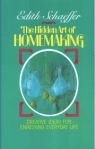
It’s Week 2 of  The Hidden Art of Homemaking Book Club hosted by Cindy at Ordo Amoris where we’re discussing Edith Schaeffer’s book, The Hidden Art of Homemaking, a chapter at a time.

Chapter 2 is “What Is Hidden Art?” Edith defines it as art found in the “minor” or “everyday” areas of life rather than art as one’s occupation or profession. Because we have different gifts and interests, the “hidden art” in each of our lives might look a little different. Because we have multiple demands on our time, no one can do it all. But incorporating some degree of artistry and creativity will require some discipline and prioritizing:

“All art involves conscious discipline. If one is going to paint, do sculpture, design a building or write a book, it will involve discipline in time and energy — or there would never be any production at all to be seen, felt or enjoyed by ourselves or others. To develop ‘Hidden Art’ will also, of course, take time and energy – and the balance of the use of time is a constant individual problem for all of us: what to do, and what to leave undone. One is always having to neglect one thing in order to give precedence to something else. The question is one of priorities” (p. 32).

But the discipline and prioritizing are worth it.

“It is true that all men are created in the image of God, but Christians are supposed to be conscious of that fact, and being conscious of it should recognize the importance of living artistically, aesthetically, and creatively, as creative creatures of the Creator. If we have been created in the image of an Artist, then we should look for expressions of artistry, and be sensitive to beauty, responsive to what has been created for us” (p. 32).

That doesn’t mean we can or should “drop everything to concentrate on trying to develop into great artists” (p. 32), nor does it necessarily mean we need to take courses in Art, which can sometimes discourage, making us feel “‘outside’ the magic circle of the talented” (p. 33). But we begin to develop an eye for seeing the artistic and then incorporating it in everyday ways.

I loved this chapter on many levels. I liked the encouragement to seek the beauty in everyday life as well as the acknowledgement that we’re limited in what we can do, and that’s ok.

In the “middle age” of life I’m in now, those limitations actually help provide focus. For instance, I’d love to learn how to play an instrument. I know I could take lessons even now in my mid-50s (I know an 84-year-old who takes lessons!) But I’ve sometimes said I have enough things I want to do to keep me occupied til I’m over 100. The time it would take to practice and learn an instrument well enough to begin to enjoy it is time I’d rather spend in other pursuits right now (though sometimes I’m still tempted!)

But though lessons of some kind can be beneficial and enjoyable, the focus of this book is more on little touches and everyday ways to incorporate creativity. I’m looking forward to the next chapters!

There is a Hidden Art of Homemaking Pinterest Board where members have been posting some of the everyday beauty in their lives, mostly outdoors shots so far. Here are some from around the house (some current, some past):

 photo CIMG5810.jpg

CIMG1857

CIMG1855

CIMG0112-1

You can find others’ thoughts on Chapter 2 here. Normally the link-up post is on Tuesdays. My Tuesday this week was taken up with hubby’s surgery for a detached retina, but I hope to be posting these chapters on or before Tuesdays from here on out.

Book Review: Comforts From Romans

ComfortsComforts From Romans: Celebrating the Gospel One Day at a Time by Elyse Fitzpatrick wasn’t originally on my radar, but I saw that the True Woman site would be going through Romans 1-8 in the four weeks preceding Easter, using this book as a supplement. I had been wanting to do something a little different in my pre-Easter reading, and I had been wanting to read something by Elyse Fitzpatrick, so I ordered the book. In the meantime, I decided to do a different reading plan for Easter, so I saved this book for afterward and caught up with the weekly discussion about it at True Woman (under Romans Reboot).

The book is not a thorough exegesis or commentary of all of Romans 1-8, but rather a “devotional taste” of its truths. Elyse mainly just pulls out those parts of it dealing with “the absolutely shocking message of grace” (p. 13). The gospel isn’t just for the obtaining salvation at the beginning of our Christian lives: we need to hear it and think about it daily. Why? To stir up praise and gratitude to God for it, but also to remind ourselves, because we’re too prone to forgetting that our relationship with God is based on Jesus’ righteousness and not our own even after salvation.

If you’re familiar with Romans at all, you know that the first three chapters start with very bad news: the fact that we are all sinful, that our sin deserves judgment from God, and there is nothing we can do in ourselves to deliver ourselves. Even if we could perfectly obey every command of God from here on out (and we can’t), that won’t erase the sin we’ve committed up to now. It’s hopeless — which is why the gospel is very good news: Jesus kept every law of God in our place, and because He was perfectly righteous and the eternal Son of God, He was the only One who could take our sin and punishment in our place so that we could be saved when we believe in Him. Elyse discusses all of these factors in more detail: our “ruined righteousness,” our inability to keep God’s law, the great grace of God in Jesus Christ, what He accomplished in our salvation, and the implications of grace in our everyday lives. It is very refreshing and encouraging: even having known these truths for decades, it has been good to meditate on them again, to be reminded of the freedom we have in Christ.

One aspect of that freedom that particularly resonated with me was when she discussed receiving an email from a friend about something she had done wrong. Elyse writes that she was able to receive the criticism, acknowledge its truth, confess and apologize for it without negative feelings for the messenger: “Because the gospel tells me that I am more sinful and flawed than I ever dared believe, I am no longer entrapped in trying to prop up my former flawed identity…I can freely admit my failure without needing to cover up, be defensive, or beat myself up…Rather than raking myself over the coals, wondering, How could I be such an idiot and sin like this? I am now free to say, Of course I sinned like this! It’s just God’s grace that I don’t get e-mails like this every day! I am, after all, a very great sinner…but I’ve got a very great Savior” (pp 79-80).

There are a few places I have some quibbles with. One is in an otherwise very good series of chapters about “One Man’s Obedience,” Jesus’s having fulfilled all of God’s law perfectly every single day of His life. How He interacted with His siblings is conjecture, of course, since the Bible doesn’t say much about His childhood, but we can imagine what He must have encountered showing love to His siblings, yet being laughed at, misunderstood, sinned against, and so on. When she gets to His baptism, however, she says, “At that moment He knew without question who He was and why He’d come” (p. 86). I don’t think He doubted it or didn’t know until then: I don’t think His Father’s voice saying, “This is my beloved Son with whom I am well pleased” was meant to reassure Him, but rather to be a testimony to those witnessing it. She goes on to say that “The Spirit, His Spirit, was finally released and flew to Him like a dove, granting Him the power to live and die and rise again.” I don’t think that’s what the Spirit was doing, but what exactly was going on and signified at Christ’s baptism is a discussion for another time, and I do understand good people can differ in their opinions about it.

In another place, she’s discussing the righteousness we have in Christ and the joy we should feel because of it: “Be done now with all your stupid efforts to approve of yourself and to look good…Be revolted by your own goodness and your love of reputation!…Dance a lot. Brag a ton about how righteous He’s made you. Show off your new clothes! Be as free as a drunk to look stupid and hop about for joy. Weep over your sin. Rejoice over His obedience…All those lessons about how to keep your religion dignified and presentable will be completely blasted away in the raucous party that will be known as ‘heaven'” (p. 100). I get that when we really grasp that we have the righteousness of Christ, when we really comprehend that as much as we’re able, we’ll be exceedingly joyful, but I don’t see anything in the glimpses of heaven the Bible shows us that compare it to a raucous party. Yes, the angels in heaven rejoice over one sinner who repents (Luke 15:7), but I don’t see that rejoicing as “raucous.” Not a big deal or a big quibble — we’ll see when we get there what it’s like. 🙂 I also cringe a little bit at “hopping around like a drunk.” I grew up in the home of an alcoholic: I have seen happy drunks (and other kinds as well), and to me it’s incongruous to think of rejoicing in Christ’s righteousness looking like that. Yes, I do know the Bible says “be not drunk with wine, wherein is excess; but be filled with the Spirit” (Ephesians 5:18) as a comparison of being under the control of something else, and that may be the kind of allusion Elyse means here, or she probably was just getting at the idea of rejoicing with abandon. It just kind of rubbed me the wrong way because of my background, but again, it’s a small quibble, taking more time to explain that it is probably worth.

Another quibble is the interchangeable use of “law” and “rules.” The verses in the Bible about “the law” are referring to the commandments given to Israel in the first five books of the Bible. Much of Romans deals with the fact that we’re no longer under that law, but that doesn’t mean we’re no longer under any “rules,” that rules are evil, etc. The New Testament is full of commandments. I delved into that more here. We don’t keep rules, or even commandments, in order to be saved, because salvation is by grace through faith. We don’t keep them to be “made” or “kept” righteous even after salvation: our walk, our growth, is by faith, not by our own works. But we don’t ditch the NT commands to love our neighbors as ourselves, etc., either: we seek His grace, His power, is strength, His love, to enable us. Commandments and laws can’t produce righteousness, but they show us what it looks like so we can see where we fall short and how much we need help.

The one area I had a big problem with, though, is when discussing Romans 6:12-14, she says, ” My guess is that you’re feeling a little nervous right now and that you’re tempted to ask the same question that Paul does in the next verse: ‘Yes. yes, but, but…are we to sin because we are not under law, but under grace?’ to which I respond, ‘You can if you want to. But God forbid that you would want to in light of all He has done'” (p. 112). She then says very much the same thing at the beginning of the next chapter. I do see the “God forbid” in Scripture, but I don’t see the “you can sin if you want to.” That totally threw me.

I wish she had talked a little bit more about sanctification in the book. She does somewhat. She discusses that we “serve in newness of spirit, and not in the oldness of the letter” (Romans 7:6), that we’re motivated to live for Christ not by heaping on more rules, but out of gratitude for what He has done, that we’re dead to sin, etc. I really would loved to have seen a discussion of Romans 8:13 about mortifying the deeds of the body through the Spirit. I’ve mentioned before that there are action verbs in the New Testament that indicate effort on our part, though it is not an effort to earn righteousness but rather effort springing from His righteousness in us. But I still wrestle with all of that, with what’s my part and what’s His part.

Probably one of the most helpful statements in the book, which ties together much that I’ve mused on here, is this, in a discussion of what it means to have died to sin: “This happened through our union with Christ in His death, burial, and resurrection as is demonstrated at our baptism. Paul doesn’t give us new, more stringent rules to live by. No, he tells us who we are. It is the realization of our new identity that will ultimately and at heart level transform us” (p. 102).

(This will also be linked to Semicolon‘s Saturday Review of Books.)

The Hidden Art of Homemaking Book Club

HomemakingI saw at Sherry‘s the other day that Cindy at Ordo Amoris is hosting a read-along book club for the next twelve weeks or so to read Edith Schaeffer’s book, The Hidden Art of Homemaking. I had read this book some time in my early married years, and it had a great impact on me. I had been wanting to revisit it, and this provided the perfect impetus: it will be inspiring and enjoyable to compare thoughts with others while we work through the book. The idea is to discuss a chapter a week and then link up at Cindy’s to compare notes.

Sadly, I could not find my copy of the book! But I did find it online here, and that will tide me over until I can find mine or obtain a new copy.

As a young woman, I wrestled with the idea of wanting my home and even my dress to be attractive. Would we be more effective Christians if we spent less time on mundane, earthly things that will pass away and lived like John the Baptist? Edith’s book helped me greatly in that regard. In the first chapter, “The First Artist,” she goes into great detail observing God’s creativity and artistry in creation. When He created the world, He called it good. And even though it has been marred by sin, still “The heavens are telling of the glory of God; And their expanse is declaring the work of His hands.” (Psalm 19:1). God could have made the world just functional, but He also made it beautiful, not only for our enjoyment, but also that we might see something of Him in His handiwork.

She also discusses the ways in which we’re created in His image, and a part of that image which will reflect Him is in the area of creativity and artistry. We’re limited by the fact that we’re finite and inherently sinful, whereas He is not, but still, we can reflect Him in these areas. In later chapters she’ll acknowledge that we have other priorities and limits on our time and finances, but she’ll discuss simple ways of incorporating art and beauty into the everyday, such as this incident when a tramp came to the door, and instead of handing a sandwich out through a barely-opened screen, she made up a nice tray complete with flowers. She’s not talking about investing big bucks buying high-end art, though there is nothing wrong with that if one can afford it: rather, she’s discussing having an eye and developing a taste for bringing beauty and artistry into even the mundane, to bring enjoyment to others and to reflect His beauty.

We’re also supposed to introduce ourselves with this first post. My name is Barbara. I became a Christian as a teenager. I’ve been married for 33 years and have three boys, one of whom is married, and only the youngest is still at home. No grandchildren yet! I’ve been privileged to be a stay-at-home mom ever since my first pregnancy. Maybe because I did not come from a Christian home, or maybe because God just wired me that way, I’ve had a heart for creating a truly Christian home since before I was married (I even listed homemaking as one of the themes of my life.) I think every woman is a homemaker, because every woman lives in a home, and her home will reflect her personality to some degree, whether she’s single, married, with children or without, and even at this stage in life when the nest is almost empty. My husband has often said that if he lived alone, there probably would be nothing on the walls, and he doesn’t always understand exactly why I have certain things there, but he likes the hominess of it. One of my most treasured comments on my blog was from him on this topic.

Besides homemaking, I enjoy reading, some crafts (mainly stitching and paper crafts), and writing.

Those discussing the first chapter are linking up here this week. I hope you can join in! Even if you can’t read the books right now, I’d love to hear your thoughts on creativity and artistry in homemaking.

What’s On Your Nightstand: April 2013

What's On Your NightstandThe folks at 5 Minutes For Books host What’s On Your Nightstand? the fourth Tuesday of each month in which we can share about the books we have been reading and/or plan to read.

April has been a lovely spring month. Though I’ve been energized to get some projects done, I did get some good reading in as well.

Since last time I have finished:

The Picture of Dorian Gray by Oscar Wilde, both audiobook and Kindle, reviewed here. Not a pleasant book, but an intriguing one. Reviewed here.

The Victory Club by Robin Lee Hatcher about four friends on the homefront in WWII, reviewed here.

Joni and Ken: An Untold Love Story by Ken and Joni Eareckson Tada with Larry Libby. I think this will be one of my top ten books of the year. I appreciate their pulling back the curtain a bit to share not only the love story but the trials and tribulations and persevering “to attain a new level of love rather than simply surviving or grimly hanging on.” Reviewed here.

In This Mountain by Jan Karon (audiobook). Father Tim deals with retirement and wondering what his life has been worth while his wife’s fame as an author goes to new heights. Though it’s a bit darker than the other Mitford books, I very much enjoyed it.

Sense and Sensibility and Northanger Abbey by Jane Austen via audiobook. It has been fun revisiting them. I had reviewed the books earlier here and here, and I enjoyed them much more this time around. I caught much more of Austen’s wit, satire, and irony in each.  I have a feeling that if one were in the same room with Austen at a social occasion, much would be shared in knowing looks and smiles rather than tittered.

The Guardian by Beverly Lewis, third in her new Home to Hickory Hollow series, reviewed here.

I’m currently reading:

Introverts in the Church: Finding Our Place in an Extroverted Culture by Adam S. McHugh. Not enjoying is as much as I thought I would, having a few quibbles with one chapter in particular, but hope to finish and discuss it soon.

Comforts From Romans: Celebrating the Gospel One Day at a Time by Elyse Fitzpatrick.

Up next:

Island of the Blue Dolphins, by Scott O’Dell, selected by Amy at Hope is the Word for Carrie’s Reading to Know Book Club for May, which is covering both adult and children’s classics this year. I’ve never read this, so am looking forward to it.

Betrayal by Robin Lee Hatcher, second in the Where the Heart Lives series.

The Freedom of Self-Forgetfulness by Tim Keller.

His Ways, Your Walk, focusing on Bible passages written specifically to women, newly published by my friend Lou Ann Keiser.

The Hidden Art of Homemaking by Edith Schaeffer along with Cindy at Ordo Amoris who is hosting a read-along book club.

Audiobooks: Pride and Prejudice by Jane Austen and Shepherds Abiding by Jan Karon.

What’s on your nightstand?

Book Review: The Guardian

OLYMPUS DIGITAL CAMERAThe Guardian, by Beverly Lewis, is the third in her new Home to Hickory Hollow series.

Jodi Winfield has come to Lancaster to house-sit for her cousin and his wife while they’re on vacation. While out jogging she comes across a little girl asleep on the side of the road. She searches for missing child alerts, but finds none, and tries to reach her cousin, who is also a policeman. The little girl only speaks German, so she can’t communicate with Jodi about where she is from or how she got there.

Jodi’s search leads her to the Amish community of Hickory Hollow, which has been praying and searching constantly for the little girl. Though normally wary of outsiders, or Englishers, they can’t help but be grateful for this one’s part in returning the little girl safely home. The girl’s mother, Maryanna, particularly befriends Jodi, and they find they have much in common in terms of love and loss, and ultimately much to teach each other.

I did have a quibble with Maryanna seeming to equate the “right” of Psalm 94:15 with “dressing Plain and leading a simple, quiet life,” but understood that the Amish might interpret it that way.

Though this is part of the Hickory Hollow series, it is easily read as a stand-alone book. I was hoping the story would NOT lead to a “join the Amish and all your problems will be taken care of” ending, and I was not disappointed. 🙂 I love the coziness of Beverly’s books, even when dealing with the depth of problems her characters face.

(This will also be linked to Semicolon‘s Saturday Review of Books.)

Book Review: Joni and Ken: An Untold Love Story

Joni and KenAt 36, Joni Eareckson felt that marriage was probably not in God’s plan for her, not only because of her age, but because of her paralysis resulting from a diving accident in her teens. Who would be willing to take on all that would be involved?

After Ken and Joni met at church, then got to know one another, then started dating, Ken felt he could. He knew he loved her and he felt their marriage could work.

Joni was afraid he idealized her. He had read about her before meeting her, accompanied her on mission trips, heard her speak, and even though she tried to be realistic about herself and her humanness (when the leg bag collecting her urine broke in public while on a tour behind the Iron Curtain, she quipped that that was God’s way of not letting the attention and acclaim go to her head), she was afraid some people thought of her more highly than they ought to.

But after much time together and discussion, they married, And though they loved each other dearly, after some years the relentless details involved in Joni’s care began to wear on Ken. He began to pull away, to need time to himself to get away from it all. Soon their lives were on nearly parallel tracks, rarely intersecting. She had had a ministry and association before he came on the scene, and he felt unneeded in her world: he had his teaching and coaching and fishing trips.

Then unexplained and excruciating pain descended on Joni, not only requiring more care, but causing frustration because nothing seemed to help. And then came a cancer diagnosis…

Marriage has its rough spots anyway, but add all these to the mix, and any of them could break a marriage. In Joni and Ken: An Untold Love Story, with Larry Libby, they want to make clear that what pulled them through was not their own strength, but God’s grace when they came to the end of their own strength. They don’t want to come across as super-saints, but as real people who found God’s grace sufficient in the most trying of times “to attain a new level of love rather than simply surviving or grimly hanging on” (p. 15).

I loved Larry Libby’s preface, talking about fairy tales and sad love songs, then musing:

We all dream dreams and know very well that they don’t always work out. Life is particularly hard on high expectations. Things hardly ever fall together the way we would have scripted them. The fact is, if we put our hope in a certain set of circumstances working out a certain way at certain times, we’re bound to be disappointed, because nothing in this life is certain.

So what’s the solution? To give up on dreams?

No, it is to realize that if we belong to God, there are even bigger dreams for our lives than our own. But in order to walk in those bigger dreams, we may face greater obstacles than we ever imagined and find ourselves compelled to rely on a much more powerful and magnificent God than we ever knew before (p. 15).

I know it’s the style these days to have a book jump back and forth in the time line, but it is somewhat confusing and choppy, and I think would have flowed much better maybe by opening with one incident and then flashing back to the beginning and progressing from there to the current time.

There is one kind of odd spot in the book when Joni had a horrible night suffering from pneumonia and prayed that Jesus would manifest Himself to her in a special way. As Ken ministered to her, suddenly she said.”You’re Jesus!” She went on to say that she could feel His touch through Ken’s, could see Him in Ken’s smile. That I can understand, but manifesting Jesus, being a conduit through which He can work, isn’t the same thing a being Jesus. And I think that’s what she ultimately meant.

I scanned some of the reviews on Amazon and was surprised to find some criticism that the book didn’t contain enough or reveal enough. I thought it was quite gracious of the Tadas to reveal as much as they did in order to show God’s grace and to encourage others: the rest really is none of our business.

Overall I loved the book and would recommend it to anyone.

I linked to this speech of Joni’s before, but it shares a condensed version of some of what is in the book.

(This will also be linked to Semicolon‘s Saturday Review of Books.)

Book Review: The Picture of Dorian Gray

Dorian GrayThe Picture of Dorian Gray by Oscar Wilde begins with a preface from Wilde about art in which he says some pretty preposterous things, such as “There is no such thing as a moral or an immoral book” and “No artist has ethical sympathies. An ethical sympathy in an artist is an unpardonable mannerism of style.” Though this fits in with his views of “art for art’s sake,” his story seems to contradict the view that art is amoral in itself. Since it was added in a later edition of the novel, after the first printing caused a ruckus, perhaps he meant it as a disclaimer.

The story itself begins with an artist, Basil Hallward, and his friend, Lord Henry Wotten, discussing Basil’s painting of an extremely good-looking young man, Dorian Gray. Lord Henry feels the painting is Basil’s best work and wants to know the subject, but Basil demurs, saying that Dorian has come to mean much to him and to have greatly influenced his art. Basil doesn’t want Henry to even meet Dorian, but as fate would have it, Dorian arrives just at that moment. Basil urges Henry not to spoil or badly influence Dorian, but Henry just laughs — and then proceeds to spoil Dorian by telling him how beautiful he is, how sad it is that his youth and beauty won’t last long, how he needs to adopt a new hedonism and live for his senses, that “Nothing can cure the soul but the senses, just as nothing can cure the senses but the soul.” He awakens new feelings and sensations in Dorian such that when Dorian sees the completed painting of himself, he mourns “How sad it is! I shall grow old, and horrible, and dreadful. But this picture will remain always young. It will never be older than this particular day of June…. If it were only the other way! If it were I who was to be always young, and the picture that was to grow old! For that–for that–I would give everything! Yes, there is nothing in the whole world I would not give! I would give my soul for that!”

And mysteriously, somehow that’s what happens. He doesn’t realize it until after he falls in love with an actress and then, when she disappoints and embarrasses him, he mercilessly spurns her. When he next sees the portrait, he notices a hint of cruelty about the mouth that he hadn’t noticed before. At first he thinks he is imagining it, but then he decides to make amends by writing to the actress and apologizing, only to find that she has taken her own life. He doesn’t feel her death as deeply as he thinks he should, and Lord Henry soothes him that it’s all right, it’s even an artistic end to her existence. Thus Dorian decides “Eternal youth, infinite passion, pleasures subtle and secret, wild joys and wilder sins–he was to have all these things. The portrait was to bear the burden of his shame: that was all…For there would be a real pleasure in watching it. He would be able to follow his mind into its secret places. This portrait would be to him the most magical of mirrors. As it had revealed to him his own body, so it would reveal to him his own soul.”

Dorian locks the painting away in an unused upper room so no one else can see its transformation and then proceeds to try every kind of “infinite passion, pleasures subtle and secret, wild joys and wilder sins.” He still wrestles with his conscience at times, but convinces himself that every sin is really someone else’s fault and due to their provocation.

“There were moments, indeed, at night, when, lying sleepless in his own delicately scented chamber, or in the sordid room of the little ill-famed tavern near the docks which, under an assumed name and in disguise, it was his habit to frequent, he would think of the ruin he had brought upon his soul with a pity that was all the more poignant because it was purely selfish. But moments such as these were rare. That curiosity about life which Lord Henry had first stirred in him, as they sat together in the garden of their friend, seemed to increase with gratification. The more he knew, the more he desired to know. He had mad hungers that grew more ravenous as he fed them.”

Though in some quarters he gains a bad reputation, most people feel as one girl did who, when “He had told her once that he was wicked, she had laughed at him and answered that wicked people were always very old and very ugly,” or, as Lord Henry had thought upon first meeting him, “There was something in his face that made one trust him at once. All the candour of youth was there, as well as all youth’s passionate purity. One felt that he had kept himself unspotted from the world. No wonder Basil Hallward worshipped him.” When a later turn to “do good” has no edifying effect on the portrait, he realizes even that desire was filled with vanity and hypocrisy. He retains his youth and beauty for the next eighteen years while the portrait continues to age and degrade, until he comes to an abrupt tragic end.

Though this was not a pleasant book to read, it is fascinating on several levels. At first I felt some sympathy for Dorian in that he seemed innocent and simple until Henry influenced him. But even before that Basil said of him, “As a rule, he is charming to me, and we sit in the studio and talk of a thousand things. Now and then, however, he is horribly thoughtless, and seems to take a real delight in giving me pain. Then I feel, Harry, that I have given away my whole soul to some one who treats it as if it were a flower to put in his coat, a bit of decoration to charm his vanity, an ornament for a summer’s day.” So perhaps Henry just stirred the flames of what was already there.

Lord Henry is an enigma as well. He says perfectly horrible things, such as

“We are punished for our refusals. Every impulse that we strive to strangle broods in the mind and poisons us. The body sins once, and has done with its sin, for action is a mode of purification. Nothing remains then but the recollection of a pleasure, or the luxury of a regret. The only way to get rid of a temptation is to yield to it. Resist it, and your soul grows sick with longing for the things it has forbidden to itself, with desire for what its monstrous laws have made monstrous and unlawful,”

Yet his friends don’t seem to take him seriously, saying things like, “You never say a moral thing, and you never do a wrong thing. Your cynicism is simply a pose.” and “I don’t agree with a single word that you have said, and, what is more, Harry, I feel sure you don’t either.” When Dorian tells Henry that a book he had given him had poisoned him, Henry replies,

“My dear boy, you are really beginning to moralize. You will soon be going about like the converted, and the revivalist, warning people against all the sins of which you have grown tired. You are much too delightful to do that. Besides, it is no use. You and I are what we are, and will be what we will be. As for being poisoned by a book, there is no such thing as that. Art has no influence upon action. It annihilates the desire to act. It is superbly sterile. The books that the world calls immoral are books that show the world its own shame. That is all.”

Yet earlier Dorian muses, “Words! Mere words! How terrible they were! How clear, and vivid, and cruel! One could not escape from them. And yet what a subtle magic there was in them! They seemed to be able to give a plastic form to formless things, and to have a music of their own as sweet as that of viol or of lute. Mere words! Was there anything so real as words?” contradicting both Lord Henry’s opinion and Wilde’s preface.

Henry seems fascinated and delighted by the psychological effect his own words have on Dorian, even though he has no idea of the extremes to which Dorian takes them, yet he morally “gets away with” his horrible influence. Early in the book when he is just hearing about Dorian, he picks a flower to pieces while he talks and listens, symbolic of the destruction his influence will have not only on a beautiful flower but a beautiful person.

There are several take-aways from reading Dorian Gray:

That last reference, oddly, was brought up in the book by Lord Henry, though he quickly denounced the thought that man even had  soul (yet he felt art did). It’s amazing that there are so many Scriptural principles in the story since Wilde, as far as I can tell, was not a believer. I’m not sure what Wilde’s purpose would have been in writing it other than just an interesting story if he didn’t believe there was any morality to it, but despite his beliefs or lack of them, truth shines through.

The Kindle version is free and the audiobook is $2.99 at the time of this writing, and the text is online here and other places.

Reading to Know - Book Club

(This will also be linked to Semicolon‘s Saturday Review of Books.)

Book Review: The Victory Club

Victory ClubThe Victory Club by Robin Lee Hatcher tells the story of four women who are friends, who work at the same base in Idaho, and who are all affected in various ways by WWII.

Margo teaches French to Army Air Corp officers who will soon be shipping out to France. Her only son is overseas and her daughter works at the same base. Though a believer, Margo isn’t a joyful one, punishing herself for sins of the past by rigidly keeping what she sees as the laws of Christianity.

Dottie, Margo’s daughter, is a young women madly in love with her new fiance who has just been shipped out. She’s bright and happy but soon faces a trial that will be difficult for herself and her fiance as well as her mother.

Lucy was married December 6, 1941, the day before the bombing of Pearl Harbor. Her new husband enlisted and was shipped out soon thereafter, leaving her with an aching loneliness.

Penelope’s husband injured his back and was unable to enlist, but instead of being grateful to have him home, she despises him and thinks he is faking his injury.

After a few months of all of them struggling individually, Lucy suggests they start a Victory Club to pray for and support each other, to seek ways to help those in their community, and to take their minds off their troubles. It gets off to a shaky start but eventually becomes a regular part of most of their lives.

I thought the characters were well-drawn and their struggles, temptations, failures and victories were realistic, and I enjoyed reading about them.

(This will also be linked to Semicolon‘s Saturday Review of Books.)

What’s On Your Nightstand: March 2013

What's On Your NightstandThe folks at 5 Minutes For Books host What’s On Your Nightstand? the fourth Tuesday of each month in which we can share about the books we have been reading and/or plan to read.

March has been a mixed-up month, with warmer temperatures earlier in the month and snow now after the official first day of spring. Wintry days make me long to curl up with a good book, and I wish I could actually do so more often. But I did get a good bit of reading in.

Since last time I have finished:

Dreams in the Medina by Kati Woronka, courtesy of a free voucher Lisa graciously shared with me, a coming-of-age story about several girls in Syria, reviewed here.

The Secret Thoughts of an Unlikely Convert by Rosaria Champagne Butterfield: a lesbian leftist professor who hates Christians….becomes one. Reviewed here, I am predicting this will be one of my top ten books of the year.

The Last Superhero by Stephen Altrogge, reviewed here. Fun read about an unlikely family of superheroes — an aging grandfather, a klutzy father, and an 8th grade son — going after a new villain.

Escaping My Story by Stephen Altrogge, about a fan of a not-too-great author of spy novels who suddenly finds himself in the real-life plot of one of the novels, with a dire outcome looming. This is the first of something like six installments of a serial novel: I think I’ll wait to review it til I’m done with the series.

Out to Canaan by Jan Karon (audiobook), Book 4 of the Mitford series, in which Father Tim contemplates and prepares for retirement, Mayor Cunningham faces an unlikely opponent, and a mysterious Florida corporation is trying to buy up Mitford property, including Miss Sadie’s Fernbank. Not reviewed, though very much enjoyed.

A New Song by Jan Karon (audiobook), in which Father Tim supplies a pulpit as an interim in Whitecap, an island on the NC coast, gets a disturbing phone call about Dooley back in Mitford, and discovers a mysterious neighbor. Also not reviewed though enjoyed.

Betsy-Tacy and Betsy-Tacy and Tib by Maud Hart Lovelace for Carrie’s Reading to Know Book Club for March, reviewed here.

I’m currently reading:

Introverts in the Church: Finding Our Place in an Extroverted Culture by Adam S. McHugh.

The Picture of Dorian Gray by Oscar Wilde, audiobook. I had forgotten this was coming up later in Carrie’s Book Club. I may save my review for then, or go ahead and write it when I am done and just link back to it then.

The Victory Club by Robin Lee Hatcher set in WWII.

Up Next:

The Guardian by Beverly Lewis, third in her new Home to Hickory Hollow series.

Betrayal by Robin Lee Hatcher, second in the Where the Heart Lives series.

The Freedom of Self-Forgetfulness by Tim Keller.

In This Mountain by Jan Karon (audiobook).

His Ways, Your Walk, focusing on Bible passages written specifically to women, newly published by my friend Lou Ann Keiser. I was honored to be asked to read the manuscript for this before it was published, and it’s so neat to actually see it in print!

After that, I’m not sure. I’ve got scores to choose from.

What’s on your nightstand?

Betsy-Tacy

For the March installment of Carrie’s Reading to Know Book Club, Annette at This Simple Home chose any title by Maud Hart Lovelace.

I had never read anything by Lovelace: I had never heard of her when my kids were younger.I have a special fondness for her last name: at some point in my childhood I wanted a more romantic sounding, flowy name, and I came up with “Crystal Lovelace.” 🙂 I don’t think I ever told anyone and I don’t think it lasted long.

I read a bit about her online and liked the fact that the Betsy-Tacy stories were based on her experiences as a child, and the first books were written on a young child’s reading level and then progressed in difficulty through the next books, so a child could “grow up” with the books. They were written from 1940-55 but the stories take place in an earlier era (late 19th, early 20th century) in Minnesota.

I thought I might enjoy some of the later books better, when Betsy and Tacy are older, but I like to begin at the beginning, so I read Betsy-Tacy and Betsy-Tacy and Tib. I was afraid they might be a little too “sweet,” but they weren’t: they were fine.

The first book tells of Tacy’s family moving in across the street from Betsy’s and how their friendship got off to an inauspicious start due to Tacy’s shyness, but soon they became almost inseparable, causing everyone who knew them to link their names together. I enjoyed reading about their imaginative play. Usually Betsy is supporting and encouraging shy Tacy in situations such as the first day of school, but when Betsy gets a baby sister that she’s not too excited about at first, then Tacy, who has many siblings, encourages Betsy. At the very end of Betsy-Tacy, they find out a new girl lives in the chocolate-colored house they’ve always admired, thus setting the scene for Betsy-Tacy and Tib.

People thought that adding a new girl to such a close friendship as Betsy and Tacy’s would cause problems, but the girls forge new bonds. Tib is a little different – she is more practical and often doesn’t “get” their pretending and states the obvious, but “Betsy and Tacy liked her just the same.” It’s interesting to get a child’s viewpoint on how cutting a lock of each other’s hair to put in a locket turns into a disaster, or how a club about being good made them especially bad one day. I often had to remind myself when my kids were young to look at things from their point of view, not to excuse wrongdoing, but to remind myself their thought patterns and the process whereby they came to do what they did was often much different from what I would have thought. Children’s books are good for that, and for creative solutions, such as the time the girls were allowed to play and make houses out of some old wood that then had to be stacked and put away. Instead of the father thundering that the children needed to stop playing and leave so the work could be done, he came up with a new play scenario so they could demolish their “house” in fun and not in tears.

Betsy and Tacy share common antagonists in their older sisters, although they do admit they are nice and helpful sometimes. This has nothing at all to do with the books, but it got me to thinking about being the oldest sister. It’s easy for older children to seem bossy when they are often put in charge or asked to tell the younger one it is time to come in or whatever. I’m the oldest of six, and I don’t think I have a reputation as the bossy older sister. I’ve tried not to be that way as an adult, and I don’t think I was as a child, though my sisters and brother might offer a different opinion if I asked them. 😀 My brother is four years younger and my oldest sister eight years young, and the next three followed a little more quickly, with the youngest being born when I was 17. A while after my parents divorced my brother went to live with my dad, and I was the official babysitter and acknowledged second-in-command to my mom. I don’t remember their being any resentment about that — it just seemed to be the way it was, and it may have been helped by the difference in our ages. A sibling closer in age might not have accepted it so easily, seeing me more as a peer, and I might have been more tempted to “lord it over” them if we were closer in age, trying to establish a shaky and unrecognized authority. But in our extended family, there is a sibling and spouse who very much hold on to the “we’re oldest, we’re in charge, we’re wiser” card (which really bugs me as another “oldest.” 🙂 ) I don’t know why I am going into all this and I may take this paragraph out — the view of the older sisters as antagonists just got me thinking. I was originally thinking maybe if an oldest child wasn’t put “in charge” except when really needed, that might lessen some of the younger children’s resentment, but I don’t know: human nature being what it is, people under the same roof are usually going to have some difficulties to work out one way or another.

The fact that reading (even children’s books) makes me think is one of the things I like about it, but to get back to these particular books: a part of me would love to continue on reading through the series. I’d love to see how the girls grow up. But the other stacks of books in my house and on my TBR list need attending to, so maybe I’ll come back to them another time. I do plan on introducing them to my grandchildren some day, especially if they are girls (I am very much planning to be the reading Grandma. Maybe reading and baking. 🙂 ).  But I might get back to the series even before then.

Thank you, Carrie and Annette, for introducing me to this series!

(This will also be linked to Semicolon‘s Saturday Review of Books.)