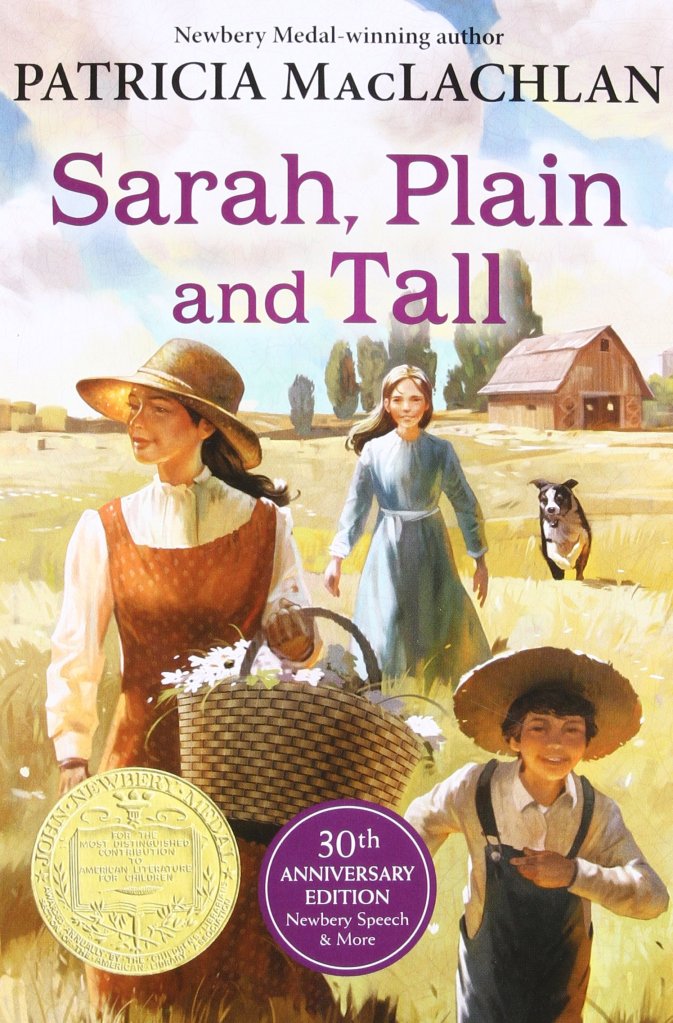
Sarah, Plain and Tall

I saw the film version of Sarah, Plain and Tall with Glenn Close several years ago and loved it. I hadn’t known then that it was based on a children’s book by Patricia MacLachlan. I just recently read the Kindle version.

The story opens with Anna, her younger brother Caleb, and their widowed father living on the prairie in the late 19th century. Written from Anna’s point of view, she notes that her parents used to sing all the time, but her Papa never does any more.

Papa tells the children he has placed an advertisement for a wife and received a reply from Sarah, a woman in Maine. She lives with her brother, but he is getting married. She’s concerned she will miss the sea, but she’s willing to come out by train to the prairie and meet the family.

Sarah exchanges letters with papa, Anna, and Caleb until she arrives. Sarah is different and does unusual things. They all like each other, but the children are afraid Sarah misses the sea too much to stay.

This was a lovely story written in a simple yet beautiful style.

A few of my favorite quotes:

Outside, the prairie reached out and touched the places where the sky came down.

My brother William is a fisherman, and he tells me that when he is in the middle of a fog-bound sea the water is a color for which there is no name.

There is no sea here. But the land rolls a little like the sea.

I shook my head, turning the white stone over and over in my hand. I wished everything was as perfect as the stone. I wished that Papa and Caleb and I were perfect for Sarah. I wished we had a sea of our own.

This book won a Newberry Medal, and the Kindle version I read included the author’s speech upon receiving it. She said the story was based on a real Sarah from Maine who had traveled to the prairie to become the wife and mother of a friend of the author’s mother. This speech contained a couple more favorite quotes:

Every writer should have a loving reader who has the courage to write both “I love this” and “Ugh” on the same page.

When Julius Lester praises children’s literature as the “literature that gives full attention to the ordinary,” he echoes my parents’ belief that it is the daily grace and dignity with which we survive that children most need and wish to know about in books.

My parents believed in the truths of literature, and it was my mother who urged me to “read a book and find out who you are,” for there are those of us who read or write to slip happily into the characters of those we’d like to be. It is, I believe, our way of getting to know the good and bad of us, rehearsing to be more humane, “revising our lives in our books,” as John Gardner wrote, “so that we won’t have to make the same mistakes again.”

I knew there was one sequel to the book, Skylark. But I hadn’t known there were three more. The Kindle version contains the first chapter of each of the books. Someday I hope to read the rest.

I wanted to rewatch the videos of both Sarah, Plain and Tall and Skylark, but they don’t appear to be available to stream from anywhere. I might see if the library has the DVDs.

Have you read or watched Sarah, Plain and Tall? What did you think?

Review: When the Day Comes

When the Day Comes by Gabrielle Meyer has an intriguing and unique premise for a novel.

Libby Conant is a time crosser. She lives in 1774 Williamsburg with her widowed mother and two sisters. She and her mother took over the printing of the Virginia Gazette after her father died, but they are barely making ends meet. Creditors threaten prison. Then the Conants are awarded the public printing contract from the House of Burgesses. They print Thomas Jefferson’s pamphlets as well as public notices. The Revolutionary War is about to break out, and tensions run high between rebels and loyalists.

Libby has loved Henry Montgomery since they were both children. She thinks he has feelings for her as well, but they move in different social circles. Plus he has secrets of his own. Whose side is he really on?

When Libby goes to sleep in Williamsburg, she wakes up as Anna Elisabeth Wells, only daughter to a prominent, wealthy family in 1914 New York. Her father’s fortune was self-made, which is not enough for her mother’s ambition for rank which values “old money.” Her mother has paraded Libby around for two seasons in New York, and now they are going to London to see what the titled male population is like there.

Libby does not want to marry, at least not before her twenty-first birthday. She enjoys working with the suffragette movement, which her mother disdains. Mother Wells is one of the most manipulative women ever and overrides Libby’s wishes and protests in her pursuit of the right suitor.

War is looming on this timeline as well, though no one knows it yet. Libby only knows because her mother in 1774 was a time crosser as well who lived in the twenty-first century.

When Libby goes to sleep in New York, she wakes up in Williamsburg again, with no loss of time in either place. Thus has it been since she was born and thus it will be until she turns twenty-one. Then she will have to choose which path she wants to live in permanently. Her body will die in the path she does not choose, but she will retain her memories of that time. If she tries to knowingly alter history in either path, she’ll forfeit her life in that path.

Libby is sure which path she will choose. She likes the conveniences of the Gilded Age in 1914, but she’s not interested in status and wealth. She’s needed in 1774 to help her family and the cause of freedom. And even if her love for Henry can never come to fruition, she wants to be where he is.

But unexpected circumstances may force her into a different choice.

This book came out last year, and I kept seeing it favorably mentioned among bloggers I follow. I still wasn’t quite sure I’d be interested, but I decided to give the audiobook a try. And . . . wow. This book was fascinating. The characters are well-drawn. It was fun seeing a few historical figures in the story. The plot kept a good pace, even with the intricacies of two timelines. I loved the eventual emphasis on the need to trust God rather than strive after our own way. I didn’t see the ending coming at all, but it was supremely satisfying.

As usual, the audiobook did not contain the author’s notes. I was curious about how she got and developed the idea for this book and found an interview with her about it here.

I enjoyed this book so much, I immediately started the sequel, In this Moment. Highly recommended.

Every Ocean Has a Shore

Every Ocean Has a Shore, a novel by Jamie Langston Turner, opens with a few people in a small diner in Chicago. Suddenly a young man with a gun comes in, locks the door, and starts barking orders.

Tragedy is averted, but everyone is shaken. The three adults in the main dining room don’t know it yet, but they are bonded together even after they go their separate ways.

The only customers in the diner at the time were an older woman, Alice, and a young boy. Alice had been estranged from her daughter for years before her daughter died. Alice just found out that her daughter left behind a young son, Ian, who had been cared or by his father. But now the father is dying, and someone finds Alice’s contact information. Alice flew from South Carolina to Chicago to pick up five-year-old Ian, who doesn’t speak. They’ve just stopped at the diner for lunch when the incident occurred.

Gary is the owner of the diner. He was always a quiet man, but became quieter still after his wife died. He’s intelligent, but it takes him a while to think through things. His loneliness and the crime in the city cause him to consider moving, but he doesn’t know where or what he would do with himself. He has a sister in Vermont who needs help fixing up her home. Maybe he’ll start there.

Fawna is the waitress, a college dropout with a birthmark on her cheek in the shape of Borneo and a penchant for saying weird things. She rents a room from a crotchety old woman named Mrs. Welborn and helps her out. Her parents died, leaving her with money to live on. She’s drifted around for the past eight or nine years, but thinks she might like to settle down somewhere. The problem is, she doesn’t know where to go or what she wants to do.

The point of view switches between these three as they go on with their lives but keep in touch. We learn some of their background and issues. Fawna discovers C. S. Lewis and begins to wonder if, as Lewis suggests, someone has been orchestrating all the events of their lives.

Fans of Jamie Langston Turner will welcome this, her first new book in nine years. A few characters from her earlier books make an appearance, particularly Eldeen, the larger-than-life older woman from Jamie’s first book, Suncatchers. But this is a stand-alone novel that can be enjoyed even if you haven’t read the previous books.

Jamie’s books are character-driven, not plot-driven. This isn’t an edge-of-your-seat kind of story. In fact, the story seems pretty slow in places. But as we learn more about each character and see how everything is woven together, we find great depth. I’ve seen many people who don’t normally like Christian fiction say that they like Jamie’s books.

Review: Gay Girl, Good God

I think I first came across Jackie Hill Perry on Twitter. I wasn’t familiar with her work, but somehow I saw things that she had tweeted. I liked what she said, so I followed her. Unfortunately, she’s not on Twitter any more.

I don’t know at what point I learned that Jackie had written a book, Gay Girl, Good God: The Story of Who I Was and Who God Has Always Been. I saw some good reviews and put it on my To Be Read list.

Jackie grew up with a single mother and a father who breezed in and out of her life. Her father once told her that he loved her, but it wouldn’t bother him if she never wanted to see him again. His absence and lack of love plus Jackie’s being sexually abused by a boy at a young age were major factors in Jackie’s gender confusion, which then led to her becoming a lesbian.

Jackie had attended church and knew that Christians believed homosexuality was wrong. She fully believed she was going to hell. But she didn’t care.

Yet she felt God’s pursuit of her. She felt Him calling her, “haunting” her.

The only thing that made sense was that someone had obviously been talking to God about me and it was the reason why God wouldn’t leave me alone. Obviously, whatever was being asked of Him, regarding me, was making my little sinful world spin. It was dizzying to live on now-a-days. Trying to stand up straight (or should I say, queer), made everything I loved, mainly myself and my girlfriend, blurry. Nothing was clear except God’s loud voice saying, “Come.” (p. 50, Kindle version).

Eventually, Jackie did come. Yet life was not then miraculously easy. She wasn’t just saved from homosexuality. She was saved from sin, any and all sin. And like every other new believer, she learned that discipleship consists of taking up one’s cross daily and following Jesus, just as He said it would.

In the last section of her book, Jackie deals with Biblical truths like our identity in Christ and some common misconceptions, especially of what she calls the “heterosexual gospel.” In witnessing to homosexuals, well-meaning Christians sometimes promise or emphasize things which the Bible does not.

A few quotes that stood out to me:

Why hadn’t they ever mentioned the place happiness had within righteousness, or how the taking up of the cross would be a practice of obtaining delight? Delight in all that God is? Even their Savior had this kind of joy in mind as He endured His cross. So why hadn’t they set their focus on the same? In their defense, they were not to blame for my unbelief. I just wonder if they would’ve told me about the beauty of God just as much, if not more, than they told me about the horridness of hell, if I would’ve burned my idols at a faster pace (p. 64).

Because a good God made the woman, then being a woman was a good thing (p. 87).

Our sexuality is not our soul, marriage is not heaven, and singleness is not hell (p. 139).

To tell you about what God has done for my soul is to invite you into my worship (p. 140).

Do you know why we have a hard time believing that a gay girl can become a completely different creature? Because, we have a hard time believing God. The Pharisees saw the man born blind, heard his testimony, heard about his past and how it was completely different from the present one, and refused to believe the miracle because of Who the miracle pointed to. They were skeptical of the miracle because they didn’t have a real faith in the God who’d done it. The miracle was less about the blind man and more about a good God. It showed Him off. His power. His ability to do what He wants. How He wants, when He wants, and to whomever He chooses (p. 107).

I especially loved this, in telling about the man who had been born blind whom Jesus healed by combing His spit with dirt, rubbing the mixture on the man’s eyes, then telling hm to go wash in the pool of Siloam: “Using his palms to brush the stubborn sections away from his eyelids, light startled him. As more mud fell, more sight came. Until at once, he could see” (p. 106).

I looked at Goodreads yesterday to see what some of the reviews said. Not surprisingly, I saw review after review with one star scathingly critical of Jackie’s story. I thought, how sad it is that her book is rated so low just because people disagree with her. But then I scrolled up and saw that only three percent of the reviews were one star. 83% were four and five stars. Yet of the ten reviews Goodreads showed on the first page, seven were one-star.

I would love to say to those who discount Jackie’s story (one review accused her and her husband of pretending to be heterosexual)—if, according to the world, life is all supposed to be about choice these days, why would anyone argue with Jackie’s choices? If everyone’s supposed to have their own truth (which I disagree with, and Jackie would, too), why would you discount the truth of her experience? Why is it that if someone has lived a heterosexual lifestyle but then thinks they might be gay, that determination is supposed to be the real, lifelong one and there’s no turning back? Why can one supposedly only turn one way, and not the other?

One can, of course. But Satan wants to blind and deceive people.

I enjoyed Jackie’s story of God’s grace. I have not heard or read her poetry, but she has a poet’s heart and her expressiveness shines through here. Her knowledge of Biblical truth is solid.

I’d recommend her books to anyone, gay or straight, Christian or not. I think it would be particularly eye-opening to Christians who can sometimes come across as glib in their witness or opinions.

I listened to the audiobook, read by Jackie. At the moment, it’s free to those with an Audible subscription. Then I bought the Kindle version so I could keep this book on hand.

Humble Roots

If people think about humility at all these days, they usually envision self-deprecation, playing down one’s attributes, talents, or accomplishments, or, at the very least, not bragging.

In Humble Roots: How Humility Grounds and Nourishes Your Soul, Hannah Anderson explores humility from a Biblical angle. Instead of viewing humility as a club or prod when we’re feeling too proud, humility frees us and leads us to rest.

I defined humility as a correct sense of self, as understanding where you come from and where you belong in this world (p. 64, Kindle version).

Theologically speaking, humility is a proper understanding of who God is and who we are as a result (p. 102).

I would describe it as a creaturely dependence. We’re “made in His image, but we are made nonetheless (p. 11)—made originally from dirt, to which our bodies return. As Paul reminds Timothy, “we brought nothing into the world, and we cannot take anything out of the world” (1 Timothy 6:7). Everything we are and everything we have comes from God.

The problem is our obsession with ourselves. With our need to fix things, our need to make ourselves better, our need to be approved by God and others, our need to “count for something.”

But this is also why Jesus calls us to come to Him. By coming to Jesus, we remember who we are and who we are not. By coming to Him, we come face to face with God and with ourselves. “It is only in our encounter with a personal God,” writes philosopher Dietrich von Hildebrand, “that we become fully aware of our condition as creatures, and fling from us the last particle of self-glory” (p. 55).

If I can’t handle little things, what can I handle? Failure at small things reminds us of how helpless we are in this great, wide world. When little things spiral out of control, they remind us that even they were never within our control in the first place (p. 26).

Humility, instead of being a negative concept, frees us:

to be the people God created us to be (p. 11).

from the cycle of stress, performance, and competition (p. 12).

from our burdens . . . by calling us to rely less on ourselves and more on Him (p. 32).

to redirect our energies toward God and those whom He has given us to love (p. 3).

from the condemnation of others, . . . from self-condemnation and unnecessary guilt (p. 108).

to hear God’s call and leads you to a place of both rest and flourishing (p. 110).

from the oppression of our emotions, when we finally learn that “God is greater than our heart (p. 114).

from the responsibility of feeling like you have to “do it all.” You are free to do only what you have been made to do (p. 163)

. . . and so much more.

Hannah follows Jesus’ admonition to consider birds and flowers by grounding each chapter in something from the garden or nature. For instance, the chapter “Vine-Ripened” begins with all the work that goes into growing garden tomatoes, then being fooled every year into thinking the ones gassed for redness in stores will be the same. That leads into a discussion of wisdom being rooted not in acquiring facts, but in submitting to the source of wisdom–the fear of the Lord. Then an 1800 court case over whether tomatoes are vegetables or fruit is tied in, along with our relentless desire to be “right.” “Humility simply leaves room that my understanding of a situation could be wrong” (p. 124). We may not have all the facts or may be influenced by culture. Because we’re limited, “my faith cannot rest on my own knowledge . . . or ability to understand . . . humility leaves room for grace” (p. 124). How unlike most social media discussions, where everyone is right in their own eyes. Hannah then refers to an Isaac Watts book which discusses a “dogmatical spirit.” Our wisdom and safety come not from our being right, but from Jesus being right. Then the chapter goes back to the process of creating store-bought tomatoes, compares that with our search for wisdom, and extols the wisdom of waiting: “Humility teaches us to let knowledge ripen on the vine” (p. 129). The chapter is much more beautifully woven together than my cobbled summation here.

Hannah points us to Jesus, “who, though he was in the form of God, did not count equality with God a thing to be grasped, but emptied himself, by taking the form of a servant, being born in the likeness of men. And being found in human form, he humbled himself by becoming obedient to the point of death, even death on a cross (Philippians 2:6-8) and who invites us to “Take my yoke upon you, and learn from me, for I am gentle and lowly in heart, and you will find rest for your souls” (Matthew 11:20).

Besides benefiting from the truths Hannah shares, I marvel at the way she is able to weave together facts from nature, literature, Scripture, and personal example seamlessly into each chapter. I don’t know how she accomplishes this without time to just sit and think, but as a busy pastor’s wife and mom, I’m sure such time is at a premium. I first read one of her books during Advent and have been working my way through her others. She has quickly become one of my favorite authors.

Even though I just finished this book, reading one chapter a week, I am thinking about going through it again. I need to soak in its truths more.

(I often link up with some of these bloggers.)

A Place to Hang the Moon

In A Place to Hang the Moon by Kate Albus, William, 12, Edmund, 11, and Anna, 9, live in 1940 England. Their parents died when William was 5. “The grandmother” had charge of them since, but she sent them off to boarding school and was cold and aloof when they were home.

Now the grandmother has died as well. The family solicitor, Mr. Engersoll, explains that the children have been left a lot of money, but no one has been named as their guardian. Apparently there is no one to ask. The children plead to stay with the family’s housekeeper, Mrs. Collins, but she’s too old to take them in.

Mr. Engersoll suggests that the children join evacuees being sent to the country. Perhaps the foster parents they find might take them in permanently. The children are advised not to tell anyone that they are alone in the world or that their family has money, so they don’t get taken advantage of.

The children agree with what Mrs. Collins calls “the preposterous plan,” as there seems to be no other option.

The children are billeted together first with one family, then another. I don’t want to spoil the story by telling what went on in those places, but neither is suitable.

The children spend many afternoons in the town library. Books have always been their friends, and the warmth and quietness of the library provide a refuge. The kind interest of the librarian, Mrs. Muller, makes the place even more welcome.

It’s not long, however, before they discern Mrs. Muller is something of an outcast. She’s married to a German man who has disappeared.

The children wish they could stay with Mrs. Muller, despite her husband’s possible Nazi leanings.

This story starts out like a classic fairy tale, with children alone in the world having to overcome various difficulties. I had thought it was a young adult book, but Amazon recommends it for grades 4-7.

I don’t often read secular books for this age group, but the Story Warren and Hope both spoke well of this story, piquing my interest. I agree with C. S. Lewis that a good children’s book can be enjoyed by adults as well. When the title came up temporarily free from Audible. I gave it a try.

I’m so glad I did. I loved this book. The story is well-told and the characters are beautifully drawn. Descriptions of both warm and cozy and difficult scenes make you feel you are experiencing them along with the children. References to beloved classic children’s books are scattered throughout. Polly Lee’s British accent enhanced the audiobook. I didn’t want the book to end.

Some of my favorite quotes:

The first words of a new book are so delicious—like the first taste of a cookie fresh from the oven and not yet properly cooled.

The librarian took this all in, standing by the fire and observing the children for a while, letting the silence be. Somehow, it didn’t feel awkward, the way silences often do. Perhaps librarians are more used to quiet than most.

William, Edmund, and Anna knew, somewhere deep in the place where we know things that we cannot say aloud, that they had never lived in the sort of home one reads about in stories – one of warmth and affection and certainty in the knowledge that someone believes you hung the moon.

Edmund took in the boy’s mended jacket, the eyes underlined in shadows, the skin above his upper lip chapped raw from a dripping nose gone unattended, and saw the sort of hunger whose endlessness digs a pit in a person. Being eleven, Edmund wouldn’t have put it quite in those words, but he recognized it nonetheless.

While she wasn’t sure of the precise definition of the word “bibliophile,” Anna was certain it meant something that she wanted to be.

The stealing of sweets, after all, is an act committed only by those with unspeakably black souls.

The smell of the cookies filled the children with a warmth that can only come from the magnificent alchemy of butter and sugar.

Truth be told, Anna was rather giving away the ending, but sometimes one cannot help oneself.

Anna thought of offering up a hearty platter of I told you so, but she didn’t. Why foul perfection with such a sharp thing as bitterness?

This is a lovely book. Not fluffy bunny and serene landscape lovely, but a wonderful tale beautifully told.

The Four Graces

The Four Graces are daughters of the vicar of Chevis Green, England, during WWII. This book is sometimes listed as the fourth Barbara Buncle book, but Barbara only appears in one scene at the beginning at a wedding. The setting and some of the characters from the previous book carry on, however.

The vicar has been a widower for some time, and his grown daughters all help around the house and village–or at least they did, until one went into the service during WWII.

Liz works on the neighboring farm of Archie Chevis-Cobb, the local squire. She’s always up for adventure and is unconventional and outspoken.

Sal takes care of most of the home chores. She was sickly as a child and therefore did not attend school. She has a quiet, steady disposition and helps her father smooth the ruffled feathers of his congregants.

Addie enlisted in the WAAF and lives in London but pops in and out.

Tilly is quiet and shy and plays the organ.

Amid the war shortages and rationing, the Graces live a quiet, pleasant life. But then William Single, a scholar interested in Rome, comes to stay with them and study what he thinks is an old buried Roman settlement nearby. William is a large but gentle, bumbling man and fits into the household nicely.

A young officer, a friend of Addie’s comes to visit–too often for Tilly’s tastes. She’s afraid he has designs on one of her sisters.

But the household is totally disrupted by the arrival of Aunt Rona, the girls’ late mother’s sister. Bombing shattered all her windows of her London house, so she came to stay with the Graces. But she takes over and tries to manage everything and everyone. And then the girls fear Aunt Rona might be trying to worm her way into their father’s affections.

This book reminded me a bit of Little Women, if it had been set during WWII. The girls here are older, though, all in their twenties.

Some of the quotes I loved:

Life was like that, thought Liz. You drifted on for years and years—then, suddenly, everything happened at once and all the things that had seemed so stable dissolved and disintegrated before your eyes…and life was new.

I have noticed that nowadays when people speak of being broad-minded they really mean muddleheaded, or lacking in principles—or possibly lacking the strength to stand up for any principles they may have.

“Books are people,″ smiled Miss Marks. ″In every book worth reading, the author is there to meet you, to establish contact with you. He takes you into his confidence and reveals his thoughts to you.

She talked less than some of the others and perhaps thought more.

I listened to the audiobook nicely read by Karen Cass.

This was a secular book, so I would not agree with every little thing–like brief mentions of astrology and a universal religion. But otherwise, this is a sweet English village story that I enjoyed very much.

In fact, I am a little disappointed to leave this setting and these characters behind. I’d love for  there to have been a sequel or at least a mention of the sisters in other books like Stevenson does with some of her characters. But we’ll just have to imagine the Graces continuing in in the ups and downs and pleasures and sorrows of life.


Babette’s Feast

Warning: spoilers ahead.

Usually when I talk about books or films here, I only share a part of the plot, some quotes, and my thoughts about them. I don’t want to give away the end or any surprises.

But “Babette’s Feast” is a short story. This post would only be a paragraph or two if I just shared a bit about it. Plus, I’d love to explore what it means and hear your thoughts as well.

“Babette’s Feast” is part of a collection published as Anecdotes of Destiny in 1958 by Isak Dinesen (pen name of Danish Author Karen Blixen). In 1987, it was made into an award-winning Danish film.

The story opens with two elderly sisters in Norway in the 1800s. Their late father was a pastor who created his own strict sect. “Its members renounced the pleasures of this world, for the
earth and all that it held to them was but a kind of illusion, and the true reality was the New
Jerusalem toward which they were longing.”

The women were beauitful and admired in their youth. Many young men noticed them, but those who approached their father for permission to court them were rebuffed. The girls were his right and left hand—would these young men tear them from him?

However, both young women had a chance at love. Lorens Löwenhielm, a rakish Calvary officer, was sent by his father to visit his aunt in the country and meditate on his ways. Lorens sees Martine in the marketplace. He visits her home and admires her all the more. But her purity seems to show up his own smallness. He eventually leaves to go back to his garrison and pour himself into his career. He marries a lady-in-waiting to the Queen.

An acclaimed singer, Achille Papin of Paris, visits the area on vacation. Bored one morning, he wanders into church and is captivated by the voice of Philippa. He offers to give her singing lessons, telling her father she will “sing . . . to the glory of God.” But inwardly, he thinks she could be a famous prima donna and sing with him.

He shares his dreams with Philippa. In one lesson, they sing a love song together and he kisses her.

Philppa tells her father she does not want to take singing lessons any more.

The young women ministered beside their father for years until he passed away. They continued charitable works in the community, helping the poor and needy, holding meetings in their home.

But the little congregation had thinned out and gotten old and contrary. Members focused on old wrongs with each other.

Now elderly, the women are startled when a pale woman shows up on their doorstep and faints. When she awakes, she gives them a letter. She was a French refugee fleeing from civil war in Paris. Achille Papin sent the sisters the letter asking them to take the women, Babette, in. It was proposed that she work as a cook and maid, but the sisters cannot afford to hire her. Babette does not want pay.

Babette recovers from her troubles and becomes a real asset to the sisters and the community. The sisters eat very plainly and show Babette how everything must be cooked. She’s savvy with merchants and saves the sisters money. Her efforts at home free them to minister even more to the community.

As the hundredth birthday of the sisters’ father approaches, they want to prepare a special dinner for the congregation. They not only want to honor their father’s memory, but they hope to inspire the congregation back to the ideals he taught.

Meanwhile, a friend of Babette’s in France had purchased a lottery ticket for her and renewed it every year. Suddenly, Babette receives news that she has won 10,000 francs.

The sisters rejoice in Babette’s good fortune but grieve that they will lose her. They are sure that with independent means, she will no longer need their hospitality.

But Babette wants to use her money to provide the feast for their father’s hundredth birthday dinner. The sisters reluctantly agree.

Babette wants to make an authentic French meal and orders supplies. The sisters are alarmed at the strange items that arrive, including a massive live turtle and several bottles of wine. The sisters face a conundrum. How can they allow these rich and foreign foods to be given to the congregation? But what can they do? They don’t feel they can offend Babette by rejecting her offer.

They go to the congregation and confess what has happened. The members understand and promise not to comment on the food, good or bad.

Meanwhile, officer Löwenhielm’s aunt wants to be included in the feast to honor the late pastor. And her nephew, Lorens, is in town: could he accompany her?

By now, Lorens has achieved all the honors he could want. But he sees it all as vanity. He remembers enough of what he heard back in the little congregation to convict him that there is more to life, and he has been foolish.

Finally the big feast arrives. Lorens is well-traveled and is the only one to recognize the superb quality of the wine and food. In fact, they remind him of the time he ate at a restaurant of one of the most famous and acclaimed chefs in Paris.

The sisters and congregants eat silently and tentatively at first. But soon the meal and the wine and the fellowship warms their hearts. They renew their love for each other and put away old wrongs.

When everyone leaves, the sisters thank Babette for the meal. They ask when she will be leaving them.

She won’t be leaving, she says. She has spent all her 10,000 francs on the meal. She had been the famous chef Lorens spoke of and gave the sisters and congregation the best meal she could produce.

_______

On the surface, this story could seem like a slam at the Puritanical practices of the sisters and an encouragement to enjoy life’s good things.

But I think the story goes deeper than that.

I don’t think it’s meant to be a slam, per se, but perhaps a different way of looking at things. The sisters’ religion looked on love and marriage as illusions. They were to concentrate on the life to come, not this one. But God gave us richly all things to enjoy, after all (1 Timothy 6:17). God’s Word and gifts do not just affect us on a spiritual plane. Some of His good gifts are physical and tactile. He wants us even to eat and drink as unto Him (1 Corinthians 10:31).

When the officer first visits the meeting at the sisters home, their father speaks of Psalm 85:10: “Mercy and truth are met together; righteousness and peace have kissed each other.” The translation in the book says “bliss” rather than “peace.” When the officer comes back to the feast so many years later, not a general, he stands up to speak and shares this same verse and talks about grace. So perhaps the author is bringing together the idea that righteous and bliss are not antithetical.

One facet of the tale is the ministry of food. Psalm 104:14-15 says God causes “the grass to grow for the livestock and plants for man to cultivate, that he may bring forth food from the earth and wine to gladden the heart of man, oil to make his face shine and bread to strengthen man’s heart.” Craig Claiborne said, ” Cooking is at once child’s play and adult joy. And cooking done with care is an act of love.”

One article talked about the women caring for each other in their own way. The sisters provided a home, even though their means were meager. Babette made meals to their preferences, even though it must have galled her to do so, until the feast. They all grew to care for and appreciate each other.

Another aspect is to not judge a book by its cover. Though austere, the sisters were genuine and kind. They were wary of Babette’s foreignness at first, but came to see her heart.

Dione Lucas said, “The preparation of good food is merely another expression of art, one of the joys of civilized living.” And this idea of giving through one’s art is mentioned in the story of Babette. She tells the sisters that the people she cooked for in France “had been brought up and trained, with greater expense than you, my little ladies, could ever imagine or believe, to understand what a great artist I am. I could make them happy. When I did my very best I could make them perfectly happy.” Later she quotes Monsieur Papin, “Through all the world there goes one long cry from the heart of the artist: Give me leave to do my utmost!”

When the sisters lament that Babette will be poor all her life, now that she has spent her fortune, she replies, “Poor? No, I shall never be poor. I told you that I am a great artist. A great artist, Mesdames, is never poor. We have something, Mesdames, of which other people know nothing.”

Here’s the trailer of the film. It’s in Danish with English subtitles.


This article discusses the film and story and the differences between the two.

Have you read or watched “Babette’s Feast”? What did you think of it?

The Two Mrs. Abbotts

The Two Mrs. Abbotts is the third Barbara Buncle book by D. E. Stevenson. By this time, Barbara Buncle is the first Mrs. Abbott, having married her publisher, Arthur.

In the previous book, Miss Buncle Married, Arthur’s nephew, Sam, worked with Arthur and came to stay with the Abbotts frequently. A neighbor of the Abbotts, a young woman called Jerry, had her own business boarding horses and teaching riding lessons. Over the course of the last book, Sam and Jerry fell in love despite some comical obstacles, and finally married. So Jerry is the second Mrs. Abbott.

In The Two Mrs. Abbotts, WWII has arrived. Sam is away fighting throughout the book, but we have one scene with him. Arthur is only seen at the beginning of the book, unfortunately.

Soldiers camp in huts near Jerry’s house, so Jerry and her longtime cook, maid, and friend, Markie, pull their living quarters to a smaller section of the house and give the soldiers access to their kitchen. All through the day they find soldiers making food, writing home, washing clothes, etc. Markie, a much older woman, becomes a mother figure to the men, helping them compose letters and listening to them talk.

Early in the book, Barbara agrees to host a woman from the Red Cross who has traveled to speak to local women about how they can help. The Red Cross woman turns out to be Susan, Barbara’s closest friend from the first book, and one of the few who was not offended by Barbara’s books about their village.

Barbara does not do much writing in this volume, her time being taken up with her two precocious children and helping in the community.

However, one of her husband’s firms best-selling authors comes to town to speak at a festival. Janetta Walters. Arthur doesn’t like her books much, but they’re popular. There’s nothing wrong with them–they’re just fluffy and unrealistic. But Jannetta is thrown for a loop when a young man assigned to take her around and provide for her needs while in town tells her her books are “rot” and she could “do better.” Jannetta knows not everyone will like her books. This young man has a right to his opinions. He doesn’t mean anything to her, so his views shouldn’t affect her. But they do. Suddenly she is no longer interested in writing, much to the chagrin of her sister, who is dependent on her income.

Jannetta disappears for a while, and just about the time I began to wonder about her, she shows up again in the most clever way.

Another prominent character in this book is Archie Chevis-Cobb, Jerry’s brother. In the last book, he was immature and reckless, assuming he was going to be his aunt’s heir. But she keeps changing her will. In the end, he does inherit. But instead of this making him more spoiled, it sobers him. He wants to fight for his country, but Arthur and others convince him that his farm, which he has brought up to great standards, is needed to support the community.

A number of other smaller plots occur: sullen, sloppy evacuees are a trial to Jerry; Barbara tries to help her young lovesick neighbor through a relationship that is obviously not good for him; a spy is reportedly lurking in the area; Jerry takes in a paying guest, Jane; a runaway girl wants to stay with Jerry and Markie. Markie has a marvelous adventure.

Though Barbara is not as prominent in this book, the stories are delightful. In fact, this might be my favorite of the three books, but that’s with having the background of the first two in mind.

A few of my favorite quotes:

Jane felt glad to have known Markie, for Markie’s example had shown her that you could do humble things splendidly, and be happy doing them—and make others happy.

Janetta sighed. She reminded herself that hundreds of thousands of people enjoyed her stories and showed their appreciation by borrowing her books from libraries—or, better still, buying them and keeping them in their bookcases. She reminded herself of the large “fan mail” that poured into Angleside from all over the world (not only letters, but parcels of food from admirers in America and Canada and South Africa who were anxious to sustain her so that she might continue to delight them with her books).

In time she would realize romance was a good thing in the right place. It was not the whole of life—as Janetta had made it—nor was it entirely foolish, as Jane seemed to think. It was like chocolate cream, thought Archie, a certain amount of it was good for you and extremely palatable; too much of it made you sick.

Mrs. Marvel looked slightly annoyed, for she hated having to use her brain.

I listened to the audiobook, nicely read, as the others were, by Patricia Gallimore. My only complaint is that the narrator changed the voice she used for Jerry from the last book and made her sound snooty, which she wasn’t.

There is one more book that is sometimes included as a Miss Buncle book, The Four Graces. Barbara only appears at the very beginning at a wedding. But some of the other characters from The Two Mrs. Abbotts continue on. I’m enjoying listening to the audiobook of it now.

The Shenandoah Road

In The Shenandoah Road: A Novel of the Great Awakening by Lynne Basham Tagawa, John Russell is a widower in need of a wife to mother his four-year-old daughter. Leaving his daughter in his sister’s care, John travels back to Boston, where his father lives, to do some trading and hopefully find a wife as well.

Abigail Williams is the daughter of a Boston merchant. Her father approaches her with a proposition. His bookkeeper’s son is looking for a woman to marry and accompany back to a settlement in Shenandoah. The two men are coming to dinner tonight. Would she think about the possibility?

The settlement in Shenandoah is smaller and much rougher than what Abigail is used to. But John Russell seems to be a kind man. She decides to marry him and go.

Abigail has dutifully kept the commandments all her life. But when John shares with her part of a sermon by George Whitfield, her heart is troubled. Is keeping the commandments not enough? How can she be sure she’s right with God?

As the Russells travel the long road back to the settlement by the Shenandoah River, they face dangers in roving buffalo, Indians, and a dangerous ruffian. Abigail wonders how she will adjust to life when she gets to John’s home. She feels her lack of knowledge about everyday housewifery. She wonders if John’s daughter will accept her. But most of all, she struggles to understand the words from Whitfield and the Bible that her husband shares with her.

I don’t know that I have ever read a novel from this time period, though I was familiar with Whitfield and Jonathan Edwards and such. It seems like every believer would have been thankful for the “Great Awakening.” But just like in our times, people had different opinions about the various proponents and points of doctrine. It was interesting to see some of that discussed.

I enjoyed the historical aspects of daily life, as well. Abigail loved botany, especially the medicine use of plants. It’s unfortunate that we’ve gotten away from such knowledge today.

I enjoyed getting to know John and Abigail as hey got to know and appreciate each other.

Still, I wasn’t swept into the story and characters as often happens with fiction. I can’t quite put my finger on why. But even though I wasn’t spellbound, the book is still a good one.