Book Review: Hard Times

In Charles Dickens’ book, Hard Times, Thomas Gradgrind is a member of Parliament who also runs a school. His philosophy of education emphasizes pure fact: no fancy, no imagination, not even any morality. He discovers one poor student in the school Sissy, who can’t seem to learn her facts. When he goes to talk to her father, he discovers that her father had worked in the circus but has mysteriously left. So he offers to take Cissy in to help care for his near-invalid wife if she promises never to return to the circus.

Gradgrind’s own children have been raised according to his philosophy at home. Both his oldest two, Louisa and Tom, are rather bored. The implications of their education play out differently for each of them.

Gradgrind’s close friend, Josiah Bounderby, is a blustery self-made man who boasts of his rise from “street kid” to a successful banker. He eventually takes on Tom as an apprentice and married Louisa. Louisa has no love for Bounderby, but as her father presents the facts of the case, marriage seems reasonable.

In another area of town lives Stephen Blackpool, one of what Bounderby calls “hands”—common workmen. Stephen was 40, but “looked older, but he had had a hard life” with seemingly all thorns and no roses. “He was a good power-loom weaver, and a man of perfect integrity” though not particularly intelligent.

Eventually Stephen’s path crosses that of the other characters and reasons for his hard life become known. His refusal to go in with the unionists gets him in trouble with them and Bounderby. When he leaves to find work elsewhere, he’s framed for a bank robbery.

Usually when I start a classic novel, I get some background information about it first. I didn’t this time: I just let the story draw me in. I wondered who would advocate a “just facts” education and why. After reading the book, I learned that a philosophy called Utilitarianism was going around at the time. You can read more about it at Wikipedia if you’re interested. Louisa’s path follows that of the son of one of Utilitarianism’s advocates, who felt he was emotionally stunted as a result of his upbringing. Tom’s maturity and character was stunted, too, but in a different way. Perhaps it’s better to say he was more warped than stunted.

The two most highly moral, compassionate, and common-sense characters, Sissy and Stephen, were not raised in this philosophy, and eventually they show some of the others a different way. Some of the characters end up sadder but wiser, “making .. facts and figures subservient to Faith, Hope, and Charity.” Dickens almost portrays all the poor as virtuous and the rich and powerful as corrupt, but he makes the characters complicated enough that they don’t fall into stereotypes. As he often writes not only for social awareness, but for social change, he appeals to the reader that “It rests with you and me, whether, in our two fields of action, similar things shall be or not.”

This is the shortest of Dickens’ novels and the only one not to have any scenes in London. This is his tenth novel and, like most of his others, first appeared in serial form. He infuses the story with his characteristic humor, pathos, and memorable characters and descriptions and keeps the reader thinking long after the book ends.

I listened to the audiobook, nicely read by Peter Batchelor, and read parts on the Project Gutenberg copy online here.

(Sharing with Carole’s Books You Loved, Booknificent)

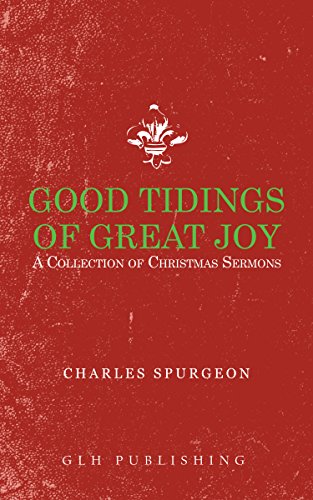
Book Review: Good Tidings of Great Joy

I like to read an Advent or Christmas devotional in December. I didn’t have any new ones on hand last year and didn’t want to reread an old one. But then I came across Good Tidings of Great Joy: A Collection of Christmas Sermons by Charles Spurgeon in my Kindle collection.

I thought I could read a bit at a time, like a devotional book. And I could—but I just wasn’t getting as much out of the sermons as I did when I read them one at a time in their entirety. The only days I could work in reading a whole sermon at once were Saturdays. So that’s why I am just now finishing a book of Christmas sermons.

Spurgeon was not a big fan of Christmas, according to these messages. He thought it was too often used as an excuse for excess. And he disliked a superstitious keeping of church holidays. But he did concede that hard-working people could use the time off and that the holidays provided a time to bring out particular truths related to Christ’s birth.

There are eight messages in all, each focused on a text connected to Jesus’ birth. I won’t go into an outline or summary of each message, but I’ll just share a few quotes.

I. The Birth of Christ, Isaiah 7:14-15: “Therefore the Lord himself shall give you a sign; Behold, a virgin shall conceive, and bear a son, and shall call his name Immanuel. Butter and honey shall he eat, that he may know to refuse the evil, and choose the good.”

Let us take courage here. If Jesus Christ was born in a manger in a rock, why should He not come and live in our rocky hearts? If He was born in a stable, why should not the stable of our souls be made into a house for Him? If He was born in poverty, may not the poor in spirit expect that He will be their Friend? If He thus endured degradation at the first, will He count it any dishonor to come to the very poorest and humblest of His creatures and tabernacle in the souls of His children? Oh, no! We can gather a lesson of comfort from His humble parentage and we can rejoice that not a queen, or an empress, but that a humble woman became the mother of the Lord of Glory!

And so, “let us keep the feast, not with old leaven, neither with the leaven of malice and wickedness; but with the unleavened bread of sincerity and truth.” Do not feast as if you wished to keep the festival of Bacchus! Do not live, tomorrow, as if you adored some heathen divinity. Feast, Christians, feast! You have a right to feast. Go to the house of feasting tomorrow! Celebrate your Savior’s birth. Do not be ashamed to be glad—you have a right to be happy.

Remember that your Master ate butter and honey. Go your way, rejoice tomorrow, but, in your feasting, think of the Man in Bethlehem—let Him have a place in your hearts, give Him the glory

II. The Great Birthday, Luke 2:10: “And the angel said unto them, Fear not: for, behold, I bring you good tidings of great joy, which shall be to all people.

It is clear that if God condescends to be so intimately allied with manhood, He intends to deliver man and to bless him. Incarnation prophesies salvation. Oh, believing Soul, your God cannot mean to curse you.

If you know yourself lost by nature and lost by practice. If you feel sin like a plague at your heart. If evil wearies and worries you. If you have known the burden and the shame of iniquity, then will it be bliss to you even to hear of that Savior whom the Lord has provided!

God’s Omnipotence comes down to man’s feebleness and infinite Majesty stoops to man’s infirmity!

III. A Visit to Bethlehem: Luke 2:15b: “Let us now go even unto Bethlehem, and see this thing which is come to pass, which the Lord hath made known unto us.

“Here,” says this faithful son of Abraham, “is the fulfillment of a thousand prophecies and promises! The hope, the expectation and the joy of my noble ancestry!”

Do you know, my children, that our comforts were purchased at the expense of His sufferings?

IV. Holy Work for Christmas, Luke 2:17-20

Holy wonder will lead you to grateful worship.

That we may go again to the Bethlehem of our spiritual nativity and do our first works, enjoy our first loves and feast with Jesus as we did in the holy, happy, heavenly days of our espousals.

Let us go to Jesus with something of that youthful freshness and excessive delight which was so manifest in us when we looked to Him at first. Let Him be crowned anew by us.

We may well excuse ourselves from the ordinary ways of celebrating this season. And considering ourselves to be “holy work-folk,” we may keep it, after a different sort from other men, in holy contemplation and in blessed service of that gracious God whose unspeakable gift the new-born King is to us.

The mystery of God Incarnate, for our sake bleeding and dying—that we might neither bleed nor die! God Incarnate descending that we might ascend! Wrapped in swaddling cloths that we might be unwrapped of the grave clothes of corruption!

Learning need not be an impediment to grace and may be a fitting weapon in a gracious hand.

Let every man who truly hears the Gospel bid others come to drink of the water of life. This is all the warrant you require for preaching the Gospel according to your ability. It is not every man who has ability to preach the Word. And it is not every man that we should like to hear preach it in the great congregation, for if all were mouth, what a great vacuum the Church would be! Yet every Christian in some method should deliver the glad tidings. Our wise God takes care that liberty of prophesying shall not run to riot, for He does not give efficient pastoral and ministerial gifts to every man. Yet every man, according to his gifts, let him minister!

We set before you, now, another mode of keeping Christmas by holy wonder, admiration, and adoration.

Think not much of yourselves, but do not think too little of your callings. There is no trade which is not sanctified by the Gospel.

You have heard the faults of the preacher—let him mourn them. You have heard his Master’s message. Do you bless God for that? Scarcely will you ever hear a sermon which may not make you sing if you are in a right frame of mind.

V. The First Christmas Carol, Luke 2:14: “Glory to God in the highest, and on earth peace, good will toward men.

I wish everybody that keeps Christmas this year, would keep it as the angels kept it. There are many persons who, when they talk about keeping Christmas, mean by that the cutting of the bands of their religion for one day in the year, as if Christ were the Lord of misrule, as if the birth of Christ should be celebrated like the orgies of Bacchus. There are some very religious people, that on Christmas would never forget to go to church in the morning; they believe Christmas to be nearly as holy as Sunday, for they reverence the tradition of the elders. Yet their way of spending the rest of the day is very remarkable; for if they see their way straight up stairs to their bed at night, it must be by accident. They would not consider they had kept Christmas in a proper manner, if they did not verge on gluttony and drunkenness. They are many who think Christmas cannot possibly be kept, except there be a great shout of merriment and mirth in the house, and added to that the boisterousness of sin. Now, my brethren, although we, as successors of the Puritans, will not keep the day in any religious sense whatever, attaching nothing more to it than to any other day: believing that every day may be a Christmas for ought we know, and wishing to make every day Christmas, if we can, yet we must try to set an example to others how to behave on that day; and especially since the angels gave glory to God: let us do the same.

VI. The Incarnation and Birth of Christ, Micah 5:2: “But thou, Bethlehem Ephratah, though thou be little among the thousands of Judah, yet out of thee shall he come forth unto me that is to be ruler in Israel; whose goings forth have been from of old, from everlasting.

VII. God Incarnate, the End of Fear, Luke 2:10a: “And the angel said unto them, Fear not

Adam was afraid and hid himself from the presence of the Lord God among the trees of the garden. Sin makes miserable cowards of us all!

Now may I come to God since God has come to me.

That holy, filial fear of God, which makes us dread sin and constrains us to be obedient to His command is to be cultivated.

VIII. A Christmas Question, Isaiah 9:6a: “For unto us a child is born, unto us a son is given.”

Now, my hearer, have you a fear of God before your eyes—a filial fear, a fear which a child has lest it should grieve its parent? Say have you a child’s love to God? Do you trust to him as your father, your provider, and your friend? Have you in your breast “The spirit of adoption whereby we cry, Abba, Father?”

My favorite of these was the fourth, which looks at how different people responded to the birth of Christ.

I wish whoever had compiled these messages had included the dates they were originally preached.

Spurgeon is always good for a thoughtful read and for bringing things out of passages I hadn’t seen or considered in quite as much depth. I disagreed with him in just a couple of places due to our differences on the implications of election and free will. But overall I enjoyed this and benefited from it very much.

(Sharing with Carole’s Books You Loved, Booknificent)

Book Review: Off the Clock

Laura Vanderkam’s subtitle for her book, Off the Clock, aptly sums up the book’s takeaway: Feel Less Busy While Getting More Done.

The title comes from that euphoric feeling we get when we clock out from work.

Laura’s curiosity was piqued when she started a phone interview with a busy executive with the promise that she wouldn’t take much of her time. Her interviewee responded that she had all the time in the world. Most people aren’t so open-ended or relaxed about other people’s requests for their time.

Laura conducted a time-perception study, asking people to keep records of how they spend their time and then asking them questions about how they felt about the time in question. The book refers back to these studies, pulls from other time management experts, and shares examples from the lives of everyday people “with full lives who nonetheless see time as abundant” (p. 16). Laura has not filled the pages with excessive, minute, rigid rules for a particular system: she groups her findings under seven broad categories.

The first is “Tend your garden.” Here she does ask readers to keep track of their time for two weeks (which I confess I have not done yet…).

Being off the clock implies time freedom, yet time freedom stems from time discipline. You must know where the time goes in order to transcend the ceaseless ticking (p. 4).

Such a record opens our eyes up how we really use our time as opposed to how we think we do. Laura thought she worked 50 hours a week. Her records showed that her work week was closer to 40 hours most of the time. So she had to figure out what happened to that other ten hours. Some tasks, like loading the dishwasher, seemed to take great chunks of time but actually only took a few minutes, relieving her dread of that task. As the title of this chapter implies, once we’re aware of how we actually use our time, we can make decisions and weed out anything not useful.

A second principle is “Make life memorable.” The days that feel lost are those where we do the same routines over and over. Vacations or special days make time seem fuller. We can’t vacation every day, so Laura encourages small steps to make memorable moments in our days: taking a different route to work, visiting an anticipated exhibit, talking to a new coworker or neighbor, etc. One interesting fact here is that our “anticipating self” and “remembering self” focus on the memorable aspects of our plans. The “experiencing self” in the present is the one to see the obstacles and talk itself out of anything new: It’s raining; The kids are fighting; I’d rather go home and watch TV.

Conscious fun takes effort. This seeming paradox—Why should fun be work?—stops us in our tracks. So we overindulge in effortless fun (scrolling through Instagram . . .) It is the effortful fun that makes today different, and makes today land in memory. You don’t say “Where did the time go?” when you remember where the time went (p. 75).

Principle three is “Don’t fill time.” Allow for some white space. “With every activity ask this question: What is my purpose here?” (p. 96). See what you can eliminate or consolidate.

Strategizing boosts efficiency; planning your toughest work for the time when you have the most energy means a task might take one hour instead of two (p. 93).

Four: “Linger.” “Find ways to savor the savor of time where [you] currently are” (p. 119). “Consciously lingering in a pleasurable downtime reminds us that we have downtime. And that can make us feel like we have more time than when we let it slip through our hands” (p. 134).

Five: “Invest in your happiness,” time, resources, and when possible, finances. That may mean moving closer to work to avoid a commute you hate, hiring a lawn service (or neighbor boy) if you don’t like yard work, etc. Treat yourself—not extravagantly, but with a few set-side moments to read a book, savoring your favorite beverage while watching the sunrise, etc. Do what’s most important first.

Feeling harried and rushed is associated with feeling like you lack the time for the things you want to do. Doing what matters first opens up the time (p. 150).

I’ll just mention the last two: “Let it go”—when your schedule doesn’t work out like you want, just do the best with what you have (neat story about an artist here) and “People are a good use of time.” That last statement is what attracted me most to the book and made me want to read it.

Laura expands on and illustrates these principles from real life. Besides benefiting from the quotes and principles mentioned, I appreciated that Laura dealt in common-sense broad principles rather than a rigid system and that her examples came from home and family as well as work and career. This is a great book for learning how to “feel less busy while getting more done.” Highly recommended.

(Sharing with Booknificent, Grace and Truth, Global Blogging, Senior Salon,
Hearth and Home, Literary Musing Monday, Happy Now, Carole’s Books You Loved)

The Last Laura Ingalls Wilder Reading Challenge Sign-up Post

This is our ninth year to celebrate the life and writing of Laura Ingalls Wilder by reading books by and about her. February seems a fitting month for this challenge since her birth and death both occurred in February.

Last year I shared why I thought Laura Ingalls Wilder was still worth reading.

If you’re looking for something other than the Little House books, I posted a Laura-related book list here. Some have also incorporated some LIW activities during that month. It’s not required, but I love to see and hear about it if you do. Annette at Little House Companion has some activities and other resources (By the way, keep an eye out for Annette’s upcoming book: The Laura Ingalls Wilder Companion due out in July!)

I don’t have many hard and fast rules about the challenge. Just sign up in the comments to let us know if you’re joining in. If you know what you’re going to read, we’d love to know: you can either share in the comments or share a link back to a post on your blog. Having a blog isn’t required.

Then, on Feb. 29, I’ll have a wrap-up post for the challenge where I’d love to hear what you read, what you thought, any corresponding activities you did. About a week later, to give people time to finish and comment, I’ll draw a name from those who participated to win their choice of a prize:

The Little House Cookbook compiled by Barbara M. Walker

OR

Laura’s Album: A Remembrance Scrapbook of Laura Ingalls Wilder by William Anderson

OR

Little House Coloring Book, which contains art and quotes from the books. It’s not designed as an “adult” coloring book, but adults could certainly use it. 🙂

If none of those suits you, I can substitute a similarly-priced Laura book of your choice. Unfortunately, I can only send physical books to US addresses due to shipping costs.

I mentioned earlier that this will be the last LIW reading challenge here. I’ve enjoyed hosting this challenge since 2012. I’ve thought about ending it the last couple of years due to waning participation and coming to an end of Laura-related things I wanted to read. But each year I’d come across another interesting book or two and decide to keep on. Now, however, I believe it’s time for me to draw this challenge to a close. If someone else would like to take it up next year, I’d be happy for you to do so.

As for this last year, I am planning to read The Mother-Daughter Book Club by Heather Vogel Frederick. It’s one of a series of novels about modern moms and middle-school daughters reading classic books. I don’t remember who recommended it to me. Modern fiction is often disappointing to me, but I have high hopes for this. I have one other title I might get to if I have time, but I am still conflicted about it. So we’ll see.

I’m looking forward to seeing what you are going to read!

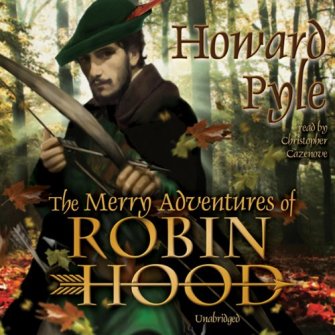
Book Review: The Merry Adventures of Robin Hood

Legends of Robin Hood have been floating around since the 14th century. Scholars debate whether early ballads and stories were based on a real person. In his earliest versions, Robin was just a crook, sometimes short-tempered, according to Wikipedia. He did not rob from the poor, but he didn’t give to them, either. Some of the aspects we know of Robin survived from the earliest stories; others were added or adapted over the years. Wikipedia details Robin’s history and variations.

The Merry Adventures of Robin Hood was the first version written specifically for children by Howard Pyle in 1883. This is the version many films and later aspects of the story are based on.

In this story, Robin is a yeoman, which seems to be a type of middle class between peasants and aristocrats (other versions cast Robin as a nobleman). He first becomes an outlaw by shooting an arrow at someone who shot at him first, subsequently killing the man. This man happened to be related to the Sheriff of Nottingham, who thenceforth became Robin’s enemy.

As Robin hid out in Sherwood Forest, others soon came to join him. Some who were poor and hungry had killed the king’s deer and fled the law. Others had goods and land confiscated by the king and had nowhere else to go.

To support themselves, Robin and his “merry men” stopped rich travelers and “invited” them to feast in Sherwood Forest, then demanded payment of them. In some cases, Robin divided up the money gathered in this way into thirds, keeping a third for his men, a third for charity, and giving a third back. Robin justified this theft because he figured those he robbed had either gotten their gain unfairly or, like wealthy clergymen, were keeping for themselves what they should be giving to others.

The poor loved Robin because he helped many of them. The classes that Robin robbed from, obviously, did not.

This book details many of the well-known stories about Robin—his first bout with Little John, his altercation of Friar Tuck (someone not in the earliest legends), the archery match in Nottingham where Robin went in disguise. Maid Marian in mentioned but never appears. Other stories I had not heard of were included as well, like how Robin met and helped Allen-a-dale to free his beloved from an arranged marriage, Robin’s deadly run-in with villain Guy of Gisborne, the recruitment of Midge, the Miller’s Son, and other tales.

The book came to a very satisfying end, until it got to the epilogue, where Robin’s death by betrayal is told.

There is an odd mention of “Cain’s wife had never opened the pottle that held misfortunes and let them forth like a cloud of flies to pester us.” That sounds like a convoluted version of Pandora’s box. And I chuckled at his phrase because a former pastor used to say it, and I didn’t know it came from this book: “There is many a slip betwixt the cup and the lip,” meaning plans don’t always work out like we hoped. Maybe it was a common saying that Pyle incorporated.

As I first started listening to the audiobook, I wished I had known of and read this book to my boys. The more I heard, though, the more I wrestled with whether that would have been a good idea or not. There’s something appealing about this version of Robin, “honest … in his own way”: someone who stands up for the little guy, who “never harmed harmless man,”  rights wrongs, bests the foolish and evil. But I could never condone vigilantism, for many reasons. And many differences in the book are solved by fighting. Plus there are copious amounts ale, beer, and the like consumed. If we had read the book as a family, we would have had to stop and discuss a lot of issues along the way. Setting aside those objections, though, the rest was fun.

There are many film version of Robin, but the only one I ever saw was the animated Disney one. I’ve seen the character in some shows like Once Upon a Time and Shrek.

I listened to the audiobook superbly read by Christopher Cazenove in a voice and accent perfect for this type of tale. Project Gutenberg has a version online here.

I read/listened to this book for the Back to the Classics challenge, but I am not sure which category to place it in yet. It would fit in two or three. I’ll wait til I read some others and then see where to place this one.

Have you ever read this version of Robin Hood? What did you think?

(Sharing with Carole’s Books You Loved, Booknificent)

Book Review and Giveaway: The Shop Keepers

The Shop Keepers by Nancy Moser is the third book in her Pattern Artist series. The first two books, The Pattern Artist and The Fashion Designer, tell the story of Annie Wood, who came from a difficult family background to become a maid to the Summerfield family of Nancy’s Manor House series. (Annie’s backstory in included in Christmas Stitches.) In the first two books, Annie had a knack for sewing and designing, but the other women in charge of that work took credit for hers. On a trip to America, Annie left her position and found a job first at Macy’s Department Store, then at the Butterick Pattern Company, then in her own dress shop. She met, fell in love, and married Sean Culver.

This third book takes place in New York in 1919, just after the first World War. Annie has two young daughters by now, but her husband has not returned from the war. He’s missing. Her shop, Unruffled, is not doing well. People had to buckle down during the war, and no one felt like buying fashionable yet practical clothes. The country is still in recovery mode. Most of the shop is decked out in black mourning dresses. One of Annie’s partners suggests they go into wedding dresses to help those who had been waiting for sweethearts to return. The prospect raises hope not only for new business but for a brighter shop and outlook.

At just the right time, a salesman from a local fabric shop offers them beautiful fabrics just right for weddings at deep discounts. Full of charm, he tempts the customers in Annie’s shop with his samples. This boon helps set the shop on a new, welcome trajectory. But something about this man bothers Annie, especially when he turns his charm her direction.

Henrietta, Annie’s bookkeeper and long-time friend. feel fortunate that her husband has returned home from the war. But he doesn’t seem totally back. He spends most of the day sitting in a chair looking out the window at the sky. She can’t seem to interest him in herself, their sons, or life in general.

Maude, who had been with Annie since her Butterick days, had married widower Antonio Ricci in the last book. Maude could not have children of her own, but welcomed Antonio’s two children. Now the oldest, Gela, is an independent-minded teenager who finds an unexpected talent. Maude is concerned where Gela’s gifts will take her in her naivete, especially when an unsavory character from Maude’s past comes on the scene.

It took me just a little bit to remember who the characters were and their backgrounds. This book could be read as a stand-alone, but I think it would be a much richer experience for those who have read the first two books.

I enjoyed this book for several reasons. I’ve often read books set during the world wars, but the time of adjustment after after WWI is a fascinating era that few focus on. There were threads of intrigue with the salesman, the man from Maude’s past, and a seeming presence in the shop workroom. Henrietta’s husband’s condition, Annie’s missing husband, and Maude’s concerns lent strands of pathos. Those were woven together with needs for forgiveness, patience, hope. I always enjoy Nancy’s afterwords with details that went her story, historical elements that were true, etc. And I love the book cover.

Once again, I found myself with both a paperback and Kindle copy of this book. I read the Kindle version, and I’d like to give the paper copy away to one of you. Just leave a comment on this post if you are interested in being part of the drawing for this book. (I’ll take all comments on this post as entries unless you let me know you’re not interested.) I’ll draw a name a week from today. I’m sorry, due to shipping costs I can only send the book to US addresses.

Have you read much from the post-WWI era?

(Sharing with Worth Beyond Rubies, Carole’s Books You Loved, Booknificent)

The giveaway is closed: the winner is Linda!

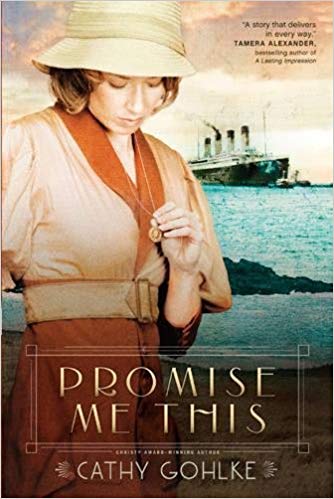
Book Review: Promise Me This

In the novel Promise Me This by Cathy Gohlke, Owen and Annie Allen have been raised by their manipulative Aunt Eleanor in England ever since their parents died. Now Owen has trained himself as a gardener and is about to set off for a new life in New Jersey with their aunt and uncle on their father’s side. He can’t take Annie with him yet, which makes her furious. But he removes her from Aunt Eleanor’s house to a school until he can send for her.

As Owen gets ready to sail on the Titanic in a week, he meets a young street kid, Michael Dunnagan. Owen has compassion on him, shares his food, and gives him odd jobs until time to leave.

Michael picks up another job making deliveries to the Titanic. He muses that in a ship that size, he could hide away and escape from his abusive uncle.

Within just a few days at sea, Owen discovers Michael and takes him into his quarters. He shares his food as well as his plans and dreams to start a new life in New Jersey and send for Annie as soon as possible.

Then comes the fateful night the Titanic hits the iceberg. Owen sends Michael off with the women and children and wraps him in the jacket where he had sewn his precious seedling samples in the lining. Michael fights with everything he has to stay with Owen, but Owen insists and bodily pushes Michael to safety.

After a series of events, Michael finds his way to Owen’s aunt in New Jersey and tells her all that has happened. She takes him in and tells him about the trouble she faces which Owen had not yet heard. In their grief, they decide to try to make a go of Owen’s plans. Michael is determined to bring Annie home.

Annie is devastated, angry, and bitter, not only that Owen died, but that Michael lived instead. Back in Aunt Eleanor’s clutches, Annie finds herself responding in kind and becoming more like her.

When Michael first writes to Annie, she sends the letter back. But soon a tentative friendship begins. Annie trains as a nurse while she waits to go to NJ. And then WWI breaks out.

My thoughts:

When I reviewed Cathy’s Saving Amelie, which became one of my top ten books of last year, I mentioned wanting to read more of Cathy’s books. A couple of people mentioned this story. When I discovered it was partially based on the Titanic, I planned to start it in conjunction with our visit to the Titanic museum.The book did enhance my visit and vice versa.

Cathy mentions in her afterword that there was a Titanic passenger named Owen Allum who was a gardener, but not much else was known about him. I enjoyed reading how she created his and Annie’s stories and what influenced her.

The Titanic section is just the first part of the book, however. I loved the example of laying down one’s life for another as Owen did. And then Michael and Annie each had to learn what it meant to love others and to receive love.

Some of my favorite quotes:

No matter what pain, what hard things come to us in life—and pain and trouble come to all of us—no matter what dark roads we walk or poor choices we make, it is not the end of the story.

It’s no good being fearful. Worry won’t change the future a whit, and it misses the joy of this glad day.

Each morning, when we wake—if we wake—we pick up whatever it is we’ve been given to carry for that day, with the sweet Lord Jesus in the yoke beside us to tote the load. Each night we lay it down, giving it into God’s hands. If it’s still there in the morning, we pick it up and begin again. If the burden is gone or if there is something different, we know where to start.

“Growing is a patient thing, lad,” Daniel explained. “You must give all living things time to adjust to their new surroundings, their new soil, then time to grow, as well.”

Does your hate make you happy, my dear, or does it continually eat through you, a cancer of its own making? Does the constant fueling of that angry fire not exhaust you and take away from living the wonderful life you’ve been given?

I loved the characters (including some not mentioned here) and the story. I loved how Cathy pulled us in to empathize with them in their anger, pain, and hope. Highly recommended.

(Sharing with Global Blogging, Senior Salon, Carole’s Books You Loved, Booknificent)

January-March 2020 Reading List

Years ago, someone who is no longer blogging used to host a “Fall Into Reading” and “Spring Reading Fling,” where participants would share what they planned to read for the next few months and then come back and share what they actually did read. I always enjoyed reading those and added to my TBR list exponentially.

Susanne misses those posts, too, and has decided to start up an informal quarterly reading list sign-up. I thought this might be a good way to break up my larger reading plans into smaller goals. You can find more information here and join in here, if you’d like.

Planning for the month or the quarter just involves looking through the unread books on my shelves, in my Kindle app, and in my audiobook library and deciding which I want to read next. It helps condense the reading decision time by doing it this way rather than every time I finish one book and look for another.

My two biggest challenges are the Back to the Classics Challenge and then two others that focus on reading books we already own (Mount TBR) or have had on our reading list a while.

For classics:

  • I’m currently listening to The Merry Adventures of Robin Hood by Howard Pyle.
  • Hard Times by Charles Dickens
  • I might start Larkrise to Candleford by Flora Thompson next. My copy has three volumes in one, so it’s rather large. But I have also been wanting to watch the series based on these stories as well, and want to read the books first.

I’ll be hosting my last Laura Ingalls Wilder Reading Challenge Feb. 1-29 and will share on Feb. 1 what I am reading for that challenge. I have one book on hand and am considering another.

From my current stash:

I just finished Panosian: A Story of God’s Gracious Providence by Chris Anderson. Next are:

Nonfiction:

  • Good Tidings of Great Joy: A Collection of Christmas Sermons by Charles Spurgeon (currently reading)
  • Off the Clock: Feel Less Busy While Getting More Done by Laura Vanderkam (currently reading).
  • The Last Castle: The Epic Story of Love, Loss, and American Royalty in the Nation’s Largest Home by Denise Kiernan about the Biltmore House. I loved what she did with The Girls of Atomic City, so I’m eagerly looking forward to this book.
  • Anne Morrow Lindbergh: Her Life by Susan Hertog

Fiction:

  • Promise Me This by Cathy Gohlke, a novel involving a couple of people on the Titanic, one who survived and one who did not, and those who wished the results had been reversed (currently reading).
  • The Space Between Words by Michele Phoenix
  • The Shopkeepers by Nancy Moser, a sequel to The Pattern Artist and The Fashion Designer, novels about a young women going into those professions in the early 1900s.
  • Castle on the Rise by Kristy Cambron, sequel to The Lost Castle, a novel involving three different timelines touching an old castle.
  • The One True Love of Alice Ann by Eva Marie Everson, a novel set in 1940s Georgia about a girl waiting for the one she loves to come home from WWII.

Those should keep me busy for a while! I’m looking forward to all of them. I probably won’t finish them all this quarter, but whatever I don’t finish will just go on next quarter’s list.

What’s on your reading horizon?

(Sharing with Susanne, Global Blogging, Senior Salon, Hearth and Soul, Happy Now, InstaEncouragement)

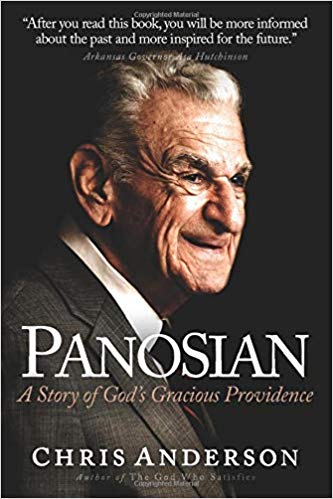
Book Review: Panosian: A Story of God’s Gracious Providence

Dr. Edward Panosian is one of the most beloved professors of my alma mater. But Panosian: A Story of God’s Gracious Providence by Chris Anderson would be beneficial to more than those who knew the doctor as a teacher. It’s not only the fascinating story of God’s hand in one family’s life. It’s the story of a people that were almost completely wiped out in the nearly forgotten Armenian Genocide.

Dr. Panosian taught several history and church history courses at Bob Jones University, but he’s most well-known for History of Civilization. Nearly every freshman took that course. For me, that class was the first time history “clicked” for me as something other than meaningless names and dates.

Students quickly became aware of Panosian’s distinctive voice and mastery of his subject. He pointed out God’s hand throughout history and made history interesting and relevant to students.

Soon students came to know their professor’s kindness, warmth, humor. He is known for many famous sayings, which Anderson lists in the book. He was a fixture riding his bike around campus.

When Dr. Panosian introduced himself the first day of class, he mentioned that he was Armenian. I thought something like, “Huh. I’ve never heard of anyone from Armenia before.” In those pre-Google days, I was, sadly, not curious enough to look up Armenia then. But there was a reason I had never heard of Armenians.

Armenia was a small Christian part of the Ottoman empire, a mostly Muslim entity. Armenians were persecuted for decades, but their ill-treatment culminated in mass murder, rape, exile, forced marches after WWI. Dr. Panosian’s great-grandfather was murdered by a mob in his family home, in front of his wife and children. His grandmother could not escape with all the children. She took one ill son with her to America, and the rest were taken to an orphanage run by German missionaries in Beirut. She didn’t see them or hear from them for nine agonizing years. That they survived and were found is miraculous.

Dr. Panosian’s father’s story is also told, and then we learn how God led Dr. Panosian to his university, wife, and calling.

Betty Panosian taught speech, particularly storytelling. For years she told and read classic stories that were heard on a local radio station Friday nights. She has narrated a few books, and she and Dr. Panosian read Scripture on Scripture Meditations 1 and 2 CDs (some of the latter can be heard here).

Some might be familiar with Dr. Panosian through the university’s Unusual Films productions or through his multiple roles in various Shakespeare plays. His foray into acting had an amusing beginning.

Dr. Panosian also, at someone’s suggestion, created presentations of famous people in history, like Martin Luther, telling their story from a first person point of view. He has given these presentations at a number of churches around the country.

I have several places marked in the book. Here are just a few quotes:

After risking everything to come to America, and after enduring grueling journeys across the Atlantic in cramped and squalid ships, immigrants now had to fret about whether they would actually be let in. It wasn’t a given. Ellis Island was a place of inspection, interrogation, and sometimes quarantine. For some, it was a place of rejection. Imagine arriving so close to the American “Paradise,” only to be sent back to the very country you had fled. For some, Lady Liberty was a sentry, not a hostess. Debates over immigration policies are nothing new. If anything, the debate over granting asylum to refugees was more volatile a century ago than it is today (p. 62).

Betty Panosian tells how she needed a tutor to help her catch up in a class she missed part of to participate in a radio program: “I looked around the class to see who made the As, and I saw Ed. He always knew everything. And so I asked him if he’d help me; and he’s been helping me ever since” (p. 127).

When Dr. Panosian taught his last History of Civilization class after 48 years, he quipped, “This is the end of the history of civilization  as we have known it” (p. 144).

You might recognize author Chris Anderson’s name from his penning hymns like “His Robes for Mine” and “My Jesus Fair.”

I got both the paperback copy of this book plus the audiobook when it came out later. The audiobook is read primarily by Anderson, with Dr. Panosian reading parts. Betty Panosian and a few other voices contribute as well. It was so good to hear the Panosians’ voices again.

Here is a book trailer for this volume:

This trailer is a bit longer, with Dr. Panosian telling some of his story.

Though this book will have special meaning to those who knew the Panosians personally, I think anyone could gain much by reading it.

(Sharing with Carole’s Books You Loved, Booknificent)

Reading Plans for 2020

There are some books you don’t get around to reading unless you plan to. Participating in some book challenges has helped be more purposeful in my reading. But I have found I also need flexibility. I don’t want to feel pressured and tied down by a reading list. I want the freedom to pick up books discovered during the year, new releases, etc. But I also want to read more classics and more books from my own shelves or list of recommendations. There are two main reading challenges I participate in every year, and sometimes I try a few others as well. Thankfully the books can overlap several challenges: otherwise I could probably only do one or two.

So this year, I’ll participate in these challenges:

The Laura Ingalls Wilder Reading Challenge begins here February 1-29. This will be my last year to host it. I have one book in mind for it this year, which I’ll share Feb. 1.

Tarissa at In the Bookcase hosts the Louisa May Alcott Reading Challenge in June.

Tarissa also hosts the Literary Christmas Reading Challenge November through December.

Karen at Books and Chocolate is hosting the Back to the Classics challenge again this year. Books have to be 50 years old for this challenge and fit into the following categories. We don’t have to determine them all at this point, but I’ll list a few I have in mind.

1. 19th Century Classic: Hard Times by Charles Dickens
2. 20th Century Classic
3. Classic by a Woman Author: Eight Cousins by Louisa My Alcott
4. Classic in Translation (originally written in something other than your native language): Possibly Phantom of the Opera by Gaston Leroux. I read it a long time ago but can’t remember much about it.
5. Classic by a Person of Color
6. A Genre Classic
7. Classic with a Person’s Name in the Title: The Mystery of Edwin Drood by Charles Dickens.
8. Classic with a Place in the Title: The Merry Adventures of Robin Hood of Great Renown in Nottinghamshire by Howard Pyle
9. Classic with Nature in the Title: Rose in Bloom by Louisa May Alcott
10. Classic About a Family (multiple members of the same family as principal characters)
11. Abandoned Classic (one you started but never finished). Possibly Billy Budd by Herman Melville. I was supposed to read that for a college class but never finished.
12: Classic Adaptation (Any classic that’s been adapted as a movie or TV series): I might try Larkrise to Candleford by Flora Thompson. It’s long, but I’ve been wanting to read it and see the series.

Most of these books would fit in many of the categories, so I might change them around as I decide on the rest of the titles.

Karen draws a name from participants at the end of the year to receive a $30 gift card towards books, and the number of categories you finish determines how many entries you get.

mount-tbr-2017Bev at My Reader’s Block hosts the Mount TBR Challenge to encourage us to read the books we already own.. Every 12 books read is another level or “mountain” climbed. We don’t have to list the books yet, but we do have to commit to a level. I am committing to Mt. Vancouver (36 books). I’ve been able to reach that pretty easily the last couple of years. The one main rule here is that the books have to have been owned by us before January 1, 2020.

Bev is also hosting the Virtual TBR Reading Challenge, like the Mount TBR except that the first one requires you to own the books you’re reading. The virtual one can include borrowed books or books on your to-be-read list that you don’t own yet. I haven’t done this one before, but I think I can commit to Mount Rum Doodle, 12 books.

The Backlist Reader Challenge sign-up link

The Backlist Reader Challenge is new to me this year. It encourages reading books on our want-to-read list, whether we already own them or not. The only caveat is they have to have been published before 2018 and be a book you’ve already been considering. Lark will give away a $15 Amazon or Book Depository gift certificate at the end of the year. Since most of the Mount TBR and Virtual Mount TBR books will qualify for this challenge, I’m going to aim for 30.

The Audiobook Challenge is new to me, too. But since I listen to several a year (usually classics), it should be easy. I’m aiming for the Stenographer level (10-15 audiobooks). there will be a couple of giveaways with this challenge, on June 30 and December 15.

Yet another new one to me is the For the Love of Ebooks Challenge, which, as the name implies, involves reading ebooks. A good chunk of my TBR books are in my Kindle app, so I think I could do the Semi-Pro status (10-19).

Finally, I am going to try the Nonfiction Reading Challenge since I read several a year anyway. I’m only going to aim for the Nonfiction Nibbler (6 books), though, since I am not interested in all the categories for the next level.

Thanks to Tarissa and Lisa for introducing me to a few that I hadn’t heard of before.

I would never do all these except that they can overlap, and many involve types of reading I already do. There are still several other interesting challenges out there that I decided against!

Do you participate in any reading challenges or make reading plans for the year?