31 Days With Elisabeth Elliot: Do the Next Thing

Elisabeth Elliot2

If you’ve read or listened to Elisabeth Elliot much, you have probably heard her use the phrase “Do the Next Thing.” Here she explains the rationale behind it. I believe this is part of a transcript from one of her “Gateway to Joy” radio programs, the transcripts of which used to be published on the Back to the Bible site, but sadly, are no more. I don’t know if this was included exactly like this in any of her books.

When I went back to my jungle station after the death of my first husband, Jim Elliot, I was faced with many confusions and uncertainties. I had a good many new roles, besides that of being a single parent and a widow. I was alone on a jungle station that Jim and I had manned together. I had to learn to do all kinds of things, which I was not trained or prepared in any way to do. It was a great help to me simply to do the next thing.

Have you had the experience of feeling as if you’ve got far too many burdens to bear, far too many people to take care of, far too many things on your list to do? You just can’t possibly do it, and you get in a panic and you just want to sit down and collapse in a pile and feel sorry for yourself.

Well, I’ve felt that way a good many times in my life, and I go back over and over again to an old Saxon legend, which I’m told is carved in an old English parson somewhere by the sea. I don’t know where this is. But this is a poem which was written about that legend. The legend is “Do the next thing.” And it’s spelled in what I suppose is Saxon spelling. “D-O-E” for “do,” “the,” and then next, “N-E-X-T.” “Thing”-“T-H-Y-N-G-E.”

The poem says, “Do it immediately, do it with prayer, do it reliantly, casting all care. Do it with reverence, tracing His hand who placed it before thee with earnest command. Stayed on omnipotence, safe ‘neath His wing, leave all resultings, do the next thing.” That is a wonderfully saving truth. Just do the next thing.

She goes on to tell about applying this in her missionary work, and then asks the listener:

What is the next thing for you to do? Small duties, perhaps? Jobs that nobody will notice as long as you do them? A dirty job that you would get out of if you could have your own preferences? Are you asked to take some great responsibility, which you really don’t feel qualified to do? You don’t have to do the whole thing right this minute, do you? I can tell you one thing that you do have to do right this minute. It’s the one thing that is required of all of us every minute of every day. Trust in the living God.

Now what is the next thing? Well, perhaps it’s to get yourself organized. Maybe you need to clean off your desk, if you have a desk job that needs to be done. Maybe you need to clean out your kitchen drawers, if you’re going to do your kitchen work more efficiently. Maybe you need to organize the children’s clothes.

Then she tells about baby-sitting her grandchildren for a few days and finding the constant demands and needs of multiple children daunting. When she asked her daughter how she managed, especially with a nursing baby, “She laughed and she said, “Well, Mama, I’ll tell you how. I do what you told me years ago to do. Do the next thing. Don’t sit down and think of all the things you have to do. That will kill you. It’s overwhelming. It’s daunting if you think of all the things that are involved in a task. Just pick up the next thing.”

Wise advice, indeed. We don’t often know the whole big picture, but we can tend to the immediate needs of the moment, and God will sustain and guide those individual moments as He leads us along the path of His will.

You can see the full transcript here.

See all the posts in this series here.

Do-the-Next-Thing

31 Days With Elisabeth Elliot: Imperfections


Elisabeth Elliot2This comes from Elisabeth’s book Keep a Quiet Heart:

The leader of a women’s conference asked me if I would be able to talk privately with a young woman who was in deep sorrow. This woman didn’t want to “bother” me, the leader said, didn’t feel she ought to take my time when there were hundreds of others who needed it. In fact, she was scared of me. Of course I said I’d be very glad to talk with her, and please to tell her I was not fierce.

After the talk, the young woman went to report to the leader.

“Oh, it wasn’t bad after all! I walked in–I was shaking. I looked into her eyes, and I knew that she, too, had suffered. Then she gave me this beautiful smile. When I saw that huge space between her front teeth, I said to myself, ‘it’s OK–she’s not perfect!'”

My daughter Valerie once taught a women’s Bible class in Laurel, Mississippi. It happened that she lost her place in her notes as she was speaking. She tried to find it while continuing to speak, realized she couldn’t, apologized and paused to search the page. The pause grew agonizingly long. At last she gave up and adlibbed through the rest of the lesson. She couldn’t find the application, couldn’t find the conclusion. Leaving the platform afterwards, she was on the point of tears because of what seemed an abysmal failure. A lady came to her to say it was the best class so far. Later someone called to thank Val for things which had helped her.

“Mama,” she told me on the phone, “I couldn’t understand why this had happened. I had prepared faithfully, done the best I could. But then I remembered a prayer I’d prayed that week (Walt told me it was a ridiculous prayer!)–asking the Lord to make those women know that I’m just an ordinary woman like the rest of them and I need His help. I guess this was His answer, don’t you think?”

I think so. It helps to know that others are “only human,” and yet to see how God uses them inspires us that He can use with all our imperfections as well.

See all the posts in this series here.

31 Days With Elisabeth Elliot: Treading Alone

Elisabeth Elliot2

The Savage My Kinsman by Elisabeth Elliot tells of her time with the Auca (now known as Waorani) Indians after they had speared to death her husband and four of his missionary friends. It picks up just after the men’s deaths but before the invitation to Elisabeth and Rachel, sister of one of the other men, to come and live with the Aucas. Elisabeth writes:

I knew that if life was to go on, it must go on meaningfully. I was forced back to the real reasons for missionary work–indeed, the real reasons for living at all. My husband Jim and the four men who had gone into Auca territory had one reason: they believed it was what God wanted them to do. They took quite literally the words “the world passeth away and the lust thereof, but he that doeth the will of God abideth forever.” It is only in obeying God that we may know Him. Obedience, if it is a good reason for dying, is just as good a reason for living. I knew that there was no other answer for me. The “whys” that screamed themselves at me ay and night could not be silenced, but I could live with them if I simply went on and did the next thing.

Jim and I had been working among the Quichua Indians in a place called Shandia. I returned to Shandia. I did the things that presented themselves as duties to me each day, and in the doing of these I learned to know God a little better. To obey is to know. To know is to be at peace. I had know idea what the future might hold. It seemed impossible that I could continue the entire mangemnet of the Quichua station alone, but there was no use concerning myself with the next day. I was confident that, as in the case of the waterfowl,

There is a Power whose care
Teaches thy way along that pathless coast,–
The desert and illimitable air,–
Lone wandering, but not lost….

He, who, from zone to zone,
Guides through the boundless sky thy certain flight,
In the long way that I must tread alone,
Will lead my steps aright.

The poem she quoted from is “To a Waterfowl” by William Cullen Bryant. I think probably nearly every wife fears at some time the prospect of widowhood, and single people can fear being alone. Elisabeth’s words and experience helped assure me that if that time ever came, though it would be painful and difficult, I could trust God to be with me and guide me “In the long way that I must tread alone.” These thought also helped a great deal in the years when my husband had to travel more frequently than I liked, which I shared a bit about in Coping when husband is away, one of my most oft-viewed posts.

See all the posts in this series here.

31 Days With Elisabeth Elliot: The Rupture of Self

Elisabeth Elliot2This is a hard one, but the last few lines help put it into perspective:

Sometimes our prayers are for deliverance from conditions which are morally indispensable–that is, conditions which are absolutely necessary to our redemption. God does not grant us those requests. He will not because He loves us with a pure and implacable purpose: that Christ be formed in us. If Christ is to live in my heart, if his life is to be lived in me, I will not be able to contain Him. The self, small and hard and resisting as a nut, will have to be ruptured. My own purposes and desires and hopes will have to at times be exploded. The rupture of the self is death, but out of death comes life. The acorn must rupture if an oak tree is to grow.

 It will help us to remember, when we do not receive the answer we hoped for, that it is morally necessary, morally indispensable, that some of our prayers be denied, “that the life of Jesus may be plainly seen in these bodies of ours” (2 Cor 4:11 JBP). Then think of this: the agonized prayer of Jesus in the garden went unanswered, too. Why? In order that life–our life–might spring forth from death–his death.

~ Elisabeth Elliot, A Lamp For My Feet

 Verily, verily, I say unto you, Except a corn of wheat fall into the ground and die, it abideth alone: but if it die, it bringeth forth much fruit.
John 12:24

To see all the posts in this series, see the bottom of this post.

31 Days With Elisabeth Elliot: Irritants As God’s Messengers

Elisabeth Elliot2Today’s quote is short but quite convicting. Yet is is also reassuring as a reminder that God truly does work all things together for our good – little irritations as well as great trials. Elisabeth speaks of other people, but I like to expand this to apply to any kind of irritant or annoyance. As I have written before, I tend to get tripped up by those more often than the big things.

How can this person who so annoys or offends me be God’s messenger? Is God so unkind as to send that sort across my path? Insofar as his treatment of me requires more kindness than I can find in my own heart, demands love of a quality I do not possess, asks of me patience which only the Spirit of God can produce in me, he is God’s messenger. God sends him in order that he may send me running to God for help.

From A Lamp For My Feet

To see all the posts in this series, see the bottom of this post.

Knowing God, Chapters 13 and 14: God’s Grace and His Judgment

Knowing GodWe’re continuing to read Knowing God by J. I. Packer along with Tim Challies’ Reading Classics Together Series. This week we are in chapters 13 and 14.

Chapter 13, “The Grace of God,” and chapter 14, “God the Judge,” would seem at first glance like an odd pairing. In fact, many people seem to think that judgment belongs to the Old Testament and grace to the New, but Packer makes a case for both in both sections.

There is something about the word “judge” that is repellent to us. We don’t want anyone judging us, especially someone who doesn’t truly know us, doesn’t know the circumstances, and is as fallible as we are. But don’t we long in our hearts sometimes for someone to set things right in the world? From our earliest experiences, we appeal to a parent or teacher to judge a situation, do the right thing, and take care of the culprit involved.

God does know all about us and our circumstances and is the only one who can judge perfectly and rightly. We can trust the “judge of all the earth” to “do right” (Genesis 18:25). And when it comes to taking care of the culprit…well, that is all of us at one time or another. Though He would be perfectly justified to dispense with any and all of us, He offers grace. He judged His own Son in our place so we could be made right with Him when we repent and believe on Him. Those who reject His grace will have to face Him as Judge.

Packer does a masterful job showing God’s judgment throughout Scripture, explaining how His judgment is a manifestation of His righteousness, and discerning how Christians will be judged in light of the fact that the Bible says we are not under condemnation: we’re not, as far as our soul’s destiny goes, but we are accountable for what we did with what God gave us, and 1 Corinthians 3:12-15 indicates there will be some kind of loss or reward when we face God.

If God is a righteous Judge, why is there so much injustice still in the world? People have wrestled with that for years (see Psalm 73), but the Bible assures us it will be dealt with–“if not here then hereafter) (p. 143).

In the chapter on grace, Packer offers reasons why people have trouble grasping it and then expounds on what it is and what it involves.

“Those who suppose that the doctrine of God’s grace tends to encourage moral laxity…are simply showing that, in the most literal sense, they do not know what they are talking about. For love awakens love in return; and love, once awakened, desires to give pleasure” (p. 137).

Paul refers to the fact that we must all appear before Christ’s judgment seat as “The terror of the Lord” (2 Cor 5:11 KJV), and well he might. Jesus the Lord, like his Father, is holy and pure; we are neither. We live under his eye, he knows our secrets, and on judgment day the whole of our past life will be played back, as it were, before him, and brought under review. If we know ourselves at all, we know we are not fit to face him. What then are we to do? The New Testament answer is this: Call on the coming Judge to be your present Savior. As Judge, he is the law but as Savior he is the gospel. Run from him now, and you will meet him as Judge then- and without hope. Seek him now, and you will find him (for “he that seeketh findeth”), and you will then discover that you are looking forward to that future meeting with joy, knowing that there is now “no condemnation for those who are in Christ Jesus” (Rom 8:1) (pp. 146-147).

Knowing God, Chapters 9 and 10: God’s Wisdom and Ours

Knowing GodWe’re continuing to read Knowing God by J. I. Packer along with Tim Challies’ Reading Classics Together Series. This week we are in chapters 9 and 10, which present different aspects of wisdom.

Chapter 9, “God Only Wise,” discusses what the Bible means when it says that God is wise and acknowledges that Biblical wisdom is not merely intellect, knowledge, or cleverness but also includes a moral quality. “Wisdom is the power to see, and the inclination to choose, the best and highest goal, together with the surest means of attaining it. Wisdom is, in fact, the practical side of moral goodness. As such, it is found in its fullness only in God. He alone is naturally and entirely and invariably wise” (p. 90). But His wisdom doesn’t guarantee a comfortable, trouble-free life: “He has other ends in view for life in the world than simply to make it easy for everyone” (p. 92).

God’s wisdom cannot be thwarted as human wisdom can “because it is allied to omnipotence…Omniscience governing omnipotence, infinite power ruled by infinite wisdom, is a basic biblical description of the divine character” (p. 91). “Wisdom without power would be pathetic, a broken reed; power without wisdom would be merely frightening; but in God boundless wisdom and endless power are united, and this makes him utterly worthy of our fullest trust” (p. 91).

After discussing God’s purposes or goals for us, part of which is to draw us into a loving relationship with Himself which involves faith in Him and deliverance from sin, manifesting His grace through our lives, Packer traces that wisdom in God’s dealing with three Biblical figures: Abraham, Jacob, and Joseph. I won’t list everything he skillfully brings out about them, but I loved this section, and his descriptions reinforced in me the need to not just read the facts, but to notice what is going on with the people in the Bible and how they change. Packer then briefly discusses how we can trust that same wisdom to be working through the perplexities in our lives.

Chapter 10 is “God’s Wisdom and Ours” and discusses what the Bible means when it says we are to be wise. It doesn’t mean that we know everything God knows or what His purposes are in what happens in the world and our lives. There is much that doesn’t make sense in life, and Packer brings out some truths in Ecclesiastes to illustrate that but also to show that ultimately we can trust God no matter what is happening or what sense it does or doesn’t make to us. He emphasizes the need for realism in our view of life and compares it to driving: we may not know why certain roads are laid out the way they are or why other drivers are acting they way they are, but we “simply try to see and do the right thing in the actual situation that presents itself. The effect of divine wisdom is to enable you and me to do just that in the actual situations of everyday life” (p. 103).

That wisdom is gained first by reverencing God (“The fear of the LORD is the beginning of wisdom” – Psalm 111:10; Proverbs 9:10, and others) and then by receiving His Word (Psalm 119:98-99, Colossians 3:16).

[Wisdom] is not a sharing in all his knowledge, but a disposition to confess that he is wise, and to cleave to him and live for him in the light of his Word through thick and thin.

Thus the effect of his gift of wisdom is to make us more humble, more joyful, more godly, more quick-sighted as to his will, more resolute in the doing of it and less troubled (not less sensitive, but less bewildered) than we were at the dark and painful things of which our life in the fallen world is full. The New Testament tells us that the fruit of wisdom is Christlikeness–peace, and humility, and love (James 3:17)–and the root of it is faith in Christ (1 Cor. 3:18; 2 Tim. 3:15) as the manifested wisdom of God (1 Cor. 1:24, 30).

Thus the kind of wisdom that God waits to give those who ask him is a wisdom that will bind us to himself, a wisdom that will find expression in a spirit of faith and a life of faithfulness (p. 108).


Book Review: Everyday Grace: Infusing All Your Relationships With the Love of Jesus

I’ve mentioned several times here that I read years ago in an old biography of a missionary who felt strongly the lack of love in her life, felt guilty about it, berated herself over it often, tried to spur herself on to do better, all to no avail. But when she began instead to meditate on God’s love for her, He began to transform her in ways she was unaware of until her husband told her people were commenting to him about the change in her.

Everyday GraceIn Everyday Grace: Infusing All Your Relationships With the Love of Jesus, Jessica Thompson takes this same principle and applies it to nearly every relationship we might have. She points out that most relationships operate on the basis of karma – I’ll do for you if you’ll do for me, or maybe I’ll do for you so that you’ll do for me in return. But Christianity operates on the basis of grace: God loved us and Jesus died for us when we were enemies, when we didn’t care, when we didn’t love Him, and He wants us to love others in the same way.

But how can we do that? He is God, and though he has saved and changed us, in our everyday lives our old fleshly nature too often evidences itself.

We are not basically good people who need a little instruction so that we can live up to our full potential. We are completely sinful people who need help from outside of ourselves in order to be made alive (p. 39).

We don’t just need a new list; we need a new heart. That is exactly what is promised to us in Ezekiel 11:19-20:

And I will give them one heart, and a new spirit I will put within them. I will remove the heart of stone from their flesh and give them a heart of flesh, that they may walk in my statutes and keep my rules and obey them. And they shall be my people, and I will be their God (p. 47)

We can operate from a basis of grace because Jesus lived a perfect life, keeping all God’s commands in our place, and died, taking all of our sin and its punishment in our place.

My hope is that this book will help you “taste and see that the Lord is good” (Psalm 34:8). That as I open up to you all that he is and all that he has done…as you taste this multifaceted relationship with God, it will transform all of your other relationships (p. 43).

Paul doesn’t just pray [in Ephesians 3:14-21] that the Ephesians would get their act together; he prays that they would somehow be able to comprehend the incomprehensible love of God in Christ (p. 49).

In subsequent chapters, Jessica discusses God as our Father and husband and how that influences our relationships with our spouse and children, Jesus as a friend, coworker, brother, and how that influences our relationships in each of those areas, as well as how our relationship with God directs our interactions with our communities and fellow church members. She ends with discussing the Holy Spirit’s help, dealing with difficult people, and “The Gospel for the Relationship Failure.”

In the chapter on friendship, she writes:

Jesus tells his disciples, “You are my friends if you do what I command you.”…It seems to be saying that he will be our friend only if we obey. But that isn’t what Jesus is saying at all. His friendship came first. This obedience is not what makes them friends; it is what characterizes his friends. I have lived most of my life under the assumption that if I am not obeying, then Christ doesn’t want any part of me. That is a terrible weight and it is a lie. God’s love for us in Christ always precedes our loveliness. His faithfulness always precedes ours, and his friendship is what brings us into relationship with him…If we are true believers in Christ, we will obey. That doesn’t mean we will obey perfectly…But it does mean that we will have a desire to obey. If your life is characterized by a growing desire to obey, you can be sure that you are a friend of Jesus. It is his very pronouncement of “my friend” that gives us the longing to be obedient to his commands. His love for us is what engenders a heart of obedience (pp. 76-77).

In a chapter on work, she writes:

While there is nothing wrong with doing a job you enjoy or looking for a job that you are passionate about, we have made a terrible point of our focus. We are setting out to fulfill ourselves instead of looking for ways to serve others. How often do we really think of our jobs as a way to be God’s hands, even if our job is just stacking books at the library? (p. 169)

[Jesus’] work wasn’t dependent on the one who received the benefit of his work. His work was only and always dependent on his love for God and his love for his people (p. 171).

I thought this from the chapter on church members was particularly lovely:

So we are humble with one another, not thinking we are better than others. We are gentle with each other, instead of beating each other over the head with a long list of “you-shoulds.” We can point out sin, when necessary, without distancing ourselves or acting like our friends have a disease that we might catch if they don’t get their acts together. We bear with one another in love, which is tough, especially if their sin affects us personally. And we are eager and excited to maintain peace, instead of eager and excited when we get a juicy bit of gossip about our friend. We remember that we are one body, and if I hurt you, I am actually hurting myself. We take a vested interest in each other and in loving one another. Lastly, we remember that all of our failures to live as one body have been paid for by the Savior. We don’t have to hide from our community when we sin against them. We confess and remember that even the sin of hurting others in the church was paid for on Christ’s cross. We pray for a new and deeper understanding of what he went through to make us one body; and we pray that this understanding changes who we are as individuals and as a community, one redeemed sinner at a time (pp. 161-162).

In the chapter on difficult people, she talks about not only people whose personalities rub us the wrong way or who have hurt us, but also those going through hard trials – not that they are difficult, but because we find it difficult to know what to say or how to comfort them. A few lines from that chapter were instructive to me:

Part of the reason I struggle to be around people who suffer is because I have to come to grips with my own inability to make everything better. I hate to see that I am actually not the Holy Spirit and I can’t bring them the comfort they need. I hate that I say the wrong things at times and I end up hurting more than helping. But I believe it is in embracing that very weakness that the Holy Spirit has more room to work. The more I try to make it better, the more I try to come up with the perfect verse, the more I am ultimately in the way. When I relinquish my desire to be the Savior and just grieve with my friends, the Holy Spirit does some pretty amazing work (p. 189).

While I found this book immensely helpful in many ways, I’m not eager to go out and buy everything Thompson has ever written. The truth grabbed me: for the most part, the writing did not. I haven’t spent a lot of time analyzing why, but it could have been a lot tighter and less wordy in places (and I realize I have no room to talk there. 🙂 ) There was a lot of repetition.  Plus I think she went way too far in her speculations in some biblical situations that the Bible doesn’t spell out, like the ways in which Jesus was tempted, the situation between Paul and Barnabas’ disagreement, what was going on in Mary’s mind the time she and her other children tried to get in and see Jesus, and instead of instructing them to be admitted or going to the door, He told those He was teaching that whoever does His will is is family. Saying, “Mary might have thought or reacted…” in a particular way is one thing. Saying Mary did think and feel in ways that the Scripture doesn’t say or even indicate she did is dangerous (Thompson postulates that Mary doubted or forgot who Jesus was for a time). This kind of thing keeps me from fulling trusting Thompson’s handling of Scripture, but she seems better in exegesis and application than in speculation. On the other hand, speculation and imagination do serve her well in some areas where she doesn’t go too far, such as picturing Jesus working as a carpenter and encountering the same kind of people we encounter in the workplace.

I found much more that I did like in the book than I didn’t like, and I feel I could recommend it with a caution about those sections.

(This review will also be linked to Semicolon‘s Saturday Review of Books.)

Knowing God, Chapters 3 and 4

Knowing God

We’re continuing to read Knowing God by J. I. Packer along with Tim Challies’ Reading Classics Together Series. This week we are in chapters 3 and 4.

Chapter 3, “Knowing and Being Known,” is one of those chapters that I wish I could produce in it’s totality, one in which I have numerous places marked.

Since Jesus said in John 17:3, “And this is life eternal, that they might know thee the only true God, and Jesus Christ, whom thou hast sent,” and since knowledge of God is commended throughout the Bible, what does it mean to know God?

It is clear, to start with, that ‘knowing’ God is of necessity a more complex business than ‘knowing’ a fellow-man, just as ‘knowing’ my neighbour is a more complex business than ‘knowing’ a house, or a book, or a language.  The more complex the object, the more complex is the knowing of it. Knowledge of something abstract, like a language, is acquired by learning; knowledge of something inanimate…comes by inspection and exploration…But when one gets to living things, knowing them becomes a good deal more complicated. One does not know a living thing till one knows not merely its past history but how it is likely to react and behave and specific circumstances…

In the case of human beings, the position is further complicated by the fact that…people keep secrets. They do not show everybody all that is in their hearts…you may spend months and years doing things in company with another person and still have to say at the end of that time, “I don’t really know him at all.” We recognize degrees in our knowledge of our fellow men…according to how much, or how little, they have opened up to us (pp. 34-35).

Taking it one step further, Packer points out that if we’re meeting someone “above us” in some way, like a queen or president, that person takes the initiative into whatever relationship we might or might not have.

And God, who is so much more “above us” than anyone else, has taken that initiative, spoken to us, invited us into His confidence.

Knowing God is a relationship calculated to thrill a man’s heart.  What happens is that the almighty Creator, the Lord of hosts, the Great God before whom the nations are as a drop in a bucket, comes to you and begins to talk to you through the words and truths of Holy Scripture.  Perhaps you have been acquainted with the Bible and Christian truth for many years, and it has meant little to you; but one day you wake up to the fact that God is actually speaking to you – you! – through the biblical message.  As you listen to what God is saying, you find yourself brought very low; for God talks to you about your sin, and guilt, and weakness, and blindness, and folly, and compels you to judge yourself hopeless and helpless, and to cry out for forgiveness.  But this is not all.  You come to realize as you listen that God is actually opening His heart to you, making friends with you and enlisting you a colleague…(p. 36)

What, then, does the activity of knowing God involve? Holding together the various elements involved in this relationship, as we have sketched it out, we must say that knowing God involves, first, listening to God’s Word and receiving it as the Holy Spirit interprets it, in application to oneself; second, noting God’s nature and character, as his Word and works reveal it; third, accepting his invitations and doing what he commands; fourth, recognizing and rejoicing in the love that he has shown in thus approaching you and drawing you into this divine fellowship (p. 37).

Packer talks about four analogies the Bible uses to help us understand how we know God: “in the manner of a son knowing his father, a wife knowing her husband, a subject knowing his king, and a sheep knowing its shepherd” (p. 37).

Then the Bible adds the further point that we know God in this way only through knowing Jesus Christ, who is himself God manifest in the flesh. ‘Don’t you know me…? Anyone who has seen me has seen the Father’; ‘No-one comes to the Father except through me’ (John 14: 9,6 NIV). It is important, therefore, that we should be clear in our minds as to what ‘knowing’ Jesus Christ means (p. 37).

Packer discusses how the disciples knew and interacted with Jesus, and, since His death and resurrection, we can know Him in the same way except in a spiritual rather than physical (bodily) way, and we have more revealed truth than they did, and “Jesus’ way of speaking to us now is not by uttering fresh words, but rather by applying to our consciences those words of his that are recorded in the gospels, together with the rest of the biblical testimony to himself. But knowing Jesus Christ still remains as definite a relation of personal discipleship as it was for the twelve when he was on earth. The Jesus who walks through the gospel story walks with Christians now, and knowing him involves going with him, now as then” (p. 38).

After sharing several passages that talk about hearing Him (John 10: 27; 6:35; 10:7, 14; 11:25; 5:23-24; Matthew 11:28-29), Packer explains:

Jesus’ voice is ‘heard’ when Jesus’ claim is acknowledged, his promise trusted, and his call answered. From then on, Jesus is known as shepherd, and those who trust him he knows as his own sheep. ‘I know them, and they follow me. I give them eternal life, and they shall never perish; no-one can snatch them out of my hand’ (John 10: 27-28 NIV). To know Jesus is to be saved by Jesus, here and hereafter, from sin, and guilt, and death.

He closes the chapter by noting that “knowing God is a matter of personal dealing,…personal involvement,…and grace” (pp. 39-40).

Knowing God is more than knowing about him; it is a matter of dealing with him as he opens up to you, and being dealt with by him as he takes knowledge of you. Knowing about him is a necessary precondition of trusting in him (‘how could they have faith in one they had never heard of?’ [Romans 10:4 NEB]), but the width of our knowledge about him is no gauge of the depth of our knowledge of him.

Chapter 4, “The Only True God,” mainly discusses the second commandment about not making idols or bowing down and worshiping them. He spends a great deal of time explaining why he believes that commandment precludes pictures of Jesus, and I understand his points that any picture, sculpture, etc., in any kind of media will be limiting and may portray Him falsely. Christians through the ages have had various opinions about that (there have been some lively discussions on the Facebook group for this series.) I wrestled with it myself when my husband gave me a print of Jesus as the Good Shepherd having just found the lost sheep. I came to terms with it because I felt it wasn’t meant to be a representation of Him, but an expression of that truth of the Shepherd’s love and care for His sheep and the sheep’s rest in the Shepherd. But I have wondered if I should take it down so it is not a stumblingblock to anyone else.

Packer also cautions us to watch for wrong mental images about God, as they can be just as idolatrous and false as wooden or sculpted ones.

How often do we hear this sort of thing: “I like to think of God as the great Architect (or Mathematician or Artist).” “I don’t think of God as a Judge; I like to think of him simply as a Father.” We know from experience how often remarks of this kind serve as the prelude to a denial of something that the Bible tells us about God. It needs to be said with the greatest possible emphasis that those who hold themselves free to think of God as they like are breaking the second commandment (p. 47).

I hadn’t thought of it in exactly that way before, but I think this is the basis of the problem I had with a book that portrayed God as an artist and not a technician. It wasn’t a full and true representation of Him: though we can and do appreciate His artistry and creativity and eye for beauty in His creation, that is only one aspect of His character.

All speculative theology, which rests on philosophical reasoning rather than biblical revelation, is at fault here [emphasis mine here]. Paul tells us where this sort of theology ends: “The world by wisdom knew not God” (1 Cor 1:21 KJV). To follow the imagination of one’s heart in the realm of theology is the way to remain ignorant of God, and to become an idol-worshipper, the idol in this case being a false mental image of God, made by one’s own speculation and imagination.

In this light, the positive purpose of the second commandment becomes plain. Negatively, it is a warning against ways of worship and religious practice that lead us to dishonor God and to falsify his truth. Positively, it is a summons to us to recognize that God the Creator is transcendent, mysterious and inscrutable, beyond the range of any imagining or philosophical guesswork of which we are capable and hence a summons to us to humble ourselves, to listen and learn of him, and to let him teach us what he is like and how we should think of him (p. 48).

This book has been immensely helpful so far, and we’re only four chapters in. We’re taking them two at a time, and they’re not overly long or difficult. It’s not too late to join in!


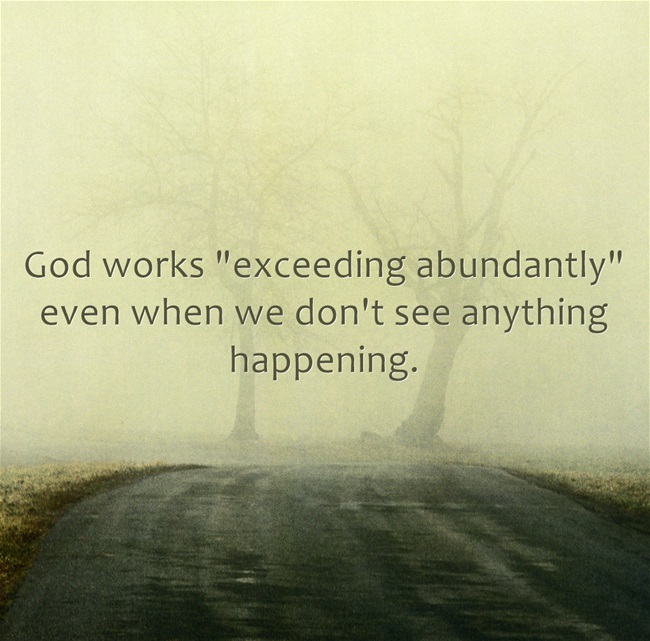
Exceeding abundantly, but unseen

In one of those “one thought leads to another” progressions, a line in girltalk’s post this morning, “No Grace For Your Imagination,”  stood out to me: “But for today’s sufficient trouble there is God’s more-than-sufficient grace.” That reminded me of Ephesians 3:20: “Now unto him that is able to do exceeding abundantly above all that we ask or think, according to the power that worketh in us.” That, in turn, got me to thinking that we tend to associate “exceeding abundantly” as “big and dramatic,” but often the process of God’s working is barely perceptible. We also tend to associate it with material needs, and it can apply to those, but look at the prayer requests that proceeded this tribute to God:

For this cause I bow my knees unto the Father of our Lord Jesus Christ, Of whom the whole family in heaven and earth is named, That he would grant you, according to the riches of his glory, to be strengthened with might by his Spirit in the inner man; That Christ may dwell in your hearts by faith; that ye, being rooted and grounded in love, May be able to comprehend with all saints what is the breadth, and length, and depth, and height; And to know the love of Christ, which passeth knowledge, that ye might be filled with all the fulness of God. Now unto him that is able to do exceeding abundantly above all that we ask or think, according to the power that worketh in us,  Unto him be glory in the church by Christ Jesus throughout all ages, world without end. Amen.

This passage, along with Colossians 1:9-14 and Philippians 1:9-11, is one that I often pray for myself and my loved ones. The particular qualities mentioned are not only unseen and internal (though the results of them are seen), they’re also the kinds of things we don’t receive in a moment. They take time to grow and develop.So praying for them can often seem discouraging because we “don’t see anything happening.” Yet even in those, especially in those, we can trust God to work “exceeding abundantly.”

For years I had written Bible verses out at the bottom of my letters to my father. He never commented on them, so I just assumed he skipped over them, thinking, “There she goes again” while rolling his eyes. Yet he told the pastor who led him to the Lord that he had read them. My mother, as well, went from not wanting to hear about the things of the Lord to being very open to them at the end of her life. If I had asked her what caused the change or how it happened, she probably could not have told me. I’ve mentioned before a missionary who longed and prayed to be more loving, and turned from berating herself to instead meditating on God’s love for her, resulting in changes she wasn’t even aware of until people commented to her husband about the change in her. Many of us have experienced being given grace and strength for a trial that we didn’t “feel” so much at the time, but looking back, we wondered how we ever got through it and knew we could only have done so by God’s grace.

William Cowper says in his hymn, “God Moves in Mysterious Ways,”

Deep in unfathomable mines
Of never failing skill
He treasures up His bright designs
And works His sovereign will.

Even in the deepest recesses of hearts, we can trust Him to work “exceeding abundantly” to answer our requests and fulfill His will.

God-works-exceeding