Disciplined by Grace

“Disciplined by Grace” is the fifth chapter in the book The Discipline of Grace by Jerry Bridges, which we’re discussing every Thursday in the “Reading Classics Together” challenge at Challies‘ place.

“Disciplined by Grace” seems an oxymoron to many who don’t associate the two together, but Bridges asserts that that’s because of a misunderstanding of both concepts.

The epigraph for this chapter is Titus 2:11-12: “For the grace of God has appeared that offers salvation to all people. It teaches us to say ‘No’ to ungodliness and worldly passions, and to live self-controlled, upright and godly lives in this present age.”The word for “teach” there “means much more than…imparting knowledge. Originally it was used as a term for the rearing of children and included not only instruction, but also admonition, reproof, and punishment, all administered in love and for the benefit of the child” (p. 80).

Spiritually, “discipline includes all instruction, all reproof and correction, and all providentially directed hardships in our lives that are aimed at cultivating spiritual growth” (p. 80). But, “all of God’s disciplinary processes are grounded in His grace – His unmerited and unconditional favor toward us (p. 80).

It’s so important to keep these two concepts in balance. With a heavier leaning towards discipline, even good spiritual practices designed to grow us can become performance-based (thinking we earn God’s favor by doing them), while a heavier leaning toward grace can lead to laxity.

Bridges points out from the verse above that grace teaches us to say “No” to some things — ungodliness and worldly passions (and he points out that ungodliness is basically “disregarding God, ignoring Him,  or not taking Him into account in one’s life. It is a lack of fear and reverence for Him”[(p. 85]) — and “Yes” to others — self control, uprightness, and godliness. This is the basic “put off/put on” scenario of Ephesians 4:20-32.

But we need to always remember “With all this emphasis on practical Christian living…we must lose sight of the fact that it is grace — not law — that teaches us” (p. 92). The law “commanded but gave no ability to obey” and then “condemned me for my failure to obey” (p. 92).  But “where the law condemns, grace forgives through the Lord Jesus Christ. Where the law commands but gives no power, grace commands but does give power through the Holy Spirit who lives and works in us” (p. 93).

I appreciated, too, what Bridges pointed out about the fact that while our acceptance before God is on the basis of grace rather than our “performance,” on the other hand, there are many admonitions about the importance of our testimony before unbelievers and the harm that can be done to the cause of Christ by a poor example in ourselves (pp. 89-90).

More discussion on this chapter is here.

Previous chapters discussed from The Discipline of Grace are:

1) How Good Is Good Enough?
2) The Pharisee and the Tax Collector
3) Preach the Gospel to Yourself
4) We Died to Sin.

“We Died to Sin”

“We Died to Sin” is the fourth chapter in the book The Discipline of Grace by Jerry Bridges, which we’re discussing every Thursday in the “Reading Classics Together” challenge at Challies‘ place.

The first response might be something like, “If I died to sin, why do I still have trouble with it?” Bridges says there is a different between “putting sin to death (Romans 8:13),” which he will discuss in chapter 11, and having died to sin.

This chapter studies Romans 6:1-14, but to fully understand that, we have to back up to Romans 5, where we learn that “Wherefore, as by one man sin entered into the world, and death by sin; and so death passed upon all men, for that all have sinned.” In Adam as our representative head, we all sinned, but “our old man is crucified with [Jesus], that the body of sin might be destroyed, that henceforth we should not serve sin” (Romans 6:6). It doesn’t say we won’t sin any more, because the next few verses instruct us not to yield to sin. But sin’s dominion over us has been broken. We’re able to resist it, through Christ. In Erwin Lutzer’s book How To Say No to a Stubborn Habit, he likened it to moving from one house to another, and having the old landlord come knocking on the door asking for our rent payment: we don’t owe him any more, and we don’t have to pay him.

Some have the reaction that, if we died to sin in Christ, if He paid for all of it, then we can relax and do whatever we want. Paul’s response in Romans 6:1-2: “Shall we continue in sin, that grace may abound? God forbid. How shall we, that are dead to sin, live any longer therein?” Because in Him we died to sin, and now we’re united to Christ, such a thing is impossible.

Another resulting thought might be “‘Why…if we died to the reign of sin, do we need to be exhorted not to let sin reign in our bodies?’ Basically Paul was saying…’Live out your lives in the reality of the gospel. Take advantage of and put to use all the provisions of grace God has given to you in Christ'” (p. 75). A former pastor used to say of Philippians 2:12b, “work out your own salvation with fear and trembling,” that that meant not to work for salvation (numerous other verses tell us it is by grace through faith, not out own efforts), but to work it out, like a math problem, to its logical conclusions: take those high and lofty principles and ideals and truths and work them out into your everyday life.

“The gospel is far more than ‘fire insurance’ from eternal punishment in hell. We will learn that through Christ’s death on the cross, we are given the ability to live lives that are both pleasing to God and fulfilling for ourselves” (p. 62).

In many ways, this is the most difficult chapter in the book so far, and these chapters and concepts in Scripture are difficult as well. I’m just scratching the surface here. They are not really hard to follow, exactly, but they do take concentration. But it is definitely worth the effort.

More discussion on this chapter is here.

That the word of the Lord may have free course

That the word of the Lord

may have free course, and

be glorified

II Thessalonians 3:1b

Amen. May the word of the Lord be heard in many hearts and have free course this day.

“Preaching the Gospel to Yourself”

I’m joining in the “Reading Classics Together” at Challies‘ place, and the book currently under discussion is The Discipline of Grace by Jerry Bridges.

I wasn’t able to discuss last week’s chapter due to family activities with loved ones from out of town, but its title was “The Pharisee and the Tax Collector.” Tim summed it up nicely here, but I’ll just say, if anyone has any shred of hope in their own goodness, this chapter will trounce that idea. We think we’re ok, like the Pharisee, because we don’t do any of the “really bad,” obvious sins like murder, adultery, etc., but we overlook our “refined” sins like pride, envy, and the like. But sin is sin. And even the good we do is shot through with wrong motives and lack of faith.

It could actually be a depressing chapter, even for one who has known those truths for years. But it is necessary to remind ourselves of those things in order to see the need for God’s grace, not just for salvation, but for daily living that pleases Him.

The title of the current chapter is “Preach the Gospel to Yourself.” My former music pastor once said that the gospel is not just the first step of the Christian life, but it is the hub of the wheel that everything else in the Christian life connects to and emanates from. Bridges says “The gospel is for believers also, and we must pursue holiness, or any other aspect of discipleship, in the atmosphere of the gospel” (p. 46).

Bridges then thoroughly discuss Romans 3:19-26, bringing out the gospel truths that “no one is declared righteous before God by observing the law,” “there is a righteousness from God that is apart from the law,” “the righteousness of God is received through faith in Jesus Christ,” “this righteousness is available to everyone on the same basis because we have all sinned and fall short of the glory of God,” “all who put their faith in Jesus Christ are justified freely by God’s grace,” “this justification is ‘through the redemption that came by Christ Jesus,'” and “God presented Jesus as a sacrifice of atonement, through faith in His blood.” Those phrases are all sections of the chapter that he then discusses in more detail.

One important distinction he makes is that between “justification and mere pardon. A pardon is excusing an offense without exacting a penalty, “such as when a president or governor pardons someone even though they are guilty. “In God’s plan of justification, however, justice is not violated by a gratuitous pardon of the convicted sinner. Rather, justice has been satisfied; the penalty has been fully paid by the Lord Jesus Christ” (p. 56).

“It is not our contrition or sorrow for our sin, it is not our repentance, it is not even the passing of a certain number of hours during which we feel we are on some kind of probation that cleanses
us. It is the blood of Christ, shed once for all on Calvary . . . that cleanses our consciences and gives us a renewed sense of peace with God” (p. 58).

“To preach the gospel to yourself, then, means that you continually face up to your own sinfulness and then flee to Jesus through faith in His shed blood and righteous life. It means you appropriate again, by faith, the fact that Jesus fully satisfied the law of God, that He is your propitiation, and that God’s holy wrath is no longer directed toward you” (p. 59). Just as in salvation we depended on Jesus’s goodness and righteousness rather than our own, so we do every day of our Christian lives as well, rejoicing that our sins are forgiven and we face no condemnation since we are in Christ.

This does not mean we do not pursue holiness. Much of the latter part of the book discusses holiness. It’s not that once we’re forgiven, we sit back, relax, and live however we want til we get to heaven. Rather, out of love for God and gratitude to Him, we should be even more motivated to pursue holiness. But we need to remember “when you set yourself to seriously pursue holiness, you will begin to realize what an awful sinner you are. And if you are not firmly rooted in the gospel and have not learned to preach it to yourself every day, you will soon become discouraged and will slack off in your pursuit of holiness” (p. 60).

On a side note, I have to admit, before reading this chapter, the phrase “preach the gospel to yourself every day” grated on me a bit. Not that I didn’t believe its truths, even before reading here, but we have such a tendency to operate by catch-phrases: I kept seeing and hearing this brought up in the face of any problem or situation. Yes, if someone has financial or marital or other problems, we do apply the truth of the gospel to it and operate on the basis of the forgiveness wrought for us in Christ. But as Wendy Alsup often says, the gospel affects everything, but the gospel isn’t everything. We apply the gospel and operate from its base, but we go on to learn the whole counsel of God and apply it to our lives as well.

This chapter is very beneficial. I would even venture to say it is the key chapter of the book. More discussion of it is here.

Book Review: Safely Home

In Safely Home by Randy Alcorn, Ben Fielding is on the fast track to becoming CEO of Getz International. To increase the company’s business with China, Ben’s boss wants him to spend a few weeks there and suggests Ben stay with his old college roommate, Li Quan, to get a feel for what the “common man” in China might need from their business.

Ben has been in China many times before, is familiar with much of the culture, even speaks fluent Mandarin, but he has never looked up his old roommate. He is uncomfortable doing so now. Quan had come to college in America an atheist and became a Christian while here: Ben was a professing Christian in college, but his business goals have usurped everything else in his life. But, being put on the spot by his boss, he has little choice but to go and see Quan.

Ben is shocked that his brilliant roommate, who as a student had been asked to stay on at Harvard as  history professor, is living in such poverty. When he begins to learn about house churches and persecution of Christians, he is disbelieving, having fallen for the public relations hype fed to American businessmen and officials. But the more time Ben spends in China with Quan, the more his eyes are opened, not only to the true situation there, but also to the needs of his own heart.

Interspersed with Ben and Quan’s story are glimpses into the heavenlies as Alcorn interprets it, the great “cloud of witnesses,” the King’s care, watchfulness, and preparation for His own.

The story was inspired by Ron DiCianni’s beautiful print Safely Home, depicting a martyr being greeted home by his Savior, an angel waiting to the side with the new arrival’s white robe, the nations of earth visible below.

Knowing a couple of people who have worked in China, I do know that true Christians have to meet “underground,” have to be very careful about their words, actions, and even e-mails, and they can lose their jobs or be arrested for their faith.

We have it so relatively easy in America, we forget the hallmark of many Christians through the ages has been suffering and martyrdom. This book is a wake-up call, and it was a rebuke to me over the “little things” that I get grumbly about or the ways I fail to stand. In myself I know I don’t have it in me to face what some Christians do. But they would say they don’t either: their Savior helps them, as He will us as we walk for Him. We just need to remember that, in a world that hates Him, we often need to make a choice whether we’ll play it safe here, or do what we ought to and take the consequences; temporary safety and ease here, or being joyously welcomed Safely Home there.

A couple of my favorite lines from the book:

From the King: “They don’t understand that I am not only at work here, preparing a place for them, but I am at work there, preparing them for that place” (p. 313).

“The hands and feet of the only innocent man became forever scarred so that guilty people would not have to bear the scars they deserved” (p. 375).

My only little teensy criticism was that the story seemed a little more message-driven rather than story-driven. All writers are conveying a message, of course, and craft stories around the truths they wanted to convey or portray. It’s just a little more obvious here. But that may just be my impression — the reviews I looked through didn’t mention that, so it’s obviously not a drawback.

I do not only recommend but encourage the reading of this book.

(This review will also be linked to Semicolon‘s Saturday Review of Books.)

Listening to God

I just saw this today at The Good Life, and it really speaks to something I’ve been pondering recently. It’s from God’s Wisdom in Proverbs by Dan Phillips, which I haven’t read, nor do I know much about Dan Phillips, but I appreciate this quote:

“Listen” does not mean, here or anywhere else in Scripture, to harken to a subjective, mystical, murmury, semi-revelatory inner voice of God. God has no intention of turning our attention within ourselves, of urging us to seek after holy hunches and vaporous mumblings inside our own deluded hearts. He categorically condemns such orientation (Prov. 28:26; Jer. 17:9). God knows all too well that dense foolishness is “original factory equipment” in our fallen minds, thanks to Great-Great-Grandad Adam (Prov. 22:15).

No, God is not speaking of our listening to the inscrutable mumblings of some spirit, as if it were His Spirit. Rather, here and everywhere God is urging us to listen to the Word of God (cf. 1:23, 33; 16:20; contrast 28:9). The content makes this unavoidable. Solomon means the wise man to listen to the words he is writing. Internal, lowgrade, spiritual “sweet nothings” would have been far from the inspired king’s mind.
~Dan Phillips
God’s Wisdom in Proverbs

One who has influenced my life

Annette at This Simple Home and Dorie at These Grace Filled Days have teamed up to create Together on Tuesdays as “a casual way to meet and connect with other women” over the summer. They’ve created a schedule of topics to discuss in order to get to know one another better, and the topic for this week is someone who has influenced our lives.

I could name several, but one who has had a significant impact is Mrs. C. I had become a Christian as a teen-ager, and my family was mostly unsaved. On Sunday mornings I would take my younger sisters to Sunday School and church with me, but otherwise I went by myself. My church was my second home, and I think of that time as my childhood in the Lord. The church folks were wonderful to me.

During my sophomore year of college, a new family moved to our area and began attending our church. I met them when I came home for the summer. On Father’s Day several of us were asked to give testimonies about our fathers. I don’t remember what I said except that, with my father being unsaved, there was something missing from our relationship, and I began to give testimony instead to God as my heavenly Father. (If I were to give a similar testimony today I would also emphasize that the Lord had taught me to respect my parents, even when they did things that did not invite respect, and more than that, to love them, and that godly love is the greatest testimony and influence to them.)

Afterward this new family, the C. family, spoke to me. They told me if I ever needed someone to talk to, I should feel free to call them. I warned them that I would take them up on that offer. :) At some point they invited me to their home for dinner, and our relationship just grew from there until I began to think of them as my spiritual family.

I don’t think they took me “under their wing” with a view to teach, to instruct, to be an example — I don’t think they saw me as a ministry or a project. I think they were just extending love. But just seeing the example of a godly Christian home was such a tremendous influence on me. I had always, in all my childhood imaginings of what I wanted to be when I grew up and alongside those other aspirations, wanted to be a wife and mother. After I became a Christian I wanted to have a distinctively Christian home. And in the C. household I saw that lived out. I saw the father’s firmness and headship of his family. I saw the children, though normal and not perfect, sinless children, love and respect their parents. I saw a loving cheery atmosphere. But most of all I saw Mrs. C. — her merry heart, her loving submission to her husband, her gentleness with her children, her creativity and industriousness in her home, her servant’s heart at church, and her interest and care for me. She was the same sweet, cheery, helpful, outreaching person in every venue. I began calling her “Mom” (not to replace my mom — I loved my mom dearly — but in a way different from my mom) and her daughter, who was a few years younger and who happened to look like me, and who later was my maid of honor, my sister. To this day she is “Mom C.” Though Mr. C. passed away several years ago, I still keep in touch with Mrs. C. She remembers all of my family’s birthdays and our anniversary.

I don’t know what I would be and what my home would be without her example and influence. I am thankful for her and I love her dearly.

Thy words were found, and I did eat them; and thy word was unto me the joy and rejoicing of mine heart: for I am called by thy name, O LORD God of hosts.
Jeremiah 15:16

It is the spirit that quickeneth; the flesh profiteth nothing: the words that I speak unto you, they are spirit, and they are life. John 6:63

May you find joy and life as you partake in His Word today.

Reading Classics Together: The Disciplines of Grace

I’m joining in the “Reading Classics Together” at Challies‘ place for the first time. I’ve always liked the idea: a group of people reads a chapter of a book a week and discusses it. But this is the first time the title they are discussing appealed enough to me for me to jump in.

The Disciplines of Grace by Jerry Bridges attracted me for a couple of reasons. I’ve heard Bridges favorably mentioned and recommended for years but just have never gotten to one of his books. And the title of this one seemed to explore what I was pondering in a post a while back, Of grace, law, commandments, rules, and effort (who knew someone had already written a book about it? 🙂 ) As I said there, people often seem to go too far one way or the other, either emphasizing grace to the point of having a laid-back attitude toward sin and obedience and even accusing those who emphasize obedience of legalism (I’ve seen this so many times in online discussions), or emphasizing obedience so much that they get caught up in their own performance and think they have to earn favor with God.

The first chapter, “How Good Is Good Enough?” deals with those two sides and illustrates them by contrasting two days, a good one where we’ve done pretty well by our standards, and a bad one where we failed at the starting block and can’t seem to get back on track all day. Bridges emphasizes that we can never earn God’s grace — by its very nature grace is undeserved, and though God wants us to obey (by His grace), even if we do, it’s only by His grace. He also emphasizes that depending on God’s grace every day doesn’t negate the need for vigorous personal effort in the pursuit of holiness.

Here are just a few quotes from the chapter that stood out to me:

The pursuit of holiness requires sustained and vigorous effort. It allows for no indolence, no lethargy, no halfhearted commitment, and no laissez faire attitude toward even the smallest sins. In short, it demands the highest priority in the life of a Christian, because to be holy is to be like Christ — God’s goal for every Christian (p. 12).

When we pray to God for His blessing, He does not examine our performance to see if we are worthy. Rather, He looks to see if we are trusting in the merit of His Son as our only hope for securing His blessing (p. 19).

It is only the joy of hearing the gospel and being reminded that our sins are forgiven in Christ that will keep the demands of discipleship from becoming drudgery. It is only gratitude and love to God that comes from knowing that He no longer counts our sins against us (Romans 4:8) that provides the proper motive for responding to the claims of discipleship (p. 21).

And my favorite:

Your worst days are never so bad that you are beyond the reach of God’s grace. And your best days are never so good that you are beyond the need of God’s grace (p, 19).

More discussion on this chapter is here.

Book Review: Not By Chance: Learning to Trust a Sovereign God

As I mentioned when I reviewed Beyond Suffering: Discovering the Message of Job by Layton Talbert, my husband and I have known Dr. Talbert for years, back before he was a PhD., before he was married….when he still had hair. 🙂 He was one of the adult Sunday School teachers at the church we attended when we were first married, and sitting under his teaching plus reading his columns in Frontline magazine, have caused me to trust his treatment of Scripture. But that trust did not come just from knowing him, but rather because of attitudes such as this:

The Holy Spirit is not capricious or careless in His use of words. It is incumbent upon us, therefore, to handle the text of Scripture attentively and accurately. If we are to form a correct understanding of the facts of the story (and, consequently, to arrive at sound theological conclusions), it is vital that we carefully observe the details — and confine our conclusions to the information explicitly communicated by those details (p. 87).

And:

We are not at liberty to draw inferences that contradict other explicit statements of Scripture. And we must be tentative about defending apparently logical inferences that carry us beyond explicit statements of Scripture (p. 252).

Though he would not claim infallibility, nor would I claim it for him, Dr. Talbert’s detailed study and respect for the Word of God and carefulness and balance in teaching it makes his books trustworthy.
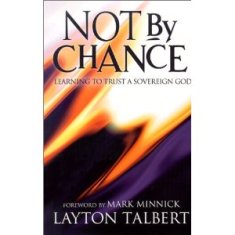
I first picked up Not By Chance: Learning to Trust a Sovereign God years ago mainly because it was his with the thought, “Yes, I should read that some time.” I believed in God’s sovereignty and providence and was often comforted by it, so I wasn’t quick to plunge into a book about it, even as much as I respected its author. But like I suspect is the case for many of us, it’s when something bad or seemingly incongruous happens to shake us up that we begin to wonder about God’s providence, not to question it per se, but to wonder how this or that fits into it.

Dr. Talbert begins by discussing what providence means and thoroughly examining Scripture concerning God’s providence over man, creation, weather, opportunities…and multitudes of other things. By the end there is no escaping the fact that God is in control. And while that’s a comfort on one hand, it’s a conundrum on the other: what about the bad things?

Dr. Talbert covers that well, too. Notice I didn’t say he explains it. There are some things about providence that we can’t understand or fully explain, just like we don’t thoroughly understand the Trinity, or the fact that Jesus is both fully God and fully man at the same time, and other mysteries. But he does shed as much light on it from Scripture as he can, and it does help. For instance, in dealing with a mistaken logical inference, he says:

We often assume that all good things come from God and all “bad” things come from Satan. That is a false and unbiblical assumption that gives Satan far too much credit and attributes to him far more power than he actually possesses. Contrary to popular misconception, Satan is not God’s evil counterpart, but Michael’s. Satan, like Michael, is “only” an angel; so he is an evil angel, not an evil God. Jehovah Himself claims that He is the only God and the ultimate ruler over all our circumstances, both the “good” and the “bad” (p. 12).

And here:

God guides and governs all events, including the free acts of men and their external circumstances, and directs all things to their appointed ends for His glory.

Notice that this definition does not say that God initiates or causes all events. If we are to maintain Biblical precision in our understanding and application of Scriptural truth, the terms we choose to state it are vital (p. 62).

And from a study of the life of Joseph:

God also providentially superintends and often uses the unfairnesses of life to accomplish His purposes in and for us and those around us (p. 66).

This is something many of us wrestle over:

Part of the mystery of providence resides in the fact that God rules and reigns over all things according to His will and pleasure (Ephesians 1:11), yet man is still fully responsible and accountable for his choices and actions. In other words, God exercises His providence and accomplishes His will through the free and voluntary choices and attitudes of men and women. Were this fact limited to God’s persuasive working in believers, that would be amazing enough. But it is equally true of the wicked. God never prompts evil men to sin, yet even their rebellion against Him and their hostility against His people is providentially governed and employed by God. (The clearest example of this…[is] found in the events surrounding the Crucifixion) (p. 86).

Sometimes pondering providence can lead us to think that it doesn’t matter what we do since God is in control anyway. But Dr. Talbert reminds us that God has assigned certain duties to us in Scripture and providentially works through them.

The providence of God is never intended to lull us into a lackadaisical attitude of fatalism, as if our actions don’t really matter because God rules and overrules however He wants anyway. It is revealed to maintain a glow of energizing trust that, despite all appearances to the contrary, God is governing for His glory and for my good — a trust that inspires me to stay faithful, obedient, loyal and devoted to Him, and confident in Him…God’s providence, then, encompasses and incorporates the faithfulness and obedience of His children (p. 70).

There are chapters on God’s preserving providence, governing providence, the mystery of providence, the means of providence, silent providence, the problems of providence, providence and prayer (why pray when God is in control? this is an excellent chapter) and case studies from Biblical characters illustrating the truths being taught. Plus there are chapters on God’s providence displayed in the incarnation and passion of Christ and the church. There is a wonderful section in the study of Joseph about why God sometimes allows delays and what He accomplishes through them. There are several appendices, one being the two sides salvation: God’s determination and man’s responsibility.

I marked over 60 quotes that especially stood out to me, so there’s no way I could share all of them here. But here are just a few more:

When we are willing to submit to and practice only what immediately makes sense to us, and ignore what doesn’t (even when it is clearly commanded), we have substituted ourselves — our finite mind — as the sovereign (p. 215).

[God] is the Maestro of providential orchestration, of split-second timing, of perfect point and counterpoint (p. 249).

We dare not construct a system of theology that helps the Holy Spirit by refining or redefining the words He selected or by interposing words He chose to omit so as to tweak out of it, ever so gently, a slightly modified meaning that better fits the system (p. 259)

One of the absolute best statements I’ve ever heard as to why God’s providence allows for hard or painful things was quoted from Steve Estes, in When God Weeps with Joni Eareckson Tada:

“God permits what He hates to achieve what He loves.”

In short (although I guess it is too late to say that, huh? 🙂 ) I do very highly recommend this book.

(This review will also be linked to Semicolon‘s Saturday Review of Books.)