Boomerangs, according to G. K. Chesterton, are “things that return.” He names sleep and a new day as boomerang blessings–something we experience which comes back to us to experience again. No matter how many times we go to sleep and wake up again, we continue to enjoy those recurring cycles.
In Winter Fire: Christmas with G. K. Chesterton, Ryan Whitaker Smith comments that feasts in the Jewish calendar were like boomerangs, recurring reminders of God’s grace in delivering and providing for His people. He quotes Chesterton again:
It is the very essence of a festival that it breaks upon one brilliantly and abruptly, that at one moment the great day is not and the next moment the great day is . . . The thing is done at a particular time so that people may be conscious of a particular truth; as is the case with all ceremonial observances, such as the Silence of Armistice Day or the signal of a salute with the guns or the sudden noise of bells for the New Year. They are all meant to fix the mind upon the fact of the feast or memorial, and suggest that a passing moment has a meaning when it would otherwise be meaningless (pp. 68-69).
Whitaker goes on to say, “As the Israelites’ festivals were a perpetual retelling of the same story, so are our Christian traditions a form of continually re-grounding ourselves in the narrative of redemption. The consistent ‘return of old things in new times,’ Chesterton tells us, . . . . the regularity of our holiday rituals is a way of maintaining godly sanity in an unstable and unpredictable world” (p. 56).
Our modern church and personal calendars may not follow the feasts given Israel in the Old Testament. But regular observances with their symbols and rituals remind us of great truths.
Christmas reminds us:
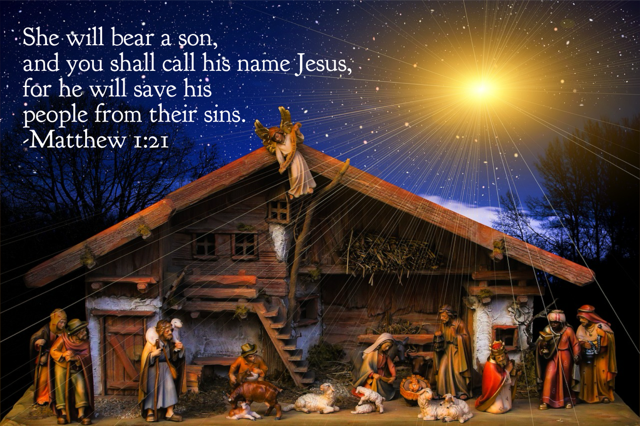
We need a Savior. “She will bear a son, and you shall call his name Jesus, for he will save his people from their sins” Matthew 1:21).
God loves us enough to rescue us at great cost to Himself. “For God so loved the world, that he gave his only Son, that whoever believes in him should not perish but have eternal life.” (John 3:16).
God’s timing is perfect. “But when the fullness of time had come, God sent forth his Son, born of woman, born under the law, to redeem those who were under the law, so that we might receive adoption as sons” (Galatians 4:4-5).
And so much more.
May the “boomerang blessing” of Christmas never be stale or empty, but rather a regular reminder that God loved us enough to send His Son to be our Savior, to die for our sins so we could become His.
Jim and I are celebrating our 45th wedding anniversary in a few days. I’m not an expert at marriage, even at this stage. I don’t say a lot about marriage here for that reason. But I thought I’d share a hodgepodge of lessons learned, advice gleaned, and favorite poems and quotes concerning marriage.
1. I *hate* don’t like the saying “Marriage is designed to make you holy, not happy.” Almost every reference to marriage in the bible presents it as a happy union. Yes, we have to battle our selfishness, and God uses marriage to sanctify us. But happiness and holiness are not mutually exclusive.
2. One of my favorite books about marriage is The Ministry of Marriage by Jim Binney. To be honest, I read it so many years ago, I can’t remember much of the content now. But I like the emphasis in the title.
3. Humor helps. “A man without mirth is like a wagon without springs, in which everyone is caused disagreeably to jolt by every pebble over which it runs” (Henry Ward Beecher). Humor can diffuse tense situations and make life easier.
4. But be careful with humor. Poking fun at each other can hurt, even if the other person laughs. They will likely wonder, “Is that what he really thinks?” Also, if someone is pouring her heart out over something, and the other person makes a joke of it, she’ll feel unheard and not taken seriously. When something crosses from gentle teasing into something hurtful is probably different for each couple.
5. Appreciate the 80%. Elisabeth Elliot once said that a wife may appreciate and agree with 80% of what her husband says and does, yet harp at the 20% she doesn’t like, making them both miserable. I assume the same could be said of the husband regarding his wife. No spouse will be perfect: We need to spend more time appreciating what we have.
6. Marriage is not 50/50. It’s 100/100.
7. Love songs speak of climbing mountains or swimming oceans. Who really does those things for love? It’s easy to say, or sing, because no one expects anyone to actually do them. Real love is shown in the everyday giving oneself for the other.
8. Not the grand gestures. Lisa-Jo Baker shared in The Middle Matters that a teenager quoted in the Huffington Post felt her love life would never be adequate “until someone runs through an airport to stop me from getting on a flight.” The girl probably saw that in a movie somewhere. Her romantic life is going to be difficult if she sets up a test scenario in an airport every time she thinks she’s in love. Everyday thoughtfulness and kindness goes much further than the occasional sweeping romantic (and unlikely) moment.
9. Love languages. There’s something to be said for love languages coined by Gary Chapman. We perceive love differently. If a husband compliments his wife all day long or buys her piles of gifts, and her love language is acts of service, she’s not going to feel loved unless he helps wash the dishes. But I agree with Tim Challies here that love languages are just a way to understand and communicate with each other, not something to demand as a right or use to manipulate.
10. Don’t take each other for granted. This can be easy to do after a number of years together, in the busyness of everyday life. It helps to take time to consciously think of what we appreciate about each other.
11. Maintain good manners. Please, thank you, etc., still go a long way and help #10.
12. Assume the best. A former pastor said 1 Corinthians 137 (“Love bears all things, believes all things, hopes all things, endures all things”) means we cherish the best expectations of each other. If the other is late, leaves something undone, does something in a way we don’t like, talk about it kindly and graciously. Don’t jump to conclusions.
13. Date nights are nice, but not, as some would say, essential. The important thing is to spend time together one on one, whether that involves going out or being at home.
14. Be aware of introversion and extroversion. My husband and I are pretty similar in this respect, though I am more of a homebody than he is. But when there are differences, we need to understand that introverts are energized by time alone and drained by time with people, and extroverts are just the opposite. We need to be balanced and considerate with each other.
15. Rituals. Every couple develops their own little rituals in everyday life. But, like I said recently regarding traditions, we need to be flexible with them and not binding. One couple we knew decided that all through their married life, they would get up at the same time and go to bed at the same time. I wonder if they both got up for babies’ nighttime feedings. That meant a lot to them, but my husband and I could not have sustained that with his work schedule and leaving way early for travel. If we start something like that and find it doesn’t work after a while, it’s okay to adjust.
16. Don’t expect the other to read your mind. We might wonder how the other could not know our preferences or desires, but they can’t unless we express them.
17. Speak plainly. This could work both ways, but I think women are more prone to hint rather than plainly say what they want, and then get frustrated when he doesn’t get it.
18. Don’t make special days a test. I heard this from Gregg Harris some thirty years ago, and he’s the only person I have known to say it. He cautioned against using anniversaries, birthdays, Valentine’s Day, etc., as tests of a spouse’s love, and then feeling angry or hurt if he/she doesn’t remember them. Instead, remind the other, or ask, “What would you like to do for” the day beforehand, etc.
19. We all need appreciation. A friend shared that her husband had done a lot of yard work, then came to the door to ask her to come out and see what he had done, saying he needed an “Atta boy.” We smiled, but it’s true–we need to know someone appreciates our work and it pleases them.
20. Respect. I cringe when I hear husbands talking down to wives or wives talking to husbands the same way they talk to their children. We shouldn’t demean or ridicule each other.
What about when a husband doesn’t act in a way that invites respect? I like to turn this around: the same passage that mentions respect in marriage mentions love (Ephesians 5:22-33). Do we want our husband only to show love to us when we act deserving of it? No! We want him to understand when we’re not very lovable and love us anyway. So we can do the same for him. We may not respect every action or sentence, but we can respect him as a person and give him grace when he’s not perfect.
21. Remember you marry a sinner. As Elizabeth Elliot said, there is no one else to marry. While on one hand we hold each other to the highest, on the other, we acknowledge that the other is only human.
22. Be careful how you talk to others about your spouse. This is not only a matter of respecting our spouse, but of being a good testimony about marriage to others. We don’t have to pretend the other is perfect and never does wrong. But what is it saying to younger people about marriage and relationships if a husband getting together with the guys or a wife with the girls if it’s a time to complain about the other?
23. It’s okay to have separate interests. I think we actually benefit when we are enriched creatively in other ways and then come together. Plus, we shouldn’t expect the other to be interested in every little thing we are.
24. But it’s good to share some interests as well, or to listen to a conversation on a topic we’re not interested in or go to an event the other likes but we don’t care for sometimes. There are some family outings where I might not really be interested in the activity, but I go for the family togetherness.
25. Adapt to your own spouse. I read of a woman who heard that a good wife is a good housekeeper. When she got around to discussing housecleaning with her husband, she was surprised to find that he didn’t really care about a pristine house. He didn’t want a sloppy home, but he didn’t feel it needed all the extra touches she was giving it. In fact, he’d much rather she spent more time with him than more time cleaning. I’ve benefited much from good books about home, marriage, and family, but we need to check them with the real live person in our home and his preferences.
26. Don’t lie. I don’t know if there is an easier way to destroy trust than to lie to someone. Sometimes we don’t outright lie, but we manipulate details to get ourselves off the hook.
27. Remember a spouse is a brother or sister in Christ. How many times have you heard of a couple fighting in the car on the way to church, and then pasting on smiles when they get there? All those one-another passages in the Bible apply to our family members as well as other people at church.
28. Don’t put a spouse in God’s place. I had a hard time when my husband worked an overnight shift a few years into our marriage and even more when he started traveling for his job. Evidently I am not alone in that, because Coping when a husband is away is one of my most often-viewed posts. God uses husbands in our lives as our protectors, providers, and companions–but for Him to work through, not for us to look to instead of Him.
29. Find your security in Christ, in the fact that He created you and gifted you for His calling. We all need encouragement and reassurance at times, but we shouldn’t be needy in the sense of needing constant affirmation.
30. Manage your expectations.
31. Avoid “always” and “never,” especially in an accusatory way.
32. Attack the problem, not the person during disagreements.
Favorite Quotes about Marriage.
33. C. S. Lewis has a long quote from Mere Christianity, included here, the gist of which is that the intense “feeling” of love in the beginning can’t be expected to last. “Who could bear to live in that excitement for even five years? What would become of your work, your appetite, your sleep, your friendships?” But “love as distinct from ‘being in love’ is not merely a feeling. It is a deep unity, maintained by the will and deliberately strengthened by habit; reinforced by (in Christian marriages) the grace which both partners ask, and receive, from God. They can have this love for each other even at those moments when they do not like each other.” “It is on this love that the engine of marriage is run: being in love was the explosion that started it.”
34: Jane Eyre. “To be together is for us to be at once as free as solitude, as gay as in company. We talk, I believe, all day long: to talk to each other is but a more animated and an audible thinking.”
35. Booth Tarkington. “It is love in old age, no longer blind, that is true love. For love’s highest intensity doesn’t necessarily mean its highest quality. Glamour and jealousy are gone; and the ardent caress…is valueless compared to the reassuring touch of a trembling hand. . . the understanding smile of an old wife to her husband is one of the loveliest things in the world.”
36. Mignon McLaughlin. “A successful marriage requires falling in love many times, always with the same person.“
Favorite Songs about Love and Marriage. I’m not a big fan of sappy love songs, except around Valentine’s Day. 🙂 That’s probably because many of them are unreal–the whole climbing mountains and swimming oceans thing mentioned earlier. But here are a couple I especially love:
37: The Voyage. Jim made this video for me in 2008. Jason and Mittu were recently engaged but not married yet, and of course Timothy wasn’t here then. The song is “The Voyage,” sung here by John McDermott, then in the Irish Tenors:
38: My Cup Runneth Over with Love. This was popular when I was a kid, and I still love it.
44. Pray for each other. Though we meet each other’s needs as much as we can, with God’s help, only He can strengthen and enable us day by day.
45. 1 Corinthians 13 is, of course, the best description of love.
When I started, I wasn’t sure if I could come up with a list of 45. Now that I’ve got the ball rolling, even more things are coming to mind. I’d sum up most of what I’ve learned about marriage with this: be kind, gracious, forgiving. Build each other up; don’t tear each other down. Appreciate the little things. Put God first, then each other.
Do you have any favorite marriage advice, quotes, or poems?
Christmas brims with traditions. Some point back to long centuries: lights to represent the light of the world, stars to remind us of the one that led the wise men, gifts exchanged in commemoration of the gifts brought to the Christ child.
Martin Luther is often credited with the first Christmas tree. Charles Dickens (perhaps unwittingly) set in motion our modern-day idea of Christmas with feasting and charity.
But personal traditions that form within families or individual lives are often the dearest.
One of the things I love best about decorating the Christmas tree together as a family is the memories inspired by the ornaments as we bring them out of boxes and hang them.
Once, one of the boys hung a snowflake ornament on the ceiling when I wasn’t looking. It took me a while to notice it, and then I couldn’t reach it to take it down. Now the plastic snowflake ornament shows up in various places almost every year: a curio cabinet, among figurines on the mantle, and all sorts of ceiling spots.
Of course, Christmas isn’t the only time for traditions. On our anniversary, my husband and I place cards for each other under the other’s pillow, and we read them last thing before we go to sleep.
One Valentine’s Day, I made mini meat loaves in the shape of hearts one year, and now it’s a tradition to have “meat hearts” that day.
Each holiday and season has its own rhythms and rites.
Traditions can form around everyday occurrences, too–football game snacks, bedtime rituals, celebrating milestones like graduation, raises, and promotions, etc.
Traditions enhance our celebrations, strengthen our relationships and sense of belonging, give us cheerful practices to anticipate and look back on with fondness. Traditions within a larger culture can help form a cultural identity.
But traditions can sometimes be a problem:
When one person wants everything the same and another wants something new. A few years ago, a friend on Facebook asked what new things people were making for Thanksgiving. I thought “New? For Thanksgiving?” 🙂 We look forward to having the same things each year. But we’ve made some adjustments as needed and are open to other suggestions. Maybe, if there’s conflict, the main dishes could be agreed upon with the side dishes changing each year.
When seasons of loss or sorrow overshadow the holidays. Sometimes it’s a comfort to do the same familiar things even when the person you did them with is no longer there. But for some, those same rituals would be painful. And there might be different tendencies within the same family. There is no one right answer except to be sensitive to each other.
Sometimes a loss can trigger a new tradition. We knew a couple whose daughter was killed by a drunk driver. They helped host a yearly holiday dinner for other families who had suffered through a similar loss. One friend’s widowed grandmother missed the rose her husband used to give her on their anniversary. The family made sure someone brought her a rose every year after that. After my mother passed away, my family in TX met to go together to the cemetery every year with a small Christmas tree or arrangement.
When new additions are added to the family. A friend was talking with her oldest son and new daughter-in-law about the holidays. Things seemed to be up in the air, and with three more young people at home who would be marrying over the next few years, my friend felt she needed to set some boundaries so the yearly celebration wasn’t an upheaval. She simply shared when they had their usual Christmas dinner and went from there.
When children marry (or parents remarry), each couple has another whole side of the family with its traditions to deal with. Hopefully, new blendings of traditions will come into the mix. But each couple will not be able to do all the things both families always do.
When circumstances interfere. For several years, our Thanksgiving tradition was to get together with a family my husband was close to from his home church. One year, we visited friends in one state overnight before traveling on to the other friends’ home for Thanksgiving. Our car broke down in the first friend’s driveway. We had to find someone to tow it away and fix it plus rent a car for the rest of the trip. We ate at Burger King on the way. Our youngest got carsick on winding mountain roads. We finally arrived just as the family we were visiting was having their evening leftovers from the noon meal.
Sometimes you just have to go with the flow and make the best of it. But those holidays that turned out different than expected are sometimes the most memorable ones.
When there are too many traditions to keep up with. We can add things to do each year until we’re over-scheduled, stressed, and frustrated. If traditions are making us tired, irritable, and wanting to be left alone, they’re doing the opposite of what they’re supposed to.
When my kids were little, December was stuffed with school programs, piano recitals, church group get-togethers, and so much more. One year we just didn’t get around to making Christmas cookies. No one seemed to notice, so we skipped that activity for several years.
I love Christmas cards and letters, but I know many who have stopped sending them due to expense and time.
Perhaps a family meeting is needed to discern what activities mean the most to each person, and some traditions can be removed or rotated from year to year.
When a tradition has outlived its usefulness or no longer carries meaning, but we can’t let go of it. I heard of a family who was discussing who was going to make a particular traditional dish for Christmas when they realized that none of them liked that dish. It was started by someone who had passed away years ago.
Sometimes we maintain a tradition for one or a few people as an expression of love to them. But if everyone is doing the same things just because “That’s what we always do,” it’s okay to let some traditions go.
A tradition is not an end in itself. We shouldn’t regard an occasion as ruined if we don’t get to incorporate a particular tradition. We need to be flexible; as life changes, we need to change and adapt with it.
And we need to remember what the tradition is for: to celebrate, to show love, to draw people together, and to make fond memories.
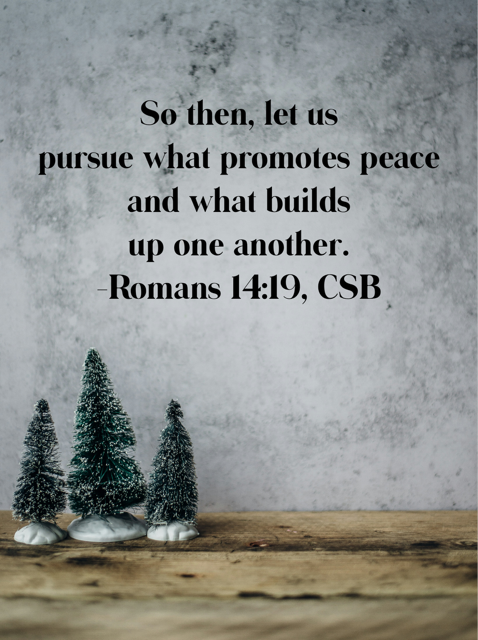
If some traditions are more of a burden than a blessing, we can remember to “pursue what promotes peace and what builds up one another.” (Romans 14:19, CSB).
I’ve sometimes heard people say, “If God will only answer this one prayer, I promise I’ll never bother Him again.”
That statement strikes me as sad, because it reveals such a misunderstanding of the nature of God.
God wants us to “bother” Him. He’s delighted to answer the prayers of His children (though He may not answer them in quite the way they had in mind because He knows what is best for them).
God doesn’t want to be only our heavenly 911 operator who will fine us if we call without an emergency. He wants to walk in fellowship with us every moment.
God is also our:
Father. “See what great love the Father has lavished on us, that we should be called children of God!” (1 John 3:1). When we believe on the Lord Jesus Christ as our Savior, we become God’s children. Fathers instruct, guide, and discipline their children, but they also love to listen to them.
Savior. “And there is no other god besides me, a righteous God and a Savior; there is none besides me. Turn to me and be saved, all the ends of the earth! For I am God, and there is no other” (Isaiah 45:21b-22). He doesn’t want to just get us out of the occasional bind. He wants to take care of the biggest problem we have–a rebellious sin nature that wants to do our will instead of His–and transform us into His likeness.
Righteousness. “In his days Judah will be saved, and Israel will dwell securely. And this is the name by which he will be called: ‘The LORD is our righteousness” (Jeremiah 23:6). “He shall say, ‘Surely in the LORD I have righteousness and strength'” (Isaiah 45:24, NKJV). We’re not righteous on our own. We need “the righteousness of God through faith in Jesus Christ for all who believe” (Romans 3:22).
King. “God my King is from of old, working salvation in the midst of the earth” Psalm 74:12). He is the king of all other kings, the ultimate good and just authority.
Shepherd. “The Lord is my shepherd; I shall not want. He makes me lie down in green pastures. He leads me beside still waters. He restores my soul. He leads me in paths of righteousness for his name’s sake” (Psalm 23:1-3). He leads, feeds, guides, and protects us.
Strength. “The Lord is my strength and my shield; in him my heart trusts, and I am helped; my heart exults, and with my song I give thanks to him. The Lord is the strength of his people; he is the saving refuge of his anointed” (Psalm 28:7-8). We’re weak and powerless on our own, but He upholds us with His strength.
Refuge. “The Lord is my rock and my fortress and my deliverer, my God, my rock, in whom I take refuge, my shield, and the horn of my salvation, my stronghold” (Psalm 18:2). He is firm, dependable, sheltering.
Help. “God is our refuge and strength, always ready to help in times of trouble” (Psalm 46:1). And not only in times of trouble: “Behold, God is my helper; the Lord is the upholder of my life” Psalm 54:4).
High Tower. “The LORD is my rock, and my fortress, and my deliverer; my God, my strength, in whom I will trust; my buckler, and the horn of my salvation, and my high tower” (Psalm 18:2, KJV). A high tower has two advantages: it’s hard for enemies to fight against it, and it gives access to the bigger picture.
Song. “The LORD is my strength and my song; he has become my salvation” (Psalm 118:14). He doesn’t just call us to bear life; He is our song.
Joy. “Then I will go to the altar of God, to God my exceeding joy, and I will praise you with the lyre, O God, my God” (Psalm 43:4). People think the Christian life is flat and joyless. They couldn’t be more wrong! “You make known to me the path of life; in your presence there is fullness of joy; at your right hand are pleasures forevermore” (Psalm 16:11).
Peace. “Then Gideon built an altar there to the LORD and called it, The LORD Is Peace” (Judges 6:24). “For to us a child is born, to us a son is given; and the government shall be upon his shoulder, and his name shall be called Wonderful Counselor, Mighty God, Everlasting Father, Prince of Peace” (Isaiah 9:6). We find peace only in Him.
God. “O God, you are my God; earnestly I seek you; my soul thirsts for you; my flesh faints for you, as in a dry and weary land where there is no water” (Psalm 63:1). He is all-powerful, all-knowing, everywhere present at all times, yet He is my God. He doesn’t want to save us and then leave us until we get to heaven. He wants a relationship with us! He intimately knows all our needs and is the only One who can meet them. He cares about every detail of our lives.
Many of these aspects of God in the Old Testament are also found in Jesus in the New Testament, because Jesus “is the radiance of the glory of God and the exact imprint of his nature, and he upholds the universe by the word of his power” (Hebrews 1:3).
Probably much more could be said, but this is enough to inspire us not to regard God as a distant entity, but as a loving Father. We don’t have to worry about coming to God too often or with too many needs. He wants us to draw close, to depend on Him for everything. He’s not just there for emergencies. He’s there for every moment.
If you don’t know Him in this personal way, as your God, I invite you to read more here: How to Know God.
From our earliest years, we’re taught the good manners to thank someone when they give us something or do something for us. Thanking them shows we recognize and appreciate the kindness, consideration, time, trouble, and expense they’ve gone to.
How much more should we thank God for so many undeserved blessings? Thanksgiving praises Him and acknowledges that “Every good gift and every perfect gift is from above, coming down from the Father of lights, with whom there is no variation or shadow due to change” (James 1:7).
But recently I came across a surprising reason to be thankful.
Ezekiel 16 is an extended metaphor comparing God’s care of Jerusalem to the care of a man who found an abandoned baby girl, cared for her, fed her, and clothed her royally. When the baby grew up into a beautiful woman, the man loved her and wanted her to be his. In verse 14, God said, “And your renown went forth among the nations because of your beauty, for it was perfect through the splendor that I had bestowed on you.”
But instead of being thankful, Jerusalem “trusted in your beauty” and then became promiscuous with just about anyone she could find, taking God’s gifts and making idols, even sacrificing her children.
This passage reminds me of King Uzziah, who “was marvelously helped, till he was strong. But when he was strong, he grew proud, to his destruction. For he was unfaithful to the Lord his God” (2 Chronicles 26:15-16).
It’s a sad facet of our human nature that we can take God’s good gifts and use them for our own glory or gain.
We become prideful, forgetting anything good in us comes from Him. And then we turn from Him to false idols like the people in Romans 1:
For although they knew God, they did not honor him as God or give thanks to him, but they became futile in their thinking, and their foolish hearts were darkened. Claiming to be wise, they became fools, and exchanged the glory of the immortal God for images resembling mortal man and birds and animals and creeping things. Therefore God gave them up in the lusts of their hearts to impurity (Romans 1:22-24).
When we thank God for what we have, we remind ourselves that everything is a gift from Him. In 1 Corinthians 4:7, Paul reminds us, “What do you have that you did not receive? If then you received it, why do you boast as if you did not receive it?”
It’s not that God wants to lord it over us or browbeat us with the reminder that we should be thankful to Him. But He knows our hearts are “prone to wander,” as the old song says.
So thanking God not only gives Him proper praise, but it keeps our own souls healthy. We remind ourselves that everything we have comes from Him and is to be used for Him. We respond with humility, appreciation, and loving service.
Many of you know that writer Elisabeth Elliot has been my “mentor from afar” for over forty years.
One of my favorites quotes comes from her book Love Has a Price Tag:
My second husband once said that a wife, if she is very generous, may allow that her husband lives up to eighty percent of her expectations. There is always the other twenty percent that she would like to change, and she may chip away at it for the whole of their married life without reducing it very much. She may, on the other hand, simply decide to enjoy the eighty percent, and both of them will be happy
That’s so true, isn’t it? We tend to fixate on the small things that bug us rather than the great majority of things we love.
I was thinking recently that this principle applies to more than marriage.
Take friendship, for instance. My best friend in high school had a lot of good qualities, but she was slow-moving, especially when we were to go somewhere together. Any attempts to hurry her led to even more slowness. Constant harping on this one issue would only have driven a wedge between us.
Or neighbors. A good neighbor is a treasure. A bad neighbor is a pain. We don’t want to offend the person who is going to live right next door to us for years, maybe decades. So we pick our battles. We can live with some irritants to keep peace.
We might love our work, but it’s not all sunshine. Even with the best job, there are always a couple of unpleasant aspects.
And what about churches? None is perfect. You’ve probably heard the old cliche: “If you find a perfect church, don’t join it, because then it won’t be perfect any more.” No one church will be and do everything we might like.
When I hear of people leaving church because of some disappointment, I often think of the Corinthians, the epitome of dysfunctional churches. If we had visited such a church in our searches, we would not have gone to this one twice.
Yet every time I read 1 and 2 Corinthians, I am amazed at how patient the apostle Paul is in dealing with them. They had much more than 20 percent that needed to be dealt with, but he never gave up on them.
Enjoying the 80 percent of any relationship doesn’t mean we can never address the aspects we don’t enjoy. But sometimes, as the KJV puts it, we need to forbear with one another. Other translations say bear with, make allowance for, tolerate, or even put up with each other.
And the Bible goes beyond just bearing with each other. Ephesians 4:1-3 says: “I therefore, a prisoner for the Lord, urge you to walk in a manner worthy of the calling to which you have been called, with all humility and gentleness, with patience, bearing with one another in love, eager to maintain the unity of the Spirit in the bond of peace.”
Humility, gentleness, patience, love, unity, and peace: these are all more important than whatever irritates us about each other.
A couple of other thoughts that help me with this: there’s probably more than 20 percent about me that others have to “put up with,” yet they graciously do. My husband and friends don’t constantly find fault and criticize or insist I do things their way. I can extend that grace to them.
Also, even though God is in the business of correcting and sanctifying us, He does it with patience and grace. He doesn’t pile up everything we need to deal with all at once. We’d be crushed under the load.
One caveat to this 80 percent principle: it depends on what’s in the 20 percent. If a wife likes everything about her husband except the fact that he beats her, that behavior is not something that should be overlooked or ignored. If one friend learned that the other was embezzling his company, or cheating on his wife, he would be wise to step in. If we love the music, fellowship, people, and preaching of a church, yet the leadership denies that Jesus is God, or tells us we get to heaven by doing good works, then we need to find another church.
But in most cases, the 20 percent we don’t like is comprised of smaller issues. Can we not overlook them, for God’s glory and for the love and fellowship of His people?
Can you imagine a body without joints? It wouldn’t even be able to move.
We don’t usually appreciate the joints in our body until they start to give us problems.
I’m at the age where various joints take turns stiffening, aching, tingling, creaking, or even going out on me. If they all ganged up on me at once, I’d be in real trouble.
What happens when a joint doesn’t work right? An achy joint limits mobility. If the joint is stiff or painful enough, it could stop movement altogether. The Bible likens an unreliable person to an unreliable joint: “Confidence in an unfaithful man in time of trouble is like a broken tooth, and a foot out of joint,” (Proverbs 25:19, KJV).
There are multiple passages comparing Christians to a body, with Christ as its head. And that body is held together and moves by way of its joints.
After telling about the gifts God has given to the church in teachers, shepherds, and evangelists to help the church mature and equip the saints for the work of the ministry, Paul says:
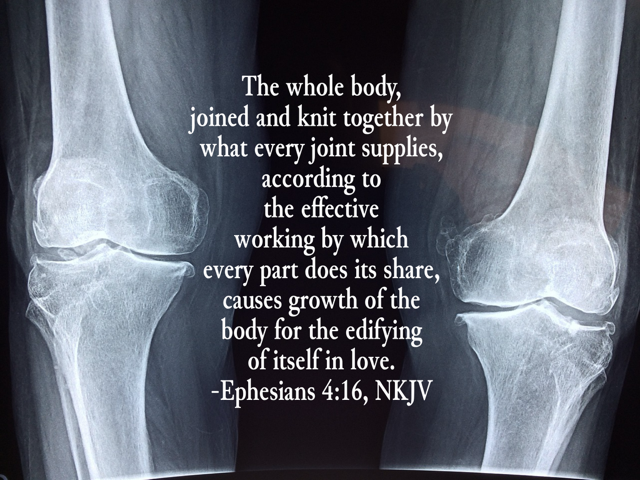
Speaking the truth in love, we are to grow up in every way into him who is the head, into Christ, from whom the whole body, joined and held together by every joint with which it is equipped, when each part is working properly, makes the body grow so that it builds itself up in love (Ephesians 4:15-16).
Colossians has similar imagery:
Holding fast to the Head, from whom the whole body, nourished and knit together through its joints and ligaments, grows with a growth that is from God (2:19).
In looking up the anatomy of joints, I was surprised to find just how complex they are. But one significant part of a joint is the synovium, which secretes synovial fluid, which in turn provides lubrication and nourishment for the joint, according to this article.
Interestingly, that article also says, the synovium “not only has its own specific functions but also interacts with other tissues in the joint both structurally and functionally.” That’s just like the body of Christ, too, isn’t it? 1 Corinthians 12 says we each have our own gifts and areas of usefulness, but we also interact as different parts of the same body.
What’s the synovial fluid among God’s people?
Ephesians 4:15 says we should be “speaking the truth in love.”
Jesus said, “A new commandment I give to you, that you love one another: just as I have loved you, you also are to love one another.By this all people will know that you are my disciples, if you have love for one another” (John 15:34-35).
Peter said, “Above all, keep loving one another earnestly, since love covers a multitude of sins” (1 Peter 4:8).
Paul wrote, “Love is patient and kind; love does not envy or boast; it is not arrogantor rude. It does not insist on its own way; it is not irritable or resentful; it does not rejoice at wrongdoing, but rejoices with the truth.Love bears all things, believes all things, hopes all things, endures all things” (1 Corinthians 13:4-7).
Wouldn’t our interactions as a body go so much more smoothly if we expressed that kind of love?
The synovial fluid also nourishes joints. Colossians says we’re “nourished and knit together through its joints and ligaments.“
As we take in God’s Word and grow in Him, we share it with each other, so that we help others grow as well.
Adrian Rogers* calls this activity within the body “flexible harmony.” “When each part is working properly, [it] makes the body grow so that it builds itself up in love” (Ephesians 4:16).
May we avoid spiritual achy joints by loving and nourishing each other in Christ.
*(This post was inspired by a couple of paragraphs near the end of Adrian Roger’s message, Faithful in Ministry, heard on BBN Radio 10/25/24. The link contains a summary, along with tabs to listen or download the transcript.)
As Americans go to the polls this week, there is a lot at stake. These are some of the things I am praying for concerning the 2024 election. I invite you to join me.
That Christians would vote. I’ve seen a meme saying that if Christians don’t participate in politics, the only voices left will be godless ones. Our trust and hope is not in politics, but since God has given us the privilege of having a voice in this country, we need to steward it well.
That the candidates He wants in office will be elected.
That no fraud or anything underhanded or shady will occur.
That no violence will occur on election day or afterward.
That the results would be clear and unmistakable so there would be no contention over who has won.
First of all, then, I urge that supplications, prayers, intercessions, and thanksgivings be made for all people,for kings and all who are in high positions, that we may lead a peaceful and quiet life, godly and dignified in every way.This is good, and it is pleasing in the sight of God our Savior,who desires all people to be saved and to come to the knowledge of the truth (1 Timothy 2:1-4).
That God would meet our country’s spiritual needs. Our country has come a long way from where it used to be even in my lifetime, and even more from where it was 200 years ago. Some things are better; many are worse. For all the talk about inclusivity and tolerance, our country is as vitriolic and divided as I have ever seen it. Personally, I am praying for another Great Awakening like they had in the 1700s.
Updated to add: Keep praying even after the election, that God would guide our leaders, help them rule justly, work through them to accomplish His will, give them wise counselors, and help them come to know Him if they don’t already.
Can you think of ways to pray for the election that I have not mentioned here?
(Please, no rants for or against particular candidates in the comments.)
Many of us cringe at the popular saying that “God doesn’t give us more than we can handle.” I wonder if people who say that have not experienced many trials in life. God often puts people in situations that bring them to the end of their own strength in order that they might rely on His.
But there are clues in the Bible that God knows how much we can take and adjusts our experiences accordingly.
For instance, there is an often overlooked passage right after the ten plagues in Egypt and the institution of the Passover.
When Pharaoh let the people go, God did not lead them by way of the land of the Philistines, although that was near. For God said, “Lest the people change their minds when they see war and return to Egypt.”But God led the people around by the way of the wilderness toward the Red Sea (Exodus 13:17-18).
Did you catch that? God didn’t lead the people out of the promised land by the shortest route because they might “change their minds if they see war.” From what I have read, this means that the Philistines would have seen the coming Israelites as an invasion, and Israel, just coming out of 400 years of slavery, would have been frightened out of their wits and tempted to turn back.
But when God takes them through a longer route, they end up caught between the Red Sea and the Egyptians, who had decided to come after then.
Didn’t God know they would still be scared out of their wits? (I’m not judging them: I would have been, too!) Of course He did. But the fact that He led them this way on purpose seems to me to indicate this is a situation they could have have trusted Him for. They had just seen Him challenge and defeat all the Egyptian deities by the plagues He sent. He miraculously delivered them from captivity. He led them with a pillar of fire by night and a pillar of cloud to this very place.
Another example even before the exodus was when God called Moses to be Israel’s leader and bring His people out of Egypt. Moses gave every excuse in the book as to why he couldn’t (and I am sure I would have done the same). But God had all the details worked out and would equip Moses for what He called Him to.
One more: when God called Gideon to deliver Israel from the Midianites, Gideon obeyed, but with some trepidation. In Judges 7, right before a major battle, God whittled his army down to 300 men to face “the Midianites and the Amalekites and all the people of the East . . . like locusts in abundance, and their camels were without number, as the sand that is on the seashore in abundance.” God told Gideon He had given the Midianite camp into Gideon’s hands. But, God said, “If you are afraid to go down, go down to the camp with Purah your servant. And you shall hear what they say, and afterward your hands shall be strengthened to go down against the camp.“
So they went down to the enemy camp and overheard one of the soldiers telling about a dream in which a barley cake rolled into the camp and hit a tent so hard that the tent fell, turned upside down, and then lay flat. “His comrade answered, ‘This is no other than the sword of Gideon the son of Joash, a man of Israel; God has given into his hand Midian and all the camp.’”
Gideon responded by worshiping God and then arousing the Israelite camp with confidence. The confidence wasn’t in himself. The main reason God had reduced the army to 300 was so that Israel couldn’t boast in saving themselves. It was still a task they couldn’t do on their own. But God “knows our frame; he remembers that we are dust“ (Psalm 10:14), and He stoops to our weakness, as one old hymn says.
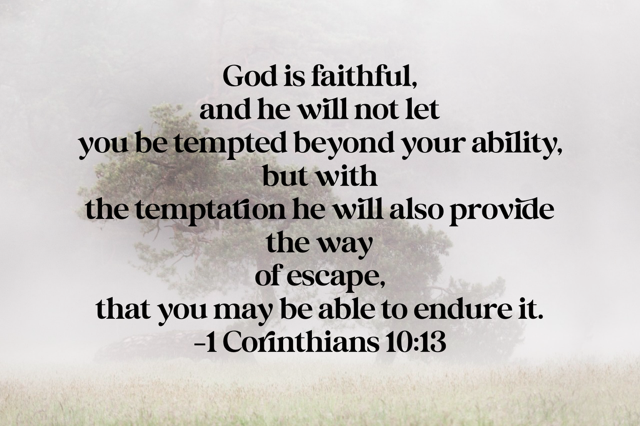
For a New Testament example, 1 Corinthians 10 tells of several in the Old Testament who failed in some way. Then Paul writes, “Therefore let anyone who thinks that he stands take heed lest he fall.No temptation has overtaken you that is not common to man. God is faithful, and he will not let you be tempted beyond your ability, but with the temptation he will also provide the way of escape, that you may be able to endure it.” There’s the warning: take heed. Don’t trust in yourself. But there’s also reassurance: God is faithful and will provide a way of escape.
In John 15, Jesus tells us to abide in Him, for without Him we can do nothing. And Philippians 4:13 says we “can do all thingsthrough him who strengthens me.”
God does bring us to more than we can handle in ourselves. Paul says in 1 Corinthians he had been at a point where he was “so utterly burdened beyond our strength that we despaired of life itself”. But, he said, “that was to make us rely not on ourselves but on God who raises the dead” (verses 8-9).
When God brings us to a situation that seems too much to handle, we can ask Him for deliverance. I’ve always been heartened by the fact that Jesus prayed in Gethsemane, “Father, if you are willing, remove this cup from me. Nevertheless, not my will, but yours, be done” (Luke 22:42).
But if God doesn’t remove the situation, we can trust Him for the grace to go through it. He knows our limits and weaknesses. He wants to grow our faith, character, and reliance on Him, and that will take us out of our comfort zone many times. Warren Wiersbe says, “When God puts us in the furnace, His hand is on the thermostat and His eye is on the clock.” He won’t keep us there longer than necessary. He promises His strength for our weakness, His presence, and His care for every step of the way.
My husband and I aren’t rah rah people. I didn’t care for pep rallies in school. We cheer at games, especially when our kids are playing. But otherwise, we’re pretty quiet people.
I’ve cringed when I’ve occasionally heard preachers rebuke people for being more excited at a football game than at church. I understand their point, but I’ve thought, “Do you really want the cacophony of a ball game in here?”
So I was encouraged when our Sunday School teacher recently pointed out a verse about silence.
She said that translations vary in how they render the first verse of Psalm 65. The ESV says, “Praise is due to you, O God, in Zion, and to you shall vows be performed.”
But many other translations mention silence, like the NASB: “There will be silence before You, and praise in Zion, God, And the vow will be fulfilled for You.”
The difference seems to be in the word “awaits,” which means, in the Greek, “A silence, a quiet waiting, repose” (according to the bottom of this page).
Worship in silence.
Personally, I feel most worshipful in silence before the Lord. I resonate with David in another psalm when he says, “For God alone my soul waits in silence; from him comes my salvation. He alone is my rock and my salvation, my fortress; I shall not be greatly shaken” (Psalm 62:1-2).
But sometimes silence results not just from personality, but from awe. Job understandably cries out about his suffering and wonders what God is doing in his life for multiple chapters of the book bearing his name.
And then God speaks. He doesn’t answer Job’s questions. But He reveals his power and care over all His creation.
Job responds, “Behold, I am of small account; what shall I answer you? I lay my hand on my mouth. I have spoken once, and I will not answer; twice, but I will proceed no further.”
The only response to such majesty, power, and greatness was humility and silence. There are just no words. As God said in Habakkuk 2:20: “But the Lord is in his holy temple; let all the earth keep silence before him.”
Sometimes silence before the Lord comes from depth of feeling, as when “the Spirit helps us in our weakness. For we do not know what to pray for as we ought, but the Spirit himself intercedes for us with groanings too deep for words” (Romans 8:26).
Sometimes we’re silent in God’s presence because we have no excuses. We know we’ve done wrong and deserve whatever chastisement we’re experiencing. We understand the author of Lamentations when he says, “The Lord is good to those who wait for him, to the soul who seeks him. It is good that one should wait quietly for the salvation of the Lord. It is good for a man that he bear the yoke in his youth. Let him sit alone in silence when it is laid on him; let him put his mouth in the dust—there may yet be hope” (3:25-29). He reminds himself just a few verses later, “For the Lord will not cast off forever, but, though he cause grief, he will have compassion according to the abundance of his steadfast love” (3:31-32).
We also need silence to listen and learn. As many a teacher has said, “You can’t listen while you’re talking.”
Worship with shouting.
But, as Ecclesiastes says, there is “a time to keep silence, and a time to speak” (3:7).
David goes on in the psalm our class was studying, Psalm 65, to talk about the blessings of answered prayer, forgiveness, and God’s presence. He exalts God for His “awesome deeds,” for creation, for God’s care of all He has made. And then he mentions shouting: “You make the going out of the morning and the evening to shout for joy” (verse 8b).
Be glad in the Lord, and rejoice, O righteous, and shout for joy, all you upright in heart! (Psalm 32:11).
Shout for joy in the Lord, O you righteous! Praise befits the upright (Psalm 33:1).
Though I am not a shouter by nature, the closest I get to that exuberant joy that can’t be contained, that has to burst out somehow, is when someone is baptized.
Worship with singing.
Psalm 65 closes with singing in verse 13: “The meadows clothe themselves with flocks, the valleys deck themselves with grain, they shout and sing together for joy.”
Perhaps we associate singing with worship more than any other activity, though all of a church service and all of our lives can be acts of worship if done as unto the Lord.
Of course, there are a plethora of verses that talk about worshiping the Lord through song:
Oh sing to the Lord a new song; sing to the Lord, all the earth! Sing to the Lord, bless his name; tell of his salvation from day to day (Psalm 96:1-2).
But let all who take refuge in you rejoice; let them ever sing for joy, and spread your protection over them, that those who love your name may exult in you (Psalm 5:11).
But I have trusted in your steadfast love; my heart shall rejoice in your salvation. I will sing to the Lord, because he has dealt bountifully with me (Psalm 13:5-6).
Let the word of Christ dwell in you richly, teaching and admonishing one another in all wisdom, singing psalms and hymns and spiritual songs, with thankfulness in your hearts to God (Colossians 3:16).
I will tell of your name to my brothers; in the midst of the congregation I will sing your praise (Hebrews 2:12).
I especially love passages that say God is our song, like Isaiah 12:2: “Behold, God is my salvation; I will trust, and will not be afraid; for the LordGod is my strength and my song, and he has become my salvation.”
Psalm 65 starts with silence and ends with shouting and singing. Sometimes our silent worship and contemplation of God’s word and character will erupt into boisterous praise. Sometimes singing God’s songs with other believers will give us something to take home and think about in silence. Some days, and some seasons of life, lend themselves to silence, others to loud praise. Whether we come before the Lord in silence or with singing and shouting, we know He is with us and will hear us.











 Stray Thoughts