The Week in Words

”"

Welcome to The Week In Words, where we share quotes from the last week’s reading. If something you read this past week  inspired you, caused you to laugh, cry, think, dream, or just resonated with you in some way, please share it with us, attributing it to its source, which can be a book, newspaper, blog, Facebook — anything that you read. More information is here.

Here is my collection for today:

From a post titled Are We Required to Attend Church on the Lord’s Day? via Challies:

The key to a Christian use of the Lord’s Day is not drawing up a list of what can and cannot be done, but to give the whole day to basking in God’s Word, loading ourselves up with the treasures of Christ.

This was similar to the conclusion I came to after seriously encountering Isaiah 58:13-14: “If thou turn away thy foot from the sabbath, from doing thy pleasure on my holy day; and call the sabbath a delight, the holy of the LORD, honourable; and shalt honour him, not doing thine own ways, nor finding thine own pleasure, nor speaking thine own words: Then shalt thou delight thyself in the LORD; and I will cause thee to ride upon the high places of the earth, and feed thee with the heritage of Jacob thy father: for the mouth of the LORD hath spoken it.” It dawned on me that the OT regulations about not working on the sabbath weren’t so much about rest from work, though that was a part of it, but about having a day for God. I’m not going to get into the arguments of the OT sabbath vs. the NT Lord’s Day or OT Jewish regulations vs. NT Gentile practices of the day — that would be another whole post. But the key part of this quote for me was that it points out our tendency to draw up our little lists when instead we need to get to the heart of the matter and do whatever we do as unto the Lord.

This was from Robin Lee Hatcher’s Facebook:

How we spend our days is, of course, how we spend our lives. ~ Annie Dillard

Sounds obvious, yet it’s so easy to think about what we’re going to do with out lives “some day” while forgetting this day’s contribution to our lives.

And finally, from a the Facebook page of a friend who is a teacher:

“To get the best out of someone, you’ve got to give the best of yourself.”

Good reminder for anyone who invests in the life of another…which is all of us. 🙂

You can share your family-friendly quotes in the comments below or write a post on your blog and then put the link to that post (not your general blog link) in Mr. Linky below.

I hope you’ll visit the other participants as well and glean some great thoughts to ponder. And don’t forget to leave a comment here, even if you don’t have any quotes to share.

Tebow-mania

I am not a football fan in any way, yet even those of us who don’t watch football can’t help but hear about Tim Tebow. From everything I hear he seems like the real deal, a genuinely nice Christian young man. Of course, what most of us “know” about him is only hearsay, but this post from a well-known Christian man who does know him backs up that perception.

But a public professing Christian can cause strange reactions in other Christians who observe him. A friend on Twitter shared the link to Can We Please Stop Being Weird About Tim Tebow? and made some excellent points. One of those weird responses is Tebowing, striking his characteristic pose — some students who were suspended for doing so were not being persecuted for their faith, as some thought: they were clogging up busy halls.

Another overreaction is that some Christians get very defensive and almost cultish of their idol object of fandom. One of my sons expressed a difference of opinion on Facebook recently about one of Tim’s actions, and my, you would have thought he blasphemed God Himself by the response he got. Derision, sarcasm, scorn, being called a fool — and that by a church leader in our former church, who apparently conveniently forgot what the Bible says about that. I thought it very odd that some of these people would treat someone they know like that in defense of someone they don’t know, and all over a difference of opinion that that one is not alone in.

As Christians, we should be able to handle differences of opinions with more grace than that. Another interesting article that came up this week is How to Disagree Online Without Being a Total Jerk. The author makes some great points about remembering that the Christian brother we’re disagreeing with (online or off) is a brother, someone created in the image of God, part of the body of Christ, someone for whose soul we should care for more than the argument we’re in.

When many Christians get into any kind of disagreement, especially online, all thoughts of Galatians 6:1 (Brethren, if a man be overtaken in a fault, ye which are spiritual, restore such an one in the spirit of meekness; considering thyself, lest thou also be tempted.) and II Timothy 2: 24-26 (And the servant of the Lord must not strive; but be gentle unto all men, apt to teach, patient, In meekness instructing those that oppose themselves; if God peradventure will give them repentance to the acknowledging of the truth; And that they may recover themselves out of the snare of the devil, who are taken captive by him at his will.) fly completely out of mind. It’s almost a feeding frenzy. Whether the other person is mistaken, misinformed, wayward, or downright wrong, belligerence, condescension, and put-downs are going to drive that person away from the truth and the people who profess to proclaim it rather than to it and them. I think sometimes we’re more concerned about defending our “right” views and putting down anyone who edges a toe across the line than meekly discussing differences of opinion and helping others see the light if they are truly in the wrong. And some differences of opinion need to be left there, as simply differences, while we “agree to disagree.”

But back to Tebow. Tebow Time: 10 Thoughts and a Cloud of Dust is an excellent post sharing many things to admire about Tebow and many reasons to be concerned about “Tebow-mania.” Personally, I want to give Tebow the benefit of the doubt. I think he’s a good guy who wants to glorify and honor God. Everyone may not agree on all his methods of doing that, and that’s fine. He can’t really help the “mania” that has arisen about him. But while he is in the public eye we should pray for him, for wisdom for him in maintaining his testimony before the eyes of a watching world, and for protection from the Enemy who does not want God glorified and who would seek to trip His representatives up. We can rejoice that the phenomenon around him might cause some to think about God and pray that they’d find the truth about Him and come to know Him personally, not just as Someone who helps win football games but as Someone who saves from sin and becomes a Friend and Shepherd for life. And we should carefully guard our own testimonies while we talk about Tebow (and anyone else), especially with those who might disagree here and there with particular things he does. We can cheer him on, but we need to be careful not to exalt him above measure. In our conversations around him, instead of exalting him, if he’s the man I think he is, he would want us to exalt God and use those conversations that arise about him to be a stepping-stone to conversation about the God he serves.

The Week in Words

”"

Welcome to The Week In Words, where we share quotes from the last week’s reading. If something you read this past week  inspired you, caused you to laugh, cry, think, dream, or just resonated with you in some way, please share it with us, attributing it to its source, which can be a book, newspaper, blog, Facebook — anything that you read. More information is here.

Though I didn’t plan it this way, all the quotes I have for today are good for starting the new year and putting those plans, resolutions, and goals into practice.

Seen on Lisa‘s Twitter:

What is not started today is never finished tomorrow. -JW von Goethe

I forgot to note where I saw this:

The way to do a great deal, is to keep on doing a little. The way to do nothing at all, is to be continually resolving that you will do everything. ~ Spurgeon

I read this in Anne’s House of Dreams by L. M. Montgomery:

“Welcome, New Year,” said Captain Jim, bowing low as the last stroke died away. “I wish you all the best year of your lives, mates. I reckon that whatever the New Year brings us will be the best the Great Captain has for us.”

I hope the same for you, friends, “that whatever the New Year brings us will be the best the Great Captain has for us.”

You can share your family-friendly quotes in the comments below or write a post on your blog and then put the link to that post (not your general blog link) in Mr. Linky below.

I hope you’ll visit the other participants as well and glean some great thoughts to ponder. And don’t forget to leave a comment here, even if you don’t have any quotes to share.

Still, My Soul, Be Still

Our assistant pastor introduced this song to us several months ago, and I was struck by the richness, depth, and Spiritual base of the words as well as the hauntingly beautiful music.

Still, My Soul, Be Still

Still my soul be still
And do not fear
Though winds of change may rage tomorrow
God is at your side
No longer dread
The fires of unexpected sorrow

God You are my God
And I will trust in You and not be shaken
Lord of peace renew
A steadfast spirit within me
To rest in You alone

Still my soul be still
Do not be moved
By lesser lights and fleeting shadows
Hold onto His ways
With shield of faith
Against temptations flaming arrows

Still my soul be still
Do not forsake
The Truth you learned in the beginning
Wait upon the Lord
And hope will rise
As stars appear when day is dimming

~ Words and Music by Keith & Kristyn Getty & Stuart Townend

No matter what happens in our lives, if we know God, we can “trust and not be shaken” and rest in Him alone.

If you don’t know God in that way, please read this.

“And this is life eternal, that they might know thee the only true God, and Jesus Christ, whom thou hast sent.” (John 17:3).

And may those of us who do know Him not “forsake the truth we learned in the beginning” and rest in Him continually.

Thinking about resolutions and words for the year…

It’s that time. The close of one year and beginning of another seems a good time for taking stock, making plans, setting goals for the year ahead.

I don’t know how the tradition of making New Year’s Resolutions first got started. I dutifully made them each January as I grew up and forgot about them in a few weeks’ time. After a while that seemed pretty ridiculous. Then I began to make goals rather than resolutions. And then later on I began realizing that the things I pondered every year around Jan. 1 were things I needed to be working on all the time anyway. So I happily gave up on the whole idea.

This year in several articles and posts going around, some have gone so far as to say Christians shouldn’t make resolutions, that resolutions smack of moralism and even legalism, putting a focus on our efforts, on trying harder, rather than on grace, and we should rest on God’s promises to us rather than making promises to Him.

Well, of course we should rest on God’s promises and His provision of grace and forgiveness. Our resolutions or goals or lists for ourselves don’t make us more accepted or loved in His sight. But does that mean we should never resolve anything or promise God anything?

A few years ago I made a study of the statement “I will” in the Bible, said not by God or Satan but by people. “I will” is a statement of determination, sometimes a vow, or we could even say a resolution. There were many I found, and that’s not even including “I will nots” or statements that say the same thing in different words.

And then our pastor has been leading us through the book of Job for the past several months and started a series last Sunday on Job’s resolutions from Job 31, beginning with “I made a covenant with mine eyes; why then should I think upon a maid?” The rest aren’t stated quite that way, but resolution can be inferred from the other behaviors Job lists in his defense against his friends who felt that he must have sinned and sinned big to deserve the affliction he suffered.

So there are Biblical grounds for making resolutions (not necessarily Jan. 1, but whenever needed, though January is a good time to examine ourselves and our schedules, etc.).

Our pastor made a little study booklet to aid in going over this section of Job in the next few weeks, and in it he nails the crux of another problem I have with resolutions: how to reconcile the fact that it is God who is making the changes in us with our efforts or promises or resolutions. That’s something I’ve wrestled with nearly all of my Christian life. It’s God who does the work of change in us, yet He requires our cooperation. He doesn’t run roughshod over our will in salvation or in sanctification. But what is God’s part and what is mine? And why won’t He just make me holy without requiring me to makes choices throughout the day as to whether to yield to the flesh or to the Spirit? If I were Spirit-filled, wouldn’t I just automatically do, feel, think the right things without having to make the conscious effort? Those are the kinds of things I wrestle with and I’m very excited that it looks like we’ll be going over some of those things in the coming weeks at church.

Pastor did bring up Jonathan Edwards’ resolutions, which begin with the statement “Being sensible that I am unable to do anything without God’s help, I do humbly entreat him by his grace to enable me to keep these Resolutions, so far as they are agreeable to his will, for Christ’s sake.” There are key elements there: that our resolutions be agreeable to God’s will, and that we acknowledge that we can’t keep them on our own and need His enabling.

So…I haven’t started making any lists yet, but I’ve been mulling this over and reading with interest several posts and links people have been putting on their blogs and Facebook. Thanks to a couple of you for letting me think through some of this in your comments section. I probably should not have taken up so much space there and should have just waited til this blog post to “think through my fingers.” 🙂

I’ve also seen a number of people choosing a word or theme for the year over the last few years. I had never heard of anyone doing that before, and wasn’t inclined to myself: I knew there would probably be several words to list areas God needed to work on me about. It’s not a practice laid out in Scripture, but there is certainly nothing wrong with it if it done as led by God. I wouldn’t necessarily want others to feel they should do this just because they see others do it and make it the new spiritual fad. But the blog friends I know of who have done this aren’t approaching it faddishly but rather with much thought and prayer.

Even though I hadn’t intentionally sought out or prayed for a word for the coming year, one that keeps coming to mind is intentional. Having good intentions is a different thing from living intentionally: I need to intentionally work those intentions out into everyday life. A former pastor once said that Philippians 2:12b, “work out your own salvation with fear and trembling,” meant first of all not to work for your salvation, but to work it out like a math problem, taking it to its logical conclusions: in other words, take those high and lofty ideals in the Bible, those rock-solid doctrines, and work them out into your everyday lives. I can see many areas in my life, both the spiritual and the practical, where I’ve been floating along for years without making any real progress. Thinking, studying, and meditating on these areas is good and necessary, but they need to translate into action. And maybe that’s where resolutions or goals come in.

Another factor I wrestle with in all this is the time it will take. In a couple of areas in particular, making changes is going to take some planning. And then, too, just the thought of schedules and such to implement some of these things makes me cringe, but that may be my lazy, resistant-to-change flesh.

I am thankful that the next verse in Philippians 2 says, “For it is God which worketh in you both to will and to do of his good pleasure.” I’m seeking His help and guidance both in the willing and the doing.

If you’ve read this far, you deserve a pat on the back, so consider it done. 🙂 Thanks for listening to my ramblings.

If you’re interested, here are some of the other posts that have fueled my thinking about resolutions:

A Resolution on Resolutions. Advocates that resolution-making might better come after Easter than New Year’s Day and that “New Year’s resolutions were meant to be inspired by repentance and redemption; they were never intended to be the path to them.”

A New Year’s Plea: Plan!

Trading One Dramatic Resolution for 10,000 Little Ones

A Different Kind of New Year’s Resolution. “My daily perseverance requires embracing God’s promises, not inventing my own, which I cannot keep. There will come a time for resolutions in the conventional sense, personal goals and the shouldering of responsibility. But the law will bear crops only where grace has fertilized the soil. So, at least for the first month of this new year, my focus will be not on what I plan to do better, but what has been done perfectly for me.” (Note: theologically I’d disagree with a couple of his resolved statements).

Many of these people I have never read before, so please don’t take this as an endorsement of everything on their sites. Most were found through recommended links of people I do know.


The Week in Words

”"

Welcome to The Week In Words, where we share quotes from the last week’s reading. If something you read this past week  inspired you, caused you to laugh, cry, think, dream, or just resonated with you in some way, please share it with us, attributing it to its source, which can be a book, newspaper, blog, Facebook — anything that you read. More information is here.

Hope you’re having a good new year so far! Is this still a day off for you? It is for us, but tomorrow works begins again for Jim and Jesse starts back to school Wednesday.

A friend posted this on Facebook last week neat the end of the year:

“The year is almost over, and the years of my life are growing few, but time does not change my Lord. New lamps are taking the place of old; perpetual change is on all things, but our Lord is the same. Force overturns the hills, but no conceivable power can affect the eternal God. Nothing in the past, the present, or the future can cause Jehovah to be unkind to me. My soul, rest in the eternal kindness of the Lord, who treats thee as one near of kin. ~ C.H. Spurgeon

Blessed, blessed thoughts.

This was posted by another friend on Facebook:

Good habits are not made on birthdays, nor Christian character at the New Year. The workshop of character is everyday life. The uneventful and commonplace hour is where the battle is lost or won.

She quoted from another friend’s Facebook and hadn’t gotten a reply back yet as to whether the quote was original with her. But it is a good one. Good habits can start with resolutions, but until they get worked down into the “uneventful and commonplace,” they’ll be the kind that fade out by March.

And I saw this one on our youth pastor’s wife’s Twitter. It doesn’t directly mention the new year, but it certainly applies:

Why would you panic at your loss of control when you can rest in the arms of the One who, in righteousness and grace, controls all things? ~ Paul David Tripp

Why? I don’t know, but I do. But I need to remember Who does have everything under control and trust Him.

You can share your family-friendly quotes in the comments below or write a post on your blog and then put the link to that post (not your general blog link) in Mr. Linky below.

I hope you’ll visit the other participants as well and glean some great thoughts to ponder. And don’t forget to leave a comment here, even if you don’t have any quotes to share.

The Week In Words

”"

Welcome to The Week In Words, where we share quotes from the last week’s reading. If something you read this past week  inspired you, caused you to laugh, cry, think, dream, or just resonated with you in some way, please share it with us, attributing it to its source, which can be a book, newspaper, blog, Facebook — anything that you read. More information is here.

I wasn’t sure whether to have TWIW this week or not, just after Christmas. But I figured I’d be here, and if any of you can join me, wonderful!

Here is one quote that caught my eye this week:

Seen at girltalk:

“So the truth of the Incarnation is not just good theology; it is practical comfort and assurance. Jesus identifies with us in our humanity, and now we know that God is for us in Christ. He can be trusted. He went through torture too. When we see Jesus on the cross we can come to trust God with an unutterable trust that never for a moment considers He will not stand by us in our sufferings.” ~Os Guinness

I looked up a former post of New Year’s Quotes and was inspired by this one, seen in Joy and Strength compiled by Mary Wilder Tileston:

The year begins; and all its pages are as blank… Let us begin it with high resolution; then let us take all its limitations, all its hindrances, its disappointments, its narrow and common-place conditions, and meet them as the Master did in Nazareth, with patience, with obedience, putting ourselves in cheerful subjection, serving our apprenticeship. Who knows what opportunity may come to us this year? Let us live in a great spirit, then we shall be ready for a great occasion. ~ George Hodges

Also from that post is this quote:

Face the New Year with the Old Book.
Face the new needs with the old promises.
Face the new problems with the old Gospel.

–Author Unknown

You can share your family-friendly quotes in the comments below or write a post on your blog and then put the link to that post (not your general blog link) in Mr. Linky below.

I hope you’ll visit the other participants as well and glean some great thoughts to ponder. And don’t forget to leave a comment here, even if you don’t have any quotes to share.

Who Is He?

Who is He in yonder stall
At Whose feet the shepherds fall?
Who is He in deep distress,
Fasting in the wilderness?

Refrain:

’Tis the Lord! O wondrous story!
’Tis the Lord! the King of glory!
At His feet we humbly fall,
Crown Him! crown Him, Lord of all!

Who is He the people bless
For His words of gentleness?
Who is He to Whom they bring
All the sick and sorrowing?

Refrain

Who is He that stands and weeps
At the grave where Lazarus sleeps?
Who is He the gathering throng
Greet with loud triumphant song?

Refrain

Lo! at midnight, who is He
Prays in dark Gethsemane?
Who is He on yonder tree
Dies in grief and agony?

Refrain

Who is He that from the grave
Comes to heal and help and save?
Who is He that from His throne
Rules through all the world alone?

Refrain

~ Ben­ja­min R. Han­by, 1866

I wish you all a wonderful Christmas celebrating Him, the King of Glory, who made it possible for us to be God’s children by faith in Jesus’s life, death, and resurrection in our place. If you don’t know Him as Lord, as your own King of Glory, I pray you will even this day.

The Week in Words

”"

Welcome to The Week In Words, where we share quotes from the last week’s reading. If something you read this past week  inspired you, caused you to laugh, cry, think, dream, or just resonated with you in some way, please share it with us, attributing it to its source, which can be a book, newspaper, blog, Facebook — anything that you read. More information is here.

Here are a few thought-provoking quotes I came across this week:

Seen at Carrie’s review of  Growing Grateful Kids, by Susie Larson:

“We cannot grow beyond our ability to receive correction.” Francis Frangipane

I have never heard of Frangipane before and know nothing about him, but, wow, that one hit me between the eyes. Taking correction really goes against the grain, but how else will we be alerted to our blind spots? The Bible had much to say about being willing to receive correction and rebuke.

Seen at Robin Lee Hatcher‘s Facebook page:

Anything I’ve ever done that ultimately was worthwhile initially scared me to death. ~ Betty Bender

I sure can identify with that, and it helps to know others have felt the same way. I used to think being scared to death meant I shouldn’t do whatever it was I was scared of….but that’s not necessarily true.

I saw this while looking in my downloaded documents section. It was on a page of tips on prayer along with prayer requests for missionary Anne Dreisbach. I don’t know if this is something she said or if it is quoted from someone else:

Such as cast their eye on the promise, with a neglect of the command, are not edified by Scripture, as they look more for comfort than for duty.

I can tend to do that — scan a passage for the promises and comfort while touching lightly on the warnings or commands. But we can’t have one without the others.

You can share your family-friendly quotes in the comments below or write a post on your blog and then put the link to that post (not your general blog link) in Mr. Linky below.

I hope you’ll visit the other participants as well and glean some great thoughts to ponder. And don’t forget to leave a comment here, even if you don’t have any quotes to share. I usually try to visit everyone who comments, but often I forget to check Mr. Linky for those who participated but didn’t comment.

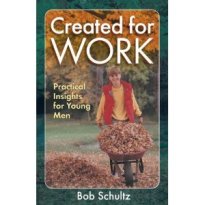
Book Review: Created For Work

After enjoying Boyhood and Beyond: Practical Wisdom for Becoming a Man by Bob Schultz with my youngest son, we tried another of his books, Created for Work: Practical Insights for Young Men. The title attracted me because I think developing a strong work ethic in young people is becoming a lost art and because people generally have a negative view of work. It was a revelation to me years ago to realize that God created and ordained work before the fall of man into sin: it’s not part of the Curse, though it is harder because of the Curse.

I don’t recall that Schultz brought out that aspect of work, but he brought out many others, using his own work and experience as an independent contractor as a backdrop for many of his insights. He discusses things you’d expect concerning work, like diligence, initiative, working within the rules, finishing well, etc. But he brought out other things I would not have thought of: looking at things from a boss’s perspective, dealing with a loss of confidence, irritations between coworkers, admitting when you’re wrong and learning from it, the dangers of diligence (becoming self-satisfied and indulgent after success), and even the way the Lord brings you into contact with other people through your work to whom you can minister. Another valuable insight was that of balancing initiative: his example was a young man who saw a neighbor’s fallen tree and decided to cut it up into firewood for them, only to discover afterward they had planned to take it to the mill to be turned into lumber.

There were just a couple of places where I disagreed with the author a bit. In one chapter titled “Great Grandpa Cornelius,” Schultz is encouraging boys to be diligent workers even before they’re of age to work at an outside job, and I agree with that. But he makes the statement, “If someone provides your food, shelter, and education, you’re a liability” (p. 42). I wouldn’t say that to a boy in the home. He goes on to say that you had no choice as a baby to have others work for you, but as soon as you can you want to work to become an asset. And I agree with that as well. From the time our boys were little, though they had jobs in the home and allowances that were loosely tied to each other, the main reason for their jobs wasn’t to earn an allowance or even to “help” their parents, but to pull together as a family and contribute to the family and to get in the habit or working. So I agree with all of that in principle, I agree with teaching boys (and girls) to work for a variety of reasons, but I still wouldn’t call being provided for as a boy at home being a liability. When he gets to be 30 or so, well, that’s different. 🙂

In another chapter titled “My Instructor,” he describes a time when his boss wanted him to install trim with costly wood in a beauitful, expensive home. He was worried because he hadn’t had much experience with the particular type of work his boss wanted him to do, worried enough to lose sleep the night before the job. He felt God was telling him that since He created the world and told Solomon how to build the temple and Noah how to build the ark, He could tell him how to do this job. And He did, through a painter who came through and gave him an off-the-cuff tip. I can’t argue with his experience, and I’ve had the experience as well of being stuck in the middle of some task, praying for wisdom, and feeling that God gave me the idea of what to do about it. But I wouldn’t want someone to take this particular experience as a substitute for owning up that you don’t know how to do a particular job or seeking out instruction on how to do it beforehand.

And finally, in a chapter on unemployment compensation he writes that he feels that such is government aid and that instead of filing for unemployment, he should find other work he can do as unto the Lord and for His kingdom, such as yard work for a widowed neighbor, etc. My husband and I feel that unemployment compensation is a form of insurance rather than a “handout” and is a legitimate and responsible way to care for one’s family between jobs. I do agree with the other principles in the chapter, however, that ultimately we work for God, not for money, though He usually provides through a job, and that there are many useful things one can do during a jobless time, like work for others and get ones’ tools ready and prepared for the next opportunity.

The space and time to explain those few caveats makes it looks I disagree with more than I agree with, and that’s not the case: I think this is a valuable resource for boys and young men. If I’d had this when my boys were younger, I think I would have gone over it with them then as well as again as older teenagers about to leave home.

(This review will also be linked to Semicolon‘s Saturday Review of Books.)