The Hidden Art of Homemaking, Chapter 5: Interior Decoration

It’s Week 5 of  The Hidden Art of Homemaking Book Club hosted by Cindy at Ordo Amoris where we’re discussing Edith Schaeffer’s book, The Hidden Art of Homemaking a chapter at a time.

Chapter 5 is about Interior Decoration, and I have to say I think this might be the chapter I feel most at home in so far, because Edith talks about decorating one’s living space, whether a “dream home” or a boarding house room, not with the latest decorating fads for a magazine-worthy decor, but with originality and personality. She says our “spot” should not only express something of ourselves to visitors but should also be a place that is satisfying and feels “at home” to us. She advises the reader not to wait for certain funds or the ideal home (some of my frustrations along those lines are here) or even for marriage, but to start right where we are with personal touches to our space, and as she has said in previous chapters, ideas beget ideas, creativity begets more creativity.

She shares some personal examples that may be beyond the scope of what many of us can or want to do, but they’re good for sparking ideas. Some are time-honored traditions, like making quilts or rugs from scraps, or restoring old furniture rather than buying new. We did some of this when we were first married, transforming a storage barrel used in college into a side table with a long tablecloth over it. Once when the kids wanted a tree house, and new lumber was prohibitively expensive, my husband found some used wooden palettes and took the boards apart, sanded them down and made a great tree house. That was one of the things I hated leaving behind when we moved.

After last week’s chapter about drawing and sketching, I began to wonder why she didn’t include crafts or home arts, like embroidery, quilting, etc., but she mentions them here.

There is nothing inherently wrong with buying new furniture and decorations, and we’ve done a good bit of that as well, but the goal should be to make it homey and express one’s own tastes and personality.

We do need to keep in mind the other people with whom we live. I don’t believe in stripping the place bare when young children are in the house, but that’s probably not the time for antique vases. I have decidedly feminine tastes in decorating, but living with all males, I’ve tried to have the family room, at least, more neutral. My husband has said that if he lived alone he probably wouldn’t think to decorate, but he does appreciate the homeyness decorations add. He usually leaves the decorating choices up to me, but we do major furniture shopping together and consult on paint colors, etc.

We need to keep in mind, too, that “this world is not our [ultimate] home,” that we’re to lay up treasures in heaven rather than earth, that here on earth moth doth corrupt and thieves can break through and steal, and we’re not to set out hearts too much on “things.” And sometimes “we are to be willing to sacrifice in the area of material things as well as in all other areas, to put first the things of God, to put first His use of our time, or money, and our talents” (p. 79). I was reminded of that just yesterday morning with this post about a time of loss. Isobel Kuhn tells of a time early in her marriage when they were ministering to a poor  tribe whose manners were decidedly different from her own. She was pleased with her nesting and her newlywed “things,” but then one of the women blew her nose into her hands and then wiped them on the new couch, and a mother held her baby away from her while the baby urinated on the new rug. Those things weren’t done to express hostility toward Isobel – it’s just the way things were done there. She had to struggle to not let her precious “things” take precedence in her heart over the needs of the people she was working with, and she learned to be very practical with her possessions. The Goforths lost everything four different times in their lives. After the last time, “when, in the privacy of their own room, the ‘weaker vessel’ broke down and wept bitter, rebellious tears, Goforth sought to comfort her by saying, ‘My dear, after all, they’re only things and the Word says, ‘Take joyfully the spoiling of your goods!’ Cheer up, we’ll get along somehow.’” He wasn’t being calloused: he had a generally faith-filled, buoyant spirit, while his wife had…one rather more like my own. We need to hold all of God’s material gifts to us loosely, remembering they are ultimately His and He has promised to supply all we need.

But even within those parameters, He often allows for some expression of personality and creativity in our living spaces.

I shared a tour of my house here, but I thought I might share just a couple of those expressions of personality here.

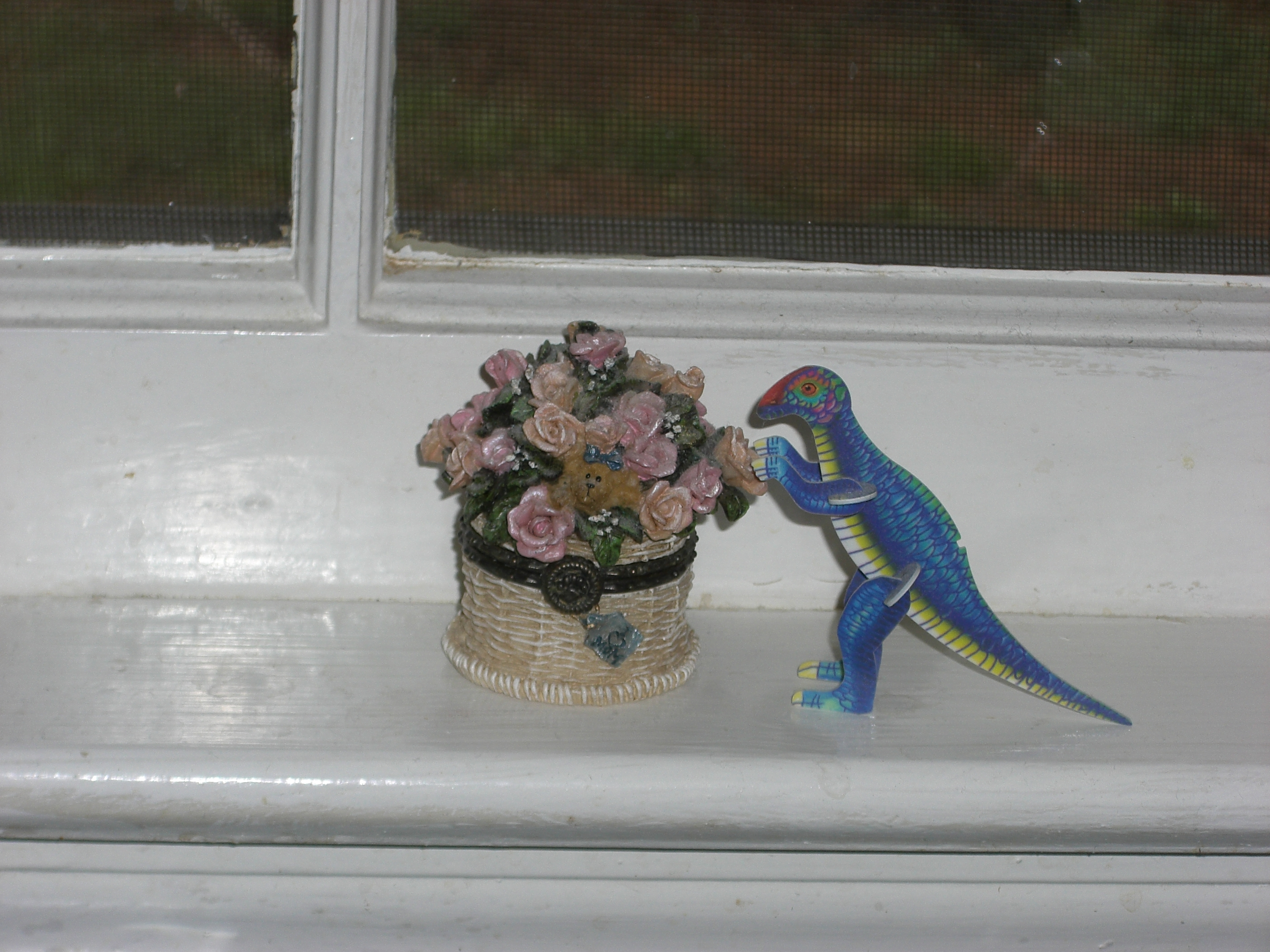
This one has a story behind it:
CIMG0034

I collected Boyd’s Bears figurines for a while, and this is a small figurine of a flower basket with a teeny little bear hiding in it. I kept it on the windowsill above the kitchen sink for a while. One day I found this little dinosaur next to it, put there by one of the boys when they were younger. I don’t know if the dinosaur was supposed to be after the flowers or the bear. 🙂 Or maybe the boys were just adding to the decorations. But I’ve always loved this as a picture of living with boys, and now I keep these together in a little curio cabinet.

Of course, living with boys, sometimes the “decorating” gets a little out of hand…

Life with boys

I mentioned Boyd’s Bear figurines – I posted some of my collection here. I just love their little faces and the details of them. There is only room for so many, though, before they become just a blur of too many to keep track of, but I tried to get my collection to reflect my interests – there is one holding the music to an Irish folks song, one reading a book, a couple cooking, several “Mom” and “couple” ones. Most were given to me by my husband or Mom.

Another of my favorites is a needlepoint piece I did when expecting my first son. My youngest still had it up in his room until his twelfth birthday, when we took it down so he wouldn’t get teased about it. That was kind of sad – an official turning from little boyhood.

Needlework bears

You can’t really tell from the picture, but there are different types of stitching in different places and the little cookies are raised rather than flat.

CIMG0557

This is one I am hanging on to. I don’t know if I will hand it off to a grandchild (if any of their parents want it) or keep it for a playroom here.

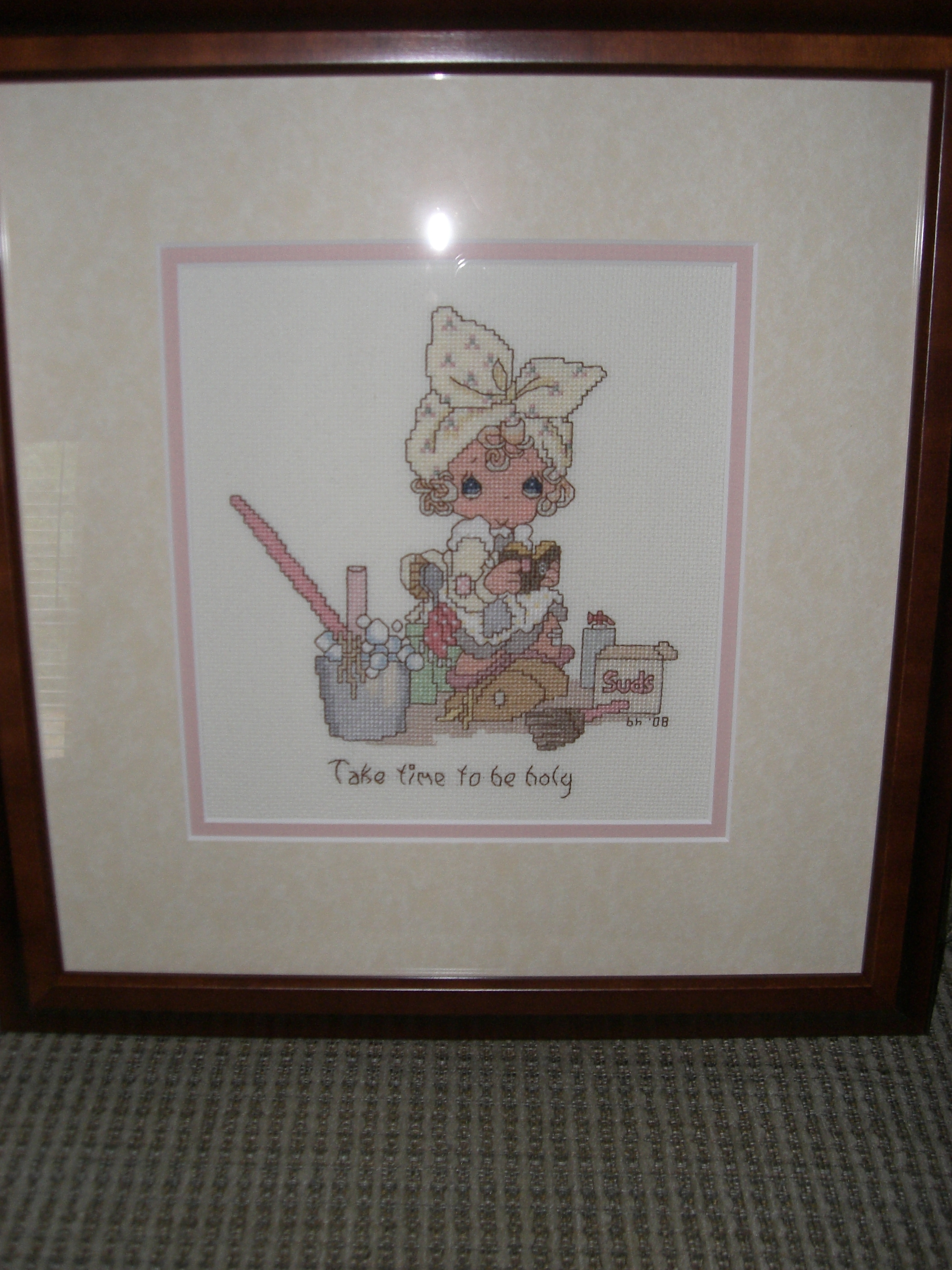
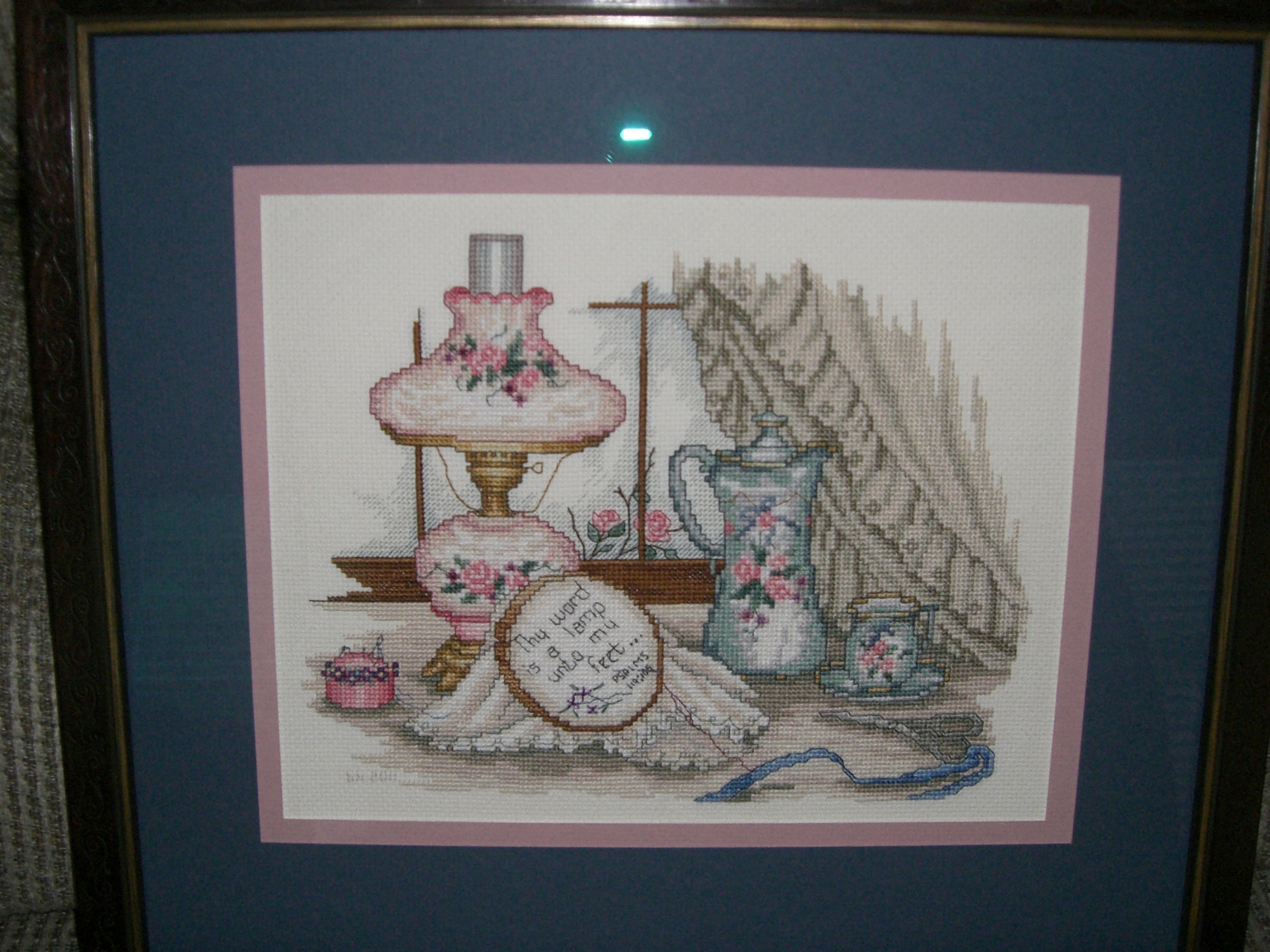
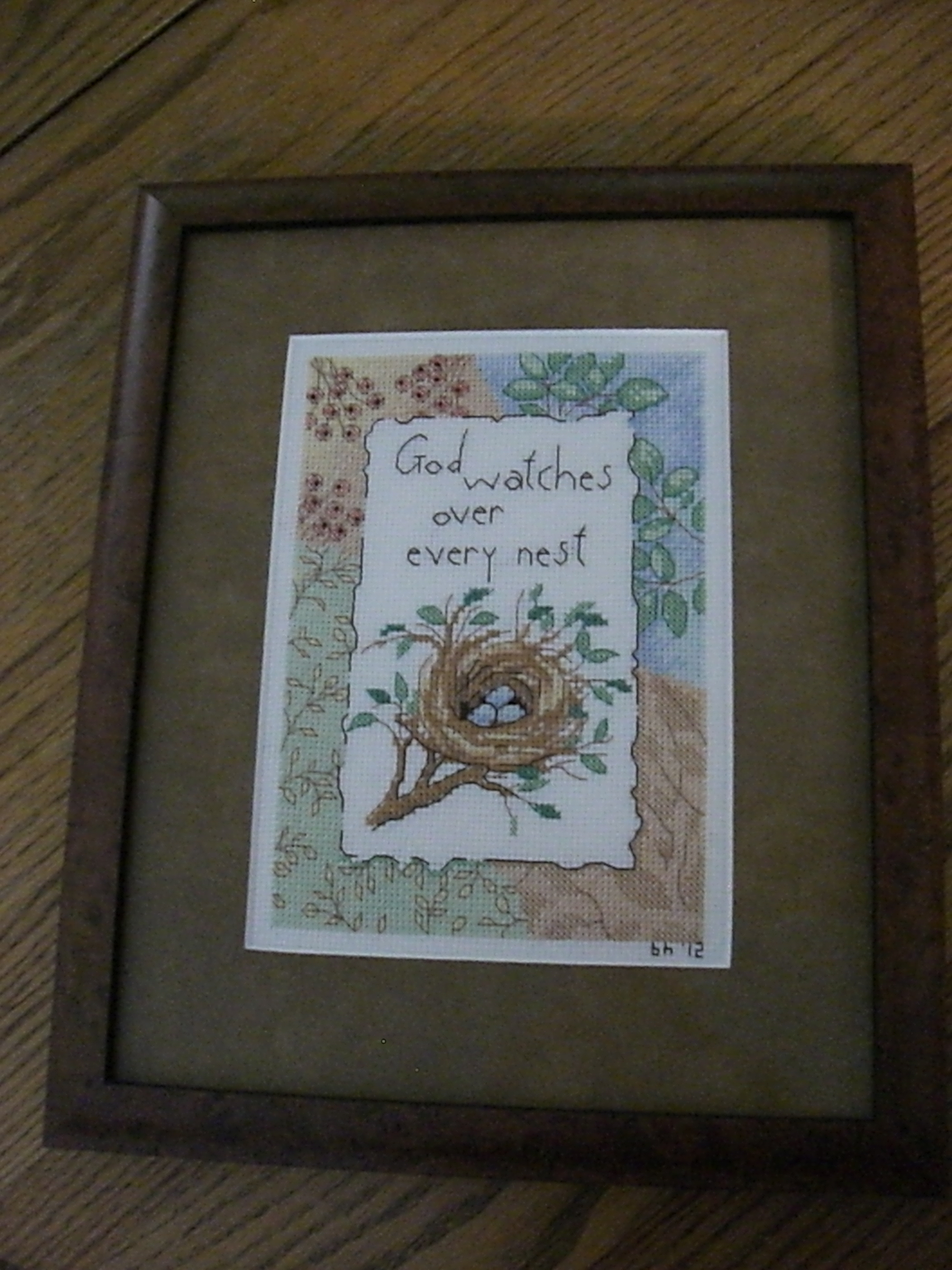
A few years ago I realized that I had done a lot of cross stitch through the years that I had given away for gifts, but didn’t have much that I had done for my own home. I wanted to do a few pieces both to express my own personality and maybe to hand down to progeny. Of course, my tastes are more feminine, as I said, and having all boys, I don’t know if they’d be interested in any of these just because their mom made them, and daughters-in-law will have their own tastes. I hope when I am gone that they will keep some things like this for grandchildren – I often wish I had something personal from my grandparents. But at any rate, these are a couple of my favorites:
Our only investment in “real art” was a set of prints by Paula Vaughan, a gift to me from my husband, who knew how much I liked them. But I have also framed cards and pages from calendars.

I did have one class in Home Furnishings in college, where we learned a bit about elements of art and principles of design, but I am far, far from expert in it. I never did get to go on and take the next class, Interior Decorating, which I would have loved, I think. Sometimes I watch decorating shows and “get” what the designers are saying, sometimes I have no idea. 🙂 I don’t always agree with what they do, but I sometimes enjoy listening to their reasons. But though some of these principles and elements are helpful (i.e., wondering why something looks “wrong” with the end table next to the couch and then realizing that it’s because the lamp there is way too small in proportion to the rest of the furniture), overall what’s most important is what Edith stresses: making a place homey, comfortable, and an expression of your own creativity and personality.

More discussion on this chapter is here.

This post will be also linked to Women Living Well.

Sewing/Craft Room Cabinet

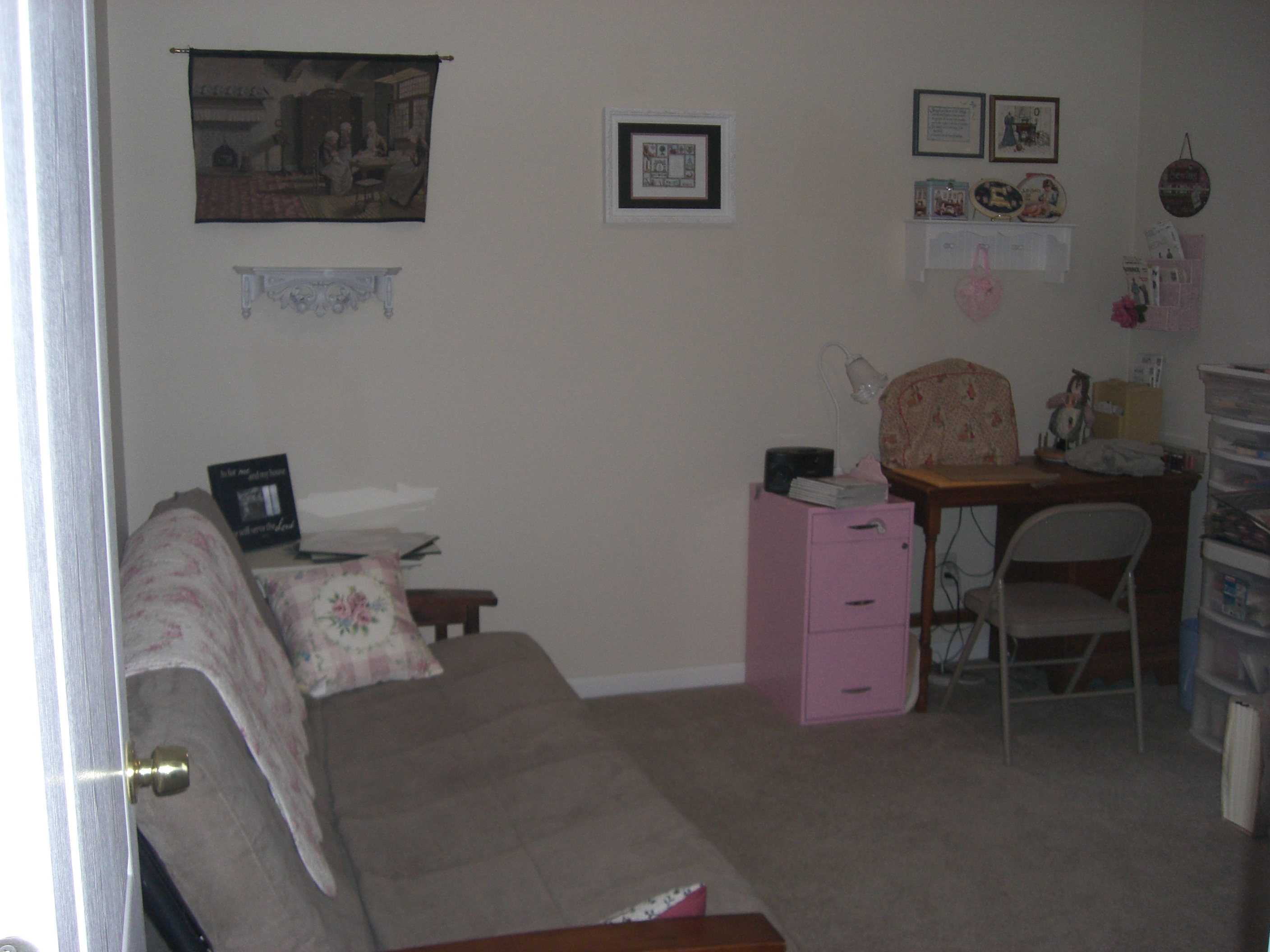
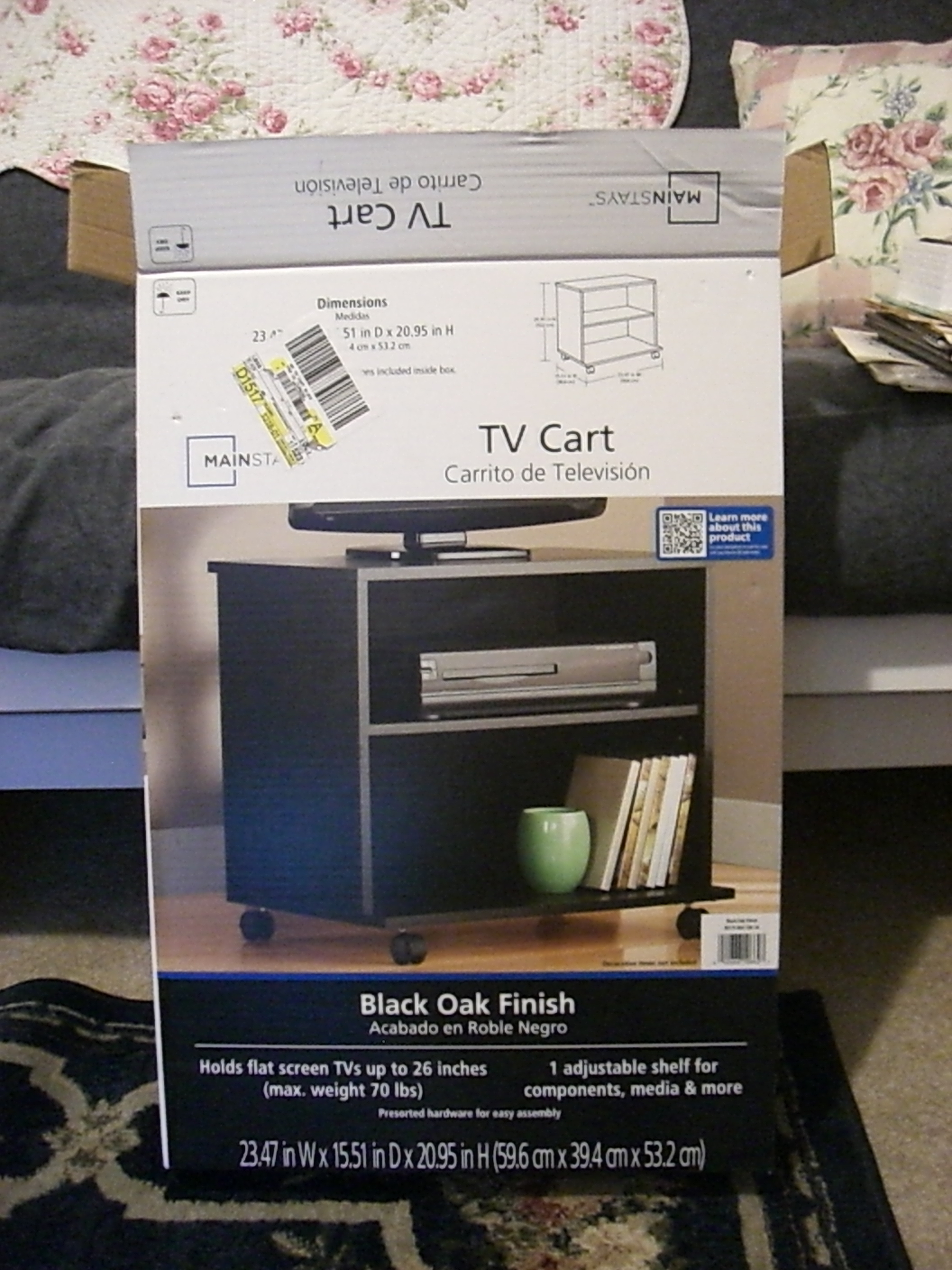
For some months now I’ve been searching for some way to keep my laminator and Cricut close by and ready to use, but off my work table so I have more space there. The room is small, so I didn’t have much wall space or closet space to put another storage unit (and I didn’t want to keep them in the closet anyway.) I wanted something on wheels, and because the laminator gets so hot, I wanted to avoid plastic storage.

I’ve been looking at various storage units and ideas and not seeing anything that would really work, and then one day this caught my eye in W-Mart:

CIMG5816

I had taken measurements of my work table and saw that this would fit underneath it! And it was the right width and already on wheels — perfect!

Except it was black. I appreciate black furniture in other people’s houses, but it’s just not my preference, and it just wouldn’t “go” in this room.

So, inspired by DIY projects I’ve seen on Pinterest and elsewhere online, I decided to spray paint it white. I knew it would take several coats, but otherwise it should be simple: just point and shoot, right?

Wrong.

I did know to paint the pieces before putting them together. At first I was holding the can too far away, so most of the paint went into the air rather than on the cabinet. (I was thinking, “Wow, there is more aerosol than paint in this thing! Then I realized the problem.) But when I got close enough for the paint to stick, then I had problems with drips, sputters, puddles, and uneven coverage. When I tried to dab off some of the drips, it took a whole chunk of paint out, down to the wood. I was SO frustrated. My husband came home at that point and took pity on me and helped me. I had been holding the button on the paint can down continuously while spraying back and forth, but he took short quick individual strokes back and forth. He sanded off some of the problems areas, and multiple coats of paint evened out everything else. I also learned the cheap 96 cent spray paint is not the best. Krylon worked the best for us.

We let the pieces cure for about a week, and then Jim assembled the cabinet for me last weekend. I had also wanted to put some decorative scrapbook paper on the back wall of the cabinet, to look something like this or this or this or this. But I just used two-sided tape because I wasn’t sure if I’d leave it and wanted it to be easy to get off or change.

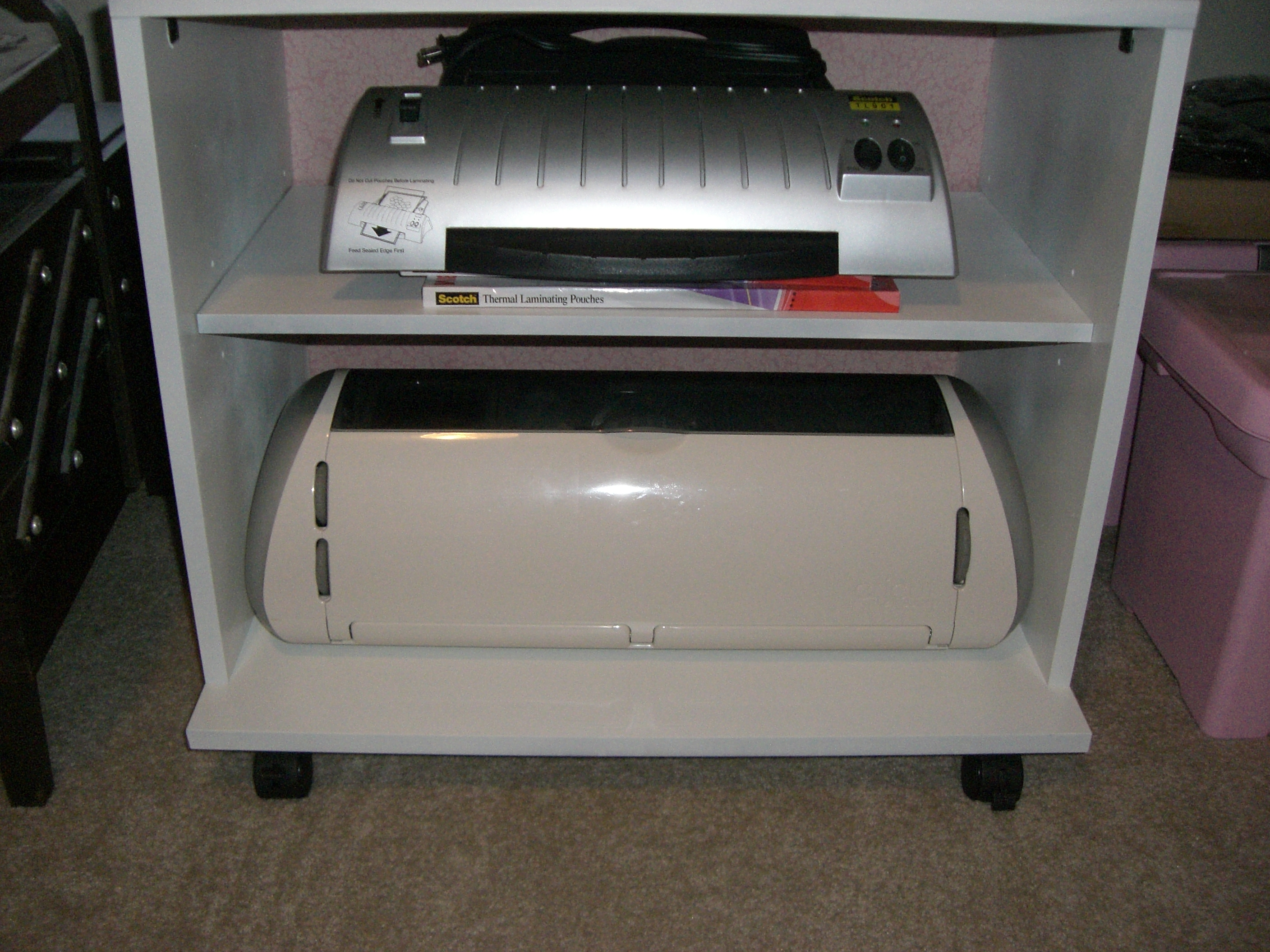
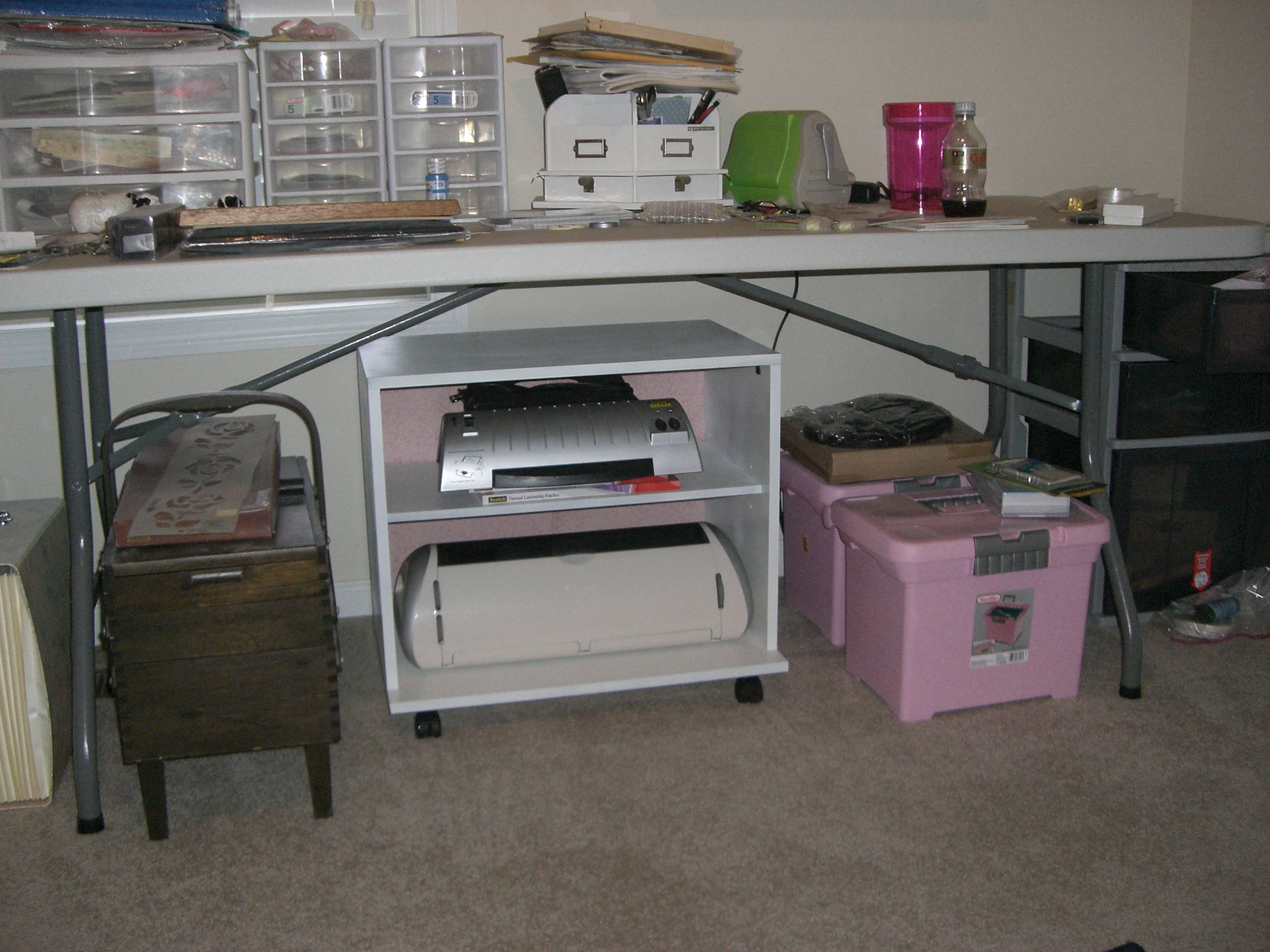
So, here is the finished product:

CIMG5820

CIMG5824

(Kindly ignore the other junk stuff on and around the work table – I’m still working on the rest of the room. 🙂 )

I love it. I like that it’s near at hand and I can roll it out when desired and put whichever machine I’m using on top, but I can keep it all tucked here out of the way otherwise.

I may decide I want to keep the Cricut out on the table after all, but if I do, I have plenty of other things I could store here.

The pink floral paper at the back really doesn’t show up except when I use the flash on the camera: otherwise it just looks dark back there. So in a sense that was kind of a waste, but mentally I’m glad to know it’s there.

I’m just tickled that this worked so well. This room is really starting to come together and be more functional.

I’m linking this project up with:

WYWWAnd

This post will be also linked to Women Living Well.
The Hidden Art of Homemaking Book Club: Chapter 2: “What Is Hidden Art?”

Photo Sharing and Video Hosting at Photobucket

It’s Week 2 of  The Hidden Art of Homemaking Book Club hosted by Cindy at Ordo Amoris where we’re discussing Edith Schaeffer’s book, The Hidden Art of Homemaking, a chapter at a time.

Chapter 2 is “What Is Hidden Art?” Edith defines it as art found in the “minor” or “everyday” areas of life rather than art as one’s occupation or profession. Because we have different gifts and interests, the “hidden art” in each of our lives might look a little different. Because we have multiple demands on our time, no one can do it all. But incorporating some degree of artistry and creativity will require some discipline and prioritizing:

“All art involves conscious discipline. If one is going to paint, do sculpture, design a building or write a book, it will involve discipline in time and energy — or there would never be any production at all to be seen, felt or enjoyed by ourselves or others. To develop ‘Hidden Art’ will also, of course, take time and energy – and the balance of the use of time is a constant individual problem for all of us: what to do, and what to leave undone. One is always having to neglect one thing in order to give precedence to something else. The question is one of priorities” (p. 32).

But the discipline and prioritizing are worth it.

“It is true that all men are created in the image of God, but Christians are supposed to be conscious of that fact, and being conscious of it should recognize the importance of living artistically, aesthetically, and creatively, as creative creatures of the Creator. If we have been created in the image of an Artist, then we should look for expressions of artistry, and be sensitive to beauty, responsive to what has been created for us” (p. 32).

That doesn’t mean we can or should “drop everything to concentrate on trying to develop into great artists” (p. 32), nor does it necessarily mean we need to take courses in Art, which can sometimes discourage, making us feel “‘outside’ the magic circle of the talented” (p. 33). But we begin to develop an eye for seeing the artistic and then incorporating it in everyday ways.

I loved this chapter on many levels. I liked the encouragement to seek the beauty in everyday life as well as the acknowledgement that we’re limited in what we can do, and that’s ok.

In the “middle age” of life I’m in now, those limitations actually help provide focus. For instance, I’d love to learn how to play an instrument. I know I could take lessons even now in my mid-50s (I know an 84-year-old who takes lessons!) But I’ve sometimes said I have enough things I want to do to keep me occupied til I’m over 100. The time it would take to practice and learn an instrument well enough to begin to enjoy it is time I’d rather spend in other pursuits right now (though sometimes I’m still tempted!)

But though lessons of some kind can be beneficial and enjoyable, the focus of this book is more on little touches and everyday ways to incorporate creativity. I’m looking forward to the next chapters!

There is a Hidden Art of Homemaking Pinterest Board where members have been posting some of the everyday beauty in their lives, mostly outdoors shots so far. Here are some from around the house (some current, some past):

 photo CIMG5810.jpg

CIMG1857

CIMG1855

CIMG0112-1

You can find others’ thoughts on Chapter 2 here. Normally the link-up post is on Tuesdays. My Tuesday this week was taken up with hubby’s surgery for a detached retina, but I hope to be posting these chapters on or before Tuesdays from here on out.

The Hidden Art of Homemaking Book Club

HomemakingI saw at Sherry‘s the other day that Cindy at Ordo Amoris is hosting a read-along book club for the next twelve weeks or so to read Edith Schaeffer’s book, The Hidden Art of Homemaking. I had read this book some time in my early married years, and it had a great impact on me. I had been wanting to revisit it, and this provided the perfect impetus: it will be inspiring and enjoyable to compare thoughts with others while we work through the book. The idea is to discuss a chapter a week and then link up at Cindy’s to compare notes.

Sadly, I could not find my copy of the book! But I did find it online here, and that will tide me over until I can find mine or obtain a new copy.

As a young woman, I wrestled with the idea of wanting my home and even my dress to be attractive. Would we be more effective Christians if we spent less time on mundane, earthly things that will pass away and lived like John the Baptist? Edith’s book helped me greatly in that regard. In the first chapter, “The First Artist,” she goes into great detail observing God’s creativity and artistry in creation. When He created the world, He called it good. And even though it has been marred by sin, still “The heavens are telling of the glory of God; And their expanse is declaring the work of His hands.” (Psalm 19:1). God could have made the world just functional, but He also made it beautiful, not only for our enjoyment, but also that we might see something of Him in His handiwork.

She also discusses the ways in which we’re created in His image, and a part of that image which will reflect Him is in the area of creativity and artistry. We’re limited by the fact that we’re finite and inherently sinful, whereas He is not, but still, we can reflect Him in these areas. In later chapters she’ll acknowledge that we have other priorities and limits on our time and finances, but she’ll discuss simple ways of incorporating art and beauty into the everyday, such as this incident when a tramp came to the door, and instead of handing a sandwich out through a barely-opened screen, she made up a nice tray complete with flowers. She’s not talking about investing big bucks buying high-end art, though there is nothing wrong with that if one can afford it: rather, she’s discussing having an eye and developing a taste for bringing beauty and artistry into even the mundane, to bring enjoyment to others and to reflect His beauty.

We’re also supposed to introduce ourselves with this first post. My name is Barbara. I became a Christian as a teenager. I’ve been married for 33 years and have three boys, one of whom is married, and only the youngest is still at home. No grandchildren yet! I’ve been privileged to be a stay-at-home mom ever since my first pregnancy. Maybe because I did not come from a Christian home, or maybe because God just wired me that way, I’ve had a heart for creating a truly Christian home since before I was married (I even listed homemaking as one of the themes of my life.) I think every woman is a homemaker, because every woman lives in a home, and her home will reflect her personality to some degree, whether she’s single, married, with children or without, and even at this stage in life when the nest is almost empty. My husband has often said that if he lived alone, there probably would be nothing on the walls, and he doesn’t always understand exactly why I have certain things there, but he likes the hominess of it. One of my most treasured comments on my blog was from him on this topic.

Besides homemaking, I enjoy reading, some crafts (mainly stitching and paper crafts), and writing.

Those discussing the first chapter are linking up here this week. I hope you can join in! Even if you can’t read the books right now, I’d love to hear your thoughts on creativity and artistry in homemaking.

Time Management

clock

Susan and I are thinking along the same track this week. She wrote about time management and I was thinking on the same subject this morning. I’m going to copy borrow her idea and share a bit of what I have learned along the way.

1. A process, not perfection. With both time management and household organization, it helps to think of it as a process of growth. If I have as my goal to be perfectly organized and scheduled all the time, I’m setting myself up for disappointment. When I fail or find flaws in my system, instead of beating myself up over it, I can use it as an opportunity to try another approach.

2. Adaptability. No one system works all the time for everyone. We all have different personalities, families, responsibilities — and before we can get fully settled, life changes: we move, the kids become teenagers, etc. Our own system needs to be adaptable through the seasons of life – and sometimes through any given day.

3. Gleaning. Some people find a particular book, person, or system and follow it exactly. I tend to be more of a gleaner: I pull different ideas from different sources. Either way is fine: just use whatever approach works for you and your family.

4. Priorities. It helps to sit down and establish your priorities and then come back and revisit them from time to time. For instance, time with God is a must: if I don’t make that a priority, then I can get caught up in other things and neglect it. For me that means spending time in the Bible and prayer as one of the first things of the day. Also, my husband is the head of the family and I’m a help for him, so when he asks me to do something that crowds out what I had planned for the week, I need to remember that those hours when everyone is at work or school are not my own to do as I please. That doesn’t mean we can’t talk about it and work something out if there is a genuine conflict, but it does mean I should not be selfish with my time or schedule things without regard to the rest of the family.

We see Jesus exercising priorities throughout His earthly life, but one clear place that shows this is Mark 1. After a busy day of healing and casting out demons, “in the morning, rising up a great while before day, he went out, and departed into a solitary place, and there prayed” (verse 35), and then when the disciples found Him and told Him people were looking for Him, instead of going back into town to heal more, He said, “Let us go into the next towns, that I may preach there also: for therefore came I forth” (verse 38). Healing was one part of His ministry, but the higher priority was preaching the gospel. And spending time with His Father was the first priority of the day.

5. Scheduling. Some years ago I came across a few women online who didn’t believe in scheduling their day: they felt they needed to be open to the leading of the Lord and let Him arrange their time. But being open to the Lord’s leading doesn’t negate planning. James 4:13-17 says, “Go to now, ye that say, To day or to morrow we will go into such a city, and continue there a year, and buy and sell, and get gain: Whereas ye know not what shall be on the morrow. For what is your life? It is even a vapour, that appeareth for a little time, and then vanisheth away. For that ye ought to say, If the Lord will, we shall live, and do this, or that.” That doesn’t say don’t plan anything: it says keep the Lord’s will in mind when you plan.

I don’t know about you, but if I don’t have some kind of plan for the day, I’ll just float along and not accomplish much of anything. Ephesians 5:15-16 says: “See then that ye walk circumspectly, not as fools, but as wise, Redeeming the time, because the days are evil.” Proverbs 13:4 says, “The soul of the sluggard craves and gets nothing, while the soul of the diligent is richly supplied.” While not talking specifically about time, obviously a diligent person is busy. Proverbs 21:5 says, “The plans of the diligent lead surely to advantage, But everyone who is hasty comes surely to poverty.” Have you ever had to act in haste because you didn’t plan ahead, and then were impoverished in some way because you forgot something or lost your temper and acted impatiently with your family?

When I was in college, I didn’t know how to plan my time well and ended up rushed, with lower grades because I kept turning things in late. In high school I had stayed up til 1 or 2 a.m. doing homework: that wasn’t an option in a Christian college which required lights out in the dorms at 11 p.m. (and that was probably good for me.) I think it was my junior year that I had a course in time management, and I felt that should have been a freshman course! One exercise the teacher had us do was to try different ways of scheduling. One was a minute-by-minutes schedule: that is probably too tedious for most people, although keeping a journal of how you use all your minutes for a few days will help you see where most of your time is going and help you know what areas you need to improve on. That kind of schedule might be helpful in isolated times, like preparing Thanksgiving dinner, when you need to plan what’s going to be in the oven when and try to have everything ready and hot at the same time, or a program, or a wedding, etc. The next was an hour by hour schedule, and that worked well for college when most of my time obligations were parceled out by the hour. I don’t remember the name for the last one, but it involved broader time frames: morning, afternoon, an evening. That worked well as my children were growing up. My schedule is a bit “looser” in my present season of life.

6. Lists. I couldn’t schedule much of anything beyond the everyday routines without a list of some kind. Lists can be frustrating to some people, but it helps to remember it’s not binding, and you shouldn’t feel guilty if you can’t check everything off at the end of the day. It’s a guideline. It helps me prioritize which things have to be done and which I can leave for another day. If I just do things off the top of my head, I may spend quite a bit of time something good but forget something critical.

One of the requirements for each of the schedules I mentioned above was that we keep a list of “5 minute tasks” that we could do if we found a few minutes free here or there, like clipping nails, sorting mail, etc. I’ve expanded that to keep a list of tasks that aren’t urgent but still need to be gotten to some time, and that helps me when I am in a slump and would otherwise gravitate to the computer.

7. Interruptions. Once I started learning the value of scheduling, I would get highly frustrated if something interrupted my day or threw me off course. That’s when I needed to remember the “if the Lord wills…” part of James 4:127, along with, “A man’s heart deviseth his way: but the Lord directeth his steps” (Proverbs 16:8). What helped me the most with this was the realization that Jesus healed the woman with the issue of blood right in the middle of going to see Jairus’s daughter. Jairus and Jesus were on their way to Jairus’s home when a woman touched the hem of Jesus’s garment, and Jesus stopped and asked who it was. He was calm and unruffled. Nothing is mentioned about Jairus’s state of mind, but it’s not hard to imagine that he might have been distressed, perhaps even impatient. And then he heard that his daughter died, and he could well have blamed her death on the delay. But Jesus said, “Be not afraid, only believe” (Mark 5:36). And then He brought her back to life, an even greater miracle than healing. Sometimes God has greater things in mind and will get greater glory by what He has planned rather than what we had planned.

8. Don’t compare. My biggest discouragements about my own housewifery came about when I compared myself to others. “How come she gets so much done and I can’t?” “How come she is so much more organized than I am?” I had a friend in early married days with the same number of young children I had, yet she worked part time, sewed her own clothes and her daughter’s, made her own curtains, her house was always (when I saw it) not only clean but also nicely decorated, and she was active in several ministries at church, while I felt like I could barely keep my head above water between dishes and meals and laundry. She was one I most often compared myself unfavorably to. One time she invited our family to dinner, and I realized for the first time that she rarely sat still for long. She was constantly up and down, getting something, doing something, going, going, going. It was hard as a guest to relax because she didn’t seem relaxed. It dawned on me that it was ok that I had a different style and temperament. My energy level, metabolism, priorities, and best time of day to do certain things will vary from others. I could learn from her and from others, and probably should have asked her for some tips, but I didn’t have to try to be just like her or lament that I wasn’t.

Similarly, another friend who was known to be highly organized said one time that she had one type of soup and sandwich for lunch Monday, Wednesday, and Friday, and another type Tuesday and Thursday. That saved time planning for lunch each day, but it sounded totally boring to me. If it takes me a little longer to look into the open refrigerator to decide what to have for lunch, that’s ok with me. She also was on a committee involved with doing projects for missionaries the church supported, and she wanted to do the same exact thing for each missionary family: that way she only had to plan once instead of planning something different each month a different missionary was focused. That would be good except that each missionary didn’t have the same type of ministry: some had children’s programs, some were involved in translation work, some ministered to college students. Sending children’s stories would work for the first one but not the others. That’s when I learned that sometimes there are higher priorities than efficiency.

(This is not to talk down about either of these ladies: it’s just to say it’s okay if we each do things differently.)

9. Know your strengths and limitations. If your sleeping habits are regular, you probably have regular parts of the day when you have more energy, and parts of the day when you don’t. Plan accordingly: don’t plan something that’s going to take a lot of mental or physical energy in the afternoon if you experience a bit of a slump then. Likewise, if having people over on Saturdays leaves you too tired for church on Sundays, see if there is some way to rectify that: maybe have guests another night, or meet earlier in the day, or plan simple meals, or do as much cleaning and cooking as you can ahead of time. Hospitality is important, but some people can handle it more often that others. Some people like to constantly have things going on; some of us like time to regroup at home with only occasional outings or activities.

A part of this is learning when to say “No” to certain activities, even good ones, even ministries. Some people say no too easily, some don’t say it often enough. I used to think that anything anyone at church asked me to do was the Lord’s will. Well, one can quickly get snowed under that way. Over the years as I learned more of what my inclinations, gifts, and aptitudes were, I had more of an idea of which ministries to participate in. Sometimes I said “Yes” to something I didn’t really have a desire for, yet I just didn’t feel the liberty from the Lord to say “No,” and I saw Him stretch me out of my comfort zone and enable me in marvelous ways as I learned to depend on Him. Other times I’ve felt no qualm at all about saying no except for feeling bad for the person who asked me, and then saw God bring someone else along who did a wonderful job, much better than I could have: I would not only have robbed the person of the opportunity but the results would have been poorer if I had done it. Part of that discernment comes with time, but part of it is just walking with the Lord and asking His guidance for what He wants you to do.

10. Prevent problems as much as possible. Prevention is probably my biggest watchword in housekeeping: I’d much rather prevent a mess than clean one up. I used to lay my clothes on a trunk in our bedroom when I changed at night, but then they’d be all wrinkled the next day: if I took a few seconds to hang them up immediately, I could maybe wear them again, or if they needed to go  in the hamper, they were taken care of instead of having to sort through them later. Putting something back where it belongs when done with it avoids clutter and avoids losing it. When my family puts dishes in the sink, I ask them to run a little water in them: that makes them easier to rinse when I load the dishwasher later than than if food or drink has dried. If someone pours coffee down the sink, I ask them to rinse the excess off rather than have a coffee stain I’ll have to scrub out later. If I hang up or fold clothes right away after they’ve been dried, I have very, very little ironing to do, plus I am not overwhelmed by a mountain of laundry needing folding. Tossing junk mail away when I first bring the mail in saves having to sort through it all later. Preventing piles of papers by putting them where they need to go immediately is easier than sorting, filing, or discarding them later. Etc., etc. Someone once shared with me the OHIO principle: Only Handle It Once. When it is possible to do that, it prevents much of the need for decluttering.

One thing to remember with all of these is not to get so fanatical about any of them that you drive your family crazy. You have to work not only with your own personality and temperament, but with everyone else’s as well. Gentle requests or reminders are better than nagging, and some things you might have to just let go of or only do yourself rather than insisting on them for everyone. Explaining why you want something done a certain way during a calm moment, not in the heat of a disagreement, might help.

I’ve gone on much longer than I intended to, but I hope some of these things I’ve learned along the way will be helpful for you, too.

What has helped you manage your time?

This post will be also linked to “Works For Me Wednesday,” where you can find an abundance of helpful hints each week at We Are THAT family on Wednesdays, as well as  Women Living Well.

 

“As seen on the Internet”

I’ve tried some tips seen on the Internet, mostly on Pinterest, lately, and I though I’d share how they turned out.

This post, seen on Pinterest, told about making an entire meal in the crock pot: pork chops on the bottom, potatoes wrapped in foil and placed on top, and corn on the cob wrapped in foil placed on top of that. I thought that sounded like a great idea, so I tried it, except instead of wrapping the potatoes in foil I cut them in chunks and placed them under the pork chops. I love potatoes that way, when the sauce and meat juices slow cook into them. But I did place corn on the cob in foil on top of that. The meat and potatoes were great, but to me the corn ended up tasting old and dry. It may be I just had some older ears of corn and it may turn out better for others, (it obviously did for the person who posted the recipe), but for me, I think I’ll stick with boiling corn on the cob in water.

Rating: 💡 💡

This pin told about using equal parts of Dawn dishwashing liquid and vinegar on the tub for an hours or more to get rid of soap scum and build-up. I tried it first with the dish liquid I use, and it didn’t really do anything. But then I bought some Dawn and tried it, and it worked great. I wouldn’t say it is completely spotless, but it did a great job. I kept clicking through to get back to the original post about it, and it said to heat the vinegar. I hadn’t seen that when I tried it, so I don’t know if that would make it work even better.

Rating: 💡 💡 💡 💡

This pin said to soak paper towels in vinegar, wrap them around the faucet, leave them for an hour, and wipe it off to remove the gunky stuff that gets around the base of the faucet. That really didn’t work any better for me than commercials cleaners, then the kitchen smelled like vinegar all afternoon. Yuk. Plus it left a white residue.

Rating: 💡 💡

What worked just as well, even a little better, was to make a paste of baking soda and vinegar and scrub it around the faucet with a toothbrush and then wipe off. The vinegar smell wasn’t bad at all and didn’t linger. And those both these methods cleaned the gunk, but they didn’t remove the hard water spots. I finally bought a commercial cleaner for that but haven’t tried it yet.

Rating: 💡 💡 💡

My favorite Internet tip wasn’t found on Pinterest but rather through a search for getting rid of ants. We had problems with them off and on through the summer. Oddly, they didn’t get into any food cabinets but came up through the medicine cabinet. Even then they didn’t get into anything there but expanded onto the counters. We’d spray them, and they’d be gone for a few days, but then come back. I wanted something longer lasting and less toxic. I saw a number of ideas that seemed pretty messy, but the one that looked easiest was leaving bay leaves in the area where they come in. So I scattered a few bay leaves in that cabinet, and we haven’t seen ants in the kitchen since!

Rating: 💡 💡 💡 💡 💡

I’ve found a number of food-related ideas and tips online. The one I was most excited about recently was how to make my own tartar sauce. We don’t have fish often, and the last time we did I discovered I was out of tartar sauce, so I dashed to the computer to find this. It really tasted great, and making about half that recipe would be about enough for one meal, which I’d prefer to do so it wouldn’t spoil since we don’t use it much.

Rating: 💡 💡 💡 💡 💡

I guess it was a sign that I have been perusing Pinterest too much when I saw what looked like grandparents in Home Depot buying a big metal drip pan and thought, “Oh, they must be making a magnet board for their grandkids!” Maybe — or maybe they just needed an oil drip pan. 🙂

Here are some other neat ideas I haven’t tried yet (if you’re not familiar with using Pinterest, usually if you click on the photo it will take you to the site that explains more about the idea):

Making onesies and socks look like cupcakes for a baby gift or shower.

A way to get kids to look at the camera.

Lace storage.

A faux cami for tops that are too low.

Assorted canvas crafts.

Some neat photography ideas (some of those will have to wait for when we have grandkids.

As will these ideas for kids.

Sigh. So many neat ideas — so little time. But it does stimulate my imagination and creativity to look at them.

Have you found any neat ideas online lately?

Patio re-do

One of the house projects I’ve wanted to work on is our back patio. My husband likes to sit on our front porch some times when it is cool:

It is nice there, but I felt like the back area would be more private and I’d be more likely to go there if I wanted to sit outside for a while. Plus I thought it would be nice for everyone to be able to eat out there when he grills.

I didn’t take a “before” picture, but all we had out there was a table my husband found on sale somewhere a while back, a couple of lawn chairs, and the grill.

One of my birthday presents that he just had a chance to assemble this weekend was this swing:

Photobucket

Recently he bought some chairs to go with the table, and he wants to paint the table to match the chairs.

Photobucket

I’d like to replace the green umbrella, too, since it has some holes in it anyway, to match the canopy over the swing.

I didn’t take a “before” photo of this area, either, but the dog’s kennel had been partly on the patio and partly on the grass, so the grassy area was kind of scraggly. We sold the kennel after she died. I had been wanting to plant a hydrangea bush because I loved them at our old house, but there wasn’t a place in the front where one would really fit. Then it occurred to me it could go right here beside the patio and have plenty of room to grow. Jim planted it for me on Saturday.

Photobucket

I think I might put some pansies there, too, and cover the dirt with mulch.

I also took an old planter that had been out by the shed, spray-painted it, and repotted a little rose plant that Jim had gotten me for my birthday. I also replanted a little plant that had been on my kitchen windowsill — I hope it perks up out here.

Photobucket

And so we were able to put the patio to use for a Labor Day picnic yesterday:

It was a little buggy, but Jim defended us with his “magic wand,” the electric flyswatter. 🙂

I didn’t remember til we were half-way through eating that I had a citronella candle. Next time I’ll try to light that before we get out there.

You can see that our back yard is pretty small, and at first I was dismayed by that, but then realized that our stage of life we don’t really need a lot of space back there (plus the guys appreciate having less to mow. 🙂 )

And one thing really nice about the yard is that the back is lined by evergreen trees. Even though the fence of the neighbor behind us is just behind the trees, we still have a feeling of privacy (at our last house, once the leaves fell off in autumn, I could see from my kitchen window straight into the family room of the house behind us, where the man sat watching TV. I’m sure he was usually watching TV rather than our windows, but still, it felt creepy. I put a suncatcher there at eye level in the window, but I still felt like we were spying on each other. So I am VERY glad these trees are evergreens!)  So far I haven’t heard these neighbors right back there at the fence unless they are doing yard work.

It was especially nice last night when Jason remarked that it was so peaceful back there. I thought, “Yes! That’s exactly what I was going for!”

I’m glad to have this new area shaped up to minister not only to our family but to guests. I’m looking forward to spending some time on the swing with a good book, too. 🙂

Thanks, hon, for the hard work in putting it together! And thank you, Lord, for these gifts of peaceful spots.

I’m featured in an e-book! And you can win a copy!

Some of you might be familiar with the Works For Me Wednesday blog carnival. It was started years ago by Shannon at Rocks in My Dryer, and then she gave it over to Kristen at We Are THAT family. Every Wednesday, scores of bloggers share a tip that they’ve found helpful in real life.

Kristen thought it would be useful to take some of the best tips shared over the years and compile them into an e-book, and she asked to use three of mine.

I have posted any tips in a while — my repertoire ran dry a while ago. But I’m glad that some folks can still see them and glean something helpful from them.

The e-book is titled That Works For Me. It contains some 800 tips divided up into 24 categories, from Babies and Blogging to Marriage to Time Management, Frugality, Decor, Cleaning, Pets — almost every category you can think of. Within each category is a list of submitted tips: a brief description and then a link to the original blog post they came from. Some are very practical, like Peanut Butter Dog Treats and iPhone Troubleshooting: some are more philosophical, like my Can Frugality Go Too Far?

There are two contests in connection with the book.

1. You can win a clean house — a $150 Visa card toward a local cleaning company — by submitting a tip here through the month of April. This contest is sponsored by the folks that compiled the e-book: if you want to enter that contest, please go there. Commenting here won’t help you win that one. 🙂

2. You can win a copy of the e-book That Works For Me! by commenting on this post.

You can earn an extra entry by “liking” the book’s Facebook page and leaving a comment here telling me you did.

You can earn and extra entry by following the book’s Pinterest page and leaving a comment here telling me you did.

You can earn an extra entry by following the book’s Twitter feed and leaving a comment telling me you did.

Also, if you want to buy the book and click through from my links here or the button at the top of the page, I get a percentage of the sale. (WordPress Police, I did get prior permission for this.) And if you’d like to save a dollar off the $8 price of the book, use the coupon code SAVE1.

I’ll draw a winner Wednsday morning, May 2, using random.org.

Have fun and enjoy the book!

(This review will also be linked to Semicolon‘s Saturday Review of Books.)

This contest is now closed. Congratulations to Ann!

The Week in Words

”"

Welcome to The Week In Words, where we share quotes from the last week’s reading. If something you read this past week  inspired you, caused you to laugh, cry, think, dream, or just resonated with you in some way, please share it with us, attributing it to its source, which can be a book, newspaper, blog, Facebook — anything that you read. More information is here.

Here are a few thought-provoking quotes I came across this week:

From a friend’s Facebook:

“Circumstances may appear to wreck our lives and God’s plans, but God is not helpless among the ruins.” Eric Liddell, Olympian

We probably would not think of God as “helpless among the ruins,” but we sure can act as if we’re thinking that way. When we’re bowled over by circumstances, we can remember that He is not.

By the way, if you’ve never read a biography about Liddell, I’d highly recommend it.

Seen at Women Living Well:

“If you have been afraid that your love of beautiful flowers and the flickering flame of the candle is somehow less spiritual than living in starkness and ugliness, remember that He who created you to be creative gave you the things with which to make beauty and gave you the sensitivity to appreciate and respond to his creation. Creativity is his gift to you and the ‘raw materials’ to be put together in various ways are His gift to you as well.” ~ Edith Schaeffer, The Art of Homemaking.

I read that book years ago and want to do so again some time. I used to struggle with whether wanting things to be pretty and pleasing was somehow unspiritual, but the realization that God made the world beautiful and enjoyable rather than just functional and utilitarian helped. We have to balance that, of course, with the available time, funds, and other responsibilities, and Mrs. Schaeffer discusses this in her book.

In a similar vein, I saw this quote at my friend Mary Beth‘s some weeks ago:

“We have our own small square of life on this planet, and it’s our choice to do with it what we will. We can bring order and beauty to that place we have been given. We can touch the people who come within our sphere of influence with love and care and comfort.” ~ Claire Cloninger

On a different subject, this was quoted in the devotional book The Invitation by Derick Bingham commenting on John 21:3:

But what good can failure do? It may shut up a path which you were pursuing too eagerly. It may put you out of heart with things seen and temporal, and give you an appetite for things unseen and eternal. It may teach you your own helplessness, and turn you to trust more implicitly in the provision of Christ. It is clear that Christians have often to toil all night in vain, that Christ may have a background black and sombre enough to set forth all the glories of his interposition. ~ F. B. Meyer, Love to the Uttermost

One of the biggest struggles I had in college was not in failing per se — I wasn’t flunking, but I was failing in my usual good grades despite good efforts, and I felt like I was failing. One of the most poignant and timely messages I ever heard was one at college on failure. I can’t remember the details, but it was a lesson I have never forgotten that God has purposes in our failure or falling short.

You can share your family-friendly quotes in the comments below or write a post on your blog and then put the link to that post (not your general blog link) in Mr. Linky below.

I hope you’ll visit the other participants as well and glean some great thoughts to ponder. And don’t forget to leave a comment here, even if you don’t have any quotes to share. I usually try to visit everyone who comments, but often I forget to check Mr. Linky for those who participated but didn’t comment.

Happy Housewife Day!

Who knew we had our own day? I didn’t until seeing that e-Mom was giving away an apron to celebrate. I’m not an apron person, but if you are go check it out — you might win!

In looking around trying to find out more about it, it doesn’t seem to be a national holiday and no one seems to know who started it. But, hey, it’s a worthy day! Give yourselves a pat on the back!

I prefer “homemaker” to “housewife” because I am not married to my house, and I am trying to create a peaceable. welcoming home.

Last year I came across this poem on someone’s blog, but they seem to have taken down all their posts, so I won’t link back to it. But it spoke to me:

My Work 

by Mary Lou Burkholder 

I have the greatest work in the world;
The job of rocking a baby to sleep,
That of guiding his tottering feet,
A baby’s clothes to launder and fold,
A precious life to shape and mold,
A drink to give from a little cup,
At night his toys to gather up,
Hurts to heal and fears to quell,
A baby to keep clean and well,
A stack of diapers to put,
Oh, what a happy worthwhile day!
I am a “Mother.”

I have the greatest work in to world;
A husband to encourage when things go wrong,
When he comes from work to greet with a song,
Denims and shirts to wash and mend,
A helping hand, when needed, to lend,
Three times a day his meals to cook,
To strive to be my best to look,
His back to rub at the close of the day,
For his faithfulness to God I pray,
When hubby’s in the field I take lemonade,
for all these tasks his love has paid.
I am a ” Wife.” 

I have the greatest work in the world;
A home to keep happy, clean and bright,
Make things go smooth and strive for the right,
Jams to cook and jellies to make,
Cookies and pies and bread to bake,
Washing, ironing, and sewing to do,
So many tasks, will I ever get though?
Lettuce to wash and peas to pick,
floors to scrub, lost items to seek,
Dishes to wash and windows to shine,
These and many more tasks are mine.
I am a “Homemaker.”

Help me, Father, to faithfully work,
Forgive if I unconsciously shirk,
give me the patience and love I pray,
To keep myself in duty’s way;
With all the hustle that each day brings
May I not neglect the needed things;
Each day to spend time alone with Thee
That Jesus Christ be seen in me.
Thank you for husband, our home, our girls and boys;
Thank you for love which brings me much joy.

 Thank you , Lord.

Here are a few things I’ve written in the past, if you want some musing on homemaking today:

Encouragement for homemakers.

Wanting things to be “perfect.”

I confess: I don’t really like to cook.

A Real Home.

A Homemaking Meme.

Another homemaking meme.

A prayer for home.

Two views of housework.

Meditations for daily tasks.

Thy list be done.

(Photo borrowed from Susannah’s Kitchen.)