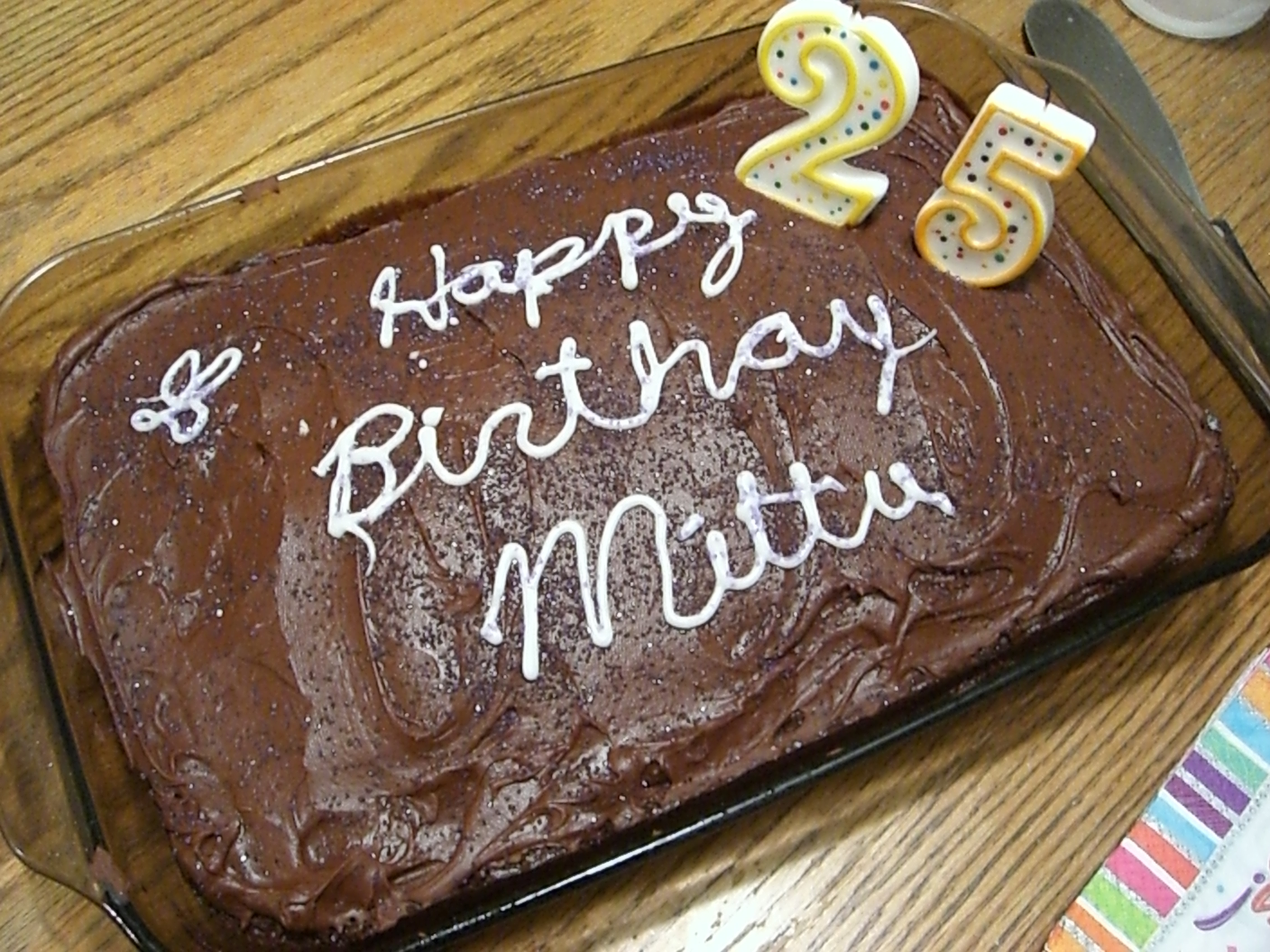
Cake decorating has never been my forte, but I used to be able to spell.

Cake decorating has never been my forte, but I used to be able to spell.
Some time back I found this quote somewhere online (I forgot to note where) from a book titled Mrs. Dunwoody’s Excellent Instructions for Homekeeping:
In these notes, I have endeavored to impart knowledge necessary for keeping a neat, well-ordered home. But beyond that, I wish for you to understand the larger issues of homekeeping — creating an environment in which all family members grow and thrive, a place where each member may evolve to the full extent our Creator intended.
I liked that, and I further liked the information posted with it, that “Mrs. Dunwoody, the wife of a judge in Georgia, was the ‘Martha Stewart’ of her time during the Civil War. She started her journal (notes) on homemaking in 1866, and would spend the next 50 years to complete her notes.”
 I liked this so much that I asked for this book for the next Christmas or birthday. When I received it and started looking through it, though, I found that it was not written by a real 1860s Mrs. Dunwoody: It was written by a modern Miriam Lukken in 2003 in the style of the “receipt books” “that nineteenth century Southern women penned as a record of all they knew and thought meaningful,” and Mrs. Dunwoody was a character based the author’s great-grandmother and other Southern women.
At first I was sorely disappointed. But then as I began reading, I realized that I still did like the philosophy of housekeeping represented.
She believed that the ordinary acts we practice every day at home are of more importance to the soul than their simplicity might suggest. Taking care of our home enables us all to feel nurtured and safe; it brings comfort and solace both in the fruits of our labor and in the freedom it affords to experience life to its fullest.
She taught that women were not just doing chores, they were creating — creating a home, a place of security, warmth, contentment, and affection (p. xii).
Home reflects the creativity, serenity, and beauty we hold dear (p. 7).
Homekeeping is a fine art. It grasps with one hand beauty, with the other utility; it has its harmonies like music, and its order like the stars in their courses. I fear really good homekeeping — which exhibits itself not in occasional entertainment or a handsome parlor, but in good housekeeping which extends from the attic to the cellar, and through every hour in the year — is far from common (p. 8).
I’ll admit that my home is not in complete order from attic to the first floor every hour…but I do see her point.
Organization has more benefits than mere efficiency…Knowing your life and home are in order reduces strife and anxiety, and increases confidences. In short, establishing your own routine for tackling domestic chaos makes the task less burdensome. And everyone feels the effects of that (p. 8).
Homekeeping is an ongoing art, a process, not an end product. It will never be “all done.” Bathrooms, clothes, and dishes, once clean, have a way of getting dirty again. But home is meant to be lived in, in the fullest, most potentially filling way for everyone in it. That means that every room does not need to be picture perfect and waiting for a perfect display, but rather, each room has a sense of order and calmness to it. The home looks like someone lives there, without appearing messy or cluttered (p. 8-9).
The rest of the book is filled with household tips and snippets of wisdom on everything from laundry, etiquette, health, garden, what to do for spring cleaning, etc.
In some parts of the book she sounds a little too rigid with her routines for my taste: I think an overly rigid housekeeper who only tolerates things done in specified ways and at specified times can make her household and guests as miserable as the lax housekeeper. Balance is needed.
And she mentions that home is “a place where even the everyday things in our lives were held sacred and should therefore be cared for and treated in a special and orderly way” (p. xii). We women do have our little treasures around the house, but I would not call them sacred. We have to remember not to “lay up treasures where moth and rust doth corrupt and where thieves break through and steal” but rather in heaven. I prefer to think in terms of stewardship: the things we “own” are given to us by God, and we should therefore take care of them.
But overall her reminders help me refocus on the fact that housework isn’t just “drudgery” — it is a ministry to family and guests, it fosters order and tranquility, and it is a testimony of a God of order, creativity, and beauty.
(This review will be posted to Semicolon‘s Saturday Review of Books.)
So, last Monday I declared Getting Things Done week. I debated with myself about whether to show what I got done (– would anyone really be interested? Would I just be booting my own horn?) But just the fact that I declared publicly that I was going to dig in and get things done last week provided a little bit of accountability, even though no one was going to come after me or check up on me to see the results. But I decided to go ahead and show the results:
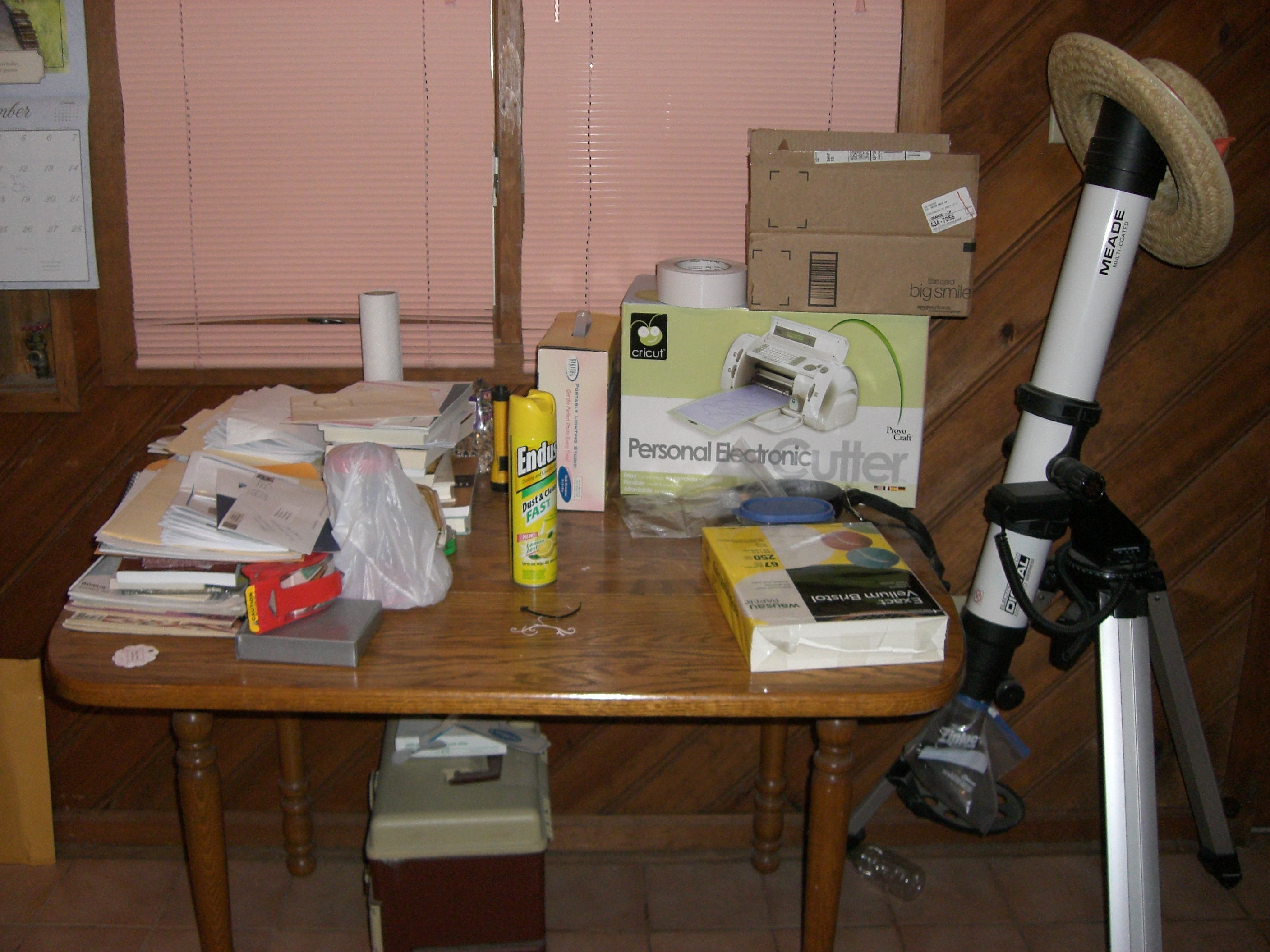
1. Cleaned off this table.
Before:
After:
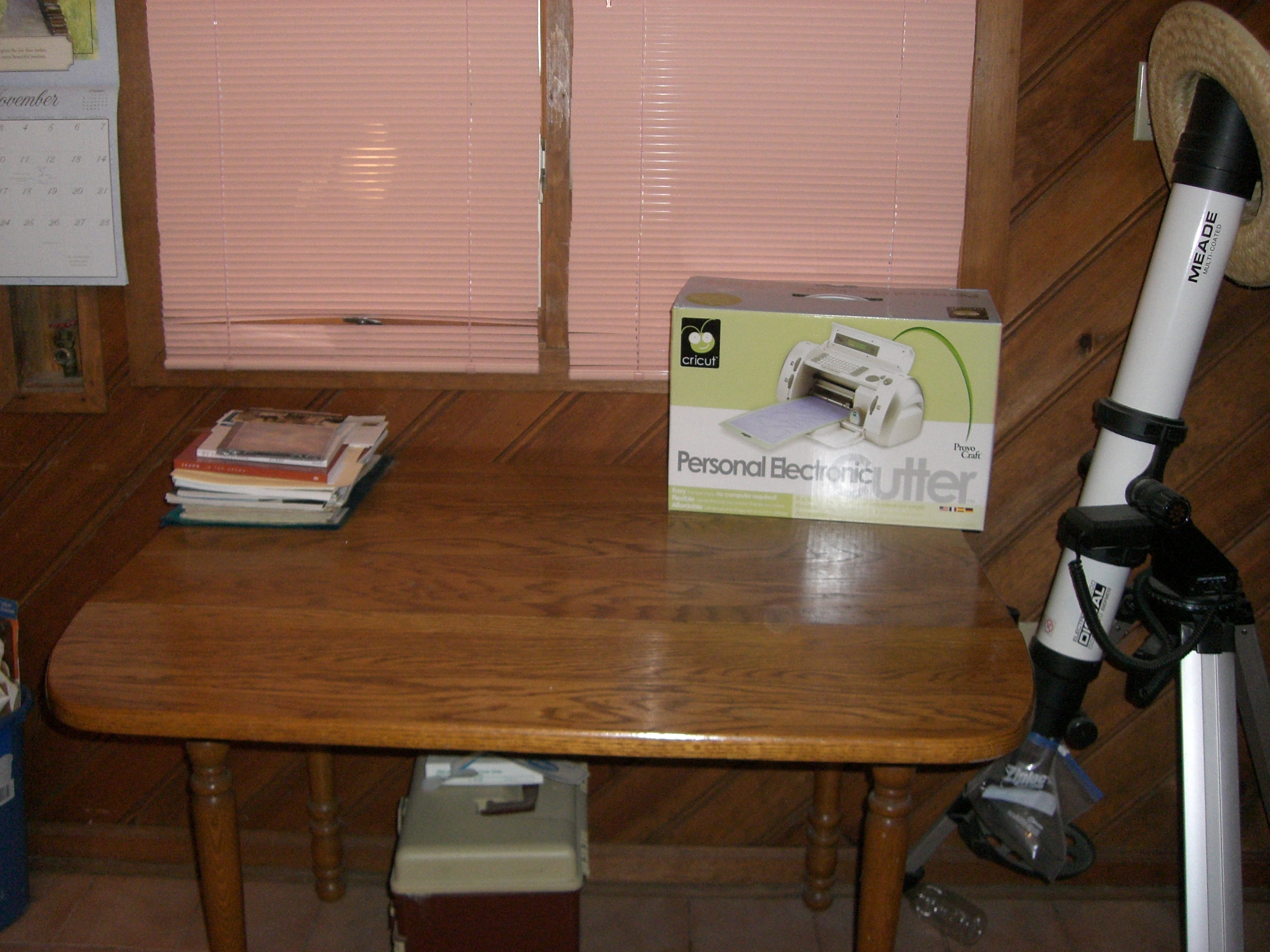
This is a little drop-leaf table that used to be our main dining table ages ago. Now it is in the “sunroom.” It’s meant to be a table where people can work on different projects that they might need to leave out to finish or dry or whatever, but it tends to end up a place to dump things.
2. Cleaned off computer desk.
Before:
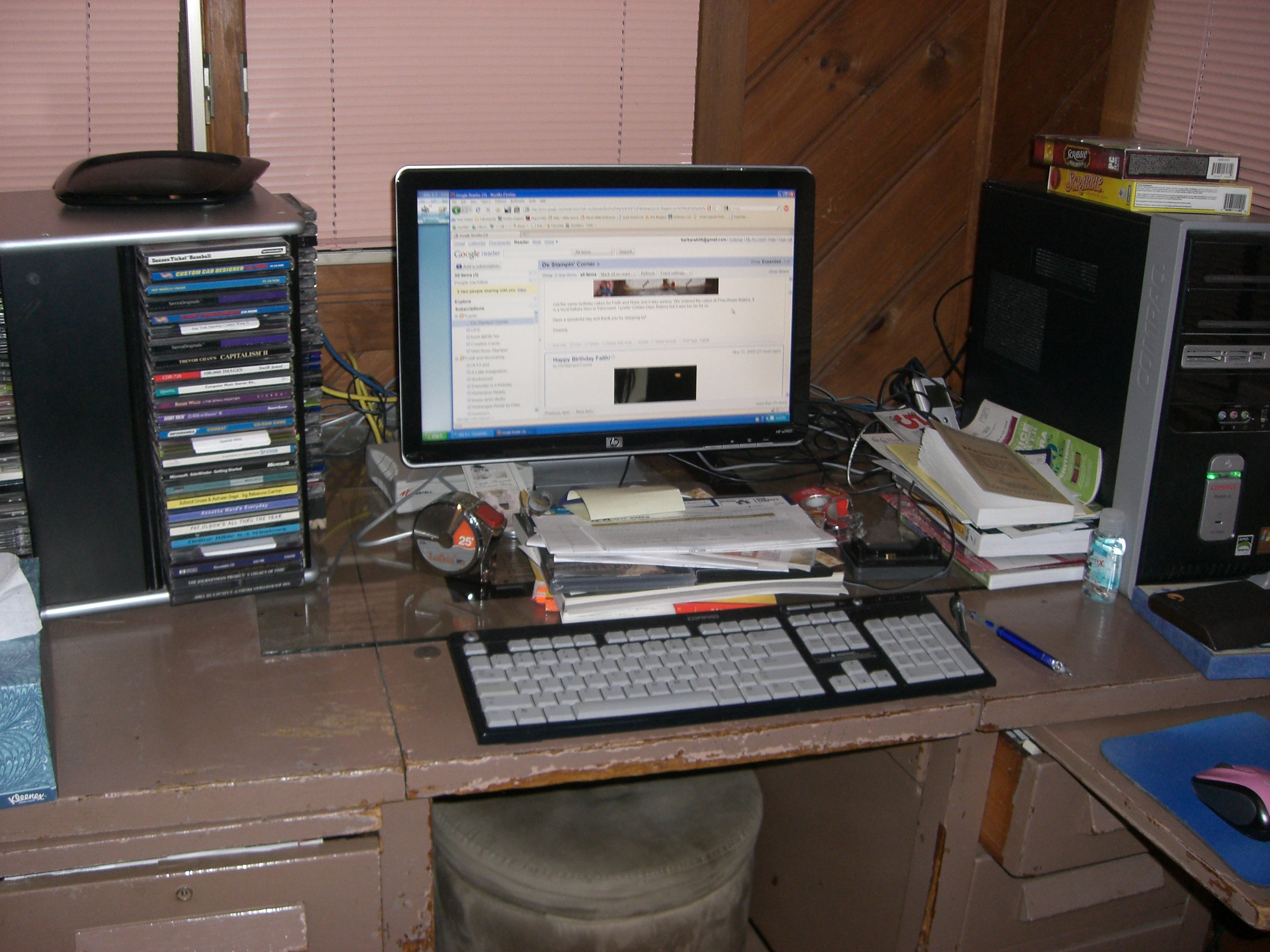

3. Sorting through files.
No photo for this one, but I sorted through two filing cabinet drawers, tossing our several things and moving them all up into the craft room into my little pink two-drawer filing cabinet (which I discovered tends to pitch forward. Sigh. Maybe I can put a brick in the back of the bottom drawer or something.) I also cleaned our two drawers in an upstairs plastic rolly-bin thing.
4. Cleaned out part of this cabinet.
Before:

After:
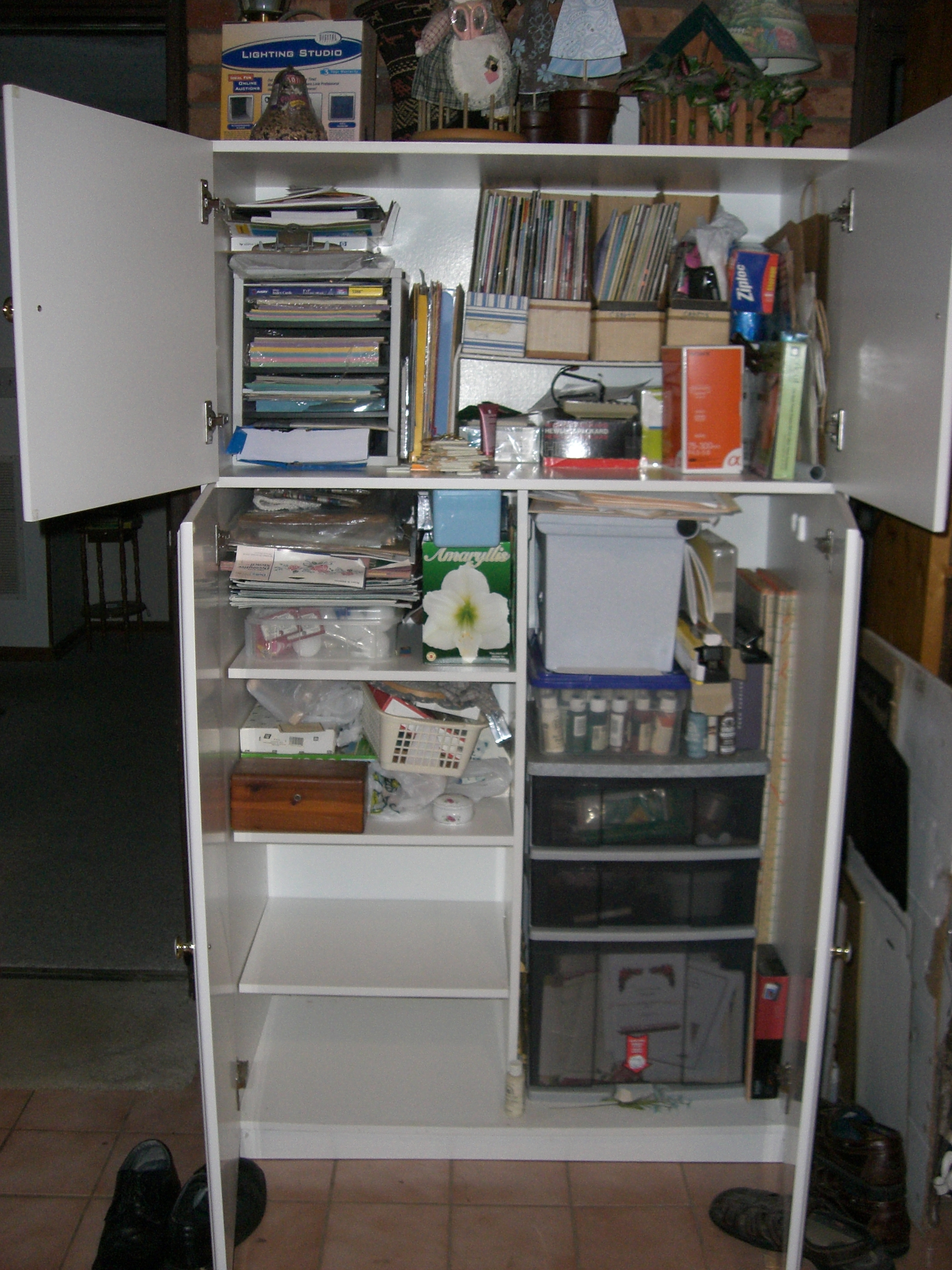
Still have some work to do there, but I put major dent in it.
By the way…that poor little amaryllis that someone gave me years ago actually bloomed all by itself in the box without having been planted. Does anyone know if I can cut off the old bloom and plant it again, or is it done?
5. Straightened and organized these bookcases.
Before:
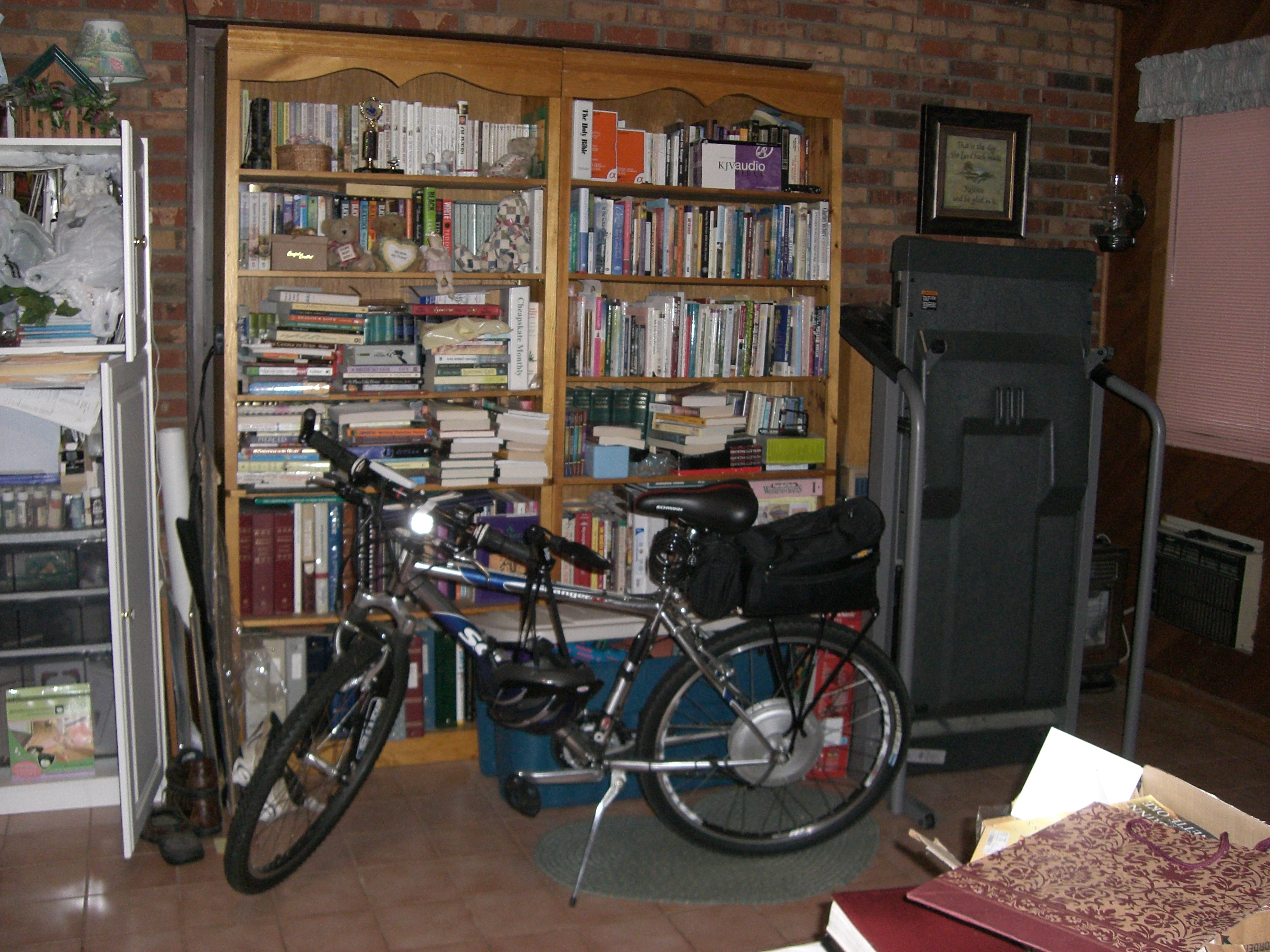
After:
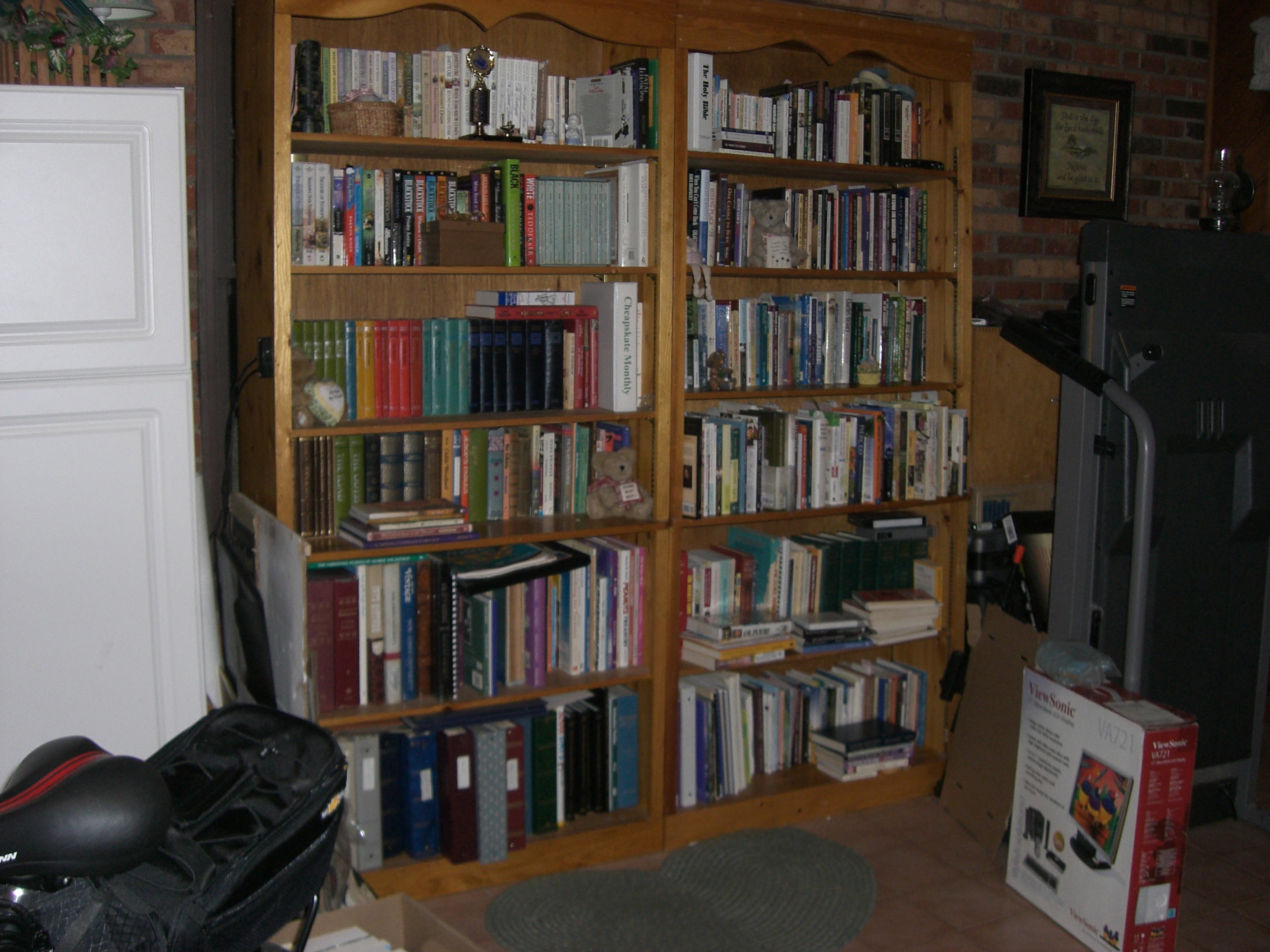
I still have a little work to do there, as you can see by several little stacks.
That blue bin contained outdoor things — basketballs, bats, super-soakers, etc. I had the boys go through it and sort out what was usable and what they wanted to keep, then they put the bin out in the shed. Then they moved two shelves worth of craft books to the craft room, and then I sorted and arranged what was left. I have a box-ful to get rid of (including a 30 year old Roget’s Thesaurus that is way out of date. I usually just use the one online anyway). I have a few more from home-schooling days that I want to list for sale — they are music books that I regret we never got to but which the boys have outgrown now.
It felt good to get to these things that have been needing attention for so long, plus it helped to actually see and remind myself of what I have. I discovered I have duplicates of a couple of books (which I am thinking I’ll hold a give-away for here). An added bonus was unexpected discoveries, like the letter I mentioned from my mom, and this sign one of the boys made a few years ago when I was repairing a stuffed animal:
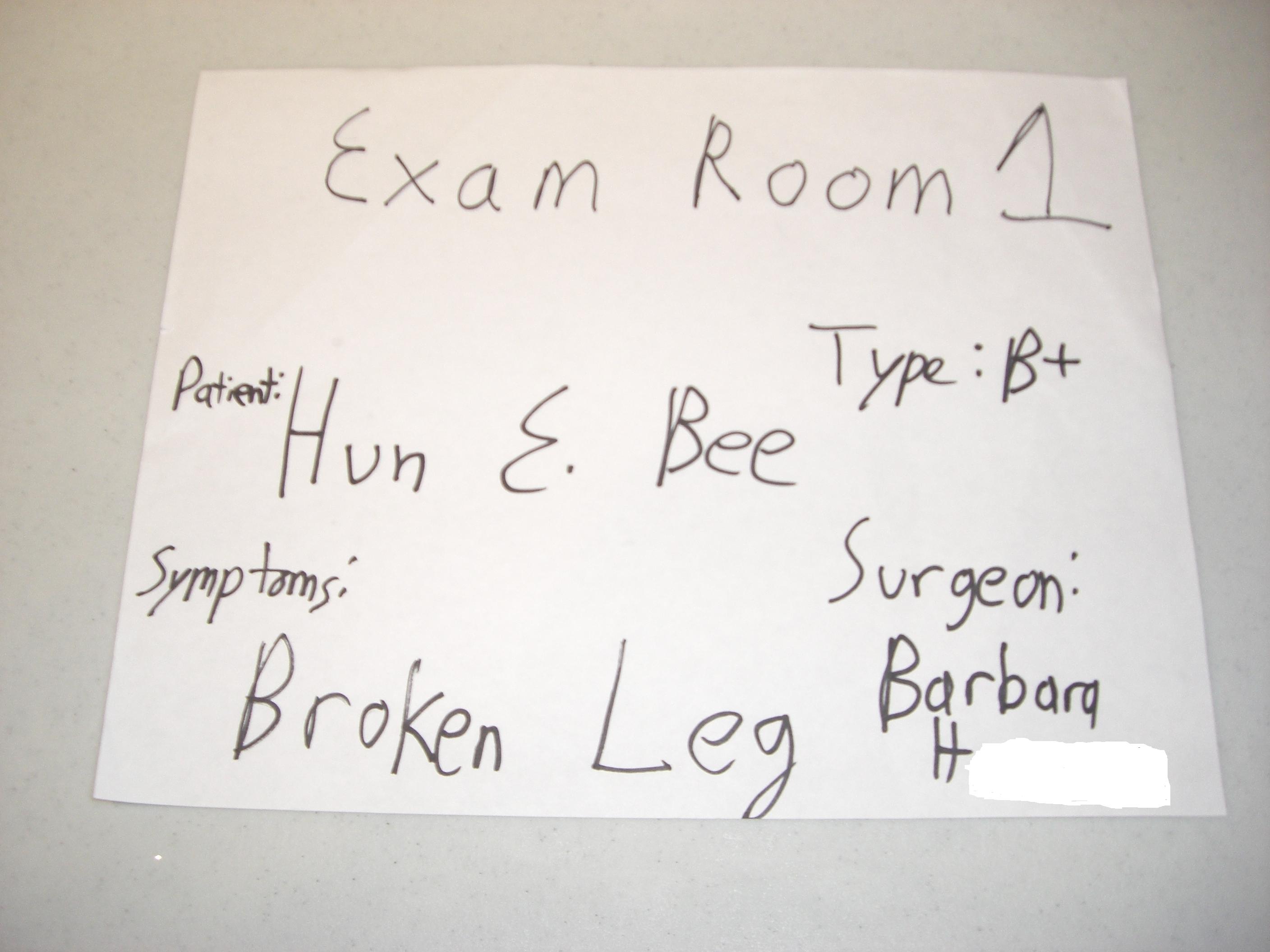
I don’t remember their having a stuffed bee, but I do remember sewing a leg on something. I got a kick out of the “B+” blood type.
So now I need to start on a new list for this week, but I am floundering this morning. I’ve been fighting off a headache that isn’t enough to incapacitate but is making me draggy and foggy. I’ve been taking acetaminophen, but the only thing that seems to help is putting pressure on my forehead or cheekbones. I don’t want to spend the day doing that, though, so I am going to see if I can keep this momentum going and maybe shake it off. I am only going to try working on these types of things today and tomorrow, though, with Thanksgiving coming. The rest of the week I’ll just play by ear.
Have a good day, whatever your plans are!
Hope you’re doing well this fine fall day!
Still have a lot to get done today, but I wanted to share some good things seen around the Web lately:
How can I know I have a heart for God at By Grace.
The waiting is the hardest part of waiting by Big Mama. Quotes: “…f you can’t find contentment and security as a single woman, then you’re not going to find it in marriage” and “Marriage wasn’t going to take away all my fears, insecurities, and worries….marriage tends to just amplify whatever junk is in your life.”
Study to show yourself an SAHM
Being merry with our husbands by nannykim.
I am my husband’s girlfriend by Candy.
Bless others with food: practical ideas and organizational tools for helping others by bringing food.
What about the culture? by Jungle Mom: answers from a missionary against the charge that missionaries adversely affect the culture they minister to.
How far is enough? Wonderful testimony from a missionary (husband of Jungle Mom).
How fiction can powerfully inform the practical application of truth, part one and part two by Jeanne Damoff, whom I had never read before, but whom I now want to read more of. Quote: “God is good in what He forbids.”

see more Lolcats and funny pictures
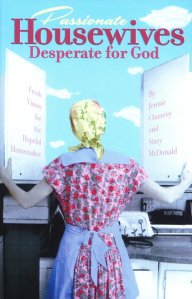 The authors of Passionate Housewives Desperate for God, Jennie Chancey and Stacy McDonald, purpose to encourage women in their roles as homemakers and to dispel various homemaker myths: the 1950s stereotypical housewife, vacuuming in pearls and high heels; the perfect super-mom; and the bored, sensual “desperate housewife” of TV fame. They not only outline the biblical teaching of a godly homemaker, but also encourage her that God will give her the strength and grace she needs.
They also want to speak out and warn against feminism and the inroads it is making into Christian culture. I knew that feminists frowned on stay-at-home mothers, but I didn’t realize quite the extent of it. The book is well-documented in its confrontation of feminism: here are just a couple of quotes of feminists themselves:
No woman should be authorized to stay at home and raise her children. Society should be totally different. Women should not have that choice, precisely because if there is such a choice, too many women will make that one.
~ Simone de Beauvoir, “Sex, Society, and the Female Dilemma,” Saturday Review, June 14, 1975.
Being a housewife is an illegitimate profession…The choice to serve and be protected and plan toward being a family-maker is a choice that shouldn’t be. The heart of radical feminism is to change that.
~ Vivian Gornick, University of Illinois, “The Daily Illini,” April 25, 1981
So much for women’s choice!
The authors also argue against what they call “Me-ology” — “books that encourage women to ‘pamper’ rather than ‘sanctify’ their flesh,” the idea that it’s “okay to live for self.” They’re not against the occasional bubble bath or time alone, but rather the idea that women should put themselves first in order to be better wives and mothers, or that they need to “escape” from their duties. The Bible teaches in many places that Christians are to live their lives in service to God and others and not for self and the more we try to grasp for ourselves, the more miserable we and our families will be (John 15:12-13, Matthew 10:39, Philippians 2:3-7, II Corinthians 5:15, Matthew 25:40, Matthew 16:24-26).
While it may seem counterintuitive, the lesson is true: living more for self will only keep us further from that true joy we’re after as women. God wants us to know that we can’t do it all, so that He can do it through us — so that He can equip us with the grace and strength we need to accomplish His will — which includes serving Him by serving others’ (p. xxv).
Please understand there is nothing intrinsically wrong with [spas, massages, pedicures], as long as we understand that we don’t need them to be content or healthy and that we aren’t somehow deprived if we don’t get them. There are many ways we can relax and enjoy ourselves when God gives us opportunity, but to feverishly pursue solace in worldly leisure and personal pleasure is to run to an empty comforter (p. 15).
I think this book is a great encouragement to any homemaker, particularly the chapters “Embracing Your Sacred Calling” and “So Show Me What a Keeper at Home Really Looks Like.” I have multitudes of quotes marked that spoke to me, too many to list, but here are a couple:
We must view serving our families as acts of service to God, rather than as acts that “get in the way” of serving Him. Martin Luther wrote about this very idea:
[Christian faith] opens its eyes, looks upon all these insignificant, distasteful, and despised duties in the Spirit, and is aware that they are all adorned with divine approval as the costliest gold and jewels. A wife…should regard her duties in the same light, as she suckles the child, rocks and bathes it, and cares for it in other ways; and as she busies herself with other duties and renders help and obedience to her husband. These are truly golden and noble works (from a sermon titled “the Estate of Marriage”) (pp. 55-56).
You see, homemaking isn’t about the house itself or the things it contains. Being keepers at home is about focusing on the Lord in all the everydayness so that our houses become centers of hospitality, forgiveness, training, business, welfare, charity, shared mourning and celebration, and — oh, yes — lots of tracked-in mud, crumbs under the chairs, and everything else that goes with human beings. We must not lose sight of the fact that our homes are God-given tools to bless others. They aren’t the end goal; they are, simply, one of the means to the end. And what is the end? Dying to self, laying down our lives, serving others that Christ may grow His kingdom and transform the world and ourselves as we do things His way (p. 94).
No talents are wasted in the Kingdom of God, and putting gifts to use in the service of husbands and godly households is not akin to burying talents in the ground. Proverbs 31 should put that notion firmly to rest, as Scripture demonstrates the wonderful scope for creativity, productivity, and achievement given to the godly keeper of the home (p. 106).
Any mother of young children has, I am sure, experienced this kind of scenario:
I remember one night praying fervently (after the baby had been up twelve or thirteen times), “Please, God, please, please, please let him sleep.” And then I heard the inevitable scream. I cried into my pillow because I knew it was only an hour before I had to get up. Wasn’t God listening?
So I pulled [the baby] into bed with me to nurse, quieted his fretful wails, and drifted off to sleep one more time, desperately hoping for just a “few more minutes” of rest. Yet, as if in a dream, I heard the distant voice of one of my older children, “Mom…Mom, Melissa’s throwing up.”
It was true. Sleep was not meant for me that morning. But I had a choice: I could be bitter toward the family God had called me to serve, or I could ask God to give the strength I needed to die to self and glorify Him. At the end of the day, though I was physically tired, I marveled at how I had made it through and was able to see ways God had eased my burden and refreshed my soul. I was able to nap when the baby rested later in the afternoon, a friend had made an “extra” casserole and wanted to know if I wanted one, and my time seemed to be multiplied. — I was shocked at how much I had accomplished. When we trust God, take our eyes off our troubles, and simply choose to do what needs to be done, God blesses us.
Your burdens will seem lighter as you allow Him to carry you. The hours of sleep may not always be [what] you would choose, but they will be enough — He always gives us enough. Give thanks to God for His provision, for the life He has given you, and for the family He has entrusted to your care.
While the book is filled with wonderful advice and encouragement, there are just a couple of things I would disagree with. One is the idea of the “dominion mandate,” taking God’s instructions to Adam and Eve far beyond what I believe is meant there. For example, one sentence on page 43 says, “If we are faithful in bearing and training up our children, by God’s grace, we will see a growing army for Christ — an army that will take dominion of the godless nations of the earth for the glory of God.” I put a big question mark next to that sentence in my book. I don’t see any instructions in the Bible for New Testament Christians to “take dominion of the godless nations of the earth.” We’re told to share the gospel and make disciples, and all through the New Testament to live a life that glories God, but we are also told we’ll face opposition and persecution, and Christ’s kingdom won’t be fully realized until He returns to Earth.
I also have problems with what they call “the myth of a quiet time.” I do know that when children are small, finding time alone with the Lord is a challenge and might not look like it always has before, and I wrote about that in a post titled “Encouragement to mothers of young children.” And that’s basically what they are saying as well, but to call it a “myth” seems to me to give the wrong impression.
And finally, though Vision Forum, through which this book is published, has a lot of good material and promotes many of the same values and beliefs I do, I would disagree with them on a few things. As just one example, I’ve mentioned before that a woman’s primary ministry is to her family (I Timothy 5:14, Titus 2:4-5, Proverbs 31:27), whether she works outside the home or not, but Vision Forum teaches that even unmarried women should not work “alongside men alongside men as their functional equals in public spheres of dominion (industry, commerce, civil government, the military, etc.)” (see point number 14 here). They take what I believe to be an extreme view in some areas. Neverthless, I think much good can be gleaned from heir materials though most of us would not embrace some of their more extreme stands.
(This review will be linked to Semicolon’s Saturday Review of books and Callapidder Days’ Spring Reading Thing Reviews.)
I believe very strongly that a married woman’s first ministry is to her home and family, even if she’s working outside the home. The older women are instructed in Titus 2:4-5 to teach younger women “to be sober, to love their husbands, to love their children, To be discreet, chaste, keepers at home, good, obedient to their own husbands, that the word of God be not blasphemed.” I Timothy 5:13-14 says younger widows “learn to be idle, wandering about from house to house; and not only idle, but tattlers also and busybodies, speaking things which they ought not. I will therefore that the younger women marry, bear children, guide the house, give none occasion to the adversary to speak reproachfully.” It’s interesting to note the negative consequences of neglecting these responsibilities: God’s word can be blasphemed and the adversary has an opportunity for reproach.
The world in general devalues homemaking. Though books and magazines abound with housekeeping and organizing tips, the idea seems to be to spend as little time on it as possible so you can get to the important stuff. Believe me, I am all for streamlining my tasks as well. But those held up for admiration are often those who are doing something else. Homemaking is seen as drudgery.
And I have to admit, though I am where I want to be by choice, desire, and belief system, sometimes it feels like drudgery: when the laundry baskets are overflowing again two days after I got the laundry caught up, when I spend hours on a nice dinner that is consumed in less than 20 minutes and then have to spend more time cleaning up afterward, when nothing stays done, but the dusting and dirty floors and grocery shopping all have to be taken care of again and again. When I am doing something for our ladies’ ministry or something else that seems more “spiritual” in nature, I can get irritated that I have to stop and take time from the “important” stuff to stop and make dinner.
But all of those things are important. Someone has to do them, and everyone is ministered to when they are done well. Have you ever stayed in a hotel where there is pink stuff growing in the corners of the shower? Have you ever been to a restaurant where the waitress acts as though she’d rather be anywhere than serving you, and the baked potato is hard, the lettuce is limp and brown-edged, the meat unidentifiable by appearance and taste? When neither the process nor the recipients are valued, homemaking details devolve into chaos. What different results there are when people care.
I hadn’t intended to write an essay: I meant to just write a little prelude to some quotes I wanted to share that I will will encourage other homemakers as much as they have me. Though I kept note of the author of each quote, I failed to keep track of where I found the quotes.
One of the reasons that women writing about homemaking a century ago were so self-possessed is that neither they nor their readers were conflicted about the importance of their subject. A Victorian woman’s home was her eminent domain, and she ruled over it with as much confidence as Queen Victoria ruled the world.
~ Sarah Ban Breathnach, Romancing the Ordinary: A Year of Simple Splendor
Why do we love certain houses, and why do they seem to love us? It is the warmth of our individual hearts reflected in our surroundings.
~ T. H. Robsjohn-Gibbings
The ordinary arts we practice every day at home are of more importance to the soul than their simplicity might suggest.
~ Thomas Moore
Homemaking—being a full-time wife and mother—is not a destructive drought of usefulness but an overflowing oasis of opportunity; it is not a dreary cell to contain one’s talents and skills but a brilliant catalyst to channel creativity and energies into meaningful work; it is not a rope for binding one’s productivity in the marketplace, but reins for guiding one’s posterity in the home; it is not oppressive restraint of intellectual prowess for the community, but a release of wise instruction to your own household; it is not the bitter assignment of inferiority to your person, but the bright assurance of the ingenuity of God’s plan for the complementarity of the sexes, especially as worked out in God’s plan for marriage; it is neither limitation of gifts available nor stinginess in distributing the benefits of those gifts, but rather the multiplication of a mother’s legacy to the generations to come and the generous bestowal of all God meant a mother to give to those He entrusted to her care.”
~Dorothy Patterson
No ordinary work done by a man is either as hard or as responsible as the work of a woman who is bringing up a family of small children; for upon her time and strength demands are made not only every hour of the day but often every hour of the night. She may have to get up night after night to take care of a sick child, and yet must by day continue to do all her household duties well; and if the family means are scant she must usually enjoy even her rare holidays taking her whole brood of children with her. The birth pangs make all men the debtors of all women. Above all our sympathy and regard are due to the struggling wives among those whom Abraham Lincoln called the plain people, and whom he so loved and trusted; for the lives of these women are often led on the lonely heights of quiet, self-sacrificing heroism.
~ Teddy Roosevelt, 1905
But housekeeping is fun……It is one job where you enjoy the results right along as you work. You may work all day washing and ironing, but at night you have the delicious feeling of sunny clean sheets and airy pillows to lie on. If you clean, you sit down at nightfall with the house shining and faintly smelling of wax, all yours to enjoy right then and there. And if you cook—that creation you lift from the oven goes right to the table. ~Gladys Taber, Stillmeadow Seasons
I long to accomplish great and noble tasks, but it is my chief duty and joy to accomplish humble tasks as though they were great and noble.
~Helen Keller
The preparation of good food is merely another expression of art, one of the joys of civilized living.
~Dione Lucas
Cooking is at once child’s play and adult joy. And cooking done with care is an act of love.
~Craig Claiborne
“Family dinners should be planned with as much thought and care as company dinners.”
~ Better Homes and Gardens Cook Book, 1946
It is wholly impossible to live according to Divine order, and to make a proper application of heavenly principles, as long as the necessary duties which each day brings seem only like a burden grievous to be borne. Not till we are ready to throw our very life’s love into the troublesome little things can we be really faithful in that which is least and faithful also in much. Every day that dawns brings something to do, which can never be done as well again. We should, therefore, try to do it ungrudgingly and cheerfully. It is the Lord’s own work, which He has given us as surely as He gives us daily bread. We should thank Him for it with all our hearts, as much as for any other gift. It was designed to be our life, our happiness. Instead of shirking it or hurrying over it, we should put our whole heart and soul into it.
~ James Reed
Charles Spurgeon describes the excellent wife: “She asks not how her behavior may please a stranger, or how another’s judgment may approve her conduct; let her beloved be content and she is glad.”
Excellence is to do a common thing in an uncommon way. ~ Booker T. Washington
Great thoughts go best with common duties. Whatever therefore may be your office regard it as a fragment in an immeasurable ministry of love. ~ Bishop Brooke Foss Westcott, b. 1825
The human being who lives only for himself finally reaps nothing but unhappiness. Selfishness corrodes. Unselfishness ennobles, satisfies. Don’t put off the joy derivable from doing helpful, kindly things for others. ~ B.C. Forbes
The trivial round, the common task,
Will furnish all we ought to ask;
Room to deny ourselves, a road
To bring us daily nearer God.
~ John Keble
What you do in your house is worth as much as if you did it up in heaven for our Lord God. We should accustom ourselves to think of our position and work as sacred and well-pleasing to God, not on account of the position and work, but on account of the word and faith from which the obedience and the work flow.
~ Martin Luther
IN little things of common life,
There lies the Christian’s noblest strife,
When he does conscience make
Of every thought and throb within;
And words and looks of self and sin
Crushes for Jesus’ sake.
J. B. S. MONSELL
Wheresoever we be, whatsoever we are doing, in all our work, in our busy daily life, in all schemes and undertakings, in public trusts, and in private retreats, He is with us, and all we do is spread before Him. Do it, then, as to the Lord. Let the thought of His eye unseen be the motive of your acts and words. Do nothing you would not have Him see. Say nothing which you would not have said before His visible presence. This is to do all in His name.
~ Henry Edward Manning
The best things in life are nearest: breath in your nostrils, light in your eyes, flowers at your feet, duties at your hand, the path of right just before you. Then do not grasp at the stars, but do life’s plain, common work as it comes, certain that daily duties and daily bread are the sweetest things in life.
~ Robert Louis Stevenson

(Since I have 13+ quotes, I am linking this to the Thursday Thirteen site.)
I wanted to share just a couple of links of interesting reading discovered in the last week or two:
The Headmistress at The Common Room has an excellent post titled Home-Making on Purpose in response to a disillusioned, discouraged homemake who had “thought that since she had been very good at her very complex previous career, staying at home ought to be something she just took to naturally, without any thought, preparation, planning, or training” and had had visions of “doing nothing but joyfully creative things” and that “being a sahm was going to look an awful lot like Ozzie and Harriet, only with more fun stuff.” There is a lot of great advice in response.
The Nester has 10 Ways to Avoid Having a Home You’ll Love — excuses or easily-removed hindrances.
I can amen Chris Anderson’s Sweetness of Speech Increases Persuasiveness.
And I am not familiar with Domestic Felicity blog, but enjoyed this post about Falling in love through the blessing of children found through a link at Breathing Grace, detailing how married love can increase rather than be hindered when children come along.
Janet at Across the Page tagged me a while back for a 5th Photo Meme. Sorry it has taken me so long to respond, Janet — it’s been a busy couple of weeks! The instructions are to “Find your 5th photo file folder, then the 5th photo in that file folder. Then pass the meme to 5 people.”
You’d think that would be straightforward enough, but when I click on “My Pictures,” it has photo files mixed in with downloaded clip art. Then, another way of looking through them, this is the actual 5th photo — though it is also the first. I don’t know why it is repeated:

This is my middle son, Jason, with his fiancee, Mittu.
If I count that one as a double, then the 5th photo is this one:

This is Jason and Jeremy celebrating their birthdays together at the end of last summer when Jason came back from working at camp for the summer. He had been away for both of them and Jeremy’s was, I believe, right before Jason came back, so we waited and celebrated them both together. Jason’s pointing toward the “21” because that’s his age — the numbers are reversed from the way they are sitting. I guess I could have had them reverse places. 🙂
Coming at the pictures from this post, though, I get completely different results, but I’ll leave it at that. Forgive me — I’m overly analytical. 🙂
I have seen this around and can’t remember who has already done it, so I won’t tag anyone, but feel free to do this one if you are interested!
I’ve had a very busy last couple of weeks, and next week our church has revival services which are busy in a different way, so I am planning on something of a lightweight day today, though there is laundry and such to be done. Hope you have a great Saturday!
Here are some other people’s thoughts that have blessed, encouraged, instructed me, and made me think recently:
Herb Cookery: Vintage Tip Sheet.
Mothering, chores, and consequences. Favorite quote: “…one theme that seems to keep coming up in some of the episodes we watch, and that’s women feeling as if they’re hopeless about getting their children to do chores. ‘They never clean up! They see me cleaning, but they never help, and finally I give up because it’s not worth the hassle and arguments they give me!’ Where did women ever get the idea that they were this hopeless? They are the MOTHERS. They can make their children clean up.”
10 good reasons to exercise hospitality. The posts linked to there are good reading as well. This is an area where I fall short consistently.
Reassurance for parents of young ones. Quote: “…the first few years are the hardest, if you do them right. Picture discipline like a pyramid: you discipline a lot in the first few years, and then when they’re older you don’t have to do very much. What’s required gets smaller and smaller because they internalize good morals (and hopefully a relationship with God).”
Raising sons, raising heroes. Quote: “I’ve been wondering lately,though, about the wisdom of always counseling my guys to avoid risks. Truth is, there are plenty of times in life that you need a guy around who is bold enough to take a risk. To do something.”
20 tips for living on one income.
Write as you read — different approaches to Bible study and getting more out of devotions.
A vision for women’s ministry. Quote: “Women’s ministry is not about women’s rights or about women’s feats, it’s about expressing our love for Jesus and His church – his body.” — Mrs. Susan Hunt
What we call “traditional” gender roles. Quote: “Far too often a couple who claims to be following the Scriptural model for gender roles are actually following a cultural tradition without any foundation.”
Collected thoughts for the new mom.
My son pointed me to the This is why you’re fat blog (that sounds funny…he shared it because he thought it was interesting, not because he was hinting that I was fat…), a site showing “deliciously gross food,” like this Deep fried cupcake with chocolate syrup and sprinkles, the Bacon Cheese Pizza Burger, which uses pizzas as the top and bottom of a burger, or this Bacon-wrapped meatloaf with a layer of macaroni and cheese.
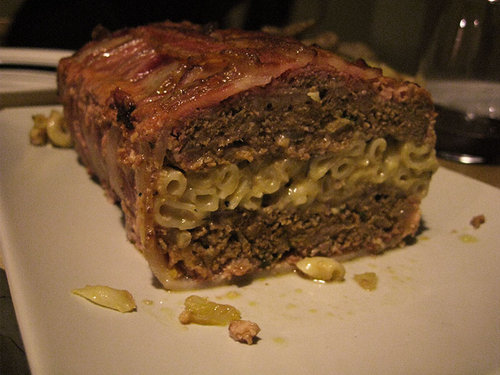
Some of it is pretty gross — some of it actually looks good — but only in small portions!!
Have a great weekend!
 Smiling Sally hosts a Blue Monday in which we can post about anything blue — pretty, ugly, serious or funny — and then link up to other Blue Monday participants.
I rechecked Sally’s guidelines to make sure this was ok and that our blue item didn’t have to be an actual object (I didn’t think so as Sally’s pretty creative in other memes she participates in, too. 🙂 ). But over the weekend I was reminded of two poems that mentioned blue, both of which touch my heart for many reasons.
The first is “The Blue Bowl,” which I discovered a while back in Lanier Ivester‘s article, “I Am a Stay-at-Home Wife,” which is excellent reading. This poem has to do with a wife’s loving ministrations for her husband throughout the day.
The Blue Bowl
All day long I did the little things,
The little things that do not show;
I brought the kindling for the fire,
I set the candles in a row,
I filled a bowl with marigolds—
The shallow bowl you love the best—
And made the house a pleasant place
Where weariness may take its rest.
The hours sped on, my eager feet
Could not keep pace with my desire.
So much to do! So little time!
I could not let my body tire.
Yet when the coming of the night
Blotted the garden from my sight,
And on the narrow graveled walks
Between the guarding flower stalks
I heard your step, I was not through
With services I meant for you.
You came into the quiet room
That glowed enchanted with the bloom
Of yellow flame. I saw your face;
Illumined by the firelit space,
Slowly grow still and comforted—
“It’s good to be at home,” you said.
~ Blanch Bane Kuder
The second is one I first saw referenced on Janet’s blog, titled “The Blue Robe” by Wendell Berry.
The Blue Robe
How joyful to be together, alone
as when we first were joined
in our little house by the river
long ago, except that now we know
each other, as we did not then;
and now instead of two stories fumbling
to meet, we belong to one story
that the two, joining, made. And now
we touch each other with the tenderness
of mortals, who know themselves:
how joyful to feel the heart quake
at the sight of a grandmother,
old friend in the morning light,
beautiful in her blue robe!
— Wendell Berry, from The Selected Poems of Wendell Berry
I like the depiction of “old love,” of two who have known and loved each other for years, and I especially like the last four lines. I’ve enjoyed discovering more of Berry’s poems since this one, such as To Tanya on My Sixtieth Birthday, They Sit Together on the Porch (both of these similarly themed about “old love,” but the second almost makes me teary with the symbolism at the end of which will go “first through the dark doorway, bidding Goodnight, and which sits on a while alone”), and To My Mother.
The tenderness in both of these poems really touches me.
Seen at Addie’s Random Rambling:
What Your Home Says About You |
|
Your hygiene is passable, but you may be hiding some dirty secrets. You are a very domestic person. You enjoy decorating, cooking, and making things homey. You are not a nurturing person by nature, but you can easily take care of someone you truly love. You feel settled in your life. You have enough time to focus on little details. You are a very self sufficient person. You can get along well without much help. Your friends see you as insightful, encouraging, and progressive. |
I don’t know about seeming intellectual (and if so I would only seem so, not really be intellectual!), but I had to smile at the “passable” hygiene. Some of the middle sentences are spot on.

 Stray Thoughts