Remembering Operation Auca 57 years later

It was the first week of January, 1956, that Operation Auca finally began to come to fruition for five missionary couples in Ecuador: Jim and Elisabeth Elliot, Roger and Barbara Youderian, Nate and Marj Saint, Ed and Marilou McCully, and Pete and Olive Fleming. On January 8, one of the men radioed the wives back at their stations, “Pray, girls: today’s the day!” On this date, January 9, the scheduled radio contact did not come and a missionary friend flew over the area where the men had been camped and saw their airplane stripped of fabric but saw no one. It was two days later that the first bodies were found. The men had been speared to death on January 8.

I can only imagine what it was like for those five women to go through those days with hope but no word and then to finally learn that their husband were gone and they were alone thousands of miles from home.

Yet, as many of you know, God used this incident to greatly impact both the Aucas (now know as Waodani or Huaorani) and the rest of the world. Later Rachel Saint (sister to Nate) and Elisabeth Elliot and her daughter Valerie were invited to come and live with the Aucas, and eventually many of them were led to the Lord: one of the killers even became a surrogate grandfather to Steve Saint’s children.

And not til eternity will we know the full impact of these men and their wives. Many lives have been touched, stirred, and inspired. Sometimes we still wrestle with why things happened as they did, but there is no doubt God used them.

A good post on the impact of Jim Elliot in particular is Today Jim Elliot was Killed. If you ever have the chance, see the documentary Beyond the Gates of Splendor. It is in four parts on Vimeo (Part 1, 2, 3, and 4), but I found the audio a bit hard to hear even turned all the way up.

In June for Carrie’s Reading to Know Book Club I’ll be hosting the reading of Through Gates of Splendor, Elisabeth Elliot’s book on the five families, what led them to Ecuador, and how their families coped in the aftermath of the men’s deaths. But when I realized this was the anniversary of that time, I couldn’t let it go by without acknowledgment.

I’ll leave you with some excerpts someone put together of the wives’ testimonies from Beyond the Gates of Splendor.

When God doesn’t deliver

In the wake of the horrible tragedy that occurred recently when a gunman entered a movie theater and opened fire, some remarkable testimonies of God’s providential deliverance have emerged. So you STILL think God is a merciful God? tells how the author and her children escaped the theater unharmed. A Miracle Inside the Aurora Shooting: One Victim’s Story relates how a bullet entered one victim’s brain through a previously undiscovered birth defect, causing the bullet to miss the brain itself.

Of course, some will attribute the circumstances to happenstance or luck. But others wonder, why does God deliver some but not others?

In Rosalind Goforth’s book How I Know God Answers Prayer, one chapter details the miraculous bur harrowing account of her family’s deliverance during the horrors of the Boxer rebellion in China in the 1900s. She says:

Many times we were asked in the homeland to tell the story of our escape during the Boxer uprising, and often the question was put, “If it was really God’s power that saved you and others on that journey, then why did He not save those of His children who were so cruelly put to death?” For a time this question troubled me. Why indeed? One day when seeking for light on the matter I was directed to Acts 12. There I found the only answer that can be given. We are told in verse 2 that James was put to death by the sword; then the rest of the chapter is given to the detailed record of Peter’s wonderful deliverance in answer to prayer (vv. 5, 12).

She goes on to say that a great many people were praying for them and that undoubtedly had a lot to do with their deliverance.

But some pray and are prayed for, yet still die or suffer. What then?

Hebrews 11, that great “Hall of Faith” passage tells of many marvelous things God wrought through the faith of His people. But then verses 36-38 take a turn from all that deliverance and provision and answered prayer:

And others had trial of cruel mockings and scourgings, yea, moreover of bonds and imprisonment: They were stoned, they were sawn asunder, were tempted, were slain with the sword: they wandered about in sheepskins and goatskins; being destitute, afflicted, tormented; (Of whom the world was not worthy:) they wandered in deserts, and in mountains, and in dens and caves of the earth.

Why were these not delivered? The text doesn’t say, but they are commended just the same as the others: “And these all, having obtained a good report through faith, received not the promise: God having provided some better thing for us, that they without us should not be made perfect” (vv.39-40).

In the New Testament, John the Baptist was beheaded. Stephen was stoned. James was killed. Layton Talbert asserts:

But martyrdom is no less providential than deliverance, and the martyrdom of these men was as providentially superintended by God as was the martyrdom of His own Son. Such deaths are neither a failure on God’s part nor a victory on Satan’s. They are a part of the outworking of God’s all-wise and always good purposes. (Not By Chance: Learning to Trust a Sovereign God, page 198).

He goes on to relate:

You have probably heard that “the safest place to be is in the center of God’s will.” A veteran missionary to Colombia, South America, once explained how experience and personal Bible study led him to modify that saying. “The most fulfilling, joyful, and peaceful place to be is in the center of God’s will,” he concluded. “But it is not necessarily the safest.” This is not heresy — unless we measure orthodoxy by conformity to cliche rather than to Biblical realism. (p. 198).

The quote is taken from the article “Peace, if not safety,” and the missionary, Timothy A. McKeown, goes on to make these statements, also quoted in Not By Chance:

It seems to me that the Bible is full of examples of God’s people often-not occasionally-being placed in unsafe, uncomfortable, and dangerous situations.

Most prayers in Scripture focus not on the personal safety and benefit of believers but on the power, majesty, testimony, and victory of God over his-and, of course, our-enemies.

The Lord calls us to obedience in spite of the “costs”-not to personal comfort and safety!

Dr. Talbert continues:

Our death is as much a matter of providence as our life. It may seem tragic or ignominious or accidental. But God’s providence rules over the tragedy, the ignominy, and yes, even accidents. Moreover, we must labor to think God’s thoughts, to maintain God’s perspective (p. 199).

He goes on to point out that the deaths of John the Baptist, Stephen, and James were not the end of them, in two senses. 1) They go on to life in heaven with God, our true and ultimate home, and 2) their influence and testimony continue on.  This is true in our times as well, as illustrated by Jim Elliot and the other four missionaries who were killed by the tribe they were trying to reach, Gracia Burnham’s husband, and any saint of God.

In On Asking God Why by Elisabeth Elliot, she included a chapter called “On Brazen Heavens” written by her brother, Thomas Howard. After describing times when God has not answered prayer, at least not as the person praying wanted, he says:

Turning again to the disclosure of God in Scripture, we seem to see that, in his economy, there is no slippage. Nothing simply disappears. No sparrow falls without his knowing (and, one might think, caring) about it. No hair on anybody’s head is without its number. Oh, you say, that’s only a metaphor; it’s not literal. A metaphor of what, then, we might ask. Is the implication there that God doesn’t keep tabs on things?

And so we begin to think about all our prayers and vigils and fastings and abstinences, and the offices and sacraments of the Church, that have gone up to the throne in behalf of the sufferer. They have vanished, as no sparrow, no hair, has ever done. Hey, what about that?

And we know that this is false. It is nonsense. All right then–we prayed, with much faith or with little; we searched ourselves; we fasted; we anointed and laid on hands; we kept vigil. And nothing happened.

Did it not? What angle of vision are we speaking from? Is it not true that again and again in the biblical picture of things, the story has to be allowed to finish?

Was it not the case with Lazarus’ household at Bethany, and with the two en route to Emmaus? And is it not the case with the Whole Story, actually–that it must be allowed to finish, and that this is precisely what the faithful have been watching for since the beginning of time? In the face of suffering and endurance and loss and waiting and death, what is it that has kept the spirits of the faithful from flagging utterly down through the millennia? Is it not the hope of Redemption? Is it not the great Finish to the Story–and to all their little stories of wandering about in sheepskins and goatskins as well as to the One Big Story of the whole creation, which is itself groaning and waiting? And is not that Finish called glorious? Does it not entail what amounts to a redoing of all that has gone wrong, and a remaking of all that is ruined, and a finding of all that has been lost in the shuffle, and an unfolding of it all in a blaze of joy and splendor?

A finding of all that is lost? All sparrows, and all petitions and tears and vigils and fastings? Yes, all petitions and tears and vigils and fastings.

“But where are they? The thing is over and done with. He is dead. They had no effect.”

Hadn’t they? How do you know what is piling up in the great treasury kept by the Divine Love to be opened in that Day? How do you know that this death and your prayers and tears and fasts will not together be suddenly and breathtakingly displayed, before all the faithful, and before angels and archangels, and before kings and widows and prophets, as gems in that display? Oh no, don’t speak of things being lost. Say rather that they are hidden–received and accepted and taken up into the secrets of the divine mysteries, to be transformed and multiplied, like everything else we offer to him–loaves and fishes, or mites, or bread and wine–and given back to you and to the one for whom you kept vigil, in the presence of the whole host of men and angels in a hilarity of glory as unimaginable to you in your vigil as golden wings are to the worm in the chrysalis.

There may be any number of reasons why someone faces death without actually dying. Many who have done so have testified it gave them a new sense of purpose. But as to the question, why does God deliver some people from death and not others, we can’t really know the answers. Even those who were delivered will have to face death another time. All we can do is trust that God has His purposes in what He allows.

But God never promises that all His people will comfortably live the American Dream for 80+years. One of the lessons in such tragedies as the one in Aurora is that truly we never know what a day may bring forth and we’re not promised another breath. We need to be ready to face our Maker. “And this is the record, that God hath given to us eternal life, and this life is in his Son.  He that hath the Son hath life; and he that hath not the Son of God hath not life” (I John 5:11-12).

Shadow and Coolness

It’s supposed to get up into the 100s today. I am so glad for air conditioning! But the forecasted high temperatures reminded me of this poem. Amy Carmichael was a missionary in India for most of her adult life. The inspiration for this poem came as a result of the heat in India and the refreshing coolness to be found in the shadow, plus the story of the Israelites being led by the pillow of fire by night and the pillar of cloud by day in the book of Exodus.

I Follow Thee

Shadow and coolness, Lord,
Art Thou to me;
Cloud of my soul, lead on,
I follow Thee.
What though the hot winds blow,
Fierce heat beats up below?
Fountains of water flow –
Praise, praise to Thee.

Clearness and glory, Lord,
Art Thou to me;
Light of my soul, lead on,
I follow Thee.
All through the moonless night,
Making its darkness bright,
Thou art my heavenly Light –
Praise, praise to Thee.

Shadow and shine art Thou,
Dear Lord, to me;
Pillar of cloud and fire,
I follow Thee.
What though the way be long,
In Thee my heart is strong,
Thou art my joy, my song –
Praise, praise to Thee.

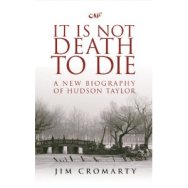
Book Review: It Is Not Death to Die: A New Biography of Hudson Taylor

(I hope you’ll forgive me for talking mostly about books the last two weeks. 🙂 I happened to finish several recently and I’m trying to finish off my spring reading plans.)

I’ve mentioned before the importance of reading missionary biographies, for our own growth and inspiration and to keep before us those names in church history that need to be remembered just like Washington, Lincoln, and others need to be remembered in our secular history.

Hudson Taylor is one of those names for several reasons. He was a pioneer missionary to China in the 1800s during a time when China was especially hostile and suspicious of foreigners. He wanted to convert people to Christ in their own culture rather than converting them to Western culture. He dressed as a Chinaman, much to the dismay and criticism of the overseas European community and even other missionaries, simply because he found that the most effective way to work with the Chinese. A missionary coming into a town dressed as a European was likely to be attacked and cause a riot. He suffered much hardship uncomplainingly and purposefully lived as simple a life as possible. He did not set out to start a mission agency, but the agency which sent him out failed miserably: they failed to advise or prepare him, failed to forward funds and communicate with him when he was on the field, causing other mission agencies to step in and help him and others, and then they had the gall to criticize other mission agencies in the periodicals of the day. The necessity of a mission agency attuned to the needs in China and resp0nsible in its habits led to Hudson beginning the China Inland Mission. There were a few missionaries in the bigger cities, but China wanted to go inland where the gospel had not been preached. Probably the most notable aspects of Hudson, however, were his simple childlike (but not childish) faith and his unswerving obedience to what he perceived God wanted him to do.

For these reasons I was very glad to see It Is Not Death to Die: A New Biography of Hudson Taylor by Jim Cromarty. There are two older well-known biographies of Hudson Taylor. One is a two-volume set, Hudson Taylor in Early Years: The Growth of a Soul and Hudson Taylor and the China Inland Mission: The Growth of a Work of God by his daughter and son-in-law, Dr. and Mrs. Howard Taylor, first published in 1911. But the first volume is over 500 pages and the second well over 600, which can be quite daunting and they can sometimes be hard to find (Amazon only had used copies but I found them on sale just now here.) These are excellent and easily readable though they were written over a hundred years ago. The other well-known biography of Taylor is Hudson Taylor’s Spiritual Secret, also written by his daughter and son-in-law, but much more compact at 272 pages and still printed regularly today.

I had high hopes that this new biography by Cromarty would bridge the gap between these two and bring Hudson’s life before a modern audience that might not seek out the older books. And while it is a faithful representation with much research evidently behind it and I can recommend it, I wish it were more dynamically written. It’s a good reference book for people who want to know more about Taylor, but I don’t know if it would draw in those who are unfamiliar with him or those who do not like to read biographies.

Biographers do have it a little rough: they can write in a story form, which is more interesting but tends to be less accurate as the biographer has to invent conversations and situations to bring out the points he needs to; or they can right a factual version which can tend to be more encyclopedic and accurate, but which doesn’t appeal to the average modern reader. This one is in the style of the latter. I think it could have been much more condensed: there are many descriptions of various CIM missionaries’ travels which could have been left out or at least summarized. The book is 481 pages, not including indexes and end notes, and I have to admit I got bogged down in places.

But I do recommend the book. If you persevere, you will find great nuggets about Taylor’s character. He was not unflawed: he was very human and he would never have wanted people to think he was some super-Christian. But he loved and followed the Lord in an exemplary and humble way.

I marked way too many places to share, especially in a review that is long already:

But here are a few places that stood out to me:

His health, as he described it, could “not be called robust” (p. 49), but I hadn’t realized he struggled so much with his health through the years, including regular bouts of dysentery.

Before he went to China, the girl he had planned to marry refused his proposal because she did not want to go to China. He wrote to his mother, “Trusting God does not deprive one of feelings or deaden our natural sensibilities, but it enables us to compare our trials with our mercies and to say, ‘Yet notwithstanding, I will rejoice in the Lord, I will joy in the God of my salvation'” (p. 55).

Once during a storm on the way to China in a ship, he took off a life jacket because he felt he was trusting in it rather than the Lord. Later he realized that was wrong thinking and wrote, “The use of means ought not to lessen our faith in God; and our faith in God ought not to hinder whatever means He has given us for the accomplishment of His own purposes…When in medical or surgical charge of any case, I have never thought of neglecting to ask God’s guidance and blessing in the use of appropriate means…to me it would appear presumptuous  and wrong to neglect the use of those measures which He Himself has put within our reach, as to neglect to take daily food, and suppose that life and health might be maintained by prayer alone” (p. 99). He was later said to be “a man of prayer, but it was prayer associated with action…’He prayed about things as if everything depended upon the praying…but he worked also, as if everything depended upon the working'” (p. 329).

To live in inland China at that time meant giving up what would be considered as Western luxuries, and Hudson tried hard to give a real picture of the mission field before new missionaries came over. “The only persons wanted here are those who will rejoice to work — really to labour — not to dream their lives away; to deny themselves; to suffer in order to save.” (p. 294). He wrote to applicants, “If you want hard work, and little appreciation of it; value God’s approbation more than you fear man’s disapprobation; are prepared, if need be, to seal your testimony with your blood and perhaps oftentimes to take joyfully the spoiling of your goods…you may count on a harvest of souls here, and a crown of glory that does not fade away, and the Master’s ‘Well done’…it is no question of ‘making the best of both worlds’ — the men who will be happy with us are those who have this world under their feet” (p. 303).

At one time he said. “My soul yearns, oh how intently for the evangelization of these 180 millions of the nine unoccupied provinces. Oh that I had a hundred lives to give or spend for their good…Better to have pecuniary and other outward trials and perplexities, and blessing in the work itself, souls being saved, and the name of the Lord Jesus being magnified, than any measure of external prosperity without it” (p. 297).

He was known to be a humble and unassuming man. Many meeting him for the first time were surprised that he didn’t “stand out,” but looked at first like a regular Chinaman. Spurgeon wrote of him, “Mr. Taylor…is not in outward appearance an individual who would be selected among others as the leader of a gigantic enterprise; in fact, he is lame in gait, and little in stature; but…his spirit is quiet and meek, yet strong and intense; there is not an atom of self-assertion about him, but a firm confidence in God” (p. 329). Many times he quietly and unassumingly helped and ministered to others, especially new arrivals. Once when a group he was with had to spend a night on a boat with a leper, and someone complained about the stench of his bedding, Hudson spent the night in his cabin uncomplainingly and bought him new bedding the next day. Another time when an exhausted group of travelers fell into bed without eating, Hudson prepared omelets for them all. Once when he knew of a paper that was critical of him, almost derogatory, he said, “That is a very just criticism, for it is all true. I have often thought that God made me little in order that He might show what a great God He is” (p. 400).

In one meeting, Hudson said, “What we give up for Christ we gain, and what we keep back is our real loss…Let us make earth a little less homelike, and souls more precious. Jesus is coming again, and so soon! Will He really find us obeying His last command?” (p. 383).

I had thought that the title of this book came from the hymn, “It is Not Death to Die,” originally written in 1832 and recently updated. But in writing of Hudson’s death, Cromarty cites the Banner of Truth 1977 publication of Pilgrim’s Progress, at the section where Mr. Valiant-For-Truth dies, and the line “It Is Not Death to Die” is in the passage he quotes but I have not found it in the online versions of Pilgrim’s Progress. Nevertheless, the sentiment is true. Dying to self and living for Christ, which Hudson Taylor exemplified, is true life, just as dying to this body makes way for heaven for those who have trusted Christ as Savior.

(For a more positive review that brings out some different things about Cromarty’s book and Taylor’s life, see my friend Debbie’s review here.)

(This review will also be linked to Semicolon‘s Saturday Review of Books.)

Book Reviews: By Searching: My Journey Through Doubt Into Faith and In the Arena

I first heard of Isobel Kuhn either in college or in the church where we were members when we first married, where there was an emphasis on reading missionary biographies. I’ve read her books By Searching: My Journey Through Doubt Into Faith and In the Arena (as well as her others) several times and know some parts of her story as well as my own. But I always enjoy reading them again, going over what’s familiar and being reminded of what I’d forgotten. Her name is well-known in some areas but not as well known, perhaps, as some of the house-hold names of classic missionary biographies, so I want to keep her story before people. She herself would probably be loathe to read that sentence, as she wouldn’t want her name to be promoted, but rather the God who worked in and through her. I feel the same, but by presenting her story I’m ultimately promoting His grace and work.

 In By Searching she shares how she came to know the Lord. She had been raised in a Christian home in Toronto, Canada, and when she went off to a secular college, her parents took care to drill her in arguments against modernism and other affronts to truth that she would encounter there. In one of her first classes, her professor asked if anyone believed in heaven and hell, in Genesis, etc. Only Isobel and one other student raised their hands. The professor didn’t present arguments against the Bible: he only said, “Oh, you just believe that because your papa and mama told you so.” On the way home from class, Isobel examined why she believed what she believed in light of what she was learning in her classes and concluded the professor was right: she only believed because of what her parents said. She determined to “accept no theories of life which [she] had not proved personally” (p. 7). She wouldn’t say there was no God, but rather that she didn’t know whether there was or not, and instead of seeking out the answer to such an important question, she determined that, since one can’t know, then it really didn’t matter what one did. So she gave up going to church so she could sleep in on Sunday to rest up after parties and dances through the week, she set aside Bible reading, and she gave herself to the activities she had always been taught were “worldly.”

At first everything was pleasant and fun, but she discovered before long that nothing satisfied. One night she was so low that she even contemplated taking her own life, but a groan from her father in his sleep in another room reminded her of the devastating effect that would have on her family. She prayed, “God, if there be a God, If You will prove to me that You are, and if You will give me peace, I will give you my whole life.”

The rest of the book tells how He answered that prayer. “To find that He is, this is the mere starting-point of our search. We are lured on to explore what He is, and that search is never finished, for it grows more thrilling the further one proceeds” (p. 94).

The title for In the Arena comes from the thought that God brings His children to various platforms, or arenas, to show Himself not only to them but to anyone observing. The book overlaps a bit at the beginning with parts of By Searching, but it’s done for the purpose of showing God in various arena experiences. One of the earliest was the staunch opposition of her mother to her going to the mission field, even though her mother was an earnest Christian and even a president of the Women’s Missionary Society. Her mother wanted her to marry well and move in “good society,” and the thought of her daughter depending on the charity of others was more than she could bear. I’ve always thought Isobel’s response to this was ideal, praying and seeking wise counsel rather than adamantly opposing her mother (though there might be times when a person has to obey God in opposition to a parent’s wishes, but when possible it should be handled gracefully.) God did turn her mother’s heart, and continued to manifest Himself to Isobel through Bible college, leading her to her husband, calling them to China, various problems, frustrations, losses, needs, rewarding work, up through facing cancer at the end of the book.

There is so much I’d love to share with you that the Lord spoke to me about in these books…but I’d end up copying most of them here if I shared everything. But here are a few of the most memorable.

On the ship on the way to China, a veteran missionary was meeting with the new girls going over, and one day she said, “Girls, when you get to China, all the scum of your nature will rise to the top.” Isobel “was shocked. Scum? Was that not a strong word? All of us were nice girls, were we not? Scum? A bit extravagant surely. And so I was totally unprepared for the revolt of the flesh which was waiting for me on China’s shores. The day was to come when on my knees in the Lord’s presence I had to say: ‘Lord, scum is the only word to describe me.'” (In the Arena, p. 37.) She then went on to explain some of those “revolts of the flesh” included, in going to a poor area, the realization that it costs to be clean, being unprepared for true poverty even though she had tried to prepare herself, fleas, lice, bedbugs and such, food that she couldn’t take at first, the tribespeople’s lack of understanding the “odd” desire for a bit of privacy sometimes, etc.

In By Searching, she tells how one by one God led her to give up various “worldly” practices, and I feel I should say here that a modern reader might disagree with whether some of them were worldly. But suffice it to say she felt led to lay them aside (“All things are lawful unto me, but all things are not expedient: all things are lawful for me, but I will not be brought under the power of any. All things are lawful for me, but all things are not expedient: all things are lawful for me, but all things edify not.’ I Corinthians 6:12; 10:23), and she didn’t miss any of them. The thing that most stood out to me was her calling them “extinguished tapers” in comparison to the “Rising Sun.” I’ve often thought the emphasis in combatting worldliness shouldn’t be so much in opposing some practices that people can argue over, but in emphasizing love for Him, for in that love lesser things will fall away in themselves.

In another vein, when I first started reading missionary biographies, I felt they were such godly Christians that I should do everything they did. You run into trouble after a while, though, as some of them might do different things! She mentions one of those extinguished tapers was voracious reading of romance novels, “not the modern sexy novels, but clean, exciting love stories” (By Searching, p. 47.) She had trouble putting them down and felt the untrue-to-life plots would make her discontent with everyday routine. One night after staying up until 1 a.m. reading an exciting novel, she then tried to read her Bible, and it seemed flat to her and the Lord seemed far away. She felt it was like filling up with candy and ice cream and spoiling her appetite for good nutrition. So for about fifteen years she gave up all fiction, but she came back to the classics when she had to spend a lot of time alone in China while her husband traveled, because they were wholesome and, since she had read them before, they didn’t have the grip on her that some other books might. I would say that it is right and noble to give up anything that you feel might hinder or hamper your love for the Lord, especially in light of the verses in Corinthians mentioned in the previous paragraph, and some people may feel led to give up some things that aren’t necessarily wrong in themselves but they feel the Lord would have them put aside for various reasons. But I obviously don’t feel the same way about fiction as she did, though I know some who do. I don’t think there was anything in the way of Christian fiction then (this would have been in the 1920s or 30s), and even ice cream and candy aren’t inherently sinful but rather need to be kept in moderation. There is some fiction, even Christian fiction, that I would avoid, and if I felt even the good kind was a hindrance in any way, I’d have to reexamine it, but I don’t feel led to toss it out as a genre.

Something that stood out to me in this reading that I hadn’t remembered from before was that for a time she suffered from stage fright in leading meetings with a group of working girls while waiting to go to China. She had had to give a speech at her college graduation and her mind went blank during it, and that seemed to set off a fear of being in front of people. At times while girls were setting up  for the meeting, she had to go to the bathroom for privacy and cry to the Lord for the nerve to do what she had to do. That touched me because I have done the same thing in bathrooms before meetings!

Another quote that stands out to me was in the context of seeking God’s guidance in whether to try to leave China when the Communists were taking over the area. A Bible verse on a calendar seemed to give direction one way, yet she knew not to take a verse at random out of context. She remarks “You only learn to discern His voice by experience. If you want to be able to hear it in the crises of life, you must first seek it in the common places of life” (In the Arena, p. 190).

I could go on, but suffice it to say that Isobel Kuhn’s life is an inspiration to me. She readily admits her flaws, but she steadfastly followed her Savior, and He worked mightily in and through her.

I have read all of her books, some of which tell more of the work in China. One, Green Leaf in Drought (linked to my review) tells of the last China Inland Missionaries to be released from China after the Communists took over. Another, Whom God Has Joined (also linked to my review), was originally titled One Vision Only and focuses on her marriage. It’s both poignant and humorous. One of my favorites is Second Mile People where she tells of some of the main people who influenced her life: I mentioned one in a previous post, A sense of Him. I want to read that one again soon. Also due to her writings I read two biographies of the man who influenced her for China, gave wise counsel in regard to her mother, and was her missions director in China, J. O. Fraser, in Mountain Rain by Eileen Crossman and Behind the Ranges by Geraldine Taylor. I’d love to read those again some time, too.

I hope you’ll explore some of her life and writings and will be as blessed by them as I have.

(This review will also be linked to Semicolon‘s Saturday Review of Books.)

Book Review: Goforth of China

Goforth of China by Rosalind Goforth is a book I have read many times, and I recently felt an urge to revisit it. It has taken me a while to talk about it, though, because I have so many places marked in it, it would be impossible to share all of them.

Jonathan Goforth grew up as the seventh of eleven children on a farm in Canada. Though an excellent farmer, he felt the call of God to go to China as a missionary after hearing someone speak on Taiwan. Jonathan’s mother was an excellent seamstress, but Jonathan was marked for teasing by his more urban classmates at college due to having home-made clothes and being somewhat naive and unpretentious. His fellow dorm mates went so far as to take new fabric he had bought to have new clothes made, cut a hole in it, put it over Jonathan’s head, and made him run up and down a hallway through a number of other laughing students. He felt afterward that this kind of behavior should be reported, but was told by the college authorities that it was just a harmless prank. It hurt him, not so much that this had been done to him, but that it had happened at a Christian college. Rosalind writes, “That night he knelt with Bible before him and struggled through the greatest humiliation and the first great disappointment of his life. The dreams he had been indulging in but a few days before had vanished, and before him, for a time at least, lay a lone road. Henceforth he was to break an independent trail. It is not hard to see God’s hand in this, forcing him out as it did into an independence of action which so characterized his whole after life” (pp. 31-32). By the time he graduated, he had the honor and support of the whole school, and many came to apologize for their actions that year. One particular student prayer meeting at a much-needed time helped make a definite change in his ability to use the Chinese language (told here).

College not only honed his intellect and forged his character, but it also was saw the beginnings of ministry as he reached out in various ways to lost people. He was a missionary long before he left the shores of his home country. He met his wife, Rosalind, as a fellow mission worker. Once when Jonathan left his Bible on a chair, Rosalind picked up his Bible. Finding markings throughout and the book itself falling apart, she thought to herself, “That is the man I would like to marry” (p. 49).

The Goforths headed to China at a time when the Chinese were greatly suspicious of “foreign devils.” Some of the stories circulated about the foreigners (such as the one that their medicine was so effective because it had the eyes and hearts of children in it, leading the people to fear the foreigners would kidnap their children) seem so ridiculous to read now and to think that anyone actually believed them, but suspicion was a great hindrance to their efforts to reach the Chinese. In an effort to counteract this, they held frequent tours of their home to let the Chinese see whatever they wanted to see (and sometimes the Chinese saw whatever they wanted to see by touching a dampened fingertip to the paper windows, making a peephole!) The result of one such incident I shared earlier near the end of this post.

The Goforths not only had to deal with everyday frustrations, but also major, heartbreaking trials. Four times in their ministry they lost nearly all their possessions, once by fire, once by flood, once during the Boxer rebellion (a harrowing time with a miraculous deliverance in itself), and lastly while on furlough when a new inexperienced missionary moved some of their belongings into an unlocked “leaking, thatched cowshed” (p. 211). After the last time, “when, in the privacy of their own room, the ‘weaker vessel’ broke down and wept bitter, rebellious tears, Goforth sought to comfort her by saying, ‘My dear, after all, they’re only things and the Word says, ‘Take joyfully the spoiling of your goods!’ Cheer up, we’ll get along somehow.'” He wasn’t being calloused: he had a generally faith-filled, buoyant spirit, while his wife had…one rather more like my own. The worst loss of all, though, that even shook Goforth himself was the loss of several children.

Despite and sometimes even through the trials they endured, God used them to bring many to Himself. Describing one of their evangelistic meetings, Rosalind said, “Oh, friends, who wrote in those days pitying us, would that you could have experienced, as we did day by day,…the keenest joy a human being can I believe experience, [seeing] men and women transformed by the message of God’s love in Christ” (p. 168).

Besides Goforth’s spirit mentioned above, one of his other major characteristics was his firmness of doctrine. Modernism was creeping into the church and eventually into its seminaries and missions, undermining its foundation, and Goforth saw firsthand the devastation it could wield on a person’s faith. He wasn’t afraid to speak out where he saw wrong, even if it wasn’t well-received and even (especially) when it infiltrated the church.

It was during such a time on furlough when some were even closing their pulpits to him that this was written, blessing my women’s-ministry-loving  heart: “Many times as he went throughout the churches he remarked on the blessed and powerful influence of the Women’s Missionary Society. When inclined to be depressed at the general deadness of the church, cheer and comfort would often come from the warmth of receptions given by the women” (p. 340).

God greatly used the Goforths not only in various countries in their own time, but ever since then as well through Rosalind’s writings. A few years ago Lifeline Ministries reproduced the original unabridged version of Goforth of China, and I was so glad to get it. Some years back Bethany House produced an abridged version titled Jonathan Goforth (which sadly doesn’t appear to be in print any more, but used copies can be found, or perhaps you can find it in a church or Christian school library). I’m afraid I’ve misrepresented that version in the past by complaining that the point of view switched from third to first person, but as I reread the original version, I saw Mrs. Goforth did that herself: overall she acted as narrator telling their story, but in some parts she slipped into the first person as she described particular incidents, especially those involving herself directly. It’s not as hard to follow, though, in the original: maybe some of the transitions didn’t make it to the abridged version. In many ways the abridged version is easier to read: the unabridged lists a great many names and places that wouldn’t mean as much to people not living at the time of the writing. My particular copy of the reproduction of the original has what appears to be some ink level problems: on some pages the print is very light, but on others it is very heavy, almost bleeding through the page. Hopefully they fixed that in subsequent printings.

Mrs. Goforth also wrote Miracles Lives of China (which I haven’t read), How I Know God Answers Prayer, and Climbing, one of my all-time favorite books. Jonathan wrote By My Spirit, telling of the revivals God sent to China. Another book which I haven’t read but which I think is geared toward children is Jonathan Goforth: An Open Door in China by Geoff and Janet Benge, part of the Christian Heroes: Then & Now series.

In an earlier post about why I love missionary biographies, I said, “There are heroes of our spiritual heritage who inspire us in love and dedication to God and to greater faith in remembering that the God they served and loved and Who provided for and used them is the very same God we love and serve today and Who will provide for us and use us.” The Goforths are such heroes, though they might balk at such a designation. Reading about them not only inspires faith but encourages us to follow in their footsteps of dedication. I hope you’ll read more about them.

(This review will also be linked to Semicolon‘s Saturday Review of Books.)

Book Review: 50 People Every Christian Should Know

In the preface to 50 People Every Christian Should Know: Learning From Spiritual Giants of the Faith, author Warren Wiersbe states that he has been greatly helped by reading biographies. “The past is not an anchor to drag us back but a rudder to help guide us into the future.” I love to read biographies as well, and this book included some that were new to me.

I didn’t realize until I received the book that it was compiled from two former books by Wiersbe, Living With the Giants and Victorious Christians You Should Know, which in turn were originally columns in the magazines Moody Monthly and The Good News Broadcaster, which are no longer being published. I am glad these testimonies have been preserved in this book.

Of the 50 (51, actually: one chapter combines two men), I had previously read biographies of six; I knew something about or had read books by about fifteen others, and the rest were new to me except for just a few whose names I had heard. There are four women, a few missionaries, but most are preachers.

Wiersbe gives a brief history of each person as well as suggestions for books by that person or other biographies of them for further reading. Some of the chapters were a little drier to me than others, but often that occurred when I was trying to read too many of them at one time. The stories I already knew were a good refresher, and some of the others were a good springboard toward finding new biographies to read. Though most of the time Wiersbe tried to convey what the person was like rather than just what they did, there were a couple of chapters where I didn’t get that sense of personality. I did appreciate that the individuals were listed in chronological order, so that we could see the effect of the issues of the day or other people on each person.

A couple of the inclusions confused me, though, as Wiersbe said they “did not preach the atonement”: one, in fact, went from a grace-based faith to a works-based religion. I don’t see how such persons could be considered “giants of the faith,” though Wiersbe did say there were things he learned from them.

One of the overall lessons this books left with me was that God can use anybody. These 51 agreed on most core, fundamental doctrines yet were from various denominations, from opposite sides of the Calvinist/Arminian and other controversies, from differing viewpoints on end times and how ministry should be conducted, from widely different personalities and academic tendencies. and yet God used each one. Does that mean none of those issues matters? No, each individual is responsible to  study the issue, the Bible, and in their own conscience before God determine what they believe and how to live it out. But seeing how God used varieties of people helps me to be a little less critical, though I trust no less analytical. We can even learn from the fact that some were gifted in one area but had faults in others, as we are all in the same state.

I marked more passages and quotes than I can possibly share in one post…

But here are a few that stood out to me:

Often, after hearing his father preach, Matthew [Henry] would hurry to his room and pray that God would seal the Word and the spiritual impressions made to his heart so that he might not lose them (p. 25).

An excellent exercise. Perhaps that’s part of what made him the commentator he was.

No place is like my study. No company like good books, especially the book of God. ~ Matthew Henry (p. 27).

My endeavor is to bring out of Scripture what is there and not to trust in what I think might be there ~ Charles Simeon (p. 49.)

Amen. Would that all preachers would so do.

“Tried this morning specially to pray against idols in the shape of my books and studies. These encroach upon my direct communion with God, and need to be watched” ~ Andrew Bonar (p. 77).

Books and studies are helpful but even they can take the wrong place in our hearts and minds.

“I can see a man cannot be a faithful minister, until he preaches Christ for Christ’s sake, until he gives up striving to attract people to himself, and seeks only to attract them to Christ” ~ Robert Murray McCheyne (p. 82).

“To efface one’s self is one of a preacher’s first duties. The herald should be lost in the message” ~Alexander Maclaren (p. 109)

Surprisingly, Maclaren was haunted all his life by a sense of failure. Often he suffered ‘stage fright’ before a service, but in the pulpit he was perfectly controlled. He sometimes spoke of each Sunday’s demands as ‘a woe,’ and he was certain that his sermon was not good enough and that the meeting would be a failure” (p. 109).

Though I am not a preacher, I can identify with those feelings. In fact, I have felt that maybe they were an indication I should not be in the ministries I was in, but I guess that’s not always the case. Similarly, John Henry Jowett wrote of his Yale lectures, which I have heard reference to as a great help by more than one preacher:

The lectures are a nightmare to me, and I am glad of getting rid of them this week! (p. 284).

And later,

Preaching that costs nothing accomplishes nothing (p. 284).

We could say that is true of much service, not just preaching. What the Lord uses in our lives may not always be the incidents where we “feel” spiritual or feel like we’re accomplishing something for Him. This next quote is a help:

“All God’s giants have been weak men, who did great things for God because they reckoned on His being with them” ~ J. Hudson Taylor (p. 133).

“Don’t go about the world with your fist doubled up, carrying a theological revolver in the leg of your trousers.” ~ Charles Spurgeon (p. 143).

I’m smiling because this reminds me of my friend from yesterday’s post. On the other hand,

[Alexander] Whyte was so much of an encourager that he forgot that Christians cannot accept every doctrine men preach, though the men may be fine people (p. 169).

“Fathers and brethren,” Whyte cried, “the world of mind does not stand still! And the theological mind will stand still at its peril.” True. but the theological mind must still depend on the inspired Word of God for truth and direction. Once we lose that anchor, we drift (p. 169).

Religious sentiment, if it is worth anything, must be preceded by religious perception. ~ George Matheson on devotional writing (p. 200).

It is urgently needful that the Christian people of our charge should come to understand that they are not a company of invalids, to be wheeled about, or fed by hand, cosseted, nursed, and comforted, the minister being head physician and nurse — but a garrison in an enemy’s country, every soul of which should have some post of duty, at which he should be prepared to make any sacrifice rather than quit it. ~ F. B. Meyer (p. 216).

“Passion does not compensate for ignorance. ” ~ Samuel Chadwick (p. 249).

“We cannot make up for failure in our devotional life by redoubling energy in service.” ~ W. H. Griffith Thomas (p. 264).

“The Bible never yield itself to indolence.” G. Campbell Morgan (p. 278).

“The ‘soul-saving passion’ as an aim must cease and merge into the passion for Christ, revealing itself in holiness in all human relationships” [Oswald Chambers]. In other words, soul winning is not something we do, it is something we are…and we live for souls because we love Christ (pp. 324-325).

The applause of the crowd is not always the approval of the Lord (p. 370).

Christian leaders must realize that if they suffer from shallowness, the malady will spread throughout their entire organization (p. 370).

When a friend told William Whiting Borden that he was “throwing his life away as a missionary,” William calmly replied, “You have never seen heathenism” (p. 342).

Of Borden, who died at the age of 26 after just starting on the mission field:

Why should such a gifted life be cut short?…”A life abandoned to Christ cannot be cut short” ~ Sherwood Day (p. 345).

I think what he means is that that was what God appointed for him — that amount of time, that mission — and he fulfilled it well and God used him — and still does.

There is a very sweet poem written by Francis Ridley Havergal to Fanny Crosby — I don’t think I had realized they were contemporaries:

Dear blind sister over the sea
An English heart goes forth to thee.
We are linked by a cable of faith and song,
Flashing bright sympathy swift along;
One in the East and one in the West,
Singing for Him whom our souls love best,
“Singing for Jesus,” telling His love,
All the way to our home above.
Where the severing sea, with its restless tide,
Never shall hinder, and never divide.
Sister! what will our meeting be,
When our hearts shall sing and our eyes shall see!

The whole poem/hymn is here.

There were some amusing things in the “My how times have changed” department: D. L. Moody “felt that the bicycle, because of its popularity, was the greatest enemy of the Sabbath” (p. 291). I wonder, 100 years from now, what things people will shake their heads at in wonder that we thought “worldly.”

I imagine some of you who read here regularly will be glad to see this one done — it’s been appearing on my Nightstand posts for months. 🙂 It was neither hard nor tedious to read: it’s just best read a bit at a time rather than plowing straight through. With 50 chapters you could easily take one a week and finish it in a year — or one a day and finish it in a couple of months. Either of those or something between would give you a rich variety of people to learn from.

Though there were some names missing I would have liked to have seen here — Jim Elliot, Jonathan and Rosalind Goforth, J. O. Fraser, Henry Ward Beecher, Martyn-Lloyd Jones (he is referred to a few times), J. Oswald Sanders, Isobel Kuhn — I do understand that every author and book has its limits. 🙂 Overall I enjoyed the book very much.

I’ll close with something William Borden wrote in his notebook in college, something that many of these would echo:

“Lord Jesus, I take hands off, as far as my life is concerned. I put Thee on the throne in my heart. Change, cleanse, use me as Thou shalt choose. I take the full power of Thy Holy Spirit. I thank Thee.” Then he added this revealing sentence: “May never know a tithe of the result until Morning” (p. 345).

(This review will also be linked to Semicolon‘s Saturday review of books.)

Booking Through Thursday: Life-Changing Books

btt  button Booking Through Thursday is a weekly meme centering on the subject of books which poses a question or a thought for participants to discuss. The question for this week is:

I’ve seen this question floating around the blogosphere a few times the last couple of days, so thought I’d pass it forward.

Which Book Changed Your Life?

The first answer would be, of course, the Bible, and not just as a platitude. There is no more life-changing book than the Bible, and it continues to change my life with each reading. But I am going to address books just after the Bible in their impact on me.

I can’t name just one, but there were a few I read around the same time, and they all happened to be missionary biographies. The first was Through Gates of Splendor by Elisabeth Elliot, the true account of five men who wanted to try to reach a fierce and feared tribe of Indians and who, in turn, were speared to death by them. Later Elisabeth, the widow of one of the men, her young daughter, and Rachel Saint, the sister of another, were invited to go and live with this tribe — and they went and evetually the Lord used them to reach this tribe with the gospel of Christ, which, among other things, resulted in a cessation of the centuries-old revenge killings that had decimated the tribe. The book was not just a thrilling story: what changed me was the level of devotion of these men and their wives.

A lot of people in my college at the time were reading this book and then Shadow of the Almighty: The Life and Testament of Jim Elliot and The Journals of Jim Elliot.  Not long after that I also read Hudson Taylor’s Spiritual Secret and Amy Carmichael of Dohnavur. All of these had a life-changing impact on me.

Missionaries would not want people to believe they are some class of super-saint. I’ve worked with enough missionaries through church ministries to know that they’re very dear people but also very ordinary people, who experience the same joys and frustrations of anyone else. And yet, in a sense, they are on another level than many of us — of obedience, of stepping out in faith, of perseverance through trials, of dedication and devotion. It’s not not they are in a different class, but that we are all supposed to walk on that level, no matter what we’re called to. And thus, more than what the Lord accomplished through them, more than their stories, their walk with God inspired and impacted my own.

Reading these books during my college days inspired a life-long love of missionary biographies, and many of the 98 books that enriched my life were missionary biographies.

I missed last week’s question because it was posted late, and by the time it came up I already had two posts scheduled for Friday, but it asked, “If you could be a character from any book, who would you be? And why?” I almost would say Laura Ingalls Wilder, but as much as I love the Little House series, I don’t think I really want to live in that time. I think I’d choose Anne Shirley of Green Gables, to see the world through her eyes, to see wonder in everything.

Book Review: Faithful Women and Their Extraordinary God

Faithful Women and Their Extraordinary God by Noel Piper contains short biographies of five women exemplary in their faith and walk with Christ.

Sarah Edwards came from a distinguished family and was intelligent and noted for her graciousness. Her husband, Jonathan Edwards, was brilliant, shy, and very much lacking in social graces. Their personalities complemented each other in a way helped each fulfill his and her ministries against the backdrop of war, uncertainty, and the consequences of taking a firm but unpopular stand based on Scriptural teaching.

Lilias Trotter was a gifted artist whose work impressed John Ruskin and caused him to take her under his wing. Yet she had a heart for ministry and “knew it isn’t possible to be wholly consumed twice” (p. 45) and that one or the other would have to take first place. She chose ministry first among the poorest women in society to an extent which was frowned on in Victorian England, and ultimately to Muslim women in Algiers despite a serious heart condition. Her art influenced her ministry both in her perspective and in producing literature decorated in a distinctly Arab style which appealed where “the visible beauty of a piece of literature” was thought to “validate its worth” (p. 61).

Gladys Aylward was an English parlor maid who dreamed of going to China as a missionary. She thought her hopes were dashed when she was turned down by the China Inland Mission and told that she probably could not handle learning the language, yet the Lord did lead this small 4′ 10″ woman on a remarkable journey to a great and fruitful ministry there. Among other things she was asked to aid in enforcing the new ban on foot-binding, despite telling the mandarin that she would share the gospel as well as enforce the law, and she led 100 children away from the Japanese Army over mountains through several days journey with little food to safety, alone.

Esther Ahn Kim faced the same dilemma as Shadrach, Meshach, and Abednego when Japanese authorities in Korea commanded everyone in her school to bow down to an idol. She was the only one who stood firm and erect. She escaped authorities for a while and hid out with her mother, preparing herself for imprisonment, which did in fact eventually come.

Helen Roseveare was a doctor who knew even before becoming a Christian that she would be a missionary. She ministered in the Belgian Congo, where her drive for excellence was challenged in situations where medical standards were a far cry from what she had been taught, yet she persevered and came up with ways to adapt. She chafed against needing to make bricks when her services were needed medically until one man told her that it was when she was down at the kilns with her hands as rough as theirs that they most knew she loved them and that they could trust her and listen to her tell of God. In fact, one hallmark of her life was her willingness to listen to the rebukes and instruction of those around her. It was in her ministry that an incident occurred which you may have received as an anonymous e-mail forward: a hot water bottle was needed to keep a newborn premature baby warm whose mother had died in childbirth. When the orphanage children were told and asked to pray, one girl prayed that they would receive a hot water bottle that afternoon and that a doll would be sent as well so the little baby girl’s sister would know God really loved her. And a parcel from Helen’s home, the first ever after four years there, arrived that very afternoon containing both a hot water bottle and a doll. Helen persevered through hardships, exhaustion, and an attack by rebel insurgents in which she was beaten, had her teeth knocked out, and raped. She was rescued by the National Army and went home for a year, but could not remain away and so went back to the newly renamed Zaire, which was then recovering from the devastation of war. The only one of the five women still living, she now lives in England where she writes and witnesses and tries to encourage others to consider the “fields white unto harvest.”

In some ways I am not sure why I picked up this book, because I had already read full biographies of Sarah Edwards (Marriage to a Difficult Man: The Uncommon Union of Jonathan and Sarah Edwards), Gladys Aylward (The Small Woman), and Esther Ahn Kim (If I Perish), and most of the material on them came from the books I had read. Yet it was a good refresher course of their lives, and there was even a bit of new information on some of them. I didn’t know, for instance, that Elisabeth Elliot had met and talked with Gladys. Lilias and Helen’s stories were new to me: I think I was only vaguely aware of their names before.

One reason I enjoy reading biographies is that the examples speak to me in my everyday life. For instance, when I find myself sometimes fearful to go certain places, I remind myself of situations like Gladys’s when she was alone in the middle of nowhere in Russia in wintertime, having just been put off the train that could go no farther because of the war. If God could keep her safe in those circumstances, can He not keep me, too, in situations far less perilous? I am challenged by women like Esther’s mother: could I help my child prepare to face certain suffering rather than seek for a way to hide her and protect her? There is so much I learn through what they learned and how God worked in and through them.

There is so much I wish I could share of the faith, faithfulness, and examples of God’s working in the lives of each of these women, but I would have to nearly reproduce the book to share all I’d like to. I highly recommend it to you.

(This review will be linked to Semicolon‘s Saturday Review on Books and 5 Minutes For Books‘ I Read It.)

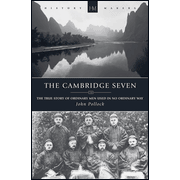
Book Review: The Cambridge Seven

In 1883 Harold Schofield, a missionary doctor in China, surveyed the needs of his field and prayed in faith “that God would waken the church to China’s claims, that He would raise up men to preach His word. Above all that He would touch the universities and call men of talent and ability and consecrate them to His work in China. It seemed a prayer absurd enough except to faith” (p. 42). He did know know that God had begun answering his prayer “even while he was yet speaking,” and he didn’t live to see the answer: like those saints in Hebrews 11, he died not having yet received the promises, but God used him in faith and prayer.

This book details the answer to that prayer. The subtitle of The Cambridge Seven by John Pollock is “The True Story of Ordinary Men Used in No Ordinary Way,” an apt title.

A fairly short book at only 111 pages, it details the Lord’s leading in the lives of seven young men from their conversions to their departure for China with a brief synopsis at the end about what happened to each of them. C.T. Studd, M. Beauchamp, S.P. Smith, A.T. Polhill-Turner, D.E. Hoste, C.H. Polhill-Turner, W.W. Cassels were all Cambridge students who felt called to offer their lives as missionaries to China. They were from different backgrounds: some were wealthy, some were in the military, some were collegiate athletes — one of them a household name in his day; some were more “ordinary.” They were of varying abilities and gifts. Yet as God called them one by one, and it became known, and they shared their testimonies of salvation and surrender over England and Scotland, God used them in a remarkable way before they ever even got to China.

For many of them, the first stirrings toward faith in Christ came when D. L. Moody and Ira Sankey held meetings in England. Some of “their friends thought it a great joke that two uneducated Americans should be coming to preach to the University” (p. 29). But the Holy Spirit worked through His servant and His Word to convict their hearts and bring them to Himself. Others came from Christian families yet were only nominal believers until the Lord began to draw them to a closer fellowship and surrender to Himself.

Some of their families supported them: others strongly resisted the idea of their sons going to a foreign mission field, at least at first.

I appreciated the caution and care with which they approached their call. As D. E. Hoste “began to feel the urge to devote himself to the gospel. Nothing else seemed worthy,” his father “refused. He pointed out how recent was Dick’s faith, and reminded him that, though nothing could break its reality, the intensity of his emotions might be transient. To rush, on impulse, to such a binding decision would be foolishly wrong and might afterwards be regretted” (p. 43). C. T. Studd was listening to an address about the needs of China and “thought for a moment of rising in his place and offering for China on the spot. But he felt ‘people would say I was led by impulse.’ When the meeting ended he slipped away by himself and prayed for guidance” (pp. 69-70). I wince sometimes in our modern-day meetings when a speaker seems to feel he has to compel people down the aisle or else they’ll miss the will of God for their lives forever afterward. That may be true in some cases — there are moments of crisis when we need to make a decision for the Lord without hesitation. But as a general rule I’d rather people take time to pray and make sure their call is really of God than to respond to man-made pressure mistaken for the Holy Spirit’s.

China was not an easy field to go to then, if indeed it ever was. Some of these men were laying aside personal wealth and the possibility of brilliant careers and social prominence. But as they shared their call, they did not do so with woebegone countenances. They did not make it seem like a sacrifice: they made it seem like a joyous privilege. Perhaps that contagious joy was one of the things that drew a number of people to give their all to the Lord in their wake. Hudson Taylor, founder of the China Inland Mission through which they would be working, even allowed them to wait past their appointed time of departure because they were being called to more meetings in the British Isles to speak: he recognized that God was doing something unusual through them.

C. T. Studd is perhaps the most well-known of the seven in our day. One of his most well-known quotes is at the end of this section:

I had known about Jesus Christ’s dying for me, but had never understood that if he died for me, then I didn’t belong to myself. Redemption means ‘buying back,’ so that if I belonged to Him, either I had to be a thief and keep what wasn’t mine or else I had to give up everything to God. When I came to see that Jesus Christ had died for me, it didn’t seem hard to give up all for HIM. It just seemed common, ordinary honesty.

(This review will be linked to Semicolon‘s Saturday Review of Books.)