Book Review: God Wears His Own Watch

When my ever-practical husband first saw the title of God Wears His Own Watch by Reid Lehman, he commented, “God doesn’t wear a watch.” True, but Mr, Lehman explains that what he means is that God operates on His own time table, not ours. Sometimes He seems to act in ways that seem late, even past our human deadlines, but He never fails.

At 144 pages, this book is a brief but compelling history of Miracle Hill Ministries and how God has provided for it and worked in the lives of both the workers and the clients.

If you’ve ever tried to work with homeless or addicted, you know it can be discouraging and frustrating, yet God does still patiently change lives. Sanctification is a long process, and when we struggle with our own besetting sins we shouldn’t be surprised that others with perhaps more visible sins do as well. It was a thrill to read of those whose lives the Lord saved and changed, and it encouraged hope for some of my own lost loved ones. One particular lady in one pastor’s neighborhood was in “a drunken haze” for fifteen years before she finally responded to his invitation to trust Christ. How few people are that patient and persistent in working with people! This lady was one of the very few who never relapsed once she was saved and later on became a faithful worker at Miracle Hill. Her own children had been taken from her by DSS, but she became a baby-sitter to Mr. Lehman’s children, which helped heal that wound in her heart, and she was later able to reestablish a relationship with her own children. Sometimes we can harshly judge that some of the painful consequences people encounter are “only what they deserve,” forgetting the depth of pain of those consequences and the mercy we have received in not getting everything we “deserve” for our sins.

Mr. Lehman is also very transparent about his own struggles with feeling inadequate to take over the leadership and how God used different situations in the ministry to reveal to him his own sins and needs in order to change him. He says on page 129:

The people we serve at Miracle Hill have real problems — massive, unsolvable problems. Pious platitudes just won’t do. Quoting Scripture at them, even though it’s the tool God uses to change lives, isn’t enough, either. When we want to see the lives of others transformed, we cannot hold anything back in our own lives — secret sins, past hurts, or running from an issue we have never been willing to face. Some counselors have left our ministry defeated because they were unable, or unwilling, to allow God to change [them].

All of us are broken in some way. If we’re allowing God to continue His painful work of change within us, if we are willing to admit we’re struggling, we can still help others change. If we deny we have problems, or hide our struggles, how can we tell others God can transform and change their lives? And so we have persevered in prayer until God showed Himself.

There are many accounts of God’s provision for the many needs of the ministry. I enjoyed hearing how it got its name: when they were pouring concrete for the children’s home, rain threatened, and volunteers who had come from out of state were limited in the time they could spend before having to return home, so they really needed to finish what they were doing. They stopped “to pray that God would not allow the rain to hinder pouring of the concrete. Soon after that prayer, the workers could see a solid sheet of heavy rain moving toward them, but they watched in astonishment as the thunderclouds parted right at the construction site at the top of the hill. The rain fell all around them, on both sides of the hill, then joined again at the base in force. The bottom of the hill was soaked, but there was only a light sprinkle at the top!” So the volunteers were able to keep working. When secretary Vera Wright heard of this answer to prayer, she said, “This is just like a miracle, isn’t it?” The “miracle on the hill” led to the entire ministry being named “Miracle Hill,” looking forward, I am sure, to the greater miracles they were trusting God to accomplish in lives.

I enjoyed this closer look into this ministry, and I hope many will read it and be stirred anew for what God can accomplish in and through people.

(This review will be linked to Semicolon’s Saturday Review of Books)

Port of Two Brothers

Port of Two Brothers by Paul Schlener is the story of two brothers and their families who went out as pioneer missionaries under ABWE on the Amazon River in Brazil in the 1950s. They had to name the piece of land when they bought it, and “Port of Two Brothers” seemed the most natural name. Paul spent all of his missionary career in Brazil,. John had to leave earlier due to health.

I am grateful for the publisher who tapped Paul on the shoulder after church one day to tell him that his experiences should be in print. Though I love the “classic” missionary books, I’ve long been an advocate of modern-day missionaries writing their stories as well, to show that God still does work through willing vessels to accomplish His will, and His power and grace are the same as they have ever been.

Paul writes about the details of establishing a pioneer work in a primitive area realistically though uncomplainingly. He and John found themselves many times facing experiences outside the primary missionary tasks of preaching, teaching, and discipling that they were not prepared for, from boat repairs to building to establishing a school to providing medical aid, but in each situation they sought the Lord, got the best information they could, and plunged ahead.

Humor is sprinkled liberally throughout.  His account of his first experience pulling teeth is hilarious to read, though I am sure it was not so funny at the time. He had wanted to avoid dentistry, but when a dentist gave him unsought books and equipment, and he saw the people in such dire need, he felt he really had no choice but to do what he could.

But more important than the needed physical help the brothers were enabled to provide was the light of the gospel they brought. What a thrill and a blessing to read of those who believed and whose lives were changed. In one instance, two visiting preachers wanted to observe a Brazilian festa. Neither the missionaries nor the national Christians thought this was a good idea, but the visitors pressed, so they worked out the details to go. The ritual “celebrating” a young girl’s coming to the full responsibilities of womanhood at puberty was macabre and ghastly, and the Christians could not even stay for the worst of it. Yet within twenty years some of those involved in that ritual had become believers. As Paul visited the same village, he wrote:

I saw again the transforming power of God in the lives of these people. I could never refer to them as uncivilized, for their lives were on a far higher spiritual and moral plane than many people educated and steeped in an industrial society.

My thoughts went back to the drunken orgy held in this place 20 years ago. No one could read. There were no Bibles, no Christians, no knowledge of God and His plan of salvation; there existed only fear, superstition, witchcraft, knife fights, and drunkenness. I lamented that Jessie (his wife) wasn’t with me to see this; John would have appreciated it as well.

I approached the little table and asked Franciso to lead in another hymn while I gathered my thoughts. I still have the little index card with my few notes on the first sentence of Psalm 23: “The Lord is my shepherd, I shall not want.” They listened as I made it through the short message without choking up.

That’s what it’s all about.

(This review will be linked to Semicolon’s Saturday Review of Books.)

We Rest On Thee

Last night we watched End of the Spear, about Jim Elliot, Nate Saint, and the other three men who were speared to death by the Indians (then known as Aucas, now as Waodani, their name for themselves) they wanted to try to reach for the Lord over 50 years ago. I had seen it before and thought the others had, but they didn’t remember it. There was so much more of the story I wished they could know: I’d recommend the companion documentary, Beyond the Gates of Splendor.

The story made the national news at the time, and then in the following years Elisabeth Elliot told it in more detail in the book Through Gates of Splendor. The title comes from this hymn which the men used to sing together — I am thinking they sang it the night before they went out, but I don’t remember for sure.

We Rest On Thee

We rest on Thee, our Shield and our Defender!
We go not forth alone against the foe;
Strong in Thy strength, safe in Thy keeping tender,
We rest on Thee, and in Thy Name we go.
Strong in Thy strength, safe in Thy keeping tender,
We rest on Thee, and in Thy Name we go.

Yes, in Thy Name, O Captain of salvation!
In Thy dear Name, all other names above;
Jesus our Righteousness, our sure Foundation,
Our Prince of glory and our King of love.
Jesus our Righteousness, our sure Foundation,
Our Prince of glory and our King of love.

We go in faith, our own great weakness feeling,
And needing more each day Thy grace to know:
Yet from our hearts a song of triumph pealing,
“We rest on Thee, and in Thy Name we go.”
Yet from our hearts a song of triumph pealing,
“We rest on Thee, and in Thy Name we go.”

We rest on Thee, our Shield and our Defender!
Thine is the battle, Thine shall be the praise;
When passing through the gates of pearly splendor,
Victors, we rest with Thee, through endless days.
When passing through the gates of pearly splendor,
Victors, we rest with Thee, through endless days.

~ Edith G. Cherry

The tune is to Finlandia by Sibelius, by which we also sing “Be Still My Soul.” Oddly, I have never heard it sung in church. I’ve only heard it on the radio. But many times when I think of these men, this hymn come to mind. The first few lines of the third verse especially resonate with me.

By the way, the foe they were going against was not the Aucas/Waodani. The foe was Satan, “hath blinded the minds of them which believe not, lest the light of the glorious gospel of Christ, who is the image of God, should shine unto them” (II Corinthians 4:3-4)

Ephesians 6:10-13: Finally, my brethren, be strong in the Lord, and in the power of his might. Put on the whole armour of God, that ye may be able to stand against the wiles of the devil. For we wrestle not against flesh and blood, but against principalities, against powers, against the rulers of the darkness of this world, against spiritual wickedness in high places. Wherefore take unto you the whole armour of God, that ye may be able to withstand in the evil day, and having done all, to stand.

Updated to add: My friend Bobbi found this version on You Tube, which sounds like the recording I hear on the radio:

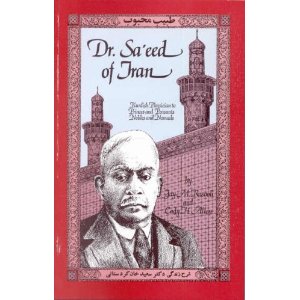
Dr. Sa’eed of Iran

Some months back I wrote about Dr. John Dreisbach, a modern-day missionary who recently went Home to heaven. I was listening to his memorial service online when I heard the following poem read:

Christ is my Life, and Christ is my light;
Christ is my guide in the darkness of night;
Priest and strong Advocate Christ is for me;
Christ is my Master, to truth he’s the key.

Christ is my Leader, he peace to me brought;
Christ is my Savior, Christ righteousness wrought;
Christ is my Prophet, my Priest, and my King;
My Way, and the Truth to which I firmly cling.

Christ is my Glory, and Christ is my Crown;
Christ shares my troubles when woe strikes me down;
Christ is my treasure in heaven above:
In every deep sorrow he soothes me with love.

Christ is my Savior, my Portion, my Lord;
All honor and homage to Him I accord.
Christ is my Peace, and Christ my Repast;
Christ is my Rapture forever to last.

In joy and in sorrow Christ satisfies me;
‘Tis Christ who from bondage of sin set me free.
In all times of sickness Christ is my Health;
In want and in poverty Christ is my Wealth.

Afterward I searched online to find out who wrote this poem and discovered it was titled “Dr. Sa’eed’s Hymn” and was contained in the book  Dr. Sa’eed of Iran: Kurdish Physician to Princes and Peasants Nobles and Nomads by Jay M. Rasooli and Cady Hews Allen. It is no longer in print, but Amazon.com has inexpensive used copies, so I ordered one. (If you don’t mind reading books on the computer, the text is online through Google books.)

Dr. Sa’eed’s is a fascinating story. He was born into a Kurdish mullah’s (an Islamic teacher) family in June of 1863 in what was then Persia, now known as Iran. He was uncommonly bright and well-taught, so much so that he was given the title of mullah at the age of thirteen when his father died.

As a child he once saw a foreigner wearing a hat with a brim, uncommon because Persians then wore brimless hats. When he asked his mother why the man wore that “funny hat.”

“He is an unbeliever,” she replied, “and they do not wish him to see the sky, which is the abode of God.” By such an answer was aversion to non-Moslems instilled in the receptive mind (p. 23).

Sometimes he might be in a Christian home and “accidentally” knock something fragile off a shelf so that it broke or sit on a rug and cut holes in it with his knife. “Such misdeeds, while inspired by bigotry, were done especially to earn merit with God by causing damage to an unbeliever or even to one of a rival Moslem sect” (p 24).

But he also had a thirst for holiness that led him to fervent study and extreme rituals. After years he was still “dissatisfied and restive” (p. 29.) His first encounters with professing Christians were with Catholics who disgusted him, as they drank alcohol (forbidden in the Koran).

When he was seventeen, some Protestant missionaries came to town and engaged Sa’eed as a tutor in the Persian language. He had heard even worse things about Protestants, but he acquiesced.

He was surprised by many things: they knew something of the Koran, they prayed for their enemies, they did not drink, lie, or gossip. Their behavior matched their teaching. They used the Bible for language study, and Sa’eed heard many discussions about Christian teachings. Over time he began to speak with Kasha Yohanan about religion and read the Bible for himself. He began to see his own failings and to doubt what he had always been taught. This was agony to him, causing him to burn himself with hot coals as a vow never to speak with Christians about religion again and to tell the missionary that he was no longer available. But the words he had heard continued to burn in his heart until he finally prayed to be led in the true way. He decided to study both the Bible and the Koran. “In Mohammed’s teachings and personal life I found nothing which would satisfy the longing soul — not a drop of water to quench the thirsty spirit” (p. 38). Finally he yielded to faith in God.

His heart was now at peace, but his persecutions began in earnest. Even his own brother planned to kill him. The rest of the book details his growth, his training as a physician, and his life as a testimony to the One who saved him. Though often in danger, he never failed to treat anyone who called on him, even his enemies. His faith and godly character were a witness and a reflection of the One in Whom he believed.

(This review will be linked to Semicolon’s Saturday Review of Books.)

Book Review: Interwoven

The cover of the book Interwoven by Russ and Nancy Ebersole shows cloth intricately woven by Igorot women in the Philippines to illustrate the interweaving of the lives of Russ and Nancy.

Russ and his first wife, Gene, were married in 1950, and after graduate school spent ten years as missionaries in the Philippines. After battling cancer for three and a half years, Gene passed away, leaving Russ a widower with five children.

Nancy and her first husband, Harry, were married in 1957. He studied in seminary, and then they were led to work as missionaries in Bangladesh (East Pakistan at that time). After just two short years on the field, though, Harry became suddenly and seriously ill, and the Lord took him home in 1965, leaving Nancy a widow at 27 with three children.

Though a few threads of their lives had intersected before, four years later Russ and Nancy were led to each other, married, and blended their families together.

This book shares the testimonies of their early lives and that of their first spouses as well as how the Lord sustained them during loss, brought them together, and used them for many years afterward in various forms of service. Included are adventures such as the rescue of the family of Russ’s first wife, Gene, in the Philippines from the Japanese during WWII on the very morning they were scheduled to be executed in what “General Douglas MacArthur called…’the most thrilling rescue in all of American history'” and Russ and Nancy’s later being on a plane that was hijacked to China. Particularly poignant to me were the sections dealing with Gene’s response to cancer and Nancy’s adjustments as a young widow as well as many stories of the people they ministered to who became strong, fervent believers, some in spite of intense persecution. Some of the struggles and adjustments for the family after Russ and Nancy first married illustrate that missionaries are ordinary people with problems like everyone else would have, yet the Lord helped everyone to adjust and blend together over time. Woven into every part is God’s faithfulness and love.

Though a book like this is not meant to read like a novel, I did find the style just a little dry here and there, reading somewhat more like a report in places. But overall I can and do highly recommend this book.

(This review will be linked to Semicolon’s Saturday Review of Books.)

Dr. John Dreisbach

During the last week of November, one of God’s great missionary statesmen of our times passed on to be with his Savior and to be reunited with the wife he had missed for nine years. Dr. John Dreisbach passed away at the age of 87, just a few weeks after being diagnosed with acute myelogenous leukemia.

I was fortunate to have attended the same church as the Dreisbachs for fourteen years. I had heard of them for years before that. Thirty years ago when I was a student at BJU, Dr. John and Bettie Dreisbach were legendary even then. The first time I heard Dr. John speak, a somewhat short, soft-spoken, grey-haired man who was not what you would call a dynamic speaker, I thought, “Is this the man I have heard so much about?” But oh, what a heart for God and for missions! His wife, Bettie, was, I’d say, a little feistier than he was, but they were both unfailingly kind, humble, gentle people who were completely sold out to do whatever God wanted.

One of my fondest memories of Dr. John was from a church picnic when, for some reason, all the missionary men on deputation or furlough (there were several in that church) were asked to don a headpiece with long dog ears attached and sing, “Do your ears hang low?” Though at first none of the men looked thrilled to be asked, Dr. John wagged his ears to the song along with the best of them. My oldest son still remembers a time Dr. John spoke in chapel and flung out a massive rolled-up snake skin that unfurled several rows over the heads of the children. I also remember when Mrs. Dreisbach spoke to the ladies about how to encourage an interest in missions in the home. They both possessed merry hearts and quick smiles. They were both genuine, transparent people who would cringe at words like “great” and “legendary” being applied to them, yet those words are not intended to magnify them but rather to show the extent to which God used them.

From Dr. Dreisbach’s memorial service I gleaned the following biographical information presented by Gospel Fellowship Association’s director, Dr. Mark Batory:

John was only four when his father and brother were killed by a lightning strike. John’s brother was fifteen years older and had been planning to be a missionary, and John immediately felt his brother’s mantle had fallen on him like Elijah’s had on Elisha. He was brought to conviction, repentance, and salvation at a revival meeting, partly because of a continuing temptation he experienced to steal marshmallow cookies from his uncle’s store.

He studied medicine with an eye toward being a medical missionary. He wanted his future wife to be already called to Africa before they met rather than just following his call. One day when he was uncharacteristically late to a Bible study, he came in to hear several students giving their testimonies. His ears perked up when he heard one young lady tell of her call to go to Africa, and though he could only see the back of her head, he knew she was the one for him.

Dr. John and Bettie were married in Panama in 1947. Dr. John had been a farm boy and hadn’t been to many weddings. He and Bettie had planned to be married at the end of an evening worship service at the church they had been attending. There were no typical wedding frills: no special wedding clothes, no attendants, no wedding pictures, and so forth. He was at that time on staff at a Panamanian hospital known for its work with leprosy patients, and the only vehicle available to him was the ambulance, so he took his new bride back to the leprosarium in the ambulance. Their house was built up on stilts, and some of the local men came and played drums underneath their house. The Dreisbachs dropped some candy down to the musicians, for which they delightedly played all the more. They then dropped some money down to them, hoping that would thank them and encourage them to stop, but they played all night long.

The Dreisbachs went to Nigeria in 1948 and worked in a leprosy hospital. Though they did outstanding medical work (Dr. John pioneered a surgery to restore usefulness to lepers’ hands and feet by using tendons from other parts of their bodies to replace the constricted ones, and he won many awards for his work), they considered their primary mission sharing the gospel. Dr. John was not a man given to exaggeration; he was very careful in what he said, but he estimated that about 25% of all those who came to the hospital left with faith in Christ.

They had been on the mission field in Nigeria for several years when, becoming concerned about compromise in their mission board and sensing a need for a change, they accepted an invitation from BJU in 1964 to come to be the campus physician and to develop a curriculum for medical missions. They also founded Project Compassion, medical missionary apprenticeship teams made up of nurses and others who had some kind of medical training. They took Project Compassion teams to 12 different countries over a period of 25 years to serve in medical evangelistic mission works.

They took a leave of absence from BJU to spend 8 years ministering to nomadic tribes people in the Sahara Dessert. The BJU film Beyond the Night comes from these years.

In 1990 Dr. John joined the staff of Gospel Fellowship Association. His beloved wife Bettie passed away in 2000 after 52 years of marriage. He continued to take missions trips to Africa, primarily to Cameroon. He had wanted to develop medical clinics there but was told by the government he was too old. He went as a consultant because his primary mission was to share the gospel. A wonderful story about that time is told here under the title “A Light in a Dark Continent.”

When Dr. John was finally told he could no longer travel because of his health, Dr. Batory suggested they tape a series of lessons in the Hausa language that could be used among the Hausa-speaking people in Cameroon. Dr. John had prepared 15 short lessons and preparations were underway to video tape his presenting these lessons. At the trial run, a faulty tape recorded only 30 seconds of the first lesson. Discouraged at first, Dr, Batory came to realized that God did not want to replace Dr. John with tapes or discs; God wanted people to take up the mantle.

Some years ago I had the opportunity to reconnect with the Dreisbachs when they were at a missions conference at a church we were visiting. I’ll never forget his speaking on the verse, “Can God furnish a table in the wilderness?“ (Psalm 78:19), and then sharing many instances of times God had provided in seemingly impossible circumstances. Neither will I forget the poem he read at that time, when he was in his 70s, titled, “Would you?”

If you had been to heathen lands
Where weary souls stretch out their hands
To plead, yet no one understands,
Would you go back? Would you?

If you had seen the women bear
Their heavy loads, with none to share
Had heard them weep, with none to care,
Would you go back? Would you?

If you had seen them in despair
Beat their breasts and pull their hair
While demon powers filled the air,
Would you go back? Would you?

If you had seen the glorious sight
When heathen people seeking right
Had turned from darkness to the light,
Would you go back? Would you?

If you had walked through Afric’s sand
Your hand within the Saviour’s hand
And knew He’d called you to that land,
Would you go back? Would you?

Yet still they wait, that weary throng.
They’ve waited, some, so very long.
When shall despair be turned to song?
I’m going back. Wouldn’t you?

— Author unknown

May God raise up many like him to take his place.

Therefore said he unto them, The harvest truly is great, but the labourers are few: pray ye therefore the Lord of the harvest, that he would send forth labourers into his harvest.  Luke 10:2

(Edited by Priscilla Dreisbach)

Why hear a missionary presentation?

What do you think when you hear that a missionary will be speaking at your church? Are you disappointed that you won’t hear the pastor? Or excited about a change of pace? Are you tempted to stay home because it is “just a missionary” after all? Or looking forward to dozing off during the video?

A few weeks ago a young lady spoke at our women’s meeting about her summer on a mission field, and I was blessed in so many ways even beyond just hearing what the Lord did that summer that I made a list of some of the blessings we can glean as missionaries present their work. Our church is having a Missions Conference this week, so it seemed like a good time to revisit these thoughts and post them.

1. Jesus told His disciples to “Lift up your eyes, and look on the fields” (John 4:35b), and hearing a missionary presentation is one good way to obey that command.

2. We can see more fields than we could possibly visit in person.

3. Our hearts are stirred for the lost.

4. We are stirred to contribute both by prayer and giving.

5. We’re stirred to come alongside and help the missionary in his or her ministry.

6. It’s educational: we learn of other cultures from those who have actually experienced them.

7. We’re stirred up to serve the Lord in our own areas of ministry.

8. Our faith is encouraged as we see God’s hand at work in the lives of ordinary people who have stepped out in faith and yielded themselves to Him, and we are encouraged to do likewise.

9. Our faith is encouraged as we see God’s provision for funds, supplies, abilities.

10. Our hearts are knit together with brethren we might never meet in this life. We get to know our spiritual relatives whom we will meet some day in heaven.

11. We’re called to be willing to be used in whatever way God might see fit in the mission field He has for each of us, possibly even an overseas one.

How about you? How do you feel about missionary presentations?

Little things

It’s funny — I’ve been pondering a post about my tendency to overreact get frustrated and upset over little things, and I was trying to find the quote below by Amy Carmichael. I thought I had written about it before, and when I searched and found this post, I was convicted and instructed all over again. This was better than what I had in mind to write now. This is from August 2007. Obviously I haven’t completely learned the lesson yet. Maybe I should read this regularly.

______________________________________________

Sometimes it seems easier to trust the Lord for the big trials of life rather than the little things.

When a major crisis comes my way, I realize it’s too big for me. I’m acutely aware of my need for God’s grace and strength. I feel myself sinking, like Peter, and cry out for help almost instinctively.

But when I encounter some smaller provocation — when someone interrupts what I am doing; when I’m trying to wrap up computer time or I’m just logging in for something quickly and my computer decides to run extremely slowly or “time out” on the connections I am trying to make; when I am running late to an appointment and hit every red light along the way; when another driver cuts me off; when I am in a hurry at the grocery store and find the shortest check-out line only to have the customer in front of me encounter some time-consuming problem; when I give dinner a quick stir and slosh red sauce over the side of the pan and onto the stove, the floor, and/or myself — then too often I react with simmering impatience, carnal anger, unloving harshness, discouragement or depression.

Amy Carmichael once wrote:

The hardest thing is to keep cheerful (and loving) under little things that come from uncongenial surroundings, the very insignificance of which adds to their power to annoy, because they must be wrestled with, and overcome, as in the case of larger hurts. Some disagreeable habit in one to whom we may owe respect and duty, and which is a constant irritation or our sense of the fitness of things, may demand of us a greater moral force to keep the spirit serene than an absolute wrong committed against us. (1)

“Well, I was provoked.”

Love…is not easily provoked. I Corinthians 13:5

“I’m only human.”

Yes. That’s the problem, not an excuse. With the exception of One, all humans have a sinful nature. Our natural reaction is likely to be a selfish one. As Christians we’re called to have a supernatural reaction.

But the fruit of the Spirit is love, joy, peace, longsuffering, gentleness, goodness, faith, meekness, temperance. Galatians 5:22-23.

Even on the highway or in a check-out line.

Thank God there is forgiveness with Him, His mercies are new every morning, and if we confess our sin, He is faithful and just to forgive us our sin and to cleanse us from all unrighteousness(I John 1:9).

But how can I get the victory over wrong reactions to little provocations and react in a right manner the next time?

  • I think first of all by not excusing it, but recognizing it as sin and confessing it to Him.
  • A careful evaluation of using my time better is a good practical solution to some situations, such as stopping whatever I am doing soon enough to leave early enough for an appointment so that a few red lights (which really don’t last as long as they seem to) will not cause me to be late (or agitated).
  • Putting it into perspective. A little thing is just a little thing. Being a Christian doesn’t mean every little bump in the road is going to be removed.
  • Then relinquishing control of my life and time and schedule into the Lord’s hands will help me to handle interruptions better. Have you ever studied the life of Christ with an eye toward how much He was interrupted? It’s enlightening. Even when He was interrupted during prayer or on his way to perform a miracle, He never reacted harshly or impatiently.
  • I need to relinquish the “I” factor as well. Some of the agitation I experience is simply my thwarted desire for things to go my way. I mentioned in an earlier post that another of Amy Carmichael’s experiences that helped me was when she felt the “I” “rising hotly” in her toward one who was unfair and dominating, and she realized that moment was a chance to die to self. “See in this which seems to stir up all you most wish were not stirred up — see in it a chance to die to self in every form. Accept it as just that – a chance to die.”
  • Remembering that my testimony before others is at stake helps as well. “That ye may be blameless and harmless, the sons of God, without rebuke, in the midst of a crooked and perverse nation, among whom ye shine as lights in the world” (Philippians 2:25). I sometimes think of Satan standing before God and accusing that Job only served God because God blessed him, but let Satan take away Job’s blessings, and he would curse God. I envision him saying of me, “Yes, she acts like a nice Christian at church, but let me trip her up here and there and see how she reacts.” We not only forget that we are a testimony to others in our homes and at check-out lines, but we forget that our testimonies are as far-reaching as heaven. Rosalind Goforth was a missionary wife to China during years in which the Chinese were quite suspicious of and disdainful toward “foreign devils.” To try to alleviate those feelings and establish relationships with the Chinese, the Goforths would allow crowds of the curious into their home to look around and to talk with them. This resulted in some agitation and disruption as well as theft of some of their belongings, but overall they felt it was worth it. Of one particular day, Rosalind writes:

The day had been an unusually strenuous one, and I was really very tired. Toward evening, a crowd of women burst through the living room door and came trooping in before I had time to meet them outside. One woman set herself out to make things unpleasant. She was rough and repulsive and– well, just indescribably filthy. I paid no attention to her except to treat her as courteously as the rest. But when she put both hands to her nose, saying loudly, “Oh, these foreign devils, the smell of their home is unbearable!” my temper rose in a flash and, turning on her with anger, I said, “How dare you speak like that? Leave the room!” The crowd, sensing a “storm,” fled. I heard one say, “That foreign devil woman has a temper just like ours!”

Now, I had not noticed that the door of my husband’s study was ajar, not did I know that he was inside, until, as the last woman disappeared, the door opened and he came forward, looking solemn and stern. “Rose, how could you so forget yourself?” he said. “Do you realize that just one such incident may undo months of self-sacrificing, loving service?”

“But Jonathan” I returned, “you don’t know how she — “

But he interrupted. “Yes, I do; I heard all. You certainly had reason to be annoyed; but were you justified, with all that is hanging in the balance and God’s grace to keep you patient?”

As he turned to re-enter his study, he said, “All I can say is I am disappointed!

Oh, how that last word cut me! I deserved it, yes, but, oh, I did so want to reach up to the high ideals he had. A tempestuous time followed alone in our inner room with my Lord. as I look back now, it was all just one farther step up the rocky hillside of life — just climbing! (2)*

  • The verses mentioned above in Galatians 5 say that gentleness, long-suffering, self-control, etc., are all a part of the fruit of the Spirit. Maintaining time in the Word so He can speak to me through it, yielding to His control throughout the day, memorizing verses in the areas I am having trouble with, sending out a quick prayer for help when I feel that agitation and frustration building up will all help in gaining the victory.

Let us therefore come boldly unto the throne of grace, that we may obtain mercy, and find grace to help in time of need. Hebrews 4:16.

___________
(1) Houghton, Frank. Amy Carmichael of Dohnavur. (Fort Washington, PA: Christian Literature Crusade, 1983), 86-87.

(2) Goforth, Rosalind. Climbing. (USA: Bethel Publishing), 45-46.

Book Review: To the Golden Shore

Imagine feeling so convicted and burdened by God’s command to go and share the gospel with every creature and so moved by the state of the lost in other countries that have never heard the gospel that you feel you must go yourself and tell them.

Now imagine doing so when you live in a country where no one has ever done so before.

To the Golden ShoreTo The Golden Shore by Courtney Anderson is a classic missionary biography of Adoniram Judson, America’s first missionary. I had read it years ago but felt an urge to revisit it.

Every missionary has to have dedication and has to be willing to make sacrifices, even in our day. But the amount of dedication and sacrifice and willingness to step into the unknown displayed by Adoniram and his wife and the small group who stepped out with them just amazes me. His wife, Ann Hassletine (also called Nancy) is one of the bravest women I have ever read of, going into the great unknown as she did and facing all that she did in later years. The letter Adoniram wrote to ask her father for her hand in marriage is an atypical proposal, but frank:

I have not to ask, whether you can consent to part with your daughter early next Spring, to see her no more in this world; whether you can consent to her departure, and her subjection to the hardships and sufferings of missionary life; whether you can consent to her exposure to the dangers of the ocean; to the fatal influence of the climate of India; to every kind of want and distress; to degradation, insult, persecution, and perhaps a violent death. Can you consent to all this, for the sake of Him who left His heavenly home and died for her and for you; for the sake of perishing immortal souls, for the sake of Zion, and the glory of God?

He was not being melodramatic: he was being realistic. It says a lot about Nancy that she accepted such a proposal.

There are several short biographies of Adoniram online, so I don’t want to retell his life story, but I just want to touch on a few highlights that stood out to me from the book.

I wrote before of his remarkable conversion. His innate intelligence, keen mind, and his own struggles coming to faith uniquely fitted him for the philosophical discussions with the Burmese that were preliminary to their understanding the gospel, and that same mind and the facility he developed with the language uniquely fitted him to translate the Bible into Burmese and to create a Burmese-English dictionary and grammar that were the standard for decades.

He had a stalwart, determined character. That could come across as stubborness in some instances, but when convinced as to the will of God, he was firm. During Adoniram’s studies over the long sea voyage, he became convinced that the Baptist mode of baptism, by immersion after a profession of salvation, was the Biblical way. That put him in a difficult position as a Congregationalist missionary. The subject was discussed and debated amongst the missionary candidates on board, but once Adoniram was convinced of the Scriptural position, he felt he had no choice but to resign as a Congregationalist missionary and seek support from the Baptists. Thankfully, in the providence of God, the situation was handled with grace, and God brought him into contact with Baptist men who took on his support. You may or may not agree about modes of baptism, but what stands out to me here was the character it took to act on what he believed even though it was going to cause difficulties.

The Burmese were open to discussion, but it was six long years before the first one believed. Progress was very slow: there was, of course, not the openness to a variety of religions as we take for granted today. Adoniram was careful not to impinge on their culture — he wasn’t trying to create an American church, but a Christian one. But slowly the gospel took root and grew. Oddly, at the time of greatest oppression by the imperialist Burmese king, when the Judsons feared they would have to leave, they had several inquirers. Some of the Burmese converts came forth as gold in the trials they faced where professing Christ cost something.

When war broke out between Burma and England in 1824, the Judsons thought that they would be safe as Americans. However, the Burmese did not understand the Western system of banking: because the Judsons’ checks were cashed through a British merchant, they were thought to be in league with the British, and Adoniram was imprisoned for twenty-one of the most grueling months of his life. A fastidious man, he dealt with filthy quarters and having his feet in fetters raised up toward the ceiling every night while his weight rested on his shoulders on the floor. Nancy daily sought help and favor for him everywhere she could: she even followed him and the rest of the prisoners on a tortuous march to another prison. As authorities searched their home, she hid what she could, especially the manuscript of the Burmese translation of the Bible over which Adoniram had been working so diligently. She hid it in a pillow and took it to Adoniram in prison. The jailer took a liking to the pillow and confiscated it for himself: Nancy made a nicer one, and Adoniram successfully offered it to the jailer in exchange.

As the war began to grind to an end, Adoniram was called on as a translator between the Burmese and British. Lack of nutrition, ill health, and extenuating circumstances all took their toll on Nancy, and she died, followed soon by their baby. None of their other children had lived.

Adoniram entered into the darkest period of his life. He threw himself into translation and missionary work, but wrestled with losses and grief: not only Nancy and all his children, but several missionary colleagues had died as well as his father back in America. Oddly, he felt guilty over his grief. He withdrew into a kind of asceticism for a while. He dug an open grave and spent long periods of time just staring into it. He requested at this time that his letters to others be destroyed, so we don’t know for sure what all he was thinking during this period. Several shorter biographies bypass this section of his life, but I think it is important to note that in his humanness, the losses he had sustained and the time in prison all had their effect on him, understandably, and it took him about three years to recover.

He eventually married Sarah Boardman, the widow of one of his colleagues, and had several more children. They had a happy eleven-year long marriage before she passed away on his only return trip to America, taken originally to try to help improve her health. God granted him another happy marriage to writer Emily Chubbuck for a few years before his own health failed in 1850 at the age of 61.

His legacies are the souls won to Christ in Burma and the churches started there, the Burmese Bible he translated, the Burmese-English dictionary and grammar, and the stirring testimony and influence of a life of character used by God.

Mimosa

783046_the_sensitive_flower

Sometimes people who work in children’s ministries can get discouraged due to the seeming lack of fruit or the fact that they have some children just a few times and then never see them again. Mimosa by Amy Carmichael tells the story of a little girl who was marvelously changed by just a short encounter with the gospel.

When Amy Carmichael was a missionary in India she learned that some little girls were sold to the temples for immoral purposes. Whenever she could, she tried to rescue these girls, to talk their parents into letting them stay with her instead. One such little girl was named Star. She had been with Amy for a while when her father came, bringing her sister, Mimosa, with him, to try to take Star back. He met and talked with Amy and Mr. Walker, the director, and at one point even stretched out his arm to take Star — yet he felt he could not move, that some strange power was preventing him.

Mimosa saw this. Some of the workers had a short time to talk with her, not even time enough to present the gospel completely. Mimosa asked her father to let her stay: he would not hear of it.

Those who had met with Mimosa longed for her: she seemed intelligent and interested. They lamented that they had not had time to tell her more. “How could she possibly remember what we had told her? It was impossible to expect her to remember……Impossible? Is there such a word where the things of the Lord are concerned?”

Something of what she heard about a God who loved her stayed with her. She knew instinctively she could no longer rub the ashes of her family’s god on her forehead, as was their custom. The women in the house thought her naughty or “bewitched” and beat her with a stick. She was bewildered, but she knew God loved her, in spite of all she could not understand of her circumstances.

After she was married at age seventeen, she found she had been deceived by her husband’s family: He was “landless [and] neck-deep in debt.” It was no shame to be in debt: in that culture: “”If you have no debt, does it not follow that no one trusts you enough to lend you anything, and from that is it not obvious that you are a person of small consequence?” But Mimosa’s character could not endure it, though she had never been taught against it. She encouraged him to sell the land in her name, the only piece of land he had that he had given as a dowry, to pay off the debt, and then suggested they would work. He was amazed at such a thing, but agreed. His unscrupulous elder brother suggested they start a salt market and that Mimosa sell her jewels to get them set up: he would take care of it. He instead somehow misused the money. She gave some money to her mother to keep for her, but then her mother would not give it to her when she asked for it: her mother was angry with her over the loss of the jewels that had been passed to her. “Let thy God help thee!” she told her daughter.

Mimosa went out to pray: “O God, my husband has deceived me, his brother has deceived me, even my mother has deceived me, but You will not deceive me…Yes, they have all deceived me, but I am not offended with you. Whatever You do is good. What should I do without you? You are the Giver of health and strength and will to work. Are not these things better than riches or people’s help?….I am an emptiness for You to fill.”

Thus her life went. She was a derision because she would not worship the false gods or engage in idolatrous practices. She worked hard because her husband would not. There were times when she was weak and could not work that God worked in unusual ways to provide for her. She had three sons; then a snake bite left her husband blind and crazy. In a couple of instances she received a bit more information about the God she loved, and she clung to it and to Him.

Meanwhile, Star was concerned for her sister. She felt led to write to her and prayed someone would read the letter to Mimosa. A cousin did read it to her, as often as Mimosa asked him, but neither of them thought to write back to Star, so she and the ladies of Dohnavur were left to wonder and pray.

A mysterious illness which took the life of one of her sons caused the neighbors to torment her further with their words. They felt it was all her fault since she would do nothing to appease the gods. Mimosa replied, “ My child God gave; my child has God taken. It is well.” Though weak, ill, grieving, and alone, she still told God, “I am not offended with you.”

The years followed in much the same way. She had two more sons. The oldest one was taken by the father (who had regained something of his right mind) to another town to work but, to Mimosa’s grief, required him to rub the god’s ashes on his forehead.

She began to long that her children should have “what she had never had, the chance to learn fully of the true and living and holy God and themselves choose His worship.” It would take too much space here to tell how God wondrously worked out the all the details to go to Dohnavur, even, miraculously, her husband’s approval. Her sister, Star, was strongly burdened to pray for Mimosa and discovered later that was just the time when all of this was coming to pass. Twenty-two years after she first visited Dohnavur, she returned. It can only be imagined what she felt as she soaked up Christian fellowship, learned to read, studied the Bible, was baptized. After a time she went back to her husband, determined to win him. He was in a less tolerant caste, yet amazingly he did not put her away. Her life was not easy. “But then, she has not asked for ease; she has asked for the shield of patience that she may overcome.”

“Is not the courage of the love of God amazing?” Amy Carmichael wrote. “Could human love have asked it of a soul? Fortitude based on knowledge so slender; deathless, dauntless faith — who could have dared to ask it but the Lord God Himself? And what could have held her but Love Omnipotent?“