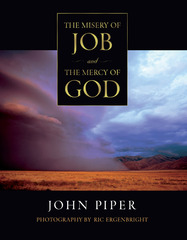
In Beyond Suffering: Discovering the Message of Job (linked to my review) author Layton Talbert referred a few times to a set of poems John Piper wrote called The Misery of Job and the Mercy of God. The poems are in book form there with some beautiful photography and a CD of John Piper reading the poems (at least, the used copy I bought from Amazon had a CD with it). The text and audio are also online here (although a few lines are missing from the text).
There is something about poetry that can express truth with beauty and poignancy, and Piper’s poems certainly accomplish that. They don’t cover every verse or every point made in the book of Job, and they include some scenes not in Job (a conversation between Job and God before Job’s calamities struck and between Job and his wife, who is treated much more tenderly here than in most sermons where I’ve heard her mentioned) which is just an imaginative way of telling the story and expressing what kinds of conversations may have passed. All in all they’re a faithful retelling.
I had wondered why Piper said early on, “And Job would lift his hands to God and wondered why he spared the rod of suffering” until I realized he was probably referring to what Job feared in 3:25 when he said, ““the thing which I greatly feared is come upon me, and that which I was afraid of is come unto me.” We’re going through Job in our church, and just recently discussed what it was that Job might have feared, and it could quite possibly be something along these lines, that God had blessed him so much that he feared that suffering of some kind was going to befall him at some point before it was all over.
There are some really beautiful sections. Here are a few of my favorites (p. 18):
Now tell me, with your heart, Would you be willing, Job, to part With all your children, if in my Deep counsel I should judge that by Such severing more good would be, And you would know far more of me?”
What parent could answer that question? Yet we’re called to yield our children to God: they’re ultimately His.
On pages 32-33, shortly after all his trials came:
O God, I cling With feeble fingers to the ledge Of your great grace, yet feel the wedge Of this calamity struck hard Between my chest and this deep-scarred And granite precipice of love.
Part of his response to his wife (p. 41):
O Dinah, do not speak like those Who cannot see, because they close Their eyes, and say there is no God, Or fault him when he plies the rod. It is no sin to say, my love, That bliss and pain come from above. And if we do not understand Some dreadful stroke from his left hand, Then we must wait and trust and see.
Part of Job’s response to his friends’ accusations (p. 58):
O that some door Were opened to the court of God, And I might make my case unflawed Before the Judge of all the world, And prove this storm has not been hurled Against me or my children there Because of hidden crimes. O spare Me now, my friends, your packages Of God, your simple adages.
And I think my favorite lines of all (p. 72):
Beware, Jemimah, God is kind, In ways that will not fit your mind.
This book took me just under half an hour to read, and then I listened to it the next day in about the same amount of time while mostly following along reading the words. It was quite an enjoyable and beneficial hour, helping to feel some of what Job might have felt. I think I’ll be returning to this volume again and again.
(This review will also be linked to Semicolon‘s Saturday Review of Books.)
Mocha With Linda hosts a weekly meme called Flashback Friday. She’ll post a question every Thursday, and then Friday we can link our answers up on her site. You can visit her site for more Flashbacks.
In honor of National Poetry Month, the prompt for today is:
What poems do you remember from your childhood? Did you have to memorize many poems for school when you were growing up? Did you learn any just for fun? Do you remember which ones they were–and can you still recite them? Did you have a poetry book that you liked to read? Do you enjoy poetry today? Do you prefer rhyming poetry or free verse? Whimsical poetry or epic poems that tell a story? Do you have a favorite poem or poet? Have you ever written any poems?
I must have been exposed to nursery rhymes early on, but my first conscience memory of poetry is from A Child’s Garden of Verses by Robert Louis Stevenson in first grade. Loved that book! My next memory concerning poetry involved making a poetry book a few years later. We were supposed to look up various poems, copy down our favorites, and illustrate them. I wish I still had that book! The only lines I remember from it are from one poem which said, “But I think mice/Are rather nice.” I do not think so now!!
I know I probably read more poetry in English classes through the years, but my next memory is of angst-filled poetry I both read and wrote as a teenager. I’ve written only a few in recent years, two silly and one serious: Ode to Hay Fever, Ode to a Summer Cold, and A Mother’s Nightly Ritual.
I do enjoy poetry today. Good poetry, anyway. When carefully chosen words really encapsulate a particular thought or feeling or truth in poetry, it just really hits home like nothing else.
In general I like rhyming poetry better than free verse — there is just something about the rhythm and disciple of rhyme that is beautiful. Free verse looks like it would be easier, but just stringing words down a page does not constitute a free verse poem, so in a way I think it might be harder to create something truly poetic as a free verse. But it can be done.
I like the idea of epic poems that tell an over-arching story — The Rime of the Ancient Mariner, etc. — but I think today’s readers would find it hard to sustain the thread of the story through that many verses. I enjoy “light verse” like Richard Armour‘s as well as devotional poetry like Amy Carmichael‘s.
I don’t know if I have a favorite poet, but the closest would probably be Robert Frost. Though his poems are mostly pretty short, he packs a lot of meaning in a few words that are accessible to most people today.
Just a few interesting things seen round the Web this week, then I have a fun poem I want to share with you.
Lisa shares 7 reasons why I still go to church. I have been thinking of writing a post about reasons to go to church, but this definitely hits the major ones.
I have a sweater I love which is disintegrating in key places. I’ve been trying to figure out something to do to preserve and use it, and this purse made from a sweater might be just the thing.
This cupcake wrapper template to use with scrapbooking paper would be great theme parties or special occasions.
I’m not sure who the author of this poem is — I received it from the Good Clean Funnies List. I’m not a Grandma yet, and I hope to be a cookie-baking, book-reading Grandma, but I will definitely be a “connected” one, too! I’ve mused over at my mother-in-law’s assisted living place how those rooms might look when the connected generation gets into them.
Grandma’s Connected
In the not too distant past– I remember very well– Grandmas tended to their knitting And their cookies were just swell.
They were always at the ready When you needed some advice And their sewing (I can tell you) Was available–and nice.
Well Grandma’s not deserted you, She dearly loves you still, You just won’t find her cooking But she’s right there at the till.
She thinks about you daily You haven’t been forsook. Your photos are quite handy In her Pentium notebook.
She scans your artwork now, though, And combines it with cool sounds To make electronic greetings; She prints pictures by the pounds.
She’s right there when you need her You really aren’t alone. She’s out now with her “puter” pals But she took her new cell phone.
You can also leave a message On her answering machine Or page her at the fun meet She’s been there since nine-fifteen.
Yes, the world’s a very different place, There is no doubt of that, So “E” her from her web page, Or join her in a chat.
She’s joined the electronic age And it really seems to suit her, So don’t expect the same old gal, ’cause Grandma’s gone “Computer.”
I saw this at my friend, Emily‘s. I don’t know who the author is. I’ve read so many missionary stories in which someone felt led to pray for someone else and did so, only to find out later that was a time of unusual need. I try to pray for a need as soon as I hear about it, but I need to follow those unexpected thoughts about others with prayers, as well.
I can not tell why there should come to me
A thought of someone miles and years away,
In swift insistence on the memory,
Unless there is a need that I should pray.
We are too busy to spare thought
For days together of some friends away;
Perhaps God does it for us — and we ought
To read His signal as a sign to pray.
Perhaps just then my friend has fiercer fight,
A more appalling weakness, a decay
Of courage, darkness, some lost sense of right;
And so, in case he needs my prayers — I pray.
I don’t know what brought this to mind this morning, but I decided to share it. I have never heard this song except at the church I attended as a teen when a new family came and sang it. I am not sure who wrote it — looking it up online I saw it quoted without an author several times, attributed to Martha Snell Nicholson a couple of times and a slightly different version of it in a poem by James S. Hewett. But whoever wrote it, it contains a good thought:
Treasures
One by one He took them from me
All the things I valued most;
‘Til I was empty-handed,
Every glittering toy was lost.
And I walked earth’s highways, grieving,
In my rags and poverty.
Until I heard His voice inviting,
“Lift those empty hands to Me!”
Then I turned my hands toward heaven,
And He filled them with a store
Of His own transcendent riches,
‘Till they could contain no more.
And at last I comprehended
With my stupid mind, and dull,
That God cannot pour His riches
Into hands already full.
Only a dad with a tired face,
Coming home from the daily race,
Bringing little of gold or fame
To show how well he has played the game;
But glad in his heart that his own rejoice
To see him come and to hear his voice.
Only a dad with a brood of four,
One of ten million men or more
Plodding along in the daily strife,
Bearing the whips and the scorns of life,
With never a whimper of pain or hate,
For the sake of those who at home await.
Only a dad, neither rich nor proud,
Merely one of the surging crowd,
Toiling, striving from day to day,
Facing whatever may come his way,
Silent whenever the harsh condemn,
And bearing it all for the love of them.
Only a dad but he gives his all,
To smooth the way for his children small,
Doing with courage stern and grim
The deeds that his father did for him.
This is the line that for him I pen:
Only a dad, but the best of men.
When my children were babies and toddlers, the last thing I did every night before going to bed was check on them. If I couldn’t hear them breathing or see the rise and fall of their chests, I’d place my hand on their back to make sure they were still breathing. As they got older, probably until they hit puberty, checking on them last thing before I went to bed was still my nightly ritual. If they were out for some activity in their teens and college years, I could not go to bed until they came home…though I did sometimes fall asleep on the couch. It was disconcerting when they got old enough to stay up later than I did. I missed that settled feeling of knowing everyone was “tucked in” before I went to sleep. That feeling was magnified as they started going away from home for longer periods, to camp or missions trips or to work somewhere for the summer, and then as I began to think of their leaving home to establish their own. But I reminded myself that they were in God’s care.
This poem arose out of that experience. I wrote it almost two years ago and sent to my friends Bet, who teaches college journalism classes, and Ann, who teaches high school English, for their critiques. Thank you both for your invaluable comments! I put it away for a while in order to come back to it later and hopefully think more clearly about it, and just got it out again several days ago. It’s still not perfect, but it’s better than it was, thanks to Ann and Bet’s suggestions.
I debated about putting it on my blog. because once it is on the Internet it’s in danger of being kidnapped. On the other hand, people don’t write poetry to keep it in a book: I hope it ministers to others’ hearts as it did my own. I would just remind people that it is copyrighted and ask that if you use it, please include my name and preferably a link back here.
A Mother’s Nightly Ritual
Before a mother goes to bed
She checks each little downy head,
Places a hand on back or chest
Of each sleeping child at rest,
Making sure that all is well
Before succumbing to sleep’s spell.
As children grow and youth abounds,
Yet Mother still must make her rounds.
She can not rest at ease until
Her little ones are calm and still,
Safely tucked into their beds,
Then softly to her own she treads.
From childhood into youth they grow,
And she waits up until she knows
They’re settled safe and sound at home
Til the next day when they roam.
Though now they stay up long past her,
She can’t rest til they’re home, secure.
Her birds fly later from her sight.
Their beds are empty now at night.
She cannot check the rise and fall
Of sleeping breaths within her walls.
Yet she trusts they’re safely kept
By Him who never once has slept.
Though now they sleep beyond her care,
They never move beyond her prayer.
Her nightly vigil now is to
Trust them to the same One Who
Watched o’er Jacob while he roamed,
And kept him safe though far from home.
Over Lent Sherry at Semicolon asked readers for their top ten “classic” poems — classic being defined here as older than copyright protection. Beginning the day after Easter, she has been counting down the top 100 in chronological order for Poetry Month. It will be interesting to see what favorites pop up that I’ve forgotten. She’s also including a bit of information about each one and sometimes a video of someone quoting it, plus such luscious quotes about poetry in general.
This might not be as familiar to most people. As I wrote in the post I linked to, I had originally read it in college, but it especially spoke to me when Elisabeth Elliot quoted some of it in her book The Savage My Kinsmen after her husband’s death.
Burns is one of my favorite poets. In this one he empathizes with a mouse whose nest he accidentally overturned while ploughing, and it contains the lines, “The best laid schemes o’ Mice an’ Men, Gang aft agley,” or, as we often quote it in modern English, “The best laid plans of mice and men go oft awry.”
(Side note: you know what I would love: for Henry Ian Cusik, the Scottish actor who plays Desmond on “Lost,” To make a recording of his reading Burns’ poems.)
Another one I think many would be familiar with. I am not much for spooky stories generally, but Poe does such a good job conveying the atmosphere here.
Another one that might not be as familiar to some, but the first two lines might be:
If ever two were one, then surely we.
If ever man were lov’d by wife, then thee.
That was all I could think of at the time. At this point I’d add Shakespeare’s Sonnet 116 (the one about “the marriage of true minds” and “Love is not love Which alters when it alteration finds.” And the more I think about it, the more several other poets come to mind. I might have to make a revised list when Sherry is done. 🙂
And I didn’t even think about Biblical poetry, but Sherry mentioned that first thing. All of the Psalms as well as other passages are poetry, though different, of course, that modern English poetry. She listed Psalm 23 as probably the most familiar and well-known Psalm, and I would agree.
And while I have snippets of other poems and names of poets running through my brain now, I’ll leave you with some favorite quotes about poems. It’s hard to define just what we like and what speaks to us about poetry, but here are some attempts:
“You cannot translate a poem into an explanation, any more than you can translate a poem into a painting or a painting into a piece of music or a piece of music into a walking stick. A work of art says what it says in the only way it can be said. Beauty, for example, cannot be interpreted. It is not an empirically verifiable fact; it is not a quantity.”~Wendell Berry, Life is a Miracle: An Essay Against Modern Superstition (Seen at Semicolon’s).
Poetry should… should strike the reader as a wording of his own highest thoughts, and appear almost a remembrance. ~John Keats
God is the perfect poet. ~Robert Browning
Poetry is life distilled. ~Gwendolyn Brooks
Poetry is thoughts that breathe, and words that burn. ~Thomas Gray
Poetry is when an emotion has found its thought and the thought has found words. ~Robert Frost
Poetry is ordinary language raised to the nth power. Poetry is boned with ideas, nerved and blooded with emotions, all held together by the delicate, tough skin of words. ~Paul Engle, New York Times, 17 February 1957
You can tear a poem apart to see what makes it tick…. You’re back with the mystery of having been moved by words. The best craftsmanship always leaves holes and gaps… so that something that is not in the poem can creep, crawl, flash or thunder in. ~Dylan Thomas, Poetic Manifesto, 1961
O Lord,
Length of days does not profit me
except the days are passed in Thy presence,
in Thy service, to Thy glory.
Give me a grace that precedes, follows, guides,
sustains, sanctifies, aids every hour,
that I may not be one moment apart from Thee,
but may rely on Thy Spirit
to supply every thought,
speak in every word,
direct every step,
prosper every work,
build up every mote of faith,
and give me a desire
to show forth Thy praise;
testify Thy love,
advance Thy kingdom.
I launch my bark on the unknown waters of this year,
with Thee, O Father as my harbour,
Thee, O Son, at my helm,
Thee O Holy Spirit, filling my sails.
Guide me to heaven with my loins girt,
my lamp burning,
my ear open to Thy calls,
my heart full of love,
my soul free.
Give me Thy grace to sanctify me,
Thy comforts to cheer,
Thy wisdom to teach,
Thy right hand to guide,
Thy counsel to instruct,
Thy law to judge,
Thy presence to stabilize.
May Thy fear by my awe,
Thy triumphs my joy.






 Stray Thoughts