31 Days of Inspirational Biography: Anne Bradstreet, Puritan Poetess

 Anne Bradstreet has been one of my favorite poets since I first “discovered” her in my college sophomore American literature class. She and her husband and her parents emigrated from England to America in 1630 with other Puritans. Her heart and spirit that shines through her poems refute the premise that the Puritans were dour and humorless. She was one of America’s first poets and the first women to have a book published in the United States. She hadn’t sought publication herself, but her brother-in-law collected some of her poems to have them published under the title The Tenth Muse Lately Sprung Up in America, By a Gentlewoman of Those Parts. Feminists like to claim that she was an early feminist, since poetry writing and publishing was outside the norm in that time, especially for Puritan women, but the content of her poems would contradict feminist leanings.

Probably one of her most well-known and favorite poems is To My Dear and Loving Husband, which begins with the lines, “If ever two were one, then surely we. If ever man were lov’d by wife, then thee.” Another of my favorites is The Author To Her Book, which begins, “Thou ill-formed offspring of my feeble brain…”  By Night While Others Soundly Slept touched my heart with her seeking communion with her Lord late at night:

By night when others soundly slept
And hath at once both ease and Rest,
My waking eyes were open kept
And so to lie I found it best.

I sought him whom my Soul did Love,
With tears I sought him earnestly.
He bow’d his ear down from Above.
In vain I did not seek or cry.

My hungry Soul he fill’d with Good;
He in his Bottle put my tears,
My smarting wounds washt in his blood,
And banisht thence my Doubts and fears.

What to my Saviour shall I give
Who freely hath done this for me?
I’ll serve him here whilst I shall live
And Loue him to Eternity.

A few years ago my friend Bet pointed me to one of Anne’s poems with which I was not familiar, Verses Upon the Burning of Our House. The title clearly states the subject. The first lines describe the surprise and fear of finding her home in flames with earnest prayer for the Lord’s comfort. Job-like, “I blest his grace that gave and took,” and she acknowledges God’s ownership of all she has and His right to do with it as He will.

Yet she begins to grieve for the special, precious things lost, the particular familiar and treasured bits of a woman’s nesting instinct.

My sorrowing eyes aside did cast
And here and there the places spy
Where oft I sate and long did lie.
Here stood that Trunk, and there that chest,
There lay that store I counted best,
My pleasant things in ashes lie
And them behold no more shall I.

Then she reminds herself of the impermanence of treasures here on earth and “sets her affection of things above“:

Then straight I ‘gin my heart to chide:
And did thy wealth on earth abide,
Didst fix thy hope on mouldring dust,
The arm of flesh didst make thy trust?
Raise up thy thoughts above the sky
That dunghill mists away may fly.
Thou hast a house on high erect
Fram’d by that mighty Architect,
With glory richly furnished
Stands permanent, though this be fled.
It’s purchased and paid for too
By him who hath enough to do.
A price so vast as is unknown,
Yet by his gift is made thine own.
There’s wealth enough; I need no more.
Farewell, my pelf; farewell, my store.
The world no longer let me love;
My hope and Treasure lies above.

Often as I have read older stories and biographies I’ve been struck by how closely they lived with loss. We have fires, floods, and such now, too, of course, but such catastrophes happen much less often now due to safety factors implemented as a result of previous disasters. Yet even though materials things may last longer now, they still won’t last forever, and our treasures are best laid up in heaven.

A lot of modern online biographical sketches of Anne’s work tend to view her through a modern, biased lens rather than taking her work at face value and in context. Some see her as rebelling against her community and religious restrictions, but she was truly using her artistic gifts to express her faith rather than to rebel against it. One recent article I saw described her as ambivalent about her faith. I had never seen any ambivalence in her poems that I had read. I sent one such link to my friend Ann, who teaches about Anne in her high school English classes and knows much more about her than I do, and asked about the perspective. One of the poems quoted as “proof” in the article in question has this section:

Then higher on the glistering Sun I gaz’d
Whose beams was shaded by the leavie Tree,
The more I look’d, the more I grew amaz’d
And softly said, what glory’s like to thee?
Soul of this world, this Universes Eye,
No wonder, some made thee a Deity:
Had I not better known, (alas) the same had I.

Ann comments, “She’s saying that nature is so beautiful that she could be like others who do worship nature, if she didn’t know better. The fact that Cotton Mather praised her says volumes, as he was a leading Puritan preacher. I think Anne Bradstreet was a strong Christian and the author of this article is trying to weaken that testimony to fit her own purposes.  Yes, that’s from my own biases – but believe the evidence of her life and writings fits that model better.” Ann also recommends Beyond Stateliest Marble: The Passionate Femininity of Anne Bradstreet by Douglas Wilson, which I had not heard of before but have put on my wish list.

I’m thankful and inspired that Anne used her poetry to reflect not only her love of home and family but of her God.

photo 3(2)

For the 31 Days writing challenge, I am sharing 31 Days of Inspirational Biography. You can find others in the series here.

Is This the Right Road Home?

dark_forest_path_shadows_m44453

Is this the right road home, O Lord?
The clouds are dark and still,
The stony path is hard to tread,
Each step brings some fresh ill.
I thought the way would brighter grow,
And that the sun with warmth would glow,
And joyous songs from free hearts flow.
Is this the right road home?

Yes, child, this very path I trod,
The clouds were dark for Me,
The stony path was sharp and hard.
Not sight but faith, could see
That at the end the sun shines bright,
Forever where there is no night,
And glad hearts rest from earth’s fierce fight,
It IS the Right Road Home!

I don’t know the author to this little poem. I rediscovered it in a devotional book yesterday, and when I looked it up online today, found this neat story of God’s using it in the life of Rosalind Goforth. That’s probably where I had seen it before, in one of her books.  That link goes on to tell about its inspiring a song, which I’ve not heard.

But we have this treasure in earthen vessels, that the excellency of the power may be of God, and not of us. We are troubled on every side, yet not distressed; we are perplexed, but not in despair; Persecuted, but not forsaken; cast down, but not destroyed; Always bearing about in the body the dying of the Lord Jesus, that the life also of Jesus might be made manifest in our body. For we which live are always delivered unto death for Jesus’ sake, that the life also of Jesus might be made manifest in our mortal flesh…

For which cause we faint not; but though our outward man perish, yet the inward man is renewed day by day. For our light affliction, which is but for a moment, worketh for us a far more exceeding and eternal weight of glory; While we look not at the things which are seen, but at the things which are not seen: for the things which are seen are temporal; but the things which are not seen are eternal. II Corinthians 4:7-11, 16-18.

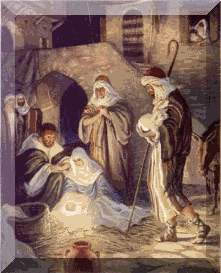
Mary’s Song

Jesus-Mary-Joseph

Blue homespun and the bend of my breast
keep warm this small hot naked star
fallen to my arms. (Rest…
you who have had so far to come.)
Now nearness satisfies
the body of God sweetly. Quiet he lies
whose vigor hurled a universe. He sleeps
whose eyelids have not closed before.

His breath (so slight it seems
no breath at all) once ruffled the dark deeps
to sprout a world. Charmed by dove’s voices,
the whisper of straw, he dreams,
hearing no music from his other spheres.
Breath, mouth, ears, eyes
he is curtailed who overflowed all skies,
all years. Older than eternity, now he
is new. Now native to earth as I am, nailed
to my poor planet, caught
that I might be free, blind in my womb
to know my darkness ended,
brought to this birth for me to be new-born,
and for him to see me mended
I must see him torn.

~ Luci Shaw

Let the Stable Still Astonish

Manger10

Let the Stable Still Astonish

Let the stable still astonish:
Straw-dirt floor, dull eyes,
Dusty flanks of donkeys, oxen;
Crumbling, crooked walls;
No bed to carry that pain,

And then, the child,
Rag-wrapped, laid to cry
In a trough.
Who would have chosen this?
Who would have said: “Yes,
Let the God of all the heavens and earth
Be born here, in this place”?
Who but the same God
Who stands in the darker, fouler rooms
of our hearts and says, “Yes,
let the God of Heaven and Earth
be born here–
in this place.”– Leslie Leyland Fields

Lord, With Glowing Heart I’d Praise Thee

Lord, with glowing heart I’d praise Thee,
For the bliss Thy love bestows,
For the pardoning grace that saves me,
And the peace that from it flows:
Help, O God, my weak endeavor;
This dull soul to rapture raise:
Thou must light the flame, or never
Can my love be warmed to praise.

Praise, my soul, the God that sought thee,
Wretched wanderer, far astray;
Found thee lost, and kindly brought thee
From the paths of death away;
Praise, with love’s devoutest feeling,
Him Who saw thy guilt-born fear,
And the light of hope revealing,
Bade the blood-stained cross appear.

Praise thy Savior God that drew thee
To that cross, new life to give,
Held a blood sealed pardon to thee,
Bade thee look to Him and live.
Praise the grace whose threats alarmed thee,
Roused thee from thy fatal ease;
Praise the grace whose promise warmed thee,
Praise the grace that whispered peace.

~ Francis Scott Key

~ Excerpted from the entire hymn here.

National Poetry Month

I just saw yesterday that April is National Poetry Month. I wouldn’t consider myself a big connoisseur of poetry. There is much I don’t know about poetry and much poetry I haven’t read or studied. I do like it. Some of it, anyway. As I said once before, in kind of my history with poetry, “When carefully chosen words really encapsulate a particular thought or feeling or truth in poetry, it just really hits home like nothing else.”

Here are just a couple of quotes about poetry:

A man should hear a little music, read a little poetry, and see a fine picture every day of his life, in order that worldly cares may not obliterate the sense of the beautiful which God has implanted in the human soul. ~ Johann Wolfgang von Goethe

This was a quote tugging at me after reading Janet’s quote from Darwin about not being able to enjoy poetry any more after neglecting it for so long.

This one was quoted in Challies’ mention of a quote from Alister McGrath’s biography of C.S. Lewis (C. S. Lewis – A Life: Eccentric Genius, Reluctant Prophet).

For Lewis, poetry works not by directing attention to the poet, but to what the poet sees: “The poet is not a man who asks me to look at him; he is a man who says ‘look at that’ and points.” The poet is not a “spectacle” to be viewed, but a “set of spectacles” through which things are to be seen. The poet is someone who enables us to see things in a different way, who points out things we otherwise might not notice. Or again, the poet is not someone who is to be looked at, but someone who is to be looked through.

A few years ago I listed some of my favorite poems here and here. and shared some here over the years. I tried my feeble hand at a few of my own: Ode to Hay Fever, Ode to a Summer Cold, and A Mother’s Nightly Ritual.

I think I’m going to make it my ambition for the rest of this month to read a poem a day. Here is one I just discovered:

Notes on the Art of Poetry

By Dylan Thomas

I could never have dreamt that there were such goings-on
in the world between the covers of books,
such sandstorms and ice blasts of words,,,
such staggering peace, such enormous laughter,
such and so many blinding bright lights,, ,
splashing all over the pages
in a million bits and pieces
all of which were words, words, words,
and each of which were alive forever
in its own delight and glory and oddity and light.

I’m linking up for Poetry Friday at hosted at Live Your Poem today.

“Jehovah Findeth None”

What Though th’ Accuser Roar

What though th’ accuser roar,
Of ills that I have done;
I know them well, and thousands more;
Jehovah findeth none.

Sin, Satan, Death, press near,
To harass and to appall;
Let but my risen Lord appear,
Backward they go and fall.

Before, behind, around,
They set their fierce array,
To fight and force me from my ground
Along Immanuel’s way.

I meet them face to face,
Through Jesus’ conquest blest;
March in the triumph of His grace,
Right onward to my rest.

There, in His book I bear
A more than conq’ror’s name,
A soldier, son, and fellow-heir,
Who fought and overcame.

His be the Victor’s name
Who fought our fight alone;
Triumphant saints no honor claim,
Their conquest was His own.

By weakness and defeat
He won the meed and crown
Trod all our foes beneath His feet,
By being trodden down.

He hell in hell laid low;
Made sin, he sin o’erthrew;
Bowed to the grave, destroyed it so,
And death, by dying, slew.

Bless, bless the Conq’ror slain!
Slain in His victory!
Who lived, who died, who lives again,
For thee, His Church, for Thee!

~ Samuel Whitelock Gandy

Shadow and Coolness

It’s supposed to get up into the 100s today. I am so glad for air conditioning! But the forecasted high temperatures reminded me of this poem. Amy Carmichael was a missionary in India for most of her adult life. The inspiration for this poem came as a result of the heat in India and the refreshing coolness to be found in the shadow, plus the story of the Israelites being led by the pillow of fire by night and the pillar of cloud by day in the book of Exodus.

I Follow Thee

Shadow and coolness, Lord,
Art Thou to me;
Cloud of my soul, lead on,
I follow Thee.
What though the hot winds blow,
Fierce heat beats up below?
Fountains of water flow –
Praise, praise to Thee.

Clearness and glory, Lord,
Art Thou to me;
Light of my soul, lead on,
I follow Thee.
All through the moonless night,
Making its darkness bright,
Thou art my heavenly Light –
Praise, praise to Thee.

Shadow and shine art Thou,
Dear Lord, to me;
Pillar of cloud and fire,
I follow Thee.
What though the way be long,
In Thee my heart is strong,
Thou art my joy, my song –
Praise, praise to Thee.

Happy Birthday, Robert Burns

I saw on Facebook that today was Robert Burns‘ birthday. Two of my ten favorite poems are his.

Scotland’s most well-known poet, Burns is a mixture of qualities. He had a pretty horrid personal life. He wrote rowdy drinking songs. I’d probably disagree with many of his views.

But he did have a tender, thoughtful heart and a unique way of expressing sentiment. One of my favorites of his poems is “To a Mouse,” where he laments accidentally upsetting the mouse’s home (the famous line, “The best laid schemes o’ Mice an’ Men, Gang aft agley,” or “oft awry” come from this poem). “A Red, Red Rose” is one of the most romantic poems/songs ever. “O Wert Thou in the Cauld Blast” speaks of sheltering someone else. “To a Louse” takes the irony of seeing one on a fine lady’s bonnet at church and makes the parallel, “O wad some Power the giftie gie us To see oursels as ithers see us.”

And somewhere along the way he been at least exposed to a godly family. In The Cotter’s Saturday Night he contrasts their simple faith and integrity with that of hypocritical religion, as shown in this excerpt:

Then, kneeling down to Heaven’s Eternal King,
The saint, the father, and the husband prays:
Hope “springs exulting on triumphant wing,”
That thus they all shall meet in future days,
There, ever bask in uncreated rays,
No more to sigh, or shed the bitter tear,
Together hymning their Creator’s praise,
In such society, yet still more dear;
While circling Time moves round in an eternal sphere

Compar’d with this, how poor Religion’s pride,
In all the pomp of method, and of art;
When men display to congregations wide
Devotion’s ev’ry grace, except the heart!
The Power, incens’d, the pageant will desert,
The pompous strain, the sacerdotal stole;
But haply, in some cottage far apart,
May hear, well-pleas’d, the language of the soul;
And in His Book of Life the inmates poor enroll.

I did read in some forgotten source a brother’s quote that he did not know what family Robert had in mind in this poem, but it certainly wasn’t theirs.

His great talent doesn’t excuse his sins. But sometimes we need to be reminded that a person is more than his sins: there’s more to a drunk than just his drunkenness or to a philanderer than his licentious ways. There’s a soul in there that Christ died for and wants to redeem. I don’t know how much Robert knew of the gospel and whether he believed it for himself: sadly, there is little evidence that he did. But for the people we encounter in these days, we can avoid writing them off for the negative we see and seek God’s wisdom to reach the inner person.

In celebration of Burns’ birthday, here is a reading of “To a Mouse” in the Scottish dialect. There is a more anglicized (and therefore more understandable to us) version here. A neat verse-by-verse analysis of the poem is here.

And here is Red, Red Rose set to music in a lovely arrangement by the King’s Singers:

I may not feel Him standing near

I had the last stanza of this in my files but failed to note how I came across it. In Googling a line of it, I found it came from a hymn titled, “Surrounded By Unnumbered Foes.” I have never heard it sung, but I thought it was good, especially the last stanza.

Surrounded by unnumbered foes,
Against my soul the battle goes;
Yet though weary, sore distressed,
I know that I shall reach my rest:
I lift my tearful eyes above—
His banner over me is love.

Its sword my spirit will not yield,
Though flesh may faint upon the field;
He waves before my fading sight
The branch of palm, the crown of light:
I lift my brightening eyes above—
His banner over me is love.

My cloud of battle-dust may dim,
His veil of splendour curtain Him;
And, in the midnight of my fear,
I may not feel Him standing near:
But as I lift mine eyes above,
His banner over me is love.

— Gerald Massey, 1863