The Captain of My Fate

Some years ago during the brief four years we taught at home, our curriculum contrasted two poems. The first was “Invictus” by William Ernest Henley:

Out of the night that covers me,
Black as the Pit from pole to pole,
I thank whatever gods may be
For my unconquerable soul.

In the fell clutch of circumstance
I have not winced nor cried aloud.
Under the bludgeonings of chance
My head is bloody, but unbowed.

Beyond this place of wrath and tears
Looms but the Horror of the shade,
And yet the menace of the years
Finds, and shall find, me unafraid.

It matters not how strait the gate,
How charged with punishments the scroll.
I am the master of my fate:
I am the captain of my soul.

The second poem is obviously a response to the first: “Conquered By Christ” by Dorothea Day:

Out of the light that dazzles me,
Bright as the sun from pole to pole,
I thank the God I know to be,
For Christ – the Conqueror of my soul.

Since His the sway of circumstance,
I would not wince nor cry aloud.
Under the rule which men call chance,
My head, with joy, is humbly bowed.

Beyond this place of sin and tears,
That Life with Him and His the Aid,
That, spite the menace of the years,
Keeps, and will keep me unafraid.

I have no fear though straight the gate:
He cleared from punishment the scroll.
Christ is the Master of my fate!
Christ is the Captain of my soul!

My son at that time had a problem with wanting to yield the captaincy of his fate to Another. That’s understandable. We’re born with an intense self-will. We’re hesitant to trust someone else with our destiny. We want to make our own choices.

But once when I did a lengthy study on one’s “own” way in the Bible, I found that following our own way didn’t usually turn out well. Here are just a couple of examples:

“All we like sheep have gone astray; we have turned—every one—to his own way; and the Lord has laid on him the iniquity of us all.” Isaiah 53:6

“The backslider in heart will be filled with his own ways, But a good man will be satisfied from above.” Proverbs 14:14.

I didn’t realize until looking for these poems online that a handwritten copy of “Invictus” was the only statement Timothy McVeigh left behind when he was executed (see here). Invictus means “unconquerable.” How sad to remain unconquered only to come to such an end. “Therefore shall they eat of the fruit of their own way, and be filled with their own devices” Proverbs 1:31.

It’s one of those seeming paradoxes of Scripture that “Whosoever shall seek to save his life shall lose it; and whosoever shall lose his life shall preserve it” (Luke 17:33). Whatever we want to hold onto for ourselves we will eventually lose. What we yield to Christ He will keep for us and give back so much more.

There is good reason to trust Christ as our Captain. He knows what is ahead. He has the wisdom to guide us. He has the power to keep us. When the path passes through deep waters or dark shadows, He promises to be with us and uphold us. He loves us so much that He gave His own life for us and has promised to provide for everything we need, not only physically but spiritually. He is the only One Who can provide for us beyond the grave. He is more than worthy of our Captaincy and our trust.

“The Discipline of Commitment”

After I first became a Christian, when I would become convicted of some sin, I’d make a commitment never to do that again…and of course, fall flat on my face. So I began to think making a commitment was not the way to go about it and was, in fact, setting oneself up for failure. And since it is better not to make a vow than to vow and not fulfill it, I began to just pray that the Lord would help me not to do that particular thing.

But Jerry Bridges makes a compelling argument for making commitments against sin in the chapter “The Discipline of Commitment” in his book The Discipline of Grace. For one thing, in Scripture we see people like Job (“I made a covenant with mine eyes; why then should I think upon a maid?” Job 31:1) and Daniel (“But Daniel purposed in his heart that he would not defile himself with the portion of the king’s meat, nor with the wine which he drank” Daniel 1:8) do so.

But before we get into making specific commitments against specific sins, we’re called to commit ourselves totally to the Lord. Romans 12:1 says, “I beseech you therefore, brethren, by the mercies of God, that ye present your bodies a living sacrifice, holy, acceptable unto God, which is your reasonable service.” Bridges says, “When we commit ourselves to the pursuit of holiness, we need to ensure that our commitment is actually to God, not simply to a holy lifestyle or a set of moral values” (p. 148).

Also, “We should not seek holiness in order to feel good about ourselves, or to blend in with our Christian peer group, or to avoid the sense of shame and guilt that follows the committing of persistent sin in our lives. Far too often our concern with sin arises from how it makes us feel” (p. 149). And we need to guard against being “more vexed at the lowering of our self-esteem than we are grieved at God’s dishonor” (p. 149).

Plus, our commitment should not but just to avoid sin, but to pursue Christlike virtues. Colossians 3:12 says, “Put on therefore, as the elect of God, holy and beloved, bowels of mercies, kindness, humbleness of mind, meekness, longsuffering.”

Psalm 119:106 says, “I have sworn, and I will perform it, that I will keep thy righteous judgments.” Bridges quotes Stephen Charnock as saying, “Frequently renew settled and holy resolutions. A soldier unresolved to fight may easily be defeated” (p. 151). “If you do not commit yourself to the pursuit of holiness in these specific areas of your life, you will find a tendency to vacillate in the face of these temptations” (p. 159).

Perhaps the hardest thing for me in this chapter was Bridges’ consistent urge to allow no exceptions. “If we do not make such a commitment to obedience without exception, we will find ourselves constantly making exceptions” (p. 153).

But how can we do such a thing? Bridges says one way is by intention. “Is it our intention to please God in all our actions?” (p. 152). He quotes William Law as saying that our lack of holiness often is due to a lack of intention. Law goes on to say, “This doctrine does not suppose that we have no need of divine grace, or that it is in our own power to make ourselves perfect. It only supposes that through the [lack] of a sincere intention of pleasing God in all our actions, we fall into such irregularities of life, as by the ordinary means of grace, we should have power to avoid” (p. 153). Or as I saw quoted somewhere else recently, “Drift is almost always away.” When we don’t have a daily intent to please God in everything, we’re going to find ourselves allowing those things that don’t please Him.

What about grace? Doesn’t this all sound a little legalistic?

“Is God really this strict?” Yes…because he cannot compromise His holiness the least bit. His goal is to conform us to the likeness of His Son, and Jesus was completely without sin, though He was tempted every way we are (Hebrews 4:15). No, we cannot, or perhaps will not, keep these commitments perfectly, but keeping them perfectly should at least be our aim. In a battle, some soldiers will always be hit, but every one of them makes it his aim not to be hit. To have a lesser aim would be the height of folly. (p. 160).

“It was in view of God’s mercy that Paul urged the Romans, and us today, to commit our bodies as living sacrifices, holy and pleasing to God” (p. 160). Paul had spent the preceding 11 chapters of Romans detailing God’s grace in the gospel. Bridges has several paragraphs, too long to repeat here, bringing out some of the truths of grace from the first part of Romans.

“It is this mercy that is reveled to us in the gospel and that we believers have experienced that is the ground for our commitment. Such a commitment as Paul called for would indeed be a legalistic and oppressive commitment if it were not grounded in love. And the only way Paul would stir up our love is to remind us of God’s love for us, revealed through His mercy and grace. What Paul asked for from us is only a response of love and gratitude, which expresses itself in loving commitment (p. 161).

God provides the grace for the commitment He calls us to (Romans 6:11-14, Hebrews 4:15-16). We need to remind ourselves of the gospel frequently not just to cleanse our consciences, but to reaffirm our commitment to Him as a response of love and gratitude (p. 162-163).

On a personal note…in the course of reading this chapter, I became convicted of a bad driving habit. You wouldn’t think to look at me that I’d be guilty of “road rage,” and as a general rule I am not an angry driver, but when other drivers do something particularly dumb that impacts me, I can get pretty hot under the collar. Just recently I had been stuck behind not one but two different pokey drivers on roads where I couldn’t pass, and I was in danger of being late for church, so when the second one finally turned off the road, I gunned the engine and veered around him before he was totally turned. Then I noticed a car behind me, and hoped it wasn’t someone from church…but it was (and interestingly, after this incident, Bridges shared a very similar one, driving the conviction even deeper.) I always feel guilty about these incidents and think, “I really shouldn’t react that way.” But while reading this chapter I began to feel that I should go further than that. I made a commitment that, God helping me, I would not react in anger while driving for several reasons: It’s dangerous (I could hit someone else while angrily reacting), it is a poor testimony to the driver I’m reacting to as well as anyone watching, and it is not demonstrating the self-control that is a fruit of the Holy Spirit. And, of course, I’ve been tested on this about 3 times since then…but God has used the commitment, or intention, to remind me and help me not to respond in a fleshly way. Bridges urges us to make a general commitment as well as commitments in specific areas….I think if I did that I’d have a very long list to work on, but this is a start.

“The Discipline of Commitment” is the 9th chapter in the book The Discipline of Grace by Jerry Bridges, which we’re discussing every Thursday in the “Reading Classics Together” challenge at Challies‘ place. More discussion on this chapter is here. I had to miss Thursday, but wanted to go through the chapter anyway for my own edification.

“Transformed Into His Likeness”

“Transformed Into His Likeness” is the sixth chapter in the book The Discipline of Grace by Jerry Bridges, which we’re discussing every Thursday in the “Reading Classics Together” challenge at Challies‘ place.

When believers are first saved, the penalty for their sin is lifted, having been borne by Christ on the Christ, and His righteousness is put to their account. Yet they still have what the Bible calls their old nature or “old man” within them. Sanctification is the word for the process whereby Christians are gradually transformed from looking and acting like the “old man” to looking and acting more like Christ. It happens in fact at salvation, it happens progressively through life, and it culminates in our perfection when we get to heaven. Or, as Bridges explains it:

Sanctification is the work of the Holy Spirit in us whereby our inner being is progressively changed, freeing us more and more from sinful traits and developing within us over time the virtues of Christlike character. However, though sanctification is the work of the Holy Spirit in us, it does involve our wholehearted obedience and the regular use of spiritual disciplines that are instruments of sanctification (p. 96).

It is “the carrying out of regeneration to its intended end” (p. 99).

You don’t hear this so much these days, but there used to be people who thought that their entire old nature was removed or changed when they became Christians and they could no longer sin. I don’t know how they missed the remaining sinful tendencies in their own hearts or the verses in the Bible that speak of our growth and change.

Today we have more of the opposite problem: people who say they have been regenerated (saved), yet do not display any evidence of a new life or any growth spiritually. Bridges says, “The solution for these people is not to change their conduct so that they might see some evidences of regeneration. The solution is to come to Jesus, renouncing any confidence in their own goodness, confessing themselves to be sinners in the sight of God, and trusting entirely in His atoning work” (p. 98).

After one becomes a Christian, the goal of our transformation is to become more like Christ. “To be like Jesus…is to always seek to do the will of the Father…Not only did Jesus do the will of the Father, not only was that His whole goal in life, but Psalm 40:8 tells us He delighted to do the will of the Father…What is our aim? Is it to please the Father in all we do, or is it just to get through life as comfortably as we can? (p. 102).

But it is not just in our actions and goals that we’re transformed into Jesus’ likeness, but in our character.

This process involves the Holy Spirit’s leading and enabling and our obedience and cooperation.

Our part, that is, our response to the Holy Spirit’s work and our cooperation with Him in His work is the pursuit of holiness…the pursuit of holiness, though requiring diligent effort on our part, is dependent on the enabling power of the Holy Spirit…It is difficult to grasp this principle of being responsible yet dependent. But it is absolutely vital that we grasp and live by it” (p. 100).

In my circles, the idea of progressive sanctification is taught often, but the emphasis tends to be more on our responsibility.  It wasn’t an entirely new thought that Holy Spirit was the agent, the enabler, the One ultimately responsible for our transformation, but I had never heard this truth brought out as thoroughly as Bridges does it, and that was a great blessing to me. Among his comments on this aspect:

Paul said in 2 Corinthians 3:18 that we are being transformed by “the Lord, who is the Spirit.” The verb being transformed is passive, that is, something being done to us, not by us. This does not mean we have no responsibility in sanctification. It means that in the final analysis it is the Spirit of God who transforms us. He calls on us to cooperate and do the part He assigns us to do, but He is the one who works deep within our character to change us (p. 106).

Several passages of Scripture emphasize the fact that sanctification is primarily the work of the Holy Spirit. In 1 Thessalonians 5:23-24 Paul said, “May God himself, the God of peace, sanctify you through and through. May your whole spirit, soul and body be kept blameless at the coming of our Lord Jesus Christ.The one who calls you is faithful, and he will do it.”…

Again, Paul wrote in Philippians 1:6, “being confident of this, that he who began a good work in you will carry it on to completion until the day of Christ Jesus.”(p. 107).

Finally, the writer of Hebrews prayed that God will “work in us what is pleasing to Him” (Hebrews 13:21) (p. 107).

Yet:

The Spirit of God has indeed given us certain responsibilities in the sanctifying process. In fact, the Bible is filled with exhortations, challenges, and commands to obey, as well as spiritual disciplines to be practiced (p. 107).

I’ve often wondered what exactly is our part and what is His, where does one end and one begin, how does it all work together. Bridges says this is a mystery. It is never quite thoroughly explained in Scripture. But as we do our part, we trust Him for His enabling and transforming.

Bridges then goes on to discuss the various means that the Holy Spirit uses in our sanctification: adversities, exhortations and encouragement from others, Scripture, and prayer. But perhaps the most significant means is found in 2 Corinthians 3:18: “But we all, with unveiled face, beholding as in a mirror the glory of the Lord, are being transformed into the same image from glory to glory.” “The glory of the Lord denotes the presence of God and all that He is in all of His attributes — His infiniteness, eternalness, holiness, sovereignty, goodness, and so on…God is glorious in all of His being and all of His works” (p. 109). The more we seek Him and gaze on Him in Scripture, the more we are transformed into His likeness.

More discussion on this chapter can be found here. My discussions of previous chapters are here.

Disciplined by Grace

“Disciplined by Grace” is the fifth chapter in the book The Discipline of Grace by Jerry Bridges, which we’re discussing every Thursday in the “Reading Classics Together” challenge at Challies‘ place.

“Disciplined by Grace” seems an oxymoron to many who don’t associate the two together, but Bridges asserts that that’s because of a misunderstanding of both concepts.

The epigraph for this chapter is Titus 2:11-12: “For the grace of God has appeared that offers salvation to all people. It teaches us to say ‘No’ to ungodliness and worldly passions, and to live self-controlled, upright and godly lives in this present age.”The word for “teach” there “means much more than…imparting knowledge. Originally it was used as a term for the rearing of children and included not only instruction, but also admonition, reproof, and punishment, all administered in love and for the benefit of the child” (p. 80).

Spiritually, “discipline includes all instruction, all reproof and correction, and all providentially directed hardships in our lives that are aimed at cultivating spiritual growth” (p. 80). But, “all of God’s disciplinary processes are grounded in His grace – His unmerited and unconditional favor toward us (p. 80).

It’s so important to keep these two concepts in balance. With a heavier leaning towards discipline, even good spiritual practices designed to grow us can become performance-based (thinking we earn God’s favor by doing them), while a heavier leaning toward grace can lead to laxity.

Bridges points out from the verse above that grace teaches us to say “No” to some things — ungodliness and worldly passions (and he points out that ungodliness is basically “disregarding God, ignoring Him,  or not taking Him into account in one’s life. It is a lack of fear and reverence for Him”[(p. 85]) — and “Yes” to others — self control, uprightness, and godliness. This is the basic “put off/put on” scenario of Ephesians 4:20-32.

But we need to always remember “With all this emphasis on practical Christian living…we must lose sight of the fact that it is grace — not law — that teaches us” (p. 92). The law “commanded but gave no ability to obey” and then “condemned me for my failure to obey” (p. 92).  But “where the law condemns, grace forgives through the Lord Jesus Christ. Where the law commands but gives no power, grace commands but does give power through the Holy Spirit who lives and works in us” (p. 93).

I appreciated, too, what Bridges pointed out about the fact that while our acceptance before God is on the basis of grace rather than our “performance,” on the other hand, there are many admonitions about the importance of our testimony before unbelievers and the harm that can be done to the cause of Christ by a poor example in ourselves (pp. 89-90).

More discussion on this chapter is here.

Previous chapters discussed from The Discipline of Grace are:

1) How Good Is Good Enough?
2) The Pharisee and the Tax Collector
3) Preach the Gospel to Yourself
4) We Died to Sin.

“Preaching the Gospel to Yourself”

I’m joining in the “Reading Classics Together” at Challies‘ place, and the book currently under discussion is The Discipline of Grace by Jerry Bridges.

I wasn’t able to discuss last week’s chapter due to family activities with loved ones from out of town, but its title was “The Pharisee and the Tax Collector.” Tim summed it up nicely here, but I’ll just say, if anyone has any shred of hope in their own goodness, this chapter will trounce that idea. We think we’re ok, like the Pharisee, because we don’t do any of the “really bad,” obvious sins like murder, adultery, etc., but we overlook our “refined” sins like pride, envy, and the like. But sin is sin. And even the good we do is shot through with wrong motives and lack of faith.

It could actually be a depressing chapter, even for one who has known those truths for years. But it is necessary to remind ourselves of those things in order to see the need for God’s grace, not just for salvation, but for daily living that pleases Him.

The title of the current chapter is “Preach the Gospel to Yourself.” My former music pastor once said that the gospel is not just the first step of the Christian life, but it is the hub of the wheel that everything else in the Christian life connects to and emanates from. Bridges says “The gospel is for believers also, and we must pursue holiness, or any other aspect of discipleship, in the atmosphere of the gospel” (p. 46).

Bridges then thoroughly discuss Romans 3:19-26, bringing out the gospel truths that “no one is declared righteous before God by observing the law,” “there is a righteousness from God that is apart from the law,” “the righteousness of God is received through faith in Jesus Christ,” “this righteousness is available to everyone on the same basis because we have all sinned and fall short of the glory of God,” “all who put their faith in Jesus Christ are justified freely by God’s grace,” “this justification is ‘through the redemption that came by Christ Jesus,'” and “God presented Jesus as a sacrifice of atonement, through faith in His blood.” Those phrases are all sections of the chapter that he then discusses in more detail.

One important distinction he makes is that between “justification and mere pardon. A pardon is excusing an offense without exacting a penalty, “such as when a president or governor pardons someone even though they are guilty. “In God’s plan of justification, however, justice is not violated by a gratuitous pardon of the convicted sinner. Rather, justice has been satisfied; the penalty has been fully paid by the Lord Jesus Christ” (p. 56).

“It is not our contrition or sorrow for our sin, it is not our repentance, it is not even the passing of a certain number of hours during which we feel we are on some kind of probation that cleanses
us. It is the blood of Christ, shed once for all on Calvary . . . that cleanses our consciences and gives us a renewed sense of peace with God” (p. 58).

“To preach the gospel to yourself, then, means that you continually face up to your own sinfulness and then flee to Jesus through faith in His shed blood and righteous life. It means you appropriate again, by faith, the fact that Jesus fully satisfied the law of God, that He is your propitiation, and that God’s holy wrath is no longer directed toward you” (p. 59). Just as in salvation we depended on Jesus’s goodness and righteousness rather than our own, so we do every day of our Christian lives as well, rejoicing that our sins are forgiven and we face no condemnation since we are in Christ.

This does not mean we do not pursue holiness. Much of the latter part of the book discusses holiness. It’s not that once we’re forgiven, we sit back, relax, and live however we want til we get to heaven. Rather, out of love for God and gratitude to Him, we should be even more motivated to pursue holiness. But we need to remember “when you set yourself to seriously pursue holiness, you will begin to realize what an awful sinner you are. And if you are not firmly rooted in the gospel and have not learned to preach it to yourself every day, you will soon become discouraged and will slack off in your pursuit of holiness” (p. 60).

On a side note, I have to admit, before reading this chapter, the phrase “preach the gospel to yourself every day” grated on me a bit. Not that I didn’t believe its truths, even before reading here, but we have such a tendency to operate by catch-phrases: I kept seeing and hearing this brought up in the face of any problem or situation. Yes, if someone has financial or marital or other problems, we do apply the truth of the gospel to it and operate on the basis of the forgiveness wrought for us in Christ. But as Wendy Alsup often says, the gospel affects everything, but the gospel isn’t everything. We apply the gospel and operate from its base, but we go on to learn the whole counsel of God and apply it to our lives as well.

This chapter is very beneficial. I would even venture to say it is the key chapter of the book. More discussion of it is here.

Listening to God

I just saw this today at The Good Life, and it really speaks to something I’ve been pondering recently. It’s from God’s Wisdom in Proverbs by Dan Phillips, which I haven’t read, nor do I know much about Dan Phillips, but I appreciate this quote:

“Listen” does not mean, here or anywhere else in Scripture, to harken to a subjective, mystical, murmury, semi-revelatory inner voice of God. God has no intention of turning our attention within ourselves, of urging us to seek after holy hunches and vaporous mumblings inside our own deluded hearts. He categorically condemns such orientation (Prov. 28:26; Jer. 17:9). God knows all too well that dense foolishness is “original factory equipment” in our fallen minds, thanks to Great-Great-Grandad Adam (Prov. 22:15).

No, God is not speaking of our listening to the inscrutable mumblings of some spirit, as if it were His Spirit. Rather, here and everywhere God is urging us to listen to the Word of God (cf. 1:23, 33; 16:20; contrast 28:9). The content makes this unavoidable. Solomon means the wise man to listen to the words he is writing. Internal, lowgrade, spiritual “sweet nothings” would have been far from the inspired king’s mind.
~Dan Phillips
God’s Wisdom in Proverbs

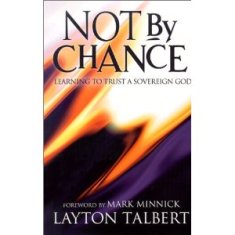
Book Review: Not By Chance: Learning to Trust a Sovereign God

As I mentioned when I reviewed Beyond Suffering: Discovering the Message of Job by Layton Talbert, my husband and I have known Dr. Talbert for years, back before he was a PhD., before he was married….when he still had hair. 🙂 He was one of the adult Sunday School teachers at the church we attended when we were first married, and sitting under his teaching plus reading his columns in Frontline magazine, have caused me to trust his treatment of Scripture. But that trust did not come just from knowing him, but rather because of attitudes such as this:

The Holy Spirit is not capricious or careless in His use of words. It is incumbent upon us, therefore, to handle the text of Scripture attentively and accurately. If we are to form a correct understanding of the facts of the story (and, consequently, to arrive at sound theological conclusions), it is vital that we carefully observe the details — and confine our conclusions to the information explicitly communicated by those details (p. 87).

And:

We are not at liberty to draw inferences that contradict other explicit statements of Scripture. And we must be tentative about defending apparently logical inferences that carry us beyond explicit statements of Scripture (p. 252).

Though he would not claim infallibility, nor would I claim it for him, Dr. Talbert’s detailed study and respect for the Word of God and carefulness and balance in teaching it makes his books trustworthy.

I first picked up Not By Chance: Learning to Trust a Sovereign God years ago mainly because it was his with the thought, “Yes, I should read that some time.” I believed in God’s sovereignty and providence and was often comforted by it, so I wasn’t quick to plunge into a book about it, even as much as I respected its author. But like I suspect is the case for many of us, it’s when something bad or seemingly incongruous happens to shake us up that we begin to wonder about God’s providence, not to question it per se, but to wonder how this or that fits into it.

Dr. Talbert begins by discussing what providence means and thoroughly examining Scripture concerning God’s providence over man, creation, weather, opportunities…and multitudes of other things. By the end there is no escaping the fact that God is in control. And while that’s a comfort on one hand, it’s a conundrum on the other: what about the bad things?

Dr. Talbert covers that well, too. Notice I didn’t say he explains it. There are some things about providence that we can’t understand or fully explain, just like we don’t thoroughly understand the Trinity, or the fact that Jesus is both fully God and fully man at the same time, and other mysteries. But he does shed as much light on it from Scripture as he can, and it does help. For instance, in dealing with a mistaken logical inference, he says:

We often assume that all good things come from God and all “bad” things come from Satan. That is a false and unbiblical assumption that gives Satan far too much credit and attributes to him far more power than he actually possesses. Contrary to popular misconception, Satan is not God’s evil counterpart, but Michael’s. Satan, like Michael, is “only” an angel; so he is an evil angel, not an evil God. Jehovah Himself claims that He is the only God and the ultimate ruler over all our circumstances, both the “good” and the “bad” (p. 12).

And here:

God guides and governs all events, including the free acts of men and their external circumstances, and directs all things to their appointed ends for His glory.

Notice that this definition does not say that God initiates or causes all events. If we are to maintain Biblical precision in our understanding and application of Scriptural truth, the terms we choose to state it are vital (p. 62).

And from a study of the life of Joseph:

God also providentially superintends and often uses the unfairnesses of life to accomplish His purposes in and for us and those around us (p. 66).

This is something many of us wrestle over:

Part of the mystery of providence resides in the fact that God rules and reigns over all things according to His will and pleasure (Ephesians 1:11), yet man is still fully responsible and accountable for his choices and actions. In other words, God exercises His providence and accomplishes His will through the free and voluntary choices and attitudes of men and women. Were this fact limited to God’s persuasive working in believers, that would be amazing enough. But it is equally true of the wicked. God never prompts evil men to sin, yet even their rebellion against Him and their hostility against His people is providentially governed and employed by God. (The clearest example of this…[is] found in the events surrounding the Crucifixion) (p. 86).

Sometimes pondering providence can lead us to think that it doesn’t matter what we do since God is in control anyway. But Dr. Talbert reminds us that God has assigned certain duties to us in Scripture and providentially works through them.

The providence of God is never intended to lull us into a lackadaisical attitude of fatalism, as if our actions don’t really matter because God rules and overrules however He wants anyway. It is revealed to maintain a glow of energizing trust that, despite all appearances to the contrary, God is governing for His glory and for my good — a trust that inspires me to stay faithful, obedient, loyal and devoted to Him, and confident in Him…God’s providence, then, encompasses and incorporates the faithfulness and obedience of His children (p. 70).

There are chapters on God’s preserving providence, governing providence, the mystery of providence, the means of providence, silent providence, the problems of providence, providence and prayer (why pray when God is in control? this is an excellent chapter) and case studies from Biblical characters illustrating the truths being taught. Plus there are chapters on God’s providence displayed in the incarnation and passion of Christ and the church. There is a wonderful section in the study of Joseph about why God sometimes allows delays and what He accomplishes through them. There are several appendices, one being the two sides salvation: God’s determination and man’s responsibility.

I marked over 60 quotes that especially stood out to me, so there’s no way I could share all of them here. But here are just a few more:

When we are willing to submit to and practice only what immediately makes sense to us, and ignore what doesn’t (even when it is clearly commanded), we have substituted ourselves — our finite mind — as the sovereign (p. 215).

[God] is the Maestro of providential orchestration, of split-second timing, of perfect point and counterpoint (p. 249).

We dare not construct a system of theology that helps the Holy Spirit by refining or redefining the words He selected or by interposing words He chose to omit so as to tweak out of it, ever so gently, a slightly modified meaning that better fits the system (p. 259)

One of the absolute best statements I’ve ever heard as to why God’s providence allows for hard or painful things was quoted from Steve Estes, in When God Weeps with Joni Eareckson Tada:

“God permits what He hates to achieve what He loves.”

In short (although I guess it is too late to say that, huh? 🙂 ) I do very highly recommend this book.

(This review will also be linked to Semicolon‘s Saturday Review of Books.)

Our relationship with God

Our relationship with God is portrayed by many different metaphors. Some relate directly to God the Father, some to Christ. Some might seem to contradict each other, but they are all facets of that relationship. Books could be (and have been) written about many of these categories, but here are just a few verses about each one.

Father/children:

John 1:12-13: But as many as received him, to them gave he power to become the sons of God, even to them that believe on his name: Which were born, not of blood, nor of the will of the flesh, nor of the will of man, but of God.

I John 3:1: Behold, what manner of love the Father hath bestowed upon us, that we should be called the sons of God: therefore the world knoweth us not, because it knew him not.

John 3:3: Jesus answered and said unto him, Verily, verily, I say unto thee, Except a man be born again, he cannot see the kingdom of God.

Galatians 4:6: And because ye are sons, God hath sent forth the Spirit of his Son into your hearts, crying, Abba, Father.

Bride/Bridegroom:

Isaiah 61:10: I will greatly rejoice in the LORD, my soul shall be joyful in my God; for he hath clothed me with the garments of salvation, he hath covered me with the robe of righteousness, as a bridegroom decketh himself with ornaments, and as a bride adorneth herself with her jewels.

Revelation 21:2: And I John saw the holy city, new Jerusalem, coming down from God out of heaven, prepared as a bride adorned for her husband.

Shepherd/Sheep:

John 10:11: I am the good shepherd: the good shepherd giveth his life for the sheep.

John 10:14: I am the good shepherd, and know my sheep, and am known of mine.

Isaiah 53:6: All we like sheep have gone astray; we have turned every one to his own way; and the Lord hath laid on him the iniquity of us all.

The characteristics of a sheep and the care given by the shepherd makes for fascinating study.

Savior/sinners:

Luke 1:47: And my spirit hath rejoiced in God my Saviour.

Titus 2:13-14: Looking for that blessed hope, and the glorious appearing of the great God and our Saviour Jesus Christ; Who gave himself for us, that he might redeem us from all iniquity, and purify unto himself a peculiar people, zealous of good works.

King/subjects:

Colossians 1:13:  Who hath delivered us from the power of darkness, and hath translated us into the kingdom of his dear Son.

Matthew 25:31-33: When the Son of man shall come in his glory, and all the holy angels with him, then shall he sit upon the throne of his glory: And before him shall be gathered all nations: and he shall separate them one from another, as a shepherd divideth his sheep from the goats: And he shall set the sheep on his right hand, but the goats on the left.

Teacher/ disciple:

Multitudes of verses about this one.

Relatives of Christ:

Mark 3:35: For whosoever shall do the will of God, the same is my brother, and my sister, and mother.

Friends:

John 15:14-15: Ye are my friends, if ye do whatsoever I command you. Henceforth I call you not servants; for the servant knoweth not what his lord doeth: but I have called you friends; for all things that I have heard of my Father I have made known unto you.

Master/servant:

Whoa, wait a minute. Is that even politically correct? And doesn’t that contradict John 15:14-15, quoted just above?

We’re not servants in the sense of being captured and chained and made slaves against our will. We’re not even really servants in the sense of a quiet butler or housekeeper who do their duties as silently and invisibly as possible. Paul wrote in Galatians 1 about the difference between being sons and servants. Yet in many of his epistles he identified himself as the servant of Christ.He called Epaphras a “servant of Christ.” In Romans 6 he talked about being a servant to whatever we yield ourselves to. I Corinthians 9:19 sheds some light when he says, “For though I be free from all men, yet have I made myself servant unto all, that I might gain the more.” Galatians 5:13 says, “For, brethren, ye have been called unto liberty; only use not liberty for an occasion to the flesh, but by love serve one another.”

Jesus was the primary example of a servant. He is called a servant in Old Testament prophecies. Though identifying Himself as Lord and Master, he washed his disciples feet (John 13) and told His disciples to follow His example (vv. 14-15). Philippians 2:5-8 tells us “Let this mind be in you, which was also in Christ Jesus: Who, being in the form of God, thought it not robbery to be equal with God: But made himself of no reputation, and took upon him the form of a servant, and was made in the likeness of men: And being found in fashion as a man, he humbled himself, and became obedient unto death, even the death of the cross.”

There is an illustration in Deuteronomy about a slave who was given his freedom but out of love chose to stay and serve his master. I think that’s the picture of the type of servants we are. God is the Lord and Master of the universe: He could easily make us do whatever He wanted us to. But He wants us to serve Him with willing and loving hearts.

I don’t mean to be silly or irreverent, but I see glimpses of this in Star Trek or war movies. When you see the captain barking out orders, those under him (usually) willingly obey because they trust him and they are all working for the good of the whole crew. Yet because he cares for them, his relationship with them is more than just giving orders.

A visiting preacher once told of a friend who was on an airplane and noticed that one of the flight attendants was especially attentive, thoughtful, courteous, and went the extra mile in meeting her passenger’s needs. Exiting the flight, he told he he really appreciated the way she took care of her passengers, ending by saying, “You have a real servant’s heart.” In my circles that’s a compliment, but we have to be careful about our “Christian cliches” and the way others might misunderstand them. This woman smiled and appreciated his comments until he said the word “servant,” then she bristled and said she was most definitely not a servant. I can understand that reaction with the negative connotation associated with that word in the world. But she truly was serving, in the best of ways, and we can and should as well, thinking of others’ needs before our own.

Happy Easter!

See, what a morning, gloriously bright,
With the dawning of hope in Jerusalem;
Folded the grave-clothes, tomb filled with light,
As the angels announce, “Christ is risen!”
See God’s salvation plan,
Wrought in love, borne in pain, paid in sacrifice,
Fulfilled in Christ, the Man,
For He lives: Christ is risen from the dead!

See Mary weeping, “Where is He laid?”
As in sorrow she turns from the empty tomb;
Hears a voice speaking, calling her name;
It’s the Master, the Lord raised to life again!
The voice that spans the years,
Speaking life, stirring hope, bringing peace to us,
Will sound till He appears,
For He lives: Christ is risen from the dead!

One with the Father, Ancient of Days,
Through the Spirit who clothes faith with certainty.
Honor and blessing, glory and praise
To the King crowned with pow’r and authority!
And we are raised with Him,
Death is dead, love has won, Christ has conquered;
And we shall reign with Him,
For He lives: Christ is risen from the dead!

~Keith and Kristyn Getty

(Graphic courtesy of Made 2 B Creative.)

Do you recognize Him?

A devotional book I read as a teen-ager (sadly, I can’t remember the name of it) started off with the story from John 21 about how the disciples went fishing after Jesus’ death, and how He appeared in His resurrected body on the shore asking if they had caught anything. They had fished through the night and caught nothing. He told them to cast their net on the other side, and they did so and caught so many fish they couldn’t draw the net in. John, the “disciple whom Jesus loved,” recognized then, “It is the Lord.” The devotional went on to encourage us to recognize the hand of God in our daily lives.

For some reason that particular lesson is all that I can specifically remember from that book, but it has stayed with me for years. I hate the little quip that “Coincidences are God’s way of remaining anonymous” because God is not in the business of remaining anonymous! He wants people to see His actions, influence, and provision.

Earlier this week I heard a story of  brother and sister in our church. The sister was known as a very slow driver, and in one outing with her brother he was getting after her about going faster. At a stop light she decided to tease him by just puttering along as slowly as she could. She was in a double turn lane, and the car beside her shot ahead — and got hit by someone running the red light. What was meant as a bit of fun was used to protect them.!

But its not just in the more dramatic episodes where He is at work and wants us to recognize Him, and He doesn’t want just His children to recognize Him. The Father “maketh his sun to rise on the evil and on the good, and sendeth rain on the just and on the unjust” (Matthew 5:45b).

And it’s not just in the good things that happen where we see His hand. He allows illnesses, accidents, losses, loneliness and such for many different reasons, all designed to focus our attention on Him, to draw us closer to Him, to meet some need in our life or to manifest His glory.

I am the LORD, and there is none else, there is no God beside me: I girded thee, though thou hast not known me: That they may know from the rising of the sun, and from the west, that there is none beside me. I am the LORD, and there is none else. Isaiah 45:5-6.

For she did not know that I gave her corn, and wine, and oil, and multiplied her silver and gold, which they prepared for Baal. Hosea 2:8.

That they may know that this is thy hand; that thou, LORD, hast done it. Psalm 109:27.