When in a strait place

I came across this in my files while working on the ladies’ newsletter for church and thought it might be helpful to some of you:

First: He brought me here, it is by His will I am in this strait place; in that I will rest.

Next: He will keep me here in His love, and give me grace in this trial to behave as His child.

Then: He will make the trial a blessing, teaching me the lessons He intends me to learn, and working in me the grace He means to bestow.

Last: In His good time, He can bring me out again–how and when, He knows.

Say: I am HERE–By God’s appointment, in His keeping, under His training, for His time.

~ Andrew Murray


Learning from the Savior’s learned obedience

One of the verses in my Daily Light reading for this morning was Hebrews 5:8: “Though he were a Son, yet learned he obedience by the things which he suffered.” The context for all the rest of the verses in today’s reading had to do with affliction, but that phrase about Jesus learning obedience arrested me, not for the first time. He had always obeyed the Father perfectly, but in Gethsemane  was the first time, as far as we know, that He prayed “not my will, but thine, be done” (Luke 22:42). So perhaps learning obedience had to do with obeying the Father’s will despite His own will? (There is more helpful commentary on this verse at the bottom of this page.)

One way in which this encourages me is to observe how the sinless Son of God obeyed and endured. Here are a few thoughts:

1. Our will and His will. It’s not necessarily wrong to struggle with God’s will. For us, more often that not, it usually is a problem of faith or obedience. People throughout Scripture have been called to do things that at first they didn’t want to do: Moses, Ananias, others.There are many times when God’s call to someone included encouragement that He would be with them and help them: Joshua, Jeremiah, Paul to name a few. These days people say you’ll know something is God’s will when you “have a peace” about it, but sometimes God’s will causes fear, trepidation, reluctance. Jesus asked, “Father, if thou be willing, remove this cup from me,” and then submitted His will to the Father’s: “nevertheless not my will, but thine, be done.” We can follow His example when we shrink from something He has called us to do. He was sinless, but we can pray and seek His Word to deal with any sinful issues we might have in regard to submitting to Him.

2. Remember our purpose. In John 12: 27, Jesus said, “Now is my soul troubled; and what shall I say? Father, save me from this hour: but for this cause came I unto this hour.” The plan of redemption had been decided upon from the foundation of the world. I’m sure many of the people mentioned above had to go back to their calling and remind themselves of God’s purposes and promises when they were later in the thick of things.

3. Seek His glory. After saying, “Now is my soul troubled; and what shall I say? Father, save me from this hour: but for this cause came I unto this hour, Jesus said, “Father, glorify thy name” (John 12:28). When we look at ourselves, our safety, our pain, our fears, our comfort, we shrink back: when we seek His glory we can find the purpose and strength we need.

4. Resist temptation with God’s Word. Satan tried to derail Jesus from His purpose, but Jesus resisted with God’s Word. We need to read and know His Word that we might do the same. Though He never sinned, we do fail, and thankfully God promises grace to forgive and help us. But he also wants us to be filled with His Word and grace and enabled to resist temptation thereby for His glory.

5. Remember the coming joy. “Looking unto Jesus the author and finisher of our faith; who for the joy that was set before him endured the cross, despising the shame, and is set down at the right hand of the throne of God” (Hebrew 12:2). I wonder what all was encompassed in that joy: perhaps having finished His course, pleasing His Father, being reunited with His Father and back home in heaven where all is right and no sin or sorrow dwells, providing the way for us to go there, too. And that leads us to…

6. Look beyond the momentary to the eternal. “For our light affliction, which is but for a moment, worketh for us a far more exceeding and eternal weight of glory; While we look not at the things which are seen, but at the things which are not seen: for the things which are seen are temporal; but the things which are not seen are eternal” (2 Corinthians 4:17-18). “If ye then be risen with Christ, seek those things which are above, where Christ sitteth on the right hand of God. Set your affection on things above, not on things on the earth” (Colossians 3:1-2).

Are there any other ways in which Jesus’ obedience encourages your own?

Seeing then that we have a great high priest, that is passed into the heavens, Jesus the Son of God, let us hold fast our profession. For we have not an high priest which cannot be touched with the feeling of our infirmities; but was in all points tempted like as we are, yet without sin. Let us therefore come boldly unto the throne of grace, that we may obtain mercy, and find grace to help in time of need. Hebrews 4:15-16

“The Discipline of Adversity”

“The Discipline of Adversity” is the 13th and final chapter in the book The Discipline of Grace by Jerry Bridges, which we’re discussing every Thursday in the “Reading Classics Together” challenge at Challies‘ place. More discussion on this chapter is here.

though we can only do all of the other disciplines Bridges has discussed with the Holy Spirit’s enabling, yet we still have some responsibility and have to take some initiative. God will speak to us through His Word, but we have to pick it up and read it; He will enable us to keep commitments, but we have to make them, and so on. Bridges reminds us that “we practice these disciplines not to earn favor with God, but because they are the means God has given to enable us to pursue holiness” (p. 228).

But adversity comes from outside of us and is imposed by God on us. It’s not a welcome imposition, but if we remember key factors about it, that will help us endure it.

1. God disciplines those He loves. Hebrews 12:5-6: “And have you forgotten the exhortation that addresses you as sons? ‘My son, do not regard lightly the discipline of the Lord, nor be weary when reproved by him. For the Lord disciplines the one he loves, and chastises every son whom he receives.’”

2. His purpose is our holiness. Hebrews 12:10-11: “For [our fathers] disciplined us for a short time as it seemed best to them, but [God] disciplines us for our good, that we may share his holiness.For the moment all discipline seems painful rather than pleasant, but later it yields the peaceful fruit of righteousness to those who have been trained by it.”

3. His purpose is our Christlikeness. Romans 8:28-29a: “And we know that for those who love God all things work together for good, for those who are called according to his purpose.For those whom he foreknew he also predestined to be conformed to the image of his Son.”

We can’t control what happens to us, but we can respond in a right or wrong way.

Wrong ways:

Hebrews 12:5: “My son, do not regard lightly the discipline of the Lord, nor be weary when reproved by him.”

Job 1:22: “In all this Job did not sin or charge God with wrong.” The KJV says “nor charged God foolishly.” Job did not do these things (a good response), but we can be tempted to do them and shouldn’t. Becoming angry with God can lead to a “grudge against God and is actually rebellion” (p. 236).

Right ways:

See God’s hand in it and don’t subscribe it to chance. Lamentations 3:37-38: “Who can speak and have it happen if the Lord has not decreed it? Is it not from the mouth of the Most High that both calamities and good things come?”

Submit to God’s discipline. Hebrews 12:9: “Moreover, we have all had human fathers who disciplined us and we respected them for it. How much more should we submit to the Father of our spirits and live!”

Even knowing all of that, sometimes we wrestle with “Why?” Why does this have to be that way? Why did this have to happen to that person, who is already struggling under so many other things? One of the most helpful sections to me in this chapter besides direct Scripture was this: “Part of the sanctifying process of adversity is its mystery; that is, our inability to make any sense out of a particular hardship” (pp. 233-34). We have to trust that God knows what He is doing, that His ways are higher than ours. “When we are unable to make any sense of our circumstances, we need to come back to the assurance in Hebrews 12:7: ‘God is treating you as sons.’ Remember, He is the one in charge of sanctification in our lives. He knows exactly what and how much adversity will develop more Christlikeness in us and He will not bring, nor allow to come into our lives, any more than is needful for His purpose” (p. 234).

Sometimes people wonder, too, since this is from God, is it wrong to seek relief from it? Not at all. “We can pray earnestly to God for relief and still be submissive to Him in regard to the outcome. Jesus is our supreme example in this as He prayed the night before His crucifixion, “‘My Father, if it is possible, may this cup be taken from me. Yet not as I will, but as you will’ (Matthew 26:39) (p. 237).

A few more thoughts that stood out to me:

“Whatever our situation is, it is far better than we deserve. None of us wants to receive from God’s hand what we actually deserve, for that would be only eternal punishment” (p. 242).

“God’s grace is sufficient for us (2 Corinthians 12:9), however difficult and frustrating our circumstances might be…God’s enabling grace will give us the inner spiritual strength we need to bear the pain and endure the hardship, until the time when we see the harvest of righteousness and peace produced by it” (p. 242).

Bridges ends the book with this chapter. It would have been nice to have had a conclusion, a wrapping-up of the whole book beyond the last paragraph or two here.

Overall I have enjoyed my first experience with Challies‘ Reading Classics Together” challenge. I definitely got more out of the book than if I had just read it straight through, because I took it more slowly by reading only a chapter a week, then went through the chapter several times while trying to write a review or sort out my thoughts. That was definitely beneficial to me; I don’t know if it benefited my readers at all. And it helped to draw even more out of the chapter to read some of the thoughts of others participating in the challenge. I don’t know if I will participate again: I guess it depends largely on what books are chosen next. But I enjoyed the experience and than Tim Challies for setting this up for us.

“I’ll Never Forsake You”

This is another song I first heard when the Steve Pettit Evangelistic Team was at our church for a Sunday morning a few months ago and which is now on their new CD is Before You Now. In my line of sight while they were singing was a young man who had just had an ostomy in January after having suffered with Crohn’s disease for something like 14 years, and I couldn’t help but think of how applicable these words were for him and for several who had undergone various trials. Some background to the song is here. I wish there was a video of the Pettit team singing it, but you can hear a clip here or here.

O soul, are you weary from wave upon wave
Of grief and affliction whom no man can save?
Has sickness surrounded, or unending night?
Uncertainty stolen your joy and your might?

O doubting, o fearful– remember His care,
The helpless and hopeless need never despair
For from your afflictions His glory shall spring–
The deeper your sorrow, the louder you’ll sing!
Remember your Father– His promise, His love:

“I’ll never forsake you, this pain will not break you,
For I will remake you for unending joy;
My promise is faithful though now it is painful;
No power can trample my covenant love.”

Remember your Savior– His grief and His pain,
The lonely affliction, unmerited shame.
Though you had betrayed Him, He died in your place;
The joy set before Him He offers by grace.
Remember your Father– His promise, His love:

“I’ll never forsake you, this pain will not break you,
For I will remake you for unending joy;
My promise is faithful though now it is painful;
No power can trample my covenant love.”

By David Ward

Whatever It Takes

I used to post hymns or spiritual songs on Sundays. But since we’ve moved here, I don’t have as much time on the computer on Sundays, due mainly to a longer drive times and services that are a bit longer than we were used to. Sunday dinners are often quick and simple now, and I leave the dishes in the sink and catch a nap. 🙂 And I don’t usually have anything in mind beforehand to get a post ready for Sunday.

But a song that I have considered posting for the last couple of weeks is “Whatever It Takes.” I was unfamiliar with it until our pastor played it just before prayer time on a Wednesday evening. He played the audio of this rendition by Kevin Inafuku from his CD He Is.

Whatever it takes
To keep me tender toward You,
Whatever it takes, Lord
I beg You to do.
Whatever You must lead me through,
Whatever it takes, Lord … do.

At times I hear your voice and try to hide
But patiently you draw me to your side.
I may not always see
That Your words are life to me.
So many times I’ve missed You,
Help me, Lord, to not resist You

Sometimes my heart gets hard and I can’t see
That Your correction is protecting me
But as I look within
The darkness of my sin
Breaks my heart and leaves me tender:
Gratefully I then surrender.

Whatever it takes
To keep me tender toward You,
Whatever it takes, Lord
I beg You to do.
Whatever You must lead me through
Whatever it takes, Lord,
There’s too much at stake, Lord.
Whatever it takes, Lord … do.

By Jon Mohr

Besides Kevin’s beautiful voice and phrasing, the song’s message arrested me. I wrestled with whether I could truly say, “Whatever It Takes.” It’s something I wrestle with from time to time, like in a previous post When Afraid to Surrender.

I can say it, by God’s grace, but instead of a full open invitation, it’s more of a squinting through the fingers of my hands as they cover my face while hoping it isn’t anything catastrophic. I can’t help wincing a bit, because God does sometimes call His people to go through excruciating things. But He does promise His grace, His presence, and His help as well.

I can’t go through a list of potential crises and say, one by one, “Yes, Lord, if You want to do that…Yes, Lord, to that…” I don’t know that that’s what He asks. But I can say, “OK, Lord,” while still wincing and squinting and trust His grace is sufficient for even that weakness.

Book Review: Not By Chance: Learning to Trust a Sovereign God

As I mentioned when I reviewed Beyond Suffering: Discovering the Message of Job by Layton Talbert, my husband and I have known Dr. Talbert for years, back before he was a PhD., before he was married….when he still had hair. 🙂 He was one of the adult Sunday School teachers at the church we attended when we were first married, and sitting under his teaching plus reading his columns in Frontline magazine, have caused me to trust his treatment of Scripture. But that trust did not come just from knowing him, but rather because of attitudes such as this:

The Holy Spirit is not capricious or careless in His use of words. It is incumbent upon us, therefore, to handle the text of Scripture attentively and accurately. If we are to form a correct understanding of the facts of the story (and, consequently, to arrive at sound theological conclusions), it is vital that we carefully observe the details — and confine our conclusions to the information explicitly communicated by those details (p. 87).

And:

We are not at liberty to draw inferences that contradict other explicit statements of Scripture. And we must be tentative about defending apparently logical inferences that carry us beyond explicit statements of Scripture (p. 252).

Though he would not claim infallibility, nor would I claim it for him, Dr. Talbert’s detailed study and respect for the Word of God and carefulness and balance in teaching it makes his books trustworthy.
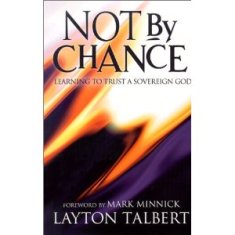
I first picked up Not By Chance: Learning to Trust a Sovereign God years ago mainly because it was his with the thought, “Yes, I should read that some time.” I believed in God’s sovereignty and providence and was often comforted by it, so I wasn’t quick to plunge into a book about it, even as much as I respected its author. But like I suspect is the case for many of us, it’s when something bad or seemingly incongruous happens to shake us up that we begin to wonder about God’s providence, not to question it per se, but to wonder how this or that fits into it.

Dr. Talbert begins by discussing what providence means and thoroughly examining Scripture concerning God’s providence over man, creation, weather, opportunities…and multitudes of other things. By the end there is no escaping the fact that God is in control. And while that’s a comfort on one hand, it’s a conundrum on the other: what about the bad things?

Dr. Talbert covers that well, too. Notice I didn’t say he explains it. There are some things about providence that we can’t understand or fully explain, just like we don’t thoroughly understand the Trinity, or the fact that Jesus is both fully God and fully man at the same time, and other mysteries. But he does shed as much light on it from Scripture as he can, and it does help. For instance, in dealing with a mistaken logical inference, he says:

We often assume that all good things come from God and all “bad” things come from Satan. That is a false and unbiblical assumption that gives Satan far too much credit and attributes to him far more power than he actually possesses. Contrary to popular misconception, Satan is not God’s evil counterpart, but Michael’s. Satan, like Michael, is “only” an angel; so he is an evil angel, not an evil God. Jehovah Himself claims that He is the only God and the ultimate ruler over all our circumstances, both the “good” and the “bad” (p. 12).

And here:

God guides and governs all events, including the free acts of men and their external circumstances, and directs all things to their appointed ends for His glory.

Notice that this definition does not say that God initiates or causes all events. If we are to maintain Biblical precision in our understanding and application of Scriptural truth, the terms we choose to state it are vital (p. 62).

And from a study of the life of Joseph:

God also providentially superintends and often uses the unfairnesses of life to accomplish His purposes in and for us and those around us (p. 66).

This is something many of us wrestle over:

Part of the mystery of providence resides in the fact that God rules and reigns over all things according to His will and pleasure (Ephesians 1:11), yet man is still fully responsible and accountable for his choices and actions. In other words, God exercises His providence and accomplishes His will through the free and voluntary choices and attitudes of men and women. Were this fact limited to God’s persuasive working in believers, that would be amazing enough. But it is equally true of the wicked. God never prompts evil men to sin, yet even their rebellion against Him and their hostility against His people is providentially governed and employed by God. (The clearest example of this…[is] found in the events surrounding the Crucifixion) (p. 86).

Sometimes pondering providence can lead us to think that it doesn’t matter what we do since God is in control anyway. But Dr. Talbert reminds us that God has assigned certain duties to us in Scripture and providentially works through them.

The providence of God is never intended to lull us into a lackadaisical attitude of fatalism, as if our actions don’t really matter because God rules and overrules however He wants anyway. It is revealed to maintain a glow of energizing trust that, despite all appearances to the contrary, God is governing for His glory and for my good — a trust that inspires me to stay faithful, obedient, loyal and devoted to Him, and confident in Him…God’s providence, then, encompasses and incorporates the faithfulness and obedience of His children (p. 70).

There are chapters on God’s preserving providence, governing providence, the mystery of providence, the means of providence, silent providence, the problems of providence, providence and prayer (why pray when God is in control? this is an excellent chapter) and case studies from Biblical characters illustrating the truths being taught. Plus there are chapters on God’s providence displayed in the incarnation and passion of Christ and the church. There is a wonderful section in the study of Joseph about why God sometimes allows delays and what He accomplishes through them. There are several appendices, one being the two sides salvation: God’s determination and man’s responsibility.

I marked over 60 quotes that especially stood out to me, so there’s no way I could share all of them here. But here are just a few more:

When we are willing to submit to and practice only what immediately makes sense to us, and ignore what doesn’t (even when it is clearly commanded), we have substituted ourselves — our finite mind — as the sovereign (p. 215).

[God] is the Maestro of providential orchestration, of split-second timing, of perfect point and counterpoint (p. 249).

We dare not construct a system of theology that helps the Holy Spirit by refining or redefining the words He selected or by interposing words He chose to omit so as to tweak out of it, ever so gently, a slightly modified meaning that better fits the system (p. 259)

One of the absolute best statements I’ve ever heard as to why God’s providence allows for hard or painful things was quoted from Steve Estes, in When God Weeps with Joni Eareckson Tada:

“God permits what He hates to achieve what He loves.”

In short (although I guess it is too late to say that, huh? 🙂 ) I do very highly recommend this book.

(This review will also be linked to Semicolon‘s Saturday Review of Books.)

The surprise at Mary’s prayer meeting

Those dear folks praying for Peter at Mary’s house in Acts 12 get such a bum rap. You remember the story: Peter was in prison, many were gathered together at Mary’s house praying for him, he was miraculously delivered, he came to Mary’s house, Rhoda answered the door, in her excitement she left him at the door while she told the others he was there, and they thought she was crazy. They’re accused of not really praying in faith if they were so astonished when the prayer was answered.

But Dr. Layton Talbert, in his book (Not By Chance: Learning to Trust a Sovereign God, brings up a different viewpoint. We don’t know that they were praying for Peter’s deliverance from prison. He points out that the text doesn’t say. James was killed by Herod earlier in the chapter: since he was not delivered they may not have expected Peter to be, either. “The only precedent we have for the church’s prayer under similar circumstances is in Acts 4:23-30. There, in the face of recent imprisonment, persecution, and renewed threats, the church made only one request. And it wasn’t for deliverance from prison or persecution; it was for boldness in the face of both (4:29)” (p. 203).

That’s a rebuke to me. When I’m experiencing any kind of trouble, the main focus of my prayer is likely to be deliverance. “Lord, please get me out of this. Please remove this problem. Soon. As soon as possible. Today, even? Now? Please?”

It’s not wrong to pray for or seek for deliverance. There are examples of both all through the Bible. Jacob. The Psalmist’s prayers. Persecution scattered the early disciples far beyond Jerusalem, taking the gospel with them. Paul escaped for his life several times. Even Jesus evaded the murderous intents of mobs when His time was not yet come.

But as we saw yesterday, it is not always God’s will to deliver, at least not in the way or the time we wanted. James was killed. Joseph spent long years as a slave and then as a prisoner. Paul was eventually imprisoned. Jesus, when His time was come, faced betrayal, arrest, torture, and death.

When we don’t know when or whether God will deliver us or a loved one from a serious trial, besides praying for deliverance, we can pray for these as well:

  • that with all boldness they may speak His word (Acts 4:29)
  • that they or we would “count it all joy when ye fall into divers temptations” (James 1:2)
  • that  we’d know “that the trying of your faith worketh patience” and “let patience have her perfect work, that ye may be perfect and entire, wanting nothing” (James 1:3-4).
  • that we’d “fear none of those things which thou shalt suffer: behold, the devil shall cast some of you into prison, that ye may be tried; and ye shall have tribulation ten days: be thou faithful unto death, and I will give thee a crown of life.” (Revelation 2:10).
  • that we’d let “none of these things move me, neither count I my life dear unto myself, so that I might finish my course with joy, and the ministry, which I have received of the Lord Jesus, to testify the gospel of the grace of God” (Acts 20:24).
  • “That their hearts might be comforted, being knit together in love, and unto all riches of the full assurance of understanding, to the acknowledgement of the mystery of God, and of the Father, and of Christ; In whom are hid all the treasures of wisdom and knowledge.” (Colossians 2:2-3) (It’s interesting to look through verses about comfort in Paul’s epistles.)

In fact, the more I look through these, the more I seem to find: not surprising since many of Paul’s epistles were written while people were after him or while he was in prison.

May we and our loved ones seek His will and grace and help in our afflictions as well as out of them.

God can be trusted

The Week in Words

”"

Welcome to The Week In Words, where we share quotes from the last week’s reading. If something you read this past week  inspired you, caused you to laugh, cry, think, dream, or just resonated with you in some way, please share it with us, attributing it to its source, which can be a book, newspaper, blog, Facebook — anything that you read. More information is here.

Sorry to be a little late with this. I try to have it up before bedtime the night before, but we played a new game with the family last night, got done around 11, and my brain was fried. 🙂 It was fun, though.

Here are some poignant quotes from the last week:

I mentioned this one in Saturday’s post, but wanted to highlight it again here. From Praying Past Our Preferred Outcomes.

To go deeper than praying only for deliverance means that we approach prayer not as a tool to manipulate God to get what we want, but as a way to submit to what he wants. ~ Nancy Guthrie

The gist of the article is that we usually pray for deliverance from trials and problems, but sometimes God has something He wants to teach us or accomplish first. Another quote:

What would happen if we allowed Scripture to provide the outcomes we prayed toward? What if we expanded our prayers from praying solely for healing and deliverance and success to praying that God would use the suffering and disappointment and dead ends in our lives to accomplish the purposes he has set forth in Scripture? Scripture provides us with a vocabulary for expanding our prayers for hurting people far beyond our predetermined positive outcomes. Instead of praying only for relief, we begin to pray that the glory of God’s character would be on display in our lives and the lives of those for whom we are praying. We pray for the joy of discovering that the faith we have given lip service to over a lifetime is the real deal. We ask God to use the difficulty to make us less self-reliant and more God-reliant. Rather than only begging him to remove the suffering in our loved ones’ lives, we ask him to make them spiritually fruitful in the midst of suffering he chooses not to remove.

And from the song “See, What a Morning” about Resurrection Day:

Death is dead, love has won, Christ has conquered!

That’s been ringing through my mind through yesterday and this morning.

You can share your family-friendly quotes in the comments below or write a post on your blog and then put the link to that post (not your general blog link) in Mr. Linky below.

I hope you’ll visit the other participants as well and glean some great thoughts to ponder. And I hope you’ll leave a comment here, even if you don’t have any quotes to share.

Repost: Christmas Grief

This is the sixth anniversary of my Mom’s death, so, though I think of her and sorely miss her often, this day (as well as her birthday and Mother’s Day) are particularly poignant days for me. Grief seems to start out like a flood but then slowly recedes to a stream that occasionally overflows its banks. There are many fond and pleasant memories, but I don’t suppose some moments of intense missing her will ever go away until I see her again. This is what I wrote on this day last year:

_________________________________________

December could be a rather gloomy month for my family. My mother passed away Dec. 10 five years ago, my father Dec. 12 a few years earlier, and my grandmother Christmas Eve a few years prior to that, leading my brother to exclaim once that he just wanted to cancel the whole month.

The death of a loved any any time of year can shadow the whole Christmas season as we miss our normal interactions with that loved one, and several years later, though maybe the pangs aren’t quite as sharp, they’re still there, and it’s not abnormal to be caught off guard by a memory or a longing leading to a good crying jag.

When someone is grieving over the holidays, they may not want to participate in some of the “normal” happy pastimes. It’s not that they don’t ever laugh or enjoy gatherings. But as Sherry said yesterday, “I am enjoying the traditional holiday celebrations, and at the same time they move me to tears, sad tears for things that have been lost this year. I am singing the music, and yet I’m tired of the froth of jingling bells and pa-rumpumpum.” I remember almost wishing that we still observed periods of mourning with wearing black or some sign of “Grief in progress” — not to rain on anyone else’s good time, but just to let people know there was woundedness under the surface, and just as physical wounds need tenderness while healing, so do emotional ones. Normally I love baby and bridal showers and make it a point to attend, but for several months after my mom’s death I did not want to go to them. I rejoiced with those who rejoiced…but just did not want to rejoice in quite that way. I first heard the news of my mom’s death during our adult Sunday School Christmas party, and the next year I just did not want to attend. Even this year, when our ladies’ Christmas party was on the anniversary of my mom’s death, I was concerned that at some point during the evening I would have to find the restroom and lock myself in to release some tears (though thankfully that did not happen).

Other events can cast a pall over Christmas: illness, job loss, a family estrangement, etc. One Christmas we were all sick as dogs, and my father-in-law had just had a major health crisis and wanted us to come up from SC to ID to visit. There was just no way we could drag ourselves onto a plane until antibiotics had kicked in a few days later, but we did go, and if I remember correctly, that was the last time any of us except my husband saw him alive, so in retrospect we were glad we went, though it wasn’t the merriest of Christmases. A good friend grieved over “ruining” her family’s Christmas by being in the hospital with a severe kidney infection. Lizzie wrote about visiting her husband in prison for Christmas. Quilly commented yesterday about being homeless one Christmas. Yet both Lizzie and Quilly mentioned reasons for rejoicing in the midst of those circumstances.

If you’re grieving this Christmas, don’t feel guilty if you’re not quite into the “froth” this year.  One quote I shared on a Week In Words post earlier had to do with giving yourself time to heal. On the other hand, there may be times to go through with the holiday festivities for family’s sake — and, truly, those times can help keep you from the doldrums. Sherry shared how making a list of reasons to celebrate Christmas helped. Look for the good things to rejoice in. E-mom left a valuable comment yesterday that we can treasure up the memories of good Christmases to tide us over the not so good ones, and then look forward to better things ahead. And as I said yesterday, remember that the first Christmas was not all about the froth, either, but was messy, lonely, and painful, yet out of it was born the Savior of the world and the hope of mankind. Rejoice in that hope and promise. Draw near to Him who has borne our griefs and carries our sorrows until grief and sorrow are done away forever.