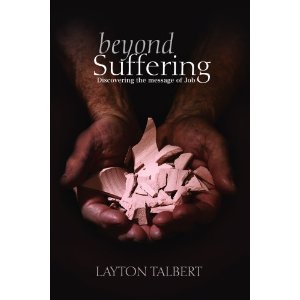
Book Review: Beyond Suffering: Discovering the Message of Job

Layton Talbert was one of our Sunday School teachers at the church we attended the first fourteen years we were married, back before he earned his PhD. In the years since our class with him, I’ve very much enjoyed his articles in Frontline magazine, where he currently serves as a contributing editor. I particularly like his regular “At a Glance” column where he usually gives an overview of a book of the Bible (his column on Ecclesiastes particularly opened that book up for me). Next to one of our former pastors, Dr. Mark Minnick, there is no one whose exegesis and teaching I trust more (though no one is infallible, of course). So when our current pastor began preaching through the book of Job and recommended Dr. Talbert’s book, Beyond Suffering: Discovering the Message of Job, I didn’t need much convincing to get it. In addition, I know personally many of the people he mentions in the book. I trust, however, that even though this prior knowledge inclined me positively toward the book even before I got it, it didn’t cloud my perspective.

Dr. Talbert has attempted (successfully, I think) to write the book on two levels: the main text is easily readable for most any layperson, but the end notes are helpful for more experienced theologians (and for others who want to delve into them.) Though probably no one loves end notes, I can understand that having those notes scattered throughout the book as footnotes would make the text look cluttered and daunting to some.

Dr. Talbert begins by acknowledging that the book of Job is both long and difficult, especially the discourses between Job and his friends, but he reminds us “the Holy Spirit does not waste space” (p. 9) and even these discourses are valuable to us. He offers several helpful suggestions for reading Job, explores the theme of the book (suggesting that suffering is the catalyst rather than the main theme), and plunges right into commentary, not verse by verse, but section by section.

I spent a few hours this week compiling a list of the quotes I marked as well as pages numbers of sections that were particularly instructive to me but were too long to quote, both as a way of review and a way to have some of them handy. I ended up with five pages. I can’t share all of that here, but I’ll try to share some of the most poignant.

Satan’s accusation that Job is “pious only for pay” undermines God as well as Job because if it is so, that means God is content with that arrangement (p. 40).

Suffering can cause us to question either God’s omnipotence or His love: either He wasn’t able to stop the suffering or He was able but allowed it because He’s not completely good. “Since both options are expressly unbiblical, we are faced with a choice: (1) Ignore what the Bible says about God and reevaluate Him on the basis of our limited experience, knowledge, and understanding or (2) accept God’s self-description and reevaluate our circumstances in the light of the Bible’s depiction of realty.” P. 57).

“It is not merely the affliction itself that Job finds so hard to bear; it is the sudden and inexplicable change in God’s posture toward him that the circumstances seem to signal (p. 85).

“Expressions of grief may not fit some people’s sanitized ideas of what a Christian ‘ought’ to think and feel. But when catastrophe strikes like lightning, ripping ragged holes in the lives of previously serene saints, God has preserved a record of the grief of godly saints for our consolation. Anger is not unbelief and questions are not sinful; they are human and shared by some of the best of God’s people” (p. 90).

You may have wondered, as I have, if Job “sinned not” in his initial reaction to his suffering at the end of chapter one, yet repents in chapter 42:1-6, what happened in between that he had to repent of? Part of the answer is this: “If Job justifies himself at the expense of God’s righteousness (as God says he did – Job 40:8), then he has virtually, if unintentionally, made himself more righteous than God….Whenever we think that God is being unfair, or that we would never do some of the things God does, we make ourselves more righteous than God” (p. 98).

On the difficulty of 19:25-27: “We must be content to enter the passage with no prejudgment as to what we will bring out of it. That’s the only way to insure that we derive our theology out of the text (exegesis) rather than read our theology into a text (eisegesis)” (p. 121). (Yes! If only all Bible teachers and preachers would get this. bh)

“[God] censures Job for defending his own righteousness over against and at the expense of God’s righteousness (40:8)” (p. 159).

“For Job to be browbeaten into ‘confessing’ uncommitted sin with the assurance that his fortunes will be restored is to trifle with his soul, to confuse his conscience, and to redirect everyone’s attention to materialism as the motivation and demonstration of one’s spiritual condition” (p. 130).

“The three friends argue that Job’s suffering is consistent with God’s justice because [Job] has (obviously) sinned. Job argues that his suffering is contrary to God’s justice because he has not sinned. Elihu offers a revolutionary third perspective: suffering is not necessarily linked to God’s justice at all. God’s justice remains intact, therefore, and may not be impugned (34:12). The issue is man’s justice in responding to inexplicable suffering sent or allowed by a just God. That suffering may not be explicitly ‘deserved’ does not render the suffering itself unjust, nor does it imply that God is unjust for permitting it” (p. 170).

“Job is not rebuked for asking why. He is rebuked for an honest question that has soured into a complaint laced with insinuation. God reprimands Job for sins of speech and attitude subsequent to his sufferings – speech and attitudes that reflect wrongly on the character of God” (p. 202).

If you’ve ever wondered, as I have, what God’s discussion of animals has to do with Job’s suffering, a part of the answer is: “By belaboring this point with Job, God unveils one of His divine qualities. The Lord is powerful and majestic and wise beyond man’s comprehension, but He is also compassionate…even towards beasts. He talks as if He has intimate knowledge of their nature and needs because He does. That’s the point” (p. 206).

“We may not always see the signs of God’s goodness in our immediate circumstances, but what we see is not all there is. That is a significant part of God’s answer to Job” (p. 206).

“The furnace of affliction may be transformed into a holy of holies, a sanctuary filled with the presence of the God Whose path is in the storm” (p. 235).

“Believe Him implicitly, with or without proof, because He has spoken. Trust Him submissively, with or without understanding, because He is sovereign and good. Worship Him reverently, with or without reward, because He is worthy… Wait for Him patiently, with or without reprieve, because He will come.” (p. 241).

“God’s revelation furnishes ample evidence to justify faith but also ample opportunity to exercise faith” (p. 256).

I was also happy to see Job vindicated from something I heard a preacher say years ago, that Job’s confession in 3:25 that “the thing which I greatly feared is come upon me, and that which I was afraid of is come unto me” indicated that he had a “life-dominating sin” of fearfulness. But God repeatedly says that Job is “a perfect and an upright man, one that feareth God, and escheweth evil” (1:8; 2:3) and that his trials came upon him “without cause” (2:3).

There are also insightful discussions on the purposes for suffering, possible reasons why God didn’t tell Job what was behind his suffering, a section on helping the hurting (an excerpt from that is here), and even an appendix on leviathan, for those who might want more information about what that creature mentioned by God might have been.

This is an immensely helpful book, both for those who have wrestled with suffering and those who have wrestled with their study of the book of Job. Those of you who read here regularly know that it is rare that I can recommend a book completely without reservation: this is one I can.

(This review will also be linked to Semicolon‘s Saturday Review of Books.)

The Week In Words

”"

Welcome to The Week In Words, where we share quotes from the last week’s reading. If something you read this past week  inspired you, caused you to laugh, cry, think, dream, or just resonated with you in some way, please share it with us, attributing it to its source, which can be a book, newspaper, blog, Facebook — anything that you read. More information is here.

Here are a couple that caught my eye this week:

From a friend’s Facebook:

“God delights to increase the faith of his children. We ought, instead of wanting no trials before victory, no exercise for patience, to be willing to take them from God’s hand as a means. Trials, obstacles, difficulties, and sometimes defeats, are the very food of faith.” ~ George Muller

I’m guilty of wanting more faith without wanting the situations that help to develop it. But that’s kind of like wanting to be fit without exercising.

This was at the beginning of a chapter in Goforth of China:

But Thou art making me, I thank Thee, sire.
What Thou hast done and doest Thou know’st well.
And I will help Thee; gently in Thy fire
I will lie burning; on Thy potter’s wheel
I will whirl patient, though my brain should reel.
Thy grace shall be enough the grief to quell,
And growing strength perfect through weakness dire.
~ George MacDonald

That’s not how I naturally feel, but may He give me grace to “whirl patient” in the Potter’s fire. Sometimes after a few trials in life we can tend to think, “OK, I’ve had my share, that should be it.” But as long as we live we’ll need continued shaping.

If you’ve read anything that particularly spoke to you that you’d like to share, please either list it in the comments below or write a post on your blog and then put the link to that post (not your general blog link) in Mr. Linky below. I do ask that only family-friendly quotes be included.

I hope you’ll visit some of the other participants as well and glean some great thoughts to ponder. And don’t forget to leave a comment here, even if you don’t have any quotes to share! 🙂

“I know their sorrows”

Sometimes I am hesitant to bring up a stray thought I have wrestled with because I don’t want to implant it in anyone else’s mind and cause them the same problem. One of my college professors did that once: he brought up a question that he didn’t really answer, and every now and then it comes back to mind and plagues me. I don’t know if I was too timid to ask him to elaborate — I don’t think it really occurred to me to do so then.

But part of “bringing into captivity every thought to the obedience of Christ” (II Corinthians 10:5b) is looking for Bible answers with which to combat errant thoughts, and, if we can’t find a direct answer, trusting what we do know of His character.

One of those thoughts that threatens my peace from time to time has to do with God’s care in our suffering. As much as I have thought and read about suffering and looked for Scriptural reasons for suffering, and know that He does have a reason for everything He allows, He does care and is with us in our trials, still sometimes the thought comes to mind that this is all for His purposes and His glory and we’re just expendable casualties. And though I am not suffering anything in particular just now and hadn’t thought about this lately, the passages in Daily Light this morning provided a welcome balm against such thoughts:

I know their sorrows.

A man of sorrows and acquainted with grief. – Touched with the feeling of our infirmities.

Himself took our infirmities, and bare our sicknesses. – Jesus being wearied with his journey, sat thus on the well.

When Jesus … saw her weeping, and the Jews also weeping which came with her, he groaned in the spirit, and was troubled. Jesus wept. – For in that he himself hath suffered being tempted, he is able to succour them that are tempted.

He hath looked down from the height of his sanctuary; from heaven did the LORD behold the earth; to hear the groaning of the prisoner; to loose those that are appointed to death. – He knoweth the way that I take: when he hath tried me, I shall come forth as gold. – When my spirit was overwhelmed within me, then thou knewest my path.

He that toucheth you toucheth the apple of his eye. – In all their affliction he was afflicted; and the angel of his presence saved them.

EXO. 3:7. Isa. 53:3. Heb. 4:15. Matt. 8:17. -John 4:6. John 11:33,35. Heb. 2:18. Psa. 102:19,20. Job 23:10. Psa. 142:3. Zech. 2:8. Isa. 63:9.

There are many others as well, such as:

But now thus saith the LORD that created thee, O Jacob, and he that formed thee, O Israel, Fear not: for I have redeemed thee, I have called thee by thy name; thou art mine. When thou passest through the waters, I will be with thee; and through the rivers, they shall not overflow thee: when thou walkest through the fire, thou shalt not be burned; neither shall the flame kindle upon thee. Isaiah 43:1-2.

Maybe it would be a good idea to collect them all in one place and add to them as I find them so that I can come back to them when that thought comes around again.

And while I was looking for something else this morning, I came across a video of a song along these lines sung by Christy Galkin. I hope it is a blessing to you.

The Week In Words

”"

Welcome to The Week In Words, where we share quotes from the last week’s reading. If something you read this past week  inspired you, caused you to laugh, cry, think, dream, or just resonated with you in some way, please share it with us, attributing it to its source, which can be a book, newspaper, blog, Facebook — anything that you read. More information is here.

Forgive me, I am running late today. But here are a few quotes that spoke to me this week:

From Robin Lee Hatcher‘s Facebook page:

“Without love for God & His Word, [our obedience is] just trying to be good. Nothing will wear you out faster.” Beth Moore

I’ve never read a Beth Moore book or Bible study, but I can attest to the truth of this statement.

From The Lion, the Witch, and the Wardrobe by C. S. Lewis:

But as for Aslan himself, the Beavers and the children didn’t know what to do or say when they saw him. People who have not been in Narnia sometimes think that a thing cannot be good and terrible at the same time. If the children had ever thought so, they were cured of it now. For when they tried to look at Aslan’s face they just caught a glimpse of the golden mane and the great, royal, solemn, overwhelming eyes; and then they found they couldn’t look at him and went all trembly.

For those who might not know, Aslan the lion is the Christ figure in the Narnia stories, and I thought this was a sweet and lovely depiction trying to explain his being both good and terrible (terrible not meaning “bad” here but inspiring awe, as in these verses.)  Sometimes I have tried to reconcile in my own mind how we can think of Christ as an elder brother and friend and God as an “Abba” father, and yet, as John, the closest disciple to Christ, fall on his face as dead when we see Him in all His glory. The closest parallel that comes to mind is what it might be like when a child of royalty sees his parent “in state” at a royal function all decked out in royal garb with pomp and ceremony.

From Beyond Suffering by Layton Talbert:

Commenting on Job being a man who “eschewed evil“: The Hebrew verb means to recoil and to go out of one’s way to avoid. Job feared God and was frightened of evil because he understood the true nature of each. Being frightened of evil is not a sign of immaturity or paranoia. It is the same sane aversion to danger that my nephew has to peanuts: they may appear harmless but he knows they can kill him (p. 29).

And later commenting on some people’s disagreeing with James’s assessment of the patience of Job: This Biblical virtue is not a sappy, carefree cheeriness. It is a manly word that means to ‘remain under’ whatever pressure or pain one is presently enduring from the hand of God. Patience is fortitude under adversity. Job struggled to maintain his integrity and his faith under great duress. (p. 32).

Finally, from the July 1 reading of The Invitation by Derick Bingham:

The Lord Jesus got down below the level of their couches and washed their feet, gently. So if we would seek to correct, say, someone’s attitude problem, we must not do it in an arrogant and proud manner, else we will do them more harm than good. Humility of attitude and helpfulness goes a long way to guiding those who have bee soiled to a place of cleansing. If you would be a true foot-washer, imitate the Lord’s method. Christians are often hopeless at this ministry simply because they are not willing to stoop low enough.

Much food for thought today!

If you’ve read anything that particularly spoke to you that you’d like to share, please either list it in the comments below or write a post on your blog and then put the link to that post (not your general blog link) in Mr. Linky below. I do ask that only family-friendly quotes be included.

I hope you’ll visit some of the other participants as well and glean some great thoughts to ponder. And don’t forget to leave a comment here, even if you don’t have any quotes to share! :)

How does God deal with evil?

Our pastor is taking us through a study of the book of Job, and of course one of the questions that arises from Job is the problem of suffering, especially seemingly undeserved suffering. That’s a question too big for one small blog post, but I wanted to share one outline that our pastor shared with us that was helpful to me.

He had titled it “How Does God Mesh Good and Evil?”

1. Sometimes He prevents it:

Gen 20:6: And God said unto him in a dream, Yea, I know that thou didst this in the integrity of thy heart; for I also withheld thee from sinning against me: therefore suffered I thee not to touch her.

2. He permits it:

Psalm 81:12-13: So I gave them up unto their own hearts’ lust: and they walked in their own counsels. Oh that my people had hearkened unto me, and Israel had walked in my ways!

3. He directs it [redeems it, uses it for good]:

Genesis 50:20: But as for you, ye thought evil against me; but God meant it unto good, to bring to pass, as it is this day, to save much people alive.

Romans 8:28: And we know that all things work together for good to them that love God, to them who are the called according to his purpose.

4. He limits it:

Psalm 124: all, sample 2-3:  If it had not been the LORD who was on our side, when men rose up against us: Then they had swallowed us up quick, when their wrath was kindled against us.

God put limits on what Satan could do to Job: Job 1:12, 2:6.

I think you could also add that He punishes it — not immediately, always, but He promises that He will take care of justice and vengeance.

Pastor has encouraged us to journal what we’re learning as we go through Job. I haven’t done that in connection with Bible study in a long while, but decided to do so this time. I’ve been thinking of putting those thoughts in a separate blog just for that purpose but I haven’t decided — it’s more in a rambling style of jotting things down as I think of them, of snatches from sermon notes, etc., rather than well thought-out and put-together posts. But we’ll see.

In the meantime, I just thought I’d share this one little section of things I’ve found helpful so far.

The Week In Words

”"

Welcome to The Week In Words, where we share quotes from the last week’s reading. If something you read this past week  inspired you, caused you to laugh, cry, think, dream, or just resonated with you in some way, please share it with us, attributing it to its source, which can be a book, newspaper, blog, Facebook — anything that you read. More information is here.

I just have a few this week, but they packed a pretty big punch for me.

Seen on Adam Blumer‘s Facebook status:

“Take care that you do not waste your sorrows; that you do not let the precious gifts of disappointment, pain, loss, loneliness, or similar afflictions … mar you instead of mending you…. There is no failure of life so terrible as to have the pain without the lesson, the sorrow without the softening.” (Hugh Black, early 20th-century pastor)

There is so much there: that our troubles can mar instead of mend us if we let them, that we can endure them without getting what we’re supposed to out of them and thereby “waste” them.

And seen on David McGuire‘s Facebook:

“Winning is great, sure, but if you are really going to do something in life, the secret is learning how to lose. Nobody goes undefeated all the time. If you can pick up after a crushing defeat, and go on to win again, you are going to be a champion someday.” — Wilma Rudolph

One of the most heartening and enlightening sermons I ever heard was in college on the topic of how to deal with failure. I wasn’t failing classes, but I was doing worse than I ever had academically, and that was a serious blow that felt like failure.

Finally, this sobering thought from the June 22 reading of The Invitation by Derick Bingham:

The message that proclaims life to those who believe it is the same message which proclaims judgment to those who disobey it. At the end of the day it is what you do with the Saviour’s word that matters.

If you’ve read anything that particularly spoke to you that you’d like to share, please either list it in the comments below or write a post on your blog and then put the link to that post (not your general blog link) in Mr. Linky below. I do ask that only family-friendly quotes be included.

I hope you’ll visit some of the other participants as well and glean some great thoughts to ponder. And don’t forget to leave a comment here, even if you don’t have any quotes to share! :)

The Week In Words

”"

Welcome to The Week In Words, where we share quotes from the last week’s reading. If something you read this past week  inspired you, caused you to laugh, cry, think, dream, or just resonated with you in some way, please share it with us, attributing it to its source, which can be a book, newspaper, blog, Facebook — anything that you read. More information is here.

Here are a few that ministered to me this week:

From a friend’s Facebook:

“Unerring wisdom ordained your lot and selected for you the safest and best condition. Remember this -had any condition been better for you than the one in which you are, divine love would have put you there. You are placed by God in the most suitable circumstances. Be content with such good things as you have, since the Lord has ordered all things for your good.” ~ C. H. Spurgeon

This spoke to me on so many levels. I had to just sit and think through it for a while.

Sherry at Semicolon shared this quote from Corrie ten Boom in A Hiding Place:

“You can never learn that Christ is all you need, until Christ is all you have.” ~ Corrie Ten Boom

Profound, from one who lived it.

A quote from a former pastor, now with the Lord:

“We are indwelt every day by either the grieved or ungrieved Holy Spirit of God.” ~ Jesse L. Boyd

May I live as much as possible without grieving Him and be quick to repent when I do.

If you’ve read anything that particularly spoke to you that you’d like to share, please either list it in the comments below or write a post on your blog and then put the link to that post (not your general blog link) in Mr. Linky below. I do ask that only family-friendly quotes be included. I hope you’ll visit some of the other participants as well and glean some great thoughts to ponder.

And please — feel free to comment even if you don’t have quotes to share!

Japan

When I first heard of the earthquake and subsequent tsunamis that hit Japan, I prayed, but I could hardly watch any footage. It was just too much, too intense. And, I thought, if it is too intense to watch, how must it be to live through it. I just cannot imagine.

I have watched since then. It’s just so hard to fathom — it almost looks like CGI of some cataclysmic movie.

The two missionary families I know there were out of the country when it happened and are checking in as frequently as possible with those they are able to reach there. Besides the destruction, which is massive, now there are problems even in areas further away with lack of water, gasoline, dwindling food supplies at stores, etc., because supplies can’t get through.

My friend Kim, one of the missionaries to Japan on furlough in the States now, left a link to a blogger she reads who lives in the area and posts regular updates at Living and Learning.

A friend on Facebook shared this video today in reference to some personal suffering, but I thought of it in context of the suffering of the people of Japan. When things like this happen, sometimes people get bitter against God, wondering why it happened. I pray that instead, people would turn to Him in their great need.

As a footnote, Joni speaks of not wanting the intellectual reasons for suffering when in the thick of it. I don’t think she means she doesn’t want them ever. I know from her other writings that she has thought through and wrestled with some of those things. Personally I find great assurance in reading over them from time to time. But I do understand what she means that sometimes when suffering you just want the comfort of His presence rather than the reasons why.

The Week In Words

”"

Welcome to The Week In Words, where we share quotes from the last week’s reading. If something you read this past week  inspired you, caused you to laugh, cry, think, dream, or just resonated with you in some way, please share it with us, attributing it to its source, which can be a book, newspaper, blog, Facebook — anything that you read. More information is here.

It’s been a busy week since last time! But I did find a few gems along the way:

I forgot to note where I saw this one:

My complaint is not that I am in the world, but that the world is in me. I cannot get it out of my heart except as I let You in. —John Baird

I like the thought of crowding out the world by letting Christ in — instead of just combating worldliness, following Christ proactively and letting Him fill the space that worldliness would take.

On a friend’s Facebook page:

“A gem cannot be polished without friction, nor a man perfected without trials.” ~Author unknown

From a post of Janet‘s:

Questions about God’s goodness or why He allows suffering are usually asked by comfortable people in comfortable houses with comfortable educations, but they’re answered by those who are walking through the most extreme trials.

Seen at Challies:

In public worship all should join. The little strings go to make up a concert, as well as the great. —Thomas Goodwin

If you’ve read anything that particularly spoke to you that you’d like to share, please either list it in the comments below or write a post on your blog and then put the link to that post (not your general blog link) in Mr. Linky below. I do ask that only family-friendly quotes be included. I hope you’ll visit some of the other participants as well and glean some great thoughts to ponder.

And please — feel free to comment even if you don’t have quotes to share!

The Week In Words

”"

Welcome to The Week In Words, where we share quotes from the last week’s reading. If something you read this past week  inspired you, caused you to laugh, cry, think, dream, or just resonated with you in some way, please share it with us, attributing it to its source, which can be a book, newspaper, blog, Facebook — anything that you read. More information is here.

Here are a few that spoke to me this week:

From Challies:

People do not drift toward holiness. Apart from grace-driven effort, people do not gravitate toward godliness, prayer, obedience to Scripture, faith, and delight in the Lord. We drift toward compromise and call it tolerance; we drift toward disobedience and call it freedom; we drift toward superstition and call it faith. We cherish the indiscipline of lost self-control and call it relaxation; we slouch toward prayerlessness and delude ourselves into thinking we have escaped legalism; we slide toward godlessness and convince ourselves we have been liberated. —D.A. Carson

Holiness is intentional; any time we’re drifting spiritually, it’s not usually in the right direction.

And speaking of being intentional, in Warren Wiersbe’s With the Word, commenting on David’s sin with Bathsheba and Uriah in II Samuel 11, he advises:

Before you yield to temptation…look back and recall God’s goodness to you; look ahead and remember “the wages of sin”: look around and think of all the people who may be affected by what you do; look up and ask God for strength to say no (I Cor. 10:13) (p. 187).

Our tendency is to push ahead and to try not to listen to conscience or the Holy Spirit. I think if we all did this, we’d reduce our giving in to temptation significantly.

The following two quotes come from Come, Thou Long-Expected Jesus: Experiencing the Peace and Promise of Christmas. I don’t usually like to post long quotes on TWIW, but I can’t see a way to shorten these and still convey the impact. Since they are so long and speak for themselves, I won’t lengthen the post with my own commentary.

The first is from “The Gifts of Christmas” by Tim Keller from his sermon “Mary” from December 23, 2001:

When September 11th happened and New Yorkers started to suffer, you heard two voices. You heard the conventional moralistic voices saying, “When I see you suffer, it tells me about a judging God. You must not be living right, and so God is judging you.” When they see suffering, they see a judgmental God.

The secular voice says, “When I see people suffering, I see God is missing.” When they see suffering, they see an absent, indifferent God.

But when we see Jesus Christ dying on the cross through an act of violence and injustice, what kind of God do we see then? A condemning God? No, we see a God of love paying for sin. Do we see a missing God? Absolutely not! We see a God who is not remote but involved.

We sometimes wonder why God doesn’t just end suffering. But we know that whatever the reason, it isn’t one of indifference or remoteness. God so hates suffering and evil that he was willing to come into it and become enmeshed in it (pp 38-39).

The second is from “For Your Sakes He Become Poor” by J. I. Packer commenting on II Corinthians 8:9: “For ye know the grace of our Lord Jesus Christ, that, though he was rich, yet for your sakes he became poor, that ye through his poverty might be rich,” excerpted from his book Knowing God:

For the Son of God to empty himself and become poor meant a laying aside of glory; a voluntary restraint of power; an acceptance of hardship, isolation, ill-treatment, malice, and misunderstanding; finally, a death that involved such agony — spiritual, even more than physical — that his mind nearly broke under the prospect of it. It meant love to the uttermost for unlovely men, who “through his poverty, might become rich.” This Christian message is that there is hope for a ruined humanity — hope of pardon, hope of peace with God, hope of glory — because at the Father’s will Jesus Christ became poor and was born in a stable so that thirty years later he might hang on a cross…

We talk glibly of the “Christmas spirit,” rarely meaning more than a sentimental jollity on a family basis. But what we have said makes it clear that the phrase should in fact carry a tremendous weight of meaning. It ought to mean the reproducing in human lives the temper of him who for our sakes became poor at the first Christmas. And the Christmas spirit itself ought to be the mark of every Christian all the year round.

…The Christmas spirit does not shine out in the Christian snob. For the Christmas spirit is the spirit of those who, like their Master, live their whole lives on the principle of making themselves poor — spending and being spent — to enrich their fellow men, giving time, trouble, care, and concern, to do good to others — and not just their own friends — in whatever way there seems need (pp. 70-72).

If you’ve read anything that particularly spoke to you that you’d like to share, please either list it in the comments below or write a post on your blog and then put the link to that post (not your general blog link) in Mr. Linky below. I do ask that only family-friendly quotes be included. I hope you’ll visit some of the other participants as well and glean some great thoughts to ponder.

And please — feel free to comment even if you don’t have quotes to share!