When the Living Word comforted with the written Word

One of the most intriguing passages of Scripture occurs in Luke 24:13-36. Just after the crucifixion and resurrection, two of Jesus’s disciples are walking to Emmaus, discussing all of these recent events. Jesus Himself draws near to them, but “their eyes were holden that they should not know Him,” and He asks what they are talking about that has made them so sad. They tell him of their dashed hopes that Jesus was “he which should have redeemed Israel” and the missing body in the tomb and the odd rumor that He was now alive.

Jesus responds, “‘O fools, and slow of heart to believe all that the prophets have spoken: Ought not Christ to have suffered these things, and to enter into his glory?’ And beginning at Moses and all the prophets, he expounded unto them in all the scriptures the things concerning himself.” Many of us would have loved for the rest of that conversation to have been recorded. but evidently the Holy Spirit didn’t deem it necessary. He continues instructing them until they arrive at their destination; they invite Him in for dinner, and as He blessed and broke the bread, “their eyes were opened, and they knew him.” And then one of them says a statement I love, “Did not our heart burn within us, while He talked with us by the way, and while He opened to us the scriptures?

We had a guest speaker at church last night, and he brought out something from this passage I had never considered before. I’ll have to paraphrase him, because I couldn’t write fast enough to get down everything exactly as he said it, but the gist of it is this:

“Why didn’t Jesus tell those two disciples, ‘It’s Me, boys! I’m alive!’ and comfort them with His physical presence? Why instead did he go through the Scriptures with them? Why did He use the written Word instead of the Living Word? Because He was about to leave them to ascend back into heaven soon and He wanted them to be confident of, trust in, and have comfort in His Word, to know they could count on it when He was no longer physically there.”

That is profound to me. When Jesus could have comforted with His physical presence (and He did reveal Himself to them just before He disappeared and then appeared again to them when they ran back to share with the disciples what had just happened), He used the written Word instead.

It would be an interesting study to see just how He used the Scripture throughout His lifetime and ministry: I’ll have to note that next time I read them. I know He used them to resist Satan’s temptations. He used them to teach about Himself. In John 6:63, He said. “It is the Spirit who gives life; the flesh profits nothing; the words that I have spoken to you are spirit and are life.”

Peter, inspired by the Holy Spirit, referred back to what had to have been one of the most magnificent experiences of his life, being with Christ during His transfiguration, and said the written Word of God is a “more sure” word of prophecy than even that, “whereunto ye do well that ye take heed.”

So we, who are without His bodily presence for now, can rest in His Word and have complete confidence in it, be instructed in it, take comfort from it.

Can people misuse the Word? Sure. Satan does, all the time, as he did when he tempted Jesus, as he did in the garden of Eden. Whole false religions have been founded on a misuse of Scripture. The Pharisees, for all their knowledge of the Scripture, missed seeing Jesus in it. I don’t know how and why that happens. Jesus said in John 7:17, “If any man will do his will, he shall know of the doctrine, whether it be of God, or whether I speak of myself.” Maybe there was an unwillingness on their part, a predisposition against the truth, or something. They were often cited for their pride: maybe they didn’t want to admit they were wrong or give up the accolades that had been coming to them. We do have to be careful to come to the Scriptures asking Him to “Open thou mine eyes, that I may behold wondrous things out of thy law” (Psalm 119:18) and not imprinting on it our preconceived notions.

But I think if we are earnestly seeking Him and willing to do what He says, and we’re comparing Scripture with Scripture rather than taking one verse out of context and going off on a tangent, we can rest in what we find there. We can’t “follow Jesus” apart from the Word: that is the avenue through which He speaks to us. Though we are without His bodily Presence until we go to be with Him or He comes back for us, He has left us with the God-breathed Scriptures and His blessed Holy Spirit, the Comforter, the Spirit of Truth, who testifies of Jesusteaches us and reminds us of what He said.

Thoughts for the New Year

It is good to sit down and take stock every now and then, and New Year’s Day is as good a day as any. I was discussing with Lou Ann yesterday that in many westerns (what few of them I have read), the rancher has to occasionally ride the fences of his property to make sure all is well, strengthen weak places, repair breaches, etc, and that reminds me a bit of what we like to do as we approach the New Year. But we also look ahead to new ventures as well. Susan at By Grace shared a helpful post a few years ago about different areas for which homemakers can set goals.

I see both of these aspects in Scripture. Revelation 3:2 says, “Be watchful, and strengthen the things which remain, that are ready to die: for I have not found thy works perfect before God.” And one of my favorite verses for the New Year in Deuteronomy 11:11-12 says, “But the land, whither ye go to possess it, is a land of hills and valleys, and drinketh water of the rain of heaven: A land which the LORD thy God careth for: the eyes of the LORD thy God are always upon it, from the beginning of the year even unto the end of the year.”

Even in those areas where things seem to be going well, we can be encouraged to abound more and more and  “excel still more,” as Paul encouraged Thessalonian believers: while commending their love for the brethren he encouraged them to increase in it.

I like the idea of goals rather than resolutions. There are times for Biblical resolutions, and I’m inspired by Jonathan Edwards’ resolutions, and this post about how to learn from them rather than be discouraged by them. But as Paul Tripp said here, it’s not usually the one dramatic resolution that makes a difference but rather the 10,000 mundane everyday decisions. A resolution can be the starting point, but unless we work into a goal or make plans to carry it out, it will fizzle out in a few weeks.

I’m also thankful for the reminder that we can come to Him for rest and grace when we fail in our goals and that our standing is based on His keeping us and not our keeping goals.

As I look ahead to this New Year, there are areas I need to “keep on keeping on” in, to strengthen, to excel in, to repair. So far we don’t have any big items on the calendar that we know of — no graduations, weddings, etc., but who knows what a day (or a year) may bring forth. I know God is fully aware of what’s around the bend and we can rely on His grace for whatever good or bad may come.

I’m still working on my personal goals for the year. One thing I am thinking about arose from the reminder several times this past year that as we grow in the Lord, we’re not just supposed to be separating ourselves more and more from sin, but we’re supposed to be following after and growing more and more in the positive Christlike qualities. As I wrote earlier this year, that kind of focus can make a difference and encourage us both in our positive spiritual growth and in “putting off” the old things. So I am thinking about making a study through the year of the fruit of the Spirit and other character qualities of God, maybe taking one a month or so and studying it out in Scripture first in how it is displayed in Him and then how it’s to be displayed in us.

I want to leave you with a little poem I just saw this morning at Susan‘s:

What shall I wish thee this New Year?
Health, wealth, prosperity, good cheer,
All sunshine- not a cloud or tear?
Nay! Only this:
That God may lead thee His own way,
That He may choose thy path each day,
That thou mayest feel Him near alway,
For this is bliss!

Unknown
Wherefore seeing we also are compassed about with so great a cloud of witnesses, let us lay aside every weight, and the sin which doth so easily beset us, and let us run with patience the race that is set before us,Looking unto Jesus the author and finisher of our faith; who for the joy that was set before him endured the cross, despising the shame, and is set down at the right hand of the throne of God. Hebrews 12:1-2
new year

That the word of the Lord may have free course

That the word of the Lord

may have free course, and

be glorified

II Thessalonians 3:1b

Amen. May the word of the Lord be heard in many hearts and have free course this day.

Discernment

I was dismayed recently, when reading through the comments on a somewhat controversial blog post, to see that when one commenter tried to bring the Scriptures to bear on the topic, he was called legalistic and judgmental (and this by other professing Christians.)

Conversely, the Bible says the Bereans “were more noble than those in Thessalonica, in that they received the word with all readiness of mind, and searched the scriptures daily, whether those things were so” (Acts 17:10). Searching through the Scripture to see if what was being said lined up with what was there was considered a noble thing.

A couple of nights ago, the evening reading from Daily Light on the Daily Path contained several verses on this topic:

The ear trieth words, as the mouth tasteth meat. Job 34:3

Beloved, believe not every spirit, but try the spirits whether they are of God: because many false prophets are gone out into the world. I John 4:1

Judge not according to the appearance, but judge righteous judgment. John 7:24

I speak as to wise men; judge ye what I say. I Corinthians 10:15.

Let the word of Christ dwell in you richly in all wisdom. Colossians 3:16a

He that hath an ear, let him hear what the Spirit saith. Revelation 2:29

He that is spiritual judgeth all things. I Corinthians 2:15a

Take heed what ye hear. Mark 4:24a

I know thy works, … and how thou hast tried them which say they are apostles, and are not, and hast found them liars. Revelation 2:2

Prove all things; hold fast that which is good. I Thessalonians 5:21

Several of those verses that speak of judging. Someone might say, “Whoa, wait a minute…I thought we weren’t supposed to judge.” That’s one of the most misunderstood concepts from the Bible. We’re not supposed to judge in the sense of condemning someone on the assumption that we know what what their motives are, condemning someone’s actions that might be different from ours when there is not a Scriptural principle involved, acting as if we’re superior in some way, etc. But to exercise discernment, to judge whether this or that statement or action is in line with Scripture (especially when the one saying or doing says it is but seems to be a little off-base) is another thing entirely.

According to a Greek lexicon the word used for “judgeth” in Acts 17:11 and I Cor. 2:14-15 quoted above means:

examine or judge

  1. to investigate, examine, enquire into, scrutinise, sift, question
    1. specifically in a forensic sense of a judge to hold an investigation
    2. to interrogate, examine the accused or witnesses
  2. to judge of, estimate, determine (the excellence or defects of any person or thing

I’ve linked back to some of the other definitions in the verses themselves so as not to be too lengthy here.

Sometimes what another person advocates won’t seem major, but as one pastor put it, if you’re taking a trip and start off on the right path, and then turn just ten degrees the wrong direction, it won’t look like a big difference at first, but if you keep going you’ll find yourself way off course.

Of course, there are some areas where Christians can have differences of opinion and practice, where the Bible doesn’t speak directly or in clear principle, and we should allow each other the grace to do so (Romans 14). But many today are taking Christian liberty to mean “I can do whatever I want and other Christians shouldn’t judge me for it,” when Romans 14 teaches the exact opposite, the reigning in of one’s freedom so as not to cause others to stumble. And even the premise there is wrong: we’re not free to do “whatever we want” as Christians.

I was stunned recently when a blogger I read and love linked to another’s post advocating a certain position that is controversial in the church today, and the author of this post effectively swept away all the New Testament arguments against her position by saying the N. T. is about attitudes rather than rules. That should raise a number of red flags to any discerning reader.

The Bible has many warnings against false prophets. Paul warns that it is not just those from the outside, but even some from within the church will lead some astray: “ For I know this, that after my departing shall grievous wolves enter in among you, not sparing the flock. Also of your own selves shall men arise, speaking perverse things, to draw away disciples after them” (Acts 20: 29-30). But he goes on to say in v. 30, “And now, brethren, I commend you to God, and to the word of his grace, which is able to build you up, and to give you an inheritance among all them which are sanctified.”

Soak in the Word of God. Hold it to a higher esteem than anyone else’s words. “Let the word of Christ dwell in you richly in all wisdom” Colossians 3:16a.

For more on this topic, see also:

Tension.
Controversies.
Analyzing vs. criticizing.
Just what does “judge not” mean, anyway?
Does niceness really matter?
Doctrine.

Our relationship with God

Our relationship with God is portrayed by many different metaphors. Some relate directly to God the Father, some to Christ. Some might seem to contradict each other, but they are all facets of that relationship. Books could be (and have been) written about many of these categories, but here are just a few verses about each one.

Father/children:

John 1:12-13: But as many as received him, to them gave he power to become the sons of God, even to them that believe on his name: Which were born, not of blood, nor of the will of the flesh, nor of the will of man, but of God.

I John 3:1: Behold, what manner of love the Father hath bestowed upon us, that we should be called the sons of God: therefore the world knoweth us not, because it knew him not.

John 3:3: Jesus answered and said unto him, Verily, verily, I say unto thee, Except a man be born again, he cannot see the kingdom of God.

Galatians 4:6: And because ye are sons, God hath sent forth the Spirit of his Son into your hearts, crying, Abba, Father.

Bride/Bridegroom:

Isaiah 61:10: I will greatly rejoice in the LORD, my soul shall be joyful in my God; for he hath clothed me with the garments of salvation, he hath covered me with the robe of righteousness, as a bridegroom decketh himself with ornaments, and as a bride adorneth herself with her jewels.

Revelation 21:2: And I John saw the holy city, new Jerusalem, coming down from God out of heaven, prepared as a bride adorned for her husband.

Shepherd/Sheep:

John 10:11: I am the good shepherd: the good shepherd giveth his life for the sheep.

John 10:14: I am the good shepherd, and know my sheep, and am known of mine.

Isaiah 53:6: All we like sheep have gone astray; we have turned every one to his own way; and the Lord hath laid on him the iniquity of us all.

The characteristics of a sheep and the care given by the shepherd makes for fascinating study.

Savior/sinners:

Luke 1:47: And my spirit hath rejoiced in God my Saviour.

Titus 2:13-14: Looking for that blessed hope, and the glorious appearing of the great God and our Saviour Jesus Christ; Who gave himself for us, that he might redeem us from all iniquity, and purify unto himself a peculiar people, zealous of good works.

King/subjects:

Colossians 1:13:  Who hath delivered us from the power of darkness, and hath translated us into the kingdom of his dear Son.

Matthew 25:31-33: When the Son of man shall come in his glory, and all the holy angels with him, then shall he sit upon the throne of his glory: And before him shall be gathered all nations: and he shall separate them one from another, as a shepherd divideth his sheep from the goats: And he shall set the sheep on his right hand, but the goats on the left.

Teacher/ disciple:

Multitudes of verses about this one.

Relatives of Christ:

Mark 3:35: For whosoever shall do the will of God, the same is my brother, and my sister, and mother.

Friends:

John 15:14-15: Ye are my friends, if ye do whatsoever I command you. Henceforth I call you not servants; for the servant knoweth not what his lord doeth: but I have called you friends; for all things that I have heard of my Father I have made known unto you.

Master/servant:

Whoa, wait a minute. Is that even politically correct? And doesn’t that contradict John 15:14-15, quoted just above?

We’re not servants in the sense of being captured and chained and made slaves against our will. We’re not even really servants in the sense of a quiet butler or housekeeper who do their duties as silently and invisibly as possible. Paul wrote in Galatians 1 about the difference between being sons and servants. Yet in many of his epistles he identified himself as the servant of Christ.He called Epaphras a “servant of Christ.” In Romans 6 he talked about being a servant to whatever we yield ourselves to. I Corinthians 9:19 sheds some light when he says, “For though I be free from all men, yet have I made myself servant unto all, that I might gain the more.” Galatians 5:13 says, “For, brethren, ye have been called unto liberty; only use not liberty for an occasion to the flesh, but by love serve one another.”

Jesus was the primary example of a servant. He is called a servant in Old Testament prophecies. Though identifying Himself as Lord and Master, he washed his disciples feet (John 13) and told His disciples to follow His example (vv. 14-15). Philippians 2:5-8 tells us “Let this mind be in you, which was also in Christ Jesus: Who, being in the form of God, thought it not robbery to be equal with God: But made himself of no reputation, and took upon him the form of a servant, and was made in the likeness of men: And being found in fashion as a man, he humbled himself, and became obedient unto death, even the death of the cross.”

There is an illustration in Deuteronomy about a slave who was given his freedom but out of love chose to stay and serve his master. I think that’s the picture of the type of servants we are. God is the Lord and Master of the universe: He could easily make us do whatever He wanted us to. But He wants us to serve Him with willing and loving hearts.

I don’t mean to be silly or irreverent, but I see glimpses of this in Star Trek or war movies. When you see the captain barking out orders, those under him (usually) willingly obey because they trust him and they are all working for the good of the whole crew. Yet because he cares for them, his relationship with them is more than just giving orders.

A visiting preacher once told of a friend who was on an airplane and noticed that one of the flight attendants was especially attentive, thoughtful, courteous, and went the extra mile in meeting her passenger’s needs. Exiting the flight, he told he he really appreciated the way she took care of her passengers, ending by saying, “You have a real servant’s heart.” In my circles that’s a compliment, but we have to be careful about our “Christian cliches” and the way others might misunderstand them. This woman smiled and appreciated his comments until he said the word “servant,” then she bristled and said she was most definitely not a servant. I can understand that reaction with the negative connotation associated with that word in the world. But she truly was serving, in the best of ways, and we can and should as well, thinking of others’ needs before our own.

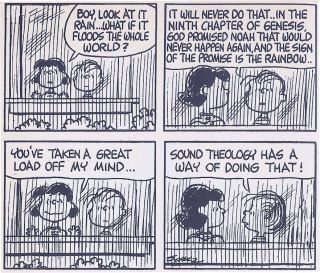
Sound Theology

Saw this going around Facebook:

There may be times sound theology will unsettle us first — when we’re facing something we cringe from in the flesh (e.g., Moses when he was told he’d face Pharoah, Christ in the garden of Gethsemane) or convicted of sin or in need of chastening. But in any situation rightly responded to,  with God’s grace, we can rest in His sovereignty, in the truth of His Word, the rightness of His judgments, the love He has for us.

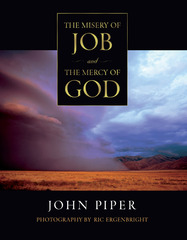
Book Review: The Misery of Job and the Mercy of God

In Beyond Suffering: Discovering the Message of Job (linked to my review) author Layton Talbert referred a few times to a set of poems John Piper wrote called The Misery of Job and the Mercy of God. The poems are in book form there with some beautiful photography and a CD of John Piper reading the poems (at least, the used copy I bought from Amazon had a CD with it). The text and audio are also online here (although a few lines are missing from the text).

There is something about poetry that can express truth with beauty and poignancy, and Piper’s poems certainly accomplish that. They don’t cover every verse or every point made in the book of Job, and they include some scenes not in Job (a conversation between Job and God before Job’s calamities struck and between Job and his wife, who is treated much more tenderly here than in most sermons where I’ve heard her mentioned) which is just an imaginative way of telling the story and expressing what kinds of conversations may have passed. All in all they’re a faithful retelling.

I had wondered why Piper said early on, “And Job would lift his hands to God and wondered why he spared the rod of suffering” until I realized he was probably referring to what Job feared in 3:25 when he said, ““the thing which I greatly feared is come upon me, and that which I was afraid of is come unto me.” We’re going through Job in our church, and just recently discussed what it was that Job might have feared, and it could quite possibly be something along these lines, that God had blessed him so much that he feared that suffering of some kind was going to befall him at some point before it was all over.

There are some really beautiful sections. Here are a few of my favorites (p. 18):

Now tell me, with your heart,
Would you be willing, Job, to part
With all your children, if in my
Deep counsel I should judge that by
Such severing more good would be,
And you would know far more of me?”

What parent could answer that question? Yet we’re called to yield our children to God: they’re ultimately His.

On pages 32-33, shortly after all his trials came:

O God, I cling
With feeble fingers to the ledge
Of your great grace, yet feel the wedge
Of this calamity struck hard
Between my chest and this deep-scarred
And granite precipice of love.

Part of his response to his wife (p. 41):

O Dinah, do not speak like those
Who cannot see, because they close
Their eyes, and say there is no God,
Or fault him when he plies the rod.
It is no sin to say, my love,
That bliss and pain come from above.
And if we do not understand
Some dreadful stroke from his left hand,
Then we must wait and trust and see.

Part of Job’s response to his friends’ accusations (p. 58):

O that some door
Were opened to the court of God,
And I might make my case unflawed
Before the Judge of all the world,
And prove this storm has not been hurled
Against me or my children there
Because of hidden crimes. O spare
Me now, my friends, your packages
Of God, your simple adages.

And I think my favorite lines of all (p. 72):

Beware, Jemimah, God is kind,
In ways that will not fit your mind.

This book took me just under half an hour to read, and then I listened to it the next day in about the same amount of time while mostly following along reading the words. It was quite an enjoyable and beneficial hour, helping to feel some of what Job might have felt. I think I’ll be returning to this volume again and again.

(This review will also be linked to Semicolon‘s Saturday Review of Books.)

The Week In Words

”"

Welcome to The Week In Words, where we share quotes from the last week’s reading. If something you read this past week  inspired you, caused you to laugh, cry, think, dream, or just resonated with you in some way, please share it with us, attributing it to its source, which can be a book, newspaper, blog, Facebook — anything that you read. More information is here.

I see this on Janet‘s sidebar:

A wise and frugal Government, which shall restrain men from injuring one another, shall leave them otherwise free to regulate their own pursuits of industry and improvement, and shall not take from the mouth of labor the bread it has earned. This is the sum of good government. (Thomas Jefferson)

I agree!

Seen at girltalk:

See that your relish for the Bible be above every other enjoyment, and the moment you begin to feel greater relish for any other book, lay it down till you have sought deliverance from such a snare, and obtained from the Holy Spirit an intenser relish, a keener appetite for the Word of God (Jer 15:16).  ~ Horatius Bonar

Forgot to note where I saw this — I think on a friend’s Facebook page:

“To be a Christian means to forgive the inexcusable because God has forgiven the inexcusable in you.” ~ C. S. Lewis

I think if we truly had hold of this truth, that any sin of anyone else’s against us pales next to ours against God, we wouldn’t have any trouble with forgiveness.

If you’ve read anything that particularly spoke to you that you’d like to share, please either list it in the comments below or write a post on your blog and then put the link to that post (not your general blog link) in Mr. Linky below. I do ask that only family-friendly quotes be included.

I hope you’ll visit some of the other participants as well and glean some great thoughts to ponder. And don’t forget to leave a comment here, even if you don’t have any quotes to share! :)

Progress

I’ve felt like I’ve been in a bit of malaise or brain fog the last couple of weeks, and, interestingly, I was scrolling through old posts yesterday looking for something and noticed I had a post saying about the same thing the first few weeks of January almost every year. I think a lot of it is due to transitioning back into routine after the holidays, but that was disrupted a bit due to several snow days. But after getting a lot of sleep, I think I’m back on an even keel. Yesterday brought progress in several areas:

  • Temperatures in the 40s! I didn’t have anything to do with that, of course, but after days and days of sub-freezing weather, 40 felt pretty nice, and most of the ice and snow has finally melted. Winter’s not over yet, but this little break was heartening.
  • Lists. In spite of “brain fog,” some of my problem was just laziness. I’d think of things to work on but would veg out with solitaire on the computer instead. After confessing that to the Lord, I made a running list of various things that needed to be done and got started on it yesterday.
  • I’m still working on decorating the house. It’s going slowly both because it takes me a while to decide where to put things and because I need Jim’s help for some of the heavier items — plus the holidays put all of that on hold. I concentrated on our room yesterday and got several things up on the wall, several boxes put away, and a dust ruffle and dresser scarf ironed and in place. A bit of lace and decorativeness does my heart good. I do still plan to post pictures of the house, hopefully soon. We’re still waiting on those living room chairs…

  • I’ve been able to make headway on this cross stitch project here and there during the evenings. Jason commented that I’d been working on it a long time, and a variation of the song came to mind…”Little by little, stitch by stitch…” I don’t even remember when I started it, but it’s fun seeing it come together. I’m dreading the words in the hoop, though, and left them for later. They’re the most important segment but they don’t follow the lines and squares — I may write them on with a washable fabric marker and stitch over them.

  • Anger…which is actually a regression rather than a progression. I’m not in general an angry person every day, and some times, by God’s grace, I can take things in stride. But sometimes I can get blindingly white-hot angry in a flash, and often over some stupid little thing. And it’s worse when I’m in “the right” (or else believe I am) because it’s harder to let that anger go. Such an incident happened yesterday (no, not with anyone in my family), and after the emotion cooled down I was terribly ashamed and discouraged. I didn’t really say anything, though if the other person was alert they could have picked up on it. But the roiling under the surface was neither healthy nor honoring to the Lord. I confessed that to the Lord as well, and a couple of verses came to mind (“Be not hasty in thy spirit to be angry: for anger resteth in the bosom of fools” [Ecclesiastes 7:9] was one, as was “the wrath of man worketh not the righteousness of God” [James 1:20]), yet I still felt shrouded in defeat. So this morning I did a brief word study on “anger” and “wrath,” mainly in Proverbs and the epistles. Several helped, but one that realy jumped out at me was, “The discretion of a man deferreth his anger; and it is his glory to pass over a transgression” (Proverbs 19:11). Meditation on that and some of the others is helping.

So, though winter will still be here for a while and I’ll always have a list of things to do and an old nature to contend with…I am encouraged to see some progress.

Laudable Linkage & Videos

Oddly, after a couple of weeks of not sharing interesting links I’ve seen, I only have a few. You’d think I’d have multitudes, but much of the blogosphere was fairly quiet over the holidays, and perhaps my reading was distracted enough that I didn’t think to save many. But here are a few:

8 Amazing Blogging Lessons from Albert Einstein, HT to Lisa Notes. The author takes quotes from Einstein and cleverly applies them to blogging.

52 Ways to Read and Study the Bible compiled by Semicolon. So many ways, and with all our electronic devices so many venues — it should be easier than ever.

A couple of years ago I compiled a list of resources and reasons for reading the Bible in Planning to read the Bible more this year?

Katrina at Callapiddar Days told of her first successful attempt at reading the Bible through in Part 1 dealing why she wanted to do so and finding a plan and Part 2 concerning how she succeeded this time, what she learned, and a few resources.

Lisa shares Why I am NOT reading the Bible through in a year, though she is still reading and shares tips for making it more effective.

One area where I’ve fallen short is memorizing. I did a lot in college and then in a children’s ministry we worked with, and those verses have pretty much stayed with me all these years (except I have trouble remembering the references) but not much at all since then. I’ve never memorized a whole book of the Bible. Some ladies at church are memorizing Ephesians, but they meet at a time that isn’t best for me and they are already a good ways into it. Lisa Notes shared a plan for memorizing Philippians by Easter: Partnering to Remember The 2011 Philippians Memory Moleskin.  Ann shares a plan for memorizing Colossians with 2 verses a week for a year with some more details and updates here. I am leaning toward the Colossians plan — 2 verses a week sounds very doable, and I have to admit the little booklet really appeals to me. They’ve set up a Facebook page as well.

Well, I guess I only thought I had just a few!

Just a couple more:

The worst gifts ever, HT to Challies. Though, I don’t know, that office chair looks good for a power nap. 🙂

How Critical Thinking Saves Faith HT again to Challies, on the need to talk with young people and wrestle through their questions with them rather than cutting them off for even asking.

I’ve shared this before, but here is some fun you can have with your Christmas tree when you’re done with it. My guys used to love shooting off model rockets, so this really appealed to them.

And I can’t remember if I shared this here or not, but it just makes me happy: