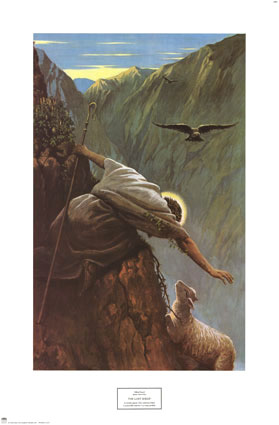
That one lost sheep

Safe were the ninety and nine in the fold.
Safe though the night was stormy and cold;
But said the Shepherd when counting them o’er,
One sheep is missing, there should be one more.

Although His feet were weary and worn,
And though His hands were rent and torn,
Although the road was rocky and steep,
Still the good Shepherd searched long for his sheep.

There in the night He heard a faint cry
From the lost sheep just ready to die.
Then in His arms to shield from the cold
He brought the lost sheep back safe to the fold.

The Shepherd went out to search for the sheep,
And all through the night on the rocky steep
He searched till he found him,
With love bands He bound him,
And I was that one lost sheep.

5391the-lost-sheep-posters.jpg

The Lost Sheep

by Alfred Soord

Courtesy of AllPosters.com

NOTE: I do not have the sheet music for this song. To those who have inquired about the sheet music for this hymn, I e-mailed Gordon Greer (http://www.greermusicministries.com/), on whose CD I heard the song, to see if he knew where the music could be found, and he said it was in Volume 2 of Singspiration Favorites. I hope you can find it!.

Psalm Sunday: Psalm 8

1 O LORD, our Lord, how excellent is thy name in all the earth! who hast set thy glory above the heavens.

2 Out of the mouth of babes and sucklings hast thou ordained strength because of thine enemies, that thou mightest still the enemy and the avenger.

3 When I consider thy heavens, the work of thy fingers, the moon and the stars, which thou hast ordained;

4 What is man, that thou art mindful of him? and the son of man, that thou visitest him?

5 For thou hast made him a little lower than the angels, and hast crowned him with glory and honour.

6 Thou madest him to have dominion over the works of thy hands; thou hast put all things under his feet:

7 All sheep and oxen, yea, and the beasts of the field;

8 The fowl of the air, and the fish of the sea, and whatsoever passeth through the paths of the seas.

9 O LORD our Lord, how excellent is thy name in all the earth!

One town we lived in during my teen years had less than 200 people. It boasted a grocery store, barbeque restaurant (which drew people from all over), a manufacturing plant where my father worked as a welder, a garage, a tavern, a church, and schools up through eighth grade. They bussed the high schoolers to the next town ten miles away. There was one traffic light. We had a “route” number rather than a street address, and we identified our house as “the house on the second hill.”

One of the nicest things about that house on that hill was the view of the sunsets. With the town a little below and a minimum of “city lights” and a wide-open sky, every evening brought a magnificent view.

Often while beholding a glorious array of colors on the sky’s canvas, I would be drawn to thoughts of God’s grandeur and majesty and man’s insignificance in contrast. What mere specks we are in the universe! Yet God created us and cares for us.

When I first “discovered” Psalm 8, I felt I thoroughly understood David’s meditations here. I could picture him on a hillside with his sheep, or on the roof of his palace, gazing up into the sky at the majesty of God’s handiwork, naturally flowing into praise and wonder.

Join us for other meditations on this Psalm at Butterfly Kisses.

My Dad

Today would have been my father’s 77th birthday. He passed away a few years ago. I was thinking about him this morning and decided I wanted to share with you the story of how he was saved in the hope that it will be an encouragement to those who have been praying for lost loved ones for years.

I don’t know much about my dad’s childhood except that he was born and raised in a little town in west Texas. It just occurred to me this morning that I don’t ever remember him sharing stories from his childhood. He was one of five children, quit school when he was about 15 to join the service for a few years, and spent time in Okinawa. At some point his family moved to southern Texas, where he met my mom. He was riding in a rodeo, got flipped off, and on his way down his pant leg got caught on the bull’s horn and ripped. My mom thought he had torn his leg and dashed into the food area to find her parents and tell them, when in walked my dad, and that’s how they met. 🙂

My mom knew that he had a short temper and was very jealous, but she felt that his jealousy would be assuaged when they got married, that that would be proof of how much she loved him, and he wouldn’t be jealous any more. (Warning to any unmarried young ladies reading: it doesn’t work that way.) She knew he drank but I guess didn’t feel he drank too much. I can remember her saying that he worked hard and had the right to drink if he wanted to. I think they were relatively happy — a few spats here and there, I am sure. Whenever he would lose his temper, he would feel horrible the next day and apologize profusely and promise never to do it again. With love’s willingness, she believed and forgave him.

I don’t think the word “alcoholic” was used then and certainly not as much was known about it as there is now, or she probably would have foreseen the pathway this would take. You can probably guess the progression. Alcohol and anger don’t mix well, and both increased through the years. I do remember happy times, stable times, even tender times. But those got more and more crowded out as the years went by.

My mother left my father when I was 15 and took all of us kids (five at that time) to another town. It was as a result of this feeling as though the rug had been pulled out from under me that the Lord got hold of my heart, which I shared earlier in my testimony. I couldn’t blame her, but it was a time of upheaval in my life.

When I became a Christian, naturally I wanted to share Christ with my family members. I think I was a bit bolder then, though I can’t remember many specifics, but overall witnessing has been one of my major failings. I could, and did, share many things in writing, but it was very hard to talk about these things in person. It was hard to talk about anything controversial with my father. There was always the fear of his reaction if he got angry and the automatic response was to lay low, stay off the radar and avoid setting him off. Plus, besides or maybe because of these things, we weren’t terribly close, though I knew he loved me in his own way and I loved and cared for him.

Over the years I did write to him many times. Sometimes I would lay out the plan of salvation in the letter; sometimes I would just write out a salvation verse at the end. When he wrote back or we talked, though, he never mentioned it. My assumption was that he skipped over that part. When he moved to our town, he went to church with me occasionally.

Our relationship continued on in a fairly amiable way, and my sharing Christ with him continued through letters as I went to college out of state, got married, and lived in SC.

His health began to slowly decline. He was always prone to pneumonia — whether because he smoked all his adult life or he was just disposed that way, I don’t know. It was after one health crisis, I think, when I called my former pastor in town there, and he went to visit my dad. My pastor told me later that my dad had prayed to receive Christ, but when I talked to my father, he never said anything about it. I had wanted him to initiate the conversation about it, but when he didn’t, I told him the pastor mentioned he had come by. He acknowledged that he had come to visit, but didn’t elaborate. So I wasn’t sure exactly what happened. My pastor was not an aggressive, “push them back into a corner til they agree” type of personality (I do have another family member who “made a profession” after an encounter with someone like that, who also has never said anything about it and never changed, so I fear he just responded as the person wanted him to because he was cornered and didn’t really come to Christ in his heart). Whether my dad was saved then but just didn’t think to or now how to express it, or what, I didn’t know. But because there was nothing said and no subsequent changes in his life over time, I wasn’t sure whether he was really saved.

He ended up quitting smoking and alcohol for health reasons: both made him feel sicker. I thought it was interesting that God removed those from him before he got saved rather than after, but I am glad, because I didn’t want him to think salvation was just a matter of stopping drinking.

He came to visit us in SC for the first time when we’d been married about 10 years. Jeremy was 5 and Jason was 2. He wasn’t doing well physically, but he had just gotten out of the hospital a few weeks before, and we thought maybe he was just doing too much too soon. He went with us to a field day and carnival at Jeremy’s school, and one of the people he met there was my pastor’s wife. She had grown up in a little town in west Texas and knew his little town in west Texas, and that and her sweet personality gave them an instant rapport. My dad ended up not feeling well enough to stay long. Earlier in the week we had invited him to church with us that Sunday. At first he declined, but then he agreed. We had been pinning all of our hopes for his salvation on that church service, so we were profoundly disappointed when he felt too sick to come. We couldn’t understand why the Lord would allow him to get sick at that time. My pastor told Jim that perhaps He knew it would just be too much or be too overwhelming for my dad at that time.

Dad was supposed to fly back home I think that Monday or Tuesday. When he woke up, he came out of his room, breathing heavily, having to hang onto something to walk, and asked if we minded if he stayed a few days longer, because he didn’t think he could travel. I said of course we didn’t mind, and hurried to get Jim to tell him something was wrong. We got my dad in to see our doctor, who called an ambulance to come and take him to the hospital, and he was admitted into the ICU.

My memory is a little fuzzy here, but I don’t remember what they initially thought was wrong. I think they had trouble figuring it out at first. I don’t know if they ever gave us an actual diagnosis. After he had been there for several days they discovered he had some infected teeth, and one theory was that the infection spread through his body, maybe because his health was not good on the first place.

Because he was in ICU, we were only able to see him for 15 minutes at a time. Because I had two young children we couldn’t just camp out up there, so life was a lot of running back and forth, taking care of the kids, getting them to baby-sittters, getting things my dad needed, and going to the hospital. He had been in for maybe 2-3 days when, as we came into the hall to see him, his nurse quickly came up to us and told us they had been trying to contact us. My dad’s heart had gone into an irregular rhythm and they had almost lost him: they had to pump all kinds of medicine in and shock him before it finally stabilized. We could go in and see him just briefly. We were shocked and astounded — we hadn’t realized his condition was so serious (later when I saw my doctor and told him my dad had almost died, he said, “He almost died in my office.” He hadn’t told me that!) We went in to see him and talked a bit. At one point he said, “I know one thing — when I get home, me and the Lord and Pastor H. are going to have to have a long talk.” We asked him if he wanted our pastor here, Pastor M., to come and see him. He said yes.

So we called our pastor and he readily agreed to come. Our church, by the way, really rallied around us in prayer and in practical help taking care of the kids. Pastor was able to see him in the ICU and spend a few minutes at a time with him. He told us that he kept emphasizing one verse, John 3: 16, with him. He didn’t feel my dad could handle a barrage of verses, and he may have shared others, but he kept talking about John 3:16 every time he visited.

Well, after several days, Dad finally got well enough to go to a private room. I think his first or second day there, when we came that night to visit him, he said, right off the bat, “I want you to know I accepted the Lord as my Savior this afternoon.” You could have knocked us over with a feather! He said Pastor M. had come by that afternoon and was able to talk with him a little longer, explained everything to my Dad’s satisfaction, and Dad prayed to receive Christ.

Pastor told me later that Dad had said something like his daughter had been after him to do this for years, and that he had read all those verses I had sent in letters, all those verses I thought he had just skipped over. My heart was so touched and it almost brings me to tears even now. So I encourage you — keep on, gently, as the Lord leads, sharing His truth. He is using it even when there is no outward evidence that anything is going on.

To share with you “the rest of the story” — my dad ended up being in SC for six weeks instead of one. When he went home, I excitedly thought this would be the catalyst to reach the rest of my family. Unfortunately, it didn’t happen that way. Though there were small, discernible changes, there was no big, dramatic, obvious change. My pastor here said that when someone has lived “on the other side” for so many years (Dad was 61 at this point), sometimes the changes take place more slowly. Plus he wasn’t in church being taught and being around other believers, so I am sure that hindered his spiritual growth. He did, however, love to read, and would devour Christian books I sent him. I remember one phone call when we discussed one of the books I had sent about Soviet Christians who had been imprisoned for their faith, marveling at all they had gone through and God’s grace in sustaining them. When I got off the phone, I just sat for a moment, marveling that I had just had a conversation with my father about the Lord.

He only lived about seven years beyond that. He had a stroke, then developed lung cancer, skin cancer, and suspected colon cancer as well as kidney problems. His poor body just gave out. My former pastor agreed to preach his funeral and was able to share the gospel.

I was surprised that I had a great deal of anger in the years after he died — angry that our relationship wasn’t what it could have been, and though I couldn’t talk to him about it, anger at his anger. I felt it was kind of silly, really, to be angry at that point when there was no way to reconcile anything with him. I have read, though, that those feelings are pretty normal. What helps is to know that now, in heaven, where hearts are made finally perfect, knowing what he knows now, everything is all right on his end and he would do things differently if he could.

One of the greatest things my dad taught me was respect. He emphasized that in our family, and that stood me in good stead with other authority figures through the years. When I became a Christian, one of the things I learned early on is that in family relationships, we’re to honor, obey, and respect our parents because of the position God gave them, even if all of their actions aren’t honorable or worthy of respect. He also tried to teach us a basic standard of right and wrong as he understood it.

I haven’t shared the negative aspects of his story to dishonor him, but just to be honest. Many people in the world have to deal with alcoholism and anger in their families, and I hope this is an encouragement.

Works-For-Me Wednesday: “You can’t say no until you pray about it”

wfmwheader_4.jpgAny article or book you read or talk you hear about managing time will include this point: you have to be willing to say no to some activities. Especially in this day and age when opportunities to do things or have your kids involved in things abound on every hand, sometimes we just have to put our foot down and say “No” to maintain our sanity and keep some kind of reasonable schedule.

On the other hand……sometimes we say no without really considering what the Lord would have us do. All we know is that we can’t take on another thing. I am assuming many of the WFMW readers are Christians, so I am speaking from that basis. Some years ago I was on a committee of ladies at church who took turns putting up bulletin boards to highlight 2-3 of our missionaries at a time each month. This committee was a part of the Ladies Missionary Prayer Group at that church. At that point in time they elected officers every year. At one fall meeting, the president told us that that nominations had been made for the following year and the officers would be contacting those ladies who had been nominated to let them know and find out if they were willing and able to accept. She then stated, “You can’t say no until you pray about it.”

Well, Debbie, the officer over that committee, told me I had been nominated for that office. My first response was, “But….I’ve been waiting all year to get off this committee!” That was not very encouraging to Debbie, I’m sure. 🙂 But I just didn’t feel the liberty to say no, so I said yes. A week or two or so later Debbie came to me and told me that the other nominees had not accepted, and therefore I was “it.” She remarked that that must have been the Lord’s will. I responded, “No…the other ladies are out of the Lord’s will for not accepting the nomination.” I was so spiritually-minded, wasn’t I? 🙄 I think she thought I was teasing, or else she would have rethought my nomination.

I did fulfill that year, and even though bulletin boards are not my forte, I really saw the Lord give some great ideas and some great people to help on the committee. I learned something about leadership. I learned to seek Him when frustrated because I couldn’t find help. I learned about the ups and downs of working with people. I don’t know if I can say I “enjoyed” that year, but I did learn a lot and I grew spiritually and as a person.

A few years later when an opportunity came along that was more scary and involved more work, I was able to face it with the confidence that if the Lord wanted me to do it, He would enable me. And He did, marvelously.

For a while I went too far the other way, thinking that anything that anyone in the church asked me to do must be from the Lord. 🙂 We can get in over our heads really quickly that way.

Since then there have been times I have felt completely free to say no and have seen the Lord bring in someone else for that opportunity who did a wonderful job, much better than I would have done if I had taken it out of a sense of duty.

But the important thing is to pray over it first, before you decide it’s out of your comfort zone or that you don’t have the time or the skills. Sometimes the Lord delights in pulling out of our comfort zone and into dependence on Him for the abilities and the time. Sometimes He wants us to lay something else aside to do what He wants us to. Look in Scripture at people who were happily minding their own business when God came to them with something He wanted them to do (Moses, Noah, Peter, Paul) and think not only what history would be like, but what their lives would have been if they had said no.

I had worked on another WFMW tip this morning, had it all done, pictures loaded, and published, when I felt impressed to pull that one and share this. I hope it is a help to someone. 🙂

To find some great tips or share your own, go to Rocks in My Dryer.

The language of Christians

It’s funny how things will come up in a particular category from different places around the same time.

Some time ago on a Christian forum I saw reference to John Piper’s apology for publicly using inappropriate language. I even saw someone say that it was ok to swear because John Piper did. Well, first of all, I would consider his word choice in this particular incident unwise and even profane, but not “swearing.” But, as I discussed a few days ago, we shouldn’t make decisions about how we act based on how other Christians act (but because weaker brethren do this, that’s one reason we need to be careful in our actions).

Since then on various Christian sites I’ve seen language I was surprised to see.

My oldest son and I have talked from time to time about how language changes. For instance, he uses the word “crap” to mean “junk,” as in, “I need to clean the junk off my desk.” When I was growing up, that word was little better than a word still recognized today as profane and still, thankfully, bleeped out on network TV. Because of that, I cringe when I hear him use it (I cringed to even type it out here) and would prefer he not use it: his argument is that it doesn’t mean what it used to, it’s become a common term, and so it is ok now. (This post is not about my son — I just bring up this incidence by way of illustration because a lot of people think this way.)

There are many terms today that, though they are becoming more mainstream, have vulgar origins, and, even if they are not considered outright vulgarity today, they’re still considered not the best speech. I come from a public school background and, unfortunately, know of some of those vulgar connotations. Yet I know some people these days can use those terms in innocence, not knowing where they came from. And the way society is these days, perfectly innocent terms can come to have a risque double meaning. There are some secular message boards I don’t frequent and comedians I don’t watch because of that kind of thing. Once one of my sons got into trouble at school for using a particular term. He said he didn’t know what it meant, and, thankfully, the principal believed him. He picked up using it because other kids were. Of course, we had to counsel him that it’s not wise to do that. But the term itself was perfectly innocent in its exact words — neither my husband or I had ever heard it used in a negative connotation before. My husband had to ask a co-worker what it meant.

Some people will point out that there are terms used in the Bible that we would consider vulgar today. True, but in the day the Bible was translated those words weren’t considered vulgar, so I don’t think that’s justification for using them commonly today.

So what’s a Christian to do? Well, first of all we consider what the Bible says about speech. There is not a list of words that are ok and words that should be banned, but there are Scriptural principles about our speech. There is much more than can be included here, but here are a few of them:

Let no corrupt communication proceed out of your mouth, but that which is good to the use of edifying, that it may minister grace unto the hearers. And grieve not the holy Spirit of God, whereby ye are sealed unto the day of redemption. (Ephesians 4:29-20).

Walk in wisdom toward them that are without, redeeming the time. Let your speech be always with grace, seasoned with salt, that ye may know how ye ought to answer every man (Colossians 4:5-6).

But I say unto you, That every idle word that men shall speak, they shall give account thereof in the day of judgment (Mattehw 12:36).

In all things shewing thyself a pattern of good works: in doctrine shewing uncorruptness, gravity, sincerity, Sound speech, that cannot be condemned; that he that is of the contrary part may be ashamed, having no evil thing to say of you (Titus 2:7-8).

The thoughts of the wicked are an abomination to the LORD: but the words of the pure are pleasant words (Proverbs 15:26).

Pleasant words are as an honeycomb, sweet to the soul, and health to the bones (Proverbs 16:24).

Seest thou a man that is hasty in his words? there is more hope of a fool than of him (Proverbs 29:20).
The lips of the righteous know what is acceptable: but the mouth of the wicked speaketh frowardness (Proverbs 10:32. The NASB puts it this way: The lips of the righteous bring forth what is acceptable, But the mouth of the wicked what is perverted.)

The tongue of the just is as choice silver (Proverbs 10:20a).

There is that speaketh like the piercings of a sword: but the tongue of the wise is health (Proverbs 12:18).

A wholesome tongue is a tree of life: but perverseness therein is a breach in the spirit (Proverbs 15:4).

This passage doesn’t deal specifically with the tongue, but it is an overriding principle that should guide everything we do:

Whether therefore ye eat, or drink, or whatsoever ye do, do all to the glory of God. Give none offence, neither to the Jews, nor to the Gentiles, nor to the church of God: Even as I please all men in all things, not seeking mine own profit, but the profit of many, that they may be saved (I Corinthians 10:31-33).

And that’s not even going into the sections about lying tongues, flattering lips, wise words, angry speech, etc. But there is plenty there to indicate to me that I should seek to have wise gracious speech that brings honor and glory to God and that isn’t profane and vulgar. I don’t think that means I need to speak formally or sound like the King James Bible in my everyday speech. But I should definitely take the high road. If I know something has a vulgar background or connotation, I don’t use it. Coming from an unsaved family, school, and background, I can tell you lost people aren’t impressed when Christians use certain language in order to sound like “one of the guys.”

James 3:8a tells us, “But the tongue can no man tame.” We need God’s help to tame it.

Personally, I use these two as a prayer:

Set a watch, O LORD, before my mouth; keep the door of my lips (Psalm 141:3).

Let the words of my mouth, and the meditation of my heart, be acceptable in thy sight, O LORD, my strength, and my redeemer (Psalm 19:14).

Clarification

I’ve been thinking the last couple of days that I might need to clarify something in regard to the “fundamentals and secondary issues” post.

I hope I didn’t make it sound like the fundamentals are all that is important and everything else is a free-for-all, doesn’t-matter, everyone can do whatever they want kind of thing. (No one in their comments indicated that reaction — I just tend to second-guess myself after I write.)

Ephesians 5:15 says, “See then that ye walk circumspectly, not as fools, but as wise.” Dictionary.com says circumspect means, “watchful and discreet; cautious; prudent, well-considered.”

Plus the fundamental truth that the Bible is inspired by God leads to the responsibility to read God’s Word, seek His will, and do as we feel led, knowing that we’re accountable to Him for everything.

Psalm Sunday: Psalm 7

1 O LORD my God, in thee do I put my trust: save me from all them that persecute me, and deliver me: 2 Lest he tear my soul like a lion, rending it in pieces, while there is none to deliver.

3 O LORD my God, If I have done this; if there be iniquity in my hands;

4 If I have rewarded evil unto him that was at peace with me; (yea, I have delivered him that without cause is mine enemy:)

5 Let the enemy persecute my soul, and take it; yea, let him tread down my life upon the earth, and lay mine honour in the dust. Selah.

6 Arise, O LORD, in thine anger, lift up thyself because of the rage of mine enemies: and awake for me to the judgment that thou hast commanded.

7 So shall the congregation of the people compass thee about: for their sakes therefore return thou on high.

8 The LORD shall judge the people: judge me, O LORD, according to my righteousness, and according to mine integrity that is in me.

9 Oh let the wickedness of the wicked come to an end; but establish the just: for the righteous God trieth the hearts and reins.

10 My defence is of God, which saveth the upright in heart.

11 God judgeth the righteous, and God is angry with the wicked every day.

12 If he turn not, he will whet his sword; he hath bent his bow, and made it ready.

13 He hath also prepared for him the instruments of death; he ordaineth his arrows against the persecutors.

14 Behold, he travaileth with iniquity, and hath conceived mischief, and brought forth falsehood.

15 He made a pit, and digged it, and is fallen into the ditch which he made.

16 His mischief shall return upon his own head, and his violent dealing shall come down upon his own pate.

17 I will praise the LORD according to his righteousness: and will sing praise to the name of the LORD most high.

David begins with a declaration of his trust in God — the first place to begin in any problem or prayer, the reason we pray in the first place.

In verses 3-8 David affirms that this situation is not because of his own sin. That’s the next thing we need to think about in any trouble: are our hearts clean? Did we bring this on ourselves? David, like Job, knew that these circumstances came on him in the innocency of his heart.

As an aside, what if we can’t say that? What if we know we have done something wrong and we fear that our awful circumstances may be God’s chastening or even just the natural results of our sin? I John 1:9: If we confess our sins, he is faithful and just to forgive us our sins, and to cleanse us from all unrighteousness. If we go to God in true confession, seeking cleansing and not just an “out” for our troubles, He will cleanse us. Then we can pray for deliverance and help in confidence.

In verse 7 David seems to be appealing to the Lord’s testimony before the congregation. Sometimes our prayers for deliverance are not just for ourselves, but so that others may see God’s righteous deliverance. That was a testimony to people in David’s time and is still a testimony today through the Psalms and the OT narratives about David’s life

Oh let the wickedness of the wicked come to an end. That is an applicable prayer for our day!

God is angry with the wicked every day. I think in these days we forget this sometimes. On the other hand, there are some who over-emphasize it and blame every calamity on the wicked and God’s anger. This may seem at odds with passages like John 3:16, but it is not. God does love the world and has provided a way of salvation, but He is angry at wickedness and will deal with it, as verses 12-13 indicate.

Verses 14-16 show the consequences of wickedness that the wicked brings on himself — the sowing and reaping principle.

David ends with praise to God. So often we forget that — we want to run into the throne room and cry for help, then run off again without praising God for His righteousness (which is one basis for our appeal and our confidence).

Thank God for His righteousness, the knowledge that He will always do the right thing at the right time, and that we can cry to Him for deliverance!

You can read others’ thoughts on this passage, or feel free to join us and share your own, at Butterfly Kisses.

Fundamentals and secondary issues

I mentioned in an earlier post on fundamentalism and separatism that there are fundamentals that we cannot budge on — the Deity of Christ, for example, or the way of salvation — but there are other issues about which good people can differ.

This is something I guess I’ve known probably most of my Christian life to some degree. But it really came home to me several years ago when we had moved to a different area, visited several churches, and the one most like us in faith and practice was still very different in many respects. There were things that were considered important and just basic in my own heart and in the church I came from that were not in this new church, though we agreed on “the fundamentals.” Many of those things were issues I could have lived with, so to speak, if it were just my husband and I. But I didn’t want my children to be confused. It’s awkward to try to explain to children why they can’t participate in an activity the church allows or dress the way others at church do, etc.

I used to (naively) think that since there is one God and He speaks with one voice, then all Christians should be on the same page. 🙂 So these differences were really troubling to my spirit until one day I just cried out to God. I was going to have to come to some kind of understanding and peace about this or I was going to have to leave the church. I took a spiral notebook and my Bible and spent I don’t know how much time going over Scripture, jotting notes and verses, and drawing principles from those verses. Though there are other applicable passages, probably the premiere one is Romans 14. Now, right off the bat some people who are familiar with that passage will brush it off, thinking, “Oh, that’s dealing with the weaker brother.” It is. But that’s no reason to dismiss it when we’re not dealing with what we think are weaker brother issues (and, really, when it comes to differences of opinion like the ones I am talking about, I don’t think we really need to do a lot of posturing about which one is the weaker brother. I have seen conversations along those lines which really seem to be born out of pride.) It is not that the principles Paul brings up only apply to a weaker brother situation: it is rather that he is applying universal Christian principles to that particular situation.

So what are some of those principles?

1) Don’t despise or judge the person whose conviction differs from yours.

Romans 14: 2-4:

2 For one believeth that he may eat all things: another, who is weak, eateth herbs.
3 Let not him that eateth despise him that eateth not; and let not him which eateth not judge him that eateth: for God hath received him.
4 Who art thou that judgest another man’s servant? to his own master he standeth or falleth. Yea, he shall be holden up: for God is able to make him stand.

Really other Scripture is on the side of the person who feels he can eat all things, but Paul doesn’t tell that person to convince his weaker brother of that. There may be a time for that kind of discussion, but Paul warns in v. 1 against “doubtful disputations.” If we can extrapolate the principle being applied here away from the specific application about what to eat, Paul doesn’t tell these people to hammer it out until they come to a consensus. He tells the person who has a conviction about an issue not to judge the one who doesn’t. Why? Because he is also God’s servant, God has accepted him, and he’s answerable to God. And that’s where most people camp when they come to this passage. But those truths also apply to the other, the one who doesn’t have the conviction, who feels it is ok to do whatever it is they have a difference about. He is told not to despise the other. We think of “despise” as meaning “really, really hate.” But in the KJV the word despise can mean to think down about. Checking this verse in the NASB, it says, ‘The one who eats is not to regard with contempt the one who does not eat.” And this, frankly, I see violated just as much as the other. The one who doesn’t do whatever is not to judge the other; the one who feels it is ok to do whatever is not regard the other with contempt.

2) Be fully persuaded in your own mind.

Romans 14:5: One man esteemeth one day above another: another esteemeth every day alike. Let every man be fully persuaded in his own mind.

Whatever one’s convictions are, he needs to come to a conclusion in his own mind. He needs to be fully persuaded. He shouldn’t change convictions with every conversation he has on the issue. He needs to pray and study the Scripture.

3) Do whatever you do as unto the Lord.

Romans 14:6: He that regardeth the day, regardeth it unto the Lord; and he that regardeth not the day, to the Lord he doth not regard it. He that eateth, eateth to the Lord, for he giveth God thanks; and he that eateth not, to the Lord he eateth not, and giveth God thanks.

It was new to me, when I did this study, that people could be on the opposite sides of the fence on an issue and both be doing what they did as unto the Lord. But that needs to be the issue: to do it as unto the Lord, not as unto what this or that person says.

4) We are all accountable to God.

Romans 14: 9-12: 9 For to this end Christ both died, and rose, and revived, that he might be Lord both of the dead and living.
10 But why dost thou judge thy brother? or why dost thou set at nought thy brother? for we shall all stand before the judgment seat of Christ.
11 For it is written, As I live, saith the Lord, every knee shall bow to me, and every tongue shall confess to God.
12 So then every one of us shall give account of himself to God.

5) We have to be careful not to make someone else stumble in what we allow ourselves to do, and
6) Conscience is not infallible, but it should not be violated.

Romans 14:13 Let us not therefore judge one another any more: but judge this rather, that no man put a stumblingblock or an occasion to fall in his brother’s way.
14 I know, and am persuaded by the Lord Jesus, that there is nothing unclean of itself: but to him that esteemeth any thing to be unclean, to him it is unclean.
15 But if thy brother be grieved with thy meat, now walkest thou not charitably. Destroy not him with thy meat, for whom Christ died.
16 Let not then your good be evil spoken of:
17 For the kingdom of God is not meat and drink; but righteousness, and peace, and joy in the Holy Ghost.
18 For he that in these things serveth Christ is acceptable to God, and approved of men.
19 Let us therefore follow after the things which make for peace, and things wherewith one may edify another.
20 For meat destroy not the work of God. All things indeed are pure; but it is evil for that man who eateth with offence.
21 It is good neither to eat flesh, nor to drink wine, nor any thing whereby thy brother stumbleth, or is offended, or is made weak.

Sometimes people take verses 2-12 as a blank check for Christian liberty, feel they can do whatever they want, and anyone who has a problem with it is judgmental and Pharisaical. But Paul says there is a consideration here, and that is whether our actions, what we could allow in good conscience, might cause someone else to stumble who does not feel that same liberty. The Christian life is not one of claiming my “rights” to the detriment of other people. He gives an example of that in I Cor. 8 with the situation of meat offered to idols. Again, the overriding principle is they key here. The chapter is not just about meat offered to idols, and therefore we can breeze past it because we don’t have that situation in America. The principle is how we act when one Christian’s conscience is affected by something that another’s is not. We don’t run roughshod over conscience in the name of Christian liberty.

Conscience is not an infallible guide, despite what Jiminy Cricket says. 🙂 One former pastor used to try to humorously illustrate that this way: he would say that if he were in a jungle and met up with some cannibals, he would not tell them to let their conscience be their guide, because they would have no conscience about eating him. 🙂 In one of Isobel Kuhn’s books, she related how that the Lisu people were very gifted musically and could sing in parts naturally. As many became Christians she enjoyed teaching them hymns. Once she asked them about using a particular gourd that others used as a musical instrument. The Christians were horrified, saying that they couldn’t do such a thing because the non-Christians used them during immoral acts. Conscience is affected by what we have been taught about right and wrong. But to him that esteemeth any thing to be unclean, to him it is unclean. All things indeed are pure; but it is evil for that man who eateth with offence. A gourd in and of itself is not unclean. As long as those Lisu Christians esteemed it as unclean and wrong, though, they should not override their conscience and use it. It may have been that with time, spiritual growth, and patient teaching from Scripture, they would have come to see that and have no problem using it with hymns; on the other hand, they may have concluded that, though it wasn’t sinful in itself, it was still associated with the heathen lifestyle and should not be used. But it was wise of the missionary not to push the issue. She could have tried to talk them into it, but if they used it still having a conscience against it, they would have been sinning, according to I Cor. 8 and Romans 14:13-21. That may be one of the reasons Paul warned against doubtful disputations in Romans 14:1 — not only do they generate more heat than light, but it is possible to “talk someone into” doing something that their conscience isn’t really convinced of yet (I don’t think that means we can’t ever discuss differences of opinions on these issues, but we have to be careful and gracious about it, not disputing or being pushy or opinionated). Both of these passages seem to me to be saying that it is not the particular thing in question (i.e., meat offered to idols) that is important for the stronger Christian, but righteousness, and peace, and joy in the Holy Ghost, and we should therefore follow after the things which make for peace, and things wherewith one may edify another. In I Cor. 8:13, Paul says, “Wherefore, if meat make my brother to offend, I will eat no flesh while the world standeth, lest I make my brother to offend.” Sometimes the stronger Christian needs to defer to the convictions of the weaker so as not to cause them to sin, because the bigger issue is not that I have liberty to do it: the bigger issue is treating our brother charitably and not wounding his weak conscience. But when ye sin so against the brethren, and wound their weak conscience, ye sin against Christ (I Cor. 8: 12). These issues, these differences are not what make up the Christian life, but rather righteousness, and peace, and joy in the Holy Ghost (v. 17).

Why shouldn’t one violate conscience?

Romans 14: 22-23: Hast thou faith? have it to thyself before God. Happy is he that condemneth not himself in that thing which he alloweth. And he that doubteth is damned if he eat, because he eateth not of faith: for whatsoever is not of faith is sin.

Conscience can be instructed and retrained, and as we learn more of God’s Word our conscience should be adapting more and more to what we are learning. But we shouldn’t do something as long as we have any doubts about it, according to these verses.

Once a guest speaker at a church we were members of several years ago shared this story. He was there for a family conference and would be well known in fundamental circles. His wife was with the Lord by then, but he said at one point several years earlier she had come to him saying that she felt she should not wear earrings any more. He had no problems with earrings (and you can make a case Scripturally as to why they are ok, but I won’t just now.) He told her to do as she felt led. Some time later, just as the Iron Curtain was coming down in the Soviet Union, he and his wife had an opportunity to go over there. Another team from our church then also went over in the earliest days and came back saying the things that this man said, that the Christians there felt that women wearing a lot of jewelry and make-up were “worldly.” As this team returned every year, they toned down the jewelry and make-up so as not to offend, and this pastor’s wife, because she came to them that way already, had an open door to minister to the women there. Now, did those Christians need to come to understand that jewelry and make-up were not in themselves worldly and that they shouldn’t judge on that basis? Sure, eventually. But there were many other larger issues that they needed to deal with first, and this pastor’s wife and ministry team were wise to lay aside their liberty in that area in order to minister to them in ways that they needed first.

Does that mean no Christian women should wear jewelry or make-up? No, not at all, but I think if a particular Christian woman is trying to minister to someone who has a problem with that, it might be wise to set it aside for a time.

Then we get into the question of, “Well, it seems like everyone is convicted about something. Are we supposed to go around not doing anything?” Well, that would be overdoing it. It is tricky, to be sure. But with prayer and the Holy Spirit’s guidance and an attitude to do others good, I feel sure the Lord will show us how this all applies in each case.

But, getting back out of the weaker brother issues and going back to applying these principles at large, we do need to realize that people can differ over when and whether the Rapture will occur, pants on women, movies, homeschool vs. public school vs. Christian school, courtship vs. dating, birth control vs. none, Bible translations, etc. etc., etc., and we can still regard each other as good Christians who love the Lord. Unity doesn’t mean we all do everything exactly the same way. But we have unity in the diversity of personalities and preferences and gifts. And we love each other in the Lord, handling our differences with grace.

“What do you say about this book?”

463462_searching_2.jpgEveryday Mommy Jules asked this question about the Bible a few days ago. I haven’t read the responses there yet, but my first thought went back to a time when my college dorm supervisor asked us to study what the Bible says about itself. Then later I thought of the man who was my pastor for fourteen years (and still would be if we had not moved) saying that when he first started preaching, he approached a given passage with the question, “What can I say about this passage?” He realized over time that the right question was, “What does this passage say?” Having fourteen years of expository preaching with that basis influences how one thinks when reading the Scripture. 🙂 (That’s not to say that Jules is asking the wrong question — not at all, it is a very important question. I’m just saying that this is how my mind works in thinking of how I would answer it: first of all I need to consider what it says about itself.)

I wish I still had the notes to that first study I mentioned. I might, buried in a box somewhere. That was before I made files for such things. But these passages come to mind.

The Bible is first and foremost God’s Word. If it were not, none of the rest would matter. There might be some pleasant sayings, some good common sense, some good stories and warnings to heed, some “inspirational” passages. The Bible is inspired, but not in the same way as we might speak of a poem or anecdote being inspirational. II Timothy 3:16-17 says, “All scripture is given by inspiration of God, and is profitable for doctrine, for reproof, for correction, for instruction in righteousness: That the man of God may be perfect, thoroughly furnished unto all good works.” The word “inspiration” there comes, I am told, from a word that means “breathed out.” II Peter1:21 says, “For the prophecy came not in old time by the will of man: but holy men of God spake as they were moved by the Holy Ghost.” Theologians debate exactly how the process worked, and I have heard some of the different views, but however it happened, the Bible is literally given to us by God. I enjoyed in Bible Doctrines class learning how Peter referred to Paul’s writings as Scripture, how Christ quoted from the Old Testament, etc. — there are many evidences that each part of the Bible is God’s Word.

It is interesting that in that passage from Peter, a little earlier he refers to the time he, James, and John were with Christ when they saw a glimpse of Him in His glory, in what is called the “transfiguration.” Peter says they were “eyewitnesses of His majesty” and heard God’s voice from heaven. Seems like that would be a pretty exciting experience, doesn’t it?! But Peter says, after referring to that incident, “We have also a more sure word of prophecy…” (II Peter 1:19) and then refers to the Scripture. He is saying that Scripture is a “more sure word” than even the experience of seeing Christ in His majesty or hearing God’s voice from heaven!

Since that is the case — that Scripture is inspired of God and more sure than experience — it is authoritative and reliable. It’s also binding. I have an obligation to listen to, heed, and obey what it says. I am responsible before God for what I do with what I read and hear.

The II Timothy 3:16-17 passage goes on to say God’s Word is “profitable for doctrine, for reproof, for correction, for instruction in righteousness: That the man of God may be perfect, thoroughly furnished unto all good works.” The word “perfect” there means “complete” rather than “flawless.” Doctrine, reproof, correction, and instruction are not what most people go to the Bible for: usually they want to be comforted, encouraged, uplifted; they want something to make them feel better, something to help them through the day. The Bible is good for those things and does do that: but primarily God wants to use it to teach us, change us, and bring us to spiritual maturity. That’s not always comfortable.

As God’s Word, the Bible also:

1. Keeps me from sin

Psalm 119:9, 11: Wherewithal shall a young man cleanse his way? by taking heed thereto according to thy word. Thy word have I hid in mine heart, that I might not sin against thee.
(See also verse 101)

2. Is my delight and my counsellor

Psalm 119:24: Thy testimonies also are my delight and my counselors.
(See also v. 35, 47, 70, 77, 92, 143)

3. Quickens (revives) me

Psalm 119:25: My soul cleaveth unto the dust: quicken thou me according to thy word.
(See also verses 37, 40, 50, 88, 107, 149, 154, 156, 159)

4. Is my basis for hope

Psalm 119:49: Remember the word unto thy servant, upon which thou hast caused me to hope.

5. Is the basis for my comfort

Psalm 119:52: I remembered thy judgments of old, O LORD; and have comforted myself.
(See also verse 76)

6. Is better than gold or silver

Psalm 119:72: The law of thy mouth is better unto me than thousands of gold and silver.

7. Is forever settled in heaven

Psalm 119:89: For ever, O LORD, thy word is settled in heaven.
(See also verses 144, 152, 160)

8. Is what I should love and meditate on

Psalm 119:97: O how love I thy law! it is my meditation all the day.

9. Is the source of wisdom and understanding

Psalm 119: 98-100:Thou through thy commandments hast made me wiser than mine enemies: for they are ever with me. I have more understanding than all my teachers: for thy testimonies are my meditation. I understand more than the ancients, because I keep thy precepts.
(See also verses 104, 130)

10. Is sweet

Psalm 119:103: How sweet are thy words unto my taste! yea, sweeter than honey to my mouth!

11. The source of guidance

Psalm 119:105: Thy word is a lamp unto my feet, and a light unto my path.

12. Is right

Psalm 119:128 Therefore I esteem all thy precepts concerning all things to be right; and I hate every false way.
(See also verses 137, 138, 172)

13. Is pure

Psalm 119:140: Thy word is very pure: therefore thy servant loveth it.

14. Is truth

Psalm 119:151 Thou art near, O LORD; and all thy commandments are truth.
(See also verses 142, 160)

And those are all just from Psalm 119. The Bible is full of instruction about itself.

And in light of what is says about itself, what can I say but Amen!

Singleness

A couple of years ago my oldest son and some of his other friends who had no girlfriends declared Valentine’s Day S. A. D.  — Single Awareness Day.  🙂

I can imagine that this day can feel awkward, sad, or even painful for single people.

Some years ago my eyes were opened, so to speak, about how things can look and feel to single people in church (in general, not just in relation to Valentine’s Day) by the article “Single on Sunday Morning” by Camerin Courtney. One comment she makes is, “I think churches, in their quest to restore ‘family values’ to modern society, have simply overlooked those of us who aren’t currently in families.” I think that can be true. In discussions about this with single ladies on a couple of Christian message boards I have participated in, I’ve tried to convey that families do need help. Society does seem to be undermining the Christian concept of a family, and, even if it wasn’t, most people don’t go into marriage or parenthood knowing what it is all about (those who think they do are usually humbled very quickly. 🙂 ) Plus, “all Scripture is given by inspiration of God and is profitable…” (II Timothy 3:16-17). There are passages directed to pastors, husbands, fathers, oxen-owners, etc., that may not seem to apply to me directly, but when I come to those in the Bible or hear them preached on in church, I need to try to see what God wants me to see and understand from those passages. So, too, with passages or messages about marriage and family — there are many parallels between those relationships and our relationship with God.

Yet, I can see how church can seem to be geared towards couples and families. Not long after discovering this article, our Sunday School class leader was discussing an upcoming fellowship for our class. Someone asked if they could bring children, and our leader said, “No, this event is couples-only.” I know he meant adults rather than couples, but I winced at that, especially as two single ladies in my line of vision looked at each other and smiled (and, ironically, the event was being held at the home of one of them).

I am not sure what all of the answers are, except to watch out for that kind of thing and to try to be more thoughtful and sensitive. I am sure the answer is not for single people to pull away. Another comment Camerin made in the above article was, “I think we singles have been guilty of segregating ourselves and not operating as fully-functioning parts of the body of Christ.” If you study some of the single women mentioned in the Bible — Anna, Mary Magdalene, Mary and Martha, Lydia, Dorcas — they are all active in the body of Christ, very much a part of things, serving Him and serving others.

I have known some single women who felt 100% sure that God wanted them single and were happy to be so. I’ve known some who seemed very hurt and sensitive, almost bitter about being single. And I have known some who were willing to be single if God wanted them to be but really would like to be married and tried to patiently wait on Him while sometimes battling with contentment and loneliness.

If I may share this, that’s something we all have in common no matter what our situation: we all have to deal with contentment and loneliness, just in different particulars. Even married people can feel lonely when a spouse is away, disagrees with them, or doesn’t understand them. That’s one of the things you read in almost any article or book about marriage or relationships: no one person can ever meet all of your needs all of the time or understand you fully and completely. Married or single, we need to be secure in our relationship with the Lord and in who we are in Him.

In some ways I am even hesitant to write these things for fear of a “Well, what would you know about it” reaction. I want to be encouraging, not come across as patronizing. But let me share a couple of other articles by single women. One is by the same Camerin Courtney about 6 years after the one I mentioned earlier, titled “Renegotiating My Seat in the House of God.” I had been pondering these two articles for some time already when the e-mail devotional I receive daily from Back to the Bible made up of Elisabeth Elliot’s writings delivered one titled “Singleness Is a Gift” (As I went to link to that one, I saw that Back to the Bible no longer includes the devotionals from previous days: only the current day’s devotionals are there. In searching for and trying to find a link to the article, I kept getting error messages. That’s too bad — it was a very good article!! But it was from her book On Asking God Why.) Also, I just discovered a discussion at Challies in response to the post, “A Question For the Single Folk.”

I’ve gone from Valentine’s Day to the church at large, but if I can bring us back to this day, for a moment, may I share one bit of unsolicited advice? If someone wishes you a Happy Valentine’s Day today, please don’t, as someone did to me today, respond by saying, “Happy Wednesday.” That does come acoss as bitter and feels like a slap in the face to one who only wanted to wish you well and to share a bit of love. Valentine’s Day doesn’t have to be just about romantic love.

But whatever you do today, whether you acknowledge Valentine’s Day or not, I hope you have a good day and know that you are loved. 🙂