The King of Love

I’ve posted this before, but it is on my mind again today. One of my favorites:

The King of love my Shepherd is,
Whose goodness faileth never,
I nothing lack if I am His
And He is mine forever.

Where streams of living water flow
My ransomed soul He leadeth,
And where the verdant pastures grow,
With food celestial feedeth.

Perverse and foolish oft I strayed,
But yet in love He sought me,
And on His shoulder gently laid,
And home, rejoicing, brought me.

In death’s dark vale I fear no ill
With Thee, dear Lord, beside me;
Thy rod and staff my comfort still,
Thy cross before to guide me.

Thou spread’st a table in my sight;
Thy unction grace bestoweth;
And O what transport of delight
From Thy pure chalice floweth!

And so through all the length of days
Thy goodness faileth never;
Good Shepherd, may I sing Thy praise
Within Thy house forever.

~ Henry W. Baker

The Week in Words

”"

Welcome to The Week In Words, where we share quotes from the last week’s reading. If something you read this past week  inspired you, caused you to laugh, cry, think, dream, or just resonated with you in some way, please share it with us, attributing it to its source, which can be a book, newspaper, blog, Facebook — anything that you read. More information is here.

Here are a few that stood out to me this week:

From a friend’s Facebook:

Doubt wonders, “Have I done enough to go to heaven?” Grace answers, “No, you haven’t. But Jesus has on your behalf.”

Seen at Janet‘s:

The gospel…is eternally “relevant” or it’s not good news at all. Our concern is not to “make it relevant,” but to be faithful to its message amidst the whirl of our time.

Seen at Chrysalis‘s Facebook:

If nothing ever changed, there’d be no butterflies. ~Author Unknown

A needed reminder as most of us do not like change, or at least not much of it.

From an Elisabeth Elliot e-mail devotional, taken from the chapter “Nevertheless We Must Run Aground” from the book Love Has a Price Tag.

Heaven is not here, it’s There. If we were given all we wanted here, our hearts would settle for this world rather than the next. God is forever luring us up and away from this one, wooing us to Himself and His still invisible Kingdom, where we will certainly find what we so keenly long for.

From Warren Wiersbe’s With the Word commenting on Proverbs 23:23:

It costs something to live by the truth, but it costs even more to abandon the truth.

I’m hesitant to add one more, and a lengthy one at that, because I have so many already, but I just don’t feel I can leave it off. It made me sit and think for a good while, and even a few days later provided more food for thought. From the September 20 reading of The Invitation by Derick Bingham concerning Peter cutting off the high priest’s servant’s ear and Jesus healing it:

Interesting, isn’t it, that the last act of supernatural healing performed by the Saviour during His earthly ministry was necessary because of the blundering zeal of one of his followers? Don’t you think the Lord is still constantly healing the wounds made on people’s lives and souls by those who ought to know better? There is still plenty of zeal-without-knowledge in the Christian church and it does more harm than good. Of course, we admire Peter’s honest zeal but Malchus didn’t, did he? Be careful you don’t wound someone today by enthusiasm for the Lord that does not come from knowledge of Him.

There are two admonitions from this passage: to be careful of a zeal without knowledge that wounds rather than helping, and, if you have been the victim of such zeal, to go to Jesus for healing rather than forever nursing that wound or letting it fester into a bitter and vitriolic infection.

I hope you’ll visit some of the other participants as well and glean some great thoughts to ponder. And don’t forget to leave a comment here, even if you don’t have any quotes to share! :)

Book Review: The Misery of Job and the Mercy of God

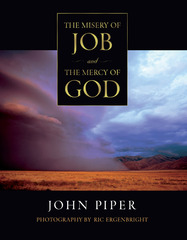
In Beyond Suffering: Discovering the Message of Job (linked to my review) author Layton Talbert referred a few times to a set of poems John Piper wrote called The Misery of Job and the Mercy of God. The poems are in book form there with some beautiful photography and a CD of John Piper reading the poems (at least, the used copy I bought from Amazon had a CD with it). The text and audio are also online here (although a few lines are missing from the text).

There is something about poetry that can express truth with beauty and poignancy, and Piper’s poems certainly accomplish that. They don’t cover every verse or every point made in the book of Job, and they include some scenes not in Job (a conversation between Job and God before Job’s calamities struck and between Job and his wife, who is treated much more tenderly here than in most sermons where I’ve heard her mentioned) which is just an imaginative way of telling the story and expressing what kinds of conversations may have passed. All in all they’re a faithful retelling.

I had wondered why Piper said early on, “And Job would lift his hands to God and wondered why he spared the rod of suffering” until I realized he was probably referring to what Job feared in 3:25 when he said, ““the thing which I greatly feared is come upon me, and that which I was afraid of is come unto me.” We’re going through Job in our church, and just recently discussed what it was that Job might have feared, and it could quite possibly be something along these lines, that God had blessed him so much that he feared that suffering of some kind was going to befall him at some point before it was all over.

There are some really beautiful sections. Here are a few of my favorites (p. 18):

Now tell me, with your heart,
Would you be willing, Job, to part
With all your children, if in my
Deep counsel I should judge that by
Such severing more good would be,
And you would know far more of me?”

What parent could answer that question? Yet we’re called to yield our children to God: they’re ultimately His.

On pages 32-33, shortly after all his trials came:

O God, I cling
With feeble fingers to the ledge
Of your great grace, yet feel the wedge
Of this calamity struck hard
Between my chest and this deep-scarred
And granite precipice of love.

Part of his response to his wife (p. 41):

O Dinah, do not speak like those
Who cannot see, because they close
Their eyes, and say there is no God,
Or fault him when he plies the rod.
It is no sin to say, my love,
That bliss and pain come from above.
And if we do not understand
Some dreadful stroke from his left hand,
Then we must wait and trust and see.

Part of Job’s response to his friends’ accusations (p. 58):

O that some door
Were opened to the court of God,
And I might make my case unflawed
Before the Judge of all the world,
And prove this storm has not been hurled
Against me or my children there
Because of hidden crimes. O spare
Me now, my friends, your packages
Of God, your simple adages.

And I think my favorite lines of all (p. 72):

Beware, Jemimah, God is kind,
In ways that will not fit your mind.

This book took me just under half an hour to read, and then I listened to it the next day in about the same amount of time while mostly following along reading the words. It was quite an enjoyable and beneficial hour, helping to feel some of what Job might have felt. I think I’ll be returning to this volume again and again.

(This review will also be linked to Semicolon‘s Saturday Review of Books.)

How Older Women Can Serve

I wrote a post a few weeks ago about Why Older Women Don’t Serve at church in an in-front-of-people way or a “take charge of big things like VBS” way. But even though older women may have physical issues and may not have the energy to serve in certain ways doesn’t mean they should not serve at all. Psalm 92:14a says, “They shall still bring forth fruit in old age.” God has given to every member of His body gifts to exercise. Older women are given a specific assignment in Titus 2:3-5.

If you’re “older” and can still coordinate the ladies’ group or cook for 200 members for a banquet or teach active five-year-olds in Sunday School, go for it! A friend of mine had an aunt who still delivered Meals on Wheels at 92. But if you’re not quite up to that, here are a few other ideas of ways you can serve:

1. Prayer. You may not have the energy to “go” and “do” a lot, but you might have more time than others to pray. There is a lot to pray for: your pastor, church, missionaries, young people seeking God’s will for their lives, adjustments for newlyweds, harried moms with young children, older moms in the “taxi years” taking their kids hither and yon, moms facing the empty nest, single ladies at any stage…there is enough to keep any of us busy praying for much longer than we do. This doesn’t mean we necessarily need to spend hours on our knees: we can pray while cleaning the kitchen, driving, resting, etc.

I can’t tell you what it meant to me when, while recovering from a serious illness, an older lady from a previous church in the town we had moved from called me to see how I was doing and to tell me she was praying for me. Some of my favorite missionary anecdotes involve people being prompted to pray for a certain missionary at a certain time, and in the days before texts and e-mails it may have been months before they knew what the specific need was, but as they and the missionary compared dates, the missionary had a specific need just when the individual was prompted to pray.

2. Show interest. As you cross paths with other ladies, ask how they’re doing. “How’s that new baby? Sleeping through the night yet?” “How did that job interview go?” “How’s Johnny liking school this year?” Just having someone take a moment to show personal interest can lift someone’s day. Watch out for new people and making them feel welcome. One lady with multiple health problems whom no one would have blamed if she stayed in bed all day instead came with her husband to every sports event, home and away, of our Christian school even though they had neither kids nor grandkids in the school. That meant a lot to those involved. Even in nursing homes and assisted living facilities, there are those who withdraw and keep to themselves and those who try to smile and brighten others’ days.

3. Word of encouragement. When you do show interest in others, you can offer words of shared joy when things are going well and words of encouragement when they’re not. One of my favorite posts of Shannon‘s was It Gets Easier for younger moms (though Shannon’s not in the category I’d generally think of as “Older Women,” we are all older than someone and can offer encouragement to those in the paths we’ve come through).

4. Offers of help. One older lady I knew would sometimes go and help a new mom after the birth of a baby when that lady’s own mother could not come, or when a pregnant lady was on bedrest. Practical help like doing dishes, laundry, tidying, making a meal can lift one’s spirits tremendously when one can’t keep up. Be alert even to little ways one can offer help: when a mom holding a baby is trying to help a toddler go potty in the ladies’ restroom at church, offer to hold the baby; when a mom is trying to coordinate a baby carrier, diaper bag, Bibles, and two preschoolers from the car to the church, ask how you can help (don’t just swoop in — the baby may cry if anyone other than mom holds her, the children may panic if you just take their hands and offer to take them in: ask, “Can I help you somehow? I’d be happy to take the baby or carry the diaper bag” or something similar.)

5. Sharing what you know. Once a lady told me she’d love to have a ladies’ meeting where someone demonstrated how to bake bread, because she couldn’t get a handle on it, and she could learn it more easily by seeing someone do it and being able to ask questions. But we couldn’t think of anyone who made their own bread. If you know how to make bread, can vegetables, knit, etc., you may or may not want to do so in a ladies’ meeting, but maybe you could invite one or two others over, or go to their houses to show them. I know one lady who went to help another younger mom harvest and put up her produce from her garden, and I know another mom who asked a retired school teacher to teach her daughters to sew, so that they could be influenced by her sweet godliness as well as being taught the basics of sewing.

6. Having one or two women over. I mentioned in the previous post a retired lady I looked up to who found various unique ways to serve. One thing she did was to have a couple of ladies at a time over to lunch at her house. She didn’t do so specifically to Try To Be a Good Influence, but people who walk with God do carry a sometimes unconscious godly influence into the lives of others.

Indwelt

Not merely in the words you say,
Not only in your deeds confessed,
But in the most unconscious way
Is Christ expressed.

Is it a beatific smile,
A holy light upon your brow;
Oh no, I felt His Presence while
You laughed just now.

For me ‘twas not the truth you taught
To you so clear, to me still dim
But when you came to me you brought
A sense of Him.

And from your eyes He beckons me,
And from your heart His love is shed,
Til I lose sight of you and see
The Christ instead.

—by A. S. Wilson

6. Visiting shut-ins. We tend to think of this with shut-ins who are alone, but when they have family nearby we assume the family is meeting all their needs and they’re well taken care of. The lady I mentioned above also brought another lady with her to visit my mother-in-law in an assisted living facility. One of us saw her every day, but it brightened her week as well as ours when these ladies came to visit her.

7. Sending notes. Or cookies. Or both. How many people send hand-written notes any more? Yet we all still love receiving them. You can brighten the day of a college student, military personnel, your pastor, or just about anyone with a little note (or even an e-mail or a Facebook post). And you may not have the stamina for a marathon cookie baking session, but maybe you could bake just a few and send a package to one person at a time.

8. Volunteer. When my dad was in the hospital, the “pink ladies” were older volunteers who kept the coffee pot going in the waiting room, stocked donuts, helped people find which way to go, and just generally made themselves available and useful. Having a sweet, friendly face in that place helped a lot. Similarly, Christian schools are having a tough time of it with decreasing enrollment, and volunteers can help provide services that the school couldn’t otherwise offer. At the Christian school my boys attended for twelve years, one older lady oversaw the library part-time while moms or sometimes grandmothers would handle each class’s library time, checking out books and reading a story to the class. Some helped with class parties, some helped sorting papers for students’ weekly folders, some helped in the lunchroom. And the students seemed to love their grandmotherly influence in the school. When I was coordinating our ladies group, sometimes when we would work on a project like cards and bookmarks for missionaries or favors for a ladies’ luncheon and wouldn’t quite get finished, ladies who took some of those things home to finish helped me tremendously.

9. Blogging. Sharing what God has taught you along the way can be a blessing to others who read.

A younger woman may be thinking, “Wow, I’d love to find an older lady to help me in some of these ways!” Pray about it and maybe take the initiative: they may be suffering from a crisis of confidence either in the loss of some of their abilities or the thought that perhaps they’re not wanted. I think many of these kinds of ministries work together: maybe as you invite someone over for coffee or ask them to show you how to do something, that can spark a relationship where some of these other things can flow.

Not everyone will be able to do all of these things, of course. Time and energy will vary from person to person. But if you’re older (in any way) and wanting to be used of the Lord but don’t know how best to serve, pray, seek His will, and start where you are with a word of kindness here, an expression of interest there, prayer here, an offer of help there. He does have work He wants you to do, and He will guide you to it and enable you to do it.

(Graphics are courtesy of Microsoft Office clip art.)

This post will be also linked to “Works For Me Wednesday,” where you can find a plethora of helpful hints each week at We Are THAT family on Wednesdays, as well as  Women Living Well.

The Week In Words

”"

Welcome to The Week In Words, where we share quotes from the last week’s reading. If something you read this past week  inspired you, caused you to laugh, cry, think, dream, or just resonated with you in some way, please share it with us, attributing it to its source, which can be a book, newspaper, blog, Facebook — anything that you read. More information is here.

Here are a few that stood out to me this week:

Seen in Claudia Barba’s Monday Morning Club e-mail:

“Damage is easier to prevent than to repair.”

That is so applicable in so many areas!

Seen at girltalk:

“They that love God as they ought, will have such a sense of his wonderful long-suffering toward them under the many injuries they have offered to him, that it will seem to them but a small thing to bear with the injuries that have been offered to them by their fellow-men.” ~ Jonathan Edwards, Charity and Its Fruits, p.78.

This concept, also seen in the parable of the servant who would not forgive a lesser debt after being forgiven a great debt, usually melts whatever resistance I have against forgiving someone. As long as I am focusing on what they did, my heart remains hard against them, but when I remember God has forgiven me so much more than I’ve done against Him, so much more than anyone else could ever do to me, I have no grounds to withhold forgiveness to anyone else.

Seen at Diane‘s Facebook:

“Prayer is the place where burdens change shoulders.”

From The Old Guys:

When you sailors see the haven before you, though you were mightily troubled before you could see any land, yet when you come near the shore and can see a certain land-mark, that contents you greatly. A godly man in the midst of the waves and storms that he meets with can see the glory of heaven before him and so contents himself. One drop of the sweetness of heaven is enough to take away all the sourness and bitterness of all the afflictions in the world. ~ Jeremiah Burroughs

“For our light affliction, which is but for a moment, worketh for us a far more exceeding and eternal weight of glory; While we look not at the things which are seen, but at the things which are not seen: for the things which are seen are temporal; but the things which are not seen are eternal.” II Corinthians 4:17-18.

Also, for those who might not have seen it and might be interested, I shared several good quotes from Beyond Suffering: Discovering the Message of Job by Laytin Talbert in my review of the book here.

If you’ve read anything that particularly spoke to you that you’d like to share, please either list it in the comments below or write a post on your blog and then put the link to that post (not your general blog link) in Mr. Linky below. I do ask that only family-friendly quotes be included.

I hope you’ll visit some of the other participants as well and glean some great thoughts to ponder. And don’t forget to leave a comment here, even if you don’t have any quotes to share! :)

Book Review: Beyond Suffering: Discovering the Message of Job

Layton Talbert was one of our Sunday School teachers at the church we attended the first fourteen years we were married, back before he earned his PhD. In the years since our class with him, I’ve very much enjoyed his articles in Frontline magazine, where he currently serves as a contributing editor. I particularly like his regular “At a Glance” column where he usually gives an overview of a book of the Bible (his column on Ecclesiastes particularly opened that book up for me). Next to one of our former pastors, Dr. Mark Minnick, there is no one whose exegesis and teaching I trust more (though no one is infallible, of course). So when our current pastor began preaching through the book of Job and recommended Dr. Talbert’s book, Beyond Suffering: Discovering the Message of Job, I didn’t need much convincing to get it. In addition, I know personally many of the people he mentions in the book. I trust, however, that even though this prior knowledge inclined me positively toward the book even before I got it, it didn’t cloud my perspective.

Dr. Talbert has attempted (successfully, I think) to write the book on two levels: the main text is easily readable for most any layperson, but the end notes are helpful for more experienced theologians (and for others who want to delve into them.) Though probably no one loves end notes, I can understand that having those notes scattered throughout the book as footnotes would make the text look cluttered and daunting to some.

Dr. Talbert begins by acknowledging that the book of Job is both long and difficult, especially the discourses between Job and his friends, but he reminds us “the Holy Spirit does not waste space” (p. 9) and even these discourses are valuable to us. He offers several helpful suggestions for reading Job, explores the theme of the book (suggesting that suffering is the catalyst rather than the main theme), and plunges right into commentary, not verse by verse, but section by section.

I spent a few hours this week compiling a list of the quotes I marked as well as pages numbers of sections that were particularly instructive to me but were too long to quote, both as a way of review and a way to have some of them handy. I ended up with five pages. I can’t share all of that here, but I’ll try to share some of the most poignant.

Satan’s accusation that Job is “pious only for pay” undermines God as well as Job because if it is so, that means God is content with that arrangement (p. 40).

Suffering can cause us to question either God’s omnipotence or His love: either He wasn’t able to stop the suffering or He was able but allowed it because He’s not completely good. “Since both options are expressly unbiblical, we are faced with a choice: (1) Ignore what the Bible says about God and reevaluate Him on the basis of our limited experience, knowledge, and understanding or (2) accept God’s self-description and reevaluate our circumstances in the light of the Bible’s depiction of realty.” P. 57).

“It is not merely the affliction itself that Job finds so hard to bear; it is the sudden and inexplicable change in God’s posture toward him that the circumstances seem to signal (p. 85).

“Expressions of grief may not fit some people’s sanitized ideas of what a Christian ‘ought’ to think and feel. But when catastrophe strikes like lightning, ripping ragged holes in the lives of previously serene saints, God has preserved a record of the grief of godly saints for our consolation. Anger is not unbelief and questions are not sinful; they are human and shared by some of the best of God’s people” (p. 90).

You may have wondered, as I have, if Job “sinned not” in his initial reaction to his suffering at the end of chapter one, yet repents in chapter 42:1-6, what happened in between that he had to repent of? Part of the answer is this: “If Job justifies himself at the expense of God’s righteousness (as God says he did – Job 40:8), then he has virtually, if unintentionally, made himself more righteous than God….Whenever we think that God is being unfair, or that we would never do some of the things God does, we make ourselves more righteous than God” (p. 98).

On the difficulty of 19:25-27: “We must be content to enter the passage with no prejudgment as to what we will bring out of it. That’s the only way to insure that we derive our theology out of the text (exegesis) rather than read our theology into a text (eisegesis)” (p. 121). (Yes! If only all Bible teachers and preachers would get this. bh)

“[God] censures Job for defending his own righteousness over against and at the expense of God’s righteousness (40:8)” (p. 159).

“For Job to be browbeaten into ‘confessing’ uncommitted sin with the assurance that his fortunes will be restored is to trifle with his soul, to confuse his conscience, and to redirect everyone’s attention to materialism as the motivation and demonstration of one’s spiritual condition” (p. 130).

“The three friends argue that Job’s suffering is consistent with God’s justice because [Job] has (obviously) sinned. Job argues that his suffering is contrary to God’s justice because he has not sinned. Elihu offers a revolutionary third perspective: suffering is not necessarily linked to God’s justice at all. God’s justice remains intact, therefore, and may not be impugned (34:12). The issue is man’s justice in responding to inexplicable suffering sent or allowed by a just God. That suffering may not be explicitly ‘deserved’ does not render the suffering itself unjust, nor does it imply that God is unjust for permitting it” (p. 170).

“Job is not rebuked for asking why. He is rebuked for an honest question that has soured into a complaint laced with insinuation. God reprimands Job for sins of speech and attitude subsequent to his sufferings – speech and attitudes that reflect wrongly on the character of God” (p. 202).

If you’ve ever wondered, as I have, what God’s discussion of animals has to do with Job’s suffering, a part of the answer is: “By belaboring this point with Job, God unveils one of His divine qualities. The Lord is powerful and majestic and wise beyond man’s comprehension, but He is also compassionate…even towards beasts. He talks as if He has intimate knowledge of their nature and needs because He does. That’s the point” (p. 206).

“We may not always see the signs of God’s goodness in our immediate circumstances, but what we see is not all there is. That is a significant part of God’s answer to Job” (p. 206).

“The furnace of affliction may be transformed into a holy of holies, a sanctuary filled with the presence of the God Whose path is in the storm” (p. 235).

“Believe Him implicitly, with or without proof, because He has spoken. Trust Him submissively, with or without understanding, because He is sovereign and good. Worship Him reverently, with or without reward, because He is worthy… Wait for Him patiently, with or without reprieve, because He will come.” (p. 241).

“God’s revelation furnishes ample evidence to justify faith but also ample opportunity to exercise faith” (p. 256).

I was also happy to see Job vindicated from something I heard a preacher say years ago, that Job’s confession in 3:25 that “the thing which I greatly feared is come upon me, and that which I was afraid of is come unto me” indicated that he had a “life-dominating sin” of fearfulness. But God repeatedly says that Job is “a perfect and an upright man, one that feareth God, and escheweth evil” (1:8; 2:3) and that his trials came upon him “without cause” (2:3).

There are also insightful discussions on the purposes for suffering, possible reasons why God didn’t tell Job what was behind his suffering, a section on helping the hurting (an excerpt from that is here), and even an appendix on leviathan, for those who might want more information about what that creature mentioned by God might have been.

This is an immensely helpful book, both for those who have wrestled with suffering and those who have wrestled with their study of the book of Job. Those of you who read here regularly know that it is rare that I can recommend a book completely without reservation: this is one I can.

(This review will also be linked to Semicolon‘s Saturday Review of Books.)

Communication in Marriage

E-Mom at Chrysalis hosts an occasional Marriage Monday, inviting bloggers to write on a certain topic related to marriage. When she announced the topic this month was communication, I didn’t think I’d have anything to say besides, “Yes, do it.” 🙂 But throughout the morning thoughts have been coming to mind about communication, so I thought I’d share a few gleaned from 30+ years of marriage. Forgive me for not having this as carefully crafted and polished as it would have been if I’d started when the topic was first announced. 🙂

1. Do communicate. Sometimes life gets so busy it seems you just pass each other on the way to getting other things done, but make time to talk. I wouldn’t necessarily schedule a set weekly time to talk: that might work for some, but for us that would be awkward and stifling. But lingering to chat a bit after dinner instead of dashing off to clean up the kitchen, etc., allows some time to touch base.

2. It’s okay to be comfortable with silence sometimes. Women in general tend to talk more than men. One statistic I saw said women use approximately three times more words a day than men. And I heard one speaker say that many men have used up all their words by the time they get home from work. A wise husband will reserve some for his wife, but a wise wife will understand that when a husband sits quietly it may not mean anything is wrong. He may just be resting his brain. Over time as you get to know each other’s personalities more, you’ll probably be able to sense when silence might indicate something is wrong.

3. Try not to communicate in anger. That’s usually when harsher and more hurtful words are used. If possible, wait until emotions are under control. On the other hand, if it is really important, don’t let it fester: try to find a time to talk about it calmly (pray beforehand for wisdom and self-control. “The heart of the righteous studieth to answer” Proverbs 15:28).

4. Avoid “never” and “always.” “You never pick up your socks!” “You always interrupt me!” Statements like that are probably not completely true, and they engender defensiveness. Just calmly state whatever the problem is and request the change you want.

5. Don’t try to talk to him when he is distracted. Whether he is paying the bills or watching a football game, those are probably not the times to ask him a question or tell him something important. My husband doesn’t watch football, but when he is involved in a project he is very focused until it’s done or at least until he gets to a stopping place. I’ve spoken to him during those times and even gotten an answer, but later he doesn’t remember any of it. Instead of getting frustrated over it, just try to make sure you have his attention and he’s not distracted before saying something important. (After all, aren’t we the same way? We can multitask talking with some things, but other times we’d really like to finish what we’re doing first.)

6. Don’t assume. We can cause so many problems when we do that. Once during our early marriage, I was taking items to donate somewhere, and my husband asked me to get a statement from the place so we could deduct the donation on our income taxes. It’s not a problem now, but at the time I felt extremely awkward asking for it, and I felt like we were supposed to give “not letting our left hand know what the right is doing,” and this would be a violation of that. I stewed over it until we finally did talk about it, and my husband explained that he didn’t want to the statement as a means to take credit for what we had given: he just didn’t want to pay a penny more in taxes than necessary. Similarly, once my son and daughter-in-law joked about digging coins out of the couch for a date (Don’t we all remember early married days like that?), and so my husband saved his pocket change for several weeks and then gave it to them for a date night. At first my daughter-in-law thought the change was a subtle hint that they should be using the laundromat instead of washing laundry at our house. We laughed about it, but some misunderstandings based on assumptions can cause serious problems, especially if we stew over it rather than saying anything.

7. Speak to him with respect. This should probably be #1.  Especially if you’re dealing with a perceived problem, don’t lash out. Don’t talk to him like he is one of the children. Think of how you carefully you would word things if you were talking to your boss, your pastor, or someone you highly respected. You know what? You’re supposed to respect your husband like that. Even more than that. (Ephesians 5:33).

8. You don’t have to say everything in your head. I’m not talking about keeping secrets, but there are two aspects of this. First, I tend to want to tell every little detail of a story or situation (maybe it’s part of having three times more words that need an outlet, I don’t know), but it can be incredibly boring to listen to (or read. I am striving for conciseness, but it is not my natural bent.)  I know because I feel that way when people are telling  a very long story with a lot of detail that isn’t really needed. When I see eyes starting to glaze over, it’s a reminder to get to the point and leave out extraneous detail.

Secondly, you don’t have to point out every little fault or flaw. How would you feel if he did that to you? Love covers a “multitude of sins” (I Peter 4:8). We all have our “besetting sins” that make us not the easiest person to live with.

9. Be careful about teasing. This is subjective and varies from person to person, but I’ve heard some couples say things to each other “in fun” that would have devasted me. You should never make fun of him, to him or to anyone else (that goes back to the respect issue), but be careful about little teasing barbs and sarcasm as well.

10. Attack the problem, not the person.

11. Remember every Scriptural instruction about the use of our words applies to marriage, too. It’s easiest to drop our guard with those closest to us when those are the ones with whom are words should be most carefully guarded. There are too many verses to list here, but a good topical study would be to look up “words,” “speak,” “tongue,” and related words in a concordance or Bible search program. If it seems too much to look through the whole Bible, just look through Proverbs: there is enough there for us to work on for a long time. But here are just a few:

There is that speaketh like the piercings of a sword: but the tongue of the wise is health. Proverbs 12:18.

Let your speech be always with grace, seasoned with salt. Colossians 4:5b

Let no corrupt communication proceed out of your mouth, but that which is good to the use of edifying, that it may minister grace unto the hearers.  And grieve not the holy Spirit of God, whereby ye are sealed unto the day of redemption. Ephesians 4:29-30.

Pleasant words are as an honeycomb, sweet to the soul, and health to the bones. Proverbs 16:24.

The tongue of the wise useth knowledge aright: but the mouth of fools poureth out foolishness. Proverbs 15:2.

I’m sure I am forgetting some great principles in communication in marriage. Can you think of any others?

This post will be also linked to “Works For Me Wednesday,” where you can find a plethora of helpful hints each week at We Are THAT family on Wednesdays, as well as  Women Living Well.

Assorted thoughts on the anniversary of 9/11

  • “Now, we have inscribed a new memory alongside those others. It’s a memory of tragedy and shock, of loss and mourning. But not only of loss and mourning. It’s also a memory of bravery and self-sacrifice, and the love that lays down its life for a friend–even a friend whose name it never knew. “ –  President George W. Bush, December 11, 2001
  • “For thou hast been a strength to the poor, a strength to the needy in his distress, a refuge from the storm, a shadow from the heat, when the blast of the terrible ones is as a storm against the wall.” Isaiah 25:4
  • I don’t know how one defends against a plane flying at you. I believe in a strong military, but “The horse is prepared against the day of battle: but safety is of the LORD.” Proverbs 21:31.
  • Those who saw 9/11 only as an act of judgment and thought they knew whose sin “caused” it need to remember Luke 13:1-5: “There were present at that season some that told him of the Galilaeans, whose blood Pilate had mingled with their sacrifices. And Jesus answering said unto them, Suppose ye that these Galilaeans were sinners above all the Galilaeans, because they suffered such things? I tell you, Nay: but, except ye repent, ye shall all likewise perish. Or those eighteen, upon whom the tower in Siloam fell, and slew them, think ye that they were sinners above all men that dwelt in Jerusalem?I tell you, Nay: but, except ye repent, ye shall all likewise perish.”
  • I’m grateful people turn to God in an hour of need: I just wish they realized they need Him every hour.

The Week In Words

”"

Welcome to The Week In Words, where we share quotes from the last week’s reading. If something you read this past week  inspired you, caused you to laugh, cry, think, dream, or just resonated with you in some way, please share it with us, attributing it to its source, which can be a book, newspaper, blog, Facebook — anything that you read. More information is here.

From a friend’s Facebook:

“God’s solution is sometimes different. He does not always lift people out of the situation. He does not pluck them out of the darkness. He becomes the light in the darkness, the peace in the midst of the conflict….” Patricia St. John

Reminds me of a plaque I had some years ago that said something like, “Sometimes God stills the storm, and sometimes He stills His child in the midst of the storm.”

From Lisa‘s Twitter feed:

God’s self-exaltation is not because he’s incomplete without praise, but because we’re not complete without it. ~ John Piper

I mentioned some time back a professor bringing up a rhetorical question without really answering it and it causing me some problems for years. It was on this topic, and this quote helps immensely. I had come to that conclusion before, that God’s wanting our praise had more to do with our need of it than his desire for it, but I love the way Piper put it.

From another friend’s Facebook:

“Failure…the opportunity to start over again with more knowledge than you had before.”

One of the most valuable sermons I ever heard, one that has stuck with me for decades, was one in college having to do with failure. I wasn’t failing, but I was struggling more than I ever had and felt like I was failing, and of course have had many individual failures throughout life. It was such a blessing to know failure was not an end in itself.

And finally, from this blog which I discovered while searching for something else:

“We ought to give thanks for all fortune: If it is ‘good’ because it is good, if ‘bad’ because it works in us patience, humility and the contempt of this world and the hope of our eternal country.” ~ C.S. Lewis

If you’ve read anything that particularly spoke to you that you’d like to share, please either list it in the comments below or write a post on your blog and then put the link to that post (not your general blog link) in Mr. Linky below. I do ask that only family-friendly quotes be included.

I hope you’ll visit some of the other participants as well and glean some great thoughts to ponder. And don’t forget to leave a comment here, even if you don’t have any quotes to share! 🙂

The Week In Words

”"

Welcome to The Week In Words, where we share quotes from the last week’s reading. If something you read this past week  inspired you, caused you to laugh, cry, think, dream, or just resonated with you in some way, please share it with us, attributing it to its source, which can be a book, newspaper, blog, Facebook — anything that you read. More information is here.

I just started reading Worldliness: Resisting the Seduction of a Fallen World edited by C. J. Mahaney this week, am only 50 pages in, and have over ten quotes marked already.

Here are two from the foreward by John Piper:

The gospel makes all the difference between whether you are merely conservative or whether you are conquering worldliness in the power of the Spirit for the glory of Christ.

What does it look like when the blood of Christ governs the television and the Internet and the iPod and the checkbook and the neckline?… The only way most folks know how to draw lines is with rulers. The idea that lines might come into being freely and lovingly (and firmly) as the fruit of the gospel is rare (p. 11).

The last part of that second one is golden: too often people try to handle worldliness with rules, working from and on the external, rather than cultivating a heart after God which will then establish the “lines.”

The second is from the second chapter by Craig Cabaniss:

Glorifying God is an intentional pursuit. We don’t accidentally drift into holiness: rather, we mature gradually and purposefully, one choice at a time (p. 40).

If we’re “drifting,” it’s probably going to be in the wrong direction.

If you’ve read anything that particularly spoke to you that you’d like to share, please either list it in the comments below or write a post on your blog and then put the link to that post (not your general blog link) in Mr. Linky below. I do ask that only family-friendly quotes be included.

I hope you’ll visit some of the other participants as well and glean some great thoughts to ponder. And don’t forget to leave a comment here, even if you don’t have any quotes to share! :)