Friday’s Fave Five

Susanne at Living to Tell the Story hosts a “Friday Fave Five” in which we share our five favorite things from the past week. Click on the button to read more of the details, and you can visit Susanne to see the list of others’ favorites or to join in.

My favorites from the past week or so:

1. Gorgeous weather this week at just the right temperatures.

2. Things are coming together for the ladies’ luncheon next month. We’d had the date, theme, and speaker for a few weeks: this week we got the caterer and menu lined up and got a good dent put into making favors at the ladies’ meeting Monday night. I need to get invitations and tickets made and printed off this weekend, then finish favors and centerpieces in the next week or two.

3. Chicken teriyaki and fried rice from the Japanese place at the mall. Jim volunteered to get that for dinner Monday night as I had a lot of preparation for the ladies’ meeting that night. Not only was that a big help to me, but I really like the stuff, too. 🙂

4. My Cricut Expressions cutting machine. My dear husband had given it to me almost a year ago, and I’ve played around with it, but hadn’t really gotten into it yet. I used it for a couple of pieces for the favors we made this week, and was able to get acquainted with it and figure some things out. Cutting 80 figures out with a machine was so much nicer and less time consuming than doing so by hand! And I so enjoyed “creating” and want to get back to doing more.

5. Some people might think that putting a Scripture passage on the same list as chicken teriyaki and nice weather is making light of Scripture. I don’t see it that way. Scripture is, of course, on a higher plane than these other things, but why wouldn’t something I read in the Bible be among my favorite things from the week? Anyway, in the last couple of days I have been in Exodus 32-34, where the children of Israel made the golden calf at the very time Moses was on the mountaintop receiving God’s commandments for them — after they had already promised to do what God said, and after all they had seen Him do. God in His anger at them wanted to wipe them out and start a new nation with Moses, but Moses interceded for them. Then God spared them, but said He would not go with them. Moses again pleaded with Him, and in one of my favorite passages in the Bible, God promises, “My presence shall go with thee, and I will give thee rest.” Moses replies, “If thy presence go not with me, carry us not up hence,” in other words, “We don’t want to go anywhere without you.”  Such a poignant scene, and such a wonderful promise, that we can trust Him not only to lead us but to be with us.

The Hidden Flame

The Hidden Flame by Janette Oke and Davis Bunn is the second in the Acts of Faith series set during the time of the early church in Acts. The first book, The Centurion’s Wife (reviewed here) took place just after the death and resurrection of Christ. The Hidden Flame picks up right where the action left off in the earlier book, but then there is a two-year gap before we see the early disciples in their new patterns of life.
The main character of this book is Abigail, a friend of Leah’s from the previous book. Abigail thought she had lost her entire family, but discovered her brother alive at the end of the first book. Now they have become integrated with the disciples, and despite Abigail’s previous injuries from a cauldron of boiling water spilling onto her, she is an active member, busy ministering in the kitchens and in distributing food to the poor. Two men are after her hand: one an older, wealthy Jewish merchant, the other a young Roman soldier. The problem, though, is that neither of them are believers, which is something she strongly desires in a mate, but women in that day had little say about whom they were given to in marriage.

I mentioned in my review of the first book that I approach Biblical fiction somewhat warily as too often the author’s imagination can take off and obscure or even supersede the facts. But David Bunn and Janette Oke are as careful as I think they can be. The reader has to understand  that the characters who are developed a little more than the Bible gives us information about are products of the author’s imagination and therefore not entirely Biblical, but I think the authors do a good job of fleshing out what they think the Biblical characters might have been like.

The main events from the book of Acts here are the way the church dealt with the persecuted or displaced early believers, the deaths of Ananias and Sapphira, the naming of the first deacons, and the stoning of Stephen. I especially appreciated the way the situation with Ananias and Sapphira was handled. We tend to breeze right through that passage on the way to the next, but this caused me to think for the first time how the incident must have impacted  both the community and the believers, who I imagine would have been very shaken. As the different believers in the story wrestle with what has happened and discuss it with each other, we hear varying views of possible reasons the Lord handled the situation in just that way without a one dogmatic, overriding view.

I am assuming there will be more books in the series: there were no loose ends at the conclusion, but there was a feel that there was more of the story to come. I look forward to it.

(This review will be linked to Semicolon‘s Saturday Review of Books.)

The Week In Words

http://breathoflifeministries.blogspot.com/2010/01/announcing-week-in-words.html Melissa at Breath of Life hosts a weekly carnival called The Week In Words,which involves sharing something from your reading that inspires you, causes you to laugh, cry, or dream, or just resonates with you in some way.

Though I’ve read several things that spoke to me this week, the one I’ve spent the most thought on came from the devotional book I am going through with my youngest son, Quiet Moments with God Devotional Journal For Teens.* In this reading from April 10, an unnamed modern potter is quoted as saying:

Both my hands shaped this pot. And the place where it actually forms is a place of tension between the pressure applied from the outside and the pressure of the hand on the inside. That’s the way my life has been. Sadness and death and misfortune and the love of friends and all the things that happened to me that I didn’t even choose. All of that influenced my life. But, there are things I believe in about myself, my faith in God, and the love of some friends that worked on the inside of me. My life, like this pot, is the result of what happened on the outside and what was going on inside of me. Life, like this pot, comes to be in places of tension.

In all the sermon illustrations and object lessons I have heard and read concerning potters, somehow I have never gotten that point, that when pressure from the outside pushes against God’s sustenance and strength on the inside (if we know Him and are being sustained through His Word and His Holy Spirit), not only does His strength keep us from caving in, but the tension between the two sources of pressure actually forms us.

That point may have been made before, and I’ve experienced it, but I never quite got it in quite that way before, and it has given me much food for thought.

The base verse for that day’s reading was II Corinthians 4:16: “For which cause we faint not; but though our outward man perish, yet the inward man is renewed day by day,” and the lesson, of course, was on the need to stay in close touch with God and feed on His Word so we have His resources to meet the needs of the day. Another quote I posted years ago was on “conditions for receiving strength” from a Bible study Rosalind Goforth had done, but I’ll just leave the link rather than requoting it here for the sake of space.

As I mentioned, there are multitudes of spiritual object lessons about potters and pottery: God’s ownership of His vessels and His right to form them as he will (Jeremiah 18:1-6, Romans 9:20-21), the need to be yielded to the potter’s hand, the problem a potter has when there is a resistant lump in the clay, or when the clay is not malleable and the potter has to take it off and knead it or take the lumps out or add water or clay to get it to the right texture before trying to rework it. But once when at our church we saw a demonstration of a Christian potter who actually brought his potter’s wheel and “threw” a pot, bringing out all the spiritual lessons, one thing stood out to me then: he brought out the intimacy of it, how the vessel he was working on was almost in his lap, how he was bent over it, arms around it, looking at it from all sides. That picture has stayed with me since then, of a God who is not aloof and insensitive, but rather bent over us, intensely interested and caring, actively and lovingly forming us.

(* Though I don’t want to take away from the precious truth here, I do feel compelled to say I cannot endorse this book completely. I’ll say more when I review it after we get back around to where we started in it, but though there are great nuggets in it, there are also places where the lesson either has nothing to do with the verse it is supposed to be taken from or is grossly misapplied.)

How Deep the Father’s Love

How deep the Father’s love for us,
How vast beyond all measure,
That He should give His only Son
To make a wretch His treasure.
How great the pain of searing loss,
The Father turns His face away
As wounds which mar the chosen One,
Bring many sons to glory.

Behold the Man upon a cross,
My sin upon His shoulders
Ashamed I hear my mocking voice,
Call out among the scoffers.
It was my sin that held Him there
Until it was accomplished.
His dying breath has brought me life
I know that it is finished.

I will not boast in anything,
No gifts, no power, no wisdom,
But I will boast in Jesus Christ,
His death and resurrection.
Why should I gain from His reward?
I cannot give an answer.
But this I know with all my heart,
His wounds have paid my ransom.

Though I found many copies of these lyrics online and many recorded versions, I can’t seem to find who originally wrote it. This version is from the Steve Pettit Evangelistic Team‘s CD Jesus, My Lord, My God, My All.

Book Review: Where My Heart Belongs

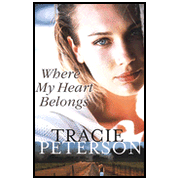
Where My Heart Belongs by Tracie Peterson is a prodigal daughter story. Amy changed her name at the age of eighteen, demanded her inheritance from her father, and left home without another word for twelve years. Suddenly she shows back up on the old homestead doorstep wanting to renew family ties. Her older sister, Kathy, is understandably wary at first and wrestles with her own feelings of anger and betrayal.

Tracie does a good job with what could have been, but is not, a clichéd story (not that the Biblical prodigal story itself is clichéd — it is a marvelous parable of redemption.) I found myself empathizing with both characters as they worked through their various issues and alternately took steps toward and then away from understanding and forgiving each other. There were layers to each that I would not have originally anticipated.

My only quibbles were that the latter part of the book seemed a little rushed, and it ended maybe a little too perfectly, but on the other hand, every now and then it is nice to have things end in the ideal way we all really wish would happen, and after all the anguish both characters suffer, it is good to see things turn around for them.

Happy Easter!

Dear Lord, I have no Easter flowers to bring,
No roses fresh, no lilies dewy sweet.
But still one offering I may gladly bear,
And lay rejoicing at Thy feet.

Enfold my weary love in Thy sweet will,
And keep it closely to Thy wounded side,
So shall I rest, nor sad and helpless mourn,
While safe in Thee my love and I abide.

~ Author Unknown

Jesus said unto her, I am the resurrection, and the life: he that believeth in me, though he were dead, yet shall he live. John 11:25

Happy Resurrection Day!

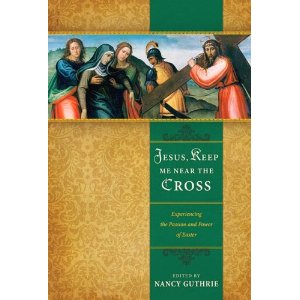
Book Review: Jesus, Keep Me Near the Cross: Experiencing the Passion and Power of Easter

Over the last couple of years, I saw the book Come Thou Long Expected Jesus mentioned on several blogs. It was compiled by Nancy Guthrie and included excerpts from the writings and sermons of godly Christians through the ages. I read and enjoyed it very much last Christmastime, and then when I saw Nancy had put together a similar book for Easter, Jesus, Keep Me Near the Cross: Experiencing the Passion and Power of Easter I got it to read this Easter season.

The preface says:

Oh, what we miss out on when we rush past the cross of Christ.Oh, the richness and reward when stop to linger before it, when we take the time to “consider him who endured from sinners such hostility against himself” (Hebrews 12:3). In a culture where crosses have become commonplace as architecture and jewelry, how we need to truly gaze upon the cross of Christ in all its ugliness and beauty, in its death and in its healing, in the painful price paid there, and in its free gift of grace. Jesus, keep us near the cross.

And that is just what the book endeavors to help us do. Each of the twenty-five chapters is an excerpt from a book or sermon from various, mostly well-known Christians throughout the ages, from Augustine, Luther, Edwards, and Spurgeon all the way to John Piper, John MacArthur, J. I. Packer, and others. There were a handful of names I did not recognize, so please don’t count this as an endorsement of everything ever written or said by every author, but for the most part I agreed with everything in this book.

The chapters all deal with Christ’s death and resurrection, some in general, some on a particular aspect, such as C. J. Mahaney’s chapter on “The Cup,” exactly what was meant, what cup Christ was talking about when he said, “O my Father, if it be possible, let this cup pass from me: nevertheless not as I will, but as thou wilt’ (Matthew 26:39), or an exploration of some of the things Christ said from the cross, or J. I. Packer’s treatment of what was meant in Christ’s descent into hell and ascension into heaven. Just yesterday I found here a list of all the chapters and authors with a quote from each chapter, but today that link brings up a window about exceeded bandwidth: hopefully that will be rectified soon. Each chapter is 3-5 pages long, and it was very manageable to read one a day. I wouldn’t recommend reading more than that at a time: just soaking on one chapter and thinking over it through the day is rich meditation.

All the chapters did not resonate with me equally, but that may have been due to sleepiness or distraction on my part on given mornings. Probably my favorites were C. J. Mahaney’s on “The Cup,” C. H. Spurgeon’s “Then They Did Spit Upon His Face,” and Raymond Ortlund’s on “The Most Important Word in the Universe.” I shared several quotes from the last one yesterday, but two that impacted me were:

In human religions, it’s the worshipper who placates the offended deity with rituals and sacrifices and bribes. But in the gospel, it is God Himself who provides the offering.

And:

The God you have offended doesn’t demand your blood; he gives his own in Jesus Christ.

Overall the book did fulfill it’s purpose set out in the preface: it did cause me to slow down and meditate on what Christ did for me, to appreciate it anew, to revive my love for Him and thankfulness to Him. I plan to make this book a regular part of my Easter preparations in the coming years, but of course the topic is not confined to Easter: this book will help you contemplate the cross and what it means for you any day of the year.

The Week In Words

http://breathoflifeministries.blogspot.com/2010/01/announcing-week-in-words.html Melissa at Breath of Life hosts a weekly carnival called The Week In Words,which involves sharing something from your reading that inspires you, causes you to laugh, cry, or dream, or just resonates with you in some way.

Here are some of the words that stood out to me this week. I’m not going to comment on them: they speak for themselves, and I don’t want to take away from the power of them.

Seen at ivman’s blague:

“To lengthen thy life, lessen thy meals.” – Benjamin Franklin

I forgot where I saw this, but I have seen it before:

Upon a life I did not live,
upon a death I did not die;
anothers life, another’s death,
I stake my whole eternity.
-Horatius Bonar

From the March 27 reading of Our Daily Walk by F. B. Meyer:

A quiet heart. I do not say a quiet life—that may be impossible, but a heart free from care, from feverish passion, from the intrusion of unworthy ambition, pride or vanity. The habit of meditating on God’s Word helps to induce the quiet heart and devout spirit which realizes the Lord’s presence. The Bible is like the garden in which the Lord God walked in the cool of the day; read it much and prayerfully, and you will meet Him in its glades.

From a chapter of Jesus, Keep Me Near the Cross: Experiencing the Passion and Power of Easter titled “The Most Important Word in the Universe” by Raymond C. Ortlund, Jr.:

God’s anger shows how serious His love is.

His wrath is the solemn determination of a doctor cutting away the cancer that’s killing his patient.

In human religions, it’s the worshipper who placates the offended deity with rituals and sacrifices and bribes. But in the gospel, it is God Himself who provides the offering.

He detests our evil with all the intensity of the divine  personality. If you want to know what your sin deserves from God, don’t look within yourself, don’t look at your own emotions. Look at the man on the cross — tormented, gasping, bleeding. Take a long, thoughtful look. God was presenting something to you there. God was saying something about his perfect emotions toward your sin. He was displaying his wrath.

The God you have offended doesn’t demand your blood; he gives his own in Jesus Christ.

Who qualifies to enjoy the liberating power of the death of Christ? Sinners. They’re the only people he died for. If your problems are always someone else’s fault, if you come to God standing upright and ready to make your own case, the cross condemns you. But if you’re far from God, if you’ve sinned and you keep on sinning and you’re ashamed and wish you could trade in your record for a better one, if your conscience knows that you deserve the wrath of God and your only hope is God’s mercy in Christ, then he longs for you to know…he sees you through the death of Christ…He longs for you to know that your sins have been nailed to the cross.

The Face of Jesus

The face of Jesus:

For my salvation.

A glorious face, now.

Let its light shine on me, O Light of Life.

Let Your radiance fall on me, Sun and Savior,

Lighten my darkness.

Then grant me this by Your grace:

That I, in turn, may give

“The light of the knowledge of the glory of God” (2 Cor 4:6 AV)

As I see it in the face of Jesus Christ.

~ Elisabeth Elliot, A Lamp For My Feet

The Week In Words

http://breathoflifeministries.blogspot.com/2010/01/announcing-week-in-words.html Melissa at Breath of Life hosts a weekly carnival called The Week In Words,which involves sharing something from your reading that inspires you, causes you to laugh, cry, or dream, or just resonates with you in some way.

I read these first few this week — in a file I had of spring quotes! I’m sorry I did not note where I first saw them. I’d like to know where the Dickens quote is from.

“It was one of those March days when the sun shines hot and the wind blows cold: when it is summer in the light, and winter in the shade.”
– Charles Dickens

March is a tomboy with tousled hair, a mischievous smile, mud on her shoes and a laugh in her voice.”
– Hal Borland

Springtime is the land awakening. The March winds are the morning yawn.” — Unkown

The first day of spring is one thing, and the first spring day is another. The difference between them is sometimes as great as a month. ~Henry Van Dyke

This is an excerpt from the March 19 reading from the Our Daily Walk devotional by F. B. Meyer

“If then ye were raised together with Christ, seek the things that are above, where Christ is, seated on the right hand of God.”– Col 3:1 (R.V.).

If some one will say, “There’s the rub! I’m afraid that is not true of me; my life is sinful and sorrowful; there are no Easter chimes in my soul, no glad fellowship with the Risen Lord; no victory over dark and hostile powers.” But if you are Christ’s disciple, you may affirm that you are risen in Him! With Christ you lay in the grave, and with Christ you have gone forth, according to the thought and purpose of God, if not in your feelings and experience. This is distinctly taught in Eph 2:1-10 and Rom. 6. The whole Church (including all who believe in our Lord Jesus) has passed into the light of the Easter dawn; and the one thing for you and me, and all of us, is to begin from this moment to act as if it were a conscious experience, and as we dare to do so we shall have the experience.

Notice how the Apostle insists on this: “You died, you were raised with Christ, your life is hid with Christ.” Give yourself time to think about it and realize it.

The Cross of Jesus stands between you and the constant appeal of the world, as when the neighbours of Christian tried to induce him to return to the City of Destruction. This does not mean that we are to be indifferent to all that is fair and lovely in the life which God has given us, but that the Cross is to separate us from all that is selfish, sensual, and savouring of the lust of the flesh, the lust of the eyes, and the pride of life (1Jo 2:15-17).

There were three I kept aside from the e-mail Elisabeth Elliot devotionals as well — but, believe it or not, I really do try to keep these things from being too long! I encourage you to sign up for those.

I also marked a couple from Carry On, Jeeves, but I’ll share that when I review it, probably tomorrow.

Happy Monday!