It’s Friday, time to look back over the blessings of the week with Susanne at Living to Tell the Story and other friends.
We’ve been blessed with a break in our cold snap and enjoyed temperatures in the 50s this week. But we’re back to 17 this weekend and more cold next week, so I’ll enjoy the moderation while I can. Meanwhile, here are some other great parts of the last week:
1. Hot oil treatment for hair. I have dry skin anyway, exacerbated by having the heater drying out the air in the winter. My scalp has been a particular problem, and using a moisturizing shampoo and conditioner didn’t help a whole lot. Years ago I used to occasionally use VO5’s Hot Oil Treatment for Hair, so I looked for it again – couldn’t find it in stores, but found it online. That and an occasional application of Scalpicin brought blessed relief.
2. Rearranging books and other tasks. Last fall I got rid of some books in my sewing/craft room, which opened up some space on those shelves. I had books I’d read in the last year or so stacked up sideways in front of the regular books on my bedroom bookshelves, so I took some time one afternoon to rearrange my books. The bookshelves in the family room are pretty well organized, but the ones in the sewing room and bedroom had some of the same categories of books in each, so I got a workout carrying armloads of books back and forth, getting books on the same subject matter together, and finding a place for the newer ones. I even culled a few more to give away. I was extremely satisfied with the results.
During December, some tasks that can wait get pushed lower and lower on the to-do list while the holiday activities are going on. This week it was good to get some of them taken care of, like hand-washing a few items that needed that care, setting up files for some card-making ideas I had printed out and torn out of magazines, etc.
3. Not cooking all weekend. Friday afternoon my son and d-i-l came over and brought take-out from a favorite BBQ place. Then Saturday night, my husband asked if I wanted to get pizza. Well, I am not going to turn down that offer! Then Sunday after church he suggested takeout from McAlister’s Deli. I enjoyed the food as well as the break. Then one warm afternoon this week, my son and d-i-l asked if we could could get out a Christmas gift we’d been holding back for Timothy – an outside riding toy that it had just been too cold to use (he knew there was a big box covered up in the garage but didn’t know it was for him. 🙂 ) They offered to make dinner, so I had one more evening “off.” That came in especially handy that night because I had pulled something the wrong way in my shoulder and had spent much of the day with Tylenol and a heating pad. (The shoulder is still tender but much better, and Timothy loved his new toy!)
4. A running gas fireplace. We hadn’t been able to use ours most of the time we’ve lived here because it emitted a terrible odor. We haven’t really needed it, so it hasn’t been a priority. My husband has tinkered with it sometimes, and recently cleaned it all out thoroughly, but it still smelled too bad to use. Then it occurred to him maybe the smell was coming from a build-up of residue on the fake logs in it, so he pulled those out and started it up – and it ran fine! He found some new logs online, and now we have a working fireplace! Even though we probably still won’t use it much – it gets the family and dining areas toasty, but then the warmth keeps the thermostat from coming on, so the rest of the house gets cold. But it will be especially helpful if we have a power outage and also if we ever need to sell the house.
5. Jesse receiving a grant. Jesse (youngest son) has been pursuing his Bachelor’s degree online for several months now. There was a small snafu that just recently came to light in his filling out his financial paperwork, so he corrected it, and he just received word that he not only received a grant for this semester, but they also gave him the one he should have received last semester as well. He was thinking he would have to obtain a loan to finish, but with these grants, the money he had saved, and a new part-time job, it looks like he will probably be able to finish without taking out a loan, or if he needs one, it won’t be much.
It’s been a week full of blessings large and small, and I am thankful to God.
Martin Pistorius was a fairly normal boy living a fairly normal childhood in South Africa. But in 1988, at age 12, he came home from school with a sore throat. Over the next few days he lost interest in eating and only wanted to sleep. He ended up in a wheelchair, silent and unresponsive. The doctors explored psychological causes and then ran every physical test they could.
It took about a year for the doctors to confess that they had run out of treatment options. All they could say was that I was suffering from a degenerative neurological disorder, cause and prognosis unknown, and advise my parents to put me into an institution to let my illness run its course. Politely but firmly the medical profession washed its hands of me as my mother and father effectively were told to wait until my death released us all.
But at about age 16, he started “waking up,” or becoming aware, for short periods of time. By age 19, he was fully conscious. But he couldn’t let anyone know. He couldn’t speak, he couldn’t control his limbs. Even when he did begin to regain movement and could lift his head up and down and smile, people didn’t recognize that the movements or expressions were purposeful. So he was trapped in his body for six more years. At times he was frustrated and angry. Other times he used his imagination to escape into fantasy.
I resembled a potted plant: something to be given water and left in a corner.
He lived at home, but spent his days at a care center while both parents worked. One of his caregivers, who used to give him massages to work his stiff muscles, thought he might be more aware than previously thought and arranged to have him assessed.
We come to rest in front of a large sheet of acrylic glass suspended on a metal stand directly in front of me. Red lines criss-cross the screen, dividing it into boxes with small black and white pictures stuck in some of them. These line drawings show simple things—a ball, a running tap, a dog—and Shakila stands on the other side of the screen watching me intently as I stare at them.
“I want you to look at the picture of the ball, Martin,” Shakila says.
And…he did. After a series of tests, both to test his responses and different kinds of communication devices, Martin was equipped with pictures of symbols he could stare at in answer to questions and eventually outfitted with a computer which gave him a “voice.” Learning to communicate was a long, painstaking process, but it was worth it.
“If someone does not expect or is not expected to achieve, then they never will.” (Dr. Diane Bryen)
One of the hardest adjustments for him was making decisions. He could remember nothing from before his illness, and life had been structured around him for so long, he didn’t know how to make decisions at first. He was glad to be able to let people know his food was too hot or cold, he was thirsty, he’d like salt, etc. But even years later, when his girlfriend too him to buy some shoes, he was overwhelmed. He had only ever had the same kind that someone else had bought him, and there were so many choices, as well as the overstimulating atmosphere of so many people and loud music, that he broke down.
Some people caring for him were excellent. Some were thoughtless or just doing a job without care for the person inside the unresponsive body. “Do they really think that a limited intellect means a child can’t feel viciousness in a person’s touch or hear anger in the tone of their voice?” Something else that came to light after Martin began to express himself more extensively was that he had been horribly abused, especially in a longer term care facility that he had been placed in if his parents went on overnight or longer trips. He had been called names, slapped, pinched, handled roughly (thrown into a chair so hard he fell face first), neglected, and sexually abused.
He had a faith that sustained him:
The only person who knew there was a boy within the useless shell was God, and I had no idea why I felt His presence so strongly. I wasn’t exposed to the rituals and traditions of worshiping Him at church and knew that I hadn’t been before my illness because my family, although they believed in God, didn’t attend. Yet somehow I instinctively knew that He was with me as my mind knitted itself back together. At times it felt confusing to be surrounded by people, utterly alone and yet aware that God was my companion. Yet my faith didn’t waver. He was as present to me as air, as constant as breathing.
___
The one person I talked to was God, but He wasn’t part of my fantasy world. He was real to me, a presence inside and around that calmed and reassured me…I spoke to God as I tried to make sense of what had happened to me and asked Him to protect me from harm. God and I didn’t talk about the big things in life—we didn’t engage in philosophical debates or argue about religion—but I talked to Him endlessly because I knew we shared something important. I didn’t have proof that He existed, but I believed in Him anyway because I knew He was real. God did the same for me. Unlike people, He didn’t need proof that I existed—He knew I did.
One unsung hero in the book is Martin’s father. In Martin’s silent years, he heard arguments between his parents about his care. His father wanted to keep him at home. His mother wanted to put him in a full-time care facility, as the strain of his care was affecting their marriage and the rest of the family. But his father insisted Martin was still part of the family and needed to remain. His mother, for a time, distanced herself from Martin, so at home all his care fell to his father, who would get up early to feed and dress him and take him to the care facility, work long hours, bring him home and feed, bathe, and put him to bed. Basically, he didn’t have a life beyond work and caregiving for years, and he did it without complaint. Martin appreciated his “quiet and steady presence,” and eventually his mother came around as well, helping him tirelessly to increase his “vocabulary.”
This book is sad and horrifying on one level, considering all that Martin endured. But it’s inspiring on another that he triumphed over it. I particularly loved what he said as he was falling in love with the girl who would become his wife: “I’ve lived my whole life as a burden. She makes me feel weightless.”
It encourages me as my mother-in-law has become less and less responsive that perhaps she does hear and perceive more than she can express, and even if not, the way she is handled will make her feel secure and loved even if words aren’t getting through.
It also angers and saddens me that such abuses and inhumane treatment goes on in care facilities. We’ve come across our share of both good and bad caregivers in the various facilities my mother-in-law has been in. That Martin should have suffered such abuse is atrocious, but that in some cases, other caregivers observed and laughed is just infuriating. And the fact that more than one could wheel him away long enough to privately sexually abuse him without anyone questioning what was going on, where they were, why they were gone so long shows up the need for better monitoring. Unfortunately, in our experiences and I am sure all over the world, those places are woefully understaffed.
But it inspires me that some caregivers went the second mile in their concern and care. The one who first noticed that Martin seemed aware and responsive used to talk to him while she worked, and that’s one thing that caused his responsiveness. After trying to make a connection with others and failing, Martin essentially shut down inside himself. As this caregiver talked with him, he would look at her and follow her with his eyes. That she would notice this and then act on it speaks so well of her. That should be the norm, but too often facility caregivers slog through the everyday thankless monotonous tasks on autopilot. We have had our share of excellent caregivers as well who take time to interact with the patient as a person and notice the details that make a difference in their care and comfort.
Some readers would want to know that there are a couple of bad words in the book, and the section on Martin’s sexual abuse is graphic but not titillating and is mostly contained in one chapter. There is a video of a TED talk with Martin here, and a sweet interview with his wife here. They made this video and submitted it along with the manuscript when they were seeking a publisher for the book:
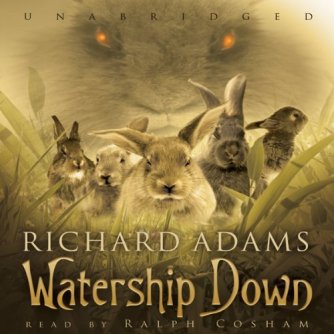
Fiver and Hazel are brother rabbits. Fiver is not a seer or prophet per se, but he has vague feelings of impending doom when something bad is about to happen, and he’s feeling strongly that some danger is about to come to the warren. Hazel takes him to the chief rabbit, but the chief rabbit doesn’t take him seriously and only goes into a long explanation about how hard it would be to evacuate a warren, especially the does and kittens.
One of the chief rabbit’s guards does take the warning seriously, however, and comes to find Hazel later. They agree to spread the word as much as they can that danger is coming and they are leaving the warren.
So a small group of rabbits sets out. Of course they face many dangers, the first of which is that the chief rabbit sends out guards after them to arrest them once he finds out they have left. So the first order of business is to get away as fast as possible. They face obstacles like rivers, enemies like cats and large birds and foxes, hardships like injuries, fatigue, and hunger. Once they find a place, they realize they have no does with them, so they have to decide what to do about that problem. And ultimately they have to defend their new home.
Richard Adams wrote Watership Down as a result of stories he used to make up to tell his daughters while they were in the car. His children urged him to write the stories down, but he resisted at first. But one night, after throwing the children’s book he was reading across the room in disgust, he decided to take a stab at writing. As he wrote sections, he would read those pages to his daughters and take their feedback. The book was published in the UK but didn’t really take off in sales until it was published in the USA.
Adams took care to have the rabbits act as rabbits, except for their being able to think and talk. There are no rabbits wearing clothing, sipping tea by the fireplace, or driving cars in this book. But endowing them with human-like thought and speech led to a rabbit mythology and history and human characteristics.
Adams insists that there is no symbolism or deeper meaning in Watership Down: it’s just an adventure story about rabbits. But there are still several things that can be gleaned from the story.
One is group dynamics. Hazel is not leading a coup or establishing himself as a new leader, but since he’s the one suggesting they leave, the others look to him to lead. He wisely does not assert anything like authority until the others show signs that they see him that way. He also is not a dictator (like another rabbit they meet along the way) or a micromanager. He knows how to rely on other rabbits’ strengths, like Blackberry’s ability to figure things out and Dandelion’s storytelling ability. Even the smallest rabbit, Pipkin, contributes to the group in ways. Bigwig, the chief rabbit’s guard initially, was the largest rabbit and their chief means of defense in a fight. Once he knows what to do and is assured a plan is a good one, he implements it with everything he has, but he isn’t afraid to question or oppose something he doesn’t think would work. Adams says in his introduction that some of the rabbits are based on people he knew and a couple on mythological figures.
The group also learns that, to grow and survive, they have to stretch themselves beyond their comfort zones. Usually does dig burrows, but as they have none, it’s either dig or stay out in the unsafe open. They also learn that making friends with other creatures they would normally avoid can sometimes benefit them.
At some times humans are portrayed as the embodiment of everything evil, and I objected to that at first, until I realized that, from a rabbit’s point of view, humans are a chief danger. But even a human does the rabbits a good turn near the end.
One section that particularly touched me was in one of their stories about El-ahrairah, kind of a folk hero of rabbit lore. Many of the tales about him are funny, celebrating his wit and cunning. In this particular tale, he has fought a long and harrowing battle, suffering great loss. As he comes back to the warren, weary and depleted, he sees a group of younger rabbits he does not know. He asks them to find one of the captains, but they’ve never heard of him. Then the young rabbits start making fun of the “white-whiskered old bunch” and criticizing them for “wicked” fighting – fighting that had kept these young rabbits safe. “If nobody fought in wars, there wouldn’t be any, would there? But you can’t get old rabbits to see that.” As El-ahrairah steps aside by himself, Lord Frith (the “god” of their legends) comes to him and asks if he is angry. He replies,
No, my lord, I am not angry. But I have learned that with creatures one loves, suffering is not the only thing for which one may pity them. A rabbit who does not know when a gift has made him safe is poorer than a slug, even though he may think otherwise himself.
I’ve heard of this book for years and wondered about it. Somehow I picked up that it was about rabbits, and they were on a journey, and I thought from the title that a boat or journey over water was involved (and though they do have to get over water a couple of times, the name comes from a real place in England called Watership Down). It seemed strange that a book about rabbits would be so popular, but since it was so well-loved, I wanted to read it some time. December turned out to be a nice month for it, as it didn’t fit into any of m reading challenges (it’s not quite old enough for the Back to the Classics Challenge, though many would consider it a classic). I like to read (or listen to audiobooks) just for enjoyment in December and not have to race to finish any challenges then, so this book fit the bill. There was one place it dragged just a little, and I wondered if almost 16 hours of the audiobook was going to get boring. But just then the group ran into another warren which seemed a relief at first: this warren wasn’t going to fight them, seemed to welcome them, but something about them seemed a bit off. I got caught up in that mystery, and thankfully figured it out before the rabbits did, and by then I was invested and eager to follow them on the rest of their journey.
To come to the end of a time of anxiety and fear! To feel the cloud that hung over us lift and disperse—the cloud that dulled the heart and made happiness no more than a memory! This at least is one joy that must have been known by almost every living creature.
It’s hard to say what age this book is for. It had trouble gaining a publisher at first because they thought only young children would like a book about bunnies, but it was a bit intense, even violent in places for young children. I think it has found a wide audience among all ages, and I am glad be familiar with the story and characters. I listened to the audiobook very nicely read by Ralph Cosham.
I’m currently reading in the book of Isaiah, about 20 chapters in, to the part where God pronounces judgment on different nations. To be honest, it’s not a section I look forward to or revel in. In the past I probably would have summarized the chapters as:
Chapter 16: God judges Moab
Chapter 17: God judges Damascus
Chapter 18: God judges Ethiopia
And so on…
But this time, either because God is opening my understanding (something I have been praying for Him to do), or because I got a new ESV study Bible, or, more likely, those two factors are working together, I am seeing some things I never saw before.
Working as silently as heat or dew, God frustrates human attempts at securing the world without him. He watches until the moment is right, and then acts. This is the truth underlying the appearance of human might in history. (ESV Study Bible, p. 1272).
In verses 1-4, the “idols tremble at his presence” and there is social unrest.
In verses 5-10, the Nile is dried up, affecting their economy and daily lives.
In verses 11-15, the wisdom of Egypt (which the ESV footnote says they were famous for) fails and “the wisest counselors of Pharaoh give stupid counsel.”
But this is not just dishing out judgment. It’s showing the futility of everything they trusted in, much like the plagues that occurred before the exodus of Israel from Egypt were not just random events but a triumph of God’s power over that of supposed deities. And why do that? Because that’s the only way they’d turn to Him, the one true God, the only One who could help them.
19 In that day there will be an altar to the Lord in the midst of the land of Egypt, and a pillar to the Lord at its border.20 It will be a sign and a witness to the Lord of hosts in the land of Egypt. When they cry to the Lord because of oppressors, he will send them a savior and defender, and deliver them.21 And the Lord will make himself known to the Egyptians, and the Egyptians will know the Lord in that day and worship with sacrifice and offering, and they will make vows to the Lord and perform them.22 And the Lord will strike Egypt, striking and healing, and they will return to the Lord, and he will listen to their pleas for mercy and heal them.
All of the terrible things in the first part of the chapter were not just a matter of judgment, but they were an evidence of mercy, to open their eyes and bring them to Himself.
And someday, Egypt, once an enemy and an oppressor of God’s people, will take its place with Israel as a blessing:
24 In that day Israel will be the third with Egypt and Assyria, a blessing in the midst of the earth,25 whom the Lord of hosts has blessed, saying, “Blessed be Egypt my people, and Assyria the work of my hands, and Israel my inheritance.”
A few take-aways I’ve gleaned from this section so far:
God is not only behind history, always observing and evaluating what’s going on, but often orchestrating it.
His purposes are mercy and redemption unless that mercy is spurned, and then there is nothing left but judgment. But God is patient and longsuffering, giving nations and individuals as much of a chance to repent as possible.
Sometimes awful things that happen are not just a matter of His judgment, but of His opening eyes to false hopes and saviors to the only true one.
What does this mean for us in our day?
If these things are true in Isaiah’s day, they’re still true now. I see a lot of people, especially young adults, despairing over the state of the world. Sometimes it seems like God is not at work. But He is. He’s doing things we can’t see with larger purposes and on a grander scale than we can take in. Some day wrongs will be made right. We can trust Him for that and for every day until then. That doesn’t mean we don’t pray, speak out, or act – God often uses those efforts. But our dependence is on Him.
Also, there are times when everything we look to or rely on is taken away or fails us. That’s an opportunity to look to Him. That was my situation when I was saved: my family was falling apart, my parents were divorcing, we moved from everything familiar to a large metropolis, I had no contact with friends for a while. I felt like the rug had been completely pulled out from under me. I’d had encounters with the gospel and believed to an extent, but at this time everything crystallized for me. I became aware of deep spiritual need and cast myself on God in a way I hadn’t before. It’s not that God orchestrates problems in our lives to create a need for Him: rather, He strips everything away to reveal a need that was already there that we couldn’t see or hadn’t paid attention to. Sometimes He has to show us that nothing else is sufficient to meet that need before we’ll turn to Him. It may seem terrible and confusing and unsettling, it may seem like God is absent or doesn’t care. But He’s very much there, He does care, and He is acting in wisdom and mercy. He’s more than sufficient to meet any need we have.
Show Me Your Endurance. “While church leaders dismissed my friend as unpolished and uneducated, I realized her experience was a part of my discipleship journey in ways that information acquisition and discipleship habits alone were not. I saw in her life what my own could look like as I trusted God to be there for my child and for me.”
These Hibernation Days, HT to True Woman. “Winter is a fallen seed, before it has sprouted again. It is God’s gift to us, to teach us of the value of rest, quiet, hiddenness, and death.”
A Launch-Yourself-Forward Worksheet. If your resolutions or “one word” choices fizzle out sooner rather than later, this worksheet might help you implement those changes.
And finally, many of us are in a very cold weather system right now. We haven’t had snow here except for about an hour one day. I hope those of you “snowed in” get some sunshine and warmer temperatures soon. Meanwhile…
It’s Friday, time to look back over the blessings of the week with Susanne at Living to Tell the Story and other friends.
The first Friday of 2018! We’re almost a week into the new year already. Monday, when my oldest son left to go back to his home, seems so long ago already! Taking the Christmas decorations down isn’t a favorite per se, but, though I miss them, it’s nice to have things back in order and change gears to start making plans for the new year. I love putting up the brand new calendars. Here are some of the best parts of the last week.
1. Wonderful family time. I don’t think we’ve ever had a bad visit, but this time just seemed especially good. Jason only had Christmas Day off, but everyone else was off more, and we had some fun outings as well as some quiet times just hanging out at home together. As I walked past the hallway while my oldest son was here, I heard him and my youngest son talking together in their rooms, and thought, “Just like old times!”
2. A bowling outing. Saturday we visited a really neat new-to-us old bowling alley in downtown Knoxville. My husband had been there for someone’s retirement party and suggested we try it. Instead of one big, open room, there were smaller spaces with four lanes each and nice couches with pillows.
It was in a really cool old building downtown. And they served really good food, a waitress taking orders and then bringing it out to the lanes.
I don’t think I’d go there at night – they emphasize alcohol and go “adults only” at 9 p.m. But on a Saturday morning it was just families. Afterward we walked around downtown a bit and ended up at a dessert/coffee place.
3. Chocolate Pretzel pie and more games! Jeremy had made this pie for us once before, so it was requested again this visit.
4. Lollipop cough drops. We ended the time together with half the family catching colds. Timothy was particularly pitiful. I remarked one night that it was too bad kids couldn’t use cough drops, but they’d probably try to crunch them instead of letting them dissolve, and it would probably be a choking hazard. Then either Jim or I remembered that they used to make cough drops for kids on lollipop sticks. I hadn’t seen them in years, but then I hadn’t looked for them in years either, and I didn’t know if they still made them. Jason went to the store, and they do still make them! Mittu said they helped immediately. He’s doing better now with just a bit of a lingering cough.
5. Warmth. We’ve had temperatures in the teens and single digits this week, so I have especially loved central heat, a snug house, sweaters, throw blankets, and coffee to keep warm.
I hope your New Year is getting off to a good start as well! And if not, well, we have 360 days to make it better.
I have enjoyed reading ever since I first learned how, and the past few years I’ve benefited from being more intentional in my reading rather than just picking up the next thing on the shelf. I’ve wanted to incorporate classics, non-fiction, and new books as well as getting to more of my beloved fiction and some of the older books I have on hand. A few reading challenges have both helped me in those ways and made it fun to do with others. So one of my favorite things to do is map out my reading plans for the year. Many of the challenges overlap, so that helps – otherwise I’d probably only be able to do one. I’ve been tweaking it year by year to be more purposeful and yet have some flexibility in case I come across something during the year that I want to read that isn’t on any list. Last year was one of the best in all those ways, so I am hoping this year will be as well.
So these are the challenges I will participate in. For the first few I’ll just list the challenge and will share what books I’ll read when the time comes. Then I’ll list the challenges where I have already chosen what to read.
The Laura Ingalls Wilder Reading Challenge is hosted right here during the month of February! More information is here as well as an extended book list. On Feb. 1 I’ll post a sign-up post and share then what I’ll be reading.
Tarissa also hosts the Literary Christmas Challenge for the last six weeks of the year. The main rule: read Christmas book!
Karen at Books and Chocolate hosts the Back to the Classics Challenge. She comes up with categories and we come up with a classic at least 50 years old to fit each category. She also gives away a prize – a $30 gift card to Amazon.com or The Book Depository. You get one entry for the prize drawing for six categories completed, two entries for nine categories completed, and three entries if you complete all twelve. We don’t have to name the books, but it helps me to do so, and we are allowed to change during the course of the year. As with each of these challenges, more information is provided at the links above. So the classics I am going to aim for this year include:
1. A 19th century classic. Villette by Charlotte Bronte (1853)(Finished 6/30/18)
2. A 20th century classic (published before 1968). The Story of My Life by Helen Keller (1903)(Finished 3/31/18)
3. A classic by a woman author. Adam Bede by George Eliot (Mary Anne Evans)(1859)(Finished 5/19/18)
4. A classic in translation (Any book originally written published in a language other than your native language.) 20,000 Leagues Under the Sea by Jules Verne (1870)(Finished 1/26/18)
5. A children’s classic. The Secret Garden by Frances Hodgson Burnett (1911)(Finished 2/3/18)
6. A classic crime story, fiction or non-fiction, which she goes on to say can be a detective or spy novel. The Man Who Was Thursday by G. K. Chesterton. (1908)(Finished 1/18/18)
7. A classic travel or journey narrative, fiction or non-fiction.Journey to the Center of the Earth by Jules Verne (Finished 2/17/18)
8. A classic with a single-word title (no articles). Frankenstein by Mary Shelley (Finished 3/12/18)
9. A classic with a color in the title. Where the Red Fern Grows by Wilson Rawls (1961)(Finished 3/17/18)
10. A classic by an author that’s new to you. He Fell in Love With His Wife by Edward Payson Roe (1866)(Finished 4/8/18)
11. A classic that scares you (due to its length or it intimidates you in some way). The Hunchback of Notre Dame by Victor Hugo. (1831)(Finished 8/4/18). I have come close to reading it many times and then backed away, but Tarissa’s review encouraged me toward trying it.
Adam at Roof Beam Reader hosts the TBR Pile Challenge to encourage us to get to those books on our shelves, Kindles, or TBR lists. For this one we have to name the books we are going to read, along with two alternates (in case we can’t get through a couple on our list), and we have to have owned them for at least a year, so any book on our To Be Read pile published 2016 and earlier qualifies. And! Adam offers a prize: a drawing for a $50 gift card from Amazon.com or The Book Depository! Tempting for any book lover! So here is what I plan to read for this challenge:
As I finish them, I’ll come back and link the title to my review.
Bev hosts the Mount TBR Challenge to also encourage us to read the books we already own, but with a few differences. Every 12 books read is another level or “mountain” climbed. We don’t have to list the books yet (although some books for the above TBR challenge will count for this one as well), but we do have to commit to a level. I am tempted to try for Mt. Vancouver (36 books) since I passed that last year, but I think I’ll keep my options open and commit to Mount Blanc (24 books). The one main rule here is that the books have to have been owned by us before January 1, 2018. But that means every book in my house and Kindle app on Jan. 1, even the ones I just got for Christmas, count! I appreciate that because too often I push my newer books back behind the ones that have been sitting there for a while.
So I think that will keep me busy for a while. 🙂 People often ask me how I get to so much reading, so once I wrote Finding Time to Read. On the other hand, last year I read 76 books, but some blog friends read twice that! So I’m not at all in the “big leagues” when it comes to reading, but I do love it for various reasons.
Do you make any reading plans for the year? What do you look forward to reading this year?
(Sharing with Semicolon‘s Saturday Review of Book)
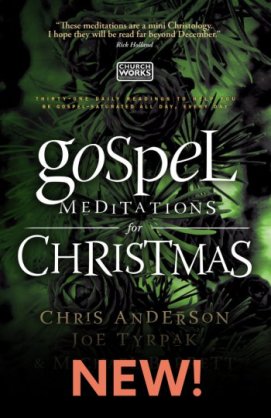
Gospel Meditations for Christmas by Chris Anderson, Joe Tyrpak, and Michael Barrett is the latest in their “Gospel Meditations” series (some of you might know Chris Anderson as the author of hymns such as His Robes for Mine and My Jesus Fair). The booklet is divided into 31 pages, one a day through the month of December (or any time, really, since these truths are eternal). Each page lists a Bible passage to read and then delves into some facet of the passage for a handful of paragraphs. The primary focus of the book is the Incarnation, and different aspects of it that the book covers are Christ’s humility, holiness, human ancestry; His being our peace, our mediator, our shepherd,; prophecies and promises about him; various names applied to Him; His Deity and humanity; and more. Quite a lot for 31 pages!
The best way to give you a flavor of the book is to share a few quotes from it:
Only as man could He die as a substitute for other men. And only as God could He suffer infinitely, paying for the sins of all the redeemed. (Day 4)
Escaping judgment begins with acknowledging that you deserve it. (Day 5)
Matthew begins his account of the good news with a record of Jesus’ ancestry. This isn’t some boring list of personal details that Matthew came across in research and decided to include as space-filler. No, this genealogy is Matthew’s attention- grabbing introduction, and it’s jam-packed with significance. (Day 7)
Consider whether your mental picture of Jesus fits the picture that Micah paints. The King that was born in Bethlehem is no longer a cherubic Baby. He’s a strong Shepherd, a majestic King, and the greatest military Commander of history. Jesus is the returning King and Judge before Whom every human will give account. Jesus is no longer a small Baby evoking your tender sympathy; He’s the world Sovereign demanding your total submission before it’s too late (Acts 17:31) (Day 9)
Having a biblical view of Jesus shouldn’t only lead you to lifelong submission; it should also lead you to patient perseverance. Like Micah’s original audience, we may respond in faith, yet die, having never seen the promises fulfilled. We must let it sink in that Micah’s generation never saw God make good on these words. Like them, we may spend our entire lives in unfulfilled longing. But if this Christmas prophecy that Micah uttered makes any difference to us today, it should fuel our persevering hope in God’s promises. Christian, even though we’re almost three millennia removed from Micah’s prophetic messages, keep longing for the return of the Shepherd-King from Bethlehem. Don’t lose heart. (Day 9)
What is a word? Don’t overthink it. It’s basically a means of communication. It’s a message, spoken or written, from one person to another—a form of revelation…Jesus Christ is God’s best and final communication to mankind. The Bible is God’s inspired Word. But Jesus is God’s incarnate Word—God revealed in human flesh. One of Christ’s great purposes in coming to earth was to reveal the unseen God. The apostle John returns to this motif throughout his writings. (Day 13)
This experience was so deeply satisfying for Simeon that he could say: “Now I’m ready to die.” God doesn’t promise us (like He had promised Simeon) that we’ll get to physically see Jesus before we die. But God does promise everyone who follows King Jesus that we will see His face and live in His presence after we die, and forever! To know and love and see the Lord is what we were made for. So the only way we can die in peace is if we have embraced the gospel by faith and if we are confident that very soon we are going to see the King with our very eyes. (Day 27)
Christmas sentimentality doesn’t help in tough circumstances. As I look back over the past decade and remember what Decembers have looked like for me, I recall many happy memories, but a lot of hardships, too. At Christmastime I’ve visited halfway houses, nursing homes, and funeral homes. I’ve received news of birth defects and of strokes, of terrorism and of persecution. And I’ve spent much time with loved ones who still don’t see their need for Jesus. When such burdens weigh heavily in December, Christmas lights don’t help. But Christmas truth does! (Day 31)
This is an excellent resource to focus your hearts and minds on Jesus and what was involved in His coming as well as many ways His incarnation should affect us personally.
Today is the first “back to the old routine” day in a while. I love all the holiday activities, and God was kind to grant me some pockets of quietness and rest amid the busyness. Getting out of the normal routine for several weeks was fun and refreshing. Getting back into it feels both good and sad at the same time. We had a wonderful Christmas with all the family home and then a very quiet but enjoyable New Year’s Eve and Day.
I thought I’d show you the Christmas cards I made for the family. I buy boxes of them for extended family and friends – I’d never be able to make as many as I send out – but for our own family I like to make individual ones.
This is Jim’s:
It doesn’t show up in the photo, but the white words are flocked. If I had been thinking, I would have cut off the bottom pine cone so more of the word Noel showed up.
This is Jeremy’s:
Sometimes ideas come from others I’ve saved on Pinterest, sometimes from something in the Cricut design space, and sometimes they come as a result of looking over the materials I have. This one started out with the fox sticker, as Jeremy likes foxes, and then the other elements came one by one. This is one of my favorite cards I’ve ever made.
This is Jason’s:
I had wanted to use blue because he likes blue, and I had also wanted to use the snowflake embossing folder on one, so those came together here.
This is Mittu’s:
I love that cozy sweater background paper, and they love coffee, so these seemed like a good pairing. The cups were done with the Cricut.
This is Jesse’s:
This started with the word sticker – that just seemed to fit him. Everything on the white part is a sticker.
This is Timothy’s:
I had seen the cookies on a cookie sheet idea on Pinterest, but the shapes on it were three of the same gingerbread men. As I looked through my scrapbook paper, I found one with these gingerbread figures on them, so I cut them out. Thankfully I had enough of a scrap of the metallic paper for the cookie sheet. 🙂
This is Jim’s mom’s:
And this was for Jim for our anniversary:
Other stray thoughts this morning:
We had turned on the TV New Year’s Eve long enough to see the ball drop, and I commented that I always wondered how they did bathroom issues in Times Square during that event. I envisioned a long row of port-a-potties somewhere. Jeremy looked it up and said there are no port-a-potties – and businesses don’t let the crowds come in to use the restrooms. And some people are there as early as 8 in the morning! They also don’t allow backpacks or large bags, don’t allow people to sit down, and they kick out the food stands to make more room for people. I looked up a couple more articles this morning (here and here). I never had aspirations to go to this anyway, but it’s definitely on my “Nope, I don’t think I’ll ever do this” list – which is guess is the opposite of a bucket list. 🙂
I’ve rediscovered cheese and crackers as a snack. My mom used to always send Swiss Colony cheese and sausage packages for Christmas until the kids all got older and it got too expensive to send them. But usually one of us gets a Hickory Farms package at some point during the Christmas season. This year we opened it on Christmas Eve. Then I had mentioned earlier that somehow we got started having the Chicken in a Biskit and Easy Cheese during the holidays, so I have enjoyed munching on them all month. They may not be the healthiest snack, though – especially the Easy Cheese – so I probably need to find a better salty snack.
One of the things I miss most about putting Christmas decorations away is the lights. But not enough to keep any up year-round.
I’ve also enjoyed several weeks of Christmas music. I got a new Christmas CD this year, Worship the Newborn King from the Wilds Christian camp. I especially loved the Candlelight Carol. I’ve loved that for years but rarely hear it. Other long time favorites have been their Christmas With Friends album (although that doesn’t seem to be available any more) and Sacred Music Services’ King of Glory. I also like some of Pentatonix – not the more raucous stuff, but I especially like their versions of Silent Night, The First Noel, Carol of the Bells, Dance of the Sugar Plum Fairy, Mary Did You Know, and others in that vein.
I don’t make resolutions per se, but I do like to make reading plans for the year and map out some projects I want to work on, so I hope to do that this week. I like to incorporate some purposefulness in my reading but with some flexibility in case I come across something new I want to read during the year. I hope to have my reading plans posted in the next day or two.
Also this time of year you see a lot of people writing about words for the year. I’m not sure how that got started. A lot of people derive great blessing from it, and that’s great. Personally I have never felt led to do so. Usually God has more than one word to work on in my life at any given time. 🙂 But can I say, if you feel stressed about choosing a word for the year or guilty because you don’t have one, don’t worry about it. Seek God about it, and if you sense His leading toward one area of concentration, then go for it, but if not, just seek Him in His Word and seek His will every day.
This is also a good time of year to find a good Bible reading plan if you haven’t already. I wrote on that extensively here. There are all kinds available. Probably the best plan is one you’ll actually use. Reading the Bible through in a year is a good thing for several reasons. A Christian radio station I listen to reads through the Bible throughout the year during daily 15 minute segments, not really too difficult for anyone. The last few years I have continued to read the complete Bible, but not in a year. I am not sure how long it takes me. I aim for a couple of chapters a day, but vary it according the the length, difficulty, or density of the passage I am in and whether I want to stop and slow down in certain passages.
And now I had best get on to some of that daily routine that needs attending to. Thanks for visiting. 🙂
“Welcome, New Year,” said Captain Jim, bowing low as the last stroke died away. “I wish you all the best year of your lives, mates. I reckon that whatever the New Year brings us will be the best the Great Captain has for us.”
~ From Anne’s House of Dreams by L. M. Montgomery
“What heavens are laid up in Jesus! What rivers of infinite bliss have their source, ay, and every drop of their fullness in Him! Since, O sweet Lord Jesus, Thou art the present portion of Thy people, favor us this year with such a sense of Thy preciousness, that from its first to its last day we may be glad and rejoice in Thee.”
~ Morning and Evening by Spurgeon













 Gospel Meditations for Christmas







 Stray Thoughts