Adventures in Elder Care: Helping Parents As They Age

Eldercare

Before I wrapped up this series, I wanted to share some odds and ends thoughts about helping parents as they age. This list would probably vary from person to person because parents age differently: we know a man well into his 80s who stills travels internationally and just got remarried a couple of years ago, but both of my parents had serious health issues in their 60s and died before they turned 70. Some parents are pretty self-sufficient as a rule whereas others need a little more help. Some want help, some don’t. These suggestions arose primarily from our own experience of seeing my mother-in-law through the last dozen years or so of living alone, then not being able to live alone, then going from assisted living to a nursing home to home with us. Some arose from friends’ experiences. By all means tailor any of this to fit your situation. I’d welcome any suggestions or experiences you’d like to share in the comments.

1. Have “the talk” – about finances. It’s hard to say when this should be done, but it should be well before finances become an issue and before any kind of dementia has set it. I’ve heard of some with dementia who thought their kids were “after their money” when they tried to work out power of attorney and such when the parent could no longer handle their own affairs. Some parents will be on top of things and will initiate the conversation with you (which is preferable). One suggestion would be to ask your parents as they get close to retirement how they’re set for the coming years and what their preferences would be if anything should happen to make them unable to take care of things.

In our case, my mother-in-law was the one who handled the finances in her marriage, and after her husband died she was happy to give her oldest son power of attorney. When she moved here, power of attorney was given to Jim since he would be the one actually handling her finances, paying for assisted living, supplies, etc. He got a joint bank account with her name and his on it so either of them could write checks. For years she wrote checks for church and for Christmas presents, but he wrote checks for bills. She would sometimes ask about how things stood but seemed content with how things were being handled.

2. Have the other talk – about end of life issues. This can be a difficult or awkward situation, and some parents will not want to discuss it at all. If something should happen and your parents have not made any living will or advanced directives, all you can do is try to make the best decisions you can. I’d advise you to do some research before having to make a decision in a crisis. For instance, we thought feeding tubes should always be offered if needed, but then discovered there are situations where it would cause more problems than it solved. When my dad needed a ventilator, one sister-in-law was adamantly against them because she had seen people who were for all practical purposes gone, but were kept alive on a ventilator; however, my father only needed one for about ten days. I once felt that CPR should always be performed, but on an elderly person, chest compressions can break bones. If you can gather information beforehand, you’ll be better prepared to make these decisions in a crisis.

3. Sibling involvement. It helps if everyone can be involved in the discussions and decisions that have to be made. Some of these, particularly end-of-life issues, can be especially delicate and emotional. If all the siblings are nearby, it’s best if they can all be involved in a parent’s care, but realistically it does not always work out that way. If the lion’s share of care falls to one sibling (often due to distance), continue to stay involved, show interest, ask how things are going, etc.  Abide by their decisions unless there is neglect or abuse. If there is an elderly family member with no children, others need to step in. We knew of a situation where an older lady in our church lived with a daughter who had some kind of mental issues, was a hoarder, had stuff stacked all over the house with only a narrow pathway for the older lady to get around in her walker, had something like 16 cats, some of whom she kept tied on strings in one room, which smelled horrible. When we knew of all this, we tried to help, but found out that unless there was active abuse, there was not much we could do as “outsiders.” Someone called animal control. and they came and took a few of the cats, but that is all. Another lady tried to help the older lady find a different place to live, but ultimately she did not want to leave her daughter. At her funeral when I saw rows and rows of her relatives, all I could think was, “Where have you people been the last several years?”

4. Help where needed, but unobtrusively. Long before parents get to a place where they can’t live alone any more, they might need help here and there with a variety of issues. They begin to lose steam or get to the place where they can’t see well and may not even know of some problems.

We lived 2,000 miles away from my husband’s parents, but the last several times we visited, my husband would seek for something to be done around the house (like rebuilding the roof on the carport, etc.)  and suggest doing it while we were there. It gave him and his dad some time to do something together, helped with something that really needed to be done, and kept his dad from climbing a ladder to do it himself. 🙂

We noticed the last several years that my mother-in-law was in her own home that things like dishes weren’t being done as well, not because she was letting them go, but because her eyesight and sense of touch was getting to the place that she didn’t realize she wasn’t doing as good of a job. I’m a bit germophobic, so when I’d drink a glass of ice water with “floaties” in it, I’d get pretty grossed out. This was before the days of readily available bottled water. She didn’t have a dishwasher, didn’t have room for one, and would not have wanted one anyway. We started getting paper plates and plastic cups when we visited, to “make things easier on her” – -which was technically true.  There were always piles of dishes after every meal, and sometimes she accepted help, but more often than not she liked to do them – it was her “thinking time.” Having some disposable products did help lighten that load, but it also helped us be assured that we were eating and drinking off clean utensils.

I mentioned earlier that sometimes household help can be hired, especially if the family doesn’t live nearby.

You may need to transfer things like Thanksgiving and Christmas to your house rather than the parents’ home, or at least spend time helping them get ready for it. You have to tread carefully with long-standing traditions like this: some might feel relieved not to have the pressure and work, but some might get their feelings hurt.

I mentioned helping unobtrusively: you don’t want to barge in and take over, or make them feel inadequate. Try to offer whatever help you think might be needed in a way that encourages them rather than demeans them.

And sometimes you just have to accept that things like the housekeeping might be at a lower standard than it once was. The last few years my mother-in-law lived alone, she pretty much let her dog have the run of the place, and every surface was covered with dog hair. It was a nuisance, but it wasn’t a safety or health issue, and his companionship meant a lot to her.

Sometimes helping means insisting on something they may not like. My mother-in-law was very much a status quo person who didn’t like to make any changes. Even when her hearing aid was not doing any good, she insisted it was fine, and we had to gently insist on going to the audiologist to be evaluated for a new one.

Sometimes helping may mean running interference. My mother-in-law had trouble with one physical therapist at the assisted living place (he had a Croatian accent and she couldn’t hear him well, couldn’t understand what he wanted her to do or why). He thought she was just being uncooperative. My husband had to take time to be with them for their first few sessions to help them interpret each other, but after they they got along great.

5. Help them to be as independent as possible as long as possible. At home or even in the lower-ranged assisted living care, there might be tools you can gets or little things you can do to help them be involved in their own care as long as possible: the seven-day pill holders to help keep their medications straight and help them remember what to take when; “reachers” to help them with hard-to-reach items (I use one of these myself!), an device to help open jars (I use one of those, too), etc. My husband tied bits of rope between his mother’s dresser drawer handles to make it easier for her to open them when she began to have trouble with them. He also put easier-to-read labels on the TV remote for the most-used buttons.

There will come a time when they will likely need help with just about everything, but for as long as possible let them do what they can do. We had elderly neighbors once, two sisters, who cut their own grass well into their 70s. One of them even painted her back steps at that age. My first impulse was, “Oh, we should go over and help them with that!” But one of them in particular liked being able to take care of herself. I just watched a Waltons episode when the grandmother came home after having a stroke, and every time she tried to do something, someone jumped up to do it and told her to relax. They meant well, but they made her feel helpless and useless. Even as their abilities diminish, let them do what they can safely do.

6. Don’t squelch talking about the past. As this post points out, they don’t have that much future left, and it may not look all that bright and cheery. This is a great time to ask them about their growing-up years – and a good time to write some of these things down for posterity. One of the things I regret with my mother-in-law is that I didn’t ask her more about these things and didn’t write down what she did say.

7. Help them find usefulness and purpose. This overlaps a bit with the above two points, but an older person can get pretty discouraged when they lose some of their abilities and even lose their home. Once when we had my mother-in-law here for dinner, a funny story from her past came up that we all enjoyed and laughed over: she did as well. Then she said, “Well, at least I’m good for a laugh.” It didn’t hit me until then that she might not have felt she was “good for” much of anything else. You can encourage a parent that as long as God has them alive, He has a purpose for them. Psalm 92:14 says, “They shall still bring forth fruit in old age; they shall be fat and flourishing.” Perhaps you can help them organize their photos into albums (something else I wish I had done) and hear the stories behind them. Remind them often that you’re glad they are here.

8. Always honor and respect them as your parents. I cringe a little at the phrase “parenting your parents” or the idea of “switching roles” with them. In one assisted living place, when we came to pick up Jim’s mom for something, one of the aides said, “It’s almost like you’re the parent now, isn’t it?” and then turned to his mom and said, “Your daddy is here.” Umm…no. Even as she has lost more of her abilities and we’ve taken on more of her care, we don’t think of her like that. As she has experienced a bit of dementia, Jim has had to remind her about some things from time to time (like using her fork rather than her fingers at meals or insisting her hands be washed), and sometimes that might have involved a sharper tone if she persists, but we don’t treat her as a child. I know family dynamics can be tricky and some parents can get more child-like, but as much as possible we still need to show them honor and respect.

9. Forgetfulness and dementia. My mother-in-law does not have Alzheimer’s, so I can’t really speak to that (and again, I’d welcome any perspectives you’d like to share in the comments). She has had a degree of dementia. It’s usually worse when under stress or when anything different is happening, and it has increased over the years.

As a general rule it doesn’t help to say, “Don’t you remember?” (Lisa suggests here to give them the answers rather than questioning them). Sometimes it does help to gently remind them of things: for instance, when Jim brought his mother here from ID, the folks at her church had all given her cards and told her good-bye, and all her kids and several grandkids had come to a combination 80th birthday/farewell party. Yet on the plane, she told Jim, “I think I’ll just stay for a few days and then head back home.” He wisely didn’t try to “set her straight” then and there, but later on he said, “Remember when all the folks at church gave you cards? Do you remember what those were for?” At some point she said, “Oh, that’s right. I’m moving to South Carolina.”

A nurse in the nursing home once told a member of a group from our church who were visiting that it is best not to alter their reality. Sometimes when they get “stuck” on something, distraction is the best tool. When Jim traveled with her, she’d say things like “I sure hope you know where we’re going” and get a little rattled by it all. Even though he is a seasoned traveler, instead of just telling her, “Don’t worry about it, I’ve got it covered,” he told her what gate he was looking for at the airport and asked her to help him look for it. That gave her something to occupy her thoughts. Recently she was “stuck” on needing to go to her daughter’s house. Jim wasn’t home when this started, and at first I tried to remind her that she lived in TN now and that her daughter was back in ID. But that wasn’t sinking in. It was one of our worst weather days this winter, and when Jim got home, he told her, “It’s snowing out now and the roads are icy, so we’re just going to stay here for the night.” He had to go over that a few more times, but after a while her thoughts turned a different direction.

Even in visiting in the “memory care” unit of assisted living, residents would stop us and ask us if we could help them get somewhere. At some level they knew they weren’t home, and some of them were constantly trying to figure out ways to get there. One lady stopped Jim once to say that something was wrong with her car and she needed to get to it. It was close to dinner time, and he said, “I tell you what, why don’t you stay and eat dinner, and we’ll see about your car later.” She felt so honored to be asked. 🙂 (On a side note, when visiting a nursing home or a memory care or Alzheimer’s unit in an assisted living facility, sometimes it is best to avoid engaging the residents in much conversation. When we visited my m-i-l in regular assisted living, we talked with the other residents quite frequently. But we quickly found that in the “memory care” unit, they often wanted you to help them with something, and when you couldn’t, they would get agitated, sometimes angry, and even start yelling and cussing, which not only disturbed themselves and others but made it hard on the aides to get everyone settled back down. We learned to just cheerfully say hello in passing without stopping to talk, and if we did get stopped and asked for something, we’d point out one of the aides and say, “Maybe she can help you.” )

10. Helping them deal with government agencies. Even if you have power of attorney, there are many situations where an agency will want your parent there. Once when my husband was trying to deal with one particular issue (I forget what it was), the man he was talking to wanted to talk to my mother-in-law on the phone. My husband tried to tell him she was very hard of hearing and especially  had trouble hearing on the phone, but the man insisted. So my husband went to her room at the assisted living facility, called the man, put the phone on speaker, and they tried to have a conversation. When she couldn’t hear and Jim was trying to convey to her what the man had said, the man shouted, “Don’t you dare tell her what to say!” Understand that they are trying to protect the elderly from being taken advantage of by unscrupulous relatives (unfortunately that does happen), but sometimes they do make it unnecessarily hard on those of us who are trying to help get necessary things done.

11. Smooth awkward moments. You don’t need to call attention to every mistake or fumble: if they’re aware of it, they probably feed bad enough already. Just help take care of spills or messes or whatever without making an issue of it. When they start needing help with personal issues, just handle it as matter-of-factly as possible – I took that cue from when I’ve had surgeries and illnesses and needed help with things I’d much rather have done on my own. Usually the nurses just came in and we got it done, and some of them were even cheerful about it. When my mother-in-law started needing help going to the bathroom, she’d say apologetically, “I bet you never thought when you got married that one day you’d have to help your mother-in-law go to the bathroom.” Well, no, I hadn’t. 🙂 And helping someone that way or changing dirty Depends later on is not really anyone’s favorite thing to do, but it helps to just look at it as meeting her needs and to handle it with as much grace as possible. My husband is great at easing awkward issues with humor.

12. Don’t neglect spiritual needs. Linda had a great post on this. When they can’t read the Bible for themselves any more, take time to read it to them. Some can handle CDs to hear the Bible read. Jim’s mom liked to attend church Sunday mornings until perhaps the last year or so when she just got too feeble and had little energy. When she was in the nursing home, a group from a church we were familiar with had a church service there Sunday afternoons, and Jim went over and accompanied her to it.

13. Have patience. There can be a multitude of frustrations as a parent gets older, even when we understand that they can’t help what they are doing and saying. This is probably the area that I most often prayed for while my mother-in-law was in assisted living, and often while driving there I often prayed and quoted to myself Colossians 1:11: “Strengthened with all might, according to his glorious power, unto all patience and longsuffering with joyfulness.”

The ultimate principle is to “do unto others as you would have them do unto you” (Luke 6:31). Put yourself in their place and treat them with as much love and grace as you would want others to show to you in the same situation.

Grandmother’s Beatitudes

Blessed are those who understand
My faltering step and palsied hand.

Blessed are those who know that my ears today
Must strain to catch the things they say.

Blessed are those who seem to know
That my eyes are dim and my wits are slow.

Blessed are those who looked away
When coffee spilled at table today.

Blessed are those with a cheery smile
Who stop to chat for a little while.

Blessed are those who never say,
“You’ve told that story twice today.”

Blessed are those who know the ways
To bring back memories of yesterdays.

Blessed are those who make it known
That I’m loved, respected, and not alone.

Blessed are those who know I’m at a loss
To find the strength to carry the Cross.

Blessed are those who ease the days
On my journey Home in loving ways.

– Esther Mary Walker

Related reading here at Stray Thoughts:

With All Our Feebleness.
Despise Not Thy Mother When She Is Old.
Caring For a Parent at Home.
Assisted Living and Nursing Homes.
Decisions for a Parent’s Care.
How Older Women Can Serve.
A Public Service Announcement Concerning Walkers.
Senior Version of “Jesus Loves Me
Am I Doing Any Good?
The Winter of Life.

Related reading on the Web:

Insignificant Is Beautiful.
Maintaining Sanity During Dementia’s Cognitive Decline.
8 Things Not to Say to Your Aging Parents.
Elders Who Abuse Relatives Taking Care of Them.
Adapting Your Home For An Older Parent.
10 Ways Caring For Parents Is Different Than Caring For Children.
You Are My Sunshine.
Alzheimer’s…My Reflections.
I’m Still Here.
A Psalm For Old Age.

Adventures in Elder Care: Caring For a Parent at Home

Eldercare

Some years ago I heard that one of the most delightful older ladies in a church we used to attend in another state had developed Alzheimer’s and that her son and daughter-in-law were caring for her in their home. One time when we had occasion to go back and visit, I asked her daughter-in-law how caring for her mother-in-law was going or what it was like. She smiled beatifically and said, “It’s our privilege!” I could only think, “Wow…she must be a better Christian than I am, because I think that would be hard.” It’s not that I wanted the nitty-gritty details, but I did want to know how God had given her grace for this ministry in case I ever had to do the same.

Our only experience with having a parent in our home for an extended time was when my dad came years before and got sick and ended up in ICU. I believe he was with us for about six weeks. He was not a Christian then (though he became one during that time), and he had lived alone so long that he had forgotten the give and take that there has to be with a number of people under one roof. I don’t mean to dishonor him by saying so, but he was quite cantankerous, especially when Jim was not home. The tension was so great that Jim said afterward we would never have a parent live in our home.

In my post on making decisions for elderly parents’ care, I mentioned that there are some relationships that thrive better when there is some distance. I share the experience with my dad mainly to say that I do understand it can be stormy to have a parent in the home, especially when age and dementia remove some the natural inhibitions. Some elderly parents can be abusive, and we heard enough even in assisted living places to know that bringing some parents home would be quite stressful. I wouldn’t even begin to know how to advise someone in such a case, especially when there don’t seem to be any other options, except to pray for a lot of grace.

In my mother-in-law’s case, we had been talking ever since we moved to TN about moving her home, because now we had a house with no stairs, and we had a room that would work well for her care (some of you may remember my talking about Jim finishing off a room from our L-shaped garage. My son and daughter-in-law lived there for a while when they first moved here, and ever since we had used it for Jim’s office and as a guest room). There was a small drop-off from the house to the garage for which we’d need to build a ramp, and we’d need to figure out shower issues. I was intimidated at first, partly because of my own health issues and partly because of the level of her needs: at the nursing home she had medical help right there. She is what the therapists call a “total assist”: she can’t walk, feed herself, go to the bathroom on her own, turn herself in bed, etc. At home it would be more complicated, and it would have a major impact on our lives. But as she seemed to sink lower and lower, we really felt the best alternative was to bring her home. So we got the room ready, the social worker at the nursing home set us up with renting a hospital bed, air mattress, and a Hoyer lift for transferring her. She also arranged for physical therapists, an occupational therapist, and a once-a-week RN visit, plus they had a couple of home health agencies they could recommend. Medicare wouldn’t spring for a Broda chair, but my husband found one on Craig’s list in a town 3 hours away for a good price.

So we brought her home at the end of July. Jim told me later he really thought we were bringing her home to die, because she had been at such a low place in the nursing home. But she has been thriving under one-on-one care. She had gotten down to 90 lbs. in the nursing home but now is well over 100 lbs. We have a home health aide here most of the day from M-F, and from 8-2 on weekends. The one who is here through the week is great: she has a lot of initiative and does a lot with her, makes sure to turn her every two hours to avoid bed sores, and they seem to get along great. She and I work together to give her a shower twice a week (actually she does the showering part, and now that we have done it several times, I’m more able to help with getting here ready for it and helping afterwards).

The physical and occupational therapists and nurse’s visits only lasted a number of weeks (about six, I believe.) The therapists told us that because she had been left contracted for so long in the nursing home, we would likely never get her straightened back out again, but doing some exercises with her would help stave off further contracting so we could dress, bathe, and move her.

The advantages of bringing her home have been:

• She’s thriving under one-on-one care. She gets more attention, time with meals to make sure she is eating adequately, stimulation of conversation and interaction with others.
• Since she has the same caregivers, they get to know her and her “quirks” as opposed to a high turnover in other facilities and having different people cycle through.
• We don’t have the long drive to see her (it had been about 20 minutes one way).
• We can see her more often through the day.

There are, of course, disadvantages, and I don’t share these to complain but rather just to be honest with anyone else reading:

• You can’t go anywhere without working around having someone else here with her.
• Caregivers cost $17 an hour with the agency we work with (more on that in a moment), so we can’t use them much more than we already use them. Consequently we rarely get to go out as a family to eat or to an activity.
• Caregivers are a big help, but the downside is having a stranger in your home (especially for an introvert like myself). Though none of the caregivers we have are strangers any more, it still feels awkward sometimes. I don’t want them to feel like they are servants who have to stay in that one area of the house: they do come into the house to do her laundry (I felt awkward about that at first, too, thinking I’d rather do it, but there is not that much for them to do since she sleeps a lot, so I relented), bring her lunch tray back, get water, go to the bathroom, etc., and everything except the bathroom involves coming through the areas where I usually am. Our regular weekday caregiver is very much a gregarious extrovert who I am sure has a hard time being in a room all day with someone who doesn’t say much, so she comes over just to chat sometimes. It’s funny – if I am up and around doing something, she doesn’t usually say much, but if I am at the computer, I guess it looks like I am “not doing anything,” so she is more inclined to come over and talk then, when that’s the time I would least like to be interrupted because I’m often trying to think through a blog post or writing a newsletter. But I’m supposed to be hospitable, so I try to be, and usually I don’t actually mind, but it’s just hard mentally to get some things done. There is one kind of freedom of having someone here and knowing her needs are being looked after; there is another kind when the caregivers are gone for the day and I feel like I can relax.
• When I am alone with my mother-in-law, there is often a certain amount of tension or pressure just in wondering if I should be over there with her if she looks like she’s awake (we have a video baby monitor). If I go in to feed or change her, I usually stay in there with her until she goes back to sleep, but often I still feel like I should be in there all day when it is really not necessary since she does sleep quite a bit.
• Changing her every two hours to avoid bedsores includes the nighttime hours, which Jim has taken on.
• If one of the regular caregivers can’t be here for some reason (going out of town, illness, etc.), there is not always a ready replacement, or we might not choose to use one because we’d spend so much time showing the new person what to do that it wouldn’t be a help to us.

I mentioned working with a home health care agency. The agencies who provide medical care (nurses, therapists) are different from the ones who provide regular day to day care like feeding, changing, etc. If we hired someone individually outside of an agency, we could probably pay them less while they would get more (I think of the $17 an hour we pay, they only get 10 or so). But we decided to use an agency for several reasons: if there is a problem with a caregiver, we can call the office instead of having to deal with it; if we don’t like how someone works, we can ask not to have that person again (which has only happened with one person); if the regular person can’t come we do have the option of having the agency send someone else out (there is one lady who is good as a fill-in); the agency checks out their background and skills before sending them out.

I haven’t mentioned finances: I can’t say much knowledgeably about them because my husband has dealt with that aspect. But I do know that neither Medicare nor insurance pays for home caregivers or assisted living: they did pay for the first 100 days in a nursing home (after a 3 day hospital stay) as long as there was some kind of skilled nursing going on (physical, occupational, or speech therapy). Once the therapies stopped, Medicare stopped paying. They did pay for the therapists who came to the house. They do pay for some of the equipment, such as the hospital bed. Actually they pay for the rental of it, and if we use it for I think 12 or 13 months, then we own it. They paid for a regular wheelchair but not the Broda chair (which she needs since she can’t sit up straight). They would not pay for the air mattress unless she currently had a bedsore (even though she’s had one before and we wanted one to help prevent another.) If her savings and monthly income were to drop to a certain level, then she’d have access to Medicaid. She receives Social Security, a small pension, and a VA benefit, which have not been enough to cover assisted living or nursing home or home health care costs, so we have had to dip into the savings from the sale of her house.

In fact, her savings has gotten down to a level that we feel we need to cut the weekday caregiver’s hours back. The weekend lady is here from breakfast til 2 p.m. since Jim is home on weekends, but the weekday lady we’ve had here til 5 p.m. To try to manage my mother-in-law’s funds better, we’re going to cut the weekday lady back to 1:30 p.m. We’re hoping that doesn’t mean she won’t be getting enough hours and will have to look for another situation: that’s one reason we haven’t cut back before now.

I’ll have to admit that even though I agree that we need to take this step, and though I can handle caring for her in the afternoon now, I don’t feel as beatific as my friend I mentioned at the beginning of this post. People act as if we’re doing something noble by caring for her at home, but it doesn’t feel so noble to spoon pureed food into someone’s mouth and clean up the other end, and there are some days (just like when a new baby is in the house) where it feels like that’s all you’re doing, even though you know it’s not. As I mentioned in talking about the “empty nest” recently, when your kids are grown and gone, you miss them, yet there is a side of you thinking, “maybe I can write that book now, or learn to quilt, or travel” (for some people – I am not a traveler myself). When a parent is in the home, some of those aspirations have to go back on the back burner.
But if this is God’s will, this is my ministry for now. In fact, the very night we decided that we would need to cut back on the caregiver’s hours, thereby increasing my own, God was so good to have these verses in my evening reading for Daily Light on the Daily Path:

Distributing to the necessity of saints. Rom. 12:13

David said, Is there yet any that is left … of the house of Saul, that I may shew him kindness for Jonathan’s sake? II Sam. 9:1

Come, ye blessed of my Father, inherit the kingdom prepared for you from the foundation of the world: for I was an hungred, and ye gave me meat: I was thirsty, and ye gave me drink: I was a stranger, and ye took me in naked, and ye clothed me: I was sick, and ye visited me: I was in prison, and ye came unto me. Inasmuch as ye have done it unto one of the least of these my brethren, ye have done it unto me. Matt. 25:34-36, 40

Whosoever shall give to drink unto one of these little ones a cup of cold water only in the name of a disciple, verily I say unto you, he shall in no wise lose his reward. Matt. 10:42

To do good and to communicate forget not: for with such sacrifices God is well pleased. Heb. 13:16

God is not unrighteous to forget your work and labour of love, which ye have shewed toward his name, in that ye have ministered to the saints, and do minister. Heb. 6:10

Another verse that often comes to mind with my mother-in-law is I Thessalonians 5:14b: “comfort the feebleminded, support the weak, be patient toward all men.” And I Corinthians 13 about love applies, too, as well as the verses I mentioned in my first post about our obligation to care for our parents.

I do need to look at it as my friend did, that it is my privilege to care for her. She does make it easy: she is sweet, rarely complains (except when someone’s hands are cold 🙂 ), and smiles and appreciates any little thing that is done for her.

Practical helps

I probably should make this part into a separate post as this is getting long, but I think I prefer to keep it all together.

I feel more confident about being able to care for her myself now after having observed and helped the aides with showering, changing, and moving her. I had been afraid of lifting her since my balance isn’t always stable, but with the Hoyer lift there is really no lifting involved. The aides started out using a draw sheet to move her from side to side or up in bed, but now we pretty much just use a large waterproof pad that is always underneath her.

Since she’s been home we’ve discovered a plethora of information available online (including videos on everything from feeding to using the Hoyer lift to repositioning) as well as resources. Just Googling ‘hospital gowns” and “waterproof pads” has led us to sites with those and other supplies. When she was having trouble staying in position in her shower chair, we tried using a gait belt, but that was a little too firm. I Googled “shower seat belt” and found just what we needed.

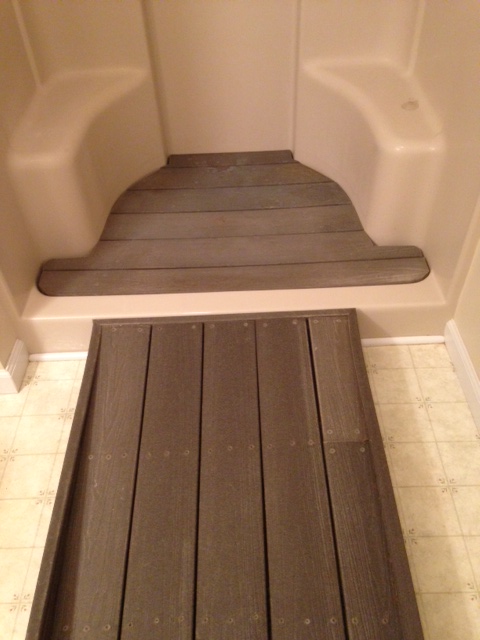
With other needs, Jim’s skills have been wonderful. I mentioned the shower situation. The therapist had recommended a sliding seat where the patient sits on one end and then is slid into the bath/shower area, but Jim’s mom wasn’t stable enough to do that. We have a step-in shower in one bathroom, so Jim built a platform in the bottom, so it was level with the step, and then a ramp leading up to it. We put her in her shower chair in her room, put a towel over her, and roll her backwards into the shower, then roll her back to her room afterward.

photo

We do put a towel under the ramp to absorb sprays and drips from the shower.

Transportation was another problem. Right after she moved home she needed to be established with a doctor since she was no longer under the care of the ones in the nursing home. Therapists, nurses, etc., make house calls, but not doctors. 🙂 There is a transport system here that can take patients in wheelchairs to appointments, but they don’t accommodate the Broda chair. So for that visit we had to prop her up in her wheelchair, be ready an hour before the time we needed them to pick her up, and be ready to wait an hour after being done with the appointment for them to come back and get her. Jim and the caregiver accompanied her, but it was a very long day, and there was no way to reposition her like we’re supposed to do every two hours to avoid pressure sores. So Jim found a ramp that would attach to the back side of our van, took out the back seats, and found that if he lowered her chair into almost a full reclining position, he could get her into the van, then raise her up into a sitting position. Then he had clamps to secure her chair into the place where the seat that he had removed usually plugged in, and he was able to secure the seat belt over her into the next seat. It’s hard to explain without photos and videos, but it worked very nicely and gives us more leeway in being able to take her places.

My man job since she has been home has been figuring out how to prepare a balanced diet that can be pureed. An immersion or hand blender works better than the big regular-sized blender (the big one works well but it leaves you with a bunch of bulky parts to wash). You can actually probably puree most anything if you add enough liquid, but some things work better than others (we even tried a tuna fish sandwich once. It did puree, but she didn’t care for it. :)). Almost any casserole purees well. Most vegetables we’ve tried work well, too (except corn and broccoli. They do well in casseroles but not so well by themselves, although creamed corn does fine). Canned vegetables and fruits work well. Mandarin oranges just turn into juice. Meats are probably the hardest. Soft meats like Salisbury steak do well. We keep a jar of prepared gravy on hand for that kind of thing. We add something called Thick-It if a food ends up too liquid. Usually we just puree whatever we’re having, but when we’re having things that would not puree well (like pizza and salad), we keep a few frozen and canned items on hand for her. Of course, things like pudding and ice cream that are already soft work great. We do supplement her diet with Ensure. It is probably not as necessary now that she has put on some weight, but we felt it was vital when she first came home and her weight was so low.

I hope some of this has been helpful. Let me know if you have any questions. As I’ve said before, I am certainly not an expert, but if I can share something I have learned along the way that will be helpful to anyone else, I’d be glad to.

Of course, the bulk of our experience has been with a parent who is pretty much bedridden. I’ve had friends who have brought parents home who are able-bodied but with Alzheimer’s or who are in good condition both physically and mentally but for various reasons can’t live alone any more. That would be a different set of adjustments, but it would include the need to incorporate a new person as an everyday family member rather than a guest and to make yourself available to that person. If you’ve had experience along those lines, please feel free to share in the comments.

In my next and probably last post in this series, I’ll discuss some ways to help parents as they age.

Laudable Linkage

Here are some thought-provoking reads from the last week or so:

How to Beat That Bad Mood.

Middle-agers Need Older Women Too.

Raise a Man.

Salvation in a Dementia Ward, HT to Challies.

Motherhood or Singleness: Which Is More Sanctifying? Short answer: whichever one you’re called to.

8 Things Not to Say to Your Aging Parents.

How to Write a Book in Your Spare Time.

7 Reasons Why I Stop Reading a Novel by author Jody Hedlund, whom I have not yet read except on this blog.

Getting Upset About the Wrong Things in Disney Movies and The Cold That Bothers Us both give thoughtful insights into Disney’s movie Frozen.

Finally, I couldn’t resist sharing with you something we noticed during Sunday breakfast. Apparently one of the biscuits was grumpy, or woke up on the wrong side of the pan or something. 🙂

Grumpy biscuit

Happy Saturday!

Adventures in Elder Care: Assisted Living and Nursing Homes

Eldercare

As I said in my first post in this series, when we were making decisions for my mother-in-law’s care, it helped me to read of other people’s experiences, so perhaps this will be of help to others. I hasten to say, though, that these are our experiences alone: they may or may not be typical and they are not meant as professional or authoritative advice.

If you foresee that you will probably need assisted living services for yourself or a loved one, the best recommendations will likely come from people you know who have also used them. Then either through the Yellow Pages or an online search, research what it available in your area. Most will have a web site for further perusal, and most are happy to set up an appointment for you to talk with the director and tour the facilities. Some good questions to ask them are listed in Seven Questions to Ask When Searching for Assisted Living and Assisted Living Community Evaluation Checklist.

There are a wide variety of assisted living facilities. My grandmother’s was basically an apartment complex for the elderly. She had her own kitchen and did her own cooking, but there was a nurse on site all the time who regularly checked blood pressure and such. Most facilities have common meals together in a dining room and provide housekeeping. Some have different levels of care, including hospice and an Alzheimer’s unit. Most provide activities for the residents; some even have “field trips” to area attractions.

Those in need of assisted living vary widely as well. Some are able bodied and sound in mind but no longer have the energy to keep up with a home. Most are in some state of decline, either physically or mentally or both, and others are confined to wheelchairs or have full-blown Alzheimer’s.

The key, then, is to find the best fit for your loved one, hopefully at a reasonable cost and not too far away. Realize that no situation is going to be perfect, whether your loved one stays with you or in a facility, but hopefully you can find a workable situation for all involved.

Let me say here that I would not recommend putting a loved one in a facility where there are no other family members nearby, especially if they have any kind of dementia. Even if they are near close friends or an active church family, those people will not have the same position of authority if any problems arise. Wherever you place them, you need to visit them often, not only to encourage them and show them love, but also to see that they’re being cared for well. Do not put them into a facility and assume they are being well taken care of and forget about them for months at a time.

I mentioned in my first post in this series about decisions that we had come to the conclusion that my mother-in-law needed to be in a facility. As we discussed the situation with other siblings, it became clear that moving her to live near us was the best option. Jim’s sister would be moving away from their town in ID, so placing his mom in a facility there would not be an option because there would be no one there to check on her regularly. She rarely complains, but to a fault: many times in the past we wouldn’t know there was some problem going on until we came to visit. When we asked why she didn’t let us know, she’d say, “I didn’t want you to worry.” So we felt if she was in a facility away from everyone, we’d never know how she was really doing. Other family members had careers and commitments, I was the only stay-at-home member at the time, our family could be involved in her life, the facilities in SC were much less expensive than in CA where Jim’s brother lived, so, all told, moving her East appeared to be the best solution.

The rest of the family lives out West, so they all gathered for Mom’s 80th birthday for a kind of farewell get-together. Jim flew back to help her get ready and to fly with her back East. Thankfully they did not have to close up the house at that time. His sister took care of that later when we got ready to sell it.

She handled the whole transition with a lot of grace. I can’t imagine leaving a home and church family of 35 years for such a major move. She did get understandably teary at saying good-bye, and one of the hardest parts was leaving her dog behind. She also got teary when her house was sold. But otherwise she has done quite well.

There was an assisted living place just a few minutes from us, and it worked out well for her to be there. It was divided into four smaller homier buildings, as opposed to a bigger, more institutional facility a little farther away. One of us visited her nearly every day, we brought her to the house often for meals and Scrabble and even to my youngest son’s basketball games, took her out to dinner a few times, brought her to church, etc. Being in a facility actually gave her a measure of independence that she enjoyed and faces to see besides ours. She was not inclined to participate in many of the activities: she usually preferred to stay in her room and read. But sometimes they’d talk her into going, especially if there was a church group singing. This facility had a bookmobile that visited at regular intervals and would even bring books to her room so she didn’t have to go rummage around for them. She was evaluated by a physical therapist and provided with a much-needed walker.

She was in that place for a year, until we had to move to TN because of my husband’s job. He valiantly staved off moving as long as he could, but finally we had to. She was in one facility here for a year, until her care needs reached a level they did not feel they could manage, and then in the “Memory Care” unit (not so much because of her memory but because she needed a higher level of care) of another facility for about a year and a half until she went to the hospital and then to a nursing home.

Each assisted living facility that we had experience with had different levels of care. Level 1 was usually minimal assistance needed: the resident could walk to and from meals, take care of their own bathroom needs, etc. Level 2 and 3 provided more assistance as needed, and of course, the higher the level of care, the more expense. We concluded that assisted living places were fine as long as you didn’t need much assistance: as Jim’s mom’s abilities declined, and the level of care she needed increased, the quality dropped off.

There were things we liked about assisted living:

• Access to physical therapy
• Regular checking of blood pressure, weight, etc.
• Camaraderie with others in the same situation. An older person can get a little depressed initially about the need to use a walker, etc., but when they see many other managing with one, it helps. They also see people in much worse conditions than themselves, which helps to put their own situation in perspective.
• Building friendships. My mother-in-law did not benefit from this as much because she preferred to stay in her room and read, but even with just going to meals, there were people who greeted her, were glad to see her, etc. It did enlarge her world a little bit.
• Family dinners. Two of the three facilities had regular dinners or events where family members were invited. It helped to get to know families of some of the other residents.
• We could decorate the rooms however we wanted (short of painting them), hang pictures on the walls, etc. to make it more homey.
• There were a few CNAs who were real pleasures, who were dedicated and kind and attentive.

But there were things we didn’t like as well. Most of these facilities were understaffed and the workers overworked and underpaid. We knew not to expect everything to go 100% like we’d like: no place is going to be perfect. But we didn’t expect to regularly have these kinds of problems:

• The only time we were away for an extended time was for my son’s wedding in another state. The day before we left, I found a broken picture frame on the floor – Mom was still using a walker then and must have accidentally knocked the picture off from where it was sitting. I picked up the big pieces of broken glass, went to the office, explained what happened, and asked if someone could vacuum up the smaller slivers. When we came back a week later, they were still there. Even without someone coming to clean that particular mess up, you’d think someone would have vacuumed the room in a week’s time.
• Food left on her face, from actual bits sticking to her face to a whole chin smeared with sauce, often enough to make red places on her face.
• The hearing aid was often left out, or put in without a battery, or the battery was put in backwards, causing her ability to hear and communicate to be almost nil.
• Food or poop (sorry for TMI, but it happens) would be left under her fingernails.
• When she began to lose the ability to sit up straight, we would come in to find her bent completely forward or bent to the side at a 45 degree angle. We purchased a shoulder harness that helped her to sit upright, but they said they weren’t allowed to use it because it was classified as a restraint. We could understand that, but we felt they could have straightened her up from a bent position and tucked pillows on either side, etc. Just looking at her should have alerted someone that she was extremely uncomfortable.
• One aide would give us grief every time we told her Mom needed to go to the bathroom. Then for a while, every time we would come in, she’d rush over and tell us that she had just taken her to the bathroom, and she’d had “a good poop.” Funny how no matter what time of day we came, she had just taken her. 🙂 The deal was, she wanted to take all the residents to the bathroom on her timetable. But of course they can’t all schedule their need to go to wait until she came. If, while we were visiting, Mom said she had to go to the bathroom, we’d call for an aide, and this one would question Mom about whether she really had to go, or make little remarks loud enough for us to hear when she took her in (“You don’t need to go? Well, we’d better try.”)
• Regular taking of supplies by the aides from one resident’s room to use for another. Granted, sometimes a resident would run out of Depends or wipes, and their family member couldn’t get there that day with more (often they didn’t let us know she needed some until she was completely out, even if it was 10 p.m.) But instead of “borrowing” from other residents, we felt the office should have kept a supply on hand that they could use in emergencies, and either incorporate it into the costs or charge the account of the person needing them. This was particularly rampant in one facility. Not only did wipes disappear at a fast rate, but Mom’s plastic cups, gait belts (used to help her stand up and to transfer her from wheelchair to other chair or toilet, etc.), and even her shower chair were used for other people, even though her name was on all of her things with black Sharpie markers. Clothes disappeared to who knows where.
• Some aides would not be gentle in moving her. For a long while, she could move and help them in their movement of her, but she’s stiff and arthritic, and it would take time. Some would jerk on her arm in ways that hurt her instead of taking their time and going about it slowly and gently.
• Some aides kept running conversations going with each other and did not interact with her at all while they transferred her or took care of her needs.

My husband would talk to the office about some of the problems, in a kind way – he’s not an angry ranter and raver. They were always very sympathetic and promised to make changes, but either that didn’t filter down to the aides, or they didn’t heed it, or things would improve for a while and then go back downhill. We did understand that if we came just after a meal, they might not have gotten to her yet to clean her up. Most of the time we would just take care of the issue and not say anything about it.

I mentioned the different levels of care. In the second facility she was in, as her abilities declined, a couple of aides began to complain about the extra work she required. We learned then that they had a rule that each resident had to be able to get out of the building on their own within 13 minutes during a fire drill. We hadn’t heard of that before. When Mom failed to do so, we were notified that she needed to move right away. No warnings, not 30 days, not even a week’s notice. We talked to the county ombudsman but found that assisted living facilities are not very regulated.

At the next place, we asked if we were going to run into the same problem when Mom declined to a new level, and they said no, she should be able to finish out her time there, and they could even arrange hospice care when it became necessary. She was there about a year and a half when she developed a serious UTI. She was prone to them, and her urine had a certain odor when she had one. When we suspected she had one, we asked the nurse at her facility if they could get a urine sample and then get her started on antibiotics (which they could do at this facility: they had a nurse practitioner who worked with them). For various reasons (among them their being out of toilet “hats” which they used to collect samples), they did not test her for a UTI until a week after we first mentioned it. They started antibiotics, but by that time the infection was rampant, and she was very sick and was taken to the hospital. While she was there we were told that they would not be able to accept her back. So we had about a week’s notice to find and arrange for her to be transferred to a nursing home.

We had talked to a couple of nursing homes before her last move and were told that she could be put on a waiting list, but it was rare that anyone was admitted through the waiting list: they usually were admitted after a hospital stay. Medicare’s regulation was that they would pay for 100 days of skilled nursing in a nursing home after at least a 3 day hospital stay. Mom was in the hospital for about a week, so that requirement was met. Physical therapists, occupational therapists, and speech therapists were all working with her, so she met the skilled nursing requirement.

When she went into the hospital, she had to be out on pureed foods, and she has not outgrown that. We never did figure out why. We thought maybe the depth of her illness as she battled infection caused her to be weaker, and then moving and adjusting to a new place and people was traumatic. But she has not regained the ability to eat regular foods without choking. All we can figure is that as she has gradually been losing muscular abilities (walking, going to the bathroom, feeding herself, etc.), this was a further loss of muscular strength.

The nursing home was the one facility we had been most afraid of, having grown up seeing people in them staring vacantly from wheelchairs or beds. But in many ways she received the best care there at first. They were very gentle in their handling of her. We didn’t have to bring up posture issues: they were on top of that. We learned there was such a thing as a Broda chair, which reclines and has little side pillows built in, so she could now sit in a wheelchair without being stuffed and strapped in. We had always thought it was sad, before, to see people in wheelchairs in the hallway, but now we understood that being out in the busier areas does get them out of their rooms for a bit, and it seemed stimulating to Mom to people-watch. Plus some people would speak to her as they passed by, giving her a bit more interaction than she would have had in her room.

One down side to the nursing home was that her living space was extremely tiny, and everything looked really run down. But a couple of the best aides were there, and one nurse, though seemingly gruff at first, ended up being one of our favorites.

But each facility is only as good as its weakest worker. Jim walked in a couple of times to see an aide feeding her, but watching TV while doing so and only interacting with Mom by shoveling food in. We asked them if they would turn off the TV while feeding her, make sure her hearing aid was in and working, and talk with her a bit while they fed her: we felt those measures would improve her eating. Some of them did. Then, after just a little while she would put up her hand to say she’d had enough. When Jim fed her and she did that, he would give her a drink, let her rest a bit, and then offer her more, and she would eat more. But the aides had the next person to get to, so at the first sign she was done, they’d move on to the next person. Even with regularly getting Ensures and high-calorie shakes, she got down to 90 lbs.

Then she developed a bedsore and couldn’t get into her wheelchair because of where it was, so she had to stay in bed for weeks while it healed. They had stopped physical therapy when she “plateaued,” but were still supposed to be putting soft splints on her arms and legs to keep her from curling up into a fetal position. But somewhere along the way that dropped off. So those weeks while she was in bed, she ended up curled up into a ball, and seemed lower than ever. When we would go to see her, she would often be sleepy or groggy, so we had no idea if she knew we had come, and she must have felt like she was spending endless days alone. People in the facility only saw her to change her Depends and feed her.

We had discussed often over the previous months whether we should try to bring her to our home. At this point we concluded that if we didn’t, she was going to waste away to nothing. In fact, when we first brought her home, Jim assumed that she didn’t have much time left, and he wanted to bring her home to pass away rather than having it happen while alone in her room there.

In my next post in this series I’ll discuss the ins and outs of having an elderly parent at home.

Adventures in Elder Care: Decisions

Eldercare

A few years ago I happened upon a couple of blogs dealing with being a caregiver for elderly parents, and they were a help to me even before we got to that point. Those blogs are no longer active, and for some time now I have been thinking of writing some of the experiences and things we learned along the way with my mother-in-law in the hopes that they may be a help to someone else.  I had hoped to contain everything I wanted to say in one post, but it got to be way too long even before I finished, so I thought I’d better divide it up into sections.

Scripturally and morally we’re obligated to care for our parents when they can no longer care for themselves. In Matthew 15:3-6, Jesus says to the Pharisees, “Why do you yourselves transgress the commandment of God for the sake of your tradition?  For God said, ‘Honor your father and mother,’ and, ‘He who speaks evil of father or mother is to be put to death.’ But you say, ‘Whoever says to his father or mother, ‘Whatever I have that would help you has been given to God,’ he is not to honor his father or his mother.’ And by this you invalidated the word of God for the sake of your tradition.” (This is from the NASB, which I think gives the clearest meaning to this passage.) God did not honor their gifts supposedly to Him at the expense of neglect of their parents. In instructing the church concerning the care of elderly widows, Paul writes in I Timothy 5:4: “But if any widow has children or grandchildren, they must first learn to practice piety in regard to their own family and to make some return to their parents; for this is acceptable in the sight of God,” again from the NASB. Both it and the ESV say “children or grandchildren”; the KJV says “children or nephews.” But the idea is that our first responsibility and ministry is to our family. The “sandwich generation” is not a new phenomenon: people have always needed to care for their parents and grandparents in some way. Besides the “obligation” of such care, we should be glad to “return the favor” of caring for those who cared for us for so many years.

Most people really don’t think seriously about what to do with a parent who can no longer live alone until they get to that place. Admittedly you can’t really make a decision until the time comes, because it will depend on the family’s life circumstances and just what condition your loved one is in. But it is good to do some research and have some discussions before you have to make a decision in a crisis.

I would say to anyone nearing retirement age that, as much as we don’t want to think about losing our independence, we have to face the fact that that day will come to all of us. It’s good to look ahead, prepare advance directives, talk to your children about your wishes and financial state, etc. We could even start reducing the amount of “stuff” we have squirreled away in attics or sheds before we get to the place where we don’t have the energy to deal with it so our kids won’t be faced with that chore.

It often seems as if other people see that an older person is having trouble living alone before that person realizes it, but I would make every provision for them to remain in their own home as long as possible. Most people wouldn’t relish the change from private home to a dorm or hospital type setting where anyone can come into your room at any time unless they are extremely gregarious, and many would feel burdensome moving in with their adult children. Some folks I’ve known have hired some household help to come in a couple of times a week; I’ve known some who rented out a room to a college student whose responsibilities around the house offset their rent (some degree of housecleaning, taking care of the lawn, perhaps some cooking, etc.)

The main reason for moving a parent out of their own home would be safety issues: the danger of falling, of forgetting to take medicine or taking too much because they’ve forgotten they already took it, etc. Even still, necessary changes need to be discussed and urged upon the parent without running roughshod over their wishes and feelings. It’s usually better to plant the seed that we need to start thinking about the future long before the need actually arises.

In my mother-in-law’s case, she wasn’t taking any medicine that we needed to be concerned about. We were all concerned about her living alone after her husband passed away. She lived 2,000 miles away from us but had a daughter and grandkids nearby. When my husband visited a couple of times, he noticed the housekeeping was declining and the dog had the run of the place (probably for companionship. They’d always had dogs, but they had never been allowed on furniture or to have free reign in the house, but now every piece of furniture was covered in thick dog hair.) He flew up to ID to accompany her to our home in SC and back for a visit to our house since we didn’t think she could travel alone, and while there he took her on a tour of an assisted living facility “just to see what it’s like.” She said it was nice, but she wasn’t ready for anything like that yet. Just about the time we felt like we needed to gently insist that she needed to consider moving, her daughter became available to move in with her. That gave everyone a reprieve from having to make any changes for a time. I don’t believe her daughter was ready, mentally and emotionally, for her to move to a facility yet, either. They did well together for a time, but then my mother-in-law began having some falls, and one time could not get herself up until her daughter got home from work. Additionally, her daughter began having some back trouble and could no longer help her with things like getting out of the bathtub. They both finally came to the conclusion that the time had come for a major change.

The next step, of course, is trying to figure out what that change should be. My husband and I discussed the possibilities many times as did my husband and his oldest brother long before this day actually arrived.

There are several things to consider when deciding whether to move a parent into your home or an assisted living facility:

1. Housing situation. Not everyone has the space to include a new adult addition, or the house might not be conducive to someone with physical problems.

2. Availability of other family members. It’s easier to bring a parent into your home if you have some kind of support system than it is to do so alone.

3. Finances.

4. Mental ability. If the elderly parent has Alzheimer’s or mental confusion, someone would need to stay with them all the time, and even a family with a stay-at-home member might not be able to manage that between errands, school obligations if there are school-aged children in the house, etc. I know some handle this by hiring someone to stay with the elderly parent a certain amount of time each week.

5. Level of care needed. There might be some situations in which the older person needs physical or medical care that can’t be given at home.

6. Relationships. Some older people will always see their adult child as a child, and won’t follow instructions about medical care (e.g., medicines), food, etc., but they would take such instruction from medical personnel in an assisted living situation.

7. Personalities. We might be loathe to admit this and we might think that every family relationship should amicable, but in real life that is just not the case. Some relationships prosper with a little bit of space for each party.

8. Safety. Particularly Alzheimer’s or some forms of dementia in advanced stages may cause some patients to physically strike their caregivers when frustrated or angry even if the patient would never have done that in earlier years.

9. Socialization. Assisted living could provide the mental stimulation of interacting with others and participating in the activities there, and it might encourage folks to know there are others who are going through the same things she is.

10. Independence. If a person is not capable of being alone, mentally or physically, for short periods of time, it would be hard to bring them into the family home unless someone else in the family can be home all the time, or the elderly person is able physically to go with the family to their activities. It might seem odd to list this as a factor when a person going into assisted living seems to be giving up their independence. But in such a facility they actually do get to make some of their own decisions and schedules to a degree and have their own living space. Some would feel that if they lived with their children they would be an imposition (even if the family is glad to have them), and they are more comfortable being on their own as much as they can be.

In our case, the biggest factor was that our home was not conducive to my mother-in-law’s needs. We had a split level at the time, and she could not handle the stairs safely. The other major factor was that we still had kids at home, one of whom was not driving yet, so our lifestyle involved a lot of taking kids to school, practice, and activities as well as errand-running where we couldn’t leave Mom at home alone. A friend who takes care of her mother-in-law with Alzheimer’s takes her with along with her to her granddaughter’s outings and school activities, etc, and she does fine, but my husband’s mother wasn’t physically capable of that and probably would not have been interested in that, either. She was very much a homebody, and even when her own kids were home, she didn’t go to many of their activities. Socialization was a smaller factor: I almost hate to even use that word because I know it is leveled as an unfair charge against home-schoolers has been a lack of socialization, and most of them get plenty of social interaction and don’t really need to be put into a classroom of people the same age to get it. But we  knew if my mother-in-law lived with us, we would be her whole world — she wouldn’t feel the need to or have the desire to interact with others besides surface greetings at church. Too, some of my own physical issues made me unsure I could help with hers: in fact, when she visited, I inadvertently hurt her shoulder trying to help her out of the tub.

My husband had been researching the nearby assisted living facilities and found one with more of a homey rather than an institutional feel just a few minutes away from us. In the next post in this series (probably next week) I’ll discuss some of our experiences with assisted living and nursing homes.

Disclaimer: This series is not meant as professional or medical advice. It is merely based on personal experiences and offered as information and encouragement. 

Laudable Linkage

It’s been a while since I shared with you some of the interesting things I’ve seen around the Internet lately. I keep thinking I need to do this more often so as to have a shorter list. I enjoy these kinds of posts on others’ sites, though of course I don’t click on every link. I don’t expect anyone to do that here, either, but I just wanted to share some good things you may not have seen.

Nancy Wilson’s post on taking offense was convicting. We often focus on not giving offense, and we need to do that, but sometimes we take offense too easily. I Corinthians 13:5 says love “is not easily provoked.” There are Biblical ways of dealing with a legitimate offense, but I know I can all too easily take offense where none was meant.

David Hosaflook at MissioMishMash shared some great thoughts in Let the Singles Singly Serve concerning awkward things we sometimes say to single people. I asked and received his permission to share this in our ladies’ ministry newsletter booklet, and my oldest son, who normally only reads the funny section, saw this and thanked me for it. One quote:

Married folks, don’t look at the singles like the undergrads of the church, just hoping that they will “graduate” to marriage. Don’t treat them as if there’s something “incomplete” about them. If they continually get that impression at church, how will they ever learn that we are complete in Christ? How will they ever not appear “desperate” to would-be suitors who are not “in” to the desperate type?

Challies has had a series going on Sexual Detox. All of the posts are good, but if you can only read one, read A Theology of Sex.

I think the rest of these I am just going to list instead of saying, “So-and-so had a great post…” Obviously I think they are all great or else I wouldn’t be listing them. 🙂

The Heart of Her Husband Safely Trusts in Her, HT to Melissa.

Studying Love.

Looking For That Secret Recipe for perfect parenting.

Help! Mommydom leaves me no time for God.

I don’t remember where I first found a link to the ElderCare site, but I’ve been encouraged and helped by much there since I discovered it. Two articles especially helpful were Caregivers Listen Up about how to listen to people with dementia and Straight talk about sibling help.

Jesus is NOT nicer than the Father.

Procrastination in housework.

The ten commandments of entertaining.

On the craft front:

A really cute way to embellish hand towels.

Armrest pincushion.

Floral brooch tutorial.

Lace jewelry frames.

Stencil masking technique.

Hope you have a good Saturday!

With all our feebleness

Two glad services are ours,
Both the Master loves to bless.
First we serve with all our powers —
Then with all our feebleness.

Nothing else the soul uplifts
Save to serve Him night and day,
Serve Him when He gives His gifts —
Serve Him when He takes away.

C. A. Fox

With my mother-in-law’s moving here plus my husband and I both reaching the half-century mark, I have been thinking a lot about aging and the decline of our strength and abilities. And though originally this post was just going to be about aging, I realized many of the principles also apply to those who are affected by illness or injury.

I discovered the above poem in Amy Carmichael of Dohnavur by Frank. L. Houghton preceding the last section of the book which told about Amy’s final years. After spending most of her adult life as a missionary in India, she suffered a fall which rendered her an invalid for twenty years. She remained in India. It is remarkable that these days most mission boards would send an invalid missionary home, yet Amy continued to have a ministry there.

In the early days after my TM diagnosis, though I wasn’t a complete invalid, in my “down” times I would think of the word “invalid,” meaning someone who is ill to the point of not being able to function, and change the accent to the second syllable to mean something that is not longer valid, or in other words, useless. Invalids can feel invalid. But they are not. God has a purpose for every person on the planet.

Our culture tends to glorify youth and vigor. But “God hath chosen the weak things of the world to confound the things which are mighty” (I Corinthians 1:27) and to showcase His strength (II Corinthians 12:8-10).

Elisabeth Elliot wrote in A Lamp For My Feet:

But my limitations, placing me in a different category from… anyone else’s, become, in the sovereignty of God, gifts. For it is with the equipment that I have been given that I am to glorify God. It is this job, not that one, that He gave me.

For some, the limitations are not intellectual but physical. The same truth applies. Within the context of their suffering, with whatever strength they have, be it ever so small, they are to glorify God. The apostle Paul actually claimed that he “gloried” in infirmities, because it was there that the power of Christ was made known to him.

If we regard each limitation which we are conscious of today as a gift–that is, as one of the terms of our particular service to the Master–we won’t complain or pity or excuse ourselves. We will rather offer up those gifts as a sacrifice, with thanksgiving.

I used to think, “Lord, I could serve you so much better without these problems.” But it’s as if He were saying, “No, this is what I am using to shape your service for Me.” As life changes, either through illness or aging, we need not lament what we can’t do any more. We can seek God’s will for what to do now.

As I wrote earlier, sometimes God’s purpose for our decline is that other people might learn and grow by ministering to us. This is hard to accept, because we don’t want to trouble them, we don’t want to be an inconvenience, we don’t want to need that kind of help. But graciously accepting that kind of help can be an example and a blessing to others.

My mother-in-law and I were discussing some of the…indignities of aging and wondering why the Lord allowed people to have to go through those kinds of things. Of course, our bodies are affected by the effects of the Fall of man and the entrance of sin in the world, one of those effects being decline and death. But years ago I heard one preacher say that our bodies fall apart as we age to make us willing to let loose of them. We have such a strong instinct of self-preservation, of wanting to live to see our children grow up, then our grandchildren, etc. But God can use the gradual decline of our bodies and their functions in order to wean us away from this world, to remind us that this body is just a temporary tabernacle, and to set our minds on getting ready for heaven.

Titus 2:3-5 tells us that older women are to teach the younger a multitude of things. I don’t think this always has to be in a classroom setting. It can be, in our culture, but at the time it was written there probably were not such things as seminars and retreats for women. But by their example and specific opportunities to say a word or give a testimony or share something learned along the way of life, older women can both teach and model those characteristics mentioned in Titus.

Psalm 71:16-18 says, “I will go in the strength of the Lord GOD: I will make mention of thy righteousness, even of thine only. O God, thou hast taught me from my youth: and hitherto have I declared thy wondrous works. Now also when I am old and greyheaded, O God, forsake me not; until I have shewed thy strength unto this generation, and thy power to every one that is to come.”

That’s our ultimate purpose: to show forth His strength and His power.

Psalm 78:2-8:

2 I will open my mouth in a parable: I will utter dark sayings of old:

3 Which we have heard and known, and our fathers have told us.

4 We will not hide them from their children, shewing to the generation to come the praises of the LORD, and his strength, and his wonderful works that he hath done.

5 For he established a testimony in Jacob, and appointed a law in Israel, which he commanded our fathers, that they should make them known to their children:

6 That the generation to come might know them, even the children which should be born; who should arise and declare them to their children:

7 That they might set their hope in God, and not forget the works of God, but keep his commandments:

8 And might not be as their fathers, a stubborn and rebellious generation; a generation that set not their heart aright, and whose spirit was not stedfast with God.

New adventures…

On the second leg of the flight back to SC, my husband and his mother had a conversation that went something like this:

Mom: I think I’ll only stay about a week.

Jim: We’ll talk about it later.

Mom: When does Jason go to California? Oh, that’s right, he left already. That’s too bad. He could have taken me back with him.

Jim: We’ll talk about it later.

Then when they got to NC and found the car to drive the last leg to SC, the conversation continued:

Jim: Mom, remember your last Sunday at church, people gave you a lot of cards?

Mom: Yeah.

Jim: Why did they do that?

Mom: (Thinking…) Oh…because I am moving to South Carolina.

But after a good night’s sleep, she remembered and has been asking questions about the new place and seems okay with it. She does tend to get confused when she is tired or nervous — like this morning, getting ready to go to the doctor’s office, she thought she was getting ready to move into the assisted living facility. But most of the time she’s pretty clear.

I’m finding that it is better to say, “Here, let me help” or to just jump in rather than asking, “Do you want me to help you?” If I ask if she wants help, she’ll usually say no, at least at first. She has this mentality of not wanting to be a “pest.” She had a little sore on her ear from wearing her hearing aid more than she’s used to and said when she first got it, the doctor told her to bring it back in if it wasn’t fitting right, but she never did, because she “didn’t want to be a pest.” We tried to get across that asking for the help you need (as well as, in that instance, getting what you paid for) isn’t being a pest. (Jim already had scheduled an appointment with the ear doctor tomorrow, so hopefully we can at least adjust the fit, and maybe see if new aids are needed.)

On the other hand, especially with personal issues, sometimes it is best to let them do things on their own even if it takes a while or is awkward so they can maintain some level of dignity and independence. It’s hard to know sometimes when to jump in and when to stand back, but, thankfully, she is not easily offended.

One of the memories I am most ashamed of happened the last time she was here. I walked into the kitchen to find her trying to open a box of cereal, but the box had already been opened, and she had it upside down. Trying to avert disaster, I dashed over and grabbed the box and turned it right-side up. But I felt bad about that: sweeping cereal off the floor isn’t that big of a disaster, and I shouldn’t have made her feel like a child. She didn’t act offended, but, still, care of her as a person is more important than efficiency.

I have learned from my own hospitalizations and ailments that, when you need assistance in ways that you would have otherwise been horrified at the thought of beforehand, it helps when the people helping are just matter-of-fact about it, acting the same as if they’re doing something more mundane. My husband is a master at that, and I have so appreciated it. He’s a cheerful and thoughtful caretaker. So I am trying to be the same way in any help I give.

I have often said I want to live to be 100, and right now I still do, but I am learning through my mother-in-law’s experiences as well as my own signs of aging that old age certainly has its problems! I am thankful God promises that “And even to your old age I am he; and even to hoar hairs will I carry you: I have made, and I will bear; even I will carry, and will deliver you” (Isaiah 46:4).

Psalm 71:8-9: Let my mouth be filled with thy praise and with thy honour all the day. Cast me not off in the time of old age; forsake me not when my strength faileth.

Psalm 92:12-15: The righteous shall flourish like the palm tree: he shall grow like a cedar in Lebanon. Those that be planted in the house of the LORD shall flourish in the courts of our God. They shall still bring forth fruit in old age; they shall be fat and flourishing; To shew that the LORD is upright: he is my rock, and there is no unrighteousness in him.

Caring for elderly parents

I mentioned a while back that my mother-in-law is moving here to SC from Idaho. Well, the time has come: she arrived Monday night. My husband flew up to travel back with her. His other brothers, a new sister-in-law, and two nieces also traveled up from other states, so, with the sister who already lived there, they had a bit of a mini-reunion.

Jim was concerned about the logistics of getting her to the airport, handling his luggage and hers, and getting the rental car back without having to leave her somewhere while he took care of things — she doesn’t have Alzheimer’s, but she can get confused in unfamiliar situations or when she is nervous. (The other relatives didn’t come with them to the airport because we fly in and out of an airport about two hours away and rent a car to drive home. Her little town does have an airport, but it’s exorbitantly expensive to fly to it.) Jeremy and I prayed specifically about that at lunch time, and Jim called me later and let me know that someone from Hertz offered to take care of the car for him and bring him the receipt; an airline employee took the luggage on an elevator for them and told them the wheelchairs were at the top of the escalator (she doesn’t usually use a wheelchair, but would have had a hard time walking the distances you have to in airports); a skycap wheeled her straight to the front of the line. Jim had allowed about an hour to take care of all of that and get through security, but it only took half an hour. We were so thankful that that all went smoothly!

She seems to be doing ok — she got a little teary saying good-bye, understandably. I just can’t imagine this week for her: saying good-bye to the area she has lived for 35 years, to the family on that side of the country (we’re the only ones on this side), to her dog, traveling across the country, and now facing a new living situation. I’ve been praying for God’s grace for her during this whole transition process. If you think of it, I’d appreciate your prayers for her and for us. As I mentioned in that earlier post, this is going to be a new situation for all of us.

I have found that when I tell people my mother-in-law is moving here, they smile and say something like, “Oh, that’s nice!” But when I say she will be living in an assisted living facility, their smile drops somewhat and they look a little uncertain.

I know some folks have the mindset that they’ll never put a loved one in a home. I probably felt that way myself at one time. But two things changed my thinking. One was the assisted living facility my grandmother was in. It was more like an apartment complex for older people with medical staff on the premises. She enjoyed living there and having a certain amount of independence while still having care close by when needed. It was hardly being “put away in a home” at all. Then, my grandfather had been living with his daughter, my mother’s sister. She worked full time, so he was home alone in the day time. He didn’t eat right, didn’t take his medications regularly, didn’t do a lot. After he had a series of small strokes, he went into the hospital. Some specification with his insurance or Medicare would only allow him to remain in the hospital a certain number of days: after that he had to go into a nursing home. My mom and her siblings stood around his bed and cried. But none of them was in a position to give him the care he needed. As it turned out, when the time came that he could have gone home, he decided to stay. He found eating three regular meals did help, and he enjoyed someone else providing them (many older people don’t like to cook for just themselves.) His medications were dispensed; he met people and had activities that were stimulating. He loved it and lived there several years until he passed away.

Though family members do have responsibility to see that their loved ones are cared for, there is no one right way to go about it. When a family has to make these kinds of decisions, there are several factors that come into play:

1. Housing situation. Not everyone has the space to include a new adult addition, or the house might not be conducive to someone with physical problems. Though Mom is only staying with us a few days until she moves into her new home, we’re concerned about her dealing with the steps. But this was one factor in deciding on assisted living care. We could move to a house that is all on one level if need be, but that takes time.

2. Availability of other family members. This is one of the reasons she moved here: much of the rest of the family was moving away from her area. I’m the only daughter-in-law who isn’t working outside the home.

3. Finances.

4. Mental ability. If the elderly parent has Alzheimer’s or mental confusion, someone would need to stay with them all the time, and even a family with a stay-at-home member might not be able to manage that between errands, school obligations if there are school-aged children in the house, etc. I know some handle this by hiring someone to stay with the elderly parent a certain amount of time each week.

5. Level of care needed. There might be some situations in which the older person needs physical or medical care that can’t be given at home.

6. Relationships. Some older people will always see their adult child as a child, and won’t follow instructions about medical care (e.g., medicines), food, etc., but they would take such instruction from medical personnel in an assisted living situation.

7. Personalities. We might be loathe to admit this and we might think that every family relationship should amicable, but in real life that is just not the case. Some relationships prosper with a little bit of space for each party. Privacy doesn’t allow me to disclose anything about situations I know of personally, but it is definitely a factor (by the way, this isn’t a factor with my mother-in-law. She is pretty easy to get along with).

8. Safety. Particularly Alzheimer’s or some forms of dementia in advanced stages may cause some patients to physically strike their caregivers when frustrated even if the patient would never have done that in ealrier years.

9. Socialization. I almost hate to even use that word because I know it is leveled as an unfair charge against home-schoolers has been a lack of socialization, and most of them get plenty of social interaction and don’t really need to be put into a classroom of people the same age to get it. But this is one of our concerns with my mother-in-law. If she lived with us, we would be her whole world — she wouldn’t feel the need to or have the desire to interact with others besides surface greetings at church. As we have talked with the staff at the assisted living facility, we feel this is an area in which she could benefit. Not only would she have the mental stimulation of interacting with others and participating in the activities there, but it might encourage her to know there are others who are going through the same things she is.

10. Independence. It might seem odd to list this as a factor when a person going into assisted living seems to be giving up their independence. But in such a facility they actually do get to make their own decisions and schedules and have their own living space. Some would feel that if they lived with their children they would be an imposition (even if the family is glad to have them), and they are more comfortable being on their own as much as they can be.

Not all of these reasons are factors for my mother-in-law, but they have been with friends dealing with elderly relatives. As we prayed and discussed the situation with the rest of the family over the past several years, we felt this was the best solution. We know to expect an adjustment period, but if she truly hates it or has a terrible experience, we’ll have to seek the Lord about what else to do. But for now we feel sure this is the right path.

My husband did all the initial legwork in researching the different facilities in out area. The one he chose is only about five minutes away from us, and it has a small, homey feel rather than a big institutional feel. Every time I have talked with any of the staff I have been reassured by their knowledge and attitude. As we have gone over several times in the last week to set up the room, hang curtains, etc., we’ve enjoyed saying hello to the other residents and look forward to getting to know them better. We do plan to visit often as well as bring Mom over to our house and take her to church with us.

I know there may be some bumps along the road for all of us as we figure things out, but ultimately I have every hope that this next stage in her life and ours will be a blessing to her.