
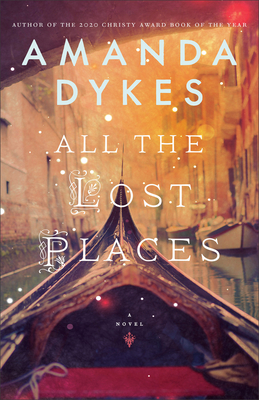
In All the Lost Places by Amanda Dykes, Daniel Goodman is a former thief in 1904 California who is trying to make restitution. He saves money from his lowly wages to repay those he robbed from. He has not seen his mother since he got out of prison: he feels he can’t face her until he has righted his wrongs.
When he hears that his mother may lose her home due to lack of finances, he looks for additional work. A seemingly chance encounter finds him interviewing with a man whose boss wants to make a “little Venice” in CA. At first Daniel applies just for physical labor. But upon finding out that someone is needed to translate one of Daniel’s favorite books and travel to Venice to sketch famous buildings, Daniel pushes hard for that role. His mother had come from Venice. She had sent him the book in question when he was in prison. He used to be able to draw–a head injury has left him unable to draw from memory any more, but he can draw something if he can see it.
The man is skeptical at first, but when Daniel draws a nearby building for him, the man agrees.
Daniel had kept himself pretty isolated after his prison confinement, so traveling and interacting with so many people is a strain on his nerves. He barely arrives in Venice when he literally runs into Vittoria, a bookseller. One of his tasks is to try to find the original copy of the book he’s supposed to translate, The Book of Waters. Daniel’s copy is one of only a few, which are all unfinished. It’s hoped that the original will have the closing chapters. He enlists Vittoria’s help to try to find the book.
As Daniel translates, he’s drawn into the story of Sebastien, who was put in a basket and floated toward an orphanage in Venice in 1807. Instead, a gondolier notices the basket, picks him up, and takes him to a guild of five artisans, who adopt him and train him in each of their skills. Though Sebastien loves his blended family, he wrestles all his life with his identity and purpose. One day, a woman washes up on the shore of the island Sebastien lives on, changing both their lives forever.
Sebastien’s story occurs when Napoleon had taken over Venice. Some Venetians planned that at some point, they would revolt and set up their Doge, or governor.
Sebastien and Daniel wrestle with some of the same questions. Though Daniel knows his origins, he can’t free himself from the guilt and losses of his past. Yet just as Venice was “the city that came from a swamp . . . a lost place that grew hope,” perhaps God can build something new and beautiful on the swampy places of a man’s life.
The Napoleonic era is one I know very little about, and I was glad to learn more of that time frame and Venice’s history. Amanda shares a lot of interesting details in in her end notes, including the fact that an Abbot Kinney really did build a “Venice of America” in CA in the early 1900s.
Some of the quotes that stood out to me:
Isn’t that the way of miracles? Something extraordinary because of the faithful ordinary (p. 53, Kindle version).
Found means someone was searching for you, running after you. You, the greatest treasure in all the world. That is what Trovato—Found—means. Sebastien Trovato, you are Found. Always and forever (p. 74).
Life had taught them hope was a dangerous and fragile thing . . . Faith sang a different song: hope was as necessary as breath, and so strong that it carried its own heartbeat (p. 115).
He dug instead for the tiniest slip of hope. And in doing so, hope became . . . purpose (p. 120).
Mosaic . . . it is the art of empty spaces. Broken things, harvested as treasure and pieced together into something entirely . . . different. Old, but new. Broken, but whole (p. 219).
“Do not be downcast, O your soul!’” He raised his face to the sun, reciting a psalm—or what sounded like one.
“Do you mean ‘O my soul’?”
“My soul is very happy in this moment. I mean your soul” (p. 249).
Perhaps you are becoming a new tool for a new work. God is not bound by the way things used to be (p. 254).
She stood before him, inches and a universe away, all at once (p. 285).
Amanda’s writings always touch the heart. This book took a little longer for me to get into than some of her others, but I loved how all the threads came together in the end.
(I often link up with some of these bloggers.)
 Stray Thoughts