My first encounter with Andrew Peterson’s music was when a friend put the music video for “Dancing in the Mine Fields” on Facebook. The song is sweet one about marriage, and the video features several older couple holding their wedding portraits.
Then when I read The Yearling by Marjorie Kinnan Rawlings, I loved it so much I looked up some background information about it. I discovered another music video of Andrew’s called “The Ballad of Jody Baxter,” Jody being the main character in The Yearling.
Those songs are folksy, but many of you might be familiar with a contemporary song of Andrew’s titled “Is He Worthy?” We sing this at church sometimes.
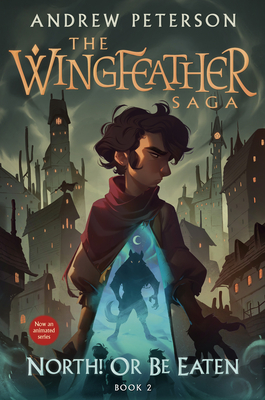
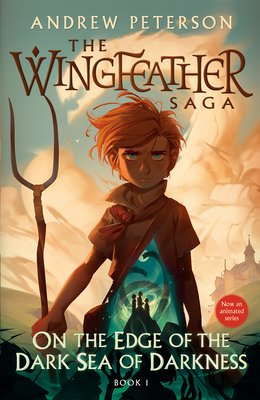
I knew that Andrew had written a series of fantasy novels for children called The Wingfeaher Saga. I have not read them yet, but I want to. I’ve heard good things about them.
And somewhere along the way, I learned that Andrew was instrumental in forming The Rabbit Room, a site dedicated to “Cultivating and curating story, music, and art to nourish Christ-centered communities for the life of the world.” I have read a few articles there.
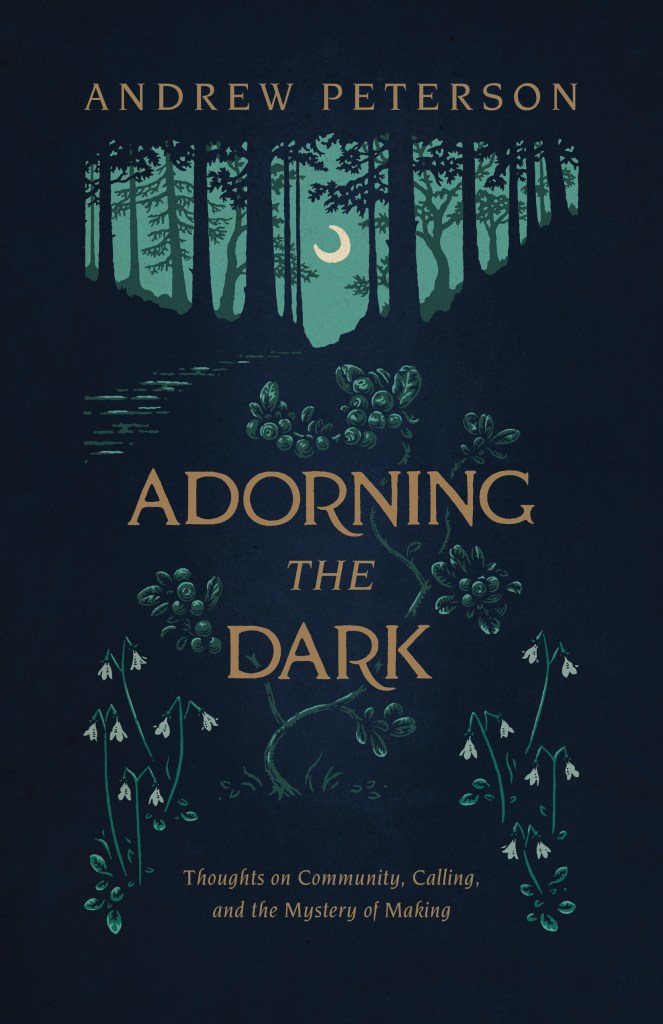
Even with that limited knowledge, I was interested when I saw Andrew’s Adorning the Dark: Thoughts on Community, Calling, and the Mystery of Making come up for a Kindle sale.
Andrew says he writes and speaks on this topic as “a practitioner, not an academic,” which means he “learned by doing, which is a nice way of saying that that I learned by doing it wrong half the time” (p. 4, Kindle version).
But not writing as an academic made the book extremely relatable. Andrew shares his journey, his testimony, and what he learned along he way.
Though he writes frequently of song-writing, many of of illustrations work for other kinds of writing and artistic expression as well.
In the first chapter, Andrew shares that many people know Bach wrote S. D. G., standing for Soli Deo Gloria (“glory to God alone”) on his manuscripts. But Andrew shares what few people know: that Bach also wrote “Jesu Juva,” Latin for “Jesus, help!” on his manuscripts as well. That’s an emphasis throughout the book. Andrew says is calling is “to use whatever gifts I’ve been given to tell the truth as beautifully as I can” (p. 4), and “to make known the heart of God” (p. 5).
He writes about battling self-doubt, creating as an act of worship, the fact that creating is work, not magic, that writing what we know doesn’t mean the polished end, but the struggle. He writes about humility, self-consciousness, and the fact that we don’t create to draw attention to ourselves even though “art is necessarily created by a Self” (p. 28). He references Lewis and Tolkien and others and talks about imagination, serving the work, and serving the audience.
One of the references to Lewis described his use of the word sehnsucht, an inconsolable longing which is evidence we were made for something more than we see and experience in this world.
One favorite section was about the tension between art and agenda and what makes Christian art Christian.
One great problem with much art that’s called “Christian” is agenda, which is to say that it’s either didactic, or manipulative, or merely pragmatic—in other words, the artistic purity of the work tends to take a back seat to the artist’s agenda (p. 47).
Art and agenda can and do coexist . . . Agenda is bad when it usurps the beauty. Christian art should strive for a marriage of the two, just as Christ is described as being “full of grace and truth” (John 1: 14). Truth without beauty can be a weapon; beauty without truth can be spineless. The two together are like lyric and melody (p. 47).
He describes revision, or selectivity, as “[pulling] the weeds before they choke the flowers” (p. 61) and being “able to discern what’s necessary to the aesthetic of the song and what isn’t. Then lose what isn’t” (p. 59). He points out that it takes forty gallon of maple sap to make one gallon of maple syrup. You wouldn’t put the sap on your pancakes. But once it’s boiled down, it’s perfect. On the other hand, “Revision is crucial . . . but it’s possible to monkey with something so much that the magic dies” (p. 99).
He writes that creating is not just inspiration, but also discernment and discipline—or dying to self.
He tells how art nourishes community and community nourishes art.
One of my favorite sections talks about how creativity isn’t just being “artsy.” We’re creative because we’re made in the Creator’s image. Andrew says the Rabbit Room’s conference, Hutchmoot, was meant to “encourage people to look for the glimmer of the gospel in all corners of life, that they would see their God-given creativity in both their artistic works and their front gardens, in their home repair and the making of their morning coffee, and that they would call out that glorious creativity in everyone they meet” (p. 89). His wife would “never claim to be an artist, but she’s one of the most creative people I know. Her song is our family” (p. 104).
I have multitudes of quotes marked besides what I’ve already shared. Here are a few:
Who do I think I am, anyway? We need not look anywhere but to the eyes of our Savior for our true identity, an identity which is profoundly complex, unfathomable, deep as the sea, and yet can be boiled down to one little word: beloved. That’s it. And that’s why it’s so silly (and perilous) to use your gifting to clothe yourself with meaning. Those clothes will never quite fit (p. 15).
Living as we do in dying bodies in a dying world, our best work always falls short of the initiating vision (p. 16).
If you wait until the conditions are perfect, you’ll never write a thing (p. 26).
Jesus, you’re the source of beauty: help us make something beautiful; Jesus, you’re the Word that was with God in the beginning, the Word that made all creation: give us words and be with us in this beginning of this creation; Jesus, you’re the light of the world: light our way into this mystery; Jesus, you love perfectly and with perfect humility: let this imperfect music bear your perfect love to every ear that hears it (p. 10).
The reintroduction of fairy tales to my redeemed imagination helped me to see the Maker, his Word, and the abounding human (but sometimes Spirit-commandeered) tales as interconnected. It was like holding the intricate crystal of Scripture up to the light, seeing it lovely and complete, then discovering on the sidewalk a spray of refracted colors. The colors aren’t Scripture, nor are they the light behind it. Rather, they’re an expression of the truth, born of the light beyond, framed by the prism of revelation, and given expression on solid ground (p. 41).
Somewhere out there, men and women with redeemed, integrated imaginations are sitting down to spin a tale that awakens, a tale that leaves the reader with a painful longing that points them home, a tale whose fictional beauty begets beauty in the present world and heralds the world to come. Someone out there is building a bridge so we can slip across to elf-land and smuggle back some of its light into this present darkness (p. 42).
The real flash of inspiration came not before they started working, but during the process (p. 47).
Keep working, keep straining toward a level of excellence that will most likely elude you forever, but it’s the only way your songs are ever going to move from bad to decent to good (p. 74)
Become a student of the craft. Have conversations with people whose insight dwarfs your own; they’ll teach you what to look for (p. 74).
Constraints are wonderful things, and lead you down paths you might not otherwise take (p. 99).
One holy way of mending the world is to sing, to write, to paint, to weave new worlds. Because the seed of your feeble-yet-faithful work fell to the ground, died, and rose again, what Christ has done through you will call forth praise from lonesome travelers long after your name is forgotten. They will know someone lived and loved here.
Whoever they were, they will think, they belonged to God. It’s clear that they believed the stories of Jesus were true, and it gave them a hope that made their lives beautiful in ways that will unfold for ages . . .
This is why the Enemy wants you to think you have no song to write, no story to tell, no painting to paint. He wants to quiet you. So sing. Let the Word by which the Creator made you fill your imagination, guide your pen, lead you from note to note until a melody is strung together like a glimmering constellation in the clear sky. Love the Lord your God, and love your neighbor, too, by making worlds and works of beauty that blanket the earth like flowers. Let your homesickness keep you always from spiritual slumber. Remember that it is in the fellowship of saints, of friends and family, that your gift will grow best, and will find its best expression (p. 98).
My only tiny quibble with the book is the title. Andrew speaks throughout the book of pushing back the darkness by shining light. To me, that sounds more accurate than adorning or decorating or enhancing the darkness.
Even though our tastes in music are different and I didn’t know many of the artists or songs Andrew referenced, I got so much from this book. I did add several of the books he mentioned to my want-to-read list. Parts of this book brought me to tears. But it also stirred my soul, fired my imagination, and left me with a burning desire to keep writing.
(I often link up with some of these bloggers.)

 Stray Thoughts