Review: Stop Asking Jesus Into Your Heart

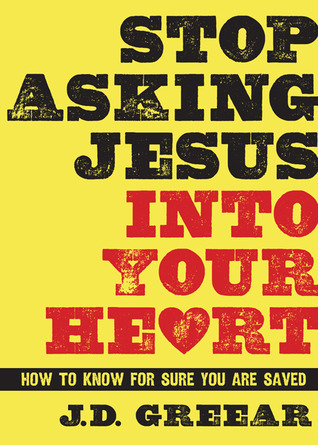
Stop Asking Jesus Into Your Heart

Perhaps you know someone who can’t seem to come to assurance that they are Christians.They’ve asked Him to save them several times, and feel content each time, but sooner or later, they question whether they really believed or repented, or did so the right way or “enough.”

Perhaps that person is you.

It was me for a couple of decades. I shared my struggle with assurance and how God helped me with it here.

Satan can trip people up over assurance because if we’re insecure about our salvation, we come to a standstill in our Christian growth. We don’t have the confidence to serve the Lord in any way. Instead of going forward in our Christian lives, we’re spinning our wheels over the same issues.

On the other hand, there is such a thing as false assurance. Jesus said there would be people who stand before Him some day, fully assured that they are all right spiritually. They’ll be shocked to hear Him say, “I never knew you; depart from me, you workers of lawlessness.”

So the stakes are high.

In Stop Asking Jesus Into Your Heart: How to Know For Sure You Are Saved, J. D. Greear says he might hold the “Guinness Book of World Records entry for ‘amount of times having prayed the sinner’s prayer.'” He shares his own testimony of struggles with assurance.

Then he explains that God truly wants us to have assurance. He shares what it means that Jesus died in our place and why we can trust Him, along with separate chapters on the nature of true faith and repentance. Another chapter discusses the seeming contradiction between Bible verses that say we will never lose our salvation with other verses that appear to indicate we can. The last two chapters cover evidences of salvation in 1 John and what to do with continued doubts. One appendix deals with whether one needs to be baptized again if they’ve made subsequent professions of faith after baptism. The second deals with the “indispensable link between assurance and the doctrine of justification by faith alone.”

At first glance, I thought this book was about reasons not to use the terminology of “asking Jesus into your heart” as a way of telling people how to be saved. Greear discusses this briefly, saying he thinks it can be used as long as the gospel has been fully understood.

Some of the quotes that stood out to me:

Salvation comes not because you prayed a prayer correctly, but because you have leaned the hopes of your soul on the finished work of Christ (Location 269, Kindle).

I can say with certainty that God wants you to have certainty about your salvation. He changes, encourages, and motivates us not by the uncertainty of fear, but by the security of love. That is one of the things that makes the gospel absolutely distinct from all other religious messages in the world (Location 295).

We don’t hope we are forgiven, we know it, because our standing before God has nothing to do with our worthiness, but the worthiness of the Advocate who now stands in our place (Location 551).

If you base your assurance on what you do or how well you do it, you’ll never find assurance. You’ll always be wondering if you are doing enough. If your assurance is based on what Christ has done, however, you can rest in His performance. Your salvation is as secure as His finished work (Location 654).

When we come to Jesus nothing can be off-limits. We cannot come with preconditions or limitations. To possess eternal life, we must be willing to let everything else go. We don’t approach Jesus to negotiate eternal life; we approach Him in total surrender. As C. S. Lewis famously said, “We don’t come to Him as bad people trying to become good people; we come as rebels to lay down our arms” (Location 887).

You don’t follow Jesus like you follow someone on Twitter, where you are free to take or leave their thoughts at your leisure. Following Jesus is not letting Him come into your life to be an influence, even if it’s a significant influence. Following Jesus means submitting to Him in all areas at all times regardless of whether you agree with what He says or not (Location 979).

If repentance were perfection, none of these people repented. Repentance, however, means recognizing Jesus’ authority and submitting to it, even though you know your heart is weak, divided, and pulled in conflicting directions. Repentance includes a plea for God to change your inconsistent, divided heart (Ps. 86: 11; Mark 9: 24) (Location 1019).

Greear writes pastorally, basing his answers firmly in Scripture but with everyday rather than academic language. I’ve not read him before, and I might disagree with a couple of his minor points. But overall I think this book was tremendously helpful both for those who have made a false profession and those who fear they might have.

Laudable Linkage

Here are some good reads found this week:

The Day I Told God No, HT to Challies. “I was free to say it, and free to live it, but I was not free to control the consequences of that one little word. There in my room I was sitting at a crossroads. I could continue with the “no”, or I could continue with God. I could not continue with both. If I wanted God in my life, I could only have him one way: as my King. He would not accept a position as my consultant.”

What If I Don’t Know When I Believed in Christ? HT to Challies. “I spiraled into a season of doubting my salvation in Christ. This severe doubt led me to sit in my pastor’s office where I heard an analogy from Spurgeon that continues to comfort me. And if you struggle with doubt and assurance, I trust this will aid you as it did me.”

How Do You Plan on Fighting Sin? HT to Challies. Each of us has besetting sins that we deal with constantly. This article has some good steps to consider and implement in fighting sin.

The Problem Is Your Worship, HT to Challies. “Your life may have you feeling stressed and burdened. You are surprised by feeling anxious over the smallest disruption in your schedule. A dark cloud of depression seems to consume your days. You try every problem-solving solution you know to shake the feelings of overwhelm and despair—better planning, networking, self-improvement classes, changing your diet and exercise, staying busy. The gripping fear that nothing is working has you running scared.”

Motherhood Isn’t Martyrdom, HT to Challies. “Many of our taglines overemphasize the pain of motherhood to the exclusion of the delight. We stress how being a mom is so hard, overwhelming, frustrating, and painful. If we’re not careful, we can begin to sound like we’re equating motherhood with martyrdom. But the Bible speaks of motherhood as a gift, a crown, and a joy.”

Your Short-Term Mission Trip Should Be About You (and That’s not a Bad Thing), HT to Challies. “I’m still a fan of short-term missions. This is not an anti-missions-trip article. Those are out there. This is not one of them. So why do I still encourage these trips? Because I believe God can use them to transform lives. Not necessarily the lives of the people you are serving. But your life? Yes!”

If a Vacation Is Worth Planning and Anticipating, How Much More Should We Anticipate Life in Heaven? Randy Alcorn: “There’s a great deal I don’t know, but one thing I do know is what people think about Heaven. And frankly, I’m alarmed.”

Sin has been pardoned at such a price that we cannot henceforth trifle with it. Spurgeon

Seven Words You Never Want to Hear

The Seven Words You Never Want to Hear that Denise Wilson writes about are from Jesus: “I never knew you; depart from me” (Matthew 7:23). Those are frightening words indeed. I struggled with them when I was unsure of my salvation. Thankfully, as Denise’s subtitle indicates, she doesn’t stop there: she tell How to Be Sure You Won’t hear those words.

Those words of Jesus occurred in what we call the Sermon on the Mount in Matthew 5-7. The full paragraph is as follows:

Not everyone who says to me, ‘Lord, Lord,’ will enter the kingdom of heaven, but the one who does the will of my Father who is in heaven. On that day many will say to me, ‘Lord, Lord, did we not prophesy in your name, and cast out demons in your name, and do many mighty works in your name?’ And then will I declare to them, ‘I never knew you; depart from me, you workers of lawlessness.’ (7:21-23).

It’s possible to “do many mighty works in your name” and yet still miss salvation, miss knowing Jesus personally.

Denise discusses several ways that could happen. One is praying “the sinner’s prayer” without faith or repentance. Another is growing up in a Christian atmosphere without ever believing on Christ personally. Or one could be deceived by the prosperity gospel or a works-based religion. Perhaps we haven’t counted the cost of discipleship and only wanted passage to heaven rather than a life of denying ourselves, taking up our cross, and following Him.

People might need to examine their hearts if they say they have been saved yet their life has not changed. We won’t be perfect after salvation. We’re forgiven and cleansed, but we still have an old nature and still need to grow. We’ll still battle with sin—yet if we’re not battling it, but letting it have full sway on our lives, something is amiss.

Denise points out that Jesus did not use a cookie-cutter approach in dealing with people. Years ago I attended classes where we were trained in how to lead someone to the Lord using the “Romans Road,” a series of verses in Romans that explain salvation. That approach is fine as far as it goes. But leading someone to the Lord is not just a matter of getting them to allow you to read them a handful of verses and then you getting them to pray. We need to be open to the Lord’s leading as we speak to people. Only He knows what obstacles to salvation are in their hearts.

Denise includes several testimonies from the Bible, from history, and from modern times. Some of them, she points out, don’t look like what we think salvation looks like. Take the thief on the cross next to Jesus. He knew he was guilty and Jesus was innocent. He asked, “Jesus, remember me when you come into your kingdom” (Luke 23:39-42). Was anyone else ever saved using those words? I don’t know. But one thing I learned in my own struggle was that becoming a Christian was not a matter of saying the “right” words, like a magic formula or an initiation rite. It’s a matter of repentance and faith in Jesus.

2 Corinthians 13:5 tells us to, “Examine yourselves, to see whether you are in the faith.” Denise provides helps to do that in this book.

Laudable Linkage

IMG_0195

Here are thought-provoking reads found recently.

Counseling for Those Struggling with Assurance.

Don’t Fall For It, HT to Challies. “Satan is clever. He’s happy to distract you with global disturbances while he chips away at the foundations of your devotion to Christ.”

Loving Difficult Neighbors Isn’t Optional, HT to Challies. “Imagine standing before God with this logic: ‘Yes Lord, they were made in your image and starved for gospel hope, but their dog’s barking always woke us up at 2 a.m., so we shut them out.'”

Taking on the Revolutionary Program of Ibram X. Kendi, HT to Challies. Several serious concerns about the book How To Be an Anti-Racist.

How to Lead and How to Follow. Applying the “Golden Rule” to both.

Catching Our Reflections in the Lives of Our Children, HT to The Story Warren. “What can we do when confronted with the sin of our children, sin that turns out to be ours as well? The discouragement can be crippling, preventing us from seeing any fruitful way forward. Even in the midst of this discouragement, God invites us to move forward in hope, pressing into the gospel of grace.”

Things to Do in November for Kids and Parents, HT to The Story Warren.

And finally, HT to Lisa:

Happy Saturday!

“Examine yourselves, to see whether you are in the faith”

Several days ago, many American Christians reeled with the news that a prominent pastor and author announced that he no longer considers himself a Christian.

Speculation and commentary abounds concerning what led to this declaration. Some have traced his history and pointed out problems with the movements he has been associated with. But no one really knows his heart.

When a person becomes a Christian, he is “born again” (John 3:3-21, I John 3:4-10). That’s one of many reasons that a Christian can’t lose his salvation. He can’t become unborn spiritually.

Christians can sometimes fall away from what they’ve been taught to varying degrees. That may be influenced by listening to false teaching, failing to grow in the Lord, neglecting His Word, bitterness, or any number of things.

But that’s a different thing from repudiating their profession of faith alltogether. When that happens, all we can conclude is that they were never genuine believers in the first place.

I hold out hope, as do others, that the man I mentioned has not truly walked away from God and his core beliefs but is instead just confused and out of fellowship. Hopefully with prayer, contemplation, and counsel, he can get things straightened out.

But I shared all of that to say this:

Whenever this kind of thing occurs, I can’t help but ask myself, “How did that happen?

Jesus said one day people will stand before Him who called Him Lord, prophesied, cast out demons, and did mighty works in His name, and yet He’ll have to tell them, “I never knew you; depart from me” (Matthew 7:21-23).

I can’t imagine a more tragic or frightening prospect. For years I feared every time I heard or read this passage. How did I know I won’t end up like these poor people?

When I asked this of a former pastor, he said that these folks all pointed to what they did. None of them said, “I came to Christ confessing my sin, repenting of it, and asking Him to be my Savior and Lord.”

That helped me a lot. But, since then, I have known people who made professions of having done this, yet fell away in later years. How does that happen?

I think perhaps for people who have grown up in a Christian culture, it’s easy to just go with the flow. They’ve heard it all their lives. It’s part of their thinking. Isobel Kuhn was like this. She says in her autobiography, By Searching: My Journey Through Doubt Into Faith, that when she went off to a secular college, she could have held a debate with anybody defending doctrines of the faith. But all it took was one professor saying, “Oh, you just believe that because your parents told you it was so” for her to realize he was right. She went off to gleefully live for herself, free from the restrictions she had grown up with. But God, in His mercy and grace, brought her to Himself.

Perhaps others did not grow up in a Christian culture, but weren’t adequately taught. Some I know responded to “positive peer pressure”–when all their friends were making professions, they figured they needed to get in on it, too. Or the person witnessing to them was so aggressive, they felt they dare not refuse to pray with the person. I’ve heard of many people who raised their hands in a church service, walked an aisle, prayed a prayer, yet did not consider themselves truly saved until later in life. Perhaps they weren’t taught well; perhaps they placed their trust in those acts rather than in Christ. But however it happened, they realized some time later that they were not believers and needed to be. Some had been professing Christians for years and were even pastors or pastor’s wives.

The Bible tells us to “Examine yourselves, to see whether you are in the faith. Test yourselves” (2 Corinthians 13:5).

The last thing I want to do is disturb the peace of genuine Christians. I lived nearly half my life unsure of my salvation, and that’s a miserable way to live. Just about the time I thought I had it settled, some new angle of doubt would creep in. I told more about that situation here.

But I’d dearly love to spare even one person from being told by Jesus, “I never knew you; depart from me.

For more information on how to become a Christian, see How to Know God.

Whoever has the Son has life; whoever does not have the Son of God does not have life.
 1 John 5:12

For God so loved the world, that he gave his only Son, that whoever believes in him should not perish but have eternal life. For God did not send his Son into the world to condemn the world, but in order that the world might be saved through him. Whoever believes in him is not condemned, but whoever does not believe is condemned already, because he has not believed in the name of the only Son of God. John 3:16-18

For the wages of sin is death, but the free gift of God is eternal life in Christ Jesus our Lord. Romans 6:23

(Sharing with Inspire Me Monday, Kingdom Bloggers, Tell His Story,
Purposeful Faith, Let’s Have Coffee, Anchored Abode,
Recharge Wednesday, Share a Link Wednesday,
Worth Beyond Rubies, Wise Woman, Stories of Hope,
Grace and Truth, Literary Musing Monday.
Linking does not imply 100% endorsement)

Book Review: Full Assurance

For several years I struggled with whether or not I was really a Christian. During that time we visited my mother-in-law’s home, and I discovered on her book shelves Full Assurance by H. A. Ironside. I borrowed it, and it helped me with one key point in particular.

Recently while looking for something else on my bookshelf, I came across this volume again (I guess that means I never gave it back – sorry, Mom!) I couldn’t remember much about it except for the one point that had helped me so much some 30 or so years before, so I decided to read through it again.

Ironside says in his introduction that he wrestled with assurance for a while himself, and he wanted to “make as plain as I possibly can just how any troubled soul may find settled peace with God” (p. 7). He said that “so many people who profess to want help along these lines are too indifferent to investigate,” but he wanted to appeal to “earnest seekers after truth” (p. 7). He assures that God cares about us and wants us to rest in His salvation.

In subsequent chapters he unpacks several verses that speak specifically of assurance, like Isaiah 32:17 (“And the work of righteousness shall be peace; and the effect of righteousness quietness and assurance for ever”) and Colossians 2:1-3 (especially verse 2: “That their hearts might be comforted, being knit together in love, and unto all riches of the full assurance of understanding“).

Then his longest chapter deals with “Difficulties Which Hinder Full Assurance” in the form of questions and answers, like “How can I be sure I have repented enough?” and “I do not feel fit to come to God” and “I don’t know if I can hold out.”

Ironside had been a preacher for almost 50 years at the time of this writing, and he deftly handles every issue from the Scriptures and shares several anecdotes to illustrate his points.

The point I mentioned having trouble with was whether I had repented “right” or “enough.” Forgive the long quote, but I wanted to share his whole answer here:

Very often the real difficulty arises from a misapprehension of the meaning of repentance. There is no salvation without repentance, but it is important to see exactly what is meant by this term. It should not be confused with penitence, which is sorrow for sin; nor with penance, which is an effort to make some satisfaction for sin; nor yet with reformation, which is turning from sin. Repentance is a change of attitude toward sin, toward self, and toward God. The original word (in the Greek Testament) literally means “a change of mind.” This is not a mere intellectual change of viewpoint, however. but a complete reversal of attitude.

Now test yourself in this way. You once lived in sin and loved it. Do you now desire deliverance from it? You were once self-confident and trusting in your own fancied goodness. Do you now judge yourself as a sinner before God? You once sought to hide from God and rebelled against His authority. Do you now look up to Him, desiring to know Him, and to yield yourself to Him? If you can honestly answer yes to these questions, you have repented. Your attitude is altogether different to what it once was.

You confess you are a sinner, unable to cleanse your own soul, and you are willing to be saved in God’s way. This is repentance. And remember, it is not the amount of repentance that counts: it is the fact that you turn from self to God that puts you in the place where His grace avails through Jesus Christ.

Strictly speaking, not one of us has ever repented enough. None of us has realized the enormity of our guilt as God sees it. But when we judge ourselves and trust the Saviour whom He has provided, we are saved through His merits. As recipients of His lovingkindness, repentance will be deepened and will continue day by day, as we learn more of His infinite worth and our own unworthiness (pp. 89-90).

One other point that I remember being struck with, though I can’t find now the specific place he discusses it, is from Hebrews 6:11-12: “And we desire that every one of you do shew the same diligence to the full assurance of hope unto the end: That ye be not slothful, but followers of them who through faith and patience inherit the promises.” Showing “diligence to full assurance” helped me understand that when we’re having problems along this line, we need to “be not slothful” but diligently seek God’s Word for the answers rather letting doubts and questions fester in the background for years.

I have many places marked in the book. Here are a few of the helpful, standout quotes:

It is well to remember that some vivid emotional experience is not a safe ground of assurance. It is the blood of Christ that makes us safe and the Word of God that makes us sure” (p. 29).

Faith is not the savior. Faith is the hand that lays hold of Him who does save. Therefore the folly of talking of weak faith as opposed to strong faith. The feeblest faith in Christ is saving faith. The strongest faith in self, or something other than Christ, is but a delusion and a snare, and will leave the soul at last unsaved and forever forlorn (p. 39).

Assurance is not based upon any emotional change, but whatever emotional experience there may be, it will be the result of accepting the testimony of the Lord given in the Scriptures. Faith rests on the naked Word of God. That Word believed gives full assurance (p. 45).

So long as a man considers himself worthy there is no salvation for him; but when, in repentance, he owns his unworthiness, there is immediate deliverance for him through faith in the Lord Jesus Christ. Without repentance the sinner is unable to believe unto salvation (pp. 91-92).

Many times Ironside counsels readers to study the Bible:

As soon as one knows he is saved, he should begin, in dependence upon the Holy Spirit, a careful regular, systematic study of the Word of God. The Bible is our Father’s letter to us, His redeemed children. We should value it as that which reveals His mind and indicates the way in which He would have us walk. ‘All Scripture is given by inspiration of God, and is profitable for doctrine, for reproof, for correction, for instruction in righteousness: that the man of God may be perfect, throughly furnished unto all good works” (II Tim. 3:16-17). The study of the Word will instruct me in the truth, it will show me what needs to be rectified in my life and walk, it will make clear how I may get right with God, and it will guide me in paths of uprightness. No Christian can afford to neglect his Bible. If he does, he will be stunted and dwarfed in his spiritual life, and he will be a prey to doubts and fears, and may be carried away by every wind of doctrine (p. 48).

Nothing will make up for lack of this diligent study of the Bible for yourself. You cannot get the full assurance of understanding without it. But as you search the Scriptures, you will find truth after truth unfolding in a wonderful way, so that doubts and questions will be banished and divinely given certainty will take their place (p. 50).

How necessary then for His redeemed ones to study His Word in dependence upon His Holy Spirit, that they may be delivered both from the fears that are a result of ignorance of His truth and pride that is a result of self-confidence. The liberating Word alone will give to the honest, yielded soul who searches it prayerfully, in order that it shall have sway over his life, the full assurance of understanding, for it is written: ‘The entrance of thy words giveth light; it giveth understanding unto the simple'” (p. 54).

There’s a very helpful section for those fearing they might not be “elect” or “predestined,” but it’s about three pages long, too long to share here. But one excerpt: “But what does the Word say? ‘Christ died for the ungodly.’ Are you ungodly? Then He died for you. Put in your claim and enter into peace” (p. 92).

I have seen this book listed by various titles just Full Assurance, or Full Assurance: How to Know You’re Saved; Full Assurance, or A Series of Messages for the Anxious Soul, and the author’s name sometimes listed as Harry A., most times as H. A. Ironside. I assume they are all basically the same book, but I don’t know whether there might have been some revisions between reprintings. The copy I have is from 1968, but it says it is a revised edition. If you look at Kindle versions, check the reviews first: one I came across said that several chapters were left out.

This book is an excellent resource especially for those who have wrestled with assurance of salvation or those who counsel such people, but it is also a good resource for those who want to learn more about what salvation is or for those who are already saved to understand and appreciate more what their salvation involves.

(Sharing with Semicolon‘s Saturday Review of Books, Literary Musing Monday, Inspire Me Monday ,Let’s Have Coffee, Carole’s Books You Loved)