
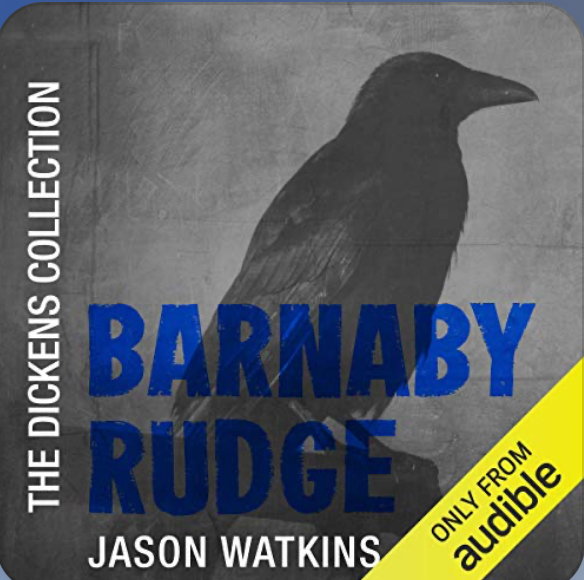
The title character in Charles Dickens’ Barnaby Rudge is a young man in his twenties with the mind of a five-year-old. He’s often called an “idiot” in the book–not in derision, but that was the main word they used at the time for someone with mental or processing deficiencies.
Barnaby lives with his widowed mother in a small village a few miles from London. His father had been the steward of Reuben Haredale, owner of a manor called the Warren. Both men were murdered twenty-two years before. The missing gardener was assumed to be the culprit. Locals still told the story of the murder, especially on the anniversary of it. Some say they see a ghost of one of the murdered men each year on that date.
Barnaby has a pet raven, Grip, who talks and interacts in the story in surprising ways. Dickens says Grip is based on two pet ravens he had. Wikipedia posits that Grip was the inspiration for Poe’s poem, “The Raven.”
Reuben Haredale’s brother, Geoffrey, now lives at the Warren with his orphaned niece, Emma, as her guardian. Emma is in love with Edward Chester, the son of Sir John Chester. But neither Geoffrey nor Sir John will agree to the match because of the disparity in each family’s financial situation, in their religion (the Haredales are Catholic, the Chesters Protestant), but mostly because the two men have been strong enemies since their school days.
Various people in the village, including Barnaby, have helped the young couple by delivering messages and aiding their rendezvous, but their guardians put a stop to it.
The Maypole is a tavern and inn in the village, run by John Willet. John’s son, Joe, feels oppressed by his father’s treating him like a child, especially in front of the clientele. He decides to run away and become a soldier. First he stops to confess his love to Dolly Varden, the locksmith’s daughter. But, though she likes him, she’s a flirt and doesn’t give him any encouragement.
Hugh is the gruff hostler at the Maypole inn. His mother had been hanged for stealing when her husband had been “pressed” into military service and some of their belongings has been seized for debts. Hugh was just a child when this happened and had a rough upbringing.
Lord George Gordon, head of the Protestant Association, comes through the village on his way to London. He’s protesting the Papists Act, which lessened in some degree discrimination against Catholics set in the Popery Act of 1698. Though Gordon is fictionalized in the novel, he was a real historical character who really did protest the Papists Act, which stirred up anti-Catholic sentiment and resulted in several days of riots, looting, burning of Catholic homes, storming Newgate prison, and threatening anyone who did business with or helped Catholics. Wikipedia says the rioting “was the most destructive in the history of London.”
The novel’s characters get caught up on opposite sides, resulting in tragedy or near-tragedy for some and the emergence of heroism in others.
Some years ago, I set myself a mission to read all the Dickens’ novels that I wasn’t familiar with. I had previously read A Tale of Two Cities (two or three times–my favorite), David Copperfield (second favorite), Great Expectations, and Oliver Twist. Barnaby Rudge was the last one I got to
Barnaby was one of his earliest novels written, but it was the fifth one published. It wasn’t a complete flop, but it didn’t sell nearly as well as his others. I think the lack of interest in it may have been because it was presented as a story about the Gordon Riots some sixty years after they happened. The subtitle of the book is A Tale of the Riots of Eighty. In fact, one reason this book is the last of his I read was that it did not sound at all exciting. It looks like it wasn’t thought to be exciting even in 1840. But I trusted that he would write a good, colorful, redemptive story. And he did.
Saying Barnaby is about the Gordon Riots is like saying A Tale of Two Cities is about the French Revolution. It is, but it’s more about the lives of Charles Darnay, Lucie Manette and her father, and Sydney Carton and how their lives intersect amid the happenings of the Revolution.
Barnaby Rudge is the same way. It’s not an encyclopedia entry. It shares the history of the times in the lives of mostly fictional characters.
It might seem strange that animosity against Catholics could grow into such monstrous rioting and pillaging. But England had fought wars in the past over Catholicism.
Dickens says in his introduction that he had “no sympathy with the Romish Church, although he acknowledges, as most men do, some esteemed friends among the followers of its creed.” He felt his descriptions were impartial. He definitely painted the rioters as villainous. He also says in his introduction:
It is unnecessary to say, that those shameful tumults, while they reflect indelible disgrace upon the time in which they occurred, and all who had act or part in them, teach a good lesson. That what we falsely call a religious cry is easily raised by men who have no religion, and who in their daily practice set at nought the commonest principles of right and wrong; that it is begotten of intolerance and persecution; that it is senseless, besotted, inveterate, and unmerciful; all History teaches us. But perhaps we do not know it in our hearts too well.
I’ve often marveled at riots in our own time. It seems incongruous that people mad about something in society would take it out on their neighbors who had no part in the situation, There’s a kind of madness in the midst of a wild mob. Then again, in this time as well as in Dickens’ not all the rioters and looters were acting for their cause. Some of Dickens’ characters didn’t care about religion at all–some were anti-authority of any kind, some thought it was fun, some just got caught up in the crowd, some were taking advantage of the situation for personal gain.
The riots are the main subject of the middle part of the book. Gordon isn’t even mentioned until about a third of the way through. The first third sets up the characters and situations mentioned, plus many others, and the last third tells the aftermath and wraps up the various threads.
I wondered why the book was named for Barnaby. Perhaps because of his innocence, perhaps because Dickens often brings to the forefront how society treats the poor and marginalized.
Dickens doesn’t say in his introduction which characters are based on real people except Gordon and the young woman who was hanged. He does say that “in the description of the principal outrages, reference has been had to the best authorities of that time, such as they are; and that the account given in this Tale, of all the main features of the Riots, is substantially correct.”
I enjoyed the book very much, despite being not very excited when I started it. It contains Dickens’ trademark humor and pathos along with an array of characters ranging from decent, salt-of-the-earth types, to quirky ones, to villains.
My favorite characters are Gabriel Varden (the locksmith) and Joe Willet.
I listened to the audiobook, marvelously read by Jason Watkins. He did such a good job not only with the sound of the different characters’ voices and accents, but with infusing their personalities in his voice. I also got the Kindle version for reference. You can find the Kindle versions for a lot of classics ranging from free to a couple of dollars.
 Stray Thoughts