Book Review: The Last Castle

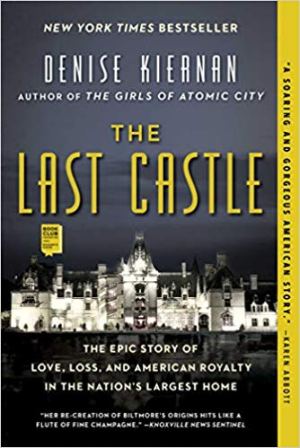
The Last Castle: The Epic Story of Love, Loss, and American Royalty in the Nation’s Largest Home by Denise Kiernan The Last Castle: The Epic Story of Love, Loss, and American Royalty in the Nation’s Largest Home by Denise Kiernan is about the Biltmore House in Asheville, NC, and the people involved with it. I wanted this book first of all because the Biltmore has been a favorite place to visit. But Denise’s previous book, The Girls of Atomic City, about the rising up of the Secret City of Oak Ridge, TN during WWII, was so well done and enjoyable, I knew she would do an equally good job with the Biltmore’s history.

George Washington Vanderbilt’s grandfather, Cornelius, made his fortune in the railroads. He also had Grand Central Station built. I was thankful I had read Mark Twain’s The Gilded Age last year, because that book covers this era. The old-family-money folks, the Four Hundred, as they were called, looked down on the new-money people like Cornelius Vanderbilt. Cornelius himself was rather rough around the edges.

But by George’s time, the family members were accepted in society. His two older brothers took over the family business, but George had no interest in it. He was introverted and liked reading, travel, and art. He kept record of the books he read and, as an adult, “averaged eighty-one books a year” (p. 126).

Diary entries from when George was thirteen years old reveal him to be a penitent, thoughtful young man: “I read my Bible this morning and began Isaiah and I think that was what made me feel so happy through the day. . . I have been reading a book this afternoon from which I ought to learn a very useful lesson of truth and gaining control over my temper, but I can do nothing without God’s help because if I rely on my own resolution I am sure to fail. . . . I don’t think I have spent today as I should have done. I have trusted too much in my own ability and not enough in Jesus (p. 12).

At age twenty-five, George visited the Asheville, NC, area with his mother, who was recovering from malaria. George himself did not have a robust constitution, and tuberculosis was a feared disease at the time. Asheville had several “breathing porches” for those wanting fresh mountain air. When George saw Mt. Pisgah, he fell in love with the area. It was common for prominent NY families to have summer homes, and George decided this was the place for his. He began quietly buying tracts of land.

Construction began in 1889. George hired famed architect Richard Morris Hunt to construct a home out of Indiana limestone to look like a French chateau. Frederick Law Olmsted , who constructed Central Park in NY, supervised the grounds. The land had been severely depleted, and Olmsted “was not impressed.” But he did a masterful job, considering not only what the landscape needed at the time, but how it would grow in the next hundred years.

George opened the home to family and friends in 1895, but it was far from finished. Construction went on for anther five years, but some parts of the house were still unfinished when George died.

George was still a bachelor until age thirty-five. I enjoyed hearing how George’s sisters encouraged one of his friends to arrange time for George and Edith Stuyvesant Dresser to have time alone together while on a ship to Paris. Edith was from one of the “four hundred” families, but both her parents had died and the family’s funds had greatly dwindled.

George and Edith were married in 1898. Their only child, Cornelia, was born in 1900.

Edith was the perfect choice for George’s wife and the lady of Biltmore. She “strode deftly between these two worlds, one of Victorian elegance, the other of rugged mountain simplicity. She may have appeared to live the life of the elite, but to those beyond the iron gates of the estate, Edith quickly emerged as one who was decidedly of the people” (p. 156).

George had plans for the estate to become self-sustaining. That didn’t happen for decades, but he started a dairy, was responsible for the first forestry school, and had several other plans for a working estate.

George and Edith were both involved in numerous charitable endeavors. George built a village for estate workers and funded the building, upkeep, and personnel of All Souls Episcopal Church. Edith not only provided funds but actively participated in several endeavors in the area.

Though George Vanderbilt was not a statesman, his contributions to history, culture, and forestry cannot be denied as he employed some of the greatest minds behind America’s civic, private, and untamed places. Though Edith was not the wife of a president, her tireless efforts in the community changed many a life; ensured the education of those with limited access to school, books, and teachers; and fostered craftsmanship and self-sufficiency (p. 302).

Sadly, George died fairly young, at age 51, after an appendectomy. The estate cost a great deal of money to keep up. Edith sold land to create the Pisgah National Forest, eventually sold off Biltmore Industries, and took various measures to preserve George’s dream.

In 1930, Cornelia and her then husband, John Cecil, opened the house to the public. It still took several years before the estate became truly self-sufficient and then started turning a profit. The Cecils divorced, with John staying in the bachelor’s wing of the estate and Cornelia selling out her portion. The house eventually came to George’s youngest grandson, William Cecil. George’s great-grandson was the current CEO at the time the book was written. Over time, the Cecil family added new features (a winery, inn, Antler Village, etc.).

The Biltmore is still privately owned. “Private ownership means that the estate receives no government grants, nor is it eligible for any associated not-for-profit tax breaks. Property and inheritance taxes remain a financial hurdle to be cleared” (p. 298).

The book goes on to tell what happened with each of the family members and many of their friends, the effects of the Depression, WWII (the Biltmore secretly stored art from Washington, DC, in case of attack on the capital), a record-setting destructive flood, and changes of times and tastes. If you’re familiar with Downton Abbey, one of the overarching themes of the show was the family’s adjustment to the major changes of the times. Those associated with the Biltmore faced these changes, too, from Gilded Age opulence to the Progressive Era and Arts and Crafts movement. “The artificial would soon give way to the natural; that which was of the elite, would soon be of the people” (p. 156). A caption under one picture of the house says, “No home in the United States has ever come close to beating the size of the 175,000-square-foot Biltmore House. But its greatest achievement may well be the fact that it has survived into the twenty-first century while other Gilded Age masterpieces have long since disappeared.”

There are so many other tidbits from the book I’d love to share (the effects of the estate on the area, a number of authors associated with Asheville, Cornelia’s life, the associations with the Grove Park Inn, which we have visited several times, and so much more.) But this post is quite long already.

I wish we could have gotten to know a bit more about the Vanderbilt family member’s personalities: Denise wished that, too, but there were not many diaries or personal letters to draw from.

My only small disappointment with the book is the cover. While the Biltmore is glorious at night, a daytime shot with the hills behind, the esplanade in front, and the grounds is so much prettier.

Denise has done tremendous amounts of research—there are over 50 pages of end notes. Yet she has managed to weave all this detail into a flowing and fascinating story.

One of the things I love about the Biltmore is that the whole house is a work of art. Every aspect was crafted with thought and taste. And, as Denise says:

Though it may be necessary to look past a sea of Bermuda shorts and ball caps and navigate legions of audio-tour zombies, a walk through the house today can transport you. . . . Walking the halls of Biltmore House for a day is a journey back in time (p. 297).

If you have an interest in the Biltmore House, the Vanderbilts, or this time in history, you’ll love The Last Castle.

(Sharing with Carole’s Books You Loved, Booknificent)


Book Review: Doctor Thorne

Doctor Thorne by Anthony TrollopeIn Anthony Trollope’s Doctor Thorne, the title character is a country doctor in a little English village. He had never married, but he had taken in his niece, Mary, when she was a child. She was the offspring of his ne’er-do-well brother and a girl in the village. His brother had been killed by the brother of the girl he seduced, and that girl, Mary’s mother, moved to America. Because Mary was with a caretaker and then away at school, by the time she came to Doctor Thorne’s home, no one made the connection between her and Thorne’s brother.

The leading family in the area were the Greshams of Greshamsbury. The squire and the doctor were good friends. Lady Gresham had come from a more highborn family and thus had lofty ideas of rank, birth, and privilege. Against her better judgment, she allowed Mary Thorne to come to her home to be taught with and to play with her daughters. Lady Gresham did not know Mary’s birth status, but even the niece of a country doctor was not the sort of person she would have preferred her children to be close to. But Mary was a good girl, and the squire in particular loved having her.

The Greshams had one son, Frank. By the time Frank came of age, his father’s debts had greatly reduced the estate. The only hope for the family’s financial survival was for Frank to marry money. But—Frank had fallen in love with Mary. He claimed he didn’t need the estate; he would learn a profession. His parents, his mother in particular, chalked his attitude up to immaturity and schemed to keep him and Mary apart.

Meanwhile, Roger Scatcherd, Mary’s unknown uncle who had killed her father, had served time for manslaughter. When he was released from prison, his skill and knowledge with railroads made him a lot of money. He eventually became a baronet. But now he was stuck between two classes. The lower classes with whom he would have formerly associated now saw him as above them. But the high society looked down on him as below them, even though he had more money than most of them. His besetting sin was drinking alcohol, which ruined his heath. Unfortunately, his son was following in his father’s footsteps.

Other subplots include Frank’s sisters’ romantic encounters, an election between Scatcherd and Frank’s sister’s beau, a wealthy and unconventional American girl who comes to visit, and an ongoing feud between Dr. Thorne and the elite doctors in nearby Barchester.

This book is the third in Trollope’s Chronicles of Barsetshire series. I haven’t read the other books in the series, or anything else by Trollope. I became aware of this story while looking for something to watch while riding my exercise bike. I discovered a series on Amazon Prime developed by Julian Fellowes of Downton Abbey fame. I enjoyed the series so much, I soon sought out the audiobook.

In Fellowes’ series, he introduces and closes each installment in a cozy wing chair by a fireplace. Trollope’s narration seemed to me to be in a similar style, as if he were sitting across from the reader while telling this story. I don’t know if that image was in my mind because of the series, or if Fellowes felt the same way about Trollope’s writing.

I love the way Trollope addresses the reader throughout the story.

As Dr Thorne is our hero—or I should rather say my hero, a privilege of selecting for themselves in this respect being left to all my readers—and as Miss Mary Thorne is to be our heroine, a point on which no choice whatsoever is left to any one, it is necessary that they shall be introduced and explained and described in a proper, formal manner. I quite feel that an apology is due for beginning a novel with two long dull chapters full of description. I am perfectly aware of the danger of such a course. In so doing I sin against the golden rule which requires us all to put our best foot foremost, the wisdom of which is fully recognised by novelists, myself among the number. It can hardly be expected that any one will consent to go through with a fiction that offers so little of allurement in its first pages; but twist it as I will I cannot do otherwise. I find that I cannot make poor Mr Gresham hem and haw and turn himself uneasily in his arm-chair in a natural manner till I have said why he is uneasy. I cannot bring in my doctor speaking his mind freely among the bigwigs till I have explained that it is in accordance with his usual character to do so. This is unartistic on my part, and shows want of imagination as well as want of skill. Whether or not I can atone for these faults by straightforward, simple, plain story-telling—that, indeed, is very doubtful.

Another favorite line:

What had he not done for her, that uncle of hers, who had been more loving to her than any father! How was he, too, to be paid? Paid, indeed! Love can only be paid in its own coin: it knows of no other legal tender.

As I watched the series, I felt it had elements of Jane Austen and Charles Dickens. The TV series was fairly predictable, but still enjoyable. The book, of course, is much more nuanced.

My only complaint is that there seemed to be a good bit of repetition: some of the same points of conversation seemed to come up several times, sometimes with the same people.

But overall, I loved the book and want to read the rest of the Chronicles of Barsetshire.

I listened to the audiobook superbly narrated by David Shaw-Parker.

Here’s a trailer for the TV series:

Have you read anything by Trollope? What did you think?

(Sharing with Carole’s Books You Loved, Booknificent)


Laura Ingalls Wilder Reading Challenge Wrap-up for 2020

The end of February closes the Laura Ingalls Wilder Reading Challenge. I hope you had fun with it, and I look forward to hearing about what you read!

A week from today I’ll use random.org to draw a name from the comments on this post to win either The Little House Cookbook compiled by Barbara M. Walker, Laura’s Album: A Remembrance Scrapbook of Laura Ingalls Wilder by William Anderson, The Little House Coloring Book, or a similarly-priced book related to Laura. A week should give some who are still reading time to finish up and post. You don’t have to have a blog to participate: you can tell us what you read in the comments here. If you have a blog, you can either let us know what you read in the comments or share the links back to any reviews or challenge-related posts from your blog or even from Goodreads if you review books there. Due to shipping costs, I’m afraid I can only ship to those in the US.

I only read one book this year: Old Town in the Green Groves by Cynthia Rylant about the two years Laura left out of the Little House Books.

Old Town in the Green Groves about Laura Lingalls Wilder's lost years
The book I had originally planned to read was actually about Little Women rather than Little House, so I’ll save it for Tarissa’s Louisa May Alcott Reading Challenge in June.

As I mentioned earlier this year, this will be the last Laura Ingalls Wilder Reading Challenge hosted here, for a number of reasons. Thanks so much to those who have participated at any point during the last nine years. I’ve thoroughly enjoyed delving into books by and about Laura, discussing them with you, and hearing what you’ve read.

Remember, leave a comment on this post about what you read or did for the challenge before Saturday of next week to be eligible for the drawing.

Update: The winner is Tarissa! Congratulations!

Book Review: Old Town in the Green Groves

Laura Ingalls Wilder originally wrote out the story of her life in Pioneer Girl. When that manuscript was rejected several times, acting upon suggestions from editors, Laura reframed her narrative into a story for children about a pioneer family traveling west (p. 31). She left out a year that the family traveled back east due to the grasshopper infestations that twice ruined their crops and hopes in Plum Creek, although she had told of it in Pioneer Girl. Pamela Smith’s Hill’s notes on this section in Pioneer Girl: The Annotated Autobiography says:

She deliberately chose not to depict this part of her family’s experiences in her fiction. “It is a story in itself,” Wilder explained to Lane in 1937, “but does not belong in the picture I am making of the [fictional Ingalls] family (LIW tp RWL, [Dec. 1937 or Jan. 1938], Box 13, file 193, Lane Papers). Moving the fictional family east and not west would have undermined Wilder’s optimistic portrait of their resilient pioneer spirit. Furthermore, her experiences in Burr Oak were more urban, gritty, even edgy. Although Wilder introduced some adult ideas and themes into her later novels, she waited until the fictional family had moved west once more into Dakota Territory, where her main character was a more mature adolescent. Wilder herself was just nine years old when the family moved to Burr Oak (p. 95, note 99).

I’ve seen some criticism of Laura for leaving out the events that take place in Burr Oak. But I would defend her decision for several reasons. Everything I have read about memoirs and autobiographies says you can’t share everything. She did include this era in her original autobiography. The Little House books were fictionalized, focusing on the life and progress of a pioneer family. The time in Burr Oak might have seemed a stop or even a setback to the action. Plus the family’s proximity to a saloon and the unsavory behavior they saw and heard might not have seemed suitable to an audience of children at the rime she was writing.

Old Town in the Green Groves about Laura Lingalls Wilder's lost yearsBut readers are curious about the “lost years” in the LH narrative. So Cynthia Rylant was asked to write what was known about the family’s story during this period in the style of the LH books. Her book is Old Town in the Green Groves.

The story begins back in Plum Creek, where the family contentedly moved from their winter rental house back to their farm. Baby brother Freddie was born. Ma was severely ill for a while, but recovered. Then the second wave of grasshoppers returned and destroyed everything growing. Pa declared he’d had enough of the “blasted country.” He had debts to pay, and the crop that would have paid them was ruined. Pa sold the farm to pay off the debts and lined up a job at a hotel in Burr Oak in Iowa.

On the way, the family stayed with their aunt and uncle and cousins, Peter and Eliza Ingalls and their children. They helped in various ways around the farm until ready to move on. Sadly, brother Freddie died there.

One chapter describes meeting with a kind beekeeper who was also planning to move since the bees couldn’t thrive without flowers. (Hill’s note on p. 96 of her book says Charles and this beekeeper kept in touch with each other for years).

When they arrived in Burr Oak, they lived above the hotel. Life was hectic: Ma helped with cooking and cleaning, and the girls all had to help, too. The saloon next door was loud, people were constantly coming in and out. Laura missed the quiet of her home and the prairie.

The book goes on to describe the various people they encountered and things that happened in Burr Oak before they decided to head west again.

I think Rylant did a good job. Just glancing over this section again in Pioneer Girl, I can see how Rylant took the narrative and fleshed it out. It’s more or less in the style of the LH books, but it’s not Laura: it couldn’t be.

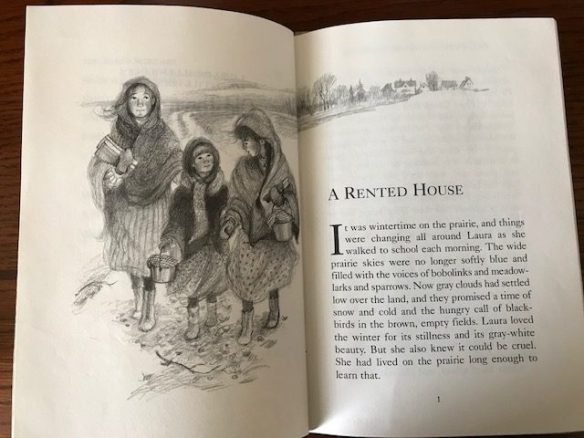
I was glad to see the illustrations by Jim LaMarche in my library copy were also similar to the Garth William’s illustrations of the Little House.books. Like the words, they were not quite the same, but they seemed a similar style and spirit.

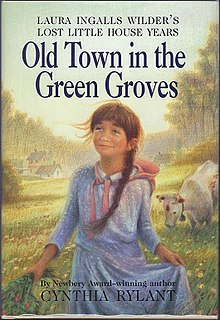
The book cover shown above is the one on my library copy. I’ve seen another illustrated cover here that makes Laura seem a little older and a photographed cover here that I didn’t care for at all.

I share my friend Ann‘s concern over the placement of the book on the back cover. The top says “Read all the Little House books.” The covers of all the books are shown, with this book set in-between On the Banks of Plum Creek and By the Shores of Silver Lake. I’m assuming this was done to show that the action in this book takes place between those two. But, as fine as this book is, I would regard it as supplemental and wouldn’t include it as part of the set or as one of the LH books.

Though this book describes some of the hard times the family went through, it also shares their resilience and hope. It’s a good story in its own right, but especially for fans of the Little House books.

(Sharing with Carole’s Books You Loved, Booknificent)

Book Review: The Words Between Us

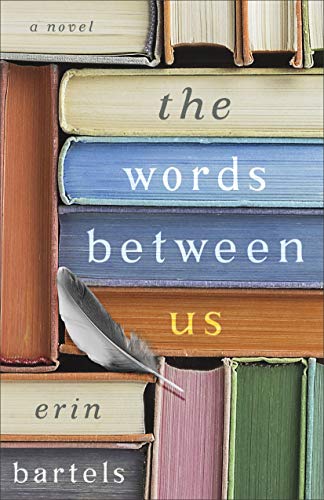
In Erin Bartels’ novel, The Words Between Us, Robin Dickinson is a loner who runs a used book shop in Michigan. Only her party-girl friend, Sarah, knows Robin’s real last name is Windsor and her father was a U. S. Senator tried and found guilty for murder and treason. Robin’s mother was implicated as well, and both parents have been in prison for eighteen years. Robin hasn’t seen either of them in all that time.

The book opens on the day Robin’s father is scheduled for execution. Robin just tries to get through the day and avoid the news when she gets a surprise package in the mail: a book from the only other person who knew her secret and betrayed her: Peter.

Robin had met Peter when she first moved to the area after her parents’ arrest to stay with her grandmother. He found out she liked to read. His mother had died a year ago and his father had boxed up all her books. Peter was reading them one by one in her honor. He offered to loan them to Robin, and she repaid him with a poem. They were heading toward a high school romance until a crisis resulted in Peter’s betrayal. Now, after having no contact in eighteen years, he sent her a copy of the first book he had loaned to her. Why? How did he know she was here?

The chapters alternate back and forth between “Then” and “Now” as Robin’s story unfolds.

In some ways, this is a story of how people survive excruciating pain. In others ways, it’s a story of judgments and misconceptions. Even when we think we have a “right” to our opinions about others, sometimes we’re wrong. It has elements of mystery and suspense. Ultimately, it’s a story about words and their effect, as the title says.

As the gorgeous cover indicates, there are a multitude of literary references.

Robin spends a lot of time thinking of the meaning of death, that indefinable something that’s missing life. Pondering a dissected frog and dead goldfish, Robin muses: “Always a body, but with something missing, something twisted out of order. It was that off bit that made me wonder. What was really missing other than breath? Because it wasn’t just that.” She notices that same absence in an old house. And later, she realizes even some books do not live:

Most of these books are not alive. They have not stood the passage of time.

They do not still burn in the hearts of those who have read them. It’s unlikely any of those readers could pull the names of the protagonists from memory. They are merely inert paper and ink, and I doubt very much they could live again.

I know why some books live on forever while others struggle for breath, forgotten on shelves and in basements. the authors . . . hadn’t bled. They hadn’t cut themselves open and given up a part of themselves that they would dearly miss. They hadn’t lost anything in the writing. That’s the difference between the books that I could never aptly explain to Dawt Pi and the ones I let The Professor [a parrot] shred. That’s the difference between the dead and the living.

Was that also what made a person or a bird or a frog alive? Was there a part of God’s heart that animated each otherwise insignificant part of the world? Had he given something up in creating me?

A couple of other quotes from the book:

Sometimes we’re handed adversity for our own good, so we’ll grow. Just because something’s hard doesn’t mean it’s not worth fighting for.

There are many types of quiet. The quiet when you first open a book and prepare yourself to enter a story. The quiet of the seed underground, waiting for spring. The quiet that follows the moment the past rips through time to invade the present.

I couldn’t remember who recommended this book to me, but I had thought it was Christian fiction. Yet I didn’t see much of anything connected to faith at first besides a couple of references, so I thought I was mistaken:

“God loves you, Robin. I pray for you—every day.” I can’t answer her without releasing the tears that are swiftly building up behind my eyes like a river behind a dam. I wish I was so sure that God looked at me with anything but fathomless disappointment.

Because of all the people I know, she’s the only one who has ever made me wonder if perhaps God must be real despite everything.

But by the end, Robin opens up to the possibility of faith in a God who loves her. So there’s a faith element, but it’s not heavy-handed.

I enjoyed Robin’s story and journey.

(Sharing with Carole’s Books You Loved, Booknificent)
 

Book Review: Hard Times

In Charles Dickens’ book, Hard Times, Thomas Gradgrind is a member of Parliament who also runs a school. His philosophy of education emphasizes pure fact: no fancy, no imagination, not even any morality. He discovers one poor student in the school Sissy, who can’t seem to learn her facts. When he goes to talk to her father, he discovers that her father had worked in the circus but has mysteriously left. So he offers to take Cissy in to help care for his near-invalid wife if she promises never to return to the circus.

Gradgrind’s own children have been raised according to his philosophy at home. Both his oldest two, Louisa and Tom, are rather bored. The implications of their education play out differently for each of them.

Gradgrind’s close friend, Josiah Bounderby, is a blustery self-made man who boasts of his rise from “street kid” to a successful banker. He eventually takes on Tom as an apprentice and married Louisa. Louisa has no love for Bounderby, but as her father presents the facts of the case, marriage seems reasonable.

In another area of town lives Stephen Blackpool, one of what Bounderby calls “hands”—common workmen. Stephen was 40, but “looked older, but he had had a hard life” with seemingly all thorns and no roses. “He was a good power-loom weaver, and a man of perfect integrity” though not particularly intelligent.

Eventually Stephen’s path crosses that of the other characters and reasons for his hard life become known. His refusal to go in with the unionists gets him in trouble with them and Bounderby. When he leaves to find work elsewhere, he’s framed for a bank robbery.

Usually when I start a classic novel, I get some background information about it first. I didn’t this time: I just let the story draw me in. I wondered who would advocate a “just facts” education and why. After reading the book, I learned that a philosophy called Utilitarianism was going around at the time. You can read more about it at Wikipedia if you’re interested. Louisa’s path follows that of the son of one of Utilitarianism’s advocates, who felt he was emotionally stunted as a result of his upbringing. Tom’s maturity and character was stunted, too, but in a different way. Perhaps it’s better to say he was more warped than stunted.

The two most highly moral, compassionate, and common-sense characters, Sissy and Stephen, were not raised in this philosophy, and eventually they show some of the others a different way. Some of the characters end up sadder but wiser, “making .. facts and figures subservient to Faith, Hope, and Charity.” Dickens almost portrays all the poor as virtuous and the rich and powerful as corrupt, but he makes the characters complicated enough that they don’t fall into stereotypes. As he often writes not only for social awareness, but for social change, he appeals to the reader that “It rests with you and me, whether, in our two fields of action, similar things shall be or not.”

This is the shortest of Dickens’ novels and the only one not to have any scenes in London. This is his tenth novel and, like most of his others, first appeared in serial form. He infuses the story with his characteristic humor, pathos, and memorable characters and descriptions and keeps the reader thinking long after the book ends.

I listened to the audiobook, nicely read by Peter Batchelor, and read parts on the Project Gutenberg copy online here.

(Sharing with Carole’s Books You Loved, Booknificent)
Book Review: Off the Clock

Laura Vanderkam’s subtitle for her book, Off the Clock, aptly sums up the book’s takeaway: Feel Less Busy While Getting More Done.

The title comes from that euphoric feeling we get when we clock out from work.

Laura’s curiosity was piqued when she started a phone interview with a busy executive with the promise that she wouldn’t take much of her time. Her interviewee responded that she had all the time in the world. Most people aren’t so open-ended or relaxed about other people’s requests for their time.

Laura conducted a time-perception study, asking people to keep records of how they spend their time and then asking them questions about how they felt about the time in question. The book refers back to these studies, pulls from other time management experts, and shares examples from the lives of everyday people “with full lives who nonetheless see time as abundant” (p. 16). Laura has not filled the pages with excessive, minute, rigid rules for a particular system: she groups her findings under seven broad categories.

The first is “Tend your garden.” Here she does ask readers to keep track of their time for two weeks (which I confess I have not done yet…).

Being off the clock implies time freedom, yet time freedom stems from time discipline. You must know where the time goes in order to transcend the ceaseless ticking (p. 4).

Such a record opens our eyes up how we really use our time as opposed to how we think we do. Laura thought she worked 50 hours a week. Her records showed that her work week was closer to 40 hours most of the time. So she had to figure out what happened to that other ten hours. Some tasks, like loading the dishwasher, seemed to take great chunks of time but actually only took a few minutes, relieving her dread of that task. As the title of this chapter implies, once we’re aware of how we actually use our time, we can make decisions and weed out anything not useful.

A second principle is “Make life memorable.” The days that feel lost are those where we do the same routines over and over. Vacations or special days make time seem fuller. We can’t vacation every day, so Laura encourages small steps to make memorable moments in our days: taking a different route to work, visiting an anticipated exhibit, talking to a new coworker or neighbor, etc. One interesting fact here is that our “anticipating self” and “remembering self” focus on the memorable aspects of our plans. The “experiencing self” in the present is the one to see the obstacles and talk itself out of anything new: It’s raining; The kids are fighting; I’d rather go home and watch TV.

Conscious fun takes effort. This seeming paradox—Why should fun be work?—stops us in our tracks. So we overindulge in effortless fun (scrolling through Instagram . . .) It is the effortful fun that makes today different, and makes today land in memory. You don’t say “Where did the time go?” when you remember where the time went (p. 75).

Principle three is “Don’t fill time.” Allow for some white space. “With every activity ask this question: What is my purpose here?” (p. 96). See what you can eliminate or consolidate.

Strategizing boosts efficiency; planning your toughest work for the time when you have the most energy means a task might take one hour instead of two (p. 93).

Four: “Linger.” “Find ways to savor the savor of time where [you] currently are” (p. 119). “Consciously lingering in a pleasurable downtime reminds us that we have downtime. And that can make us feel like we have more time than when we let it slip through our hands” (p. 134).

Five: “Invest in your happiness,” time, resources, and when possible, finances. That may mean moving closer to work to avoid a commute you hate, hiring a lawn service (or neighbor boy) if you don’t like yard work, etc. Treat yourself—not extravagantly, but with a few set-side moments to read a book, savoring your favorite beverage while watching the sunrise, etc. Do what’s most important first.

Feeling harried and rushed is associated with feeling like you lack the time for the things you want to do. Doing what matters first opens up the time (p. 150).

I’ll just mention the last two: “Let it go”—when your schedule doesn’t work out like you want, just do the best with what you have (neat story about an artist here) and “People are a good use of time.” That last statement is what attracted me most to the book and made me want to read it.

Laura expands on and illustrates these principles from real life. Besides benefiting from the quotes and principles mentioned, I appreciated that Laura dealt in common-sense broad principles rather than a rigid system and that her examples came from home and family as well as work and career. This is a great book for learning how to “feel less busy while getting more done.” Highly recommended.

(Sharing with Booknificent, Grace and Truth, Global Blogging, Senior Salon,
Hearth and Home, Literary Musing Monday, Happy Now, Carole’s Books You Loved)

Book Review and Giveaway: The Shop Keepers

The Shop Keepers by Nancy Moser is the third book in her Pattern Artist series. The first two books, The Pattern Artist and The Fashion Designer, tell the story of Annie Wood, who came from a difficult family background to become a maid to the Summerfield family of Nancy’s Manor House series. (Annie’s backstory in included in Christmas Stitches.) In the first two books, Annie had a knack for sewing and designing, but the other women in charge of that work took credit for hers. On a trip to America, Annie left her position and found a job first at Macy’s Department Store, then at the Butterick Pattern Company, then in her own dress shop. She met, fell in love, and married Sean Culver.

This third book takes place in New York in 1919, just after the first World War. Annie has two young daughters by now, but her husband has not returned from the war. He’s missing. Her shop, Unruffled, is not doing well. People had to buckle down during the war, and no one felt like buying fashionable yet practical clothes. The country is still in recovery mode. Most of the shop is decked out in black mourning dresses. One of Annie’s partners suggests they go into wedding dresses to help those who had been waiting for sweethearts to return. The prospect raises hope not only for new business but for a brighter shop and outlook.

At just the right time, a salesman from a local fabric shop offers them beautiful fabrics just right for weddings at deep discounts. Full of charm, he tempts the customers in Annie’s shop with his samples. This boon helps set the shop on a new, welcome trajectory. But something about this man bothers Annie, especially when he turns his charm her direction.

Henrietta, Annie’s bookkeeper and long-time friend. feel fortunate that her husband has returned home from the war. But he doesn’t seem totally back. He spends most of the day sitting in a chair looking out the window at the sky. She can’t seem to interest him in herself, their sons, or life in general.

Maude, who had been with Annie since her Butterick days, had married widower Antonio Ricci in the last book. Maude could not have children of her own, but welcomed Antonio’s two children. Now the oldest, Gela, is an independent-minded teenager who finds an unexpected talent. Maude is concerned where Gela’s gifts will take her in her naivete, especially when an unsavory character from Maude’s past comes on the scene.

It took me just a little bit to remember who the characters were and their backgrounds. This book could be read as a stand-alone, but I think it would be a much richer experience for those who have read the first two books.

I enjoyed this book for several reasons. I’ve often read books set during the world wars, but the time of adjustment after after WWI is a fascinating era that few focus on. There were threads of intrigue with the salesman, the man from Maude’s past, and a seeming presence in the shop workroom. Henrietta’s husband’s condition, Annie’s missing husband, and Maude’s concerns lent strands of pathos. Those were woven together with needs for forgiveness, patience, hope. I always enjoy Nancy’s afterwords with details that went her story, historical elements that were true, etc. And I love the book cover.

Once again, I found myself with both a paperback and Kindle copy of this book. I read the Kindle version, and I’d like to give the paper copy away to one of you. Just leave a comment on this post if you are interested in being part of the drawing for this book. (I’ll take all comments on this post as entries unless you let me know you’re not interested.) I’ll draw a name a week from today. I’m sorry, due to shipping costs I can only send the book to US addresses.

Have you read much from the post-WWI era?

(Sharing with Worth Beyond Rubies, Carole’s Books You Loved, Booknificent)
The giveaway is closed: the winner is Linda!

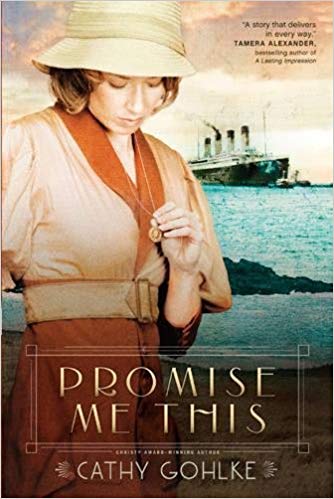
Book Review: Promise Me This

In the novel Promise Me This by Cathy Gohlke, Owen and Annie Allen have been raised by their manipulative Aunt Eleanor in England ever since their parents died. Now Owen has trained himself as a gardener and is about to set off for a new life in New Jersey with their aunt and uncle on their father’s side. He can’t take Annie with him yet, which makes her furious. But he removes her from Aunt Eleanor’s house to a school until he can send for her.

As Owen gets ready to sail on the Titanic in a week, he meets a young street kid, Michael Dunnagan. Owen has compassion on him, shares his food, and gives him odd jobs until time to leave.

Michael picks up another job making deliveries to the Titanic. He muses that in a ship that size, he could hide away and escape from his abusive uncle.

Within just a few days at sea, Owen discovers Michael and takes him into his quarters. He shares his food as well as his plans and dreams to start a new life in New Jersey and send for Annie as soon as possible.

Then comes the fateful night the Titanic hits the iceberg. Owen sends Michael off with the women and children and wraps him in the jacket where he had sewn his precious seedling samples in the lining. Michael fights with everything he has to stay with Owen, but Owen insists and bodily pushes Michael to safety.

After a series of events, Michael finds his way to Owen’s aunt in New Jersey and tells her all that has happened. She takes him in and tells him about the trouble she faces which Owen had not yet heard. In their grief, they decide to try to make a go of Owen’s plans. Michael is determined to bring Annie home.

Annie is devastated, angry, and bitter, not only that Owen died, but that Michael lived instead. Back in Aunt Eleanor’s clutches, Annie finds herself responding in kind and becoming more like her.

When Michael first writes to Annie, she sends the letter back. But soon a tentative friendship begins. Annie trains as a nurse while she waits to go to NJ. And then WWI breaks out.

My thoughts:

When I reviewed Cathy’s Saving Amelie, which became one of my top ten books of last year, I mentioned wanting to read more of Cathy’s books. A couple of people mentioned this story. When I discovered it was partially based on the Titanic, I planned to start it in conjunction with our visit to the Titanic museum.The book did enhance my visit and vice versa.

Cathy mentions in her afterword that there was a Titanic passenger named Owen Allum who was a gardener, but not much else was known about him. I enjoyed reading how she created his and Annie’s stories and what influenced her.

The Titanic section is just the first part of the book, however. I loved the example of laying down one’s life for another as Owen did. And then Michael and Annie each had to learn what it meant to love others and to receive love.

Some of my favorite quotes:

No matter what pain, what hard things come to us in life—and pain and trouble come to all of us—no matter what dark roads we walk or poor choices we make, it is not the end of the story.

It’s no good being fearful. Worry won’t change the future a whit, and it misses the joy of this glad day.

Each morning, when we wake—if we wake—we pick up whatever it is we’ve been given to carry for that day, with the sweet Lord Jesus in the yoke beside us to tote the load. Each night we lay it down, giving it into God’s hands. If it’s still there in the morning, we pick it up and begin again. If the burden is gone or if there is something different, we know where to start.

“Growing is a patient thing, lad,” Daniel explained. “You must give all living things time to adjust to their new surroundings, their new soil, then time to grow, as well.”

Does your hate make you happy, my dear, or does it continually eat through you, a cancer of its own making? Does the constant fueling of that angry fire not exhaust you and take away from living the wonderful life you’ve been given?

I loved the characters (including some not mentioned here) and the story. I loved how Cathy pulled us in to empathize with them in their anger, pain, and hope. Highly recommended.

(Sharing with Global Blogging, Senior Salon, Carole’s Books You Loved, Booknificent)

January-March 2020 Reading List

Years ago, someone who is no longer blogging used to host a “Fall Into Reading” and “Spring Reading Fling,” where participants would share what they planned to read for the next few months and then come back and share what they actually did read. I always enjoyed reading those and added to my TBR list exponentially.

Susanne misses those posts, too, and has decided to start up an informal quarterly reading list sign-up. I thought this might be a good way to break up my larger reading plans into smaller goals. You can find more information here and join in here, if you’d like.

Planning for the month or the quarter just involves looking through the unread books on my shelves, in my Kindle app, and in my audiobook library and deciding which I want to read next. It helps condense the reading decision time by doing it this way rather than every time I finish one book and look for another.

My two biggest challenges are the Back to the Classics Challenge and then two others that focus on reading books we already own (Mount TBR) or have had on our reading list a while.

For classics:

  • I’m currently listening to The Merry Adventures of Robin Hood by Howard Pyle.
  • Hard Times by Charles Dickens
  • I might start Larkrise to Candleford by Flora Thompson next. My copy has three volumes in one, so it’s rather large. But I have also been wanting to watch the series based on these stories as well, and want to read the books first.

I’ll be hosting my last Laura Ingalls Wilder Reading Challenge Feb. 1-29 and will share on Feb. 1 what I am reading for that challenge. I have one book on hand and am considering another.

From my current stash:

I just finished Panosian: A Story of God’s Gracious Providence by Chris Anderson. Next are:

Nonfiction:

  • Good Tidings of Great Joy: A Collection of Christmas Sermons by Charles Spurgeon (currently reading)
  • Off the Clock: Feel Less Busy While Getting More Done by Laura Vanderkam (currently reading).
  • The Last Castle: The Epic Story of Love, Loss, and American Royalty in the Nation’s Largest Home by Denise Kiernan about the Biltmore House. I loved what she did with The Girls of Atomic City, so I’m eagerly looking forward to this book.
  • Anne Morrow Lindbergh: Her Life by Susan Hertog

Fiction:

  • Promise Me This by Cathy Gohlke, a novel involving a couple of people on the Titanic, one who survived and one who did not, and those who wished the results had been reversed (currently reading).
  • The Space Between Words by Michele Phoenix
  • The Shopkeepers by Nancy Moser, a sequel to The Pattern Artist and The Fashion Designer, novels about a young women going into those professions in the early 1900s.
  • Castle on the Rise by Kristy Cambron, sequel to The Lost Castle, a novel involving three different timelines touching an old castle.
  • The One True Love of Alice Ann by Eva Marie Everson, a novel set in 1940s Georgia about a girl waiting for the one she loves to come home from WWII.

Those should keep me busy for a while! I’m looking forward to all of them. I probably won’t finish them all this quarter, but whatever I don’t finish will just go on next quarter’s list.

What’s on your reading horizon?

(Sharing with Susanne, Global Blogging, Senior Salon, Hearth and Soul, Happy Now, InstaEncouragement)