Review: The Cricket on the Hearth

CricketThe Cricket on the Hearth: A Fairy Tale of Home is a novella by Charles Dickens, one of his five Christmas books. It’s one of the few where he does not engage in social commentary.

It’s the story of John Peerybingle, a carrier (someone who transports goods for others) and his wife, Dot. They live in a modest home with their baby and the baby’s nanny, Tilly Slowboy. They are good friends with Caleb Plummer and his blind daughter, Bertha, who both work by making toys for the Scroogish Mr. Tackleton to sell. Mr. Tackleton has somehow gotten a young friend of the group, May, to agree to marry him, though she has admitted to him that she does not love him and she still pines for Edward, Caleb’s son who is thought to have died in South America.

The story opens with John coming home to a scene of domestic tranquility, complete with a cricket on the hearth which Dot regards with special affection because she first heard it the night John brought his young wife home and  “It seemed so full of promise and encouragement. It seemed to say, you would be kind and gentle with me.” It’s “music” has cheered and encouraged her many a time, and she comments, “This has been a happy home, John; and I love the Cricket for its sake!”

John has brought home an elderly gentlemen whom he had picked up in his work, but those who were supposed to retrieve him did not come for him. They make him feel at home for the time being.

There are various comings and goings and discussion with and about their friends, particularly the upcoming wedding between Mr. Tackleton and May. In one conversation between John and Tacklelton,

“Bah! what’s home?” cried Tackleton. “Four walls and a ceiling! (why don’t you kill that Cricket? I would! I always do. I hate their noise.) There are four walls and a ceiling at my house. Come to me!”

“You kill your Crickets, eh?” said John.

“Scrunch ’em, sir,” returned the other, setting his heel heavily on the floor.

Everyone is invited to a pre-wedding celebration, and at one point there, Tackleton shows John a scene through a window where the elderly visitor takes off his wig, is revealed to be quite young, and interacts with Dot very familiarly. Tackleton assumes Dot is being unfaithful. John is at first quite angry and thinks murderous thoughts against the imposter, but the cricket somehow turns into a sort of a fairy and reminds him of all Dot’s good qualities. John decides that in his love for Dot, the best thing he can do is release her to marry the person she actually loves.

But, as you can guess, Dot is not being at all unfaithful or untrue. As to what is really going on and who the stranger is, I’ll leave for you to find out in the book.

I do like Dickens, and I have enjoyed listening to audiobooks of his works that I am already familiar with, but I am finding that when I listen to an audiobook of one of his books I haven’t read before, it takes me a very long time to get into them. It usually takes him a while to get through the characterizations and set-up, and my mind tends to wander in that part until he actually gets going with the story. But I enjoyed going back through the online version. So I don’t know if Dickens (at least unread Dickens) is better read rather than listened to, or if I just get more out of him the second time through a story rather than the first. I don’t think the narrator helped this version much, so that contributed as well. I didn’t enjoy the story much at the beginning, but by the end I thought it was very sweet, and enjoyed it much more going over it again. I especially liked what Dot said at the end of explaining to her husband what was going on:

“Now, my dear husband, take me to your heart again! That’s my home, John; and never, never think of sending me to any other!”

(This will also be linked to Semicolon‘s Saturday Review of Books.)

Back to the Classics Challenge Wrap-up

classics2014Karen at Books and Chocolate hosted the Back to the Classics Challenge this year, where we could choose to read and review classics that fit in certain categories, with drawings for prizes at the end of the year. There are some required categories and some optional categories, and, thankfully, I was able to finish them all. I will link each title back to my review.

Required:

  1. A 20th Century Classic: My Man Jeeves by P. D. Wodehouse
  2. A 19th Century Classic: Bleak House by Charles Dickens
  3. A Classic by a Woman Author: The Blue Castle by L. M. Montgomery
  4. A Classic in Translation  (A book originally written in a different language from your own.) The Brothers Karamazov by Dostoyevsky.
  5. A Classic About War  The Scarlet Pimpernel by Baroness Orczy.
  6. A Classic by an Author Who Is New To You: The Woman in White by Wilkie Collins
Optional Categories:
  1. An American Classic: Farmer Boy by Laura Ingalls Wilder
  2. A Classic Mystery, Suspense or Thriller:  A Study in Scarlet by Arthur Conan Doyle, the first Sherlock Holmes book
  3. A Historical Fiction Classic: I will Repay by Baroness Orzcy, part of The Scarlet Pimpernel series.
  4. A Classic That’s Been Adapted Into a Movie or TV Series: To Kill a Mockingbird by Harper Lee.
  5. Extra Fun Category:  Write a Review of the Movie or TV Series adapted from Optional Category #4: To Kill a Mockingbird

Karen asks us to “Please remember to indicate within your post how many entries you have earned for the prize drawing.  You earn one entry for completing the six required categories, an additional entry for completing three of the optional categories; complete all five optional entries, and you receive two additional entries for completing all of the optional categories. The most entries one person can earn is three. ” Since I completed all of the required and optional categories, I have three entries.

I did not grow up reading a lot of classics, so I have purposefully tried to incorporate a few classics into my reading the last few years. This challenge was a fun way to do that. I had pretty much decided not to do it next year, however, just because I had been involved in too many challenges this past year and felt a little constricted and constrained. But Karen changed the format for the Back to the Classics Challenge 2015: this time there are twelve categories of classics but we have the choice of reading from whichever category we want, with a minimum of six required to enter for a $30 Amazon prize, and more entries are earned at different reading levels. So I think perhaps I will join in after all, but I’m going to wait til after Christmas to decide whether to and which classics to read if I do.

Book Review: To Kill a Mockingbird

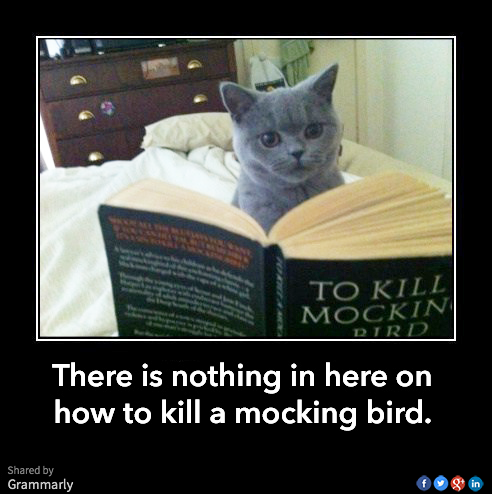
Despite its title, you won’t find anything like this in To Kill a Mockingbird by Harper Lee.
mockingbird

🙂 I’ll forewarn you that I will probably say more about the plot than I usually do. I don’t like to reveal key details in a review, but since I read this one this time in connection with Carrie’s  Reading to Know Classics Book Club, this discussion will involve others who have already read it, plus I am still processing some parts of it. But whatever I share about it, I will try not to spill all the major beans, and there will be much to discover if you do go on and read the book.

Published in 1960, To Kill a Mockingbird is set in the early 30s in a small Alabama town called Maycomb. The story is told through the eyes of Jean Louise Finch, known as Scout, who is six years old as the novel opens. She lives with her older brother, Jem, short for Jeremy, and her widowed father, Atticus, a lawyer. The first part of the book evokes a realistic feel of growing up in a sleepy Southern town. Jem and Scout and their friend, Dill, who comes to visit his aunt in Maycomb each summer, spend a great deal of their time trying to devise a way to get their reclusive neighbor, Arthur Radley, known as Boo, to come out. They meet with no success and get themselves in trouble over their escapades more than once. In these early scenes we get a picture of Scout, smart but bored at a school that scolds her for learning to read at home, Jem’s maturing into a young man, Atticus, who seems detached as a parent sometimes, but shows a depth of wisdom and integrity in handling his work, his life, and his children, and an overview of the citizenship of Maycomb.

There is something of a caste system in the South of this time, with “old” families concerned about their history and standing, to poor but decent folks, to uneducated “trash” who live near the dump. Then there are the Negroes or colored folks, as they are called in the book. There are varying degrees of feelings toward the colored people, with, sadly, most of the townsfolk considering them at least a race apart if not a race beneath. Atticus seems to be one of the few who believes that all people need to be treated with decency and respect no matter what their race.

The children get an inkling that their world is about to shift when they start getting taunted for their father being an “n-lover.” Scout is a scrappy tomboy and her first instinct in any confrontation is to answer with her fists. But her father asks her to refrain from fighting about this issue. The children learn that their father has been appointed the defense attorney for Tom Robinson, a black man accused of raping a white woman. Most of the town thinks, at the very least, that it is not a good idea, and some are quite caustic about it, even to the children (which is low-down and dirty in my opinion.)

Tension builds until the day of the trial. Scout, Jem, and Dill sneak in to watch, and there is no room in the courthouse except in the colored section of the balcony, which welcomes them. Lee deftly handles the details of the case even though her narrator doesn’t really understand what rape is. The evidence is only circumstantial, and Atticus brings out the fact that the alleged victim, Mayella Ewell, has flirted with and lured Tom into her home, and since no one took her to a doctor, there is no proof that a sexual assault occurred. Tom insists that none did. But even though Jem is sure they’ve won the case, the jury returns a guilty verdict.

Though the verdict went the Ewell’s way, Mr. Ewell is angry with Atticus for “destroying his credibility” and threatens to “get” Atticus if it is the last thing he does.

There were many things that stood out to me in this book. One was how Atticus tried to prepare his children for the trouble to come. He didn’t want them to fuss about it nor to think ill of their friends who might say unkind things. When asked why he took the case when the townspeople and even his own relatives think ill of him for it, he says things like he couldn’t live with himself, couldn’t go to church, couldn’t ask his children to obey him if he didn’t. It was the right thing to do, and his conscience would smite him if he didn’t. The children don’t learn until the court day that Atticus was appointed to the case. Scout says it would have saved them many fights if they could have defended him with that piece of information. It says a lot about Atticus that he did not use that fact to defend himself.

Another was how often innocence saw truth. When Scout hears her teacher at the courthouse saying this trial will “teach ’em a lesson, they were gettin’ way above themselves,” she wonders how her teacher can hate Hitler and feel sorry for the Jews in Europe in their classroom and “then turn around and be ugly about folks right at home.” “It’s not right to persecute anybody, is it? I mean have mean thoughts about anybody, even, is it?” It’s Scout innocently talking with one of her neighbors about his son at school that halts an angry mob, unbeknownst to her at first. It’s Dill who gets upset and sick at the courthouse over how the prosecuting attorney is treating Tom on the stand.

I appreciated how the children’s view of their father changes throughout the book. They love him, but compared to other fathers, he is “old,” doesn’t play football, doesn’t have an interesting job, and reads all the time. Their neighbor, Miss Maudie, helps them understand him a bit better, finding out he is a crack shot helps immensely, and the course of events eventually helps them to see him for the man that he is.

One of the most poignant parts of the book for me was when Scout was helping her Aunt Alexandra (who throughout the book tries to make Scout into a lady) at a ladies’ missionary meeting. There are poor examples of womanhood, such as when some of the women say embarrassing things to Scout for a laugh and when others gossip or others laud the heart of missionaries in other countries but fail to acknowledge needs in their own county. When Atticus comes in with bad news about Tom and asks his colored cook to go with him to Tom’s wife, Scout, Miss Maudie, and Scout are shaken. But they don’t want to let the ladies know what has happened, so they put on a brave face and go back out and serve refreshments. Aunt Alexandra smiles at Scout, who thinks to herself, “If Aunty could be a lady at a time like this, so could I.” That contrast between real womanhood and the silliness of so many, and Scout’s realization of it, just spoke volumes to me.

So what does a mockingbird have to do with all of this? When the children are given air rifles one Christmas, Atticus tells them they can “shoot all the bluejays you want, if you can hit ’em, but remember it’s a sin to kill a mockingbird.” Miss Maudie explains to Scout that mockingbirds don’t do people any harm, but they “sing their hearts out for us.” This metaphor of it being a sin to harm the innocent comes up throughout the book, especially beautifully near the end when Scout realizes its meaning and applies it to Boo Radley as well.

Miss Maudie tells the children after the trial,  “Atticus Finch won’t win, he can’t win, but he’s the only man in these parts who can keep a jury out so long in a case like this…We’re making a step – it’s just a baby step, but it’s a step.” Though the battle in this case was lost, there was much that happened that made it a baby step in the right direction. Race relations in this country are still not what they should be, but they’re a far cry from what they were in this time period, mostly due to individual steps along the way, some large and some small. I don’t know if massive cultural changes can be made by a revolution: I think they often come through slow change, through individual men and women standing up and doing the right thing within their sphere of influence.

Some quotes that especially stood out:

Atticus to Scout: “You never really understand a person until you consider things from his point of view…until you climb into his skin and walk around in it.”

Miss Maudie (a neighbor) to Scout: “Atticus Finch is the same in his house as he is in the public streets.”

Scout: “Atticus, are we going to win it?”

“No, Honey.”

“Then, why – “

“Simply because we were licked a hundred years before we started is no reason for us not to try to win.”

When Atticus tries to explain to Scout that “n-lover” is a term that “ignorant, trashy people use,” she ask, “You’re not rely one, then, are you?” He replies, “I certainly am. I do my best to love everybody.”

When Scout and Jem are asked to visit the crusty Mrs. DuBose, unaware that in her dying days she is trying to come out of a morphine addiction brought on my treatment of her illness: “I wanted you to see what real courage is, instead of getting the idea that courage is a man with a gun in his hand. It’s when you know you’re licked before you begin but you begin anyway and you see it through no matter what. You rarely win, but sometimes you do.”

Miss Maudie to the children: “There are some men in this world who are born to do our unpleasant jobs for us. Your father’s one of them…We’re so rarely called upon to be Christians, but when we are, we’ve got men like Atticus to go for us.”

Miss Maudie to Aunt Alexandra: “Whether Maycomb knows it or not, we’re paying the highest tribute we can pay a man. We trust him to do right…The handful of people in this town who say that fair play is not marked White Only; the handful of people who say a fair trial is for everybody, not just us.”

When Scout comments that a boy who was thought to have done certain misdeeds hadn’t and was actually “real nice,” Atticus replies: “Most people are, Scout, when you finally see them.”

I think Lee is an excellent author. There is so much that she brought out so well that I can’t explain or portray any more than I have. It is too bad she only wrote the one book.

The only thing that mars the book is a smattering of bad language – some “damns” and “hells” and a couple of instances of taking God’s name in vain. I am not shocked by them because I grew up in an environment where that kind of talk was common, but my family now doesn’t use that kind of language, and I usually avoid books with it. I don’t like to feed them into my brain. I had forgotten they were in this book. I always struggle with whether to recommend a book that is a great read in every way except this. That is up to the individual reader.

I first read this book in 2008, and I purposely didn’t read that review until I got done with this one. It was interesting to see what things stood out to me both times.

I’m thankful that Annette chose this book for Carrie’s  book club. I listened to the audiobook ably narrated by Sissy Spacek, and her Southern accent really added to the feel of the story.

(This will also be linked to Semicolon‘s Saturday Review of Books.)

Reading Challenge Wrap-Up

I’ve been finished with the TBR Pile Challenge for a while and finished or close to finished with the others as well, so I thought I would wrap them up all in one post except for the Back to the Classics Challenge, which I should complete within a few days. Some of these will overlap – I could not have participated in multiple challenges if they hadn’t.

2014tbrbutton

The 2014 TBR Pile Challenge hosted by Roof Beam Reader was to read 12 books in a year that have been on your shelves unread with a publication date before 2013. My original post is here. My links are to my reviews:

1. Made to CraveSatisfying Your Deepest Desire with God, Not Food by Lisa TerKeurst

2. Crowded to Christ by L. E. Maxwell

3. Ida Scudder: Healing Bodies, Touching Hearts by Janet and Geoff Benge

4. The House Is Quiet, Now What? by Janice Hanna and Kathleen Y’Barbo

5. How to Read Slowly by James W. Sire

6. How to Be a Writer by Barbara Baig

7. Walking From East to West: God in the Shadows by Ravi Zacharias

8. The Great Divorce by C. S. Lewis

9. Loving the Church by John Crotts

10. The Book of Three by Alexander Lloyd

11. Wednesdays Were Pretty Normal: A Boy, Cancer, and God by Michael Kelley

12. Why We Are Not Emergent: By Two Guys Who Should Be by Kevin DeYoung and Ted Kluck

I did not read How To Be a Writer. I want to some time, but just couldn’t get motivated to start it this year. However, we were allowed two alternates and I read both of them, totally 13 books for this challenge:

Girl in the Gatehouse by Julie Klassen

Just Jane: A Novel of Jane Austen’s Life by Nancy Moser

I haven’t decided yet if I will do this challenge next year, but I did like that it did motivate me to get to books that had been untouched on my shelves or in my Kindle app for too long.

bible-verse-christian-hebrews-12-1-2The Cloud of Witnesses Challenge was sponsored by Becky at Operation Actually Read Bible, and the idea was to read nonfiction books by godly authors who have gone on to be with Jesus. Sermons or articles could count as well, but I did not keep track of those. I did plan to read at least four books, but got a little more in:

Crowded to Christ by L. E. Maxwell

How I Know God Answers Prayer by Rosalind Goforth

Mere Christianity by C. S. Lewis

The Knowledge of the Holy by A. W. Tozer

On Stories and Other Essays on Literature by C. S. Lewis. I am not sure if this counts – it is non-fiction, and C. S. Lewis is in heaven, but though it is not a theological book, it does apply spiritual truth to the topic.

The Weight of Glory and Other Addresses by C. S. Lewis

By the end of the year I will also have completed Traveling Toward Sunrise, a daily devotional by Mrs. Charles E. Cowman, Daily Light, a devotional of Scripture verses compiled by Samuel Bagster, and Come Thou Long Expected Jesus, a compilation of essays compiled by Nancy Guthrie having to do with Christmas (some of those authors there would fit this category – Luther, Whitefield, Lloyd-Jones, Edwards, Spurgeon, Augustine, Schaeffer, etc.).

I am thankful to Becky for this challenge. It had been a long time since I had read Tozer and some of these types of books, and it was very beneficial to get back into them.


Nonfiction Challenge hosted at The Introverted ReaderThe Nonfiction Reading Challenge was to read any non-fiction book on any topic. There were different levels one could aim for:

Dilettante–Read 1-5 non-fiction books

Explorer–Read 6-10

Seeker–Read 11-15

Master–Read 16-20

I was aiming for Seeker. The non-fiction books I read so far this year are:

Come Thou Long-Expected Jesus compiled by Nancy Guthrie

Crowded to Christ by L. E. Maxwell

Gospel Meditations for Missions, not reviewed.

Gospel Meditations for the Hurting by Chris Anderson and Joe Tyrpak, not reviewed.

The House Is Quiet, Now What? by Janice Hanna and Kathleen Y’Barbo

How I Know God Answers Prayer by Rosalind Goforth

How to Read Slowly by James W. Sire

Ida Scudder: Healing Bodies, Touching Hearts by Janet and Geoff Benge

Jesus, My Father, the CIA, and Me: A Memoir of Sorts by Ian Morgan Cron

The Knowledge of the Holy by A. W. Tozer

Loving the Church by John Crotts

Made to Crave Action Plan Participant’s Guide by Lysa TerKeurst and Ski Chilton

Made to CraveSatisfying Your Deepest Desire with God, Not Food by Lisa TerKeurst

Mere Christianity by C. S. Lewis

On Stories and Other Essays on Literature by C. S. Lewis

Seeking Allah, Finding Jesus: A Devout Muslim Encounters Christianity by Nabeel Qureshi

Walking From East to West: God in the Shadows by Ravi Zacharias

Walking in the Spirit: A Study Through Galatians 5 by Steve Pettit

Wednesdays Were Pretty Normal: A Boy, Cancer, and God by Michael Kelley

The Weight of Glory and Other Addresses by C. S. Lewis

Why We Are Not Emergent: By Two Guys Who Should Be by Kevin DeYoung and Ted Kluck

Women of the Word by Jen Wilkin

In addition to Traveling Toward Sunrise and Daily Light, mentioned above, I will also have completed Let Every Heart Prepare Him Room by Nancy Guthrie.

So that’s 22, or 25 including the ones I will finish by year’s end, more than I had planned. Since I usually gravitate toward fiction, I am pleased. The TBR Challenge contributed greatly to this one: most of the books I have on my shelves but have not read yet are non-fiction.

As I said with the TBR challenge, I have not yet decided whether to participate in any of these next year, assuming all of the hosts will be hosting them again. I did enjoy that they got some books into my reading that might not have gotten there otherwise, but I didn’t like the self-imposed feeling of  pressure at the beginning of the year that I “had” to get these done before I could pick up any book just for pleasure. I am not going to think about it until after Christmas. But I would recommend any of these challenges to you: they were all beneficial.

Book Review: Number the Stars

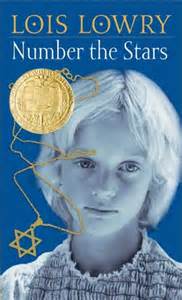
Number the StarsI had never heard of Number the Stars by Lois Lowry until seeing it listed on Carrie’s  Reading to Know Classics Book Club for November. It was published in 1989 and awarded a Newberry medal in 1990. Its name is taken from Psalm 147, read in a moment of need:

Praise ye the Lord: for it is good to sing praises unto our God; for it is pleasant; and praise is comely.

The Lord doth build up Jerusalem: he gathereth together the outcasts of Israel.

He healeth the broken in heart, and bindeth up their wounds.

He telleth the number of the stars; he calleth them all by their names.

It’s the story of WWII in Denmark through the eyes of a ten year old girl, Annemarie. At the opening of the story, the Nazis have been in Denmark for two years. Their beloved king had surrendered because they were a small country without much of an army, and they would only lose people in a war. Soldiers with guns are on almost all the street corners. One of them scared Annemarie and her friend, Ellen, by stopping them when they were racing down the street. Different items have been rationed or are no longer available.

Ellen’s family, the Rosens, are Jewish and good friends with Annemarie’s family, the Johansens. When the Rosens receive word that the Jews are about to be “relocated,” some members of the Resistance help many of them to escape. Mr. and Mrs. Rosen depart while leaving Ellen with the Johansens for a while, everyone pretending that Ellen is another daughter.

Annemarie’s mother takes the girls to her uncle’s house for a visit, and Annemarie perceives it has something to do with helping the Jews. When her mother and uncle begin talking of a Great Aunt Birte who has died and whose casket will be brought to his house. Annemarie knows there is no such person as Great-Aunt Birte and she is offended that they lied to her, but her uncle explains the situation as much as he can. He explains that not even he knows everything about the operation and that “it is much easier to be brave if you do not know everything.”

Annemarie and Ellen are delighted to find that the Rosens are among those whom Uncle Henrik and others are helping, but sad that that means Ellen will have to go away. There are several scares before they can actually leave, however, and Annemarie finds herself in a position of being the only one who can carry out a vital part.

Early in the story Annemarie wonders if she would be brave enough to die to protect her friends and comforts herself that she is only an “ordinary person who would never be called upon for courage.” I really liked how the bravery and courage of “ordinary people” were woven into the story. For some it was being part of an underground plot to help the Jews escape, for some it was facing their fear of an ocean to enable their family to get to freedom, for others it was pretending life is normal when it is anything but. When Annemarie’s protests her uncle calling her brave, because she had actually been terribly frightened, her uncle tells her, “That’s all being brave means – not thinking about the dangers. Just thinking about what you must do. Of course you were frightened. I was too, today. But you kept your mind on what you had to do” (pp. 122-123).

I have heard that sentiment in many a story of  real-life heroes. They didn’t think themselves brave or heroic. They just did what needed to be done.

I really enjoyed the afterword, too, in which the author explains which parts of the story are real and which are fictional. Some of the characters are fictional, though some are based on real ones, but the historical facts are accurate. Denmark helped almost its entire Jewish population (nearly 7,000 people) by smuggling them into Sweden.

This story has the same vibe to me as another favorite children’s book, Keep the Lights Burning, Abbie by Peter Roop. Though the plot and setting are different, it has the same theme of being able to do and face something you didn’t think you could. I enjoyed this story very much and am thankful to Heather for choosing it for us.

(This will also be linked to Semicolon‘s Saturday Review of Books.)

Book Review: The Gift of the Magi and Other Christmas Stories

Gift of the MagiI picked up The Gift of the Magi and Other Christmas Stories when it was free or on sale for the Kindle (as of this writing it’s 99 cents). It contains four stories:

“The Gift of the Magi” by O. Henry
“The Heavenly Christmas Tree” by Fyodor Dostoevsky
“The Story of the Other Wise Man” by Henry Van Dyke
“Where Love Is, God Is” by Leo Tolstoy

“The Gift of the Magi”is well-known, about a young couple with not much money who give up their most precious possessions out of love to buy a Christmas present for the other. I have to confess that in earlier encounters with this story, I found it very frustrating. I know the point is that they loved each other so much they sacrificed their best, but it kind of seems like, “Give up your best and get….nothing.” 🙂 I don’t remember if I had ever read the story in its entirety before, though I was very familiar with it, but it did help to do so. One of my favorite lines is when Della tried to fix what was left of her hair after selling it:

“She got out her curling irons and lighted the gas and went to work repairing the ravages made by generosity added to love. Which is always a tremendous task, dear friends–a mammoth task.”

I liked that she “had a habit for saying little silent prayer about the simplest everyday things.”

And I knew the title connected their giving with the Magi, but I didn’t quite realize it fully until this paragraph:

The magi, as you know, were wise men–wonderfully wise men–who brought gifts to the Babe in the manger. They invented the art of giving Christmas presents. Being wise, their gifts were no doubt wise ones…And here I have lamely related to you the uneventful chronicle of two foolish children in a flat who most unwisely sacrificed for each other the greatest treasures of their house. But in a last word to the wise of these days let it be said that of all who give gifts these two were the wisest. O all who give and receive gifts, such as they are wisest. Everywhere they are wisest. They are the magi.

So, reading the whole story in context, I enjoyed it more. Though it is still not my favorite Christmas story, there was a sweetness and winsomeness about it I hadn’t caught before.

“The Heavenly Christmas Tree” is pretty sad, about a poor, cold, hungry boy who is mistreated after his mother dies, and who then dies himself, but they are reunited around “Christ’s Christmas tree” along with all the other children and mothers who died. The mistreatment is a convicting reminder of how not to treat the poor, and the end is, of course, sweet.

I don’t think I have ever read “The Story of the Other Wise Man” before, but I was familiar with it: I may have seen it in a play or some other venue. As the title says, it is about a fourth wise man, Artaban, who was supposed to meet up with the others and take three precious jewels to the Christ Child, but missed the excursion and used one of his jewels to help an ill man. He decides to try to find the Child on his own over the next 30 years, but keeps missing Him, and uses up all his jewels helping other people in need. Thinking he has failed in his life’s quest, ultimately he finds that “Verily I say unto thee, inasmuch as thou hast done it unto one of the least of these my brethren, thou hast done it unto me” (Matthew 25:40).

That verse is the theme of “Where Love Is, God Is” as well. I have seen this as a play in my children’s school and heard it somewhere else with a different name for the main character and possibly a different title. It is the story of a cobbler who lost interest in life after his wife and son died, until a visitor urges him to live for God and read the Gospels to learn how. The cobbler does so, and his life changes. One day when he falls asleep while reading, he hears a voice saying, “Martin, Martin! Look out into the street to-morrow, for I shall come.” All day he looks for the Savior to come so he can welcome Him, but he only finds various other people who need help he is glad to give. In the end he finds that in welcoming them, he has welcomed Christ.

The latter two seem on the surface to equate doing good deeds with salvation rather than faith, but I think, reading between the lines, we can assume the good deeds came because of faith, not in place of it.

Though I am not likely to seek these out to reread for future Christmases, I did enjoy getting a fuller version of the stories than what I had remembered of them. And they have whetted my interest to read more Tolstoy in particular.

(This will also be linked to Semicolon‘s Saturday Review of Books.)

Book Review: The Weight of Glory

Weight of GloryThe Weight of Glory and Other Addresses by C. S. Lewis is a collection of his essays. Some were sermons, some were addressed to specific groups, a couple were published in other venues. Five of them were published together in a book during his lifetime and a few more were added in a 1980 revision. There is a lengthy introduction by Walter Hooper, in which he gives some of the background of the essays, where, when, and to whom they were given, as well as his connection to Lewis.

I probably have a higher percentage of pages tabbed in this book than any other. I’ll list the essays with a few words about each:

“The Weight of Glory” discusses out desire for heaven and what “glory” actually means. That seems like such a paltry summation, but thoughts from this essay stayed with me for days. An excellent outline of the chapter is here. In talking about whether the promise of heaven is a “bribe” and whether longing for it is right, Lewis remarks:

“It would seem that Our Lord finds our desires not too strong, but too weak. We are half-hearted creatures, fooling about with drink and sex and ambition when infinite joy is offered us, like an ignorant child who wants to go on making mud pies in a slum because he cannot imagine what is meant by the offer of a holiday at the sea. We are far too easily pleased” (p. 26).

He speaks of the almost ineffable quality of longing we have for something we haven’t quite experienced yet:

“In speaking of this desire for our own far off country, which we find in ourselves even now, I feel a certain shyness. I am almost committing an indecency. I am trying to rip open the inconsolable secret in each one of you—the secret which hurts so much that you take your revenge on it by calling it names like Nostalgia and Romanticism and Adolescence; the secret also which pierces with such sweetness that when, in very intimate conversation, the mention of it becomes imminent, we grow awkward and affect to laugh at ourselves; the secret we cannot hide and cannot tell, though we desire to do both. We cannot tell it because it is a desire for something that has never actually appeared in our experience. We cannot hide it because our experience is constantly suggesting it, and we betray ourselves like lovers at the mention of a name. Our commonest expedient is to call it beauty and behave as if that had settled the matter. …The books or the music in which we thought the beauty was located will betray us if we trust to them; it was not in them, it only came through them, and what came through them was longing. These things—the beauty, the memory of our own past—are good images of what we really desire; but if they are mistaken for the thing itself they turn into dumb idols, breaking the hearts of their worshipers. For they are not the thing itself; they are only the scent of a flower we have not found, the echo of a tune we have not heard, news from a country we have never yet visited” (pp. 30-31).

About the things we do not understand:

“If our religion is something objective, then we must never avert our eyes from those elements in it which seem puzzling or repellent; for it will be precisely the puzzling or the repellent which conceals what we do not yet know and need to know” (p. 34).

The section on the glory of heaven is deeply thought-provoking. Just one quote from it:

“The sense that in this universe we are treated as strangers, the longing to be acknowledged, to meet with some response, to bridge some chasm that yawns between us and reality, is part of our inconsolable secret. And surely, from this point of view, the promise of glory, in the sense described, becomes highly relevant to our deep desire. For glory means good report with God, acceptance by God, response, acknowledgement, and welcome into the heart of things. The door on which we have been knocking all our lives will open at last.”

I’ll try to be a little more brief with the remaining ones.

“Learning in War Time” addresses students who wonder if they should be working toward their chosen professions while the war is on, whether doing so is “like fiddling while Rome burns.” Lewis brings this into the larger question of whether “creatures who are every moment advancing either to Heaven or hell” should “spend any fraction of the little time allowed them in this world on such comparable trivialities as literature or art, mathematics or biology” (pp. 48-49). His answer is yes, and he goes on to explain why.

“The work of a Beethoven and the work of a charwoman become spiritual on precisely the same condition, that of being offered to God, of being done humbly ‘as to the Lord'” (pp. 55-56).

“An appetite for [knowledge, beauty, the arts] exists in the human mind, and God makes no appetite in vain” (p. 56).

“Why I Am Not a Pacifist” was given to a pacifist society in 1940. Lewis explains that while “war is very disagreeable,” there are just causes for war (for instance, what would have happened if no one had stood up to Hitler?) and there are Biblical examples affirming war. He then goes on to explain why Jesus’s command, “”But I say to you, do not resist an evil person; but whoever slaps you on your right cheek, turn the other to him also” (Matthew 5:39) is not a justification for pacifism. Lewis says the text “means exactly what is says, but with an understood reservation in favour of those obviously exceptional cases which every hearer would naturally assume to be exceptions without being told” (p. 85). One example he proposes is when one witnesses and attempted murder, tries to help, and is knocked away by the assailant. No one would think this verse meant to stand back and let the murderer have his way. But in a case where “the only relevant factors…are an injury to me by my neighbor and a desire on my part to retaliate,” we’re to mortify that desire.

“Transposition” was probably the hardest for me to grasp. The basic theme is that it is hard to take something very complex and put it into simple forms: for example, a pencil drawing or even a painting of a landscape may be beautiful and give us an idea of the actual scene, but it is not the same. The actual scene has elements which can’t be expressed in limited resources. We face the same problem with trying to explain spiritual things when there is so much more to them, so much that we won’t even grasp until we’re transformed in heaven.

“Is Theology Poetry?” answers the question “Does Christian theology owe its attraction to its power of arousing and satisfying our imaginations? Are those who believe it mistaking aesthetic enjoyment for intellectual assent, or assenting because they enjoy?” While Lewis concedes that Christianity has some poetical or metaphorical aspects to it (indeed, one can hardly describe spiritual truths without some kind of metaphor), the metaphor is not to be mistaken for the reality. He also discusses that Christianity can make room for science and reason and makes some pretty good points against evolution.

“The Inner Ring” is about what we would call the inner circle in our day and the fact that nearly every group has one. It may not be bad in itself, but “our longing to enter them, our anguish when we are excluded, and the kind of pleasure we feel when we get in” (p. 149) can  lead us into temptation. If you’ve read That Hideous Strength, the third in Lewsis’s space trilogy, this was exactly what drew Mark Studdock further and further into an evil organization, which he didn’t recognize as such because he was so blinded by his ambition to be included.

“Membership” deals with the idea that though we need solitude sometimes, we are created as part of the body of Christ. Religion seems to be “relegated to solitude,” or made a private affair, by a society which then keeps one so busy that there is little time for solitude, and the busy-ness of “the collective” takes the place of true spiritual friendship. As one who likes time alone, this sentence convicted me: “The sacrifice of selfish privacy which is daily demanded of us is daily repaid a hundredfold in the true growth of personality which the life of the Body encourages” (p. 167). He is not saying at all that one should never have privacy or solitude, nor is he saying that we lose our identity when we become a member of the Body of Christ, but rather that is where we find our true identity. The following paragraph stood out to me:

“The infinite value of each human soul is not a Christian doctrine. God did not die for man because of some value He perceived in him. The value of each human soul considered in itself, out of relation to God, is zero. As St. Paul writes, to have died for valuable men would have been not divine but merely heroic; but God died for sinners. He loved us not because we were lovable, but because He is love” (p. 170).

“On Forgiveness” begins with Lewis wondering why believing in the forgiveness of sins was put in the Creed of his church, when it seemed that would be obvious and go without saying or without need of reminder. But he discovered that believing in forgiveness is not so easy to do and does need frequent reminding. Too often when we come to God for forgiveness, what we really want is for Him to excuse us.

Forgiveness says, ‘Yes, you have done this thing, but I accept your apology; I will never hold it against you and everything between us two will be exactly as it was before.’ But excusing says ‘I see that you couldn’t help it or didn’t mean it; you weren’t really to blame.’ If one was not really to blame then there is nothing to forgive (pp. 178-179).

Too often we “go away imagining that we have repented and been forgiven when all that has really happened is that we have satisfied ourselves with our own excuses” (pp. 179-180).

And he reminds us that the same forgiveness we seek from God, He commands us to show to others. It is in this essay that his famous line comes from: “To be a Christian means to forgive the inexcusable, because God has forgiven the inexcusable in you” (p. 182).

On “A Slip of the Tongue,” Lewis shares that one day in his prayers he inadvertently mixed up the “temporal” and the “eternal.” Though it was just a slip of the tongue, he did realize that too often that is exactly what we do.

“I mean this sort of thing. I say my prayers, I read a book of devotion, I prepare for, or receive, the Sacrament. But while I do these things, there is, so to speak, a voice inside me that urges caution. It tells me to be careful, to keep my head, not to go too far, not to burn my boats. I come into the presence of God with a great fear lest anything should happen to me within that presence which will prove too intolerably inconvenient when I have come out again into my ‘ordinary’ life. I don’t want to be carried away into any resolution which I shall afterwards regret. For I know I shall be feeling quite different after breakfast; I don’t want anything to happen to me at the altar which will run up too big a bill to pay then…The root principle of all these precautions is the same: to guard the things temporal.”

“This is my endlessly recurrent temptation: to go down to that Sea (I think St. John of the Cross called God a sea) and there neither dive nor swim nor float, but only dabble and splash, careful not to get out of my depth and holding on to the lifeline which connects me with my things temporal” (p. 187).

“Our temptation is too look eagerly for the minimum that will be accepted. We are in fact very like honest but reluctant taxpayers” (p. 188).

“For it is not so much of our time and so much of our attention that God demands; it is not even all our time and all our attention; it is ourselves. For each of us the Baptist’s words are true: ‘He must increase and I decrease.’ He will be infinitely merciful to our repeated failures; I know no promise that He will accept a deliberate compromise. For He has, in the last resort, nothing to give us but Himself; and He can give that only insofar as our self-affirming will retires and makes room for Him in our souls. Let us make up our minds to it; there will be nothing ‘of our own’ left over to live on, no ‘ordinary’ life” (p. 189).

“What cannot be admitted—what must exist only as an undefeated but daily resisted enemy—is the idea of something that is ‘our own,’ some area in which we are to be “out of school,” on which God has no claim. For He claims all, because He is love and must bless. He cannot bless us unless He has us. When we try to keep within us an area that is our own, we try to keep an area of death. Therefore, in love, He claims all. There’s no bargaining with Him” (p. 190).

This is so convicting to me, because that is precisely my tendency, to keep some area of my will for my own, to fear what He might ask. Even after, as Lewis said, “daily or hourly repeated exercises of my own will in renouncing this attitude…it grows all over me like a new shell each night” (p. 192). Thankfully “failures will be forgiven; it is acquiescence that is fatal…We may never, this side of death, drive the invader out of our territory, but we must be in the Resistance” (p. 192).

One of the things I appreciate most about Lewis is that he “could…swiftly cut through anything that even approached fuzzy thinking,” as Sheldon Vanauken wrote. Plus he so often hits the nail right on the head: in the last essay I had the feeling my innermost thoughts had been found out. I came across a blog post a few weeks ago where the blogger, whose views I would probably generally agree with, mentioned several areas where he differed with Lewis. So far I haven’t found the differences he mentioned. The only one that stood out to me in this book was that he would take some parts of the Bible as symbolic that I would take to be literal. But I think if we are regularly feasting on and meditating on God’s Word, we can read with discernment authors with whom we might not agree on every little point. Lewis has a way of writing that delineates the truth clearly and precisely (even though his intellect is so far above my own) in a manner that is easy to understand. And I can’t think of any writer whose work make me long for heaven more. This book will definitely be reread at intervals through the years, especially the first and last essays.

(This will also be linked to Semicolon‘s Saturday Review of Books.)

Book Review: The Wonderful Wizard of Oz

OzI hadn’t planned on reading The Wonderful Wizard of Oz any time soon. It was one of those “Maybe someday…” books to me. But when a great sale on an Audible version read by Anne Hathaway came through some time ago, I went ahead and bought it. And last month when I had several days between the end of my last audiobook and the availability of my next Audible credit at the beginning of the month and looked for a short book to fill the time, this seemed like a perfect choice.

The story is so well-known, I don’t think I need to go over the plot at all, but just in case someone is unfamiliar with it, the main character is Dorothy Gale, a little girl who lives with her Aunt Em and Uncle Henry in Kansas. Everything is pretty grey and cheerless, except Dorothy’s little dog, Toto. When a cyclone heads toward their house, Dorothy doesn’t quite make it to the storm cellar before the house is whisked away and ends up in the land of the Munchkins, right on top of the wicked witch of the East, for which the Munchkins are very grateful. Dorothy wants to get home to Kansas, but they don’t know how to help her: they can only advise that she go to see the great wizard, Oz, in the Emerald City. So she follows the yellow brick road that direction and along the way meets a Scarecrow who wishes he had brains, a Tin Woodman who wishes he had a heart, and a Cowardly Lion who wishes he had courage. They all decide to join her to see if Oz can help them. But Oz doesn’t quite respond the way they want, sending them on a mission to kill the Wicked Witch of the West. And eventually they find the wizard isn’t who they thought he was at all.

Of course, the book has its differences from the well-known movie. We only see 3 Munchkins rather than a townful, there is no “Lions and tigers and bears, oh my!” line, the shoes Dorothy is given from the dead witch are silver rather than ruby (probably due to the effect of which would look best in Technicolor). I enjoyed getting more back story of the characters, especially the Tin Woodman and how he came to be tin when he was originally human. The winged monkeys aren’t inherently evil – they’re mischievous, but they prove helpful in the end. There is an elephant-sized spider, a little town made of china people and buildings, and a race of people called Hammerheads who can shoot their necks out and butt people off the hill they’re guarding. Those are all interesting in themselves, but since they come between Dorothy’s leaving Oz (which is the end of the movie version) and her finally getting back home, they seem a little anticlimactic.

The book was written in 1899 and is considered the first American fairy tale. In the introduction, Baum says he wrote it just for the pleasure of children. He felt that “Modern education includes morality; therefore the modern child seeks only entertainment in its wonder-tales and gladly dispenses with all disagreeable incident.” I would say there is still plenty of “disagreeable incident” in the story, with some of the trials the troop has to undergo, but they are not of the “horrible and blood-curdling” variety he feels are “devised by their authors to point to a fearsome moral to each tale.” I don’t think morals and stories are antithetical, but I agree it’s fine to  have a story just for fun. And though Baum wasn’t necessarily trying to dispense morality, I think an observant reader would glean good traits from the good characters (their kindness, thoughtfulness, bravery, hard work, persistence, etc.).

I found it interesting that in the book, the idea that “There’s no place like home” came from Dorothy herself: it wasn’t something she had to be told by Glinda.

The Scarecrow listened carefully, and said, “I cannot understand why you should wish to leave this beautiful country and go back to the dry, gray place you call Kansas.”

“That is because you have no brains” answered the girl. “No matter how dreary and gray our homes are, we people of flesh and blood would rather live there than in any other country, be it ever so beautiful. There is no place like home.”

When my children were very little, I had trouble with the idea of a “good witch” in the story, so I didn’t let them see the film for a long while. But I eventually came to terms with the idea that fairy tale witches are a completely different thing from real-life ones.

Apparently Baum did not want to write sequels, but the interest and demand was so great that he wrote thirteen of them.

I’m so glad I gave it a go. Anne Hathaway did a marvelous job narrating. I agree with C. S. Lewis’s quote to the effect that a good children’s book should be enjoyable by adults as well. It would be hard to say whether I like the book or the film better. I like them both. They each have their charms.

(This will also be linked to Semicolon‘s Saturday Review of Books.)

What’s On Your Nightstand: November 2014

 What's On Your NightstandThe folks at 5 Minutes For Books host What’s On Your Nightstand? the fourth Tuesday of each month in which we can share about the books we have been reading and/or plan to read.

I don’t know where in the world November has gone. It doesn’t seem like I have gotten much reading in, but sometimes I surprise myself when I actually start listing it.

Since last time I have completed:

The Return of Sherlock Holmes by Arthur Conan Doyle, audiobook, reviewed here.

The Last Bride by Beverly Lewis, 5th in her Home to Hickory Hollow series, reviewed here.

Walking in the Spirit: A Study Through Galatians 5 by Steve Pettit, reviewed here.

Jesus, My Father, the CIA, and Me: A Memoir of Sorts by Ian Morgan Cron, audiobook, reviewed here.

Nope, no surprises this time – only two actual (paper) books!

I’m currently reading:

Weight of Glory by C. S. Lewis

The Pound a Day Diet by Rocco DiSpirito

Number the Stars by Lois Lowrey for for Carrie’s  Reading to Know Classics Book Club for November

The Gift of the Magi and Other Christmas Stories by O. Henry, Fyodor Dostoevsky, Henry van Dyke, and Leo Tolstoy

Next up:

To Kill a Mockingbird for Carrie’s  Reading to Know Classics Book Club for December

Other than that I am not sure. I got out my Christmas books (some fictional, some devotional) and was surprised to discover a couple I didn’t even know I had and one that I thought I had read but hadn’t. I like to do a little Christmas reading during December but haven’t decided which of these to attempt yet.

Speaking of Christmas books…I am giving some away here.

Some of you might be interested in a post I wrote this month about reasons to read fiction and Christian fiction. It’s one I have been wanting to write for ages, and I was glad to finally do so.

Happy reading!

Book Review: Jesus, My Father, the CIA, and Me

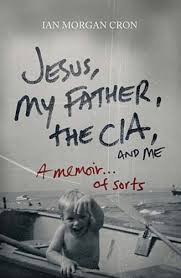
CronI have been wanting to read Jesus, My Father, the CIA, and Me: A Memoir of Sorts by Ian Morgan Cron ever since Lisa’s review of it.

Despite the mention of the CIA in the title, it’s not the primary focus of the book. Ian didn’t know his dad was involved with the CIA until his mid-teens. There had been odd “business trips” when he had thought his father was out of work, his mention of having met people (like President Ford) whom he would not likely have crossed paths with, etc., but the pieces didn’t come together until Cron’s teens.

Cron grew up in England until his father’s work took the family back to the States, where the family set down roots. Cron describes his Irish Catholic upbringing mostly humorously but with a few poignant moments as well. In fact, there is a humorous slant to much of Cron’s writing, but not in connection with his father’s alcoholism. The book focuses primarily on the effect Cron’s father’s alcoholism had on his life: the embarrassment, the anger, the missed concerts, the lack of good example and teaching, the bad example, the lack of relationship.

“’Home is a place you grow up wanting to leave, and grow old wanting to get back to.’ That’s what John Edward Pearce said. But what if your childhood was a train wreck? What if your memories of home are more akin to The Shining than The Waltons? It doesn’t matter. Home is not just a place; it’s a knowing in the soul, a vague premonition of a far-off country that we know exists but haven’t seen yet. Home is where we start, and whether we like it or not, our life is a race against time to come to terms with what was or wasn’t” (p.3).

Ian went from trying to be a “good boy” to win his father’s approval, to trying to be a “bad boy” to get his attention. As happens all too often, he began following in his father’s footsteps with drinking, and then went further with drug experimentation.

But the story is also one of redemption. Though tenderhearted towards spiritual things as a child, Ian felt God had let him down by not answering his prayers concerning his father, and he was highly resistant to any kind of Christian influence. But God brought him to the end of himself. Coming to believe was one step, but overcoming his own alcoholism took much longer, and facing and dealing with the buried emotions and the psychological effects of his relationship with his father took longer still.

As the daughter of an alcoholic, I could identify with much that Ian wrote. Somehow I never had the thought that so many kids have that it must be all my fault. (I knew my dad’s problems were his own. I did learn to lay low and stay under the radar either when he was drinking or when he was angry, and to this day I have problems interacting when I think someone is angry. My first instinct is to retreat.)

Some of the quotes that stood out to me:

“Boys with fathers who, for whatever reason, keep their love undisclosed begin life without a center of gravity. They float like astronauts in space, hoping to find ballast and a patch of earth where they can plant their feet and make a life. Many of us who live without these gifts that only a father can bestow go through life banging from guardrail to guardrail, trying to determine why our fathers kept their love nameless, as if ashamed.”

“My father’s psychological and emotional problems so consumed his visual field that he had trouble seeing anyone but himself , much less a lost, father-hungry kid.”

The author definitely has a way with words, and the book is filled with many descriptive phrases. One disadvantage to listening to the audiobook rather than reading a paper or electronic version is that one can’t flip back through the pages, and I didn’t mark as many quotes as I should have (one can “bookmark” with an audiobook – but not while driving or cooking 🙂 ). The writing seemed a little disjointed in some places, being more thematic than linear. But there is light humor as well as deep sadness, poignancy, beauty and grace. I think those of us who are more conservative need to be reminded that God sometimes uses seemingly unconventional ways and means to reach a person, and that we’re not all cookie cutter Christians.

At one point the author says that many of the Christians he knew, I think in his college years, were fans of John McDowell and C. S. Lewis, but he could never get into them, because he didn’t want to parse God, he wanted to experience Him ecstatically. While I do agree that our Christianity needs to be experiential and not just academic (and I think that’s what he was trying to convey), I have a couple of problems with this line of thinking. For one, voices in our heads aren’t always trustworthy. For another, those men are hardly “just” academic, and many are ministered to by their writings and by thinking through the issues they address. The Bible has a lot to say about knowledge and doctrine. I’ve referenced this here many times before, but Peter had one of the most wonderful experiences possible when he saw Jesus transfigured before his eyes, yet he calls the Scripture (a more sure word of prophecy” – more sure than even that experience (II Peter 1:16-21).

Although I think the book is a worthwhile read, I could not recommend it unreservedly. To me the humor slips into irreverence sometimes, there are a few instances of crudeness (jokes about men’s private parts), the theology was a little wonky in some places. I think this book would be especially good if you or someone within your sphere of influence has had an alcoholic parent or a strained relationship with one.

(This will also be linked to Semicolon‘s Saturday Review of Books.)