

When we’ve been walking with the Lord for a while, we’re sometimes dismayed that we’re still fighting battles with the same sins. We think, “Shouldn’t we be past that by now?”
Or perhaps we’ve gotten victory over some sins, but new ones crop up. Or regrets over past actions haunt us.
We might think God must be saying the same thing–“Shouldn’t she have made more progress by now? Is she ever going to get it right?”
Of course, God doesn’t ask questions like that. He knows us inside and out and knows our future as well as our past.
When I searched the Internet for articles about disappointing God, the first few discussed how God doesn’t have emotions as we do and is totally self-sufficient and self-satisfied in Himself.
I found that distinctly unhelpful in this context. Yes, God is self-sufficient and doesn’t need anyone or anything. But the Bible speaks of Him being pleased and displeased, angry or delighted.
A case study of what certainly looked like disappointing God came to mind: Peter’s denial of Christ. In Luke 22:31-34, at the last supper, Jesus told Peter that he would deny Jesus three times, even though Peter was sure he would follow Christ to the death.
In verse 40, Jesus told Peter, James, and John, “Pray that you may not enter into temptation.” But they fell asleep.
After Jesus was arrested, Peter followed behind and waited at the high priest’s courtyard while Jesus was inside. Peter was asked or accused three times of being one of Christ’s followers, but he denied it, denied even knowing Jesus. The Bible says, “And immediately, while he was still speaking, the rooster crowed. And the Lord turned and looked at Peter. And Peter remembered the saying of the Lord, how he had said to him, ‘Before the rooster crows today, you will deny me three times.’ And he went out and wept bitterly.”
We don’t know what was in that look of Jesus. I imagine it was something like the song, “The Look,” although that’s not about this situation.
We also don’t know what Peter was feeling, though we can imagine. In his place, I would have felt remorse, regret, probably some degree of self-loathing.
Later, though, the Lord was very tender with Peter.
After Jesus’ crucifixion and resurrection, the angels told the women who came to the tomb, “But go, tell his disciples and Peter that he is going before you to Galilee. There you will see him, just as he told you” (Mark 16:7).
Tell the disciples and Peter. Special mention. Jesus hadn’t dismissed Peter or ejected him from among Jesus’ followers.
Jesus appeared to His followers several times after His resurrection. Then Peter and a few others went fishing. I’ve heard sermons scolding Peter for this, accusing him of going back to his old life instead of fulfilling his mission. That may be. He may have thought, “I failed at being a disciple of Jesus–I should go back to what I know.” But the Bible doesn’t really say. Maybe he was bored. Maybe they were running out of funds and needed to make some money–they’d been hiding out for several days.
But whatever Peter’s motive, the group fished through the night without catching anything. In a scene reminiscent of the time Jesus called Peter to follow Him, He appeared and told the disciples to cast their nets on the other side. When they did, they netted so many fish, they couldn’t haul them into the boat.
Then we have the famous scene where Jesus asked Peter three times whether he loved Him. Three times, Peter said yes. Three times, Jesus told him to feed His sheep.
Three times–the same number of times Peter denied Jesus.
Was Jesus rubbing Peter’s failure in? I think He was reassuring him that he was restored and still had a purpose in God’s kingdom. Was Peter’s failure at catching fish a reminder that Peter couldn’t even do the task that was his strength, his profession, without Jesus? Possibly.
Many years later, when Peter wrote, “He himself bore our sins in his body on the tree, that we might die to sin and live to righteousness. By his wounds you have been healed. For you were straying like sheep, but have now returned to the Shepherd and Overseer of your souls” (1 Peter 2:24-25). Perhaps he was thinking of his own straying and return to his Shepherd.
I don’t profess to have all the answers to whether God is ever disappointed in us, but, as I have pondered the question, a few things came to mind.
We won’t reach sinless perfection in this life. We receive a new nature when we’re saved, but we still have the old one until we get to heaven. We’re sanctified–set apart unto God–from the first moment we’re saved. But until we reach heaven, and sin and Satan are removed completely, we’ll still fight our old nature. Galatians 5:17 says, “For the desires of the flesh are against the Spirit, and the desires of the Spirit are against the flesh, for these are opposed to each other, to keep you from doing the things you want to do.”
The Bible makes provision for forgiveness of sin after salvation. John wrote, “My little children, I am writing these things to you so that you may not sin. But if anyone does sin, we have an advocate with the Father, Jesus Christ the righteous” (1 John 2:1) and “If we say we have no sin, we deceive ourselves, and the truth is not in us. If we confess our sins, he is faithful and just to forgive us our sins and to cleanse us from all unrighteousness. If we say we have not sinned, we make him a liar, and his word is not in us” (1 John 1:8-10). This isn’t a green light or an encouragement that sin doesn’t matter. It does. But when it happens, as God knew it would, there is forgiveness.
God sees us through Jesus. The essence of salvation is that Jesus took our wrong on Himself so that we might receive His righteousness. He lived a righteous life in our place because we couldn’t. “For our sake he made him to be sin who knew no sin, so that in him we might become the righteousness of God” (2 Corinthians 5:21). The Bible says in many places that once we repent of our sin and believe on Jesus as our Lord and Savior, we’re in Christ. “There is therefore now no condemnation for those who are in Christ Jesus” (Romans 8:1). Again, this doesn’t mean that we can live any old way because God sees Jesus’ righteousness rather than ours. That feeling is incompatible with salvation. Our desires change when we’re saved to where we want to please God. Though we fail sometimes, our ultimate desire is to please Him. And when we do go our own way in rebellion, the Bible says God disciplines and chastens His children (Hebrews 12:5-13) to train them in righteousness.
Remember Satan’s influence. Jesus told Peter, “Satan demanded to have you, that he might sift you like wheat” (Luke 22:31). We can’t blame Satan when we sin, because God has promised a way of escape (1 Corinthians 10:13). But it helps to know that some of the weird thoughts that occasionally assail us might be coming from an outside influence.
Don’t trust in yourself. Peter had good, fervent intentions. But they were not enough to keep him from falling. 1 Corinthians 10:12 warns, “Let anyone who thinks that he stands take heed lest he fall.”
Use the means God provided. Jesus told Peter to watch and pray, lest he enter into temptation. Paul told the Galatians, “Walk by the Spirit, and you will not gratify the desires of the flesh” (5:16). God’s Word builds us up and strengthens us (Romans 16:25; Acts 20:32). Jesus defeated Satan’s temptations with Scripture.
A heightened awareness of sin develops as we grow in the Lord. When we first hear about sin, we might respond, “Well, nobody’s perfect.” Or we feel we’re not guilty of the “big stuff”–murder, adultery, stealing, drug dealing, etc.–so we’re not so bad. But as we read the Bible, we find that pride, self-glory, angry thoughts, and hatred are every bit as sinful. And we realize even more that sin is an affront to a holy God. We identify with David when he said, “My iniquities have overtaken me, and I cannot see; they are more than the hairs of my head; my heart fails me” (Psalm 40:12).
God knows our frailties. David writes in Psalm 103, “As a father shows compassion to his children, so the Lord shows compassion to those who fear him. For he knows our frame;
he remembers that we are dust.”
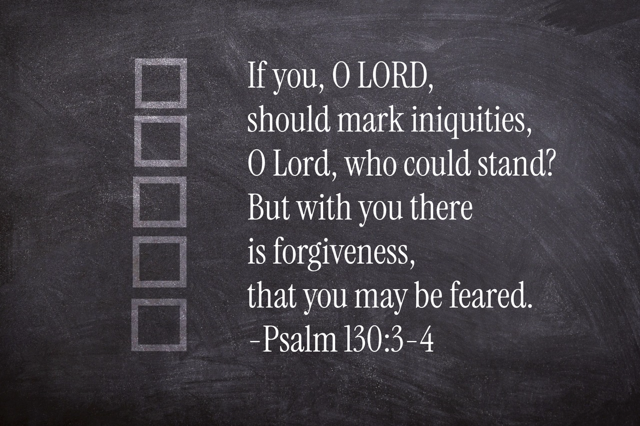
God’s posture towards His own is loving, merciful and faithful. David went on to say in Psalm 40, “But may all who seek you rejoice and be glad in you; may those who love your salvation say continually, ‘Great is the Lord!’ As for me, I am poor and needy, but the Lord takes thought for me. You are my help and my deliverer; do not delay, O my God!” (verses 16-17). Another psalmist writes, “If you, O Lord, should mark iniquities, O Lord, who could stand? But with you there is forgiveness, that you may be feared” (Psalm 130:3-4). Lamentations 3:22-23 says, “The steadfast love of the Lord never ceases; his mercies never come to an end; they are new every morning; great is your faithfulness.” “The Lord is gracious and merciful, slow to anger and abounding in steadfast love” (Psalm 145:8).
Just before Jesus told Peter of his coming denial, He said, “I have prayed for you that your faith may not fail” (Luke 22:32). Even knowing that Peter would fail, Jesus said, “When you have turned again, strengthen your brothers.” He knew Peter would fall, but He also knew Peter would repent.
Have you ever felt like God must be disappointed in you? What truths helped you? Do any of these thoughts resonate with you?
(I often link up with some of these bloggers.)
 Stray Thoughts