Review: The British Booksellers

The British Booksellers by Kristy Cambron

The British Booksellers by Kristy Cambron shifts back and forth from WWI to WWII.

Amos Darby and Charlotte Terrington are secret childhood friends with a love for books. But that’s all they can ever be. Amos is a tenant farmer’s son, and Charlotte is an earl’s daughter. Though Charlotte loves Amos, her parents arrange her marriage with Will Holt, the future Earl of Harcourt.

Amos goes off to WWI and comes back scarred. He opens a book shop on Bailey Lane in Coventry, England, but becomes something of a recluse.

Charlotte, now widowed Lady Harcourt, has opened a bookshop as well across the lane with her daughter, Eden. The booksellers have been rivals and enemies for over twenty years, though Eden has tried to negotiate a peace between them.

When an American lawyer, Jacob Cole, shows up with alarming news for Charlotte and Eden, they fight back to keep their estate, even though it is becoming ever harder to maintain.

But when WWII begins and German bombers fly across Coventry, Amos, Charlotte, Eden, and Jacob have to work together to help each other and their neighbors survive.

The Coventry Blitz is referred to as the Forgotten Blitz. The London Blitz received so much attention, Coventry was overlooked in the press. Kristy Cambron says in her author’s notes that some officials suppressed news of the devastation of Coventry so as not to damage morale.

The story includes four Land Girls, part of the Women’s Land Army in Britain who helped out at various farms and homes across the nation. I had read of these women in other books, so it was neat to see their roles fleshed out a bit more.

The historical story was quite interesting, but Charlotte and Amos’ story was so touching.

With characters who have a common love for books and who become rival booksellers, the importance of books comes up often. One of my favorite quotes about this aspect:

Books are an escape that beckons the reader from the heavy burdens of this world.’ Isn’t that what you told me once? They can challenge as well as comfort. Entertain and educate. Even save us in ways we’d never expect. You’ve used the words art, oxygen, and life all to describe them. Anyone who can see such value in these pages ought to also see that they could take him away from a future he doesn’t want. If anything, that is what Dickens wrote for his characters. Isn’t that what you wish for yourself?

I listened to the audiobook, beautifully read by Barrie Kreinik. Happily, this time the audiobook did contain author’s notes about the historical aspects of the book. There weren’t any notes about what inspired the personal stories, though.

With going back and forth between timelines, it was a little hard to keep up sometimes with where we were in the story. It’s not as easy with an audiobook to flip back to the beginning of the chapter to check the dates. Plus 1914 and 1940 sound alike. But it didn’t take too long to get oriented.

Overall, I loved the book and the characters and felt for them.

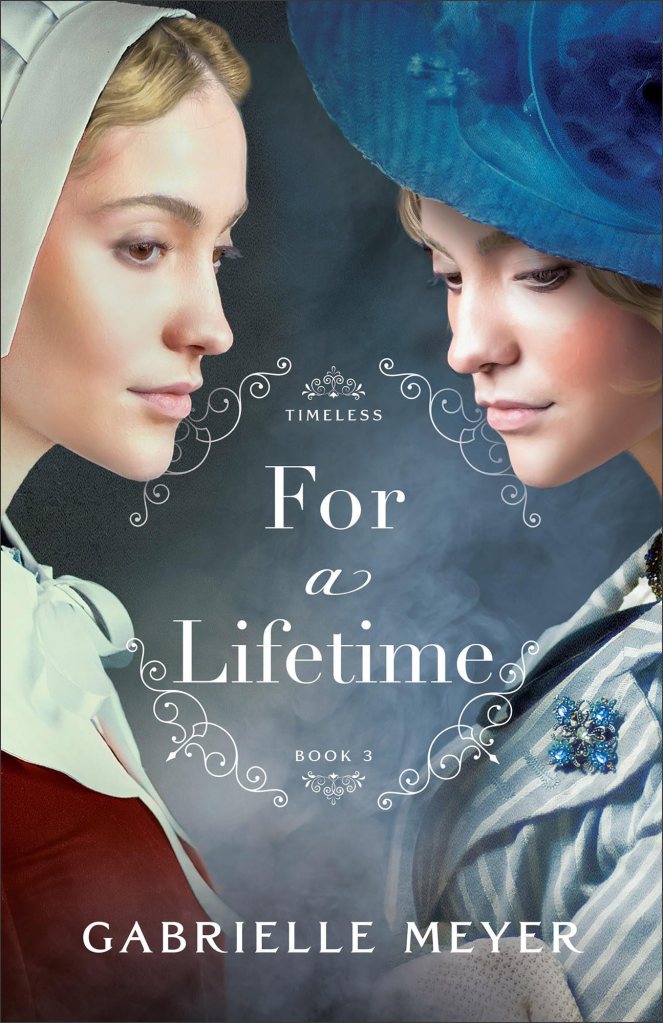
Review: For a Lifetime

For a Lifetime by Gabrielle Meyer

For a Lifetime is Gabrielle Meyer’s hot-off-the-press third book in her Timeless series about time crossers.

In this series of novel, a time crosser is one who lives in two timelines. They live in one period of history, and when they go to sleep, they wake up in a different time without any loss of time between. When they go to sleep again, they wake up back in the first time as the very next day, going back and forth. They all bear a sunburst birthmark that marks them as time crossers, some over their heart, some on the back of their heads. The ones with the head marking have until their twenty-fifth birthday to decide which time they want to live the rest of their lives in. If they knowingly try to change history at all, they’ll forfeit their lives in that time period.

In this book, the time crossers are twin girls, Faith and Hope. One of their timelines is in Salem Village, Massachusetts, in 1692, just before the Salem witch trials begin. The twins are twenty-four, working at their father’s tavern and restaurant. They never knew their mother, having been told she died in childbirth. Their father is harsh and distant, treating them more like servants than daughters.

Their second timeline in in 1912, where Grace is a journalist and Hope is a beginning aviatrix in New York. Their mother in this timeline is a time crosser as well (from the previous book) and lives in Washington DC, where her husband had been a Pinkerton agent during the Civil War and then helped start the Secret Service.

The young women have both decided to stay in 1912 on their twenty-fifth birthdays. Hope thinks they should change history in 1692 so they can go ahead and stay in 1912. Grace thinks the risks are too great–one change could cause a catastrophe.

Grace is dutiful, thoughtful, kind, and level-headed. Hope is adventurous, strong-willed, and prefers acting to thinking.

In 1912, one of Grace’s articles exposed an owner of shirtwaist factories for his unsafe practices which resulted in a serious fire. He struck back by trying to buy the building her parents rented for their orphanage, offering three times the amount the building was worth. Grace wants to confront him, but her father warns that it’s unsafe. So they try to find another way to raise the money to purchase the orphanage themselves.

Also in 1912, Hope is attracted to her flying instructor, well-known aviator Lucas Voland. But he wants to keep their relationship professional. When she introduces Luc to Grace, they instantly dislike each other.

In 1692, Grace is attracted to a neighboring farmer named Isaac, but he only has eyes for Hope. Hope, however, wants nothing to do with him.

In 1912, Grace once looked up a history book about the Salem witch trials and saw, to her horror, that she was said to have accused Hope of being a witch. Grace shut the book and didn’t look up any more information about it. She didn’t tell anyone, and has no intention of accusing Hope–she doesn’t see how such a thing could ever be.

Meanwhile, some young girls are said to be “afflicted,” experiencing convulsions and complaining of being pinched, etc. They accuse a few women in the village of afflicting them. Thus the hysteria begins.

The Salem witch trials are not my favorite time in history to read about. They seem a blight not only on American history, but on church history. The lack of common sense, much less spiritual sense, among the leadership in the village is troubling. If this account is true, if anyone challenged to accusations, then they became a target.

But it was interesting to read how Grace, Hope, and Isaac dealt with life under such situations.

Plus I didn’t like Hope much as first. She seemed immature and selfish. But part of her story arc includes her realizing that about herself.

I had thought, with twins being the main characters, that the major conflict would go one particular direction. It didn’t appear to go the way I was thinking at first until a major, shocking, unexpected plot twist occurred. My interest in the book increased after that.

I listened to the audiobook, nicely read by Rachel Botchan. Happily, this audiobook did include the author’s historical notes at the end. She had ancestors on both sides of the Salem trials, sparking her interest. Her research shows that some of the afflicted girls probably had some form of mental illness, which would not have been understood at the time. But others took advantage of the hysteria. She said the reasons for the hysteria were many and complicated.

She also said both Grace’s and Hopes characters in 1912 were inspired by Harriet Quimby, who was both a journalist and flyer, the first woman to fly across the English Channel. (if you’re interested in reading this book, I would hold off reading about Harriet, or you might get some spoilers.)

I loved how everything ended up in both timelines. There are a number of themes in this book, but one that stood out to me was that God often works the most in our lives through circumstances that we did not want.

Review: Yours Is the Night

Yours Is the Night by Amanda Dykes

In Yours Is the Night by Amanda Dykes, Matthew Petticrew grows up with his sister on a racetrack in New York in the early 1900s until the father who never claimed them sent them away. Matthew’s sister, Celia, was sent to nursing school, Matthew to be a groom at the stables of Harvard University.

When Matthew travels with some Harvard boys to Plattsburg Training Camp to deliver horses, a chance meeting with his childhood hero, Jasper Truett, one of Theodore Roosevelt’s Rough Riders, changes his life.

Matthew and three acquaintances are sent to the Argonne forest for more wood to reinforce the trenches.

One of the men, George Piccadilly, is a Brit whose parents had sent him to Harvard to get a divinity degree to avoid having to fight in the first World War. However, through a series of events, he ends up at Plattsburg Training Camp . He has no use for religion but somehow ends up a chaplain. His joviality and Matthew’s seriousness don’t seem like they would mix, but George sticks close to Matthew because he looks like he would know how to survive. Plus George thinks he can lighten Matthew up a bit.

The last acquaintance is Henry Mueller, a bookish young man who was recruited as a fresh-faced, boy-next-door to write for the newspaper about the war under the pen name Hank Jones.

As they gather wood, they hear a woman singing. George dubs her the Angel of Argonne. And then one night they meet her in person at the freshly dug grave of her grandfather.

Mireilles, called Mira, grew up with her father and grandfather in the Argonne. When the war came crashing into their quiet lives, Mira’s father went to fight. Now her grandfather is gone, too.

The men feel they can’t leave her alone in her forest home so near the front lines. But they don’t want to send her out alone, either. They obtain permission to accompany her to her nearest relative’s house.

The journey will change each of them.

It took me longer to get into this book than Amanda’s previous book, Whose Waves These Are. The point of view shifts back and forth between Matthew, George, Hank, Jasper, and Mira. It took a little while to get them all sorted out. Plus there was a lot of bickering between George, whose character I didn’t really like at first, and the other two younger men. It was understandable, even funny at times. But not my favorite.

But at some point, everything clicked into place. The last few chapters were just beautiful. I loved the ending. Right after finishing, I went back and reread the first few chapters, understanding them better.

The prologue and epilogue tell of the choice of a casket for the Tomb of the Unknown Soldier. In the author’s notes, Amanda tells of visiting the tomb on the centennial anniversary year and how much the symbolism meant to her. She writes that she did not mean to fictionalize the unknown soldier, but “His anonymity allows him to represent the countless ones who never came home. . . . I hope that only respect, gratitude, and a fierce guarding of the real soldier’s true story—untouched by this imagined one—is found in these pages.”

Some of the other quotes I liked:

That burning justice is a gift. . . . But you be sure and save it for where it’s needed. Some battles aren’t battles after all (p. 23, Kindle app).

I understood the way words can shape hearts. Evade the creation of mobs and fear, and instill a home-front army of citizens armed with hope (p. 65).

The sky rumbled like only the earth should, and the earth bled like only people should, and people—people lived and died like nobody, ever, should (p. 151).

War happens. We help. It’s what we do. Not one of us can fix this whole mess, but maybe we can help this one moment (p. 151).

Men of few words, I was realizing, said much with their silence over here (p. 174).

“The matches . . . they are hope.” They are hope. The three words socked the air from me. Bringers of hope . . . creators of light from dark, when struck on hard places (p. 178).

It’s not mine to change what has happened . . . I cannot. It is mine to walk through what will come (p. 181).

There are none who can undo the past. But there is one who will carry the pain of it. He knows too well the sting of injustice. No, more than that. The blood of it. But with it, He bears the scars of his own injustice with the same hands that carry me now (p. 182).

Her brother was a thoughtful speaker, one who weighed his words and chose few of them to speak, ones that seemed always to carry so much in their depths. His sister seemed to do just the opposite—speak her words, then catch them and consider them, then say more words to explain. As if she were swimming in them, and happily so (p. 195).

What if what we believe to be our shortcomings, our oddities, are actually purposeful quirks that suit us for the moments we were made for? (p. 257).

Though I loved Whose Waves These Are more, I came to enjoy this book quite a lot as well. I’m a fan of Amanda’s writing and eager to read more of her books.

Review: All My Secrets

All My Secrets by Lynn Austin

In Lynn Austin’s Gilded Age novel, All My Secrets, one of the wealthiest men in America has just died. The Stanhopes were contemporaries of New York’s elite families, like the Vanberbilts, Astors, and Van Burens.

Arthur Benton Stanhope III, known as A. B., was only forty-six when he passed. At the reading of his will, his mother, Junietta, wife Sylvia, and daughter Adelaide, or Addy, all found out that the original Arthur Stanhope had written his will in such a way that the Stanhope business and the bulk of the family money could only be passed down to the closest male heir. A small trust was left for Sylvia and Addy, but it was not as large as it might have been if the investments had the expected time to grow. But with a little economy, and perhaps the sale of the family yacht, they should manage fine.

Such economic measures, however, would send them toppling from the pinnacle of society they enjoyed. That was fine with Junietta. But Sylvia’s position and reputation as a hostess were her life. Sylvia decided the best thing they could do was find acceptable suitors to discreetly introduce Addy to in the hope that she might marry well before their financial state became too dire.

Addy didn’t like the idea of marrying a man for his money or feeling like a bargaining chip. Her mother assured her the choice was hers, and she wanted her to be happy. But Addy felt duty-bound to do everything in her power to keep the only home she had ever known in the family for her mother’s sake. Addy herself, didn’t want anything to change more than it had to.

Junietta thought their palatial home was a monstrosity. It had more rooms than they could ever possibly use. Addy had gotten lost in them as a child. The rooms they did inhabit were too large, their decorations overdone. The money expended on their balls and dinner parties could feed other families for weeks. Their contemporaries were gossipy rivals more than friends.

Junietta was more or less trapped in her marriage, but she wants Addy to know she has choices. Will Addy ever warm to the idea that the excessive wealth they are used to is wasteful, that there are better ways to live? Or would Addy write her grandmother off as eccentric? Junietta was going to have to reveal some of the secrets of her past that changed her own views. Would she have time to, before her erratic heart gave out?

I enjoyed this book a lot. I don’t see many novels set in this era, so it was fun to experience that time. Junietta’s secrets were revealed gradually in flashbacks, eventually prompting Sylvia to share secrets of her own. I enjoyed the characters and the natural way the faith element was woven in. The author makes sure to emphasize that being rich is not a sin in itself, and being poor is not inherently virtuous. But we’re all stewards of what we’ve been given.

But the book isn’t just about stewardship. It also involves loss, love, grief, life choices, forgiveness, and more.

In a fun coincidence, my oldest son visited the Marble House in RI with friends. It was built by William Vanderbilt for his wife, Alva, and started off the “summer cottage” fad among the elite (the “cottages” being 50+ rooms rather than what we think of as a cottage). The day after my son told us about his visit to this house, it came up in this book.

I enjoyed the audiobook, nicely read by Sarah Zimmerman. As usual, the audio version did not contain any of the author’s notes at the end, but I found some of that information in an interview with the author here.

I wished that the author had included an epilogue. The characters are left in such a way that we have a good idea what will happen to them, but I would have liked things to be a bit more wrapped up at the end. I just learned in the interview mentioned above that the author has written a novella with these characters that will come out at Christmas.

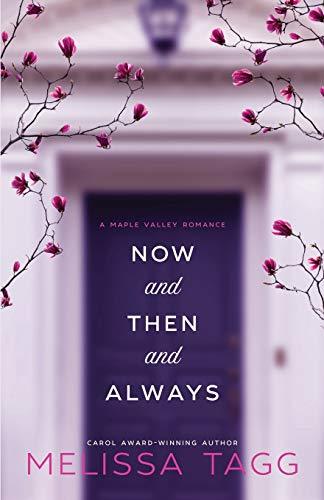
Review: Now and Then and Always

Now and Then and Always

In Now and Then and Always, a novel by Melissa Tagg, Mara Bristol found refuge. Her father had left the family when she was a child. Her mother was so distraught that she was emotionally unavailable to Mara. When her mother died, Mara found various nanny jobs until the last one ended in disaster and danger.

Learning of the Everwood Bed and Breakfast through a rest stop brochure, Mara heads to Maple Valley, Iowa, to find it. The building is charming with good bones, but it’s a little run down. However, it is presided over by a sweet older lady, Lenora, who takes Mara in. Mara is not a Christian and had never felt she was important enough for God to notice. But Lenora sees her as a God-sent daughter. Mara’s stay extends for months.

Then one day, Lenora has to take a trip and asks Mara to take care of the B&B until she returns.

Except she doesn’t return. She doesn’t have a cell phone, so Mara can’t contact her. When foreclosure notices arrive, Mara wonders if Lenora knew of the impending doom and fled. Once again, Mara feels forsaken and alone.

One stormy night, Detective Marshall Hawkins arrives on the Everwood’s doorstep. His only daughter had died two years before, and he’s stuck in his grief. His wife left him. He nearly got addicted to painkillers for constant migraines. He refused to admit anything was wrong, until mistakes in his job led his captain to put him on administrative leave. Marshall packed up and headed out with no destination in mind until stumbling upon Everwood, which looks just like the ideal house that his daughter loved in a magazine ad.

Mara becomes friends with some of the townspeople and with Marshall, who help her renovate Everwood. But as the house reveals its secrets they begin to wonder if Lenora knew them and if she is in danger.

There’s a lot going on in this book. Each main character and even the side characters have multiple issues. Then there’s the house itself and its secrets and background. The mystery of what went on there and what happened to Lenora were both quite good mysteries.

I ended up enjoying the book and I was glad I stuck with it, but I was about ready to toss it during the first two chapters. Much of the dialogue was extremely stilted due to paragraphs of backstory or description or information between each line.

Some of my favorite quotes:

Far be it for me to speak for the Almighty, but I feel fairly confident saying God isn’t looking for impressive people. He’s looking for people who are willing to be impressed by Him.

But I don’t want to spend my life letting my pain be the lens through which I see the world.

Kindness is its own shade of heroism.

Don’t underestimate God’s ability to use even the things we label as random.

She didn’t have to know how it would all work. She just had to take the next step.

I listened to the audiobook, which is free for Audible subscribers until May 7.

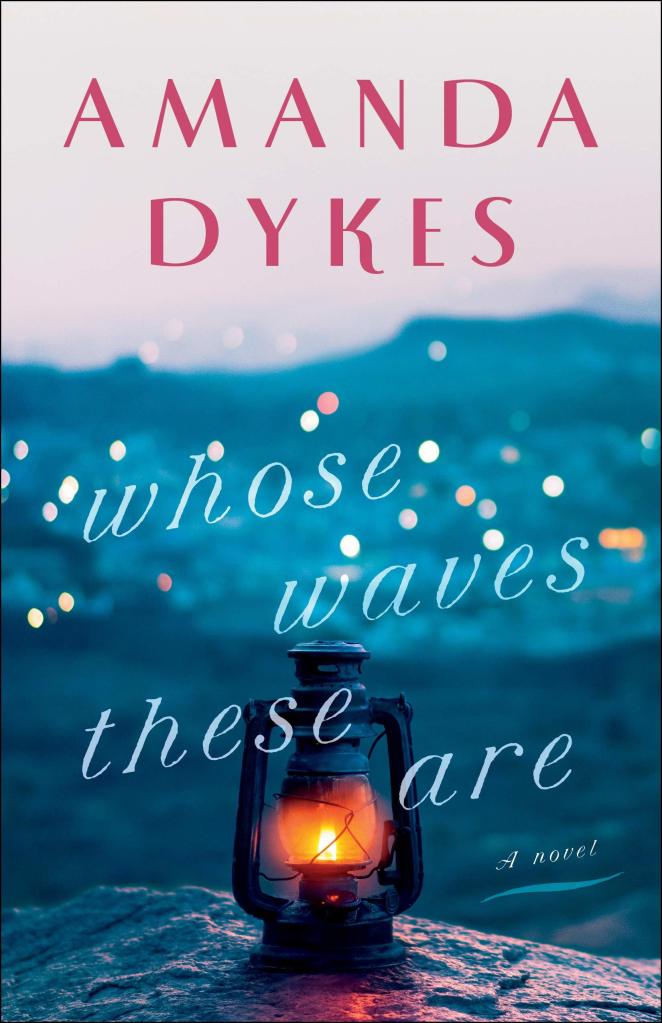
Review: Whose Waves These Are

Whose Waves These Are by Amanda Dykes

Whose Waves These Are by Amanda Dykes begins in September, 1944. Identical twin brothers in a small Maine village, Ansel-by-the -Sea, have just turned eighteen. Enlistment in military service has been closed “to protect the home-front work force,” but the draft is in effect. A letter arrives from the President ordering one of the twins to report for duty. Robert Bliss assumes, hopes, the letter is for him. He’s single, ready to go. His brother, Roy, is married to Jenny–the girl Robert has loved for years but didn’t speak up for soon enough. Roy and Jenny have just discovered they’re going to be parents.

But, no. The letter is for Roy.

Robert proposes that he could go in Roy’s place. They’ve stood in for each other many times. But Roy argues that it’s his turn to help save others.

Then we’re whisked to Chicago in 2001, where Annie Bliss crunches numbers. She was an anthropology major, but her first assignment to help a small village ended in disaster. In her current job, at least she can’t hurt anybody.

Then she receives news that her “Grandbob” back in Ansel-by-the-Sea is in grave condition in the hospital.

Annie speeds back to Maine, where she had visited as a child when her parents’ deployments overlapped and they left her with Bob. There she is known as “Bob’s Annie.”

While Bob is unconscious, Annie gets reacquainted with the people she knew. There’s one newcomer since she lived there, a quiet, brooding postman and EMT named Jeremiah Fletcher, or Fletch. Annie discovers boxes of rocks in a closet in Bob’s house. Jeremiah shows her even more in the boathouse. Bob has left her a key, but no word about what it belongs to. As Annie asks around town, people either don’t know or aren’t sharing what Bob was up to.

The point of view switches back and forth between these two time frames. The older one unfolds what happened with the brothers during the war and the years afterward. As one grieves the loss of the other, he writes the only poem of his life asking for rocks to represent people lost during the war. He plans to build something to represent hope and healing. But another tragedy halts his efforts.

The twenty-first century timeline shares Annie’s story and shows her discovering the pieces of her history that she had not known.

I loved this book. I just wanted to sit and hug it after finishing it. It left me wishing I could visit Ansel-by-the-Sea, if it were a real place and these people lived there. I love books with a strong sense of place, whose stories could not have taken place anywhere else.

I loved the characters. I loved the way the author unfolded and wove together everyone’s stories.

I also loved many of the author’s turns of phrases. A few:

A wake is a ripple left after a departure (p. 41).

He said it was time to be part of the unbreaking, of the making of something. He told me there was a Carpenter who was going to build me right up, too (p. 75).

She looks at Bob lying there, face mapped in wrinkles carved from compassion (p. 79).

She’s used to city life, rich in its own way, with an energy and bustle from the lives there, but where eye contact is a safety issue and a good neighbor is your insurance company’s tagline (p. 87).

Annie tries for small talk. Which, as she’d learned, could sometimes lead to large talk. Which made the small talk bearable (p. 131).

Don’t get stuck in the dark . . . There’s a whole lotta light . . . Go there instead (p. 171).

Saluting—a stance of the fiercest heartache schooled into firmest respect (p. 173).

The song she offered up was all the more beauitful in its wavering and brokenness. Courageous, and offering. The laying out of her broken heart before her God (p. 188).

Words begin to light up, pour right through, like someone turned on a faucet and he’s just trying to catch them. They’re not his, really, he’s just the one scratching them out (p. 188).

He slaps courage back into himself and goes to church (p. 202).

I choose to believe there is some shred of light left in him. A light I pray he fights for (p. 238).

His thoughts are becoming more like an ongoing conversation with heaven, these days—usually more questions than anything else. And this was a big one. What now? (p. 249).

He looks like someone who’s been cut loose to drift and hasn’t found shore (p. 252).

Not healed . . . but held. Like the pieces of him have been gathered right up, and that is enough for now. The rest will follow (p. 275).

The strength of the storm does not change whose waves these are. There is One mightier still (p. 348).

I was motivated to read this book because I had seen high praise for it. That praise was well-deserved. I’ll be looking up more of Amanda Dykes’ books to read.

Review: You’re the One that I Want

You're the One that I Want by Susan May Warren

You’re the One that I Want is the sixth book in Susan May Warren’s Christiansen family series set in Deep Haven. Minnesota.

Though each book involves the whole family, each focuses primarily focuses on one of the adult children. This time it’s Owen’s turn, the fifth child and youngest brother.

Owen had figured heavily in the first two books as well, especially the second. He had played hockey since his earliest childhood and excelled through the ranks until he landed a spot on the MN pro team. The fame, acclaim, and money all went to his head, however. He became something of an entitled jerk until a tragic accident took the sight in one eye, derailing his career.

Exploding with anger and grief, Owen roamed about, working different jobs, leaving a trail of one-night stands behind him.

What he doesn’t know is that one of those encounters resulted in a pregnancy. The girl in question later met and fell in love with Owen’s brother, Casper.

If that sounds kind of soap-opera-ish, yes, even one character admitted as much. However, people do get themselves entangled in such messes, though maybe not within their own family.

As this book opens, Owen’s anger has been spent. He’s cleaned up his act, more or less, no longer involved in reckless behavior. He’s on a crab-fishing boat in the Bering Sea with a reputation for kindness and hard work. He just takes life a day at a time, too ashamed to go home.

Scotty is the captain’s daughter and first mate. Her mother had died in childbirth. Her father makes her call him Red rather than Dad and suppresses emotion. Scotty has been on the boat most of her life. She’s had to be tough to command the men in her father’s stead and ward off any unwanted attention.

When Scotty is swept overboard in a storm, Owen jumps in to save her. They spend a night in a life raft until they’re rescued, nursing injuries and telling each other their lives.

Casper and Raina had worked out their issues in the fourth book. Casper wants to marry Raina and raise her daughter as his own. But he feels the right thing to do would be to track down Owen, tell him the situation, and bring him home. He wants to get Owen’s blessing and ask him to sign over his rights to his daughter.

Meanwhile, Casper is unaware that he’s wanted for questioning in the murder of Raina’s old boyfriend, Monty. He and Casper had an altercation the night Monty was killed, and Casper seems to be the last one who saw him alive.

When Owen and Casper try to fly home, Casper is taken into custody. Scotty, who has taken a job in the police force in Alaska since her dad is selling their boat, agrees to accompany them back to Deep Haven in an official capacity. Owen is thrilled to have more time with her.

There, Scotty encounters the love and loyalty of a family like she has never known. Though she’s drawn to them, she’s also not sure she would ever fit in. She’s had a very different upbringing and has no use for faith—even though she did break down and pray through Owen’s injuries.

If that sounds like a lot of drama for one book—it is! I’ve mentioned before that though these books fall into the romance genre, they’re something of a family drama as well.

Reading, or listening to, six of these books in a row, one catches some of the writer’s repeated quirks. Here are a few:

  • Several of the female characters are said to catch their lip in their teeth.
  • All the males are “sculpted” and “chiseled.”
  • Most of the kissing scenes involve saying what one or the other “tastes” like, usually involving whatever they last ate or drank (yuck) and and then adding that they taste of “freedom” or “summer days” or some such.

I roll my eyes at some of that, but that seems to go with this genre—one reason I don’t read it much.

I did like how the series wrapped up, though. Amid some of the silly moments were embedded some deep truths about faith, grace, and forgiveness.

Some of my favorite quotes:

In order to live without the haunting voice of regret, you must learn to forgive yourself, to embrace mercy, to open your eyes and see God in your past and His grace in your future. Your mistakes don’t define you. Your past doesn’t define you. You are not the sum of your bad decisions. You are the decision you make right now.

Fresh-baked cookies do not make a successful marriage . . . It’s knowing each other, valuing the same things, being what the other person can’t be, making each other better people.

So you made some bad choices. Some of God’s best players were His imperfect, broken prodigals. In fact, iffy players are God’s best picks. He specializes in short-tempered, reckless, flawed people to accomplish his plans.

God is constantly using broken, messy people to restore the world and bring glory to Himself, to touch other people.

Once you became a Christiansen, you had to get used to being loved large, to belonging to a family that didn’t have it all figured out, but weathered life by holding on to faith.

Unfortunately, the audiobooks didn’t include author’s notes, and Susan didn’t have any notes or background information on her website for the last two books in the series as she did for the previous ones.

Besides these major books in the series, there’s a prequel novella focused on the relationship of the parents, John and Ingrid, as well as two Christmas novellas. There’s also another collection of novels set in Deep Haven written after the Christiansen family series with other authors. However, though I enjoyed the series, I want to get away from romances for a while. I’ll probably read John and Ingrid’s story just to finish out the series and save the Christmas ones for December.

Review: The Wonder of You

The Wonder of You by Susan May Warren

The Wonder of You is the fifth in Susan May Warren’s Christiansen family series.

So far, each book has focused on one of the six siblings in small-town Minnesota family in birth order. The last two books flip the order, though.

Amelia is the youngest and always wanted to venture out, away from Deep Haven. She took a photography course in Prague, but came home early. She had met a man there, Roark St. John, and thought they were in love. But when she saw him with someone else, she came home, brokenhearted.

She’s disappointed in herself, but figures maybe she was wrong about her life direction: maybe she’s meant to stay in Deep Haven after all and marry the boy she’s known all her life and dated through high school, Seth.

Then Roark shows up on her family’s doorstep one day with flowers and an apology. Her brothers run him off, but Amelia feels she should at least listen to what he has to say.

Roark has given himself two months to try to win Amelia back before giving in to his uncle’s insistence that he come home to Brussels and take over the family business.

Amelia has insisted that there be no lying between them, but Roark is not sure how much he should tell her about his past mistakes and his fear that God has forsaken him.

In one subplot, a visiting family drowns, leaving behind their newly-adopted daughter from Ukraine who speaks no English. She comes to stay with the Christiansen family, growing close to Grace. When it appears she might be sent back to the Ukraine, Grace begins to wonder if she and Max could adopt her. But Max had long ago determined not to have children. He carries the gene of a disease that killed his father, and he is not going to leave behind fatherless children to experience the same tragedy he did.

Amelia’s character is somewhat immature, but she’s only twenty. She deals with what a lot of young people go through in trying to discern what God wants them to do in life. I liked that the author brought out that calling is not only a matter of which guy, which vocation, and which country one should choose, but having a heart that pursues God, trusts in His sufficiency, and wants to do His will.

And Roark needed to learn that the past is forgivable and God gives grace for each new day.

As I’ve said before, I like stories where the characters learn and grow, whether that story is a romance or another genre. That’s certainly the case in this series.

Review: Always On My Mind

Always On My Mind by Susan May Warren

Always On My Mind is the fourth novel in the Christiansen family series by Susan May Warren.

Casper is the fourth child and middle son of the family. The previous book, When I Fall in Love, focused on his older sister, Grace, but also shared Casper’s budding relationship with a new girl in town, Raina.

After a big blow-up near the end of that book, Casper, an archeology major, accepted an invitation to a dig in Honduras. He’s always felt overshadowed by his brothers and wants to do something to stand out on his own. But this dig is going nowhere. Even a side project yields no results. He can’t get Raina off his mind. He decides to forgive the past, go home, and tell Raina he loves her.

But when he gets home, he is surprised to discover that Raina is pregnant and shocked to learn who the father is. Further, Raina wants him to go away and leave her alone.

Raina still loves Caspar, but feels she is damaged and no good for him.

Casper goes back to Deep Haven to help at his family’s resort and work in town until he can decide what to do next. He also helps out at the town Historical Society, where he’s surprised to discover that Raina has come back to Deep Haven, too. Their work throws them together, so they form a tentative friendship.

Caspar is dismayed when Raina starts dating Monty, a bully he knew from high school. But Monty turns on the charm with Raina, and she delights in feeling special in his eyes.

One subplot involves Casper’s discovery of clues from an old local legend about a missing gangster and the steel bonds he supposedly left hidden somewhere.

Another involves oldest brother Darek, featured in the first book in the series, who has taken over running his parents’ resort after they retired. But the responsibilities of repairs and projects and the lack of customers and therefore income weigh heavily on him. His long hours away from home start taking a toll on his family. He wonders if he should go back to firefighting.

I’ve mentioned before that I’m not keen on romances. But I do like good stories where people learn, grow, and overcome. Susan’s stories don’t have the silliness and physicality that some romances do. Plus, I got invested in the family in the first book, and since the series was free at Audible for a time, I decided to follow through.

Susan had written here that part of her reason for writing this series was that she and her husband were in the season of parenting adult children, and she wanted to write about “watching, hoping, praying your adult children into a legacy of faith.” The Christiansen parents, John and Ingrid, are somewhat background characters in the books, but emerge to share a word of wisdom, guidance, or encouragement here and there.

Each story begins a beautiful letter that Ingrid has written to the child featured in that book.

Susan writes that part of her focus in this particular novel is “What do you do when you love someone who seems bent on self-destruction? Worse, when they seem incapable of listening to reason? Pray. Hope. Love anyway.”

There’s kind of an obvious symbolism between Casper’s hunt for lost treasure and Raina being a type of lost treasure.

My only difficulty with this story is that I didn’t care for Raina at first. I didn’t have a problem with the fact that she was a “broken soul,” had a lot of baggage, and needed redemption. I just didn’t see any qualities that would cause Casper to fall in love with her. But by the end of this story, I did.

On a side note, for some reason, the audiobook covers are different from the e-book and print covers. I like the book covers much better.

Review: A Noble Scheme

A Noble Scheme by Roseanna M. White

A Noble Scheme is the second novel in Roseanna M. White’s Imposters series. The first book, A Beautiful Disguise, established that The Imposters were a private investigation firm in the early 1900s. Siblings Yates and Marigold Fairfax learned that their father’s spendthrift ways had left no money. One of his whimsical purchases had been an entire circus which stayed at the estate when not traveling. The circus performers and animals became close friends of the Fairfaxes. Yates and Marigold had learned acrobatics, theatrics, and other performance tricks from them. They decided to use these skills to support themselves and their circus friends by maintaining their place in society and secretively, in disguise, investigating matters for high-end clientele.

However, in A Nobel Scheme, a waiter comes to them–someone who could not afford them. Yet when they hear that his son has been kidnapped, mistaken for his almost identical wealthy cousin, the team accepts the case pro bono.

Gemma Parks is also part of the Imposters. She writes a society column as G. M. Parker and fills in however she can. She keeps her ears open in society functions and sometimes masquerades as Marigold so Marigold can look for clues.

Graham Wharton is the Fairfaxe’s distant cousin who came to live with them when his parents died. He’s an architect who can help the Fairfaxes find tunnels or keeps or hiding places in old houses.

Graham and Gemma had grown up together and fallen in love. But in the last book, they were estranged. Several references were made to what had happened between them, but that situation wasn’t explained until this book. It’s a pretty big reveal, so I won’t spoil it.

Gemma avoids Graham as much as she can, but they try to put aside their differences for the cases they are working on. This particular case throws them together more than normal. Graham hopes to win Gemma back, but she can’t forgive him. He, in turn, blames God. He acknowledges his foolishness in what happened, but God could have prevented it.

I love that this series is different from the usual historical fiction fare. The themes of faith and forgiveness are woven in naturally. Roseanna is one of my favorite authors, and this book didn’t disappoint.

Some of my favorite quotes:

The more she wrote for herself, the more herself she became.

Words were wily things—but they were miraculous too. They created, they shaped, they breathed life. God had used them to form the universe, and Christ had come as a living Word to write Himself onto the hearts of humankind. Was it any wonder, then, that words had pulled her from the brink of darkness and delivered her, however slowly, back to the Light?

I enjoyed the audiobook nicely read by Susan Lyons. Sadly, the audiobook didn’t include any author’s notes. But I found this interview in which Roseanna shares how she came to write about nobility hosting a circus and investigating in disguise.